
North America Data Center Grid Infrastructure and Interconnection Market Size and Share
Market Overview
| Study Period | 2021 - 2032 |
|---|---|
| Forecast Data Period | 2027 - 2032 |
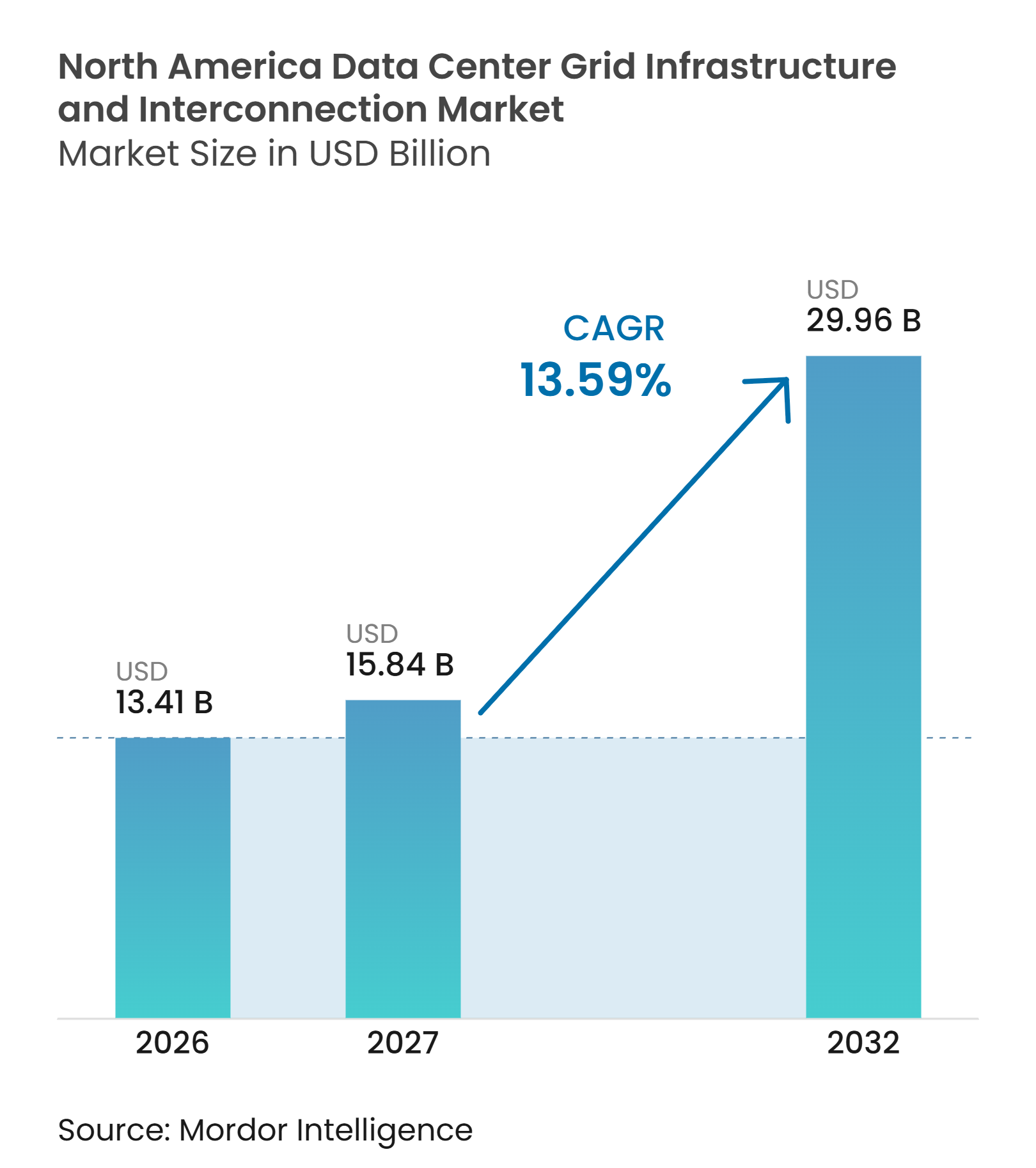
| Base Year Market Size (2026) | USD 13.41 Billion |
| Market Size (2027) | USD 15.84 Billion |
| Market Size (2032) | USD 29.96 Billion |
| Growth Rate (2027 - 2032) | 13.59 % |
| Market Concentration | Medium |
Major Players *Disclaimer: Major Players sorted in no particular order Image © Mordor Intelligence. Reuse requires attribution under CC BY 4.0. | |
North America Data Center Grid Infrastructure and Interconnection Market Analysis by Mordor Intelligence
The North America data center grid infrastructure and interconnection market size was valued at USD 13.41 billion in 2026 and estimated to expand from USD 15.84 billion in 2027 to reach USD 29.96 billion by 2032, at a CAGR of 13.59% during the forecast period, 2027-2032. The North America data center grid infrastructure and interconnection market is shifting from conventional utility service requests toward negotiated large-load arrangements, dedicated assets, and faster interconnection pathways. Rising AI workloads are increasing the need for high-capacity substations, transmission connections, and grid control systems. The US Department of Energy and the Federal Energy Regulatory Commission have focused policy attention on large-load interconnection, reliability, and transparent cost allocation. Equipment availability and utility study timelines remain central to project delivery, which gives suppliers with manufacturing capacity, engineering depth, and regulatory experience an advantage. The North America data center grid infrastructure and interconnection market also creates opportunities for phased energization, flexible load arrangements, co-located generation, and digital protection systems.
Key Report Takeaways
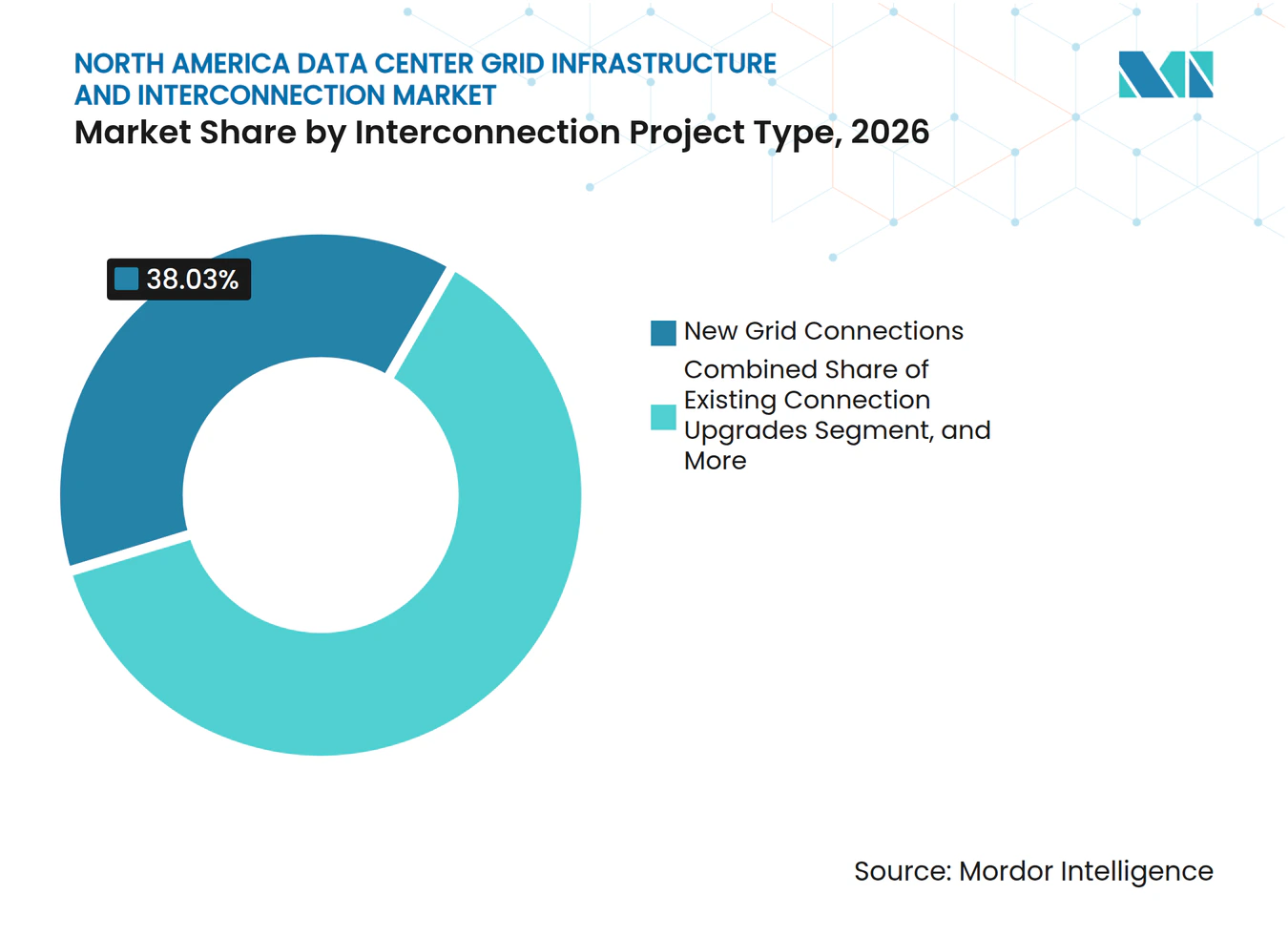
- By interconnection project type, new grid connections held 38.03% of regional revenue in 2026, while dedicated transmission infrastructure is projected to expand at a 14.39% CAGR through 2032.
- By infrastructure component, substations and switchyards accounted for 28.04% of the North America data center grid infrastructure and interconnection market size in 2026, while grid connection, control, and monitoring systems are projected to advance at a 14.57% CAGR through 2032.
- By voltage level, high-voltage installations held 43.89% of revenue in 2026, while extra-high-voltage systems are projected to expand at a 14.18% CAGR through 2032.
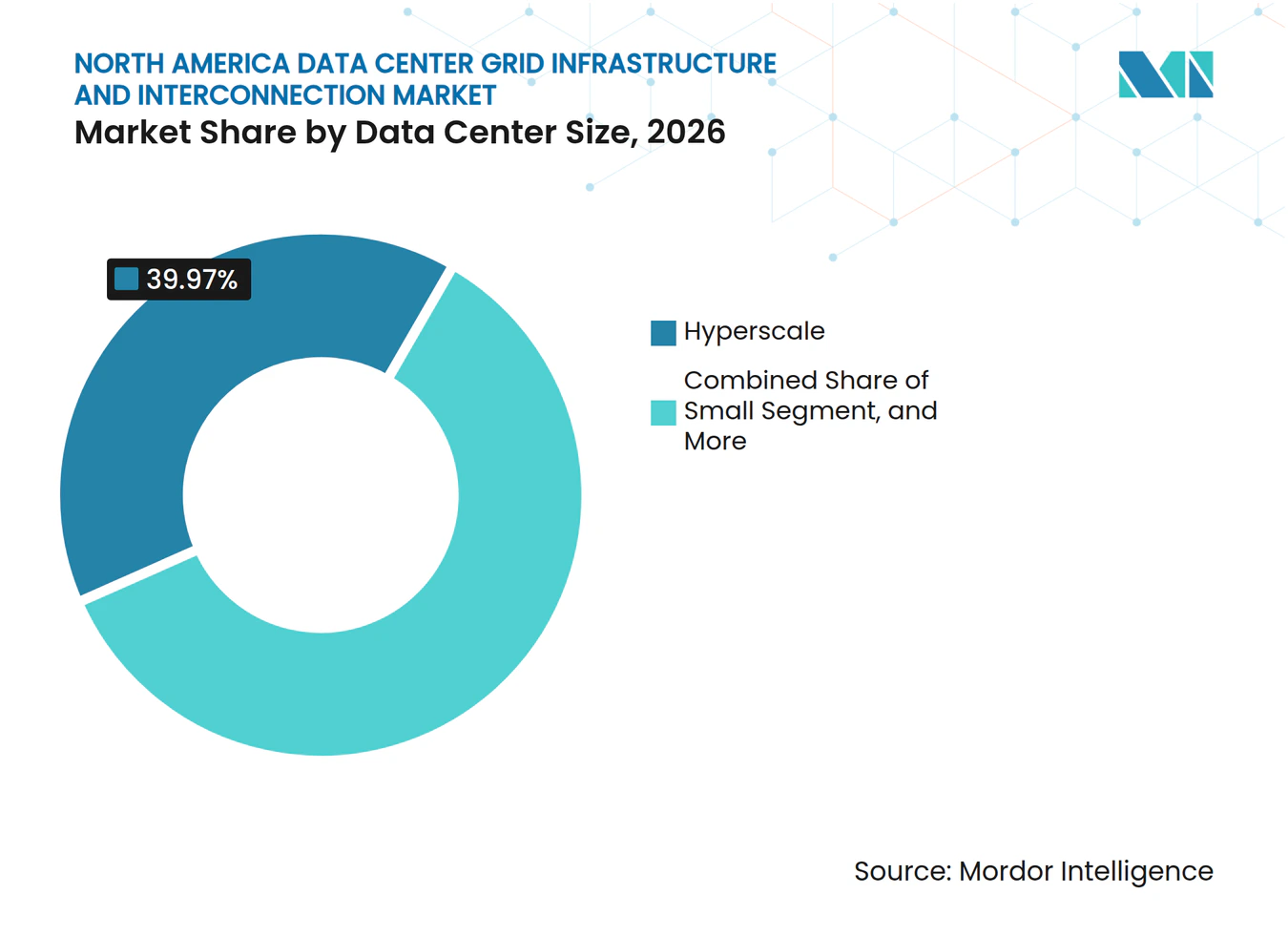
- By data center size, hyperscale facilities accounted for 39.97% of revenue in 2026 in the North America data center grid infrastructure and interconnection market and are projected to grow at a 14.32% CAGR through 2032.
- By data center type, cloud service providers accounted for 46.01% of revenue in 2026 and are projected to grow at a 14.28% CAGR through 2032.
- By geography, the United States accounted for 79.04% of regional revenue in 2026, while Mexico is projected to expand at a 14.34% CAGR through 2032.
Note: Market numbers in this report are based on Mordor Intelligence's proprietary estimation framework, which combines nine months of actuals with Q4 projections for base year 2026.
Market Trends and Insights
Drivers Impact Analysis of North America Data Center Grid Infrastructure and Interconnection Market*
| Driver | (~) % Impact on CAGR Forecast | Geographic Relevance | Impact Timeline |
|---|---|---|---|
| AI and Hyperscale Data Center Load Growth | +4.2% | United States, Virginia, Texas, and Ohio. Canada, Ontario and Alberta. | Short term (≤ 2 years) |
| Dedicated Interconnection Asset Investment | +3.1% | United States, PJM, ERCOT, and WECC footprints. Canada. | Medium term (2-4 years) |
| Grid Modernization and Aging Infrastructure Replacement | +2.3% | United States, Midwest and Northeast. Canada. | Long term (≥ 4 years) |
| Renewable Energy and Storage Integration | +1.6% | United States, Texas, California, and Midwest. Canada, Ontario. | Medium term (2-4 years) |
| Phased Energization and Flexible Large-Load Interconnection Models | +1.3% | United States, all ISO and RTO footprints. Mexico. | Short term (≤ 2 years) |
| Increasing Value of Power-Ready Data Center Sites | +0.8% | United States, Northern Virginia, Central Ohio, and Phoenix. Canada. | Short term (≤ 2 years) |
| Source: Mordor Intelligence | |||
AI and Hyperscale Data Center Load Growth Drives Infrastructure Spending
AI workloads are changing the power requirements of grid interconnection infrastructure across North America. EPRI projects that data centers could consume 9%-17% of US electricity by 2030, and AI workloads account for 15%-25% of data center electricity use. The US Department of Energy reported that data centers used 4.7% of US electricity in 2024 and could use 9.5%-15.3% by 2030.[1] The North America data center grid infrastructure and interconnection market, therefore, requires more high-capacity substations, dedicated transmission spurs, and protection equipment. FERC reported that the average connected capacity of data centers entering service in 2025 approached 80 MW, compared with 25 MW in 2020. These larger connections place extra-high-voltage designs and real-time grid visibility at the center of supplier and utility planning.
Dedicated Interconnection Asset Investment Reshapes Capital Flows
The North America data center grid infrastructure and interconnection market is increasingly supported by direct investment from hyperscalers and large colocation operators. These customers are funding substations, transmission lines, and grid upgrades rather than relying solely on utility-funded network expansion. American Electric Power announced a USD 72 billion capital plan through 2030 and a strategic relationship with Quanta Services for 765-kV transmission work and the expansion of domestic equipment manufacturing. PJM approved USD 5.9 billion in transmission projects that support large-load interconnections. This funding model shifts procurement, equipment scheduling, construction, and cost risk more directly to the data center customer. It also favors providers that can deliver integrated engineering, procurement, construction, and equipment coordination for the North America data center grid infrastructure and interconnection market.
Grid Modernization and Aging Infrastructure Replacement Expands Interconnection Work
Transmission and substation replacement needs are occurring alongside the increase in data center power demand. NERC forecasts 224 GW of growth in summer peak demand over the next 10 years, which is 69% above its 2024 projection. In September 2026, the Department of Energy announced USD 5.25 billion in funding for 31 grid improvement projects across 26 states. The program covers more than 1,500 miles of transmission rebuilding or reconductoring and grid-enhancing technologies across 21,000 miles. Aging transformers and substations in major data center corridors can determine whether a planned campus receives power on schedule. This alignment of replacement work and new demand supports engineering and equipment opportunities in the North America data center grid infrastructure and interconnection market.
Renewable Energy and Storage Integration Adds Interconnection Requirements
Data center clean-energy commitments are increasing the need for interconnection designs that accommodate generation, storage, and flexible demand. FERC directed PJM in late 2025 to create transmission service alternatives for co-located loads. A 2026 PNAS study found that spare capacity at 3,890 existing US fossil and renewable plants could support up to 597 GW of economically viable cogeneration without exceeding existing interconnection capacity. Portland General Electric demonstrated in October 2025 that AI-enabled flexibility tools could free more than 80 MW of interconnection capacity. EPRI's DCFlex initiative links data center load flexibility with faster interconnection treatment. These arrangements increase the role of control systems, storage coordination, and protection design in the North America data center grid infrastructure and interconnection market.
Restraints Impact Analysis of North America Data Center Grid Infrastructure and Interconnection Market*
| Restraint | (~) % Impact on CAGR Forecast | Geographic Relevane | Impact Timeline |
|---|---|---|---|
| Multi-Year Utility Study and Construction Timelines | -1.8% | United States, all RTO footprints. Canada and Mexico. | Short term (≤ 2 years) |
| Transformer, Switchgear, and Cable Supply Constraints | -1.4% | United States, Canada, and Mexico. | Medium term (2-4 years) |
| Fragmented Permitting and Cost-Recovery Rules | -0.9% | United States, state-by-state variation. Canada, provincial variation. | Long term (≥ 4 years) |
| Uncertainty in Data Center Load Ramp and Project Completion | -0.6% | United States, primary hyperscale locations. Canada. | Short term (≤ 2 years) |
| Source: Mordor Intelligence | |||
Multi-Year Utility Study and Construction Timelines Constrain Time to Power
The interval between an interconnection request and energization is a major conversion risk for the North America data center grid infrastructure and interconnection market. Lawrence Berkeley National Laboratory reported that only 13% of the capacity requesting interconnection from 2000 to 2020 had reached commercial operation by the end of 2025. The same analysis found that 75% of that capacity had been withdrawn.[2] Data center construction typically takes 12-24 months, while studies, substations, and transmission upgrades can take 3-7 years. FERC's large-load rulemaking seeks to address such delays, but implementation by ISOs and RTOs remains a multiyear process. The gap between construction and power delivery increases the value of flexible-load commitments, phased energization, and early engagement with utilities.
Transformer, Switchgear, and Cable Supply Constraints Reduce Schedule Certainty
Equipment shortages continue to constrain delivery schedules for the North America data center grid infrastructure and interconnection market. Large power transformers, high-voltage switchgear, circuit breakers, and medium-voltage equipment are required simultaneously across utility, generation, and data center projects. Hitachi Energy announced a US investment exceeding USD 1 billion, including USD 457 million for a large power transformer facility in South Boston. The company also described investments in transformer components, high-voltage equipment, and transformer manufacturing. Prysmian began a USD 500 million, 5-year expansion in Texas that includes a medium-voltage cable facility expected to enter service in 2027. Until new capacity is fully available, delivery risk supports early procurement and favors suppliers with secured manufacturing positions.
*Our forecasts treat driver/restraint impacts as directional, not additive. The impact forecasts reflect baseline growth, mix effects, and variable interactions.
North America Data Center Grid Infrastructure and Interconnection Market Segment Analysis
By Interconnection Project Type:
Dedicated Transmission Supports Larger CampusesNew grid connections accounted for 38.03% of regional revenue in 2026. This position reflects the continued importance of standard utility-mediated service for enterprise and colocation facilities. Dedicated transmission infrastructure is projected to record a 14.39% CAGR from 2027 to 2032. Hyperscale operators are using private 500 kV and 765 kV spurs when conventional queues cannot meet project schedules. Lawrence Berkeley National Laboratory found that interconnection development can take more than 5 years from request to commercial operation. Substation and grid interconnection upgrades form the second-largest project type as utilities raise hosting capacity in established data center corridors. Existing connection upgrades remain relevant for operators adding load to energized campuses. These projects generally have lower unit values than new dedicated transmission systems. Together, the categories show that the North America data center grid infrastructure and interconnection market covers both new large-load entry points and upgrades to existing service.
FERC's June 2026 tailored orders require RTOs to address transmission services for flexible large loads and to allocate costs. The orders support a move from standard service requests toward customized interconnection arrangements. The Department of Energy's large-load proposal links curtailment commitments with faster study treatment. This approach encourages investment in storage and co-located generation that can reduce grid draw during constrained periods. Dedicated assets can also make the timing, scope, and sequencing of a project more transparent for the customer. They transfer more scheduling and procurement responsibility to the developer. EPC contractors must therefore manage construction sequencing and equipment lead times more closely. The North America data center grid infrastructure and interconnection industry benefits where providers can coordinate utility requirements with customer-funded assets.



By Infrastructure Component:
Monitoring Systems Lead GrowthSubstations and switchyards held 28.04% of the North America data center grid infrastructure and interconnection market size in 2026. Each large campus needs a dedicated or utility-owned substation at its primary grid interface. Grid connection, control, and monitoring systems are projected to expand at a 14.57% CAGR from 2027 to 2032. Data center operators need real-time visibility and automated protection at the interconnection point. Schweitzer Engineering Laboratories identified grid stability concerns related to AI load patterns during its September 2026 technical session. Power transformers remain an important component because large campuses need high-capacity conversion and connection equipment. Transmission lines and cables also benefit from private utility spurs and network upgrades. Prysmian's Texas investment reflects demand for medium-voltage cable production supporting these connections
Switchgear and protection systems complete the core equipment mix for the North America data center grid infrastructure and interconnection market. Gas-insulated switchgear is well-suited to space-constrained urban and suburban locations, where a smaller footprint supports project design. Suppliers are also developing equipment for higher-density computing loads and more compact power architectures. Siemens and Reinhausen announced in August 2026 a solid-state transformer designed to provide a stable 800 VDC output. The equipment is modular and scalable to 36 kV AC. Such development targets both physical footprint and interconnection infrastructure requirements. Digital control products must also work with conventional utility protection and communications systems. As a result, component suppliers compete on technical compliance, equipment availability, and integration capability rather than hardware capacity alone.
By Voltage Level:
Extra-High Voltage Addresses the Scale RequirementHigh-voltage installations held 43.89% of the North America data center grid infrastructure and interconnection market size in 2026. The 69 kV-230 kV range remains the principal connection tier for enterprise, colocation, and mid-scale cloud facilities. Extra-high-voltage systems are projected to expand at a 14.18% CAGR from 2027 to 2032. These systems operate at 345 kV, 500 kV, and 765 kV and serve the largest hyperscale requirements. ERCOT approved a USD 9.4 billion transmission project in 2026 that covers more than 1,100 miles in eastern Texas. The project was designed to carry more than twice the electricity of the existing 345 kV lines. Low- and medium-voltage installations continue to serve smaller enterprises and edge facilities. These lower-voltage projects have a large number of projects but lower individual values.
The AEP and Quanta Services relationship covers 765-kV transmission design and domestic manufacturing expansion of extra-high-voltage equipment. This work positions EPC firms for larger and more complex interconnection projects. Korean equipment manufacturers are expanding US capacity to supply the highest voltage tiers. LS Electric secured a USD 312 million contract in November 2025 for 525 kV equipment serving data center projects. Hyosung maintains a 765 kV transformer manufacturing facility in Memphis, Tennessee. HD Hyundai Electric plans to begin production of 765 kV equipment at its second Alabama plant by mid-2027. The North America data center grid infrastructure and interconnection market requires equipment suppliers to meet voltage, reliability, and production standards simultaneously. That requirement creates a meaningful barrier for suppliers without relevant manufacturing and testing capability.
By Data Center Size:
Hyperscale Facilities Combine Scale and Demand GrowthHyperscale facilities accounted for 39.97% of the North America data center grid infrastructure and interconnection market share in 2026. They are projected to record a 14.32% CAGR through 2032. This category concentrates on demand for extra-high-voltage substations, dedicated transmission spurs, and advanced monitoring systems. Large facilities in the 10-100 MW range also add significant substation upgrade volumes. Medium and small facilities serve enterprise and edge use cases where connection complexity is lower. Their aggregate project count remains significant in locations with less hyperscale development. Hyperscale campuses increasingly use phased energization because the full planned capacity can exceed the initial energized load. The grid infrastructure must support commissioning in stages while maintaining reliable operations. This combination of scale and staged delivery makes hyperscale projects important to the North America data center grid infrastructure and interconnection market.
Phased campus development often combines 300-450 MW increments within a much larger plan. The power system must support sequential commissioning while preserving stability for the wider network. This requirement creates demand for specialized engineering, switching plans, and control system design. Hyperscalers also have the capital and demand certainty to fund dedicated infrastructure earlier in the project lifecycle. GE Vernova and AWS signed a March 2025 framework agreement for turnkey substation solutions across multiple data center sites. The agreement includes electrical equipment, project management, and construction support. These arrangements embed equipment and engineering providers into the data center development pipeline. Large projects also intensify the need for early utility engagement and firm procurement schedules. Suppliers that can execute repeatable, high-capacity deployments are better positioned in this part of the North America data center grid infrastructure and interconnection industry.

By Data Center Type:
Cloud Service Providers Anchor Current DemandCloud service providers held 46.01% of revenue in the North America data center grid infrastructure and interconnection market in 2026. They are projected to expand at a 14.28% CAGR through 2032. This dual position reflects large cloud providers' capital commitments to bespoke grid infrastructure. Their projects frequently require integrated equipment packages, dedicated substations, and long-lead procurement. GE Vernova's agreement with AWS illustrates this direct supplier integration. Cloud providers also use larger campus plans, which increase demand for phased interconnection and flexibility services. Their purchasing practices can help equipment suppliers plan capacity and contract volumes. These characteristics establish cloud service providers as the principal demand anchor for the North America data center grid infrastructure and interconnection market.
Colocation operators form the second-largest data center type segment. For these operators, power-ready substation capacity is an important factor in attracting hyperscale tenants. Enterprise and edge facilities represent a third group with smaller individual connections across more distributed locations. Prefabricated e-House solutions can reduce on-site construction time for such projects. NERC reliability standards and evolving large-load requirements influence procurement across all facility types. Enterprise operators increasingly need to demonstrate that proposed connections can be served reliably. The resulting opportunity is not limited to very large campuses. It also extends to standardized connection equipment and services across a broader range of data center projects. The North America data center grid infrastructure and interconnection market, therefore, includes distinct procurement models, but each relies on dependable grid access.
Geography Analysis
The United States accounted for 79.04% of the North America data center grid infrastructure and interconnection market share in 2026. It has the region's largest concentration of hyperscale campuses, extensive interconnection queues, and major investment in equipment manufacturing. EPRI projects that data centers could represent 39%-57% of Virginia's electricity use by 2030. Texas is strengthening its transmission network through ERCOT's USD 9.4 billion, 765 kV expansion. ERCOT AEP reported 18 GW of committed data center load by 2030 across 11 states. California remains a high-demand but constrained location, which requires substantial transmission planning for new large loads. The United States, therefore, combines high demand with the strongest pipeline of grid investment and supplier activity.
Canada accounts for a growing share of regional demand, particularly in Ontario, Alberta, and British Columbia. Hydroelectric availability and cooler conditions support data center development in several provinces. Manitoba Hydro announced in October 2026 an investment of up to CAD 1.2 billion (USD 870 million) to renew 42 substations in Winnipeg and Brandon. The program reflects the broader need to replace aging grid assets while accommodating rising demand. Cross-border transmission corridors also support planning links between Canadian supply and US demand centers. Canada adds utility modernization work and power availability considerations to the North America data center grid infrastructure and interconnection market.
Mexico is projected to record the highest regional CAGR at 14.34% from 2027 to 2032. MEXDC reported installed IT capacity of 279 MW in April 2026, with 205 MW under construction and 1,730 MW announced. Querétaro is a major development location, but a grid connection can add 3 years to a data center schedule. MEXDC estimates that projects above 50-70 MW may require up to 35% additional capital expenditure for grid reinforcement, to be donated to CFE. A September 2026 CFE and MEXDC coordination agreement established technical working groups to plan for electricity needs on a weekly basis. Mexico's opportunity depends on structured interconnection planning, utility coordination, and infrastructure funding.
Competitive Landscape
Market Concentration
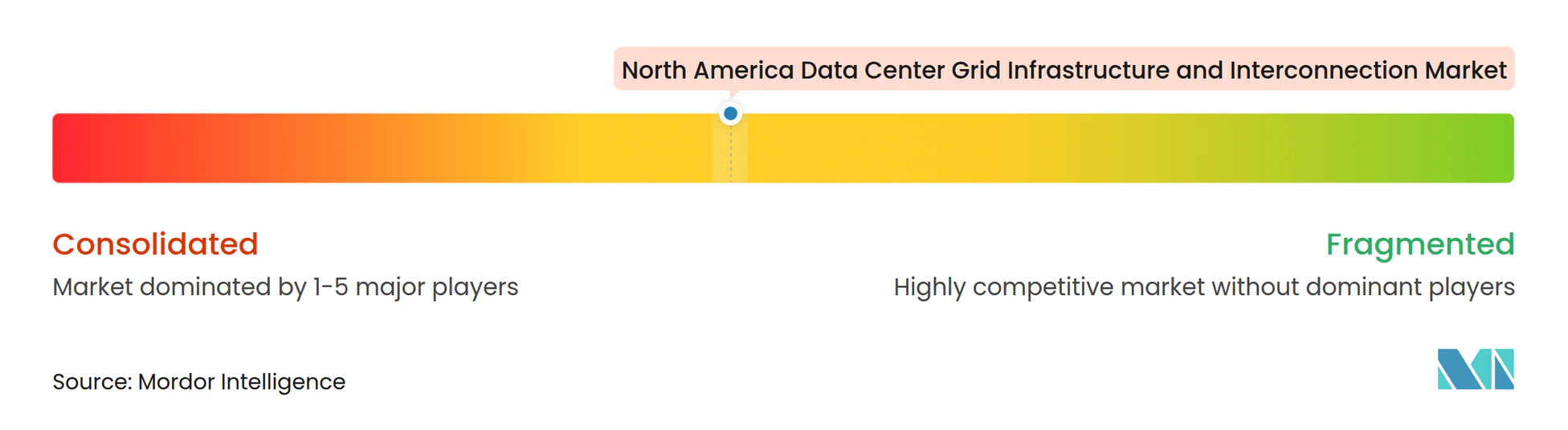
The North America data center grid infrastructure and interconnection market is moderately concentrated in equipment and fragmented across EPC and specialty construction. ABB, Siemens Energy, Schneider Electric, GE Vernova, Eaton, and Hitachi Energy collectively account for 55%-60% of switchgear revenue based on the supplied market assessment. The leading equipment firms compete through manufacturing capacity, portfolio breadth, technical standards, and project delivery support. Hitachi Energy committed more than USD 1 billion to US expansion, including USD 457 million for a large power transformer facility in South Boston. Korean manufacturers are also expanding local production for demand in the 345 kV-765 kV range. This concentration is more visible in high-voltage equipment than in construction services.
EPC firms compete by bundling engineering, procurement, construction, generation, storage, transmission, and substation capabilities. Quanta Services was selected by NiSource in October 2025 to design, procure, and construct 3 GW of generation and grid infrastructure for a large-load customer.[3] The program includes combined-cycle gas turbines, battery storage, transmission, substations, and underground infrastructure. AEP and Quanta Services also formed a strategic relationship to advance high-voltage transmission and manufacturing. These moves show a shift toward integrated delivery for customer-funded grid infrastructure.
Technology companies and utility partners are pursuing capacity optimization and compact equipment designs. Portland General Electric's flexibility tools demonstrated more than 80 MW of released interconnection capacity in October 2025. Siemens and Reinhausen are developing a solid-state transformer for AI-ready data centers. NERC standards and FERC large-load action favor suppliers with regulatory knowledge, high-voltage operating experience, and domestic manufacturing credentials. The most open opportunities are in phased energization services, AI-based load protection systems, and procurement platforms that improve equipment delivery visibility. Competition will remain strongest where large projects require proven equipment, compliance support, and dependable execution.
North America Data Center Grid Infrastructure and Interconnection Industry Leaders
-
Quanta Services, Inc.
-
GE Vernova Inc.
-
Hitachi Energy Ltd.
-
Siemens Energy
-
MYR Group Inc.
- *Disclaimer: Major Players sorted in no particular order
North America Data Center Grid Infrastructure and Interconnection Market Companies Covered in this Report
- Quanta Services, Inc.
- GE Vernova Inc.
- Hitachi Energy Ltd.
- Siemens Energy AG
- MYR Group Inc.
- Primoris Services Corporation
- Prysmian S.p.A.
- Nexans S.A.
- Eaton Corporation plc
- ABB Ltd
- Schneider Electric SE
- Mitsubishi Electric Corporation
- Toshiba Energy Systems and Solutions Corporation
- Hyosung Heavy Industries Co., Ltd.
- HD Hyundai Electric Co., Ltd.
- LS ELECTRIC Co., Ltd.
- Hubbell Incorporated
- Vertiv Holdings Co
- Schweitzer Engineering Laboratories, Inc.
- Burns & McDonnell Engineering Company, Inc.
Recent Industry Developments in North America Data Center Grid Infrastructure and Interconnection Market
- October 2026: Avangrid completed investments at more than 40 substation and substation-adjacent facilities across Maine, New York, and Connecticut through 2026, including major equipment replacements, automation upgrades, flood mitigation, and capacity enhancements at transmission-level assets supporting growing energy demand.
- September 2026: Hyosung Heavy Industries won KRW 386.5 billion, USD 280 million, in extra-high-voltage transformer orders in a single month, comprising 765 kV units valued at KRW 220 billion and 345 kV units valued at KRW 166.5 billion (USD 125.7 million), for AI data centers in the southern and northern United States.
- September 2026: DOE's SPARK initiative announced USD 5.25 billion across 31 grid-improvement projects in 26 states, including USD 1.9 billion in federal funding, to reconductor or rebuild more than 1,500 miles of transmission lines and deploy grid-enhancing technologies across 21,000 miles, unlocking more than 23 GW of additional grid capacity relevant to data center interconnection corridors.
- September 2026: American Transmission Company filed requests totaling USD 2.63 billion-USD 2.98 billion for new transmission lines and substations to serve Microsoft and Vantage data centers in southeastern Wisconsin. The filing included 3 approved projects for Microsoft's Mount Pleasant campus and Meta's Beaver Dam data center costing at least USD 1.18 billion.
North America Data Center Grid Infrastructure and Interconnection Market Report Scope
The North America Data Center Grid Infrastructure and Interconnection Market comprises the infrastructure, equipment, and systems required to connect data centers to the electrical grid and ensure reliable, efficient, and high-capacity power delivery across the region. The market includes new grid connections, upgrades to existing connections, dedicated transmission infrastructure, substations and switchyards, power transformers, transmission lines and cables, switchgear and protection systems, and grid connection, control, and monitoring systems.
The North America Data Center Grid Infrastructure and Interconnection Market Report is Segmented by Interconnection Project Type (New Grid Connections, Existing Connection Upgrades, Dedicated Transmission Infrastructure, and Substation and Grid Interconnection Upgrades), Infrastructure Component (Substations and Switchyards, Power Transformers, Transmission Lines and Cables, Switchgear and Protection Systems, and Grid Connection, Control and Monitoring Systems), Voltage Level (Low and Medium Voltage, High Voltage, and Extra-High Voltage), Data Center Size (Small, Medium, Large, and Hyperscale), Data Center Type (Colocation, Cloud Service Providers [CSPs], and Enterprise and Edge), and Geography (United States, Canada, and Mexico). The Market Forecasts are Provided in Terms of Value (USD).
Segmentation Overview
| New Grid Connections |
| Existing Connection Upgrades |
| Dedicated Transmission Infrastructure |
| Substation and Grid Interconnection Upgrades |
| Substations and Switchyards |
| Power Transformers |
| Transmission Lines and Cables |
| Switchgear and Protection Systems |
| Grid Connection, Control, and Monitoring Systems |
| Low and Medium Voltage |
| High Voltage |
| Extra-High Voltage |
| Small |
| Medium |
| Large |
| Hyperscale |
| Colocation |
| Cloud Service Providers (CSPs) |
| Enterprise and Edge |
| United States |
| Canada |
| Mexico |
| By Interconnection Project Type | New Grid Connections |
| Existing Connection Upgrades | |
| Dedicated Transmission Infrastructure | |
| Substation and Grid Interconnection Upgrades | |
| By Infrastructure Component | Substations and Switchyards |
| Power Transformers | |
| Transmission Lines and Cables | |
| Switchgear and Protection Systems | |
| Grid Connection, Control, and Monitoring Systems | |
| By Voltage Level | Low and Medium Voltage |
| High Voltage | |
| Extra-High Voltage | |
| By Data Center Size | Small |
| Medium | |
| Large | |
| Hyperscale | |
| By Data Center Type | Colocation |
| Cloud Service Providers (CSPs) | |
| Enterprise and Edge | |
| By Geography | United States |
| Canada | |
| Mexico |
Key Questions Answered in the Report
What is the North America data center grid infrastructure and interconnection market valuation?
The market is valued at USD 13.41 billion in 2026 and is estimated to reach USD 29.96 billion by 2032 at a 13.59% CAGR.
What is driving investment in data center grid infrastructure?
AI workloads, larger hyperscale connections, direct investment in dedicated assets, and utility modernization are supporting demand.
Which interconnection project type has the largest share?
New grid connections held 38.03% of revenue in 2026, while dedicated transmission infrastructure is projected to record the fastest CAGR of 14.39%.
Which data center type leads demand for grid connections?
Cloud service providers held 46.01% of revenue in 2026 and are projected to expand at a 14.28% CAGR through 2032.
Why are power equipment supply constraints important for data center projects?
Transformers, switchgear, and cables can delay energization, which increases the value of early procurement and established supplier capacity.
Which geography is projected to expand fastest through 2032?
Mexico is projected to expand at a 14.34% CAGR, although grid connection timelines and reinforcement costs remain important constraints.