
North America Data Center Fire Protection and Life Safety Market Size and Share
Market Overview
| Study Period | 2021 - 2032 |
|---|---|
| Forecast Data Period | 2027 - 2032 |
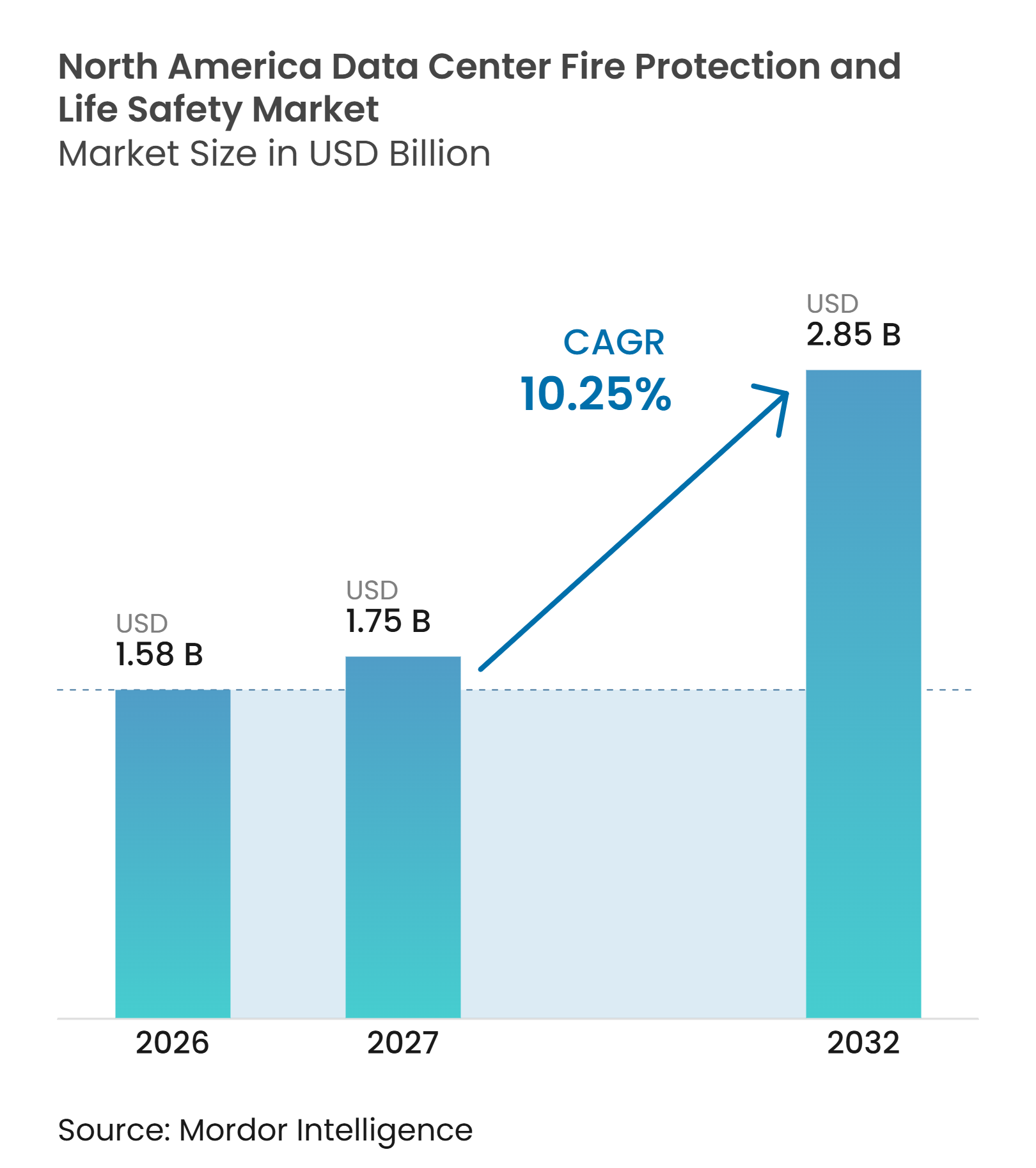
| Base Year Market Size (2026) | USD 1.58 Billion |
| Market Size (2027) | USD 1.75 Billion |
| Market Size (2032) | USD 2.85 Billion |
| Growth Rate (2027 - 2032) | 10.25 % |
| Market Concentration | Medium |
Major Players *Disclaimer: Major Players sorted in no particular order Image © Mordor Intelligence. Reuse requires attribution under CC BY 4.0. | |
North America Data Center Fire Protection and Life Safety Market Analysis by Mordor Intelligence
The North America data center fire protection and life safety market size is projected to expand from USD 1.58 billion in 2026 to USD 2.85 billion by 2032, registering a CAGR of 10.25% between 2027 and 2032. Construction activity, AI computing demand, and changing rack designs are expanding the need for detection, suppression, and maintenance services across the North America data center fire protection and life safety market. Higher-density GPU systems bring liquid-cooling equipment, new electrical risks, and larger battery installations into facilities that were originally designed for lower-density equipment. Insurer requirements and fire codes are increasing the importance of documented system performance, especially for lithium-ion UPS rooms and liquid-cooled computing areas. Suppliers that can combine engineering, equipment, commissioning, and recurring maintenance are better placed to support large campus projects and upgrades at existing facilities.
Key Report Takeaways
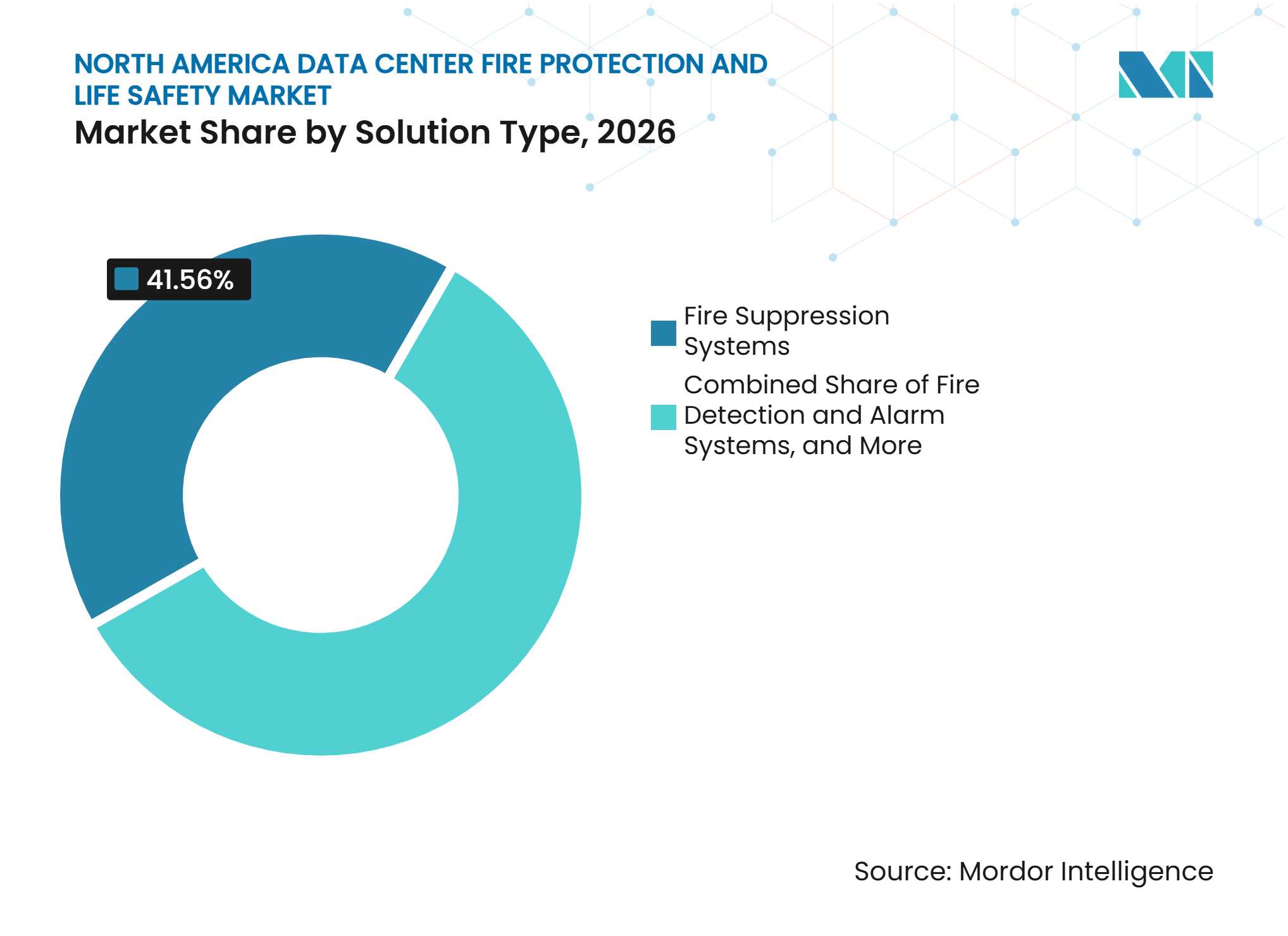
- By solution type, fire suppression systems held 41.56% of the North America data center fire protection and life safety market share in 2026, while fire detection and alarm systems are projected to expand at an 11.44% CAGR through 2032.
- By fire protection technology, clean agent suppression held 25.48% of revenue in 2026, while aspirating smoke detection is projected to expand at an 11.65% CAGR through 2032.
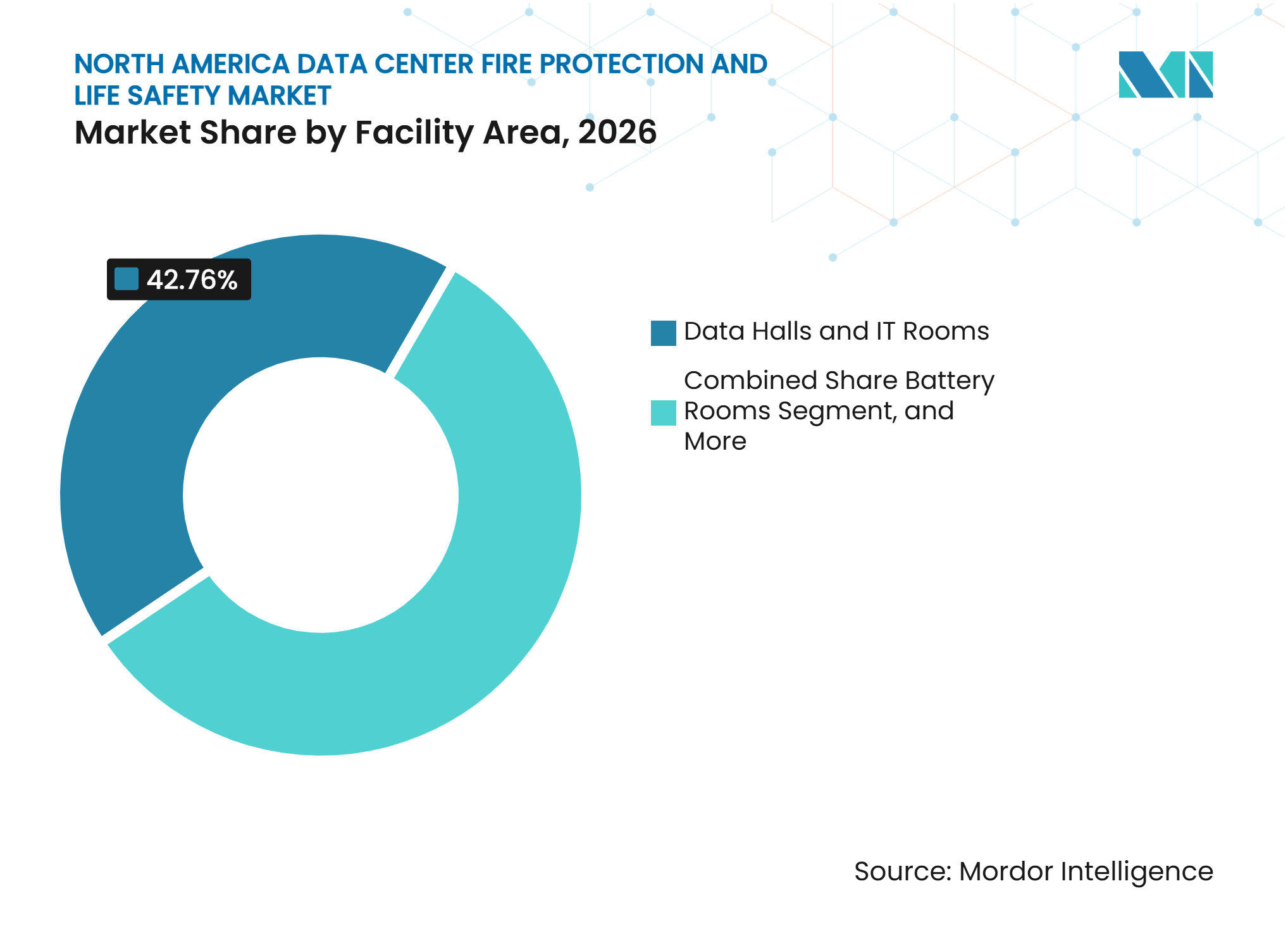
- By facility area, data halls and IT rooms accounted for 42.76% of demand in 2026, while battery rooms are projected to expand at an 11.64% CAGR through 2032.
- By data center size, large data centers held 35.45% of demand in 2026, while hyperscale data centers are projected to expand at an 11.62% CAGR through 2032.
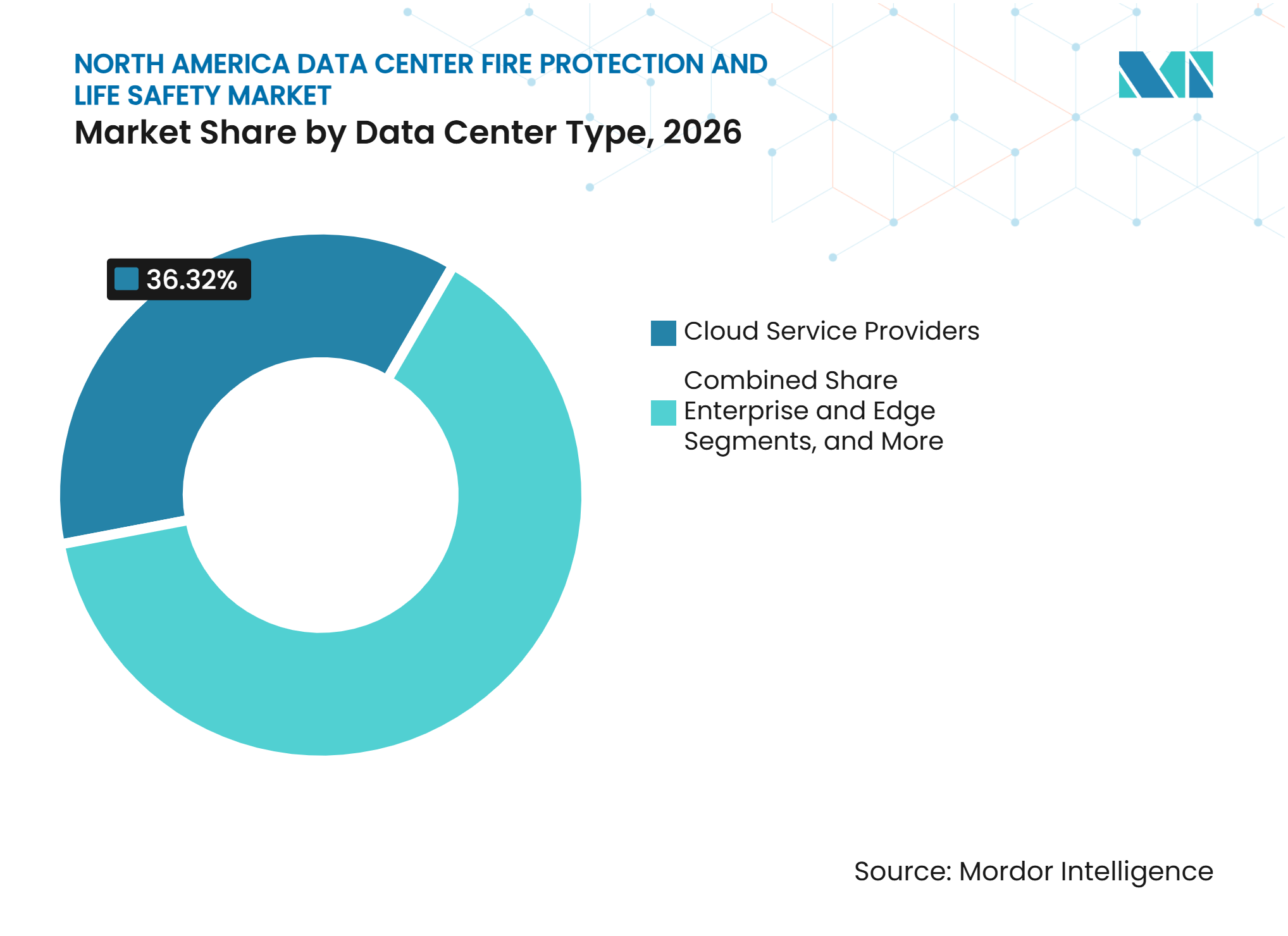
- By data center type, cloud service providers held 36.32% of demand in 2026 and are projected to expand at an 11.28% CAGR through 2032.
- By geography, the United States held 89.11% of demand in 2026, while Mexico is projected to expand at an 11.75% CAGR through 2032.
Note: Market numbers in this report are based on Mordor Intelligence's proprietary estimation framework, which combines nine months of actuals with Q4 projections for base year 2026.
Market Trends and Insights
Drivers Impact Analysis of North America Data Center Fire Protection and Life Safety Market*
| Driver | (~) % Impact on CAGR Forecast | Geographic Relevance | Impact Timeline |
|---|---|---|---|
| AI and High-Density GPU Data Center Expansion | +2.8% | United States, with secondary relevance in Canada | Short term (≤ 2 years) |
| Hyperscale and Colocation Capacity Buildout | +2.3% | United States and Mexico | Short term (≤ 2 years) |
| Tightening Fire Safety and Insurer Requirements | +1.6% | North America, with influence from FM Global DS 5-32, NFPA 75, and IFC 2024 | Medium term (2-4 years) |
| Adoption of Connected Fire Monitoring and Predictive Maintenance | +1.2% | United States | Medium term (2-4 years) |
| Rising Protection Requirements for Lithium-Ion UPS and Battery Systems | +1.0% | United States and Canada | Medium term (2-4 years) |
| Concentration of New Capacity in Power-Constrained Campuses | +0.8% | Northern Virginia, Atlanta, Dallas, and Toronto | Long term (≥ 4 years) |
| Source: Mordor Intelligence | |||
AI and High-Density GPU Data Center Expansion
GPU-accelerated computing is changing the fire risk profile of new data centers. CPU racks that typically operated at 3-10 kW are being replaced by GPU clusters that can draw 50-100 kW per rack. These systems often require direct-to-chip or immersion cooling, which adds fluid systems and higher electrical density to the data hall. FM Global identifies energized cabling, glycol-based cooling circuits, and dense lithium-ion battery arrays as important risks in AI-optimized facilities. These conditions increase the need for protection designs that address the operating environment rather than relying only on earlier air-cooled facility practices.[1]
Hyperscale and Colocation Capacity Buildout
Large campus construction is increasing the number and scale of fire protection projects across North America. Hyperscale facilities require detection, suppression, alarm, and emergency communication systems to be planned during the design stage. Integrated planning is particularly important when multiple buildings operate under a single fire alarm network. The North America data center fire protection and life safety market benefits when suppliers provide standardized system packages that can be installed at commissioning speed. The need does not end after construction, because completed campuses also require inspection, testing, and maintenance throughout their operating life.
Tightening Fire Safety and Insurer Requirements
Insurers increasingly influence fire protection decisions alongside local building and fire authorities. FM Global updated Data Sheet 5-32 in July 2026, adding terms for cooling, IT load, network core, and UPS battery units. The revision also updated guidance on clean-agent use around rack-mounted lithium-ion battery environments. NFPA 75 and NFPA 2001 continue to guide protection of information technology equipment and clean-agent systems. NEMA also issued 2025 guidance that addresses early planning, detection placement, and coordination among fire and life safety systems in data centers.
Adoption of Connected Fire Monitoring and Predictive Maintenance
Networked monitoring is moving fire protection from a periodic compliance task toward continuous operational management. Johnson Controls introduced its Simplex Incident Manager and Autocall Fire Site Administrator workstations in August 2026. The platforms can monitor up to 250,000 devices and connect 687 fire alarm control units in one installation. This supports centralized oversight across large campuses and distributed data center portfolios. Aspirating smoke detection can also use staged alarms, allowing operators to investigate early conditions before suppression is released.[2]
Restraints Impact Analysis of North America Data Center Fire Protection and Life Safety Market*
| Restraint | (~) % Impact on CAGR Forecast | Geographic Relevance | Impact Timeline |
|---|---|---|---|
| High Retrofit Cost and Operational Disruption | -1.4% | United States, especially legacy enterprise facilities, and Canada | Medium term (2-4 years) |
| Shortage of Specialized Fire Protection Engineers and Commissioning Personnel | -1.0% | United States, especially rural and emerging data center locations | Short term (≤ 2 years) |
| Incomplete Code Coverage for Liquid Cooling and AI Infrastructure | -0.7% | United States and Canada | Long term (≥ 4 years) |
| Clean-Agent and Battery-Hazard Compatibility Constraints | -0.5% | United States | Medium term (2-4 years) |
| Source: Mordor Intelligence | |||
High Retrofit Cost and Operational Disruption
Retrofits in live facilities can be difficult because operators must avoid disruption to customer workloads. Lithium-ion UPS upgrades can require changes to sprinkler design, gas detection, ventilation, and fire-rated room arrangements. The International Telecommunication Union states that clean-agent, dry powder, and carbon dioxide systems cannot reliably suppress lithium-ion thermal runaway or prevent re-ignition. That finding can require a different design approach in battery rooms than the one used in nearby data halls. Smaller operators may delay complex upgrades when staged work and shutdown planning are expensive.[3]
Shortage of Specialized Fire Protection Engineers and Commissioning Personnel
The available workforce for specialized fire protection work is limited in many emerging data center locations. The NFPA has reported that AI data centers and energy storage are creating new fire protection challenges faster than engineering capacity can expand. Commissioning aspirating detection, clean-agent controls, and pre-action systems requires skills that are not interchangeable with general commercial fire protection work. The constraint is more severe in areas where large projects arrive before local technical service networks develop. The North America data center fire protection and life safety market can therefore face longer commissioning schedules and higher field-service costs.
*Our forecasts treat driver/restraint impacts as directional, not additive. The impact forecasts reflect baseline growth, mix effects, and variable interactions.
North America Data Center Fire Protection and Life Safety Market Segment Analysis
By Solution Type:
Fire Suppression Supports Revenue While Detection AcceleratesFire suppression systems held 41.56% of the North America data center fire protection and life safety market share in 2026. Clean-agent, inert-gas, and pre-action water systems are widely specified in data halls, UPS rooms, and battery enclosures. These systems address different hazards and are often used together, rather than selected as substitutes, in the same facility. Clean agents are relevant where a residue-free discharge is needed to limit damage to sensitive IT equipment. Inert-gas systems can be selected where protection design also considers the safety of people present in protected rooms. Pre-action water systems provide a controlled water-based layer that can support broader building-code needs. NFPA 2001 provides requirements for clean-agent extinguishing systems used in these applications. Equipment choices are therefore shaped by room use, the equipment inside it, and the site’s wider protection strategy. Suppliers must also coordinate suppression controls with detection, alarms, emergency power procedures, and operator response plans. This layered approach keeps suppression at the center of project spending even as other solutions become more advanced.
Fire detection and alarm systems are projected to expand at an 11.44% CAGR through 2032. Their role is widening as facilities connect detection devices, alarm panels, and building systems across multiple buildings. Centralized software gives operators visibility over conditions that could interrupt computing operations or trigger an unnecessary shutdown. Enterprise-level controls are useful because hyperscale projects can include several facilities built in separate phases. The market size for this solution group is supported by both greenfield installations and upgrades to older alarm networks. Monitoring systems can add real-time status information that supports fault identification and maintenance planning. Inspection, testing, and maintenance services add recurring work because system reliability must be demonstrated at scheduled intervals. Emergency notification systems are also being linked with access control, occupancy information, and security processes. These links make system integration as important as the individual hardware components. The result is a solution mix in which suppression supports revenue while detection, monitoring, and service work create additional demand.



By Fire Protection Technology:
Clean Agents Lead While Aspirating Detection AdvancesClean agent suppression accounted for 25.48% of revenue in 2026. It is used in critical IT environments because it can extinguish fires without leaving residue on equipment. The technology is particularly useful where conventional water discharge could disrupt computing equipment and recovery procedures. Its role reflects the high value of servers, storage, network equipment, and related electronics within the protected area. Inert gas systems also remain important where system design must consider people working in protected areas. Water-based systems provide a building-code foundation in many facilities and are frequently paired with other technologies. Conventional smoke and heat detection continues to serve administrative, support, and lower-risk areas of data center facilities. Each technology addresses a distinct operating condition, so specification decisions are based on hazard type and room function. The installed base also supports continuing demand for replacement parts, tests, and upgrades. This combination of new deployment and installed-system support maintains demand across several technology categories.
Aspirating smoke detection is projected to expand at an 11.65% CAGR through 2032. The technology actively samples air through a pipe network and can identify low smoke concentrations before visible smoke accumulates. This matters in high-airflow data halls where hot-aisle containment can disperse smoke before a ceiling device responds. A laser detection chamber analyzes the air samples and supports a more sensitive response than passive point detection. Staged alerts such as Aware, Action, Fire 1, and Fire 2 give operations teams time to investigate developing conditions. Earlier intervention can reduce false alarms, avoid unnecessary agent releases, and limit disruption to computing operations. The technology also fits facilities that want closer integration between detection systems and building management platforms. Advanced detection share should benefit as operators seek earlier warning in denser and more complex equipment spaces. Its value increases when higher airflow and equipment concentration make conventional placement less effective. This makes aspirating detection an important complement to clean-agent and pre-action protection, rather than a replacement for either system.
By Facility Area:
Data Halls Lead Demand While Battery Rooms ExpandData halls and IT rooms accounted for 42.76% of demand in 2026. Their large installed equipment base and high protection intensity support spending on zoned suppression, detection, alarms, and emergency power interlocks. High-density GPU rows may require detection ports that align with rack return-air paths. The systems also need to coordinate with fire alarm controls and facility operating procedures. Data halls may combine aspirating detection, clean-agent protection, and pre-action sprinklers in layers. This structure reflects the need to detect an incident early while maintaining a wider building protection system. High-value equipment and continuous operating requirements make both design quality and maintenance important. Expansion of liquid cooling also requires safety planning around equipment layouts that were not common in earlier air-cooled facilities. These needs make the data hall the central area for fire and life safety spending across most new projects. They also create service opportunities when operators reconfigure rooms for higher-density equipment.
Battery rooms are projected to expand at an 11.64% CAGR through 2032. Lithium-ion UPS installations are increasing the need for fire-rated separation, ventilation, detection, and water-based protection suitable for thermal runaway. The ITU recommends water spray fire extinguishing at a minimum density of 20 L/(min·m²) for data center battery rooms. It also notes that gaseous systems alone cannot reliably control re-ignition after lithium-ion battery events. This makes battery protection different from conventional data-hall clean-agent applications. Electrical and UPS rooms also receive greater attention because insurer specifications can require 2-hour fire-rated separation and enhanced sprinkler design. Cooling and mechanical rooms present additional considerations when glycol-based fluids or dielectric liquids are near energized equipment. Administrative and support areas generally retain conventional sprinkler and detection approaches. The market size for battery-room work is linked to the changing UPS mix and the retrofit requirements that follow. Suppliers that understand battery hazards and water-based protection can address a focused but expanding part of the project scope.

By Data Center Size:
Large Facilities Hold Demand While Hyperscale Sites AccelerateLarge data centers held 35.45% of demand in 2026. Their complexity includes multiple suppression zones, redundant detection networks, and interconnected emergency communication systems. This creates substantial installation and service work across the facility lifecycle. Large sites also often require coordination among equipment suppliers, building contractors, and operations teams. Redundancy is important because operators seek to keep essential computing processes available during a fault or maintenance event. The facility may include several different room types, each with its own detection and suppression needs. These conditions require clear control sequences between alarm equipment, emergency power systems, and ventilation systems. They also make inspection and maintenance programs more detailed than those at a smaller site. Large facilities can therefore support high contract values even when they are not hyperscale campuses. Their installed base provides a continuing source of work for local and national service providers.
Hyperscale data centers are projected to expand at an 11.62% CAGR through 2032. Such campuses are commonly developed in phases, with several buildings connected by an integrated fire alarm and building management architecture. They need protection planning early because late changes become difficult after core structures and utilities are installed. The North America data center fire protection and life safety market has opportunities for suppliers that can repeat approved designs across campus phases. Their work can extend from original engineering through commissioning and multiyear maintenance contracts. Standardized designs can reduce project complexity when the same system approach is deployed repeatedly. At the same time, each campus may need modifications for local authorities, water conditions, and the computing equipment installed. Early coordination helps avoid changes that could delay capacity commissioning. The size of these projects favors vendors that can supply equipment, design support, and field teams at the required pace. Their scale also creates a long-term relationship after the first building enters service.
By Data Center Type:
Cloud Service Providers Lead Demand and GrowthCloud service providers held 36.32% of revenue in 2026. These operators commission large volumes of capacity and typically require designs that support uptime, service continuity, and corporate insurance requirements. Performance-based design can help tailor protection to specific GPU, liquid-cooling, and battery arrangements. FM Global Data Sheet 5-32 provides a loss-prevention reference point for data centers and related facilities. This framework is particularly relevant where generalized code provisions do not fully address a new infrastructure design. Cloud operators can use this approach to document why a particular combination of detection, suppression, and room design is appropriate. Their large projects also require consistency across multiple buildings and construction phases. This favors suppliers that understand both fire protection equipment and wider facility controls. The value of standardized work is high when a design is repeated across a large portfolio. These factors explain why cloud providers account for the largest spending concentration within this segmentation.
Cloud service providers are also projected to expand at an 11.28% CAGR through 2032. Colocation operators remain important because their multi-tenant layouts require control of fire-zone boundaries throughout the occupancy period. Individual customer suites can change over time, so operators need systems that remain effective as layouts and equipment loads evolve. Enterprise facilities are upgrading older sites as computing hardware becomes denser and hybrid cloud strategies change local equipment needs. Edge facilities are smaller but can create demand for modular detection and suppression packages across many locations. These sites may favor repeatable, pre-engineered solutions over highly customized installations. Colocation and enterprise demand can also provide steadier service work when the pace of hyperscale construction changes. The varied customer base limits reliance on a single type of data center project. This broad mix gives the North America data center fire protection and life safety market a base of demand beyond the largest cloud campuses. It also supports suppliers that can serve both standardized and site-specific requirements.
Geography Analysis
United States
The United States held 89.11% of regional demand in 2026. Northern Virginia retained North America’s largest inventory position at 4,496.5 MW in the first half of 2026, while Atlanta’s capacity under construction rose 52.3% year over year to 2,882 MW. New development in Atlanta, Dallas, Chicago, Phoenix, West Texas, and Pennsylvania is expanding the locations where suppliers must provide engineering, equipment installation, and commissioning support. This broader project map reduces dependence on a small number of established hubs but also increases the importance of local technical coverage. NFPA 75, NFPA 76, the IFC 2024, and FM Global DS 5-32 shape design choices across these facilities, while the North America data center fire protection and life safety market gains from the need to interpret these requirements in site-specific designs. NFPA clarified in September 2026 how NFPA 75 connects with NFPA 1 and NFPA 5000 for information technology equipment areas. The clarification is relevant as operators adapt facilities for liquid cooling, more densely configured GPU racks, and battery energy storage. It also reinforces the importance of coordinating early design choices with local authorities and insurance requirements. New campuses can offer suppliers a chance to embed life safety systems before structures and operating procedures are finalized.
Mexico
Mexico is projected to expand at an 11.75% CAGR through 2032. The Mexican Data Center Association identified USD 82.5 billion in announced data center investment between 2026 and 2031, which supports the region’s long project pipeline. Installed capacity stood at 279 MW in 2026, with 205 MW under construction and 1,730 MW announced for future deployment. Querétaro held more than 65% of installed capacity and is attracting large cloud campus commitments. Water availability in the region can affect the choice of dry-pipe and pre-action configurations, while battery adoption increases the need for suitable battery-room protection. The North America data center fire protection and life safety market size in Mexico also depends on whether suppliers establish local installation and commissioning capacity before project volume rises. International campus operators may apply familiar NFPA and FM Global requirements even where the local prescriptive framework differs from U.S. practice. That can favor contractors with proven clean-agent, detection, water-based suppression, and performance-based design capability. The planned construction activity also creates an opportunity to establish service networks that can support systems after commissioning.
Canada and Emerging U.S. Locations
Canada’s development is concentrated in Ontario and Quebec, where facilities serve domestic enterprise demand and cloud operators with data-residency needs. The National Building Code of Canada, National Fire Code of Canada, provincial rules, CSA-Z317, and FM Global specifications can affect equipment selection, installation practices, and operating procedures across mission-critical data center sites throughout North America. Retrofit work at older enterprise sites provides a steadier source of demand than new construction alone, which gives the North America data center fire protection and life safety market a more varied base of activity. Emerging U.S. locations such as West Texas, Pennsylvania, Wyoming, and the Mountain West face a different issue because construction can outpace local engineering capacity. Vendors may need regional commissioning networks or field teams from established data center areas, and they may have to manage longer travel times for inspection and emergency service. Across these secondary locations, AI infrastructure, insurer requirements, and battery energy storage rules are broadening demand outside the traditional Northern Virginia and Silicon Valley centers. The developing regional mix can reward suppliers that combine national technical standards with responsive local support.
Competitive Landscape
Market Concentration
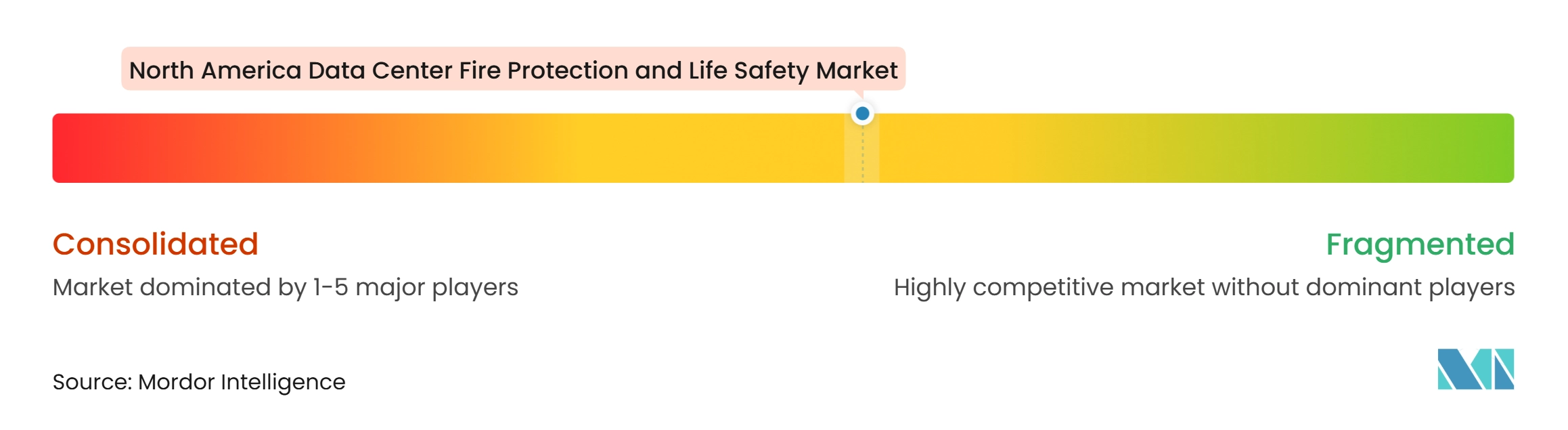
The North America data center fire protection and life safety market is moderately concentrated among integrated building-technology suppliers, including Johnson Controls, Honeywell International, and Siemens. Their positions reflect the value of combining fire safety equipment with wider building automation, monitoring, and service relationships. Johnson Controls expanded this approach in August 2026 with the launch of Simplex Incident Manager and Autocall Fire Site Administrator workstations. The company stated that these workstations can monitor up to 250,000 devices and connect 687 fire alarm control units. Their ISA/IEC 62443-aligned cybersecurity architecture responds to the need for secure integration between fire safety systems and digital building operations.
Supplier competition also reflects the need for products that fit specific facility hazards. ORR Protection introduced ProtectORR pre-engineered hardware bundles and SelectORR digital specification tools in 2025 to support repeatable deployment in data center projects. Marioff’s HI-FOG water-mist approach addresses the need for controlled water application in battery-related applications where clean-agent systems may not be suitable. The ITU’s battery safety guidance supports closer attention to water-based protection for thermal-runaway risks. FM Global DS 5-32 remains an important qualification reference for approved suppression agents, detection systems, and control panels.
The service layer is consolidating as providers seek national coverage, established customer relationships, and a broader technician base. Pye-Barker Fire and Safety completed 57 acquisitions in 2025, expanding its fire alarm, sprinkler, suppression, and security footprint, while APi Group announced a USD 1.1 billion cash acquisition of Onyx Fire Protection Services in 2025 and cited Onyx’s data center and logistics exposure. In the North America data center fire protection and life safety market, these transactions show why local service capability remains valuable even where equipment markets favor larger platform suppliers, because installation, inspection, testing, and maintenance depend on responsive field coverage, qualified personnel, access to replacement parts, and detailed knowledge of each facility’s protection design and operating procedures across mission-critical data center sites throughout North America. The North America data center fire protection and life safety market therefore has both integrated equipment providers and consolidating service organizations, but no combined top-player share was provided, so a numerical concentration score cannot be substantiated without estimating market shares.
North America Data Center Fire Protection and Life Safety Industry Leaders
-
Johnson Controls International plc
-
Honeywell International Inc.
-
Siemens AG
-
Robert Bosch GmbH
-
Eaton Corporation plc
- *Disclaimer: Major Players sorted in no particular order
North America Data Center Fire Protection and Life Safety Market Companies Covered in this Report
- Johnson Controls International plc
- Honeywell International Inc.
- Siemens AG
- Robert Bosch GmbH
- Eaton Corporation plc
- Minimax Viking GmbH
- Fike Corporation
- Halma plc
- Kidde Global Solutions
- Spectrum Safety Solutions
- WAGNER Group GmbH
- Hochiki Corporation
- Victaulic Company
- Amerex Corporation
- ORR Protection Systems, Inc.
- SEM-SAFE Fire Protection A/S
- Marioff Corporation Oy
- Nohmi Bosai Ltd.
- Encore Fire Protection
- Jensen Hughes, Inc.
- DLB Associates Consulting Engineers, P.C.
Recent Industry Developments in North America Data Center Fire Protection and Life Safety Market
- September 2026: NFPA published guidance on the application of NFPA 75 to data centers, confirming the standard’s direct integration with NFPA 1 and NFPA 5000, while acknowledging ongoing committee work to address liquid-to-chip cooling, on-site battery energy storage, and fire department access constraints in AI-optimized campuses.
- August 2026: Johnson Controls launched next-generation Simplex Incident Manager and Autocall Fire Site Administrator fire safety workstations, monitoring up to 250,000 devices and connecting 687 fire alarm control units, 2.5 times more than competing alternatives. The platforms incorporate ISA/IEC 62443-aligned cybersecurity architecture, are UL, ULC, and FM Approved, and directly target large data center and campus deployments, enabling enterprise-scale fire system visibility from a single centralized command interface.
- July 2026: FM Global issued an interim revision to Data Sheet 5-32, *Data Centers and Related Facilities*, adding glossary definitions for Cooling, IT Load, Network Core, and UPS Battery Unit, and updating guidance on clean-agent system applicability and restrictions for rack-mounted lithium-ion battery environments. The revision establishes clearer loss-prevention benchmarks that form the basis of insurer requirements at hyperscale and colocation sites across North America.
- February 2026: NFPA Journal published a detailed assessment of fire code readiness gaps for AI data centers, with fire protection engineers identifying NFPA 75’s 3-year revision cycle and user-governed risk assessment structure as insufficient for liquid-cooled and battery-integrated facility archetypes, and noting that performance-based design is increasingly required in jurisdictions where authorities having jurisdiction lack AI data center-specific code provisions.
North America Data Center Fire Protection and Life Safety Market Report Scope
The North America Data Center Fire Protection and Life Safety Market comprises the technologies, systems, software, and services deployed across data center facilities in the United States and Canada to prevent, detect, suppress, monitor, and manage fire incidents while ensuring personnel safety, business continuity, and regulatory compliance.
The North America Data Center Fire Protection and Life Safety Market Report is Segmented by Solution Type (Fire Detection and Alarm Systems, Fire Suppression Systems, Emergency Notification and Evacuation Systems, Fire Monitoring and Control Systems, and Inspection, Testing, and Maintenance Services), Fire Protection Technology (Smoke and Heat Detection, Aspirating Smoke Detection, Clean Agent Suppression, Inert Gas Suppression, Water-Based Suppression, and Other Fire Protection Technologies), Facility Area (Data Halls and IT Rooms, Electrical and UPS Rooms, Battery Rooms, Cooling and Mechanical Rooms, and Administrative and Support Areas), Data Center Size (Small Data Centers, Medium Data Centers, Large Data Centers, and Hyperscale Data Centers), Data Center Type (Colocation, Cloud Service Providers, and Enterprise and Edge), and Geography (United States, Canada, and Mexico). The Market Forecasts are Provided in Terms of Value (USD).
Segmentation Overview
| Fire Detection and Alarm Systems |
| Fire Suppression Systems |
| Emergency Notification and Evacuation Systems |
| Fire Monitoring and Control Systems |
| Inspection, Testing, and Maintenance Services |
| Smoke and Heat Detection |
| Aspirating Smoke Detection |
| Clean Agent Suppression |
| Inert Gas Suppression |
| Water-Based Suppression |
| Other Fire Protection Technologies |
| Data Halls and IT Rooms |
| Electrical and UPS Rooms |
| Battery Rooms |
| Cooling and Mechanical Rooms |
| Administrative and Support Areas |
| Small Data Centers |
| Medium Data Centers |
| Large Data Centers |
| Hyperscale Data Centers |
| Colocation |
| Cloud Service Providers |
| Enterprise and Edge |
| United States |
| Canada |
| Mexico |
| By Solution Type | Fire Detection and Alarm Systems |
| Fire Suppression Systems | |
| Emergency Notification and Evacuation Systems | |
| Fire Monitoring and Control Systems | |
| Inspection, Testing, and Maintenance Services | |
| By Fire Protection Technology | Smoke and Heat Detection |
| Aspirating Smoke Detection | |
| Clean Agent Suppression | |
| Inert Gas Suppression | |
| Water-Based Suppression | |
| Other Fire Protection Technologies | |
| By Facility Area | Data Halls and IT Rooms |
| Electrical and UPS Rooms | |
| Battery Rooms | |
| Cooling and Mechanical Rooms | |
| Administrative and Support Areas | |
| By Data Center Size | Small Data Centers |
| Medium Data Centers | |
| Large Data Centers | |
| Hyperscale Data Centers | |
| By Data Center Type | Colocation |
| Cloud Service Providers | |
| Enterprise and Edge | |
| By Geography | United States |
| Canada | |
| Mexico |
Key Questions Answered in the Report
What is the North America data center fire protection and life safety market size?
The market is valued at USD 1.58 billion in 2026 and is projected to reach USD 2.85 billion by 2032 at a 10.25% CAGR.
What is driving demand for data center fire protection systems in North America?
AI-focused construction, higher rack density, liquid cooling, lithium-ion UPS systems, and insurer requirements are increasing demand for integrated protection systems.
Which solution type holds the largest share in data center fire safety?
Fire suppression systems hold the largest share, accounting for 41.56% of revenue in 2026.
Which fire protection technology is expanding fastest in data centers?
Aspirating smoke detection is projected to expand at an 11.65% CAGR through 2032 because it can provide earlier smoke detection in high-airflow data halls.
Why are battery rooms important for fire protection planning?
Battery rooms are projected to expand at an 11.64% CAGR through 2032 as lithium-ion UPS systems require protection designed for thermal runaway and re-ignition risks.
Which geography is expanding fastest in North America?
Mexico is projected to expand at an 11.75% CAGR through 2032, supported by announced data center investment and new capacity development.