
North America Data Center Energy Storage and Microgrids Market Size and Share
Market Overview
| Study Period | 2021 - 2032 |
|---|---|
| Forecast Data Period | 2027 - 2032 |
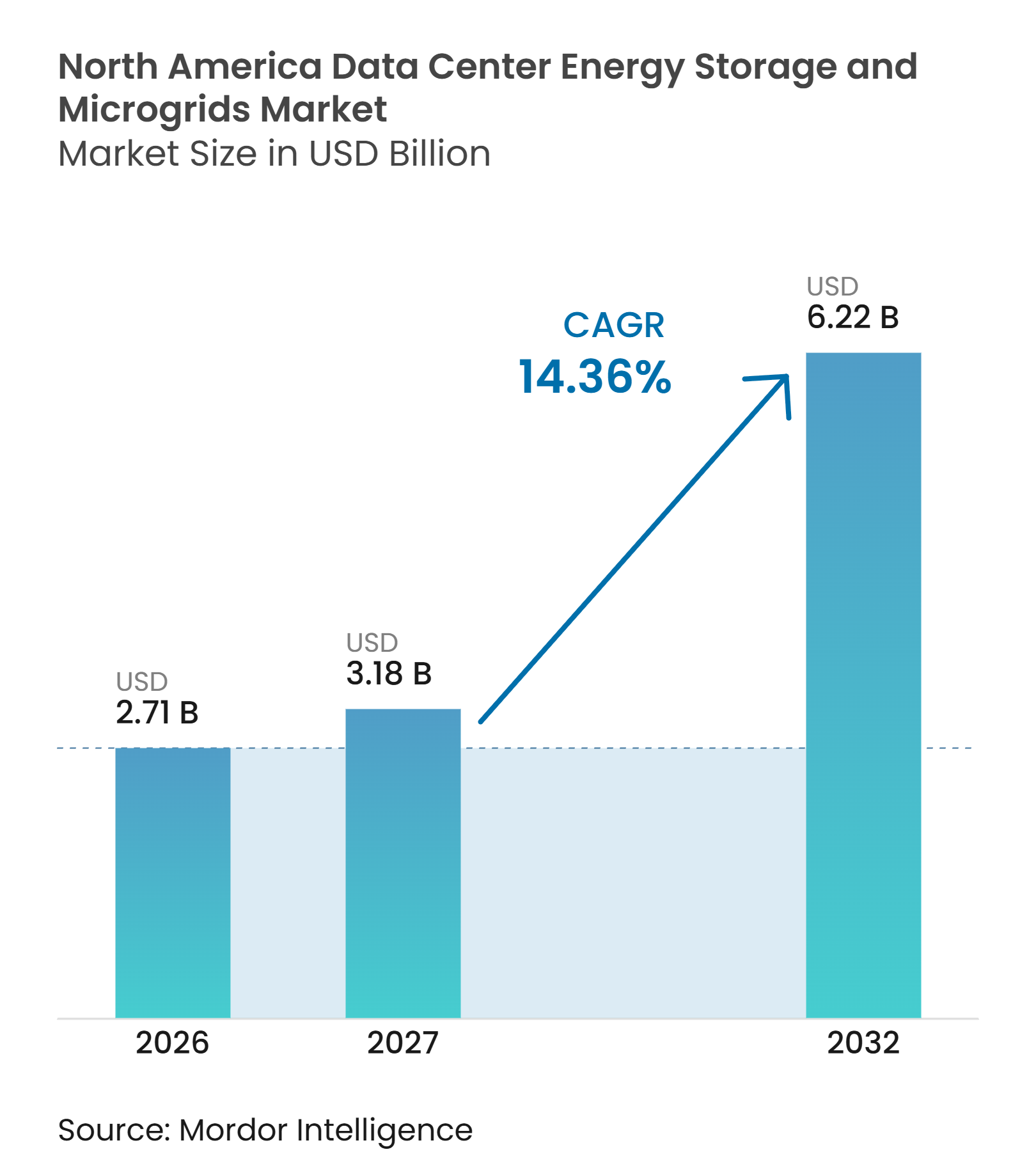
| Base Year Market Size (2026) | USD 2.71 Billion |
| Market Size (2027) | USD 3.18 Billion |
| Market Size (2032) | USD 6.22 Billion |
| Growth Rate (2027 - 2032) | 14.36 % |
| Market Concentration | Medium |
Major Players *Disclaimer: Major Players sorted in no particular order Image © Mordor Intelligence. Reuse requires attribution under CC BY 4.0. | |
North America Data Center Energy Storage and Microgrids Market Analysis by Mordor Intelligence
The North America data center energy storage market size is projected to expand from USD 2.71 billion in 2026 to USD 3.18 billion in 2027, and to USD 6.22 billion by 2032, registering a CAGR of 14.36% between 2027 and 2032. AI computing is raising power density and making short interruptions more consequential for operators. Grid connection delays are also changing project planning, as a completed campus can wait years for its full utility supply to come online. This has made on-site generation, storage, and control systems part of the initial power design rather than a later resilience upgrade. The North America data center energy storage market is therefore attracting providers that can combine equipment, controls, financing, and commissioning support. Procurement is moving toward integrated solutions because operators need to coordinate batteries, fuel cells, renewable generation, and utility imports across large campuses.
Key Report Takeaways
- By solution type, energy storage systems held 42.09% of the North America data center energy storage market share in 2026. Microgrid control systems are projected to expand at a 15.36% CAGR through 2032.
- By storage technology, lithium-ion batteries held 42.13% share in 2026. Flow batteries are expected to expand at a 15.32% CAGR through 2032.
- By microgrid configuration, grid-connected microgrids held 38.32% share in 2026. Hybrid grid-connected and islandable microgrids are projected to expand at a 15.18% CAGR through 2032.
- By primary energy source, grid electricity accounted for 38.04% of the North America data center energy storage market in 2026. Fuel cells are projected to expand at a 15.47% CAGR through 2032.
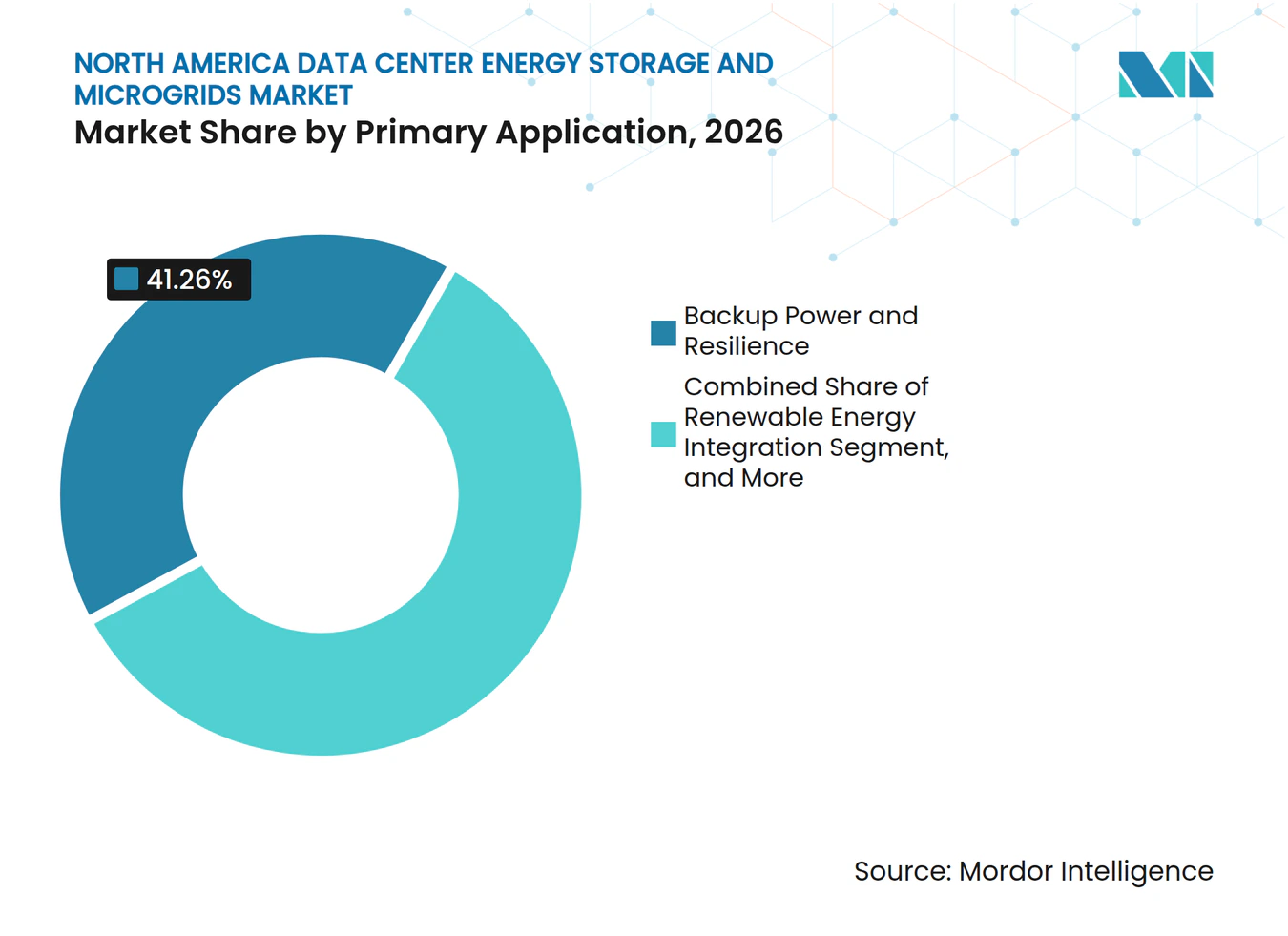
- By primary application, backup power and resilience accounted for 41.26% of the market in 2026. Grid services are expected to expand at a 15.28% CAGR through 2032.
- By data center size, hyperscale facilities held 46.98% share in 2026 and are projected to expand at a 15.97% CAGR through 2032.
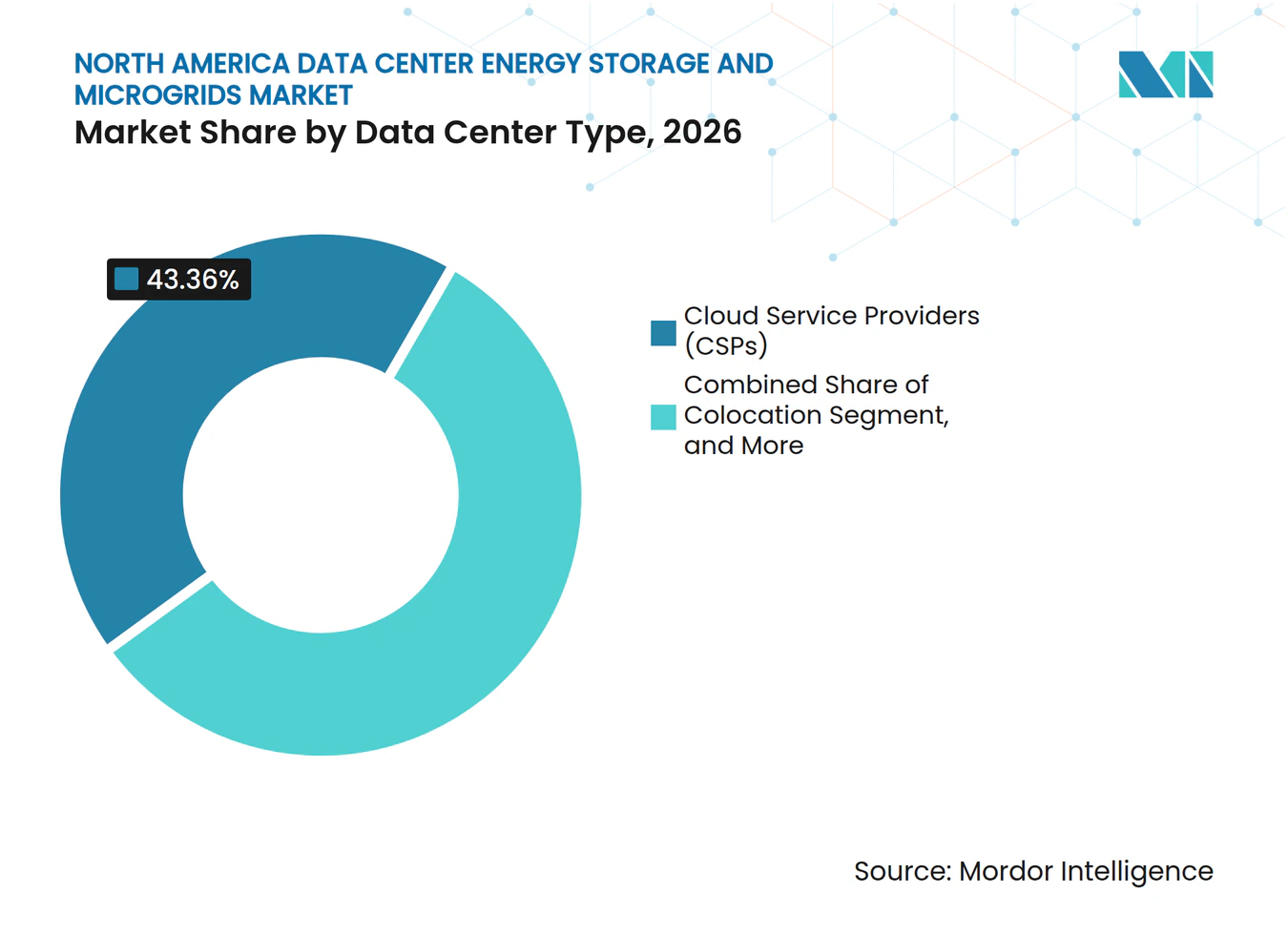
- By data center type, cloud service providers held 43.36% share in 2026 and are expected to expand at a 15.89% CAGR through 2032.
- By geography, the United States held 82.52% share in 2026. Mexico is projected to expand at a 15.74% CAGR through 2032.
Note: Market numbers in this report are based on Mordor Intelligence's proprietary estimation framework, which combines nine months of actuals with Q4 projections for base year 2026.
Market Trends and Insights
Drivers Impact Analysis of North America Data Center Energy Storage and Microgrids Market*
| Driver | (~) % Impact on CAGR Forecast | Geographic Relevance | Impact Timlene |
|---|---|---|---|
| AI Workload Growth and Higher Data Center Power Density | +3.5% | United States, Canada, and Mexico | Short term (≤ 2 years) |
| Hyperscale Data Center Expansion | +2.8% | United States and Mexico | Short term (≤ 2 years) |
| Grid Congestion and Interconnection Delays | +2.4% | United States, with spillover to Canada | Medium term (2-4 years) |
| Sustainability Mandates and Carbon-Reduction Targets | +1.9% | United States and Canada | Medium term (2-4 years) |
| Extreme Weather and Grid-Outage Exposure | +1.5% | United States | Short term (≤ 2 years) |
| Behind-the-Meter Revenue Stacking | +1.4% | United States | Medium t |
| Source: Mordor Intelligence | |||
AI Workload Growth and Higher Data Center Power Density
AI workloads are raising the electricity requirement of a single rack and changing the role of storage in power design. Average rack density rose from 8.3 kW in 2024 to 9 kW in 2025, while liquid-cooled AI racks can require more than 120 kW. High-density racks also create rapid load changes that conventional UPS configurations may not handle as effectively. Battery systems with fast response and sustained discharge capability can manage those variations. A peer-reviewed study describes coordinated storage across chip, rack, facility, and grid levels as an appropriate response to AI-related power fluctuations. This architecture expands demand beyond routine UPS replacement and supports wider use of control software in the North America data center energy storage market.
Hyperscale Data Center Expansion
Hyperscale operators are the largest buyers of integrated power infrastructure because their campuses require large, reliable, and quickly deployable capacity. Bloom Energy reported that expectations for fully on-site-powered facilities rose by 22% among surveyed hyperscale and colocation providers in the six months leading up to early 2026. The same report states that 1 in 5 campuses could exceed 1 GW by 2030. These projects favor suppliers capable of supporting multiyear deployment programs rather than isolated equipment orders. Large contracts can lower hardware costs, but they also favor firms with manufacturing capacity and established service networks. The North America data center energy storage market benefits when operators use storage and generation to avoid leaving completed computing assets idle while grid power is pending.
Grid Congestion and Interconnection Delays
Grid connection delays are shifting data center investment toward behind-the-meter power systems. More than 2,000 GW of generation and storage remained in active US interconnection queues at the end of 2025. The Federal Energy Regulatory Commission issued show-cause orders in June 2026 that required regional transmission organizations to explain or improve their large-load interconnection rules. Operators may use microgrids while waiting for transmission upgrades or when the upgrade timetable does not align with their construction schedule. This favors systems that can connect to the grid when available and operate independently during constraints. It also raises the value of engineering firms that can manage utility interface requirements and on-site assets together.
Sustainability Mandates and Carbon-Reduction Targets
Corporate climate targets continue to influence equipment choices even when reporting requirements change. Fuel cells and renewable generation paired with storage can help operators reduce diesel use and support lower-emission power plans. The International Energy Agency notes that clean-energy technology supply chains remain important to the energy transition and to critical mineral demand.[1] Larger cloud providers can place long-term orders for lower-carbon on-site power, while smaller firms may adopt the same approaches later through standardized products. This pattern makes voluntary commitments an important procurement signal in the North America data center energy storage market. It also creates an opening for providers that can document emissions performance, equipment safety, and lifecycle operations.
Restraints Impact Analysis of North America Data Center Energy Storage and Microgrids Market*
| Restraint | (~) % Impact on CAGR Forecast | Geographic Relevance | ImpactTimeline |
|---|---|---|---|
| High Upfront Capital Requirements for Integrated Energy Infrastructure | -1.9% | United States and Canada | Short term (≤ 2 years) |
| Battery Thermal-Runaway and Fire-Safety Requirements | -1.5% | United States, Canada, and Mexico | Medium term (2-4 years) |
| Interoperability and Cybersecurity Risks Across Distributed Energy Assets | -1.2% | United States | Medium term (2-4 years) |
| Critical-Mineral Supply and Trade Policy Volatility | -0.9% | North America | Long term (≥ 4 years) |
| Source: Mordor Intelligence | |||
High Upfront Capital Requirements for Integrated Energy Infrastructure
Integrated power systems require spending on generation, storage, controls, civil works, and grid interfaces before a data center begins generating revenue. The cost is more difficult for enterprise and mid-market operators to absorb than for hyperscale companies. Battery storage projects also incur procurement and installation costs, as well as transformer, structural, and control-system expenses. Long lead times for large transformers can increase carrying costs when other parts of a campus are ready. Energy-as-a-service and power-purchase structures can shift some capital requirements to an infrastructure provider. These models are likely to be most accessible first to customers with long-term contracts and strong credit quality.
Battery Thermal-Runaway and Fire-Safety Requirements
Battery systems must meet fire-safety rules, which add to design work and project costs. NFPA 855 addresses the installation of stationary energy storage systems, while the International Fire Code guides local enforcement.[2] UL 9540A provides a test method for evaluating thermal runaway fire propagation in battery energy storage systems. New York City’s Rule 3616-07 shows how local requirements can add siting and separation conditions beyond a base code. These compliance factors encourage interest in lithium iron phosphate, flow batteries, and flywheels, where their safety profiles align with the project. They also favor experienced integrators that can address permitting requirements across multiple jurisdictions.
*Our forecasts treat driver/restraint impacts as directional, not additive. The impact forecasts reflect baseline growth, mix effects, and variable interactions.
North America Data Center Energy Storage and Microgrids Market Segment Analysis
By Solution Type:
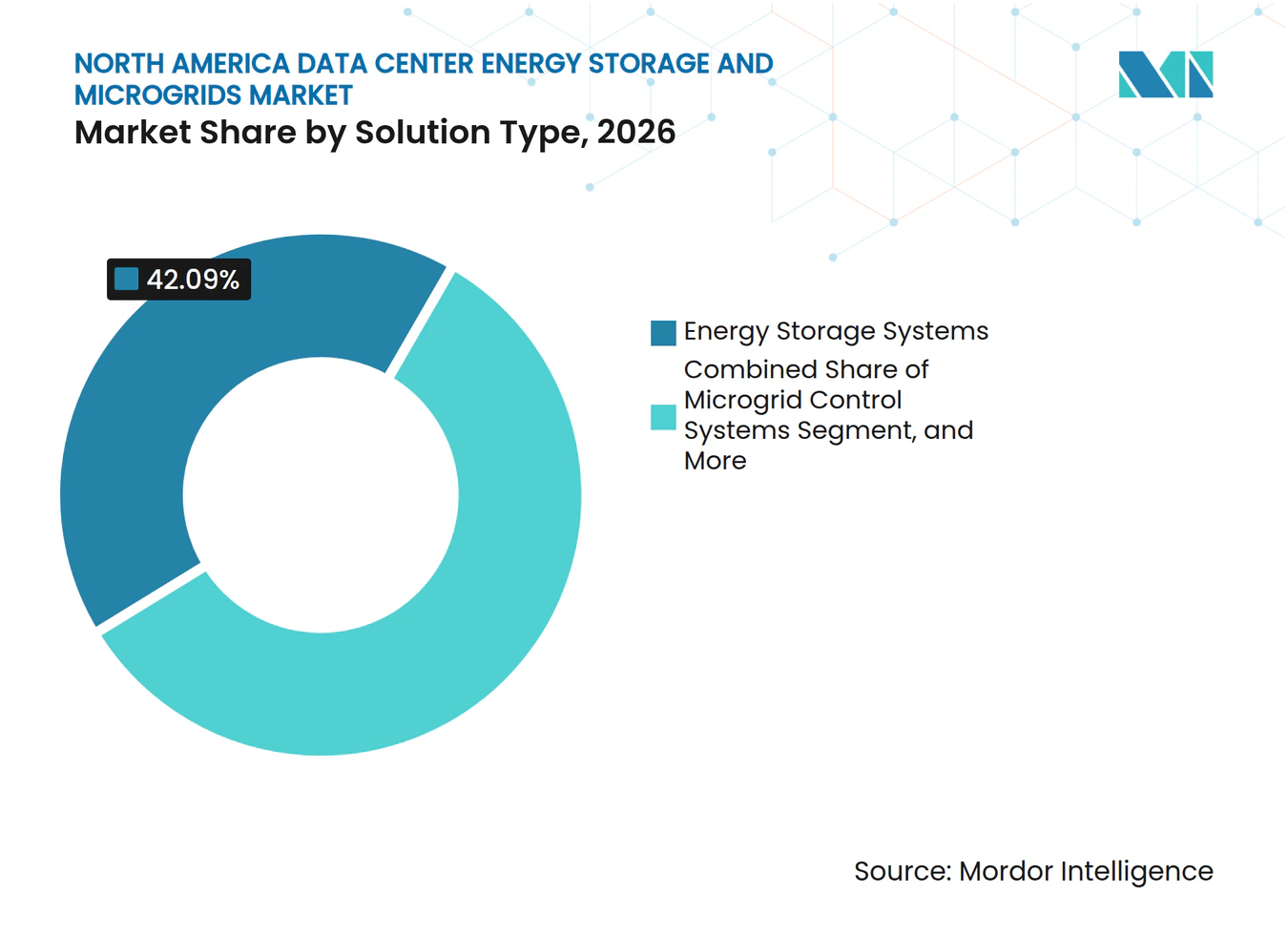
Controls Gain Importance in Integrated Power DesignsEnergy storage systems accounted for 42.09% share in 2026. They remain central to UPS replacement, short-duration backup, and power-quality applications. Distributed generation systems provide the local supply that supports a broader microgrid design. Power conversion systems manage the AC and DC interfaces across batteries, generation assets, and critical loads. Microgrid control systems are projected to expand at a 15.36% CAGR through 2032. Their role is becoming more important as campuses add batteries, fuel cells, solar assets, and utility connections. Operators need a control layer that can manage these resources in real time. Integrated microgrid offerings reduce the number of vendors a customer must coordinate. They can also simplify commissioning and service responsibilities. The North America data center energy storage market is consequently placing greater value on operational coordination alongside installed capacity.
Control platforms can improve battery utilization by scheduling charging, dispatch, and reserve capacity to meet a campus's needs. They may also help facilities manage transitions between grid-connected and islanded operation. Eaton’s collaboration with Xendee combined microgrid software with power hardware for distributed energy systems. A multilevel storage model can coordinate assets from the rack level to the grid level. This makes software a practical part of resilience planning, not a separate digital feature. Hardware suppliers that can demonstrate predictable operating results may retain stronger pricing than firms selling batteries alone. Service models can also reduce the customer’s direct capital exposure. The segment, therefore, reflects a move toward turnkey systems that combine equipment, controls, and long-term support.



By Storage Technology:
Lithium-Ion Leads While Alternatives Address Longer DurationsLithium-ion batteries accounted for 42.13% of the North America data center energy storage market in 2026. Their position reflects the installed base of UPS systems and the suitability of these systems for short-duration applications. Lead-acid batteries remain in some legacy and cost-sensitive facilities. Their greater weight and space requirements can limit their appeal in new high-density designs. Flywheels are used in applications that require a very fast response to short disturbances. Flow batteries are projected to expand at a 15.32% CAGR through 2032. They are relevant where a campus requires several hours of autonomous operation. This includes larger facilities that require a longer discharge duration than a conventional UPS battery bank can provide. Technology selection depends on space, duration, safety, and the local supply chain. Operators are increasingly evaluating these factors together rather than selecting a chemistry based only on initial equipment price.
XL Batteries and Prometheus Hyperscale signed a multiyear agreement for an organic flow battery project at a Wyoming data center campus. The plan begins with a 333 kW demonstration in 2027 and scales to 12.5 MW and 125 MWh systems in 2028 and 2029. This project illustrates how long-duration storage can move from smaller demonstrations toward campus-scale deployment. Critical mineral prices and export restrictions remain relevant to lithium-based storage decisions. The International Energy Agency reported that lithium prices more than doubled between 2025 and early 2026. Safety testing and local permitting may further support the use of alternative chemistries in larger projects. Flow battery and flywheel systems can reduce thermal-runaway concerns in suitable use cases. Diversification gives operators more options when cell supply or project specifications change.
By Microgrid Configuration:
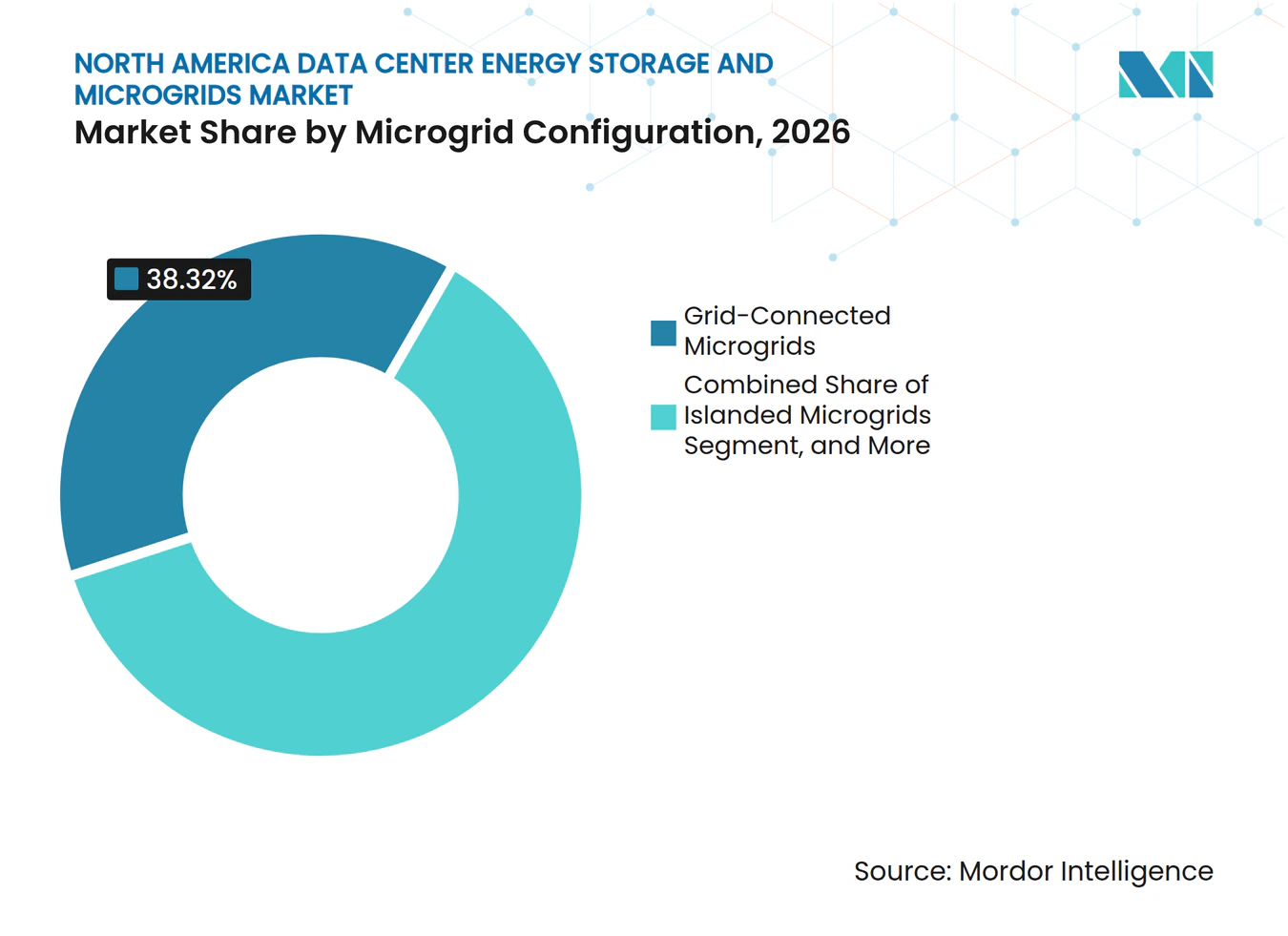
Hybrid Systems Combine Grid Access and Independent OperationGrid-connected microgrids held 38.32% share in 2026. Most operating data centers still rely on utility supply for a major portion of their power. Islanded systems are used where grid reliability is limited or continuous operation is especially critical. Their higher cost can be justified when an outage would carry substantial operational consequences. Hybrid grid-connected and islandable systems are projected to expand at a 15.18% CAGR through 2032. These systems can use utility power when it is available and disconnect during an outage or grid constraint. They can also support participation in grid programs where rules permit. This combination is relevant to new hyperscale campuses facing uncertain power connection schedules. It gives operators greater flexibility than a fully grid-dependent design. The North America data center energy storage market is adopting these designs where resilience and power access must be planned together.
Hybrid designs require reliable controls, protection equipment, and operating procedures. They must detect an outage and transfer modes without disrupting critical computing loads. UL 1741 and IEEE 1547 provide relevant requirements for distributed energy systems and interconnection. Compliance adds engineering work but can reduce uncertainty during utility and permitting reviews. FERC’s actions regarding large-load interconnection may further clarify how data centers coordinate on-site resources with the grid. Vendors with proven islanding and transition capabilities can differentiate their offerings. The segment also rewards integrators who understand both power electronics and utility processes. This is important because a hybrid system must perform under normal grid conditions and during a disruption.

By Primary Energy Source:
Fuel Cells Gain Relevance for Time-to-Power NeedsGrid electricity accounted for 38.04% of primary energy sources in 2026. It remains the main supply arrangement for most existing data centers. Diesel and natural gas generators retain an important role in backup and peak-demand service. Solar is increasingly paired with storage in locations with favorable generation conditions. Wind is more commonly accessed through power-purchase arrangements than on-site equipment. Fuel cells are projected to expand at a 15.47% CAGR through 2032. They can provide on-site power when a grid connection is delayed or insufficient. Their adoption is linked to resilience goals and lower-emission power strategies. The North America data center energy storage market is therefore considering fuel cells as more than a limited backup option. They are becoming part of early site planning for some large campuses.
Bloom Energy and Oracle expanded their master services agreement in April 2026 to support up to 2.8 GW of fuel-cell capacity, with an initial 1.2 GW under deployment. Bloom Energy also expanded its arrangement with Equinix to exceed 100 MW across 19 US data center locations in February 2025. These agreements show the importance of multiyear procurement commitments for on-site power. The National Renewable Energy Laboratory demonstrated a 1.5-MW proton-exchange membrane fuel cell microgrid in collaboration with Caterpillar, Ballard Power Systems, and Microsoft. The demonstration supports the technical viability of extended autonomous operation. Hydrogen safety practices and local requirements remain important during design. Fuel-cell projects will compete with batteries, gas generation, and renewable systems based on fuel availability, cost, and operating needs.
By Primary Application:
Revenue Opportunities Supplement Resilience SpendingBackup power and resilience accounted for 41.26% share in 2026. This reflects the existing UPS base and the operational priority placed on continuous service. Peak shaving and load shifting can reduce exposure to time-based tariffs and demand charges. Renewable integration requires storage to smooth intermittent generation and manage on-site output. Energy cost optimization also includes better scheduling and battery health management. Grid services are projected to expand at a 15.28% CAGR through 2032. Storage can support frequency response, reserves, and demand response where market rules allow. These uses can create revenue from an asset that would otherwise remain idle for much of the year. The North America data center energy storage market is responding to this shift by designing systems for resilience and controlled market participation. The economic case is strongest in locations with established ancillary-service programs.
Participation in grid services depends on technical qualification, utility rules, and local market access. ERCOT, CAISO, and PJM provide some of the more developed structures for ancillary services in the United States. A storage system must reserve sufficient capacity for its primary resilience obligation before it can provide external services. Controls are therefore essential for setting limits and protecting critical loads. Projects in Canada and Mexico may face different participation models and utility requirements. Providers that can translate these rules into a clear operating plan can help customers assess revenue opportunities. The segment is also encouraging data center finance teams to treat storage as an operating asset rather than insurance only. That change may improve the economics of larger battery systems where reliable market access exists.
By Data Center Size:
Hyperscale Campuses Set Technical RequirementsHyperscale facilities held 46.98% share in 2026 and are projected to expand at a 15.97% CAGR through 2032. This combination of scale and pace makes the segment central to equipment specifications and supplier planning. These campuses need large power blocks, multiple redundant paths, and rapid commissioning. Bloom Energy reported that 1 in 5 data center campuses could exceed 1 GW by 2030. Such facilities require a power infrastructure that is designed alongside computing capacity. Large data centers follow many of the same practices but often use less complex configurations. Medium and small sites have historically received less attention from integrated microgrid providers. Standardized equipment is making these systems more accessible to smaller projects. The North America data center energy storage market benefits when concepts proven at hyperscale sites can be adapted into modular products.
Eaton launched an 800 VDC reference architecture for AI data centers in October 2025. Eaton and Siemens Energy also announced a collaboration in June 2025 for data centers with integrated on-site power. Their approach included a standardized 500 MW modular power plant concept. Modular designs may reduce the minimum project size at which integrated power systems become viable. They also allow construction teams to repeat proven equipment and control arrangements. Code requirements can add cost, but standardized compliance packages may simplify smaller projects. This allows suppliers to offer repeatable designs rather than one-off engineering work. The segment will remain shaped by the needs of the largest campuses, but its technical advances can reach the broader data center base.
By Data Center Type:
Cloud Providers Drive Large Procurement ProgramsCloud service providers held 43.36% share in 2026 and are projected to expand at a 15.89% CAGR through 2032. Their scale concentrates purchasing power among a relatively small group of large operators. These customers require resilient power for cloud platforms and AI computing capacity. Colocation providers remain important because their tenants expect clear resilience commitments. Enterprise and edge facilities are smaller but increasingly require local power solutions as AI inference moves closer to end users. Cloud providers are more likely to sign long-term agreements for storage, generation, and controls. This helps suppliers plan capacity and service resources. The North America data center energy storage market is strongly influenced by cloud provider specifications, as these standards can extend to colocation sites. Other operators can then adopt similar designs as products become more standardized.
Fluence disclosed that more than 30 GWh of its pipeline consists of data center projects, most of which are located behind the meter. Oracle’s fuel-cell agreement with Bloom Energy shows how cloud customers are using large procurement programs to secure on-site power. Colocation facilities may use similar systems where anchor tenants request them. Enterprise and edge sites can benefit from modular storage and microgrid systems as costs and implementation requirements become clearer. These customers may not need gigawatt-scale capacity, but they still need reliable local power. Suppliers that offer scalable designs can serve both large and smaller facility types. The result is a market in which cloud demand creates the initial volume, while other user groups broaden the customer base.
Geography Analysis
The United States held 82.52% of the North America data center energy storage market share in 2026. Northern Virginia, Texas, and Arizona remain major centers of data center demand. Texas is expected to become the leading US data center market within 3 years based on power, land, and regulatory conditions. Grid queue delays are increasing interest in on-site generation and storage. FERC’s large-load proceedings show that federal rules are adapting to rising demand, although regulatory changes will take time. California and New York add local fire-safety considerations for battery projects. New York City Rule 3616-07 took effect in October 2025 and adds local siting requirements. The country offers the deepest market for vendors that can combine power hardware, storage, software, and compliance support.
Canada has a smaller but meaningful regional position, supported by investment in Ontario, Quebec, and British Columbia. Hydroelectric generation can provide relatively clean baseload power, reducing the need for local generation in some areas. Storage still supports demand-charge management, renewable integration, and resilience. Provincial utilities and clean-electricity policies shape the economics of demand response and storage participation. The Canadian Standards Association and building-code provisions provide a framework that is broadly aligned with US safety expectations.[3] Cross-border solution providers can use this alignment to transfer design practices between countries. Hyperscale growth in the Toronto and Montreal corridors is creating further demand for behind-the-meter systems. The North America data center energy storage market can benefit from Canadian sites that combine clean power with storage for operational flexibility.
Mexico is projected to expand at a 15.74% CAGR through 2032, the strongest regional pace in the North America data center energy storage market. Queretaro is attracting data center investment as nearshoring and AI-related demand expand local computing capacity. CloudHQ announced a USD 4.8 billion commitment in September 2025 to build 6 data centers in Queretaro. The facilities are expected to use a 900 MW private substation. The country’s power constraints create a role for self-consumption, on-site storage, and microgrids. Projects must align with national electricity rules and local permitting procedures. New self-consumption provisions can support isolated or grid-connected configurations where project conditions allow. Mexico offers suppliers an opportunity to pair data center construction with power infrastructure from the start. This can favor providers that understand local grid requirements and can deliver systems suited to phased campus development.
Competitive Landscape
Market Concentration
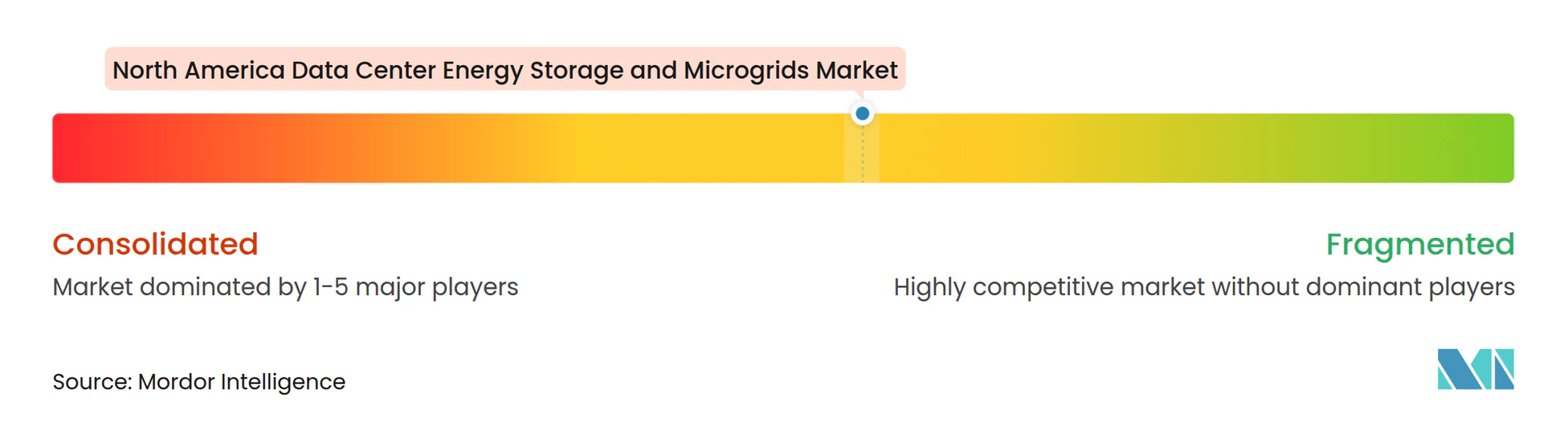
The North America data center energy storage market is moderately fragmented because no provider dominates every layer of the solution stack. Schneider Electric, Eaton, ABB, Siemens, Vertiv, and Hitachi Energy compete in power management and electrical infrastructure. Bloom Energy, GE Vernova, Cummins, and Caterpillar supply on-site generation technologies. Fluence, Tesla, BYD, CATL, LG Energy Solution, and Samsung SDI participate in battery supply and storage systems. Engineering firms such as Ameresco, Black and Veatch, and Burns and McDonnell can integrate equipment from several vendors. Competition increasingly depends on the ability to combine hardware, controls, project delivery, and service. Eaton’s investment in and collaboration with Xendee are examples of a power equipment provider expanding its software capabilities. Schneider Electric’s collaboration with AZZO under EcoStruxure Microgrid Flex reflects a similar interest in modular microgrid development.
Large buyers are encouraging suppliers to use multiyear master supply arrangements. Bloom Energy’s agreement with Oracle supports up to 2.8 GW of fuel-cell capacity, underscoring the scale of these commitments. Vertiv introduced EnergyCore in December 2025 as a utility-scale battery storage system capable of delivering up to 5 MW and 25 MWh per unit. The product addresses the need for larger storage blocks at data center sites. Suppliers with manufacturing certainty, expertise in controls, and proven commissioning capabilities can be favored in this environment. Neutral engineering firms also have a role where customers prefer to select equipment from multiple vendors. FERC rules affecting behind-the-meter generation and large-load interconnection may influence which configurations can reach grid-service programs. This keeps regulatory knowledge relevant to competitive positioning.
Battery hardware is becoming more widely available, which can increase price competition for standalone systems. Differentiation is stronger where a provider can improve operating outcomes through system controls or service. Fuel-cell providers can compete where time-to-power is more important than waiting for a full grid upgrade. Storage providers can compete where resilience, demand management, and ancillary-service participation are combined in one project. Integrators may benefit when customers need a bankable design that satisfies utility, safety, and customer requirements. Smaller providers can remain relevant by focusing on a specific technology or regional delivery capability. Large companies retain an advantage in major contracts because customers need supply certainty and long-term support. Partnerships are likely to remain important because few companies provide all hardware and software components in-house.
North America Data Center Energy Storage and Microgrids Industry Leaders
-
Schneider Electric SE
-
Vertiv Holdings Co
-
Eaton Corporation plc
-
ABB Ltd.
-
Siemens AG
- *Disclaimer: Major Players sorted in no particular order
North America Data Center Energy Storage and Microgrids Market Companies Covered in this Report
- Schneider Electric SE
- Vertiv Holdings Co
- Eaton Corporation plc
- ABB Ltd.
- Siemens AG
- Fluence Energy, Inc.
- Tesla, Inc.
- Cummins Inc.
- Caterpillar Inc.
- Generac Holdings Inc.
- Bloom Energy Corporation
- GE Vernova Inc.
- Hitachi Energy Ltd.
- Delta Electronics, Inc.
- Mitsubishi Electric Corporation
- Honeywell International Inc.
- BYD Company Limited
- Contemporary Amperex Technology Co., Limited
- LG Energy Solution Ltd.
- Samsung SDI Co., Ltd.
- Panasonic Holdings Corporation
- Wärtsilä Corporation
- Ameresco, Inc.
- Enchanted Rock Holdings, Inc.
- Black & Veatch Holding Company
- Burns & McDonnell Engineering Company, Inc.
Recent Industry Developments in North America Data Center Energy Storage and Microgrids Market
- September 2026: A peer-reviewed analysis in Advances in Applied Energy identified coordinated energy storage across chip, rack, facility, and grid layers as an engineering response to AI-workload power fluctuations in data centers.
- June 2026: The Federal Energy Regulatory Commission issued 6 show-cause orders to regulated regional transmission organizations, directing them to justify or reform large-load interconnection rules, including transparency into transmission-upgrade cost allocation.
- May 2026: The US Securities and Exchange Commission proposed repeal of its Scope 1 and Scope 2 climate disclosure rule, creating uncertainty around formal compliance timelines and maintaining attention on voluntary corporate decarbonization targets.
- April 2026: Bloom Energy and Oracle expanded their strategic partnership to support up to 2.8 GW of fuel cell deployments across Oracle's AI and cloud computing infrastructure in the United States under a master services agreement, with an initial 1.2 GW already contracted and under deployment. This marks the largest disclosed fuel cell procurement in the history of the data center industry.
North America Data Center Energy Storage and Microgrids Market Report Scope
The North America Data Center Energy Storage and Microgrids Market comprises energy storage systems, microgrid control systems, distributed generation systems, power conversion systems, and integrated microgrid solutions used to ensure reliable power supply, improve energy efficiency, optimize electricity costs, and integrate renewable energy into data center operations.
The North America Data Center Energy Storage and Microgrids Market Report is Segmented by Solution Type (Energy Storage Systems, Microgrid Control Systems, Distributed Generation Systems, Integrated Microgrid Solutions, and Power Conversion Systems), Storage Technology (Lithium-Ion Batteries, Flow Batteries, Lead-Acid Batteries, Flywheel Energy Storage, and Other Storage Technologies), Microgrid Configuration (Grid-Connected Microgrids, Islanded Microgrids, and Hybrid Grid-Connected and Islandable Microgrids), Primary Energy Source (Grid Electricity, Solar Power, Wind Power, Fuel Cells, and Other Energy Sources), Primary Application (Backup Power and Resilience, Peak Shaving and Loaf Shifting, Renewable Energy Integration, Energy Cost Optimization, and Grid Services), Data Center Size (Hyperscale, Large, Medium, and Small), Data Center Type (Cloud Service Providers, Colocation, and Enterprise and Edge Data Centers), and Geography (United States, Canada, and Mexico). The Market Forecasts are Provided in Terms of Value (USD).
Segmentation Overview
| Integrated Microgrid Solutions |
| Energy Storage Systems |
| Microgrid Control Systems |
| Distributed Generation Systems |
| Power Conversion Systems |
| Lithium-Ion Batteries |
| Lead-Acid Batteries |
| Flow Batteries |
| Flywheel Storage |
| Other Storage Technologies |
| Grid-Connected Microgrids |
| Islanded Microgrids |
| Hybrid Grid-Connected and Islandable Microgrids |
| Grid Electricity |
| Diesel and Natural Gas |
| Solar Power |
| Wind Power |
| Fuel Cells |
| Other Energy Sources |
| Backup Power and Resilience |
| Peak Shaving and Load Shifting |
| Renewable Energy Integration |
| Grid Services |
| Energy Cost Optimization |
| Small |
| Medium |
| Large |
| Hyperscale |
| Colocation |
| Cloud Service Providers (CSPs) |
| Enterprise and Edge |
| United States |
| Canada |
| Mexico |
| By Solution Type | Integrated Microgrid Solutions |
| Energy Storage Systems | |
| Microgrid Control Systems | |
| Distributed Generation Systems | |
| Power Conversion Systems | |
| By Storage Technology | Lithium-Ion Batteries |
| Lead-Acid Batteries | |
| Flow Batteries | |
| Flywheel Storage | |
| Other Storage Technologies | |
| By Microgrid Configuration | Grid-Connected Microgrids |
| Islanded Microgrids | |
| Hybrid Grid-Connected and Islandable Microgrids | |
| By Primary Energy Source | Grid Electricity |
| Diesel and Natural Gas | |
| Solar Power | |
| Wind Power | |
| Fuel Cells | |
| Other Energy Sources | |
| By Primary Application | Backup Power and Resilience |
| Peak Shaving and Load Shifting | |
| Renewable Energy Integration | |
| Grid Services | |
| Energy Cost Optimization | |
| By Data Center Size | Small |
| Medium | |
| Large | |
| Hyperscale | |
| By Data Center Type | Colocation |
| Cloud Service Providers (CSPs) | |
| Enterprise and Edge | |
| By Geography | United States |
| Canada | |
| Mexico |
Key Questions Answered in the Report
What is the size of the North America data center energy storage market?
The North America data center energy storage market is projected to expand from USD 2.71 billion in 2026 and USD 3.18 billion in 2027 to USD 6.22 billion by 2032, at a 14.36% CAGR.
Which data center energy storage segment is expanding fastest?
Hyperscale facilities are projected to expand at a 15.97% CAGR through 2032. Fuel cells are projected to expand at a 15.47% CAGR among primary energy sources.
Why are data centers using microgrids in North America?
Interconnection delays, higher AI-related power demand, and resilience requirements are encouraging operators to use on-site generation, storage, and controls.
What storage technology is used most widely in data centers?
Lithium-ion batteries held 42.13% share in 2026, supported by their established use in UPS and short-duration backup applications.
How do grid services affect data center storage projects?
Grid services are projected to expand at a 15.28% CAGR through 2032 because qualified storage systems can support services such as frequency response and demand response.
Which country is projected to expand fastest in North American data center energy storage?
Mexico is projected to expand at a 15.74% CAGR through 2032, supported by data center development in Queretaro and th