
North America Data Center Disaster Resilience and Business Continuity Market Size and Share
Market Overview
| Study Period | 2021 - 2032 |
|---|---|
| Forecast Data Period | 2027 - 2032 |
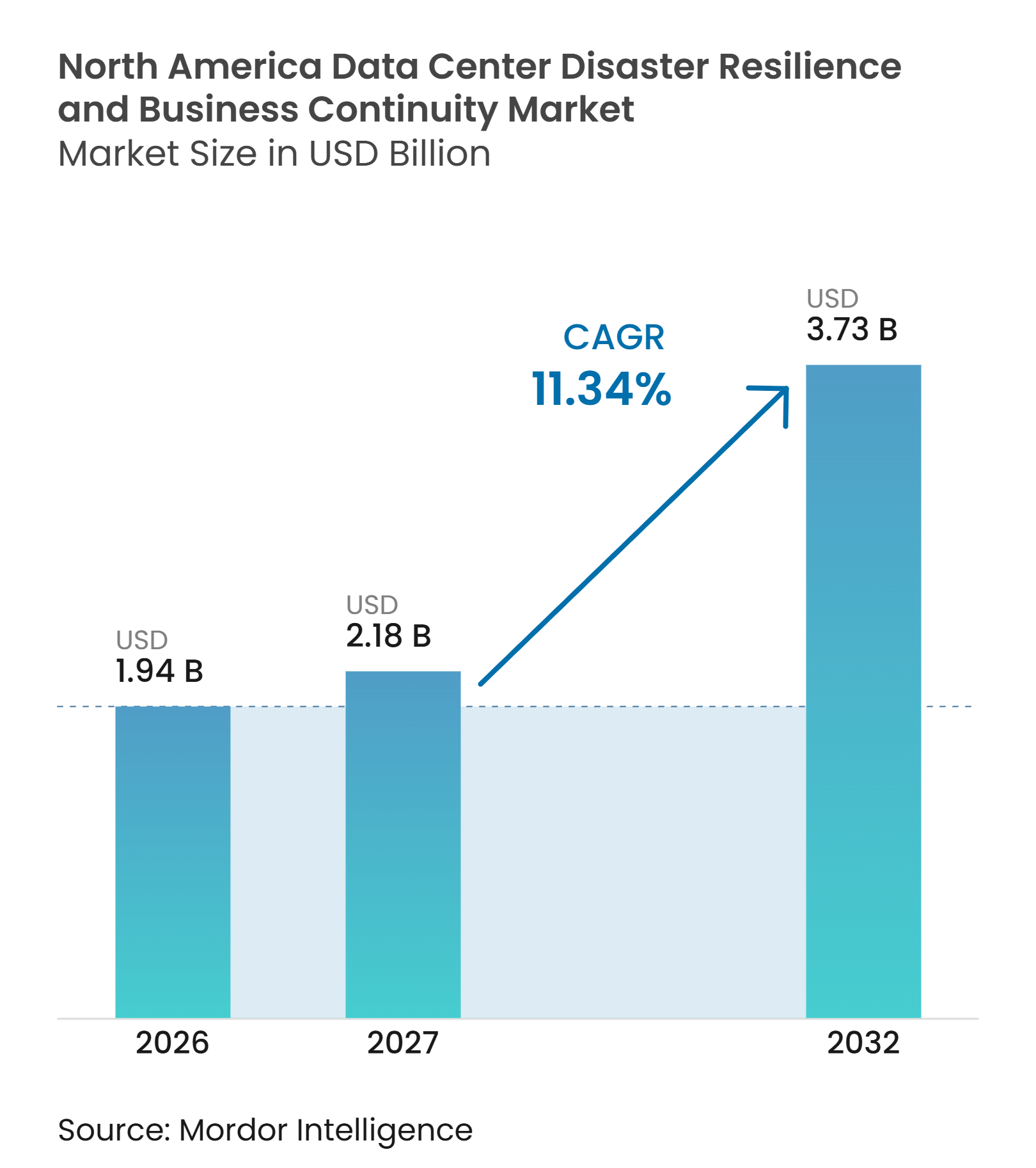
| Base Year Market Size (2026) | USD 1.94 Billion |
| Market Size (2027) | USD 2.18 Billion |
| Market Size (2032) | USD 3.73 Billion |
| Growth Rate (2027 - 2032) | 11.34 % |
| Market Concentration | Medium |
Major Players *Disclaimer: Major Players sorted in no particular order Image © Mordor Intelligence. Reuse requires attribution under CC BY 4.0. | |
North America Data Center Disaster Resilience and Business Continuity Market Analysis by Mordor Intelligence
The North America Data Center Disaster Resilience and Business Continuity Market size is expected to increase from USD 1.94 billion in 2026 to USD 2.18 billion in 2027 and reach USD 3.73 billion by 2032, growing at a CAGR of 11.34% over 2027-2032. The region’s concentration of cloud capacity and enterprise workloads makes recovery planning a continuing operational requirement rather than an occasional compliance activity. Ransomware has widened the scope of recovery from restoring data to restoring applications, identities, and validated operating environments. Buyers are therefore placing more weight on tested recovery procedures, immutable copies, and isolated recovery environments. The North America data center disaster resilience and business continuity market also benefits from hybrid architectures, because these estates need coordinated recovery across private infrastructure, cloud regions, and edge locations. Platform vendors and cloud providers are responding by joining data protection, security monitoring, and recovery workflows more closely.
Key Report Takeaways
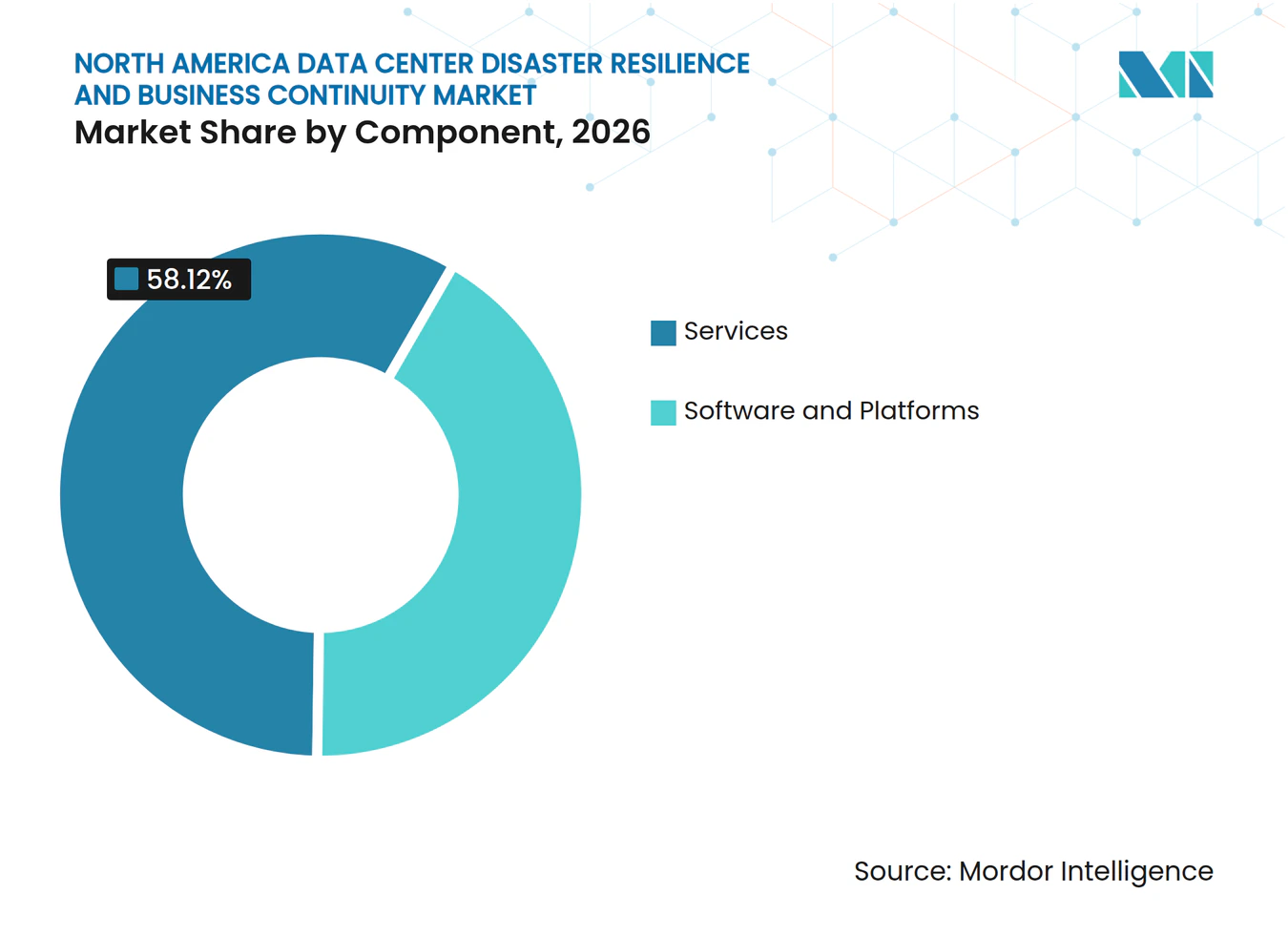
- By component, services held 58.12% of the North America data center disaster resilience and business continuity market share in 2026, while software and platforms are expected to expand at an 11.74% CAGR through 2032.
- By deployment mode, cloud accounted for 41.81% of revenue in 2026 and is projected to grow at an 11.71% CAGR through 2032.
- By data center type, enterprise and edge data centers held 36.79% of revenue in 2026, while cloud service provider data centers are projected to expand at an 11.89% CAGR through 2032.
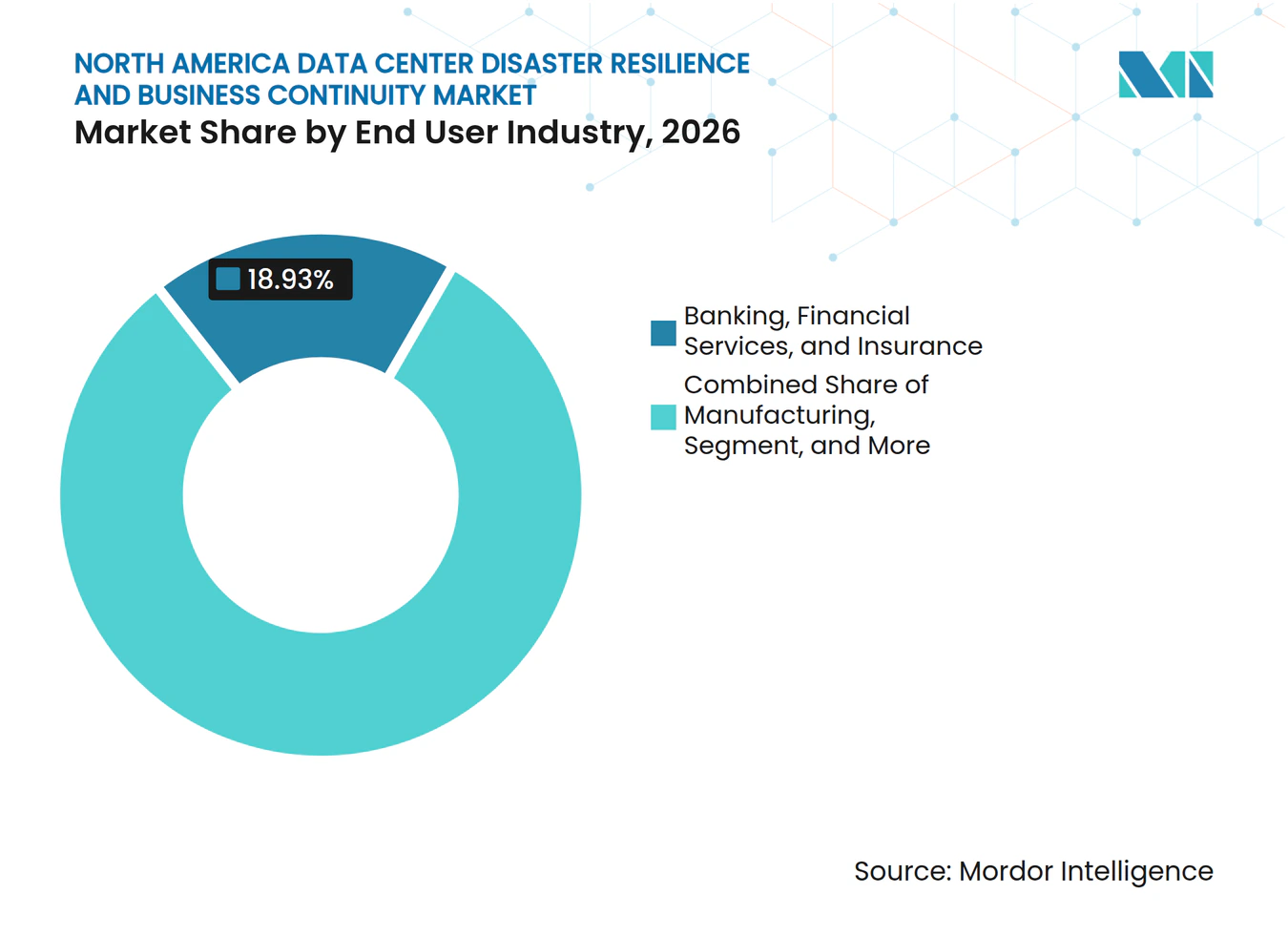
- By end-user industry, BFSI accounted for 18.93% of revenue in 2026 in the North America data center disaster resilience and business continuity market and is expected to grow at a 12.28% CAGR through 2032.
- By geography, the United States held 88.56% of revenue in 2026, while Mexico is projected to expand at a 12.36% CAGR through 2032.
Note: Market numbers in this report are based on Mordor Intelligence's proprietary estimation framework, which combines nine months of actuals with Q4 projections for base year 2026.
Market Trends and Insights
Drivers Impact Analysis of North America Data Center Disaster Resilience and Business Continuity Market*
| Driver | (~) % Impact on CAGR Forecast | Geographic Relevance | Impact Timeline |
|---|---|---|---|
| Ransomware and Destructive Cyberattack Exposure | 3.20% | United States primary, Canada secondary, Mexico emerging | Short term (≤ 2 years) |
| Regulatory and Audit Requirements for Tested Recovery | 2.50% | United States and Canada, FFIEC, FedRAMP, and state mandates | Medium term (2-4 years) |
| Hybrid Cloud Modernization and Data Center Exit Programs | 2.10% | North America, with the United States as a leading adopter | Medium term (2-4 years) |
| Demand for Immutable Recovery and Clean-Room Failover | 1.80% | United States centered, with spillover to Canada | Medium term (2-4 years) |
| Rising Recovery Expectations for AI and Data-Intensive Workloads | 1.40% | United States hyperscale hubs, Canada, and Mexico | Long term (≥ 4 years) |
| Concentration of Critical Digital Infrastructure in North America | 0.90% | United States, especially Virginia and Texas, with inland expansion | Long term (≥ 4 years) |
| Source: Mordor Intelligence | |||
Ransomware and Destructive Cyberattack Exposure
Ransomware and destructive attacks remain a direct driver of demand for the North America data center disaster resilience and business continuity market. Augur Security recorded 4,353 ransomware victims in North America in 2025, a 38% increase over 2024, while its early 2026 tracking indicated sustained high activity. These incidents increasingly affect applications, identities, and backup environments rather than only production data. GuidePoint Security reported that the United States represented more than 55% of recorded global ransomware victims in 2025.[1] This exposure shifts procurement toward clean recovery environments that can be validated before critical systems are restored. The resulting need for faster and more certain recovery supports demand for managed testing, orchestration software, and protected recovery copies.
Regulatory and Audit Requirements for Tested Recovery
Regulatory requirements make documented recovery capability an operational necessity for many buyers in the North America data center disaster resilience and business continuity market. The FFIEC handbook requires financial institutions to identify and validate data center recovery alternatives that fit their risk profiles. California revised its technology recovery policy in October 2025 and requires state agencies to complete business impact analysis, develop recovery plans, and test them at least annually. FedRAMP Rev. 5 also requires integrity-protected baselines and defined restoration capabilities for covered systems. These requirements elevate audit records, recovery exercises, and evidence of restoration from supportive features to purchasing criteria. Financial services providers also need continuity plans that address communications, customer access, and operational capacity under FINRA rules.
Hybrid Cloud Modernization and Data Center Exit Programs
Hybrid cloud modernization complicates the recovery problem because workloads may span multiple environments simultaneously. Flexera reported that 73% of organizations operated hybrid cloud estates in 2026. Recovery processes designed for a single primary site do not readily extend to cloud regions, colocation facilities, private infrastructure, and edge nodes. A 2025 scientific study found that infrastructure-as-code and policy-as-code can improve consistent continuity and recovery deployment across hybrid environments. Organizations must therefore map dependencies and recovery objectives before they can automate failover safely. This need supports cloud-based orchestration, policy management, and continuity planning tools. It also explains why cloud deployment combines a leading revenue position with a leading forecast rate in this North America data center disaster resilience and business continuity market.
Demand for Immutable Recovery and Clean-Room Failover
Immutable recovery and clean-room failover have become central to cyber recovery planning. IBM explains that clean-room recovery isolates restoration work, enabling organizations to identify malware and rebuild from a verified state. This approach addresses the risk that ransomware remains dormant in backups before a visible encryption event occurs. Commvault, Kyndryl, and Pure Storage described a four-layer design that combines an immutable vault, a clean recovery zone, rapid restoration, and immutable snapshots. Such designs help organizations apply zero-trust controls to both recovery and production systems. The capability is especially relevant to cloud service provider environments, where customers need isolation and geographic redundancy without maintaining a separate physical site. It also gives the North America data center disaster resilience and business continuity market a wider role in ransomware containment.
Restraints Impact Analysis of North America Data Center Disaster Resilience and Business Continuity Market*
| Restraint | (~) % Impact on CAGR Forecast | Geographic Relevance | Impact Timeline |
|---|---|---|---|
| Legacy Application and Dependency Complexity | -1.50% | United States and Canada, especially financial services and government | Medium term (2-4 years) |
| Data Residency, Privacy, and Third-Party Control Concerns | -1.10% | United States cross-border workloads, Canadian provincial rules, and Mexican data sovereignty | Long term (≥ 4 years) |
| High Migration and Integration Costs | -0.80% | North America-wide, most pronounced in the mid-market | Medium term (2-4 years) |
| Shortage of Specialized Recovery and Resilience Personnel | -0.50% | United States primary, with sharper constraints in Canada and Mexico relative to scale | Long term (≥ 4 years) |
| Source: Mordor Intelligence | |||
Legacy Application and Dependency Complexity
Legacy application complexity can delay modernization, even when the recovery risk is clear. Cohesity’s September 2025 survey found that 76% of respondents had experienced a material cyberattack, while 47% reported complete confidence in their ability to withstand current threats. Older systems often contain undocumented links between applications, databases, identity services, and customized interfaces. A recovery test can itself create an availability risk when those dependencies are poorly understood. Organizations may therefore postpone migration or automated orchestration until they have completed assessment and mapping work. This constraint is particularly relevant to government and financial services estates with long-running core systems. It sustains demand for advisory services but can slow the adoption of advanced platform capabilities across the North America data center disaster resilience and business continuity market.
Data Residency, Privacy, and Third-Party Control Concerns
Data residency and third-party control concerns narrow recovery choices for regulated organizations. AWS notes that country-level residency requirements can restrict cross-border failover and require in-jurisdiction recovery designs. Canadian public-sector and health data requirements can make a United States recovery region unsuitable for certain workloads. Mexico’s Federal Law on Protection of Personal Data Held by Private Parties also forms part of the compliance context for organizations designing cross-border continuity arrangements. Procurement teams may need to negotiate data location, access control, and provider responsibility in greater detail. These steps extend implementation schedules for recovery-as-a-service offerings. They also preserve a role for local infrastructure and sovereign recovery environments in the North America data center disaster resilience and business continuity market.
*Our forecasts treat driver/restraint impacts as directional, not additive. The impact forecasts reflect baseline growth, mix effects, and variable interactions.
North America Data Center Disaster Resilience and Business Continuity Market Segment Analysis
By Component:
Services Lead While Platforms ExpandServices held 58.12% of the North America data center disaster resilience and business continuity market share in 2026. The position reflects the continued need for specialist support in assessment, planning, testing, and managed continuity operations. Many organizations begin with a business impact analysis to identify critical dependencies before setting recovery objectives. Advisory teams can document recovery priorities across business processes, applications, and infrastructure. Managed continuity services are particularly relevant to financial institutions that need ongoing plan reviews and third-party oversight. The FFIEC framework reinforces the need to assess recovery alternatives and maintain plans that reflect an institution’s operating environment. This work is difficult to sustain internally, where recovery expertise is limited. It keeps services central even as software capabilities improve.
Software and platforms are projected to expand at an 11.74% CAGR through 2032. Integrated tools bring together business impact analysis, plan documentation, exercise management, notification workflows, and crisis coordination. This reduces the need to maintain separate point tools for adjacent continuity tasks. FedRAMP requirements for protected system baselines and restoration procedures support the demand for platforms that retain evidence of testing and recovery. The component transition does not eliminate the role of service providers, as implementation still requires process design and validation. It does, however, shift recurring work toward configurable workflows and automated documentation. Vendor consolidation can reinforce this change when broader data protection portfolios add orchestration and response features. The North America data center disaster resilience and business continuity industry consequently has a services-led present and a more software-centered path to expansion.


By Deployment Mode:
Cloud Combines Revenue Leadership with Faster AdoptionCloud held 41.81% of 2026 revenue and is projected to expand at an 11.71% CAGR through 2032. The model allows organizations to provision recovery capacity in a separate location without having to buy and operate a secondary data center. It is particularly suited to immutable vaults and isolated recovery environments that must remain separate from production systems. Flexera reported that hybrid cloud estates were in use at 73% of organizations in 2026.[2] These architectures make cloud-based recovery a practical option for workloads that already span multiple environments. The cloud segment’s position shows that resilience is increasingly being designed into broader infrastructure choices. It also reflects the need to recover shared applications, identities, and data in a coordinated order.
On-premises deployment remains important when organizations face strict location rules or need a predictable response for latency-sensitive workloads. Health care, government, and other regulated operators may retain local systems for applications that cannot depend on a distant recovery region. Hybrid deployment combines local recovery for priority workloads with a cloud-based, isolated copy for more severe incidents. This structure can support quicker operational restoration while maintaining geographic separation against ransomware. AWS states that residency requirements can make geographically constrained recovery necessary, which helps explain the ongoing demand for local and hybrid architectures. Buyers must still test the connection between their local and cloud environments because a protected copy alone does not establish recoverability. The North America data center disaster resilience and business continuity market, therefore, supports several deployment choices rather than a complete replacement of local infrastructure. The central buyer's question is whether the chosen model can restore critical services within the agreed objectives.
By Data Center Type:
Enterprise and Edge Sites Retain Scale as Cloud Providers AccelerateEnterprise and edge data centers held 36.79% of revenue in 2026. This North America data center disaster resilience and business continuity market size reflects the large installed base of enterprise, colocation, and distributed infrastructure. Financial services, health care, manufacturing, and public-sector organizations continue to operate workloads across multiple public cloud environments. Edge sites add a distinct continuity challenge because local operations may depend on connectivity, power, and systems that are distant from central facilities. Manufacturing and retail sites need plans that can support operational processes when wide-area connectivity is interrupted. These locations often require recovery procedures that account for both local equipment and central applications. Enterprise teams also need to document dependencies before an isolated recovery exercise can be trusted. This installed base keeps enterprise and edge environments central to demand.
Cloud service provider data centers are projected to expand at an 11.89% CAGR through 2032. Hyperscale and cloud environments need recovery services that fit their shared-responsibility models and their marketplace purchasing methods. Immutable vaults, isolated recovery automation, and tenant-level orchestration are increasingly relevant in this setting. Cohesity’s AWS Resilience Competency and its availability through AWS Marketplace illustrate a vendor's effort to align cyber recovery tools with cloud provider channels. Colocation facilities also remain relevant during transitions from owned infrastructure to cloud services. Organizations may move workloads into colocation before deciding which systems should migrate further. That transition can temporarily increase the need for continuity coverage across multiple environments. The North America data center disaster resilience and business continuity market is therefore shaped by a broad installed base and a faster-moving cloud provider opportunity.
By End-User Industry:
BFSI Leads Revenue and Forecast ExpansionBFSI held 18.93% of revenue in 2026 and is projected to expand at a 12.28% CAGR through 2032. The sector combines low tolerance for downtime with detailed requirements for operational and customer continuity. Augur Security recorded a 39% year-over-year rise in the number of financial-services ransomware victims between February and April 2026. Financial institutions must address data recovery, alternate communications, and the continuity of financial and operational services. The FFIEC guidance requires risk-based planning for data center recovery alternatives. FINRA also expects member firms to maintain business continuity plans appropriate to their business structure and risks. These expectations support regular testing and documented evidence, not only technical backup capacity. BFSI consequently combines the largest revenue position with the fastest forecast rate among the stated end-user categories.
IT and telecommunications providers form another major user group because they carry contractual uptime and restoration commitments for enterprise customers. Health care and life sciences organizations face short response windows and significant operational consequences when clinical systems become unavailable. Government and public administration programs must balance mandated recovery obligations against legacy application complexity and budget cycles. Manufacturing and retail organizations are extending continuity planning into distributed operational environments, including production sites and distribution centers. Energy and utilities also require recovery plans that account for critical service availability and distributed assets. Mid-market users outside the primary verticals are adopting continuity programs as managed offerings make expertise more accessible. Each vertical has different technical dependencies, but all require clear recovery ownership and repeated validation. This breadth of need supports a diverse demand base for the North America data center disaster resilience and business continuity market.


Geography Analysis
United States
The United States held 88.56% of the North America data center disaster resilience and business continuity market share in 2026. Augur Security reported that the country accounted for 89.5% of recorded ransomware victims in North America since 2024.[3] The concentration of digital infrastructure and enterprise targets makes tested recovery a routine requirement for many organizations. Hyperscale activity is also spreading beyond the largest coastal centers into inland locations. This expansion creates recovery design needs across regions with different power, network, and operational conditions. FFIEC, FedRAMP, HIPAA, and FINRA requirements shape continuity spending in regulated sectors. Vendors that can document exercises and recovery outcomes are positioned to serve these compliance needs.
Mexico
Mexico is projected to expand at a 12.36% CAGR through 2032. The country is attracting data center development connected with nearshoring, cloud localization, and AI-related demand. Mexico is attracting large data center investments linked to nearshoring, cloud localization, and AI-related demand. New facilities create a larger base of operators that need continuity programs aligned with multinational client commitments. Power availability and grid resilience are particularly relevant to local business continuity design. Mexico’s data protection law also affects how organizations plan for storage, access, and cross-border data recovery. The North America data center disaster resilience and business continuity market has an opportunity to support local recovery planning before new capacity becomes deeply embedded in client operations.
Canada and Regional Dynamics
Canada has a distinct role because it has accounted for 8.6% of North American ransomware victims since 2024. Provincial rules governing health and public-sector data may require Canadian recovery environments rather than cross-border alternatives. This compliance factor sustains demand for locally hosted, isolated, and air-gapped recovery capability. The wider regional context also includes distributed edge sites serving manufacturing routes between the United States and Mexico. These sites may require continuity plans that cover both local operations and central cloud dependencies. Emerging architectures increasingly combine an immutable copy, a clean recovery environment, and automated recovery runbooks. IBM identifies clean-room recovery as a way to isolate restoration from malware that may have entered backup environments. This approach can help regional operators address ransomware exposure while respecting data location requirements. It also provides a common recovery design across a geographically diverse North America data center disaster resilience and business continuity market.
Competitive Landscape
Market Concentration
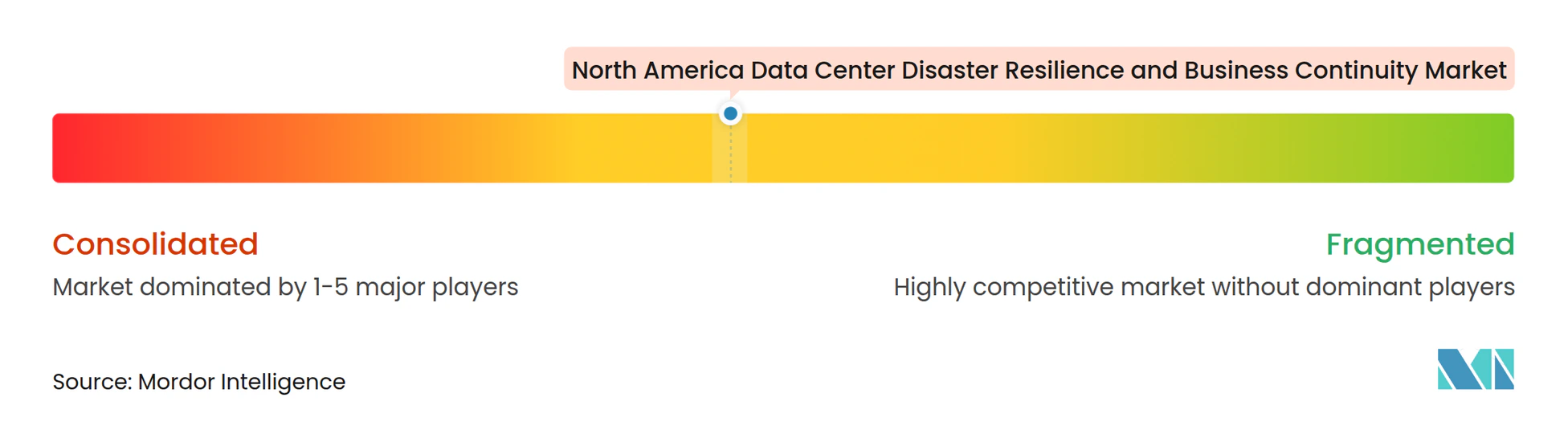
The North America data center disaster resilience and business continuity market is moderately consolidated at the platform level, while managed and advisory services remain more fragmented. Buyers are consolidating point tools into broader platforms that combine backup, identity recovery, testing, and incident response. This favors vendors that can offer an integrated product set and support a recovery process from detection through restoration. The competitive boundary between data protection and cybersecurity has become less distinct because ransomware affects both functions. Providers increasingly differentiate through anomaly detection, identity recovery, clean-room validation, and automated recovery workflows. NIST guidance on storage security recognizes the importance of protecting storage systems and the controls around them. This creates value for architectures that limit a compromised administrator's ability to alter recovery points.
Cohesity’s combination with Veritas NetBackup and Alta expanded its enterprise customer base and combined data protection with recovery orchestration and security services. The company also expanded its partnership with HPE in May 2026, including reciprocal resale arrangements and integration with HPE GreenLake HPE. These moves show how platform vendors are using alliances to reach private cloud and public-sector buyers. Rubrik and Cognizant introduced Business Resilience-as-a-Service in October 2025, combining the vendor’s cyber-resilience platform with managed services expertise.[4] The offering addresses organizations that need a managed path from technical recovery to broader continuity planning. Commvault also described a recovery architecture with Kyndryl and Pure Storage that connects immutable storage, a clean recovery zone, restoration, and snapshots. These examples indicate that vendor relationships are becoming an important part of competitive positioning.
Hyperscale providers create additional pressure by embedding immutable storage, isolated recovery, and related controls into cloud contracts. Standalone vendors therefore need to show how their platforms work across cloud, private, colocation, and edge environments. The mid-market remains an opening for subscription-based services because many organizations lack in-house recovery specialists. Providers that can simplify assessment, testing, and recovery documentation may be more accessible to these buyers.
North America Data Center Disaster Resilience and Business Continuity Industry Leaders
-
Amazon Web Services, Inc.
-
Microsoft Corporation
-
VMware by Broadcom
-
11:11 Systems, Inc.
-
International Business Machines Corporation
- *Disclaimer: Major Players sorted in no particular order
North America Data Center Disaster Resilience and Business Continuity Market Companies Covered in this Report
- Amazon Web Services, Inc.
- Microsoft Corporation
- VMware by Broadcom
- International Business Machines Corporation
- 11:11 Systems, Inc.
- Hewlett Packard Enterprise Company
- Veeam Software Group GmbH
- Rubrik, Inc.
- Cohesity, Inc.
- Commvault Systems, Inc.
- Dell Technologies Inc.
- Veritas Technologies LLC
- Druva Inc.
- Arcserve (USA), LLC
- Zerto Ltd.
- Sungard Availability Services, LLC
- TierPoint, LLC
- Flexential Corp.
- Recovery Point Systems, Inc.
- InterVision Systems, LLC
- Fusion Risk Management, Inc.
- Everbridge, Inc.
- ServiceNow, Inc.
- Riskonnect, Inc.
- Castellan Solutions, Inc.
Recent Industry Developments in North America Data Center Disaster Resilience and Business Continuity Market
- September 2026: IBM published a technical reference on clean-room recovery, defining the approach as essential for addressing dormant malware that can contaminate backup environments before encryption activity begins.
- May 2026: HPE and Cohesity expanded their 7-year partnership, with reciprocal resale agreements covering Cohesity NetBackup and DataProtect on HPE infrastructure and Cohesity’s resale of HPE Zerto for continuous data protection.
- March 2026: Veeam Data Platform was named the winner of the 2026 SC Award for Best Business Continuity, Disaster and Ransomware Recovery Solution. The recognition highlighted its backup, ransomware protection and recovery capabilities across physical, virtual and cloud environments. Veeam formally published its announcement on April 2, 2026.
- October 2025: Rubrik and Cognizant launched Business Resilience-as-a-Service, a subscription-based managed resilience model that combined Rubrik’s cyber-resilience platform with Cognizant’s domain expertise.
North America Data Center Disaster Resilience and Business Continuity Market Report Scope
The market refers to software platforms and professional and managed services designed to help data center operators and enterprises assess operational risks, develop business continuity and disaster recovery plans, coordinate crisis response, test recovery capabilities, and maintain critical IT services during disruptive events, including cyberattacks, infrastructure failures, and natural disasters.
The North America Data Center Disaster Resilience and Business Continuity Market Report is segmented by Component (Software and Platforms, and Services), Deployment Mode (Cloud, On-Premises, and Hybrid), Data Center Type (Cloud Service Provider, Colocation, and Enterprise and Edge), End-User Industry (IT and Telecomm, BFSI, Government and Public Administration, Healthcare and Life Sciences, Manufacturing, Retail and E-Commerce, Energy and Utilities, and Other Industries), and Geography (United States, Canada, and Mexico).
Segmentation Overview
| Software and Platforms | Integrated Continuity and Resilience Management Platforms |
| Standalone Business Impact Analysis and Dependency Mapping Software | |
| Standalone Continuity Planning and Documentation Software | |
| Standalone Crisis Response and Incident Coordination Software | |
| Others (Standalone Resilience Exercise and Testing Management Software, etc) | |
| Services | Advisory, Business Impact Analysis, and Resilience Assessment Services |
| Continuity and Crisis Response Plan Development Services | |
| Software Implementation and Systems Integration Services | |
| Resilience Testing, Simulation, and Training Services | |
| Managed Continuity Program Services |
| Cloud |
| On-Premises |
| Hybrid |
| Cloud Service Provider |
| Colocation |
| Enterprise and Edge |
| IT and Telecom |
| BFSI |
| Government and Public Administration |
| Healthcare and Life Sciences |
| Manufacturing |
| Retail and E-Commerce |
| Energy and Utilities |
| Other End User Industries |
| United States |
| Canada |
| Mexico |
| By Component | Software and Platforms | Integrated Continuity and Resilience Management Platforms |
| Standalone Business Impact Analysis and Dependency Mapping Software | ||
| Standalone Continuity Planning and Documentation Software | ||
| Standalone Crisis Response and Incident Coordination Software | ||
| Others (Standalone Resilience Exercise and Testing Management Software, etc) | ||
| Services | Advisory, Business Impact Analysis, and Resilience Assessment Services | |
| Continuity and Crisis Response Plan Development Services | ||
| Software Implementation and Systems Integration Services | ||
| Resilience Testing, Simulation, and Training Services | ||
| Managed Continuity Program Services | ||
| By Deployment Mode | Cloud | |
| On-Premises | ||
| Hybrid | ||
| By Data Center Type | Cloud Service Provider | |
| Colocation | ||
| Enterprise and Edge | ||
| By End User Industry | IT and Telecom | |
| BFSI | ||
| Government and Public Administration | ||
| Healthcare and Life Sciences | ||
| Manufacturing | ||
| Retail and E-Commerce | ||
| Energy and Utilities | ||
| Other End User Industries | ||
| By Geography | United States | |
| Canada | ||
| Mexico | ||
Key Questions Answered in the Report
What is the size of the North America data center disaster resilience and business continuity market?
The North America data center disaster resilience and business continuity market size is USD 1.94 billion in 2026 and is projected to reach USD 3.73 billion by 2032 at an 11.34% CAGR. The forecast starts from USD 2.18 billion in 2027 and covers the period through 2032 for the North America data center disaster resilience and business continuity market in the United States, Canada, and Mexico.
What is driving demand for data center disaster resilience in North America?
Ransomware exposure, mandated recovery testing, hybrid cloud complexity, and demand for immutable recovery environments are central demand factors. Buyers also need to coordinate application, identity, and data restoration, rather than treating backup as a stand-alone safeguard.
Which component leads spending on data center disaster resilience and business continuity?
Services led with 58.12% of revenue in 2026, reflecting demand for assessment, planning, testing, and managed continuity support. Many organizations need specialist help to map dependencies and validate whether recovery plans work under realistic conditions.
Which deployment model is expanding fastest for disaster recovery?
Cloud led revenue with 41.81% in 2026 and is projected to expand at an 11.71% CAGR through 2032. It supports geographically isolated recovery environments without requiring every organization to maintain a separate physical recovery site.
Why does BFSI require extensive business continuity capability?
BFSI led end-user revenue with 18.93% in 2026 and faces strict recovery and continuity expectations from bodies such as FFIEC and FINRA. The sector must preserve operational continuity, data restoration, customer communications, and evidence that plans have been tested across normal operations, cyber incidents, technology failures, and disruptions that affect clearing or settlement processes.
Why is Mexico a fast-expanding location for resilience services?
Mexico is projected to expand at a 12.36% CAGR through 2032 as data center investment increases with nearshoring, cloud localization, and AI-related demand. New operators will need recovery approaches that address power resilience, client commitments, and data protection requirements.