
North America Data Center Demand Response and Energy Management Market Size and Share
Market Overview
| Study Period | 2021 - 2032 |
|---|---|
| Forecast Data Period | 2027 - 2032 |
| Base Year Market Size (2026) | USD 3.23 Billion |
| Market Size (2027) | USD 3.65 Billion |
| Market Size (2032) | USD 6.87 Billion |
| Growth Rate (2027 - 2032) | 13.50 % |
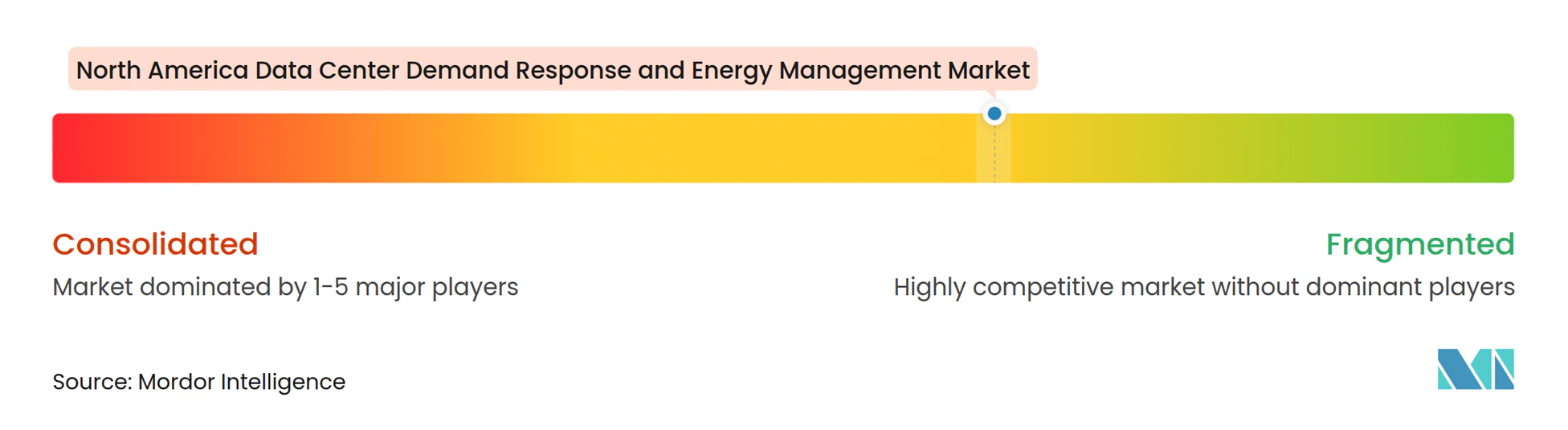
| Market Concentration | Medium |
Major Players *Disclaimer: Major Players sorted in no particular order Image © Mordor Intelligence. Reuse requires attribution under CC BY 4.0. | |
North America Data Center Demand Response and Energy Management Market Analysis by Mordor Intelligence
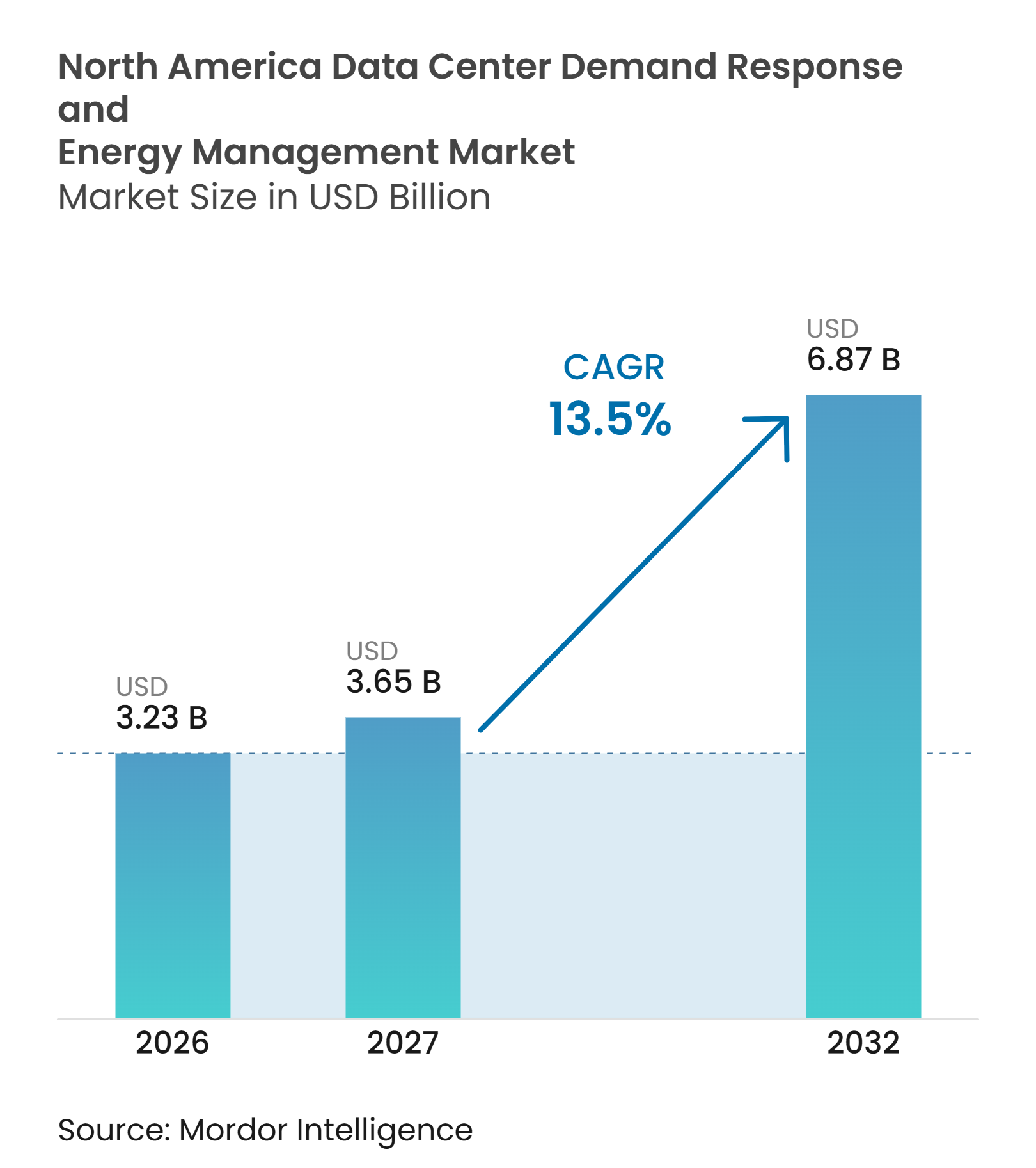
The North America data center demand response and energy management market size was valued at USD 3.23 billion in 2026 and is estimated to expand from USD 3.65 billion in 2027 to reach USD 6.87 billion by 2032, at a CAGR of 13.50% during the forecast period (2027-2032). The North America data center demand response and energy management market is being shaped by a widening gap between AI-related electricity demand and the speed at which grid capacity can be added. Operators are shifting from fixed consumption patterns toward systems that can monitor, forecast, and adjust selected loads when grid conditions or electricity prices change. This makes energy management software, utility coordination, and workload scheduling increasingly important to data center planning. The North America data center demand response and energy management market also benefits when flexible-load commitments help operators secure power connections sooner. Mission-critical service requirements and differing program rules across power markets limit how much load can be curtailed and how quickly programs can scale.
Key Report Takeaways
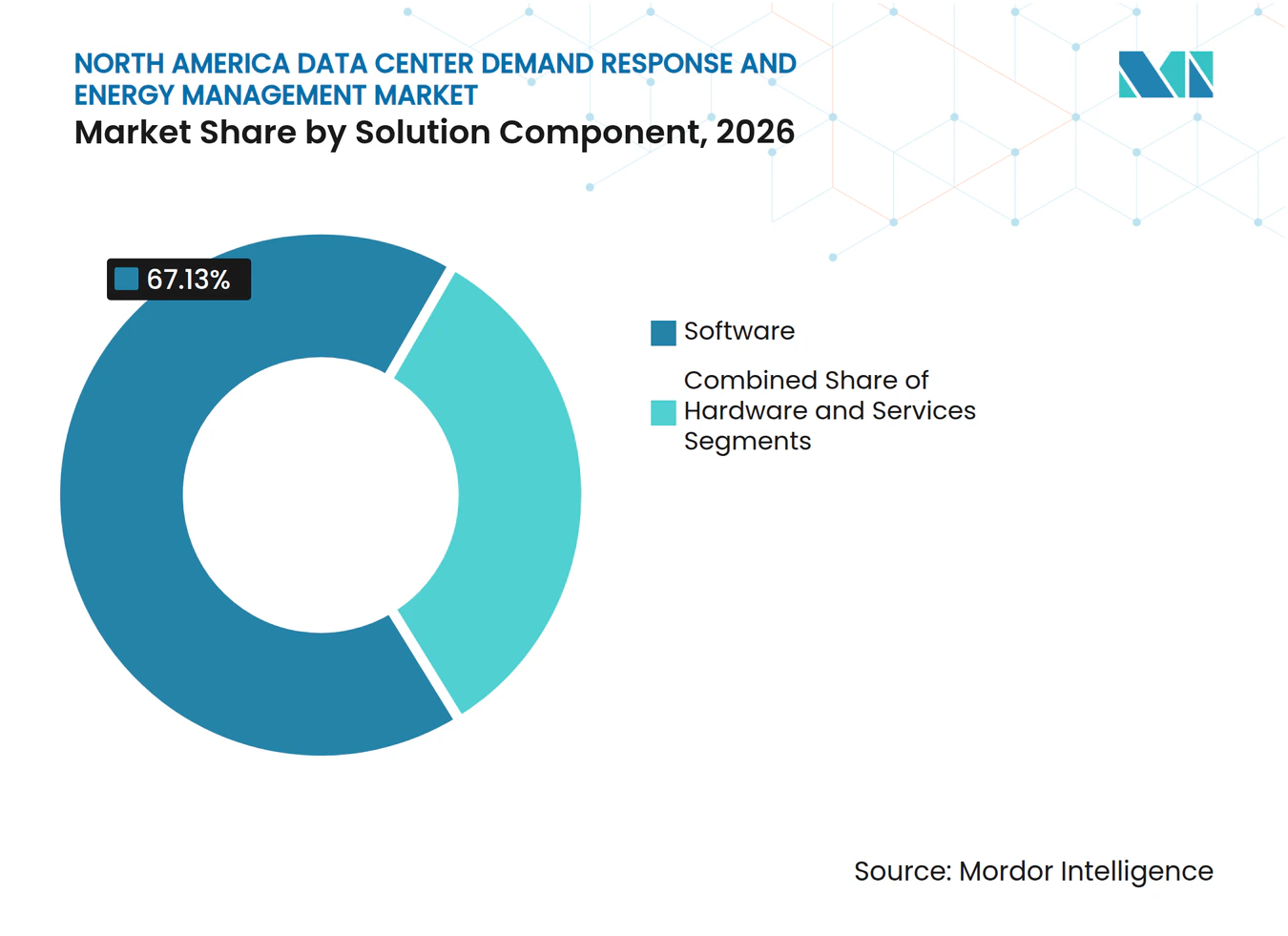
- By solution component, software held 67.13% of the North America data center demand response and energy management market share in 2026, while services are projected to expand at a 15.67% CAGR through 2032.
- By software solution type, energy management software held 58.42% of the North America data center demand response and energy management market in 2026, while energy forecasting and optimization software is projected to expand at a 15.33% CAGR through 2032.
- By demand response program type, incentive-based programs held 71.23% of the North America data center demand response and energy management market share in 2026, while no fastest-growing program type was provided.
- By automation level, manual and non-automated solutions held 70.12% of the North America data center demand response and energy management market share in 2026, while automated and advanced demand response solutions are projected to expand at a 16.98% CAGR through 2032.
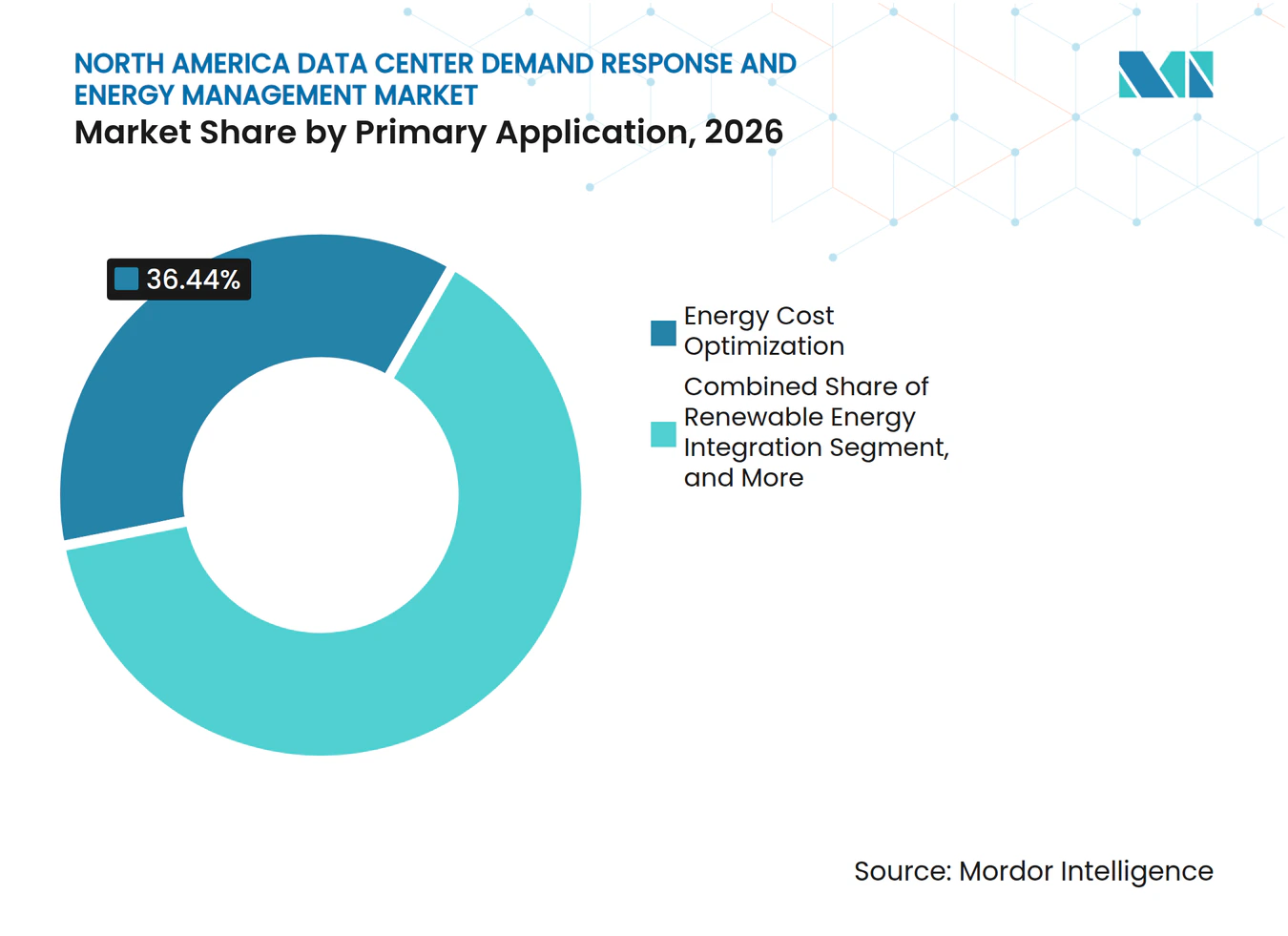
- By primary application, energy cost optimization held 36.44% of the North America data center demand response and energy management market share in 2026, while renewable energy integration is projected to expand at a 14.62% CAGR through 2032.
- By data center size, hyperscale facilities held 59.17% of the North America data center demand response and energy management market share in 2026 and are projected to expand at a 14.91% CAGR through 2032.
- By data center type, colocation operators held 63.47% of the North America data center demand response and energy management market share in 2026, while cloud service providers are projected to expand at a 15.92% CAGR through 2032.
- By geography, the United States accounted for 65.22% of North America data center demand response and energy management market share in 2026, while Mexico is projected to expand at a 16.34% CAGR through 2032.
Note: Market numbers in this report are based on Mordor Intelligence's proprietary estimation framework, which combines nine months of actuals with Q4 projections for base year 2026.
Market Trends and Insights
Drivers Impact Analysis of North America Data Center Demand Response and Energy Management Market*
| Driver | (~) % Impact on CAGR Forecast | Geographic Relevance | Impact Timeline |
|---|---|---|---|
| Escalating AI and High-Density Compute Load Growth | +4.2% | Global, with early intensity in U.S. data center clusters | Short term (≤ 2 years) |
| Rising Demand Charges and Coincident-Peak Exposure | +2.8% | North America, concentrated in PJM and ERCOT markets | Short term (≤ 2 years) |
| Grid Reliability and Flexible-Capacity Procurement | +2.1% | U.S., with regulatory spillover to Canada and Mexico | Medium term (2-4 years) |
| Expansion of Automated Demand Response and Distributed Energy Resource Platforms | +1.7% | Global, with early commercialization in U.S. wholesale markets | Medium term (2-4 years) |
| Grid-Responsive AI Workload Shifting | +1.3% | U.S. hyperscale clusters, with early activity in CAISO and PJM | Long term (≥ 4 years) |
| Interconnection Queue Delays Driving Behind-the-Meter Flexibility | +1.0% | U.S., with secondary relevance in Mexico | Medium term (2-4 years) |
| Source: Mordor Intelligence | |||
Escalating AI and High-Density Compute Load Growth
AI computing is changing the power profile of modern facilities and is strengthening the case for the North America data center demand response and energy management market. The International Energy Agency expects global data center electricity use to increase from 415 TWh in 2024 to 945 TWh by 2030, with the United States and China accounting for nearly 80% of the increase. AI-focused facilities use graphics-processing workloads that require materially more electricity than conventional computing, increasing cooling needs and peak-load exposure. This makes rack-level telemetry and power balancing more important when operators deploy high-density computing systems. Energy management tools can help facilities use available electrical headroom without exceeding operational power budgets or incurring avoidable demand charges. Research on collaborative cloud data center energy management also shows that optimized operating profiles can reduce energy costs when electricity prices change over time.
Rising Demand Charges and Coincident-Peak Exposure
Demand charges can account for a large share of a data center's electricity bill under many North American tariff structures, making peak control a practical priority. Higher AI utilization increases the possibility that facility demand will coincide with a system peak. This gives operators a stronger financial reason to manage flexible training workloads and participate in utility programs. Incentive-based programs pay operators when they reduce load during a grid event, while software can help identify loads that can be delayed without affecting customer commitments. Schneider Electric reported 17% year-over-year North American growth in its energy management business, while software represented 19% of group revenue in its reported period. The North America data center demand response and energy management market, therefore, has a direct link to how utilities set demand charges and peak-period tariffs.
Grid Reliability and Flexible-Capacity Procurement
Grid planners increasingly treat large data center loads as both a reliability challenge and a potential flexible resource. PJM expects 32 GW of peak-demand growth between 2025 and 2030, with data centers contributing nearly 30 GW of that increase. On June 18, 2026, FERC directed six regional transmission organizations and independent system operators to explain or revise their tariffs for large-load interconnection, co-location arrangements, behind-the-meter generation, and flexible-load transmission services. The action places flexible-load planning closer to the center of interconnection policy. NERC reported that summer peak demand across its assessment areas increased by more than 11 GW from summer 2025, while demand response resources helped offset internal demand. These conditions support the North America data center demand response and energy management market, as operators can use verified flexibility to inform capacity planning and connection requests.
Expansion of Automated Demand Response and Distributed Energy Resource Platforms
Automated demand response is becoming more practical as energy platforms link grid signals with facility controls and computing operations. CPower Energy, Bentaus, and Supermicro demonstrated an energy orchestration system in California that responded to a full dispatch cycle in less than 20 milliseconds while maintaining AI workloads. The demonstration reported electricity use as much as 75% lower during the response window. Academic research has also documented a 256-GPU field demonstration that sustained a 25% power reduction for 3 hours while retaining AI service-quality commitments. Voltus introduced its Bring Your Own Capacity offering in 2025 to help data center developers finance virtual power plant programs around prospective sites.[1] These developments make the North America data center demand response and energy management market more relevant to both power procurement and grid capacity planning.
Restraints Impact Analysis of North America Data Center Demand Response and Energy Management Market*
| Restraint | (~) % Impact on CAGR Forecast | Geographic Relevance | Impact Timeline |
|---|---|---|---|
| Mission-Critical Uptime and Service-Level Agreement Risk | -1.8% | Global, most acute in colocation and enterprise facilities | Short term (≤ 2 years) |
| Fragmented ISO and Utility Program Rules | -1.2% | North America, especially across PJM, CAISO, MISO, and ERCOT | Medium term (2-4 years) |
| Cybersecurity and Legacy-System Integration Complexity | -0.8% | U.S. and Canada, with a high effect on multi-tenant colocation operators | Medium term (2-4 years) |
| Limited Dispatchable Flexibility in Continuous High-Density Compute Loads | -0.6% | Global, concentrated in hyperscale AI inference facilities | Long term (≥ 4 years) |
| Source: Mordor Intelligence | |||
Mission-Critical Uptime and Service-Level Agreement Risk
Demand response participation is limited by service-level agreements that impose penalties when availability requirements are missed. Cloud and colocation operators must protect high-availability services, leaving only narrow windows for curtailment. Deferrable training workloads generally offer more flexibility than latency-sensitive inference traffic. As a result, only part of a facility load can be committed during a grid event. Large operators with several facilities and varied workload profiles can shift work across locations more easily than single-campus providers. The North America data center demand response and energy management market must therefore support contracts and control systems that recognize uptime obligations rather than assume that all load is dispatchable.
Fragmented ISO and Utility Program Rules
Program rules differ across PJM, CAISO, MISO, ERCOT, and provincial utilities, creating additional work for operators with sites in several power markets. Baseline methods, eligibility rules, performance penalties, and settlement practices can require separate enrollment and compliance processes. Reuters reported in 2026 that pressure on U.S. power grids was prompting data centers to pursue more flexible arrangements, while varied program structures were slowing the aggregation of demand-response capacity. FERC's large-load proceeding could reduce some of this friction, but tariff filings, review, and implementation take time. This creates an advantage for platforms that can manage market-specific requirements across a portfolio. It also slows adoption where operators lack internal regulatory and energy-market resources.
*Our forecasts treat driver/restraint impacts as directional, not additive. The impact forecasts reflect baseline growth, mix effects, and variable interactions.
North America Data Center Demand Response and Energy Management Market Segment Analysis
By Solution Component:
Software Supports Grid-Responsive OperationsSoftware held 67.13% of the North America data center demand response and energy management market share in 2026. Its role is to turn facility and equipment data into decisions on load commitments, energy costs, and program participation. Energy management platforms, demand response management systems, and forecasting tools help operators use infrastructure that is already installed. They also help convert monitoring data into auditable records for utilities and grid operators. Hardware remains necessary for sensing, controls, and switching during a response event. Open protocols such as OpenADR 2.0 can reduce dependence on a single hardware supplier and facilitate software integration. The North America data center demand response and energy management industry is, therefore, placing more value on intelligence and integration than on stand-alone monitoring devices.
Services are projected to expand at a 15.67% CAGR through 2032, supported by program enrollment, performance monitoring, and compliance needs. Managed providers can help operators without internal teams for utility coordination and market settlement. This is particularly relevant for smaller sites that cannot justify a dedicated energy-market function. Hardware suppliers are also adding software and service capabilities to retain relevance as control architectures become more digital. Schneider Electric reported that its software business accounted for 19% of group revenue in its reported period.[2] The transition does not remove the need for physical power infrastructure. Instead, it gives operators a way to improve the economic return from that infrastructure.



By Software Solution Type:
Forecasting Adds Predictive CapabilityEnergy management software held 58.42% of the software segment in 2026. It provides the operational base for consumption monitoring, power usage effectiveness work, demand-charge management, and energy reporting. Operators use this layer to understand how electrical demand moves across equipment and time periods. The data can also support decisions about when to shift or curtail a workload. Modern platforms need to connect facility systems with utility tariffs and grid program signals. ISO 50001 provides a recognized framework for organized energy management and increases the importance of traceable energy data. This part of the North America data center demand response and energy management market is fundamental because later automation depends on accurate, timely information.
Energy forecasting and optimization software is projected to expand at a 15.33% CAGR through 2032. The category helps operators move from reacting to past consumption toward planning against expected electricity demand and price signals. Forecasting quality matters when a site makes a day-ahead flexibility commitment. Research on market-driven cloud data center energy management found that collaborative optimization can reduce total energy costs under dynamic locational prices. Monitoring and analytics platforms provide the telemetry that forecasting systems require. Demand response management platforms then organize enrollment, dispatch, performance tracking, and settlement. A connected software stack can therefore link the physical data center to grid and utility processes without treating these functions as separate activities.
By Demand Response Program Type:
Incentives Retain the Larger RoleIncentive-based programs held 71.23% share in 2026. Their appeal comes from capacity payments and direct curtailment incentives that can create a clear financial return for a verified response commitment. Voluntary participation can be easier to plan around than a tariff that exposes all demand to real-time price changes. FERC Commissioner Rosner's concurrence on a PJM filing in October 2026 supported voluntary demand response as a mechanism for managing grid emergencies before mandatory curtailment. This regulatory direction reinforces the value of programs that reward prepared operators. Incentive structures are especially useful where sites need predictable revenue to justify investment in controls and processes.
Price-based programs give operators a different signal by exposing them to time-of-use or real-time electricity prices. Their use can increase as facility controls and workload orchestration become more automated. Research on grid-interactive data centers has demonstrated a sustained reduction in computing power during utility peak events while maintaining service-quality commitments. This technical capability can support price-responsive operations, but it does not remove the need for reliable baselines and risk controls. Operators must still protect against bill volatility and service disruption. Vendors increasingly package those planning and compliance tasks as managed services. Both program types depend on rules that recognize large flexible loads as eligible grid resources.
By Automation Level:
A Manual Installed Base Creates Replacement DemandManual and non-automated solutions held 70.12% share in 2026. This reflects established operating practices that rely on human review, planned load shedding, and operator-led switching. The installed base shows that many facilities have not yet connected grid signals directly to power and workload controls. Manual processes can be adequate for infrequent, prearranged events. They are less suited to short response windows or changing market prices. This leaves a large installed base that can be upgraded as program requirements become more demanding. The North America data center demand response and energy management industry can address this need through phased automation rather than a full replacement of power systems.
Automated and advanced demand response solutions are projected to expand at a 16.98% CAGR through 2032. FERC's action on flexible large loads has increased attention on interconnection arrangements that can demonstrate verifiable flexibility. Platforms such as Emerald AI Conductor are designed to translate grid signals into changes in computing workload schedules. Silicon Valley Power and Emerald AI launched a Santa Clara pilot in 2026 to test flexible data center operations without disrupting AI workload performance. Automation can help operators respond consistently and document performance. It can also reduce dependence on manual intervention during time-sensitive events. Adoption will still depend on cybersecurity, workload governance, and confidence that customer commitments are protected.
By Primary Application:
Cost Management Leads Current DemandEnergy cost optimization held 36.44% share in 2026. It provides a direct case for using demand response through avoided peak charges, lower costs during expensive intervals, and program revenue. Operators can evaluate these benefits with familiar electricity procurement metrics. Peak-load management, emergency reduction, capacity participation, and ancillary services address other grid needs. Large sites may participate in more than 1 of these activities via an aggregation platform. The North America data center demand response and energy management market size, linked to cost optimization, reflects the practical need to control a major operating expense. It also creates a starting point for facilities that later want to provide more advanced grid services.
Renewable energy integration is projected to expand at a 14.62% CAGR through 2032. Corporate clean-energy commitments make it more valuable to align computing activity with periods of stronger renewable output. This approach treats flexibility as part of power procurement rather than a separate emergency resource. Academic research on grid-interactive AI data centers has shown that controlled reductions can retain service quality during a power-system event. Fast response from computing loads could also become relevant to ancillary-service programs. Program eligibility, measurement rules, and grid operator acceptance will determine how widely that opportunity develops.

By Data Center Size:
Hyperscale Facilities Combine Scale and FlexibilityHyperscale data centers held 59.17% share in 2026. Their electrical demand can reach hundreds of megawatts at a campus, making avoided peak demand and capacity payments material to site economics. Program enrollment and compliance work also becomes more efficient when spread across a larger committed load. These characteristics make large operators early participants in demand response. They also have more diverse workloads than smaller facilities. This diversity can provide a larger pool of work that is suitable for rescheduling. The result is a strong connection between compute scale and grid-interactive energy management.
Hyperscale facilities are projected to expand at a 14.91% CAGR through 2032. Large utility arrangements indicate how a hyperscale operator can use flexible load in broader energy contracting. Small and medium facilities face a different position because their loads may not meet the minimum size for some capacity products. Aggregators can combine those sites into a portfolio that is large enough to participate. Large data centers in the middle of the size range are also investing in automated controls for utility-specific programs. The economics, therefore, differ by facility scale, but all categories can benefit from simpler enrollment and more accessible software. The North America data center demand response and energy management market has room for both direct participation by hyperscalers and aggregated participation by smaller sites.
By Data Center Type:
Colocation and Cloud Providers Follow Different PathsColocation operators held 63.47% share in 2026. Their broad tenant base and mixed infrastructure create a need for detailed visibility into circuit-level power use. Energy management platforms can reduce operating costs while improving the information that colocation providers offer tenants. These tools can also support energy and emissions reporting requested by enterprise customers. Multi-tenant environments require clear rules on which loads may be included in a response commitment. That makes consent, metering, and contractual allocation important. Colocation providers may therefore adopt demand response through a controlled, tenant-aware operating model.
Cloud service providers are projected to expand at a 15.92% CAGR through 2032. These operators manage large computing fleets and can use workload placement across facilities as part of their energy response strategy. IEEE research indicates that cloud data centers can reduce energy costs by combining workload flexibility with localized energy resources and price-aware optimization. Enterprise and edge facilities are more likely to participate through utility-managed programs than through direct wholesale market products. Automated platforms can reduce the administrative burden for these smaller and more distributed sites. The North America data center demand response and energy management industry, therefore, serves distinct operating models rather than a single class of data center buyer. The pace of adoption will depend on each operator's workload control, contract structure, and access to program support.
Geography Analysis
United States
The United States held 65.22% of regional revenue in 2026. Its position reflects dense data center activity in Northern Virginia, Ohio, Georgia, and Texas, as well as wholesale electricity markets that enable operators to monetize load flexibility. PJM expects nearly 30 GW of its projected 32 GW increase in peak demand between 2025 and 2030 to come from data centers.[3] FERC's 2026 action on large-load tariffs makes flexible operations more relevant to interconnection discussions across the regional markets it oversees. Large utility arrangements indicate that data centers are using demand flexibility in power-connection planning.
Mexico
Mexico is projected to expand at a 16.34% CAGR through 2032. Grid constraints and delays in adding new electrical capacity are encouraging operators to consider behind-the-meter generation, storage, and energy management controls. These measures can help a site manage local power availability and operating costs while grid connections are developed. Coordinated planning between the electricity sector and data center operators will be important as large facilities seek additional capacity. The North America data center demand response and energy management market can benefit from software that helps combine grid supply with on-site resources. Regulatory coordination and reliable power-system planning remain necessary for these measures to scale.
Canada
Canada has an advantage from its low-carbon electricity base in several provinces, but large new computing loads can still create localized capacity constraints. Provincial utilities have a central role because utility-administered programs are likely to provide the initial route for data center flexibility in many areas. The G7 Energy and AI Work Plan identifies demand response and demand-side management as tools for meeting AI-related electricity needs. This policy direction supports a gradual development of large-load flexibility programs as provincial market rules evolve.
Competitive Landscape
Market Concentration
The North America data center demand response and energy management market includes integrated infrastructure suppliers, demand response aggregators, virtual power plant operators, and software-focused energy platforms. Schneider Electric, Eaton, Vertiv, Siemens, ABB, and Honeywell compete by combining electrical and cooling equipment with monitoring and control software. Schneider Electric connects its EcoStruxure portfolio with Motivair liquid-cooling products for high-density environments. Eaton introduced an 800 VDC reference architecture for AI factories in 2025, developed in support of NVIDIA's 800 VDC initiative.[4] Vertiv introduced the Unify infrastructure management platform in 2025 to provide real-time visibility and control across power and thermal systems.
Aggregators such as CPower, Voltus, and Enel X North America compete on access to utility programs, enrollment support, dispatch capabilities, and portfolio management. Voltus launched its Bring Your Own Capacity product in 2025 to help developers finance virtual power plants near data centers. Voltus and Octopus Energy US also announced a 2026 partnership to combine distributed energy resources to offer flexibility across several U.S. power markets. These offers link data center expansion plans to existing flexible resources rather than relying solely on new power generation. Competition is stronger in software and services because product differentiation depends on forecasting accuracy, workload control, and the speed of utility integration.
Software-focused platforms are seeking an opening between traditional building controls and the computing layer. Emerald AI's Conductor platform is designed to use grid signals in workload scheduling, while the Silicon Valley Power pilot tested this approach in a utility setting. Building management suppliers retain a role where facilities depend on established BACnet and OpenADR control environments. UL, IEC, and OpenADR compliance can create entry requirements for equipment that connects to grid-response systems.
North America Data Center Demand Response and Energy Management Industry Leaders
-
Schneider Electric SE
-
Siemens AG
-
Eaton Corporation plc
-
ABB Ltd.
-
Honeywell International Inc.
- *Disclaimer: Major Players sorted in no particular order
North America Data Center Demand Response and Energy Management Market Companies Covered in this Report
- Schneider Electric SE
- Siemens AG
- Eaton Corporation plc
- Vertiv Holdings Co.
- ABB Ltd.
- Honeywell International Inc.
- Johnson Controls International plc
- Enel X North America, Inc.
- CPower Energy Management, LLC
- Voltus, Inc.
- AutoGrid Systems, Inc.
- EnergyHub, Inc.
- Google LLC
- Microsoft Corporation
- Amazon Web Services, Inc.
- Oracle Corporation
- IBM Corporation
- Cisco Systems, Inc.
- Equinix, Inc.
- Digital Realty Trust, Inc.
Recent Industry Developments in North America Data Center Demand Response and Energy Management Market
- October 2026: Schneider Electric's new Motivair Water-Cooled Distribution Unit, capable of achieving up to 3.5 MW of cooling capacity per unit and designed for 30-40 MW data halls, began shipping in select regions. Up to 20 units can operate together in group mode, enabling scalable liquid cooling infrastructure for high-density AI environments. Pre-orders open in the United States in early 2027.
- June 2026: Google and Voltus signed the first large-scale Bring Your Own Capacity agreement, under which Voltus will assemble up to 100 MW of distributed energy resource capacity from batteries, smart thermostats, and other DERs across the PJM Interconnection region over a 3-year term. The agreement is structured to unlock capacity for Google's data center expansion by leveraging existing grid flexibility rather than waiting for new generation projects.
- June 2026: FERC issued tailored show-cause orders under Section 206 of the Federal Power Act to all 6 RTOs and ISOs under its jurisdiction, requiring each to file tariff revisions within 60 days to develop large-load-specific transmission services, accommodate co-location agreements and behind-the-meter generation, and establish new transmission services for flexible large loads. The action establishes demand response participation as a formal component of large-load interconnection policy across North American wholesale electricity markets.
- April 2026: Silicon Valley Power and Emerald AI launched a pilot program in Santa Clara, California, to demonstrate data center flexibility as a grid resource. The pilot, co-developed with NVIDIA, uses the Emerald AI Conductor platform to dispatch flexible AI compute workloads in response to SVP grid signals without disrupting AI workload performance, targeting capacity acceleration across SVP's constrained transmission network.
North America Data Center Demand Response and Energy Management Market Report Scope
The North America Data Center Demand Response and Energy Management Market comprises technologies and services deployed across data centers in the United States, Canada, and Mexico to optimize energy consumption, participate in utility demand response programs, support grid reliability, and manage rising power requirements from AI, cloud, and hyperscale workloads. The market includes demand response management platforms, energy optimization software, monitoring solutions, automation technologies, and associated services designed to improve operational efficiency, reduce electricity costs, facilitate the integration of renewable energy, and enable participation in capacity and ancillary service markets.
The North America Data Center Demand Response and Energy Management Market Report is Segmented by Solution Component (Hardware, Software, and Services), Software Solution Type (Demand Response Management Platforms, Energy Management Software, Energy Monitoring and Analytics Software, and Energy Forecasting and Optimization Software), Demand Response Program Type (Price-Based Programs, and Incentive-Based Programs), Automation Level (Manual and Non-Automated Solutions, and Automated and Advanced Demand Response Solutions), Primary Application (Peak Load Management, Emergency Load Reduction, Capacity Market Participation, Ancillary Services, Energy Cost Optimization, and Renewable Energy Integration), Data Center Size (Small, Medium, Large, and Hyperscale), Data Center Type (Colocation, Cloud Service Providers [CSPs], and Enterprise and Edge), and Geography (United States, Canada, and Mexico). The Market Forecasts are Provided in Terms of Value (USD).
Segmentation Overview
| Hardware |
| Software |
| Services |
| Demand Response Management Platforms |
| Energy Management Software |
| Energy Monitoring and Analytics Software |
| Energy Forecasting and Optimization Software |
| Price-Based Programs |
| Incentive-Based Programs |
| Manual and Non-Automated Solutions |
| Automated and Advanced Demand Response Solutions |
| Peak Load Management |
| Emergency Load Reduction |
| Capacity Market Participation |
| Ancillary Services |
| Energy Cost Optimization |
| Renewable Energy Integration |
| Small |
| Medium |
| Large |
| Hyperscale |
| Colocation |
| Cloud Service Providers (CSPs) |
| Enterprise and Edge |
| United States |
| Canada |
| Mexico |
| By Solution Component | Hardware |
| Software | |
| Services | |
| By Software Solution Type | Demand Response Management Platforms |
| Energy Management Software | |
| Energy Monitoring and Analytics Software | |
| Energy Forecasting and Optimization Software | |
| By Demand Response Program Type | Price-Based Programs |
| Incentive-Based Programs | |
| By Automation Level | Manual and Non-Automated Solutions |
| Automated and Advanced Demand Response Solutions | |
| By Primary Application | Peak Load Management |
| Emergency Load Reduction | |
| Capacity Market Participation | |
| Ancillary Services | |
| Energy Cost Optimization | |
| Renewable Energy Integration | |
| By Data Center Size | Small |
| Medium | |
| Large | |
| Hyperscale | |
| By Data Center Type | Colocation |
| Cloud Service Providers (CSPs) | |
| Enterprise and Edge | |
| By Geography | United States |
| Canada | |
| Mexico |
Key Questions Answered in the Report
What is the North America data center demand response and energy management market size?
The market is valued at USD 3.23 billion in 2026 and is projected to reach USD 6.87 billion by 2032 at a 13.50% CAGR.
Which solution component has the largest share?
Software holds 67.13% share in 2026 because it supports monitoring, forecasting, load control, and utility-program participation.
Which automation category is expanding fastest?
Automated and advanced demand response solutions are projected to expand at a 16.98% CAGR through 2032.
Why are hyperscale data centers important for grid flexibility?
Hyperscale facilities held 59.17% share in 2026 and can commit larger loads while spreading program and compliance costs across a broader portfolio.
Which country is projected to expand fastest?
Mexico is projected to expand at a 16.34% CAGR through 2032 as grid constraints encourage investment in energy management and behind-the-meter flexibility.