
North America Data Center Cyber-Physical Security Market Size and Share
Market Overview
| Study Period | 2021 - 2032 |
|---|---|
| Forecast Data Period | 2027 - 2032 |
| Base Year Market Size (2026) | USD 1.02 Billion |
| Market Size (2027) | USD 1.17 Billion |
| Market Size (2032) | USD 2.28 Billion |
| Growth Rate (2027 - 2032) | 14.27 % |
| Market Concentration | Medium |
Major Players *Disclaimer: Major Players sorted in no particular order Image © Mordor Intelligence. Reuse requires attribution under CC BY 4.0. | |
North America Data Center Cyber-Physical Security Market Analysis by Mordor Intelligence
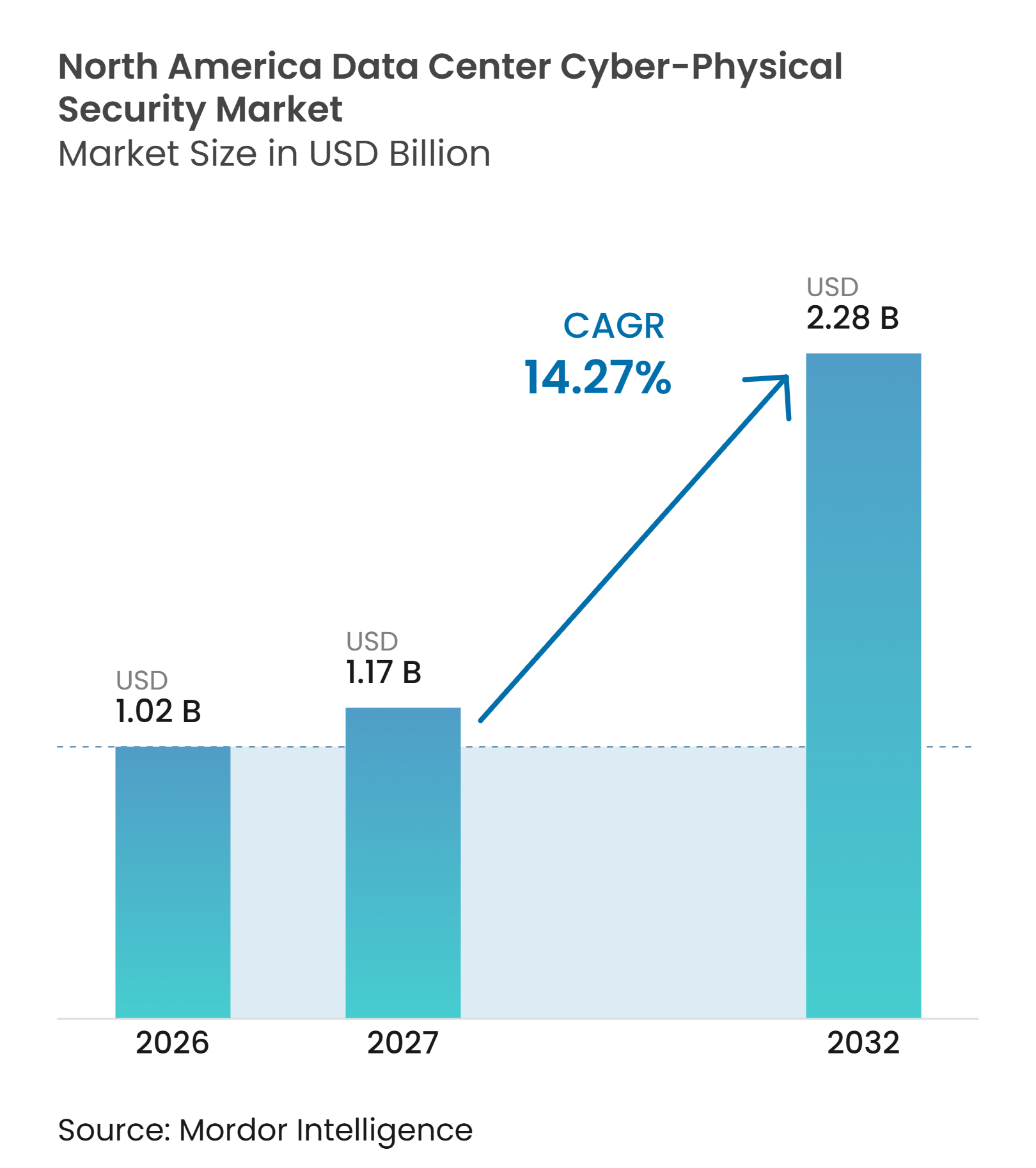
The North America data center cyber-physical security market size is expected to increase from USD 1.02 billion in 2026 to USD 1.17 billion in 2027 and reach USD 2.28 billion by 2032, growing at a CAGR of 14.27% over 2027-2032. AI-focused campus construction is increasing the need for coordinated perimeter, facility, and network safeguards as operators build larger and more complex sites. Ransomware attacks and weaknesses across connected building systems are increasing the value of security platforms that combine physical and digital event data. Cloud delivery is supporting centrally managed security operations across distributed facilities, while compliance requirements are making security spending less discretionary for critical infrastructure operators. Suppliers are responding by combining access control, video management, environmental monitoring, and network protection in fewer operational interfaces.
Key Report Takeaways
- By solution type, Network and Operational Technology Security Solutions accounted for 29.72% of the North America data center cyber-physical security market revenue in 2026, while Unified Cyber-Physical Security Platforms are projected to expand at a 16.26% CAGR through 2032.
- By security layer, Integrated Security Operations Platforms accounted for 32.38% revenue share in 2026 and are projected to expand at a 17.92% CAGR through 2032.
- By deployment model, cloud-based solutions held 64.78% of the North America data center cyber-physical security market in 2026 and are projected to expand at a 15.39% CAGR through 2032.
- By service type, System Integration and Implementation Services held 26.54% revenue share in 2026, while Security Auditing and Compliance Services are projected to expand at a 16.59% CAGR through 2032.
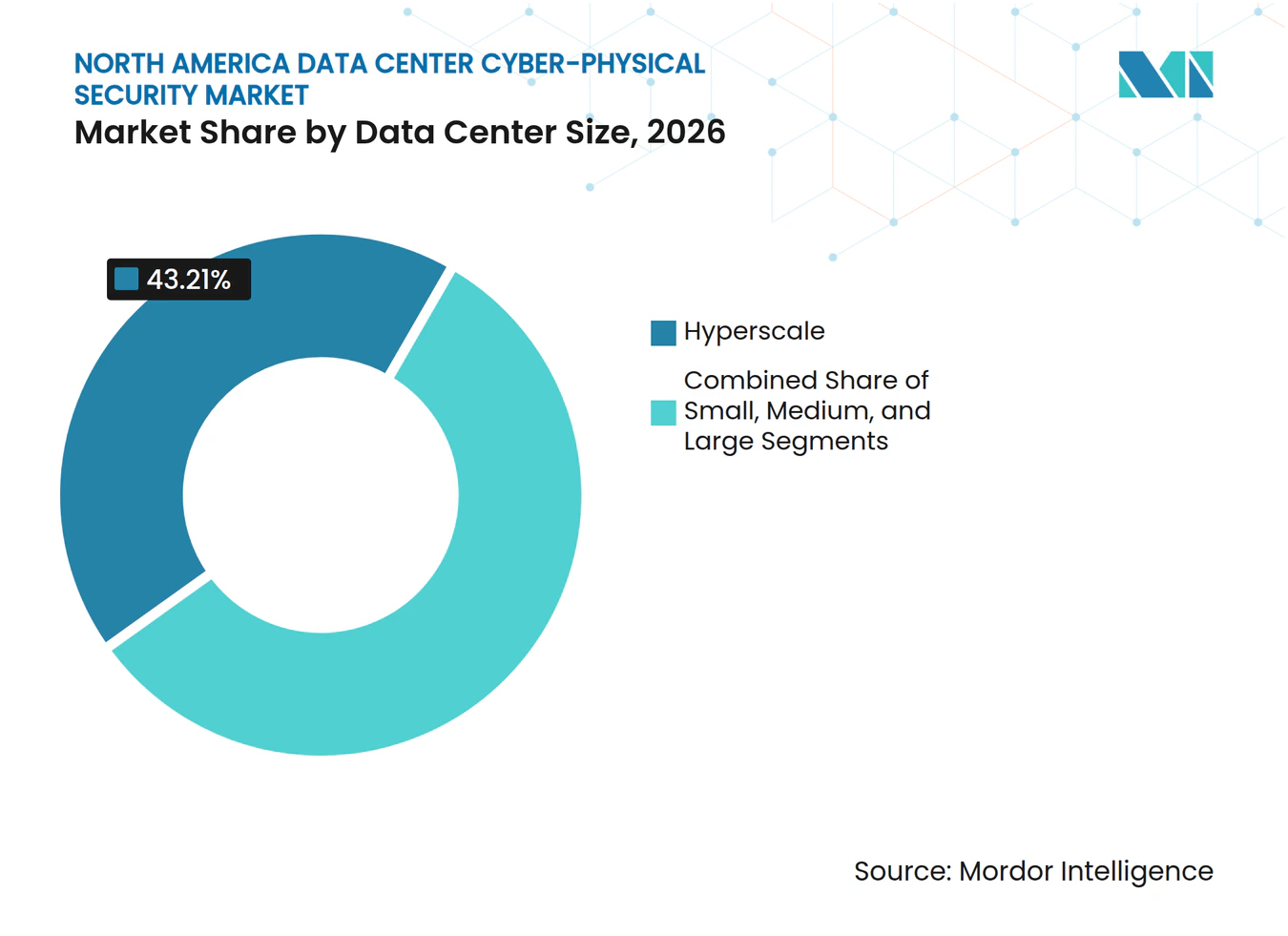
- By data center size, hyperscale facilities accounted for 43.21% revenue share in 2026 and are projected to expand at an 18.27% CAGR through 2032.
- By data center type, Cloud Service Providers held 41.64% revenue share in 2026, while Enterprise and Edge facilities are projected to expand at a 17.38% CAGR through 2032.
- By geography, the United States held 78.53% of the data center cyber-physical security market revenue share in 2026, while Mexico is projected to expand at a 16.93% CAGR through 2032.
Note: Market numbers in this report are based on Mordor Intelligence's proprietary estimation framework, which combines nine months of actuals with Q4 projections for base year 2026.
Market Trends and Insights
Drivers Impact Analysis of North America Data Center Cyber-Physical Security Market*
| Driver | (~) % Impact on CAGR Forecast | Geographic Relevance | Impact Timeline |
|---|---|---|---|
| Hyperscale and AI Data Center Expansion | +3.2% | United States, Mexico, Canada | Long term (≥ 4 years) |
| Escalating Ransomware and Multi-Vector Attacks | +2.8% | Global, concentrated in United States and Canada | Short term (≤ 2 years) |
| Adoption of Zero-Trust and Identity-Centric Security Architectures | +2.3% | United States, Canada | Medium term (2-4 years) |
| Increasing Compliance Requirements for Critical Digital Infrastructure | +1.9% | United States, Canada, with growing influence in Mexico | Medium term (2-4 years) |
| Security Convergence Across Distributed and Edge Data Center Footprints | +1.4% | United States, Mexico, including Monterrey and Querétaro | Long term (≥ 4 years) |
| AI-Enabled Sensor Fusion for Faster Physical Threat Response | +1.1% | United States, Canada | Medium term (2-4 years) |
| Source: Mordor Intelligence | |||
Hyperscale and AI Data Center Expansion
The North America data center cyber-physical security market is supported by the construction of hyperscale campuses built for AI workloads. The Stargate Project announced USD 500 billion in AI infrastructure investment in January 2025, including an initial USD 100 billion commitment and sites in Texas, New Mexico, and the Midwest. These campuses require stronger perimeter controls, biometric access, environmental monitoring, and security operations capabilities that match their physical complexity. CBRE reported a 1.6% vacancy rate in primary U.S. data center markets during 2025, despite a 43% increase in supply, which points to sustained demand for capacity. Compressed commissioning schedules can leave security configurations incomplete at site opening, which extends demand for auditing and compliance services after installation. Macquarie Asset Management closed a partnership of up to USD 5 billion with Applied Digital in October 2025 to support high-performance computing development.
Escalating Ransomware and Multi-Vector Attacks
Ransomware groups are adapting their methods for environments where operational technology and enterprise IT are connected. Dragos recorded 355 industrial ransomware incidents in North America during the second quarter of 2025, representing 54% of the global total. Attackers have used VMware ESXi-focused lockers that encrypt virtual machine files and interrupt running workloads, creating direct continuity risks for data centers. ZeroFox documented at least 1,309 ransomware and digital extortion incidents affecting North America-based organizations during the first quarter of 2025. Palo Alto Networks reported that the interval from compromise to data exfiltration fell from 9 days to 1 day among sophisticated threat actors. These conditions increase the value of platforms that can link network alerts with physical access and facility events before an intrusion disrupts operations.
Adoption of Zero-Trust and Identity-Centric Security Architectures
Zero trust adoption is moving beyond network boundaries into facility access, operational technology authentication, and workload communications. NIST published Special Publication 1800-35 in June 2025, describing 19 implementation examples for zero trust architectures.[1] The publication gives operators structured approaches for identity governance, microsegmentation, and software-defined perimeters. A 2025 academic study reported lower security incident levels among enterprises that used comprehensive zero-trust controls in data center environments. Facilities that support federal workloads also face FedRAMP and Department of Defense requirements, which place greater attention on identity controls. This creates demand for access management suppliers and integrated operations platforms that can apply the same policy principles across physical and digital environments.
Increasing Compliance Requirements for Critical Digital Infrastructure
Compliance requirements are increasing the baseline security obligations of data center operators. CISA, the FBI, the EPA, and the DOE issued guidance in May 2025 that called on critical infrastructure operators to segment IT and operational technology networks and use multi-factor authentication for remote access.[2] CISA and the UK National Cyber Security Center issued related operational technology guidance in September 2025 that referenced IEC 62443 and ISO/IEC 27001. Large AI campuses may face further requirements when they are treated as participants in critical power systems. The NERC CIP framework requires defined electronic security perimeters, physical controls, and incident reporting for covered assets. These requirements bring compliance and security capital spending closer together, making deferral more difficult as cost pressures rise.
Restraints Impact Analysis of North America Data Center Cyber-Physical Security Market*
| Restraint | (~) % Impact on CAGR Forecast | Geographic Relevance | Impact Timeline |
|---|---|---|---|
| High Integration and Lifecycle Costs | -1.8% | North America, strongest in mid-market colocation and enterprise | Medium term (2-4 years) |
| Shortage of Specialized Security and OT Cybersecurity Skills | -1.3% | United States, Canada, most acute in Mexico | Long term (≥ 4 years) |
| Interoperability Gaps Across Legacy Building and Security Systems | -0.9% | North America, strongest in enterprise and edge deployments | Medium term (2-4 years) |
| Privacy and Governance Risks from Continuous Biometric and Video Monitoring | -0.6% | National, particularly in states with biometric privacy statutes | Short term (≤ 2 years) |
| Source: Mordor Intelligence | |||
High Integration and Lifecycle Costs
Modern facilities must connect access control, video management, building automation, environmental sensors, and cyber protection tools that often use incompatible protocols. A 2025 zero trust study found that enterprise integration projects averaged 14 months and experienced 5.3-month overruns because of legacy integration and application dependency mapping. The total lifecycle cost of a converged security environment can compete with other major infrastructure investments for smaller operators. This can cause operators to choose point products, even though those products can add operational complexity over time. Managed security subscriptions can shift some costs into operating budgets, but use remains limited outside large colocation providers. The North America data center cyber-physical security market, therefore, depends on suppliers making integrated designs easier to deploy and maintain.
Shortage of Specialized Security and OT Cybersecurity Skills
Cyber-physical protection requires skills that traditional IT security teams and physical security integrators do not always possess together. CISA guidance emphasizes continuous vulnerability assessment, segmentation, and real-time monitoring for operational technology systems. These capabilities require familiarity with facility engineering, IT architecture, and threat intelligence. MEXDC expects more than 1,500 MW of new Mexican data center capacity by 2030, which raises demand for qualified security operations staff as new sites are commissioned. The United States and Canada also compete for professionals in defense, energy, and financial services. Staffing shortages can lead to permissive configurations and higher insurance costs, which can slow investment decisions.
*Our forecasts treat driver/restraint impacts as directional, not additive. The impact forecasts reflect baseline growth, mix effects, and variable interactions.
North America Data Center Cyber-Physical Security Market Segment Analysis
By Solution Type:
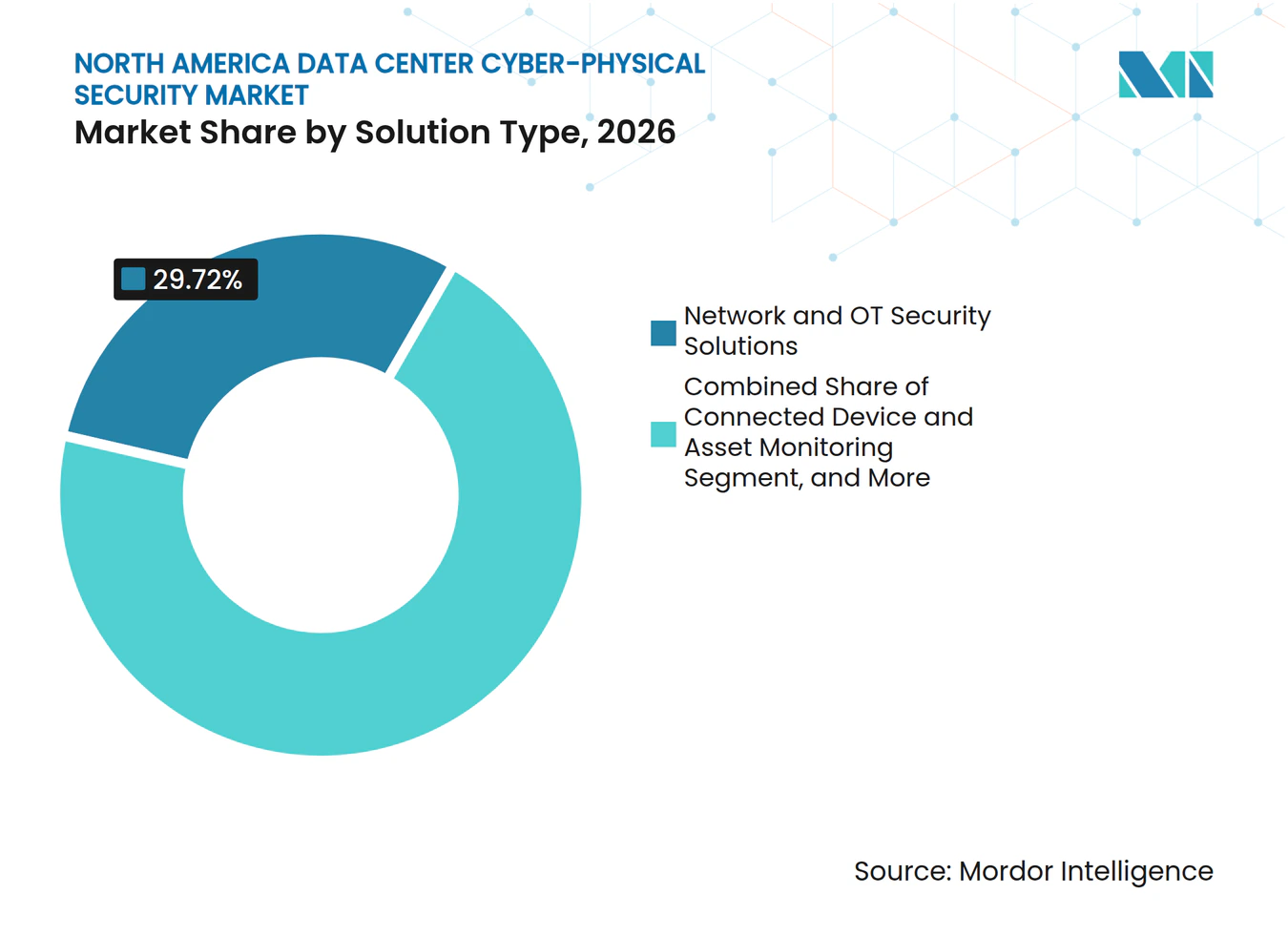
Network and Operational Technology Security Holds the Largest ShareNetwork and Operational Technology Security Solutions held 29.72% of the North America data center cyber-physical security market share in 2026. The segment benefits from connecting power, cooling, access, fire suppression, and building management systems to enterprise networks. These systems can create entry points for attackers when they are not adequately segmented or monitored. Operators are therefore extending protection beyond traditional server and network assets. The segment also reflects the need to protect facility processes whose disruption can affect uptime.
Unified Cyber-Physical Security Platforms are projected to expand at a 16.26% CAGR through 2032. Across the North America data center cyber-physical security market, these platforms address vendor sprawl by connecting physical and cyber alerts within a common workflow. NIST guidance on identity governance and microsegmentation supports this direction by giving operators tested zero-trust implementation patterns. Connected Device and Asset Monitoring Solutions are gaining use as campuses track power, temperature, humidity, and access events across denser sensor networks. Identity and Access Management Solutions, event correlation tools, and incident response services remain important because incident playbooks designed for cyber-only environments can fail at the intersection of physical and digital controls.



By Security Layer:
Integrated Security Operations Platforms Lead Share and GrowthIntegrated Security Operations Platforms held 32.38% revenue share in 2026 and are projected to expand at a 17.92% CAGR through 2032. This dual position shows a shift from independent point products toward unified operations management in the North America data center cyber-physical security industry. Facility security teams are replacing separate screens for access control, video, and environmental alerts with shared systems that can prioritize events. Physical Access Control Systems and Video Surveillance Systems continue to receive investment as hyperscale campuses add perimeter zones and server halls. Biometric verification is also replacing card-and-PIN processes at many high-availability facilities.
Johnson Controls released C-CURE IQ 3.20 and exacqVision 26.2 at GSX 2026, with access, video, incident management, and analytics functions delivered in browser-based workflows.[3] Building Management and Facility Control Systems remain essential because they manage cooling, power distribution, and HVAC systems. Environmental and Infrastructure Monitoring Systems are becoming increasingly important as high-density AI workloads heighten the need for thermal anomaly detection. Procurement also reflects physical security requirements under ISO/IEC 27001 and availability expectations associated with Uptime Institute tiers. These requirements help sustain the North America data center cyber-physical security market across several security layers even when operators face broader cost constraints.
By Deployment Model:
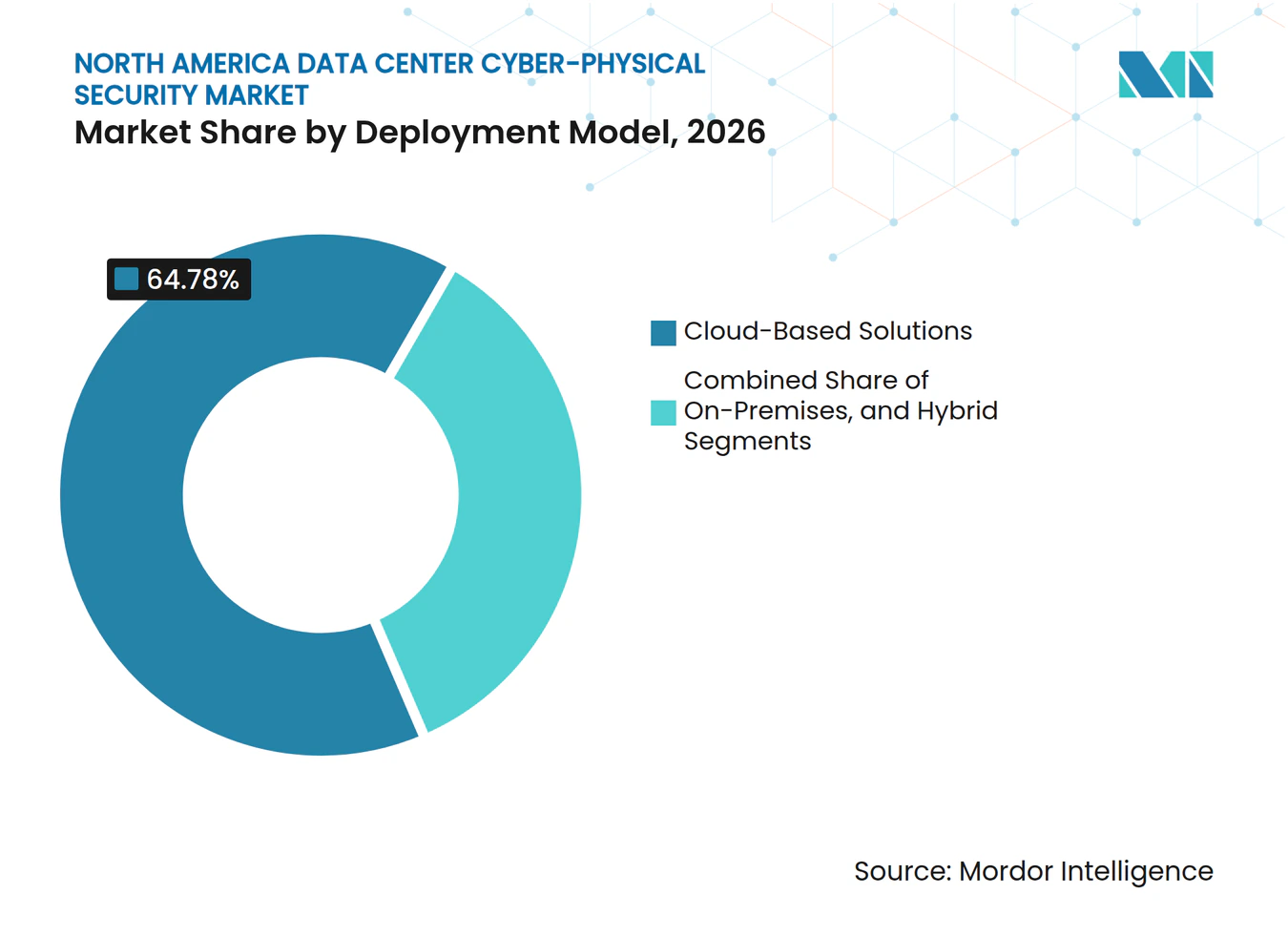
Cloud-Based Solutions Hold the Largest ShareCloud-based solutions held 64.78% of revenue in 2026 and are projected to expand at a 15.39% CAGR through 2032. Their large share reflects the preference of hyperscale and colocation operators for centrally managed, software-defined security tools. Cloud platforms can distribute policy changes, threat intelligence, and firmware updates across sites without requiring staff to travel to every location. This is especially useful as data center footprints extend into edge locations. The North America data center cyber-physical security market size for cloud-based solutions benefits from this ability to manage dispersed operations consistently.
Palo Alto Networks and Arista Networks expanded their zero-trust partnership in November 2025 to combine policy management with hardware-speed inspection in data center fabrics. On-premise systems remain relevant for government-linked and regulated operators that require local control or air-gapped management. Hybrid designs are emerging where operators retain sensitive logs locally while using cloud-delivered analytics and intelligence. In the North America data center cyber-physical security market, maintaining consistent policies across cloud and local systems can increase integration costs. Hybrid misconfigurations can also create security gaps that are difficult to identify and correct.

By Service Type:
System Integration Leads While Compliance Services AccelerateSystem Integration and Implementation Services held 26.54% of service revenue in 2026. New hyperscale and colocation construction requires providers to connect hardware, cybersecurity tools, and building management systems from the outset. Integrators that can join access panels, cameras, sensors, and cyber platforms can command premium project fees. The shortage of specialists with both facility and cyber expertise reinforces demand for these services. This work is particularly important where operators are replacing a mix of legacy systems.
Security Auditing and Compliance Services are projected to expand at a 16.59% CAGR through 2032. Increased attention to operational technology documentation, vulnerability assessment, and incident reporting supports this service category. Managed Monitoring and Detection Services are also gaining importance among operators that cannot staff a 24/7 operations center. Cyber-Physical Risk Assessment services are used when insurers and institutional investors request documented risk information before underwriting or financing facilities. This service mix allows the North America data center cyber-physical security market to address both routine oversight and complex recovery needs after an intrusion.
By Data Center Size:
Hyperscale Facilities Lead in Share and GrowthHyperscale data centers accounted for 43.21% of revenue in 2026 and are projected to grow at an 18.27% CAGR through 2032. Their scale creates security needs that rise faster than their physical footprint because each campus has multiple zones, access tiers, and operational systems. A single campus can cover hundreds of acres and contain infrastructure worth tens of billions of dollars. This makes access governance, environmental monitoring, and network segmentation central to facility operations. Hyperscale projects, therefore, form the strongest source of new demand for integrated security design.
Macquarie Asset Management's October 2025 partnership with Applied Digital included up to USD 5 billion for high-performance computing development, including the planned 400 MW Polaris Forge 1 campus in North Dakota. Large facilities continue to attract spending as enterprises shift workloads from on-premise settings to colocation sites with established certifications. Medium-sized operators are adopting cloud-managed security to reduce the burden of maintaining separate products across multiple locations. Small facilities and edge sites remain smaller in value but are strategically important because they are widely distributed and often have limited on-site staffing. This range of requirements broadens the North America data center cyber-physical security market beyond its hyperscale base.
By Data Center Type:
Cloud Service Providers Lead While Enterprise and Edge Expand FastestCloud Service Providers held 41.64% of revenue in 2026. These operators support contractual uptime commitments and manage large volumes of customer data, which makes integrated security a central operating requirement. They commonly use dedicated security operations centers, biometric access, anti-tailgating controls, and continuous environmental monitoring. Their procurement standards are increasingly influencing colocation and enterprise facilities. Cisco announced 4 Secure Access data centers in San Jose, Los Angeles, Miami, and Reston in September 2025, using its Edge v2 architecture.
Enterprise and Edge data center types are projected to expand at a 17.38% CAGR through 2032. Distributed, latency-sensitive computing is placing more capacity closer to end users and connected operations. Edge sites are often smaller and have fewer on-site security staff, even when they handle sensitive workloads. MEXDC reported edge expansion in Monterrey to serve IoT and industrial automation applications. Colocation providers continue to invest because their multi-tenant model requires careful segregation of physical and logical access between customers. This expanding footprint gives the North America data center cyber-physical security market more diverse operating conditions to protect.
Geography Analysis
The United States held 78.53% of the North America data center cyber-physical security market share in 2026. Its position reflects the concentration of hyperscale and colocation capacity in Northern Virginia, Silicon Valley, and Dallas-Fort Worth. The American Society for Industrial Security reported that the country had more than 4,000 data centers in September 2025. Operators face security requirements that arise from CISA guidance and NERC CIP expectations. Zscaler reported that U.S. organizations accounted for 50% of global ransomware attacks in its most recent analysis.
The Stargate Project supports long-term investment in U.S. AI capacity through sites announced in Texas, New Mexico, and the Midwest. Mexico is projected to expand at a 16.93% CAGR through 2032, supported by a transition toward a regional data center hub. Querétaro had 181 MW of active capacity and 1,192 MW of additional announced projects through 2031, according to October 2026 reporting. In June 2026, the Mexican government set a USD 82.5 billion national data center investment target through 2031. This investment pipeline expands the North America data center cyber-physical security market beyond its established U.S. base. CloudHQ announced a USD 4.8 billion commitment in September 2025 to develop 6 data centers in Querétaro.
Canada is distinguished by demand for data sovereignty, which is guiding procurement and domestic capacity development. CIRA reported that 69% of Canadian organizations identified data sovereignty as their leading cybersecurity selection criterion in 2025, compared with 60% in 2024. Microsoft announced CAD 19 billion (USD 14 billion) in investment between 2023 and 2027 in December 2025, with new capacity scheduled to come online in the second half of 2026. The company also launched a Threat Intelligence Hub in Ottawa. Vantage Data Centers committed CAD 500 million (~USD 350 million) in February 2025 for its Quebec expansion, including a 32 MW QC24 facility and 86 MW total campus capacity.
Competitive Landscape
Market Concentration
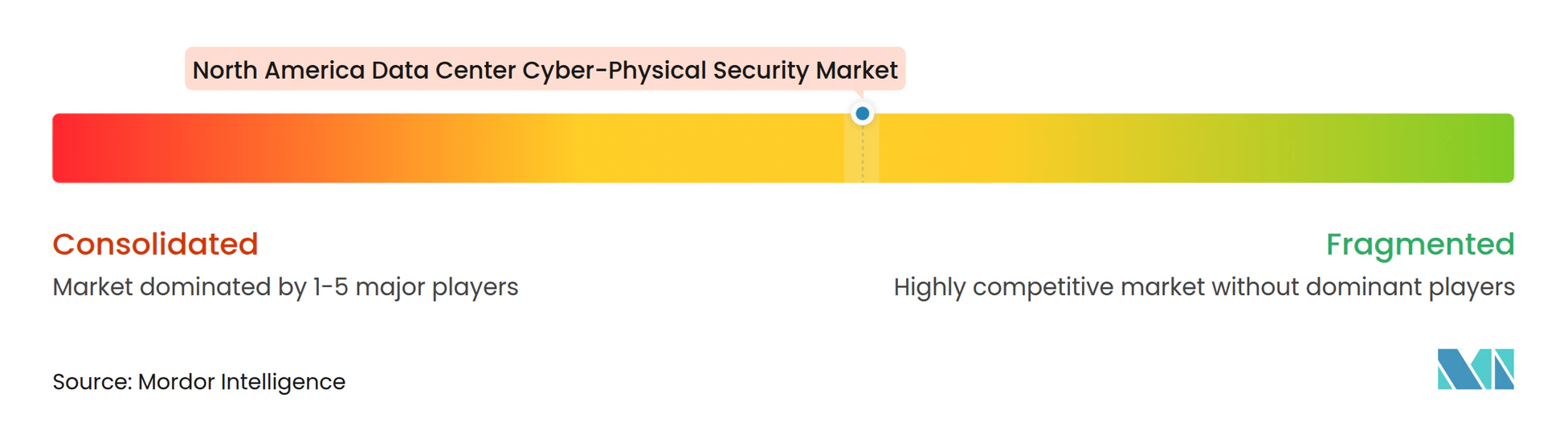
The North America data center cyber-physical security market is moderately fragmented, with Johnson Controls International, Honeywell International, Cisco Systems, and Palo Alto Networks among the established suppliers. These companies benefit from their ability to combine physical security systems with network and operational technology security. Platform consolidation is central to competition because customers want fewer interfaces for access control, video, building systems, and threat intelligence. Cisco launched the N9300 Smart Switch series in February 2025, integrating Hypershield processing into the switching silicon via AMD Pensando data processing units, reducing reliance on separate security appliances for network connectivity and enforcement.
Johnson Controls has continued a software-led platform strategy through releases including C-CURE IQ 3.20 and exacqVision 26.2 in 2026. These releases joined video, access, incident management, and analytics in browser-based workflows. Palo Alto Networks and Arista Networks expanded their partnership in November 2025 to enable threat-triggered workload quarantine at hardware line rate. The approach represents the direction of high-end integrated response design for large facilities. Suppliers that can provide documented compliance alignment also have an advantage in regulated data center projects.
Brivo Systems competes in cloud-native access control where operators prefer hardware-agnostic management. Genetec and Milestone Systems maintain positions in video management by supporting open architectures and third-party device integration. Convergint Technologies benefits from certified audit trails and regulatory knowledge in projects subject to SOC 2 Type II, ISO/IEC 27001, and NERC CIP expectations. The remaining opportunity lies in making automated, coordinated quarantine available to mid-market operators, not only to large enterprises. The North America data center cyber-physical security market is likely to continue favoring providers that can reduce complexity without forcing customers into isolated product ecosystems. Market concentration score: 5 out of 10, reflecting moderate concentration among established platform suppliers, while the available information does not report combined shares for the leading companies.
North America Data Center Cyber-Physical Security Industry Leaders
-
Johnson Controls International plc
-
Honeywell International Inc.
-
Cisco Systems, Inc.
-
Schneider Electric SE
-
Siemens AG
- *Disclaimer: Major Players sorted in no particular order
North America Data Center Cyber-Physical Security Market Companies Covered in this Report
- Johnson Controls International plc
- Honeywell International Inc.
- Cisco Systems, Inc.
- Schneider Electric SE
- Siemens AG
- ABB Ltd.
- Axis Communications AB
- Robert Bosch GmbH
- Genetec Inc.
- Motorola Solutions, Inc.
- International Business Machines Corporation
- Microsoft Corporation
- Amazon Web Services, Inc.
- Palo Alto Networks, Inc.
- Check Point Software Technologies Ltd.
- Hewlett Packard Enterprise Company
- Trend Micro Incorporated
- SentinelOne, Inc.
- Securitas Technology AB
- Brivo Systems, LLC
- ASSA ABLOY AB
- Senstar Corporation
- Milestone Systems A/S
- Convergint Technologies LLC
Recent Industry Developments in North America Data Center Cyber-Physical Security Market
- September 2026: Johnson Controls released C-CURE IQ 3.20, exacqVision 26.2, and Proactive Video Solutions at GSX 2026, combining AI-driven video analytics, centralized managed monitoring, and a unified dashboard for physical-cyber security operations. The release targets operator demand for integrated incident intelligence that reduces analyst workload and accelerates detection-to-response cycles.
- September 2026: TEPCO Power Grid deployed Genetec Security Center to unify security operations across its critical infrastructure network, centralizing management of over 30,000 cameras and establishing a scalable platform supporting future digital transformation across the TEPCO grid. This deployment signals growing adoption of unified physical security platforms in energy-adjacent critical infrastructure with operational parallels to large data center campuses.
- June 2026: Mexico's federal government set a national data center investment target of USD 82.5 billion through 2031, signaling a sustained pipeline of hyperscale and colocation facility construction across Querétaro, Mexico City, and Nuevo León. Each new facility entering construction represents a discrete security infrastructure procurement opportunity requiring integrated physical-cyber protection from the ground up.
- March 2026: Johnson Controls unveiled C-CURE IQ 3.2, IQ Panel 5 updates, and PowerSeries Neo 5 hybrid intrusion platform configurations at ISC West 2026. The release combines access control, video management, and incident workflows into a unified interface for mission-critical environments including data centers.
North America Data Center Cyber-Physical Security Market Report Scope
The North America data center cyber-physical security market covers revenue from cyber-physical security hardware, software, platforms, and services deployed in data centers across the United States, Canada, and Mexico. The market is driven by hyperscale campus expansion, stringent compliance requirements, advanced SOC adoption, and increasing integration of physical security with IT and OT security operations.
The North America Data Center Cyber-Physical Security Market Report is Segmented by Solution Type (Unified Cyber-Physical Security Platforms, Connected Device and Asset Monitoring Solutions, Security Information and Event Correlation Solutions, Network and Operational Technology Security Solutions, Identity and Access Management Solutions, and Integration and Incident Response Services), Security Layer (Physical Access Control Systems, Video Surveillance Systems, Building Management and Facility Control Systems, Environmental and Infrastructure Monitoring Systems, and Integrated Security Operations Platforms), Deployment Model (On-Premise Solutions, Cloud-Based Solutions, and Hybrid Solutions), Service Type (Cyber-Physical Risk Assessment, System Integration and Implementation, Managed Monitoring and Detection, Incident Response and Recovery, and Security Auditing and Compliance Services), Data Center Size (Small, Medium, Large, and Hyperscale), Data Center Type (Colocation, Cloud Service Providers (CSPs), and Enterprise / Edge), and Country (United States, Canada, and Mexico). The Market Forecasts are Provided in Terms of Value (USD).
Segmentation Overview
| Unified Cyber-Physical Security Platforms |
| Connected Device and Asset Monitoring Solutions |
| Security Information and Event Correlation Solutions |
| Network and Operational Technology Security Solutions |
| Identity and Access Management Solutions |
| Integration and Incident Response Services |
| Physical Access Control Systems |
| Video Surveillance Systems |
| Building Management and Facility Control Systems |
| Environmental and Infrastructure Monitoring Systems |
| Integrated Security Operations Platforms |
| On-Premise Solutions |
| Cloud-Based Solutions |
| Hybrid Solutions |
| Cyber-Physical Risk Assessment |
| System Integration and Implementation |
| Managed Monitoring and Detection |
| Incident Response and Recovery |
| Security Auditing and Compliance Services |
| Small |
| Medium |
| Large |
| Hyperscale |
| Colocation |
| Cloud Service Providers (CSPs) |
| Enterprise / Edge |
| United States |
| Canada |
| Mexico |
| By Solution Type | Unified Cyber-Physical Security Platforms |
| Connected Device and Asset Monitoring Solutions | |
| Security Information and Event Correlation Solutions | |
| Network and Operational Technology Security Solutions | |
| Identity and Access Management Solutions | |
| Integration and Incident Response Services | |
| By Security Layer | Physical Access Control Systems |
| Video Surveillance Systems | |
| Building Management and Facility Control Systems | |
| Environmental and Infrastructure Monitoring Systems | |
| Integrated Security Operations Platforms | |
| By Deployment Model | On-Premise Solutions |
| Cloud-Based Solutions | |
| Hybrid Solutions | |
| By Service Type | Cyber-Physical Risk Assessment |
| System Integration and Implementation | |
| Managed Monitoring and Detection | |
| Incident Response and Recovery | |
| Security Auditing and Compliance Services | |
| By Data Center Size | Small |
| Medium | |
| Large | |
| Hyperscale | |
| By Data Center Type | Colocation |
| Cloud Service Providers (CSPs) | |
| Enterprise / Edge | |
| By Country | United States |
| Canada | |
| Mexico |
Key Questions Answered in the Report
What is the size of the North America data center cyber-physical security market?
The North America data center cyber-physical security market size is expected to increase from USD 1.02 billion in 2026 to USD 1.17 billion in 2027 and reach USD 2.28 billion by 2032, growing at a CAGR of 14.27% over 2027-2032.
Which deployment model leads data center cyber-physical security adoption in North America?
Cloud-based solutions lead with 64.78% revenue share in 2026 and are projected to expand at a 15.39% CAGR through 2032. They support centrally managed policy updates and threat intelligence across distributed sites without regular on-site intervention.
Why are hyperscale data centers important to cyber-physical security demand?
Hyperscale facilities account for 43.21% of 2026 revenue and are projected to expand at an 18.27% CAGR because their larger sites require layered physical and digital protection. Multiple access zones, complex facility controls, and high-value computing assets increase the need for integrated systems.
Which security solution category has the largest share?
Network and Operational Technology Security Solutions hold 29.72% revenue share in 2026, supported by the need to protect connected cooling, power, and building systems. The category addresses operational assets that can become pathways to server infrastructure when controls are weak.
What is driving demand in Mexico?
Mexico is projected to expand at a 16.93% CAGR through 2032, supported by new data center investment and construction in Querétaro, Mexico City, and Nuevo León. New hyperscale and colocation projects require physical access control, video surveillance, environmental monitoring, and security operations capabilities.
How are suppliers competing in cyber-physical security for data centers?
Suppliers are combining access control, video management, environmental monitoring, and network protection in unified systems to reduce operational complexity. They are also using cloud delivery, open integration, and automated response capabilities to address different operator requirements, including the need for stronger policy consistency across distributed, multi-tenant, and high-availability facilities throughout the full data center lifecycle.