
North America Data Center Counter-Drone and Airspace Security Market Size and Share
Market Overview
| Study Period | 2027 - 2032 |
|---|---|
| Forecast Data Period | 2027 - 2032 |
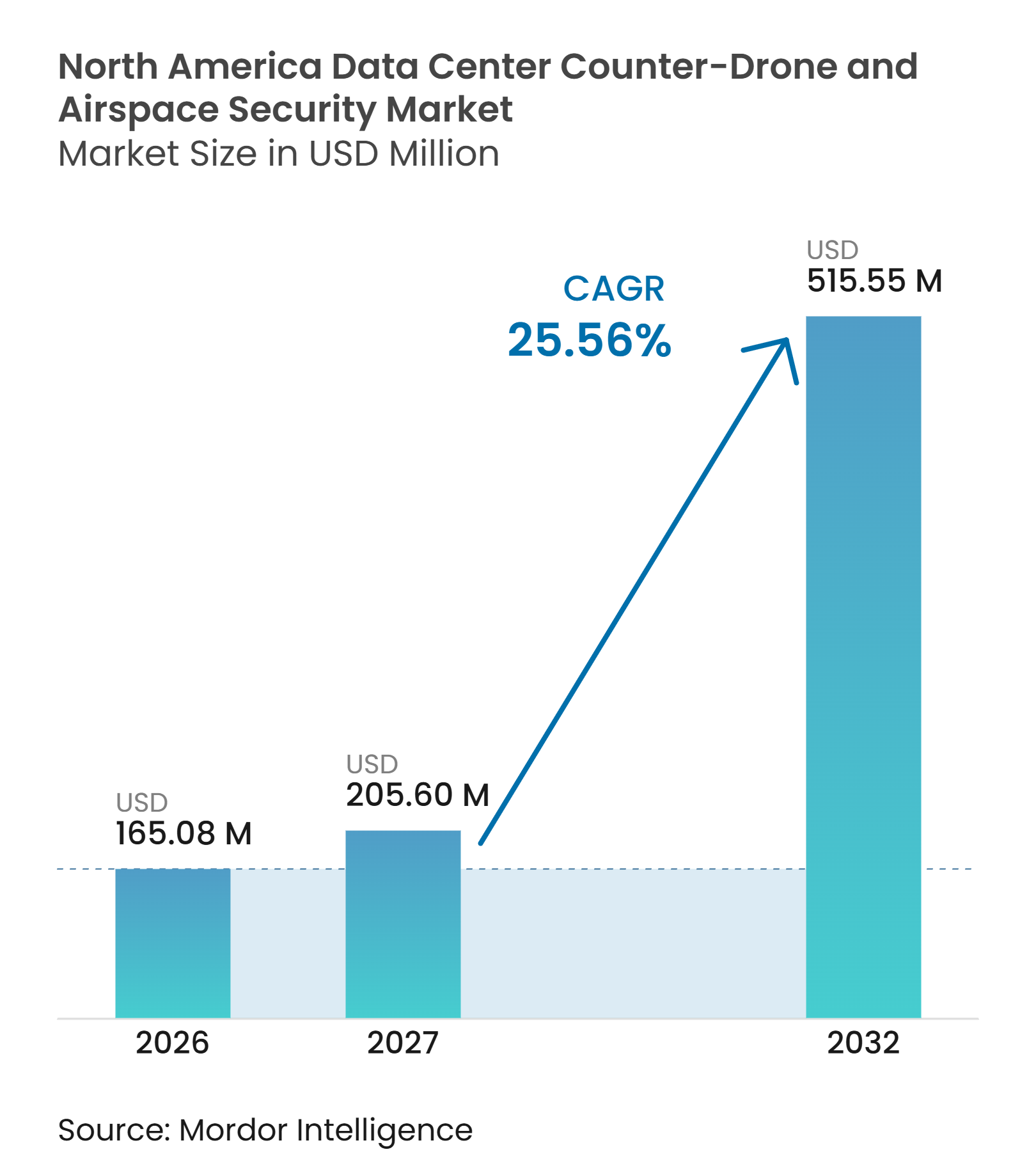
| Base Year Market Size (2026) | USD 165.08 Million |
| Market Size (2027) | USD 205.60 Million |
| Market Size (2032) | USD 515.55 Million |
| Growth Rate (2027 - 2032) | 25.56 % |
| Market Concentration | Medium |
Major Players *Disclaimer: Major Players sorted in no particular order Image © Mordor Intelligence. Reuse requires attribution under CC BY 4.0. | |
North America Data Center Counter-Drone and Airspace Security Market Analysis by Mordor Intelligence
The North America data center counter-drone and airspace security market size is valued at USD 165.08 million in 2026 and is expected to reach USD 515.55 million by 2032 at a CAGR of 25.56% from 2027 to 2032. AI-related campus construction is increasing the number of large fixed assets that need protection beyond ground-level perimeter controls. The Americas data center sector has 50.3 GW of operating capacity, 37.7 GW under construction, and a 91.7% precommitment rate in 2026, which concentrates exposure at high-value sites. Hardware procurement is often tied to the construction schedule, because installation after commissioning can raise costs and leave a temporary coverage gap. Detection remains central to the North America data center counter-drone and airspace security market because private operators have limited authority to disable drones. The market also benefits from insurer attention to airspace exposure, while policy proposals could expand the options available to critical infrastructure owners.
Key Report Takeaways
- By component, hardware held 58.27% of the North America data center counter-drone and airspace security market share in 2026, while software and analytics is projected to expand at a 26.42% CAGR through 2032.
- By technology, RF detection accounted for 32.34% of revenue in 2026, while integrated multi-sensor systems are expected to expand at a 26.71% CAGR through 2032.
- By solution type, drone detection and identification held 34.18% of revenue in 2026, while integrated counter-drone platforms are projected to expand at a 26.38% CAGR through 2032.
- By deployment type, fixed installations accounted for 77.48% of revenue in 2026 and are expected to expand at a 26.71% CAGR through 2032.
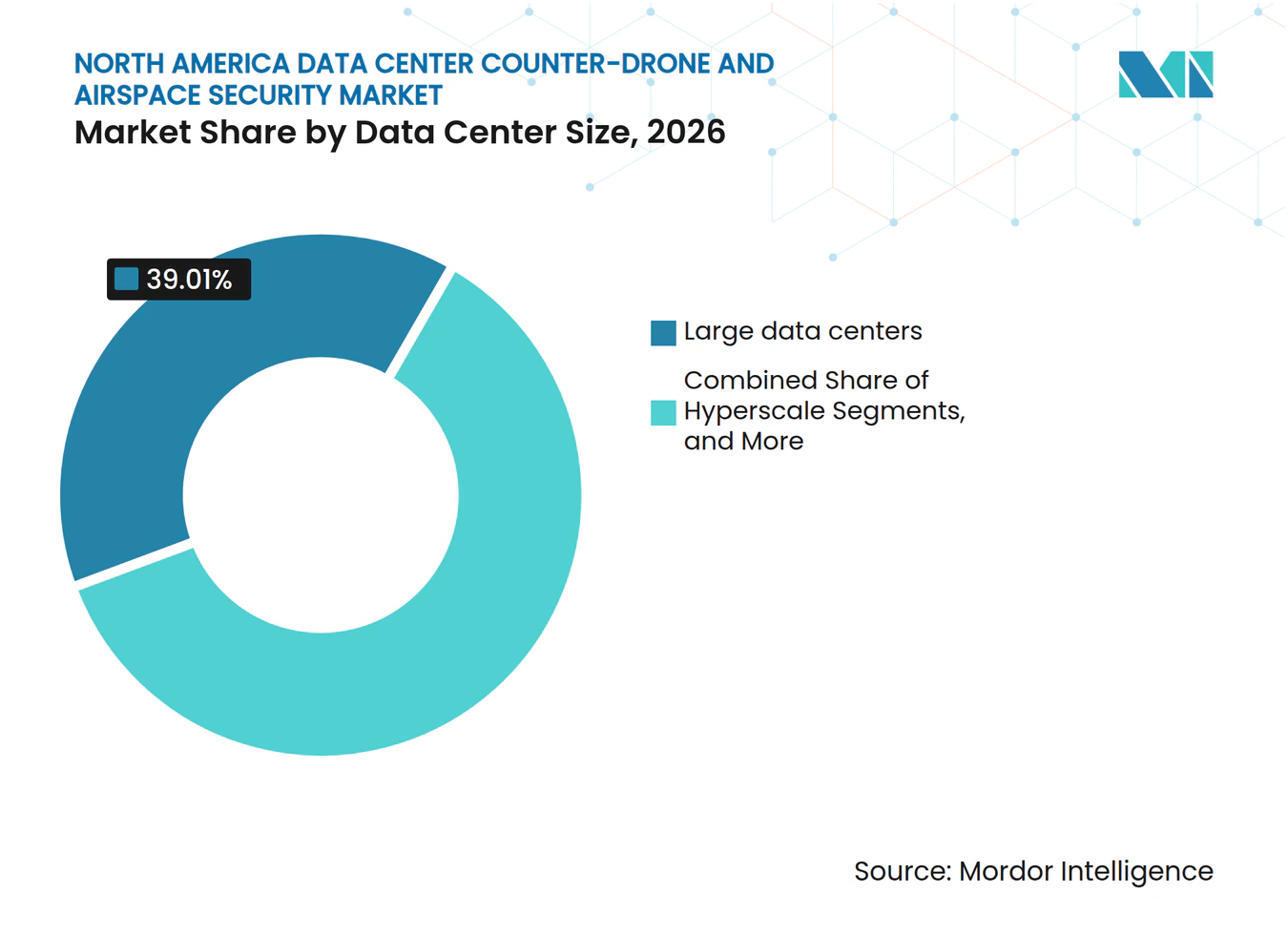
- By data center size, large facilities held 39.01% of revenue in 2026, while hyperscale facilities are projected to expand at a 26.56% CAGR through 2032.
- By data center type, cloud service providers held 42.34% of revenue in 2026 and are expected to expand at a 26.83% CAGR through 2032.
- By geography, the United States held 47.56% of regional revenue in 2026 and is projected to expand at a 26.74% CAGR through 2032.
Note: Market numbers in this report are based on Mordor Intelligence's proprietary estimation framework, which combines nine months of actuals with Q4 projections for base year 2026.
Market Trends and Insights
Drivers Impact Analysis of North America Data Center Counter-Drone and Airspace Security Market*
| Driver | (~) % Impact on CAGR Forecast | Geographic Relevance | Impact Timeline |
|---|---|---|---|
| AI Data Center Construction and Campus Expansion | +8.2% | United States, primary, Canada, secondary | Short term (≤ 2 years) |
| Unauthorized Drone Surveillance of Data Center Assets | +5.7% | Global, concentrated in the United States | Short term (≤ 2 years) |
| Layered Multi-Sensor Airspace Awareness | +4.3% | United States and Canada | Medium term (2-4 years) |
| Remote ID-Enabled Drone Accountability | +2.8% | United States, FAA-mandated, with spillover to Canada | Medium term (2-4 years) |
| Customer and Insurer Pressure for Airspace Risk Controls | +2.1% | North America and Europe | Medium term (2-4 years) |
| Security-by-Design in New Data Centers | +1.4% | United States and Canada | Long term (≥ 4 years) |
| Source: Mordor Intelligence | |||
AI Data Center Construction and Campus Expansion
The North America data center counter-drone and airspace security market gains demand from the rapid expansion of AI-focused campuses. The United States had 161 campuses under construction in 2026, while OpenAI, Oracle, and Related Digital were advancing a 1+ GW Stargate campus in Michigan within a USD 450 billion multi-site program.[1] These sites often cover hundreds of acres and are located in semi-rural areas. Their scale makes conventional perimeter systems insufficient for full airspace awareness. Security requirements are therefore moving into site design, alongside power, cooling, and network planning. Early integration can shorten procurement cycles and increase contract values for the North America data center counter-drone and airspace security market.
Increasing Unauthorized Drone Surveillance of Data Center Assets
Unauthorized drone activity creates a direct demand case for the North America data center counter-drone and airspace security market. Dedrone reported a 4.3x increase in DIY drone detections in 2025 compared with 2024, and 37.5% of detections occurred in low-visibility conditions. Germany's BSI identified data centers as potential targets for drone-borne cyber threats in 2025. Its guidance described payload delivery, rooftop access, remote hacking, and disruption of cooling systems as relevant risks.[2] Aerial imagery can reveal site layouts, sensitive IT zones, and power-line entry points. The resulting security concern extends beyond intrusion to espionage and physical disruption planning.
Rising Adoption of Layered Multi-Sensor Airspace Awareness
The North America data center counter-drone and airspace security market is shifting from single sensors to layered detection systems. Passive RF equipment can miss autonomous and RF-silent drones, while acoustic sensors may perform poorly near cooling equipment. Radar can generate false alerts in cluttered environments, and EO/IR cameras are limited in low-light conditions. Robin Radar Systems and AirMatrix introduced a system in 2025 that combines radar, RF, EO/IR, acoustic, and Remote ID inputs in one alert stream. AeroVironment states that Titan-MS can track more than 500 targets while combining RF, X-band radar, and EO/IR/UV data. These systems move procurement toward integrated platforms and interoperable command-and-control software.
Remote ID-Enabled Drone Accountability
Remote ID provides an accountability layer for the North America data center counter-drone and airspace security market. The FAA requires registered drones to broadcast identification, location, and control-station information under 14 CFR Part 89. This data helps security teams separate compliant aircraft from unidentified flights. The FAA issued airspace restrictions over fixed critical infrastructure sites in May 2026, with limited exceptions to Remote ID requirements. DHS also described a path toward dashboard views that combine Remote ID signals with law enforcement data.[3] Receiver capability is becoming a standard element in new detection installations, including at sites with lower threat exposure.
Restraints Impact Analysis of North America Data Center Counter-Drone and Airspace Security Market*
| Restraint | (~) % Impact on CAGR Forecast | Geographic Relevance | Impact Timeline |
|---|---|---|---|
| Restrictions on Private-Sector Drone Mitigation | -3.8% | United States, primary, and Canada | Short term (≤ 2 years) |
| High Integration and Lifecycle Costs | -2.7% | North America and Europe | Medium term (2-4 years) |
| False Positives in Dense and RF-Contested Environments | -1.9% | United States urban data center locations | Medium term (2-4 years) |
| Autonomous, Low-Observable, and Frequency-Agile Drones | -1.3% | Global | Long term (≥ 4 years) |
| Source: Mordor Intelligence | |||
Restrictions on Private-Sector Drone Mitigation
Legal restrictions limit the near-term addressable scope of the North America data center counter-drone and airspace security market. US private owners cannot independently use kinetic intercept, jamming, spoofing, or directed-energy actions. These authorities remain with federal agencies and specifically authorized law enforcement. The July 2026 DOJ and DHS interim rule set a framework for state and local operations, but it did not give comparable authority to private facility owners. The Critical Infrastructure Airspace Defense Act proposes a certification program and USD 250 million in grants, but it remained in committee in October 2026. Operators can thus fund detection but may only notify law enforcement, which can create a response-latency concern.
High Integration and Lifecycle Costs
Integration cost remains a practical restraint for the North America data center counter-drone and airspace security market. A multi-sensor system requires radar, RF, EO/IR, and command-and-control software to work within a common security operations environment. This requires systems engineering and continued software licensing. Echodyne opened an 86,350-square-foot Washington manufacturing facility backed by USD 40 million in July 2026. Fortem Technologies had opened a 51,000-square-foot manufacturing headquarters in June 2025. Even as suppliers scale production, calibration, software updates, spectrum filings, and 24/7 staff training add ongoing cost for operators.
*Our forecasts treat driver/restraint impacts as directional, not additive. The impact forecasts reflect baseline growth, mix effects, and variable interactions.
North America Data Center Counter-Drone and Airspace Security Market Segment Analysis
By Component:
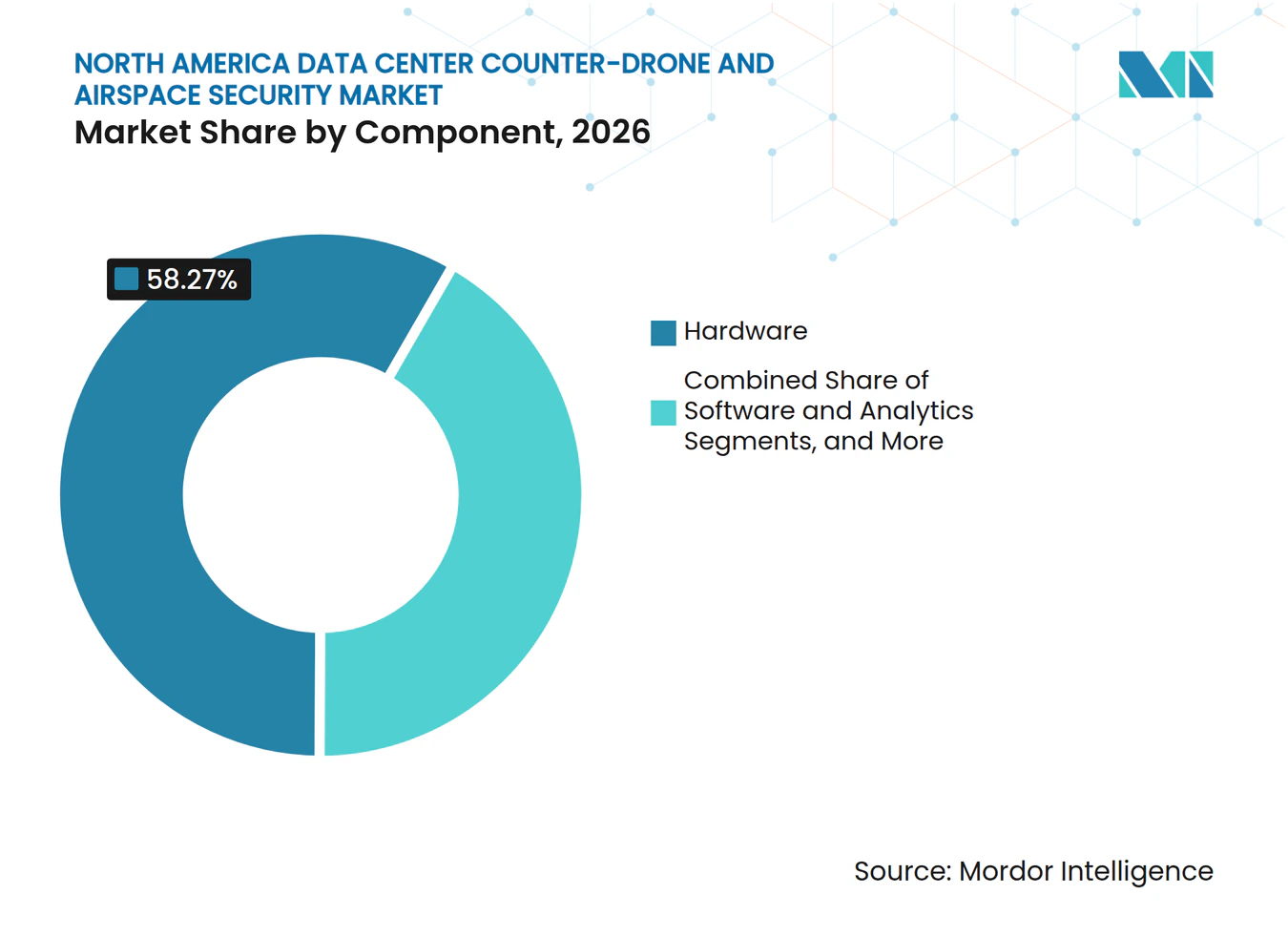
Hardware Anchors Initial Deployment, While Software Supports Long-Term ValueHardware accounted for 58.27% of component revenue in 2026. Sensor arrays commonly include radar, RF antennas, and EO/IR cameras. Operators often install this equipment before the campus enters service. This approach avoids the higher cost and operational interruption of retrofit work. Services support commissioning, systems integration, and managed monitoring. These contracts can help hyperscale customers shift part of their security spend from capital expenditure to operating expenditure. Hardware demand remains closely tied to new-site construction and major campus expansions. It also establishes the physical base for later software upgrades.
Software and analytics is projected to expand at a 26.42% CAGR through 2032. The segment uses analytics to reduce false positives and classify threats across distributed campuses. It also supports the audit records that security and compliance teams need. AeroVironment introduced Halo_Shield in April 2026 as a modular C-UAS design that combines distributed sensing and processing into a shared AI-driven operating picture. CISA advises critical infrastructure owners to document, update, and audit their detection practices as the threat changes. This shifts the North America data center counter-drone and airspace security industry toward software-orchestrated operations. It also makes integration quality more important after the initial hardware sale. The component mix therefore combines construction-led equipment demand with recurring software value.



By Technology:
RF Detection Leads, While Multi-Sensor Integration ExpandsRF detection held 32.34% of technology revenue in 2026. It has a relatively low entry cost and can identify drone models from known RF signatures. Many security deployments can add RF equipment to existing infrastructure. The technology is useful where drones communicate with a controller. Autonomous drones can follow GPS-programmed routes without emitting control signals. Passive RF systems may therefore miss this threat category. This limitation explains why a leading technology position does not eliminate demand for other detection layers. Radar, electro-optical and infrared, and acoustic systems each address different gaps.
Integrated multi-sensor systems are projected to expand at a 26.71% CAGR through 2032. Their appeal comes from combining technologies rather than relying on any single sensor. This is important across campuses with varied terrain, light conditions, and radio-frequency noise. Echodyne introduced EchoWare in October 2025 to maintain one track identity across networked radars. The platform addresses the data fragmentation that can require manual correlation in larger deployments. The North America data center counter-drone and airspace security market therefore favors technology stacks that combine sensor feeds in a shared interface. Interoperability affects both detection accuracy and operator workload. The technology choice is increasingly a platform decision instead of a standalone sensor purchase.
By Solution Type:
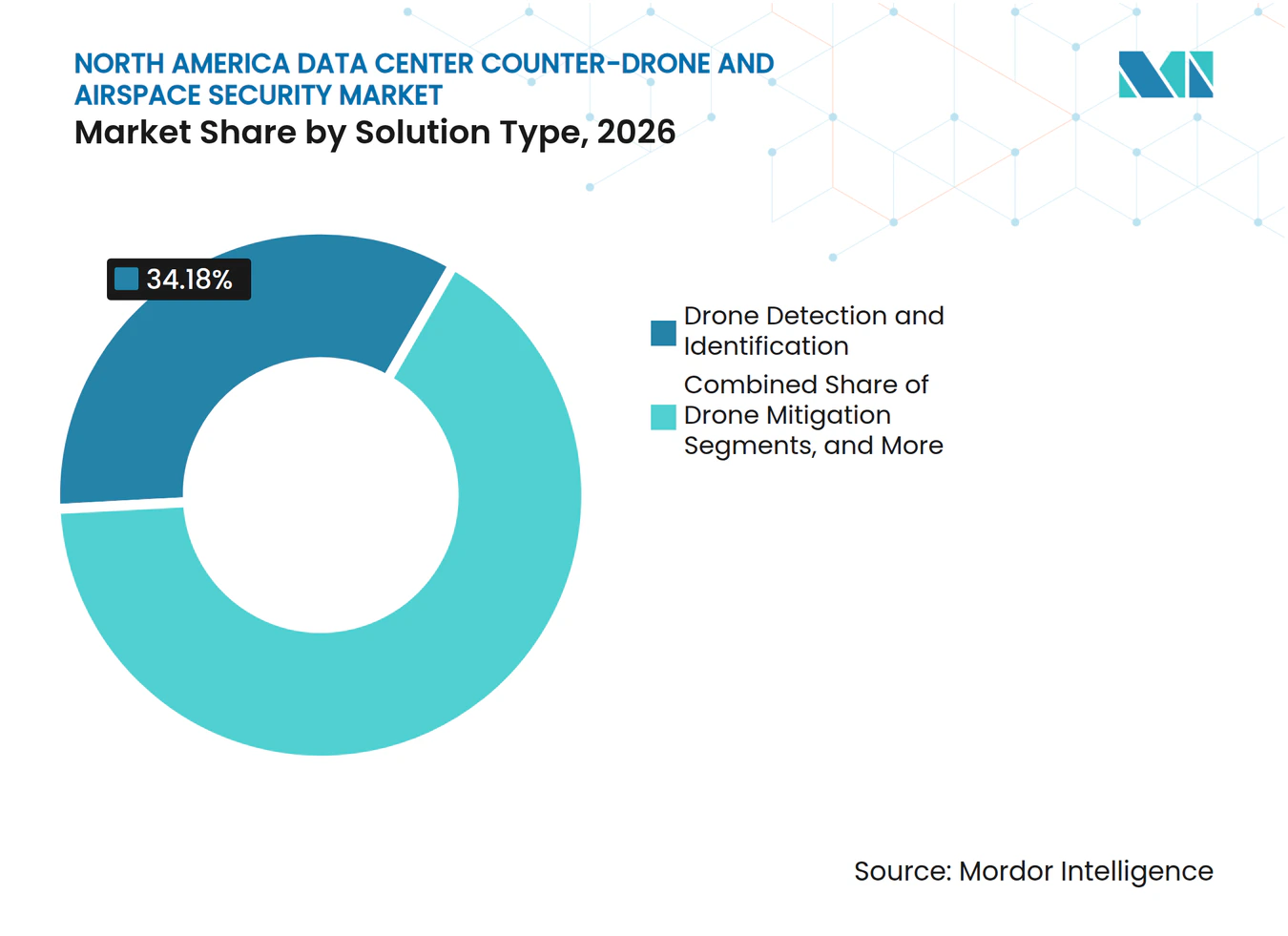
Detection Leads, While Integrated Platforms Gain GroundDrone detection and identification accounted for 34.18% of solution-type revenue in 2026. Its leading position reflects the legal limits on private drone defeat activities. Private owners can operate detection equipment continuously within their security programs. Tracking and classification add the situational awareness needed for law enforcement notifications. Airspace monitoring and alerting help teams maintain a shared operating picture. Drone mitigation and response represent a smaller part of spending because defeat actions require authorized entities. Detection is therefore the solution layer that a private operator can adopt with the greatest independence. It remains the foundation for most civilian site programs.
Integrated counter-drone platforms are projected to expand at a 26.38% CAGR through 2032. Buyers are moving from point systems toward end-to-end airspace management tools. These platforms bring sensor data into a unified command-and-control interface. This can simplify escalation and reduce manual correlation. Anduril received an USD 87 million JIATF-401 task order for Lattice as an enterprise C2 platform in March 2026. The government use case shows the direction of larger critical infrastructure programs. The North America data center counter-drone and airspace security market will benefit if private mitigation authority expands. Until then, integrated platforms still offer value through detection, classification, and incident coordination.

By Deployment Type:
Fixed Installations Support Continuous CoverageFixed installations captured 77.48% of deployment revenue in 2026. They are also expected to expand at a 26.71% CAGR through 2032. Data center campuses need continuous monitoring without coverage gaps. Permanent sensors can be integrated with perimeter design and the security operations center. This differs from military and public-safety missions that require frequent redeployment. Fixed architecture is particularly suited to large campuses with repeatable flight paths and defined operational boundaries. New facilities in West Texas, Pennsylvania, and Cheyenne add to the installed-base opportunity. This supports a long planning cycle for site-specific installations.
Mobile and portable systems provide a complementary role rather than replacing fixed systems. They can monitor construction sites before permanent equipment is commissioned. They also provide temporary coverage during maintenance periods or incident response. Fortem began deliveries of DroneHunter 5.0 in January 2026 with an entanglement-based capture system. Non-destructive capture can be relevant for civilian sites where kinetic actions raise liability concerns. The North America data center counter-drone and airspace security market uses portable systems to address narrow operational needs. Fixed systems remain the core choice because they support uninterrupted monitoring. The two models can operate together within a layered airspace program.
By Data Center Size:
Large Facilities Lead, While Hyperscale Sites Drive Future DemandLarge facilities held 39.01% of size-segment revenue in 2026. They have the installed footprint and capital capacity to justify dedicated airspace protection. Their physical scale can require sensor coverage across large property lines and rooftops. Small and medium facilities remain a secondary source of demand. Tighter budgets and urban locations can lead these operators toward managed detection services. Their sites can also face RF interference and limited mounting options. The large-facility segment forms the broadest existing buyer base for dedicated systems. It supports near-term demand for site-specific equipment and integration work.
Hyperscale facilities are projected to expand at a 26.56% CAGR through 2032. Their growth is linked to the development of gigawatt-scale campuses for AI training and inference. Cushman and Wakefield reported a 285 GW planned development pipeline in the Americas in 2026, with much of it in hyperscale formats. RAND identified aerial access as a major physical threat vector for secure AI inference data centers in 2025. These facilities hold high-value model weights and other sensitive computing assets. The North America data center counter-drone and airspace security market is therefore becoming part of the security-by-design discussion for the largest sites. Hyperscale buyers can also support multi-year programs across geographically dispersed campuses. This gives vendors opportunities for broader platform and service contracts.
By Data Center Type:
Cloud Service Providers Lead Across Share and ExpansionCloud service providers held 42.34% of data center type revenue in 2026. The segment is also projected to expand at a 26.83% CAGR through 2032. CSPs operate many of the largest and most widely distributed facilities. Their scale makes them high-value buyers of multi-year airspace security programs. They also face substantial public accountability for site resilience. These factors support more mature security procurement practices. CSP demand therefore combines high spending capacity with a need to standardize security across multiple campuses. This position gives CSPs influence over product design and interoperability requirements.
Colocation providers are an important secondary segment. Enterprise tenants can seek evidence of airspace security during contract due diligence. That creates pressure from tenants to strengthen facility controls. Enterprise and edge operators face different challenges in dense urban locations. RF interference and shared rooftops can restrict sensor placement. The North America data center counter-drone and airspace security market responds with managed services and deployment designs that fit smaller sites. Security-by-design adoption by CSPs also brings vendors into projects earlier in the procurement cycle. This can compress sales cycles and increase contract value where planning begins before construction. The data center type split therefore requires different commercial models for hyperscale, colocation, and enterprise operators.
Geography Analysis
The United States held 47.56% of the North America data center counter-drone and airspace security market share in 2026 and is projected to expand at a 26.74% CAGR through 2032. It has the highest concentration of hyperscale development and an active federal C-UAS policy environment. Texas, Virginia, and Georgia had 107, 94, and 43 active campus developments in October 2026. Their suburban, exurban, and rural sites have different airspace risks. The White House directed the FAA in June 2025 to finalize flight restriction work over critical infrastructure. It also directed DHS to issue detection guidance for private operators. DOT, the Department of War, and DHS announced a temporary flight restriction within 1 nautical mile of the US-Mexico border in October 2026. The restriction prohibited unauthorized drones from the surface to 400 feet above ground level. This created a localized precedent for defined airspace denial zones.
Canada is a developing geography for the North America data center counter-drone and airspace security market. The Canadian Department of National Defence ran its C-UAS Sandbox 2026 from September through October. It sought deployable solutions that could detect and defeat micro and mini UAS and connect to broader command-and-control systems. The program can support aligned standards and certification pathways for civilian critical infrastructure. Alberta has emerged as a location for large proposed hyperscale projects. Canada, Mexico, and the United States held their first trilateral C-UAS coordination meeting in August 2025. The meeting supported threat response channels ahead of the 2026 FIFA World Cup. This coordination can also support continuing critical infrastructure security activity.
Mexico is the smallest geography in the North America data center counter-drone and airspace security market. Its data center activity is concentrated in Mexico City, Monterrey, and Guadalajara. Mexican rules treat unauthorized drone flights over critical infrastructure as priority enforcement matters. Detection and identification procedures are centralized through the national aerospace control structure. International colocation providers drive much of the local demand by applying global security standards. Organized-crime drone use increases the broader risk environment. Trilateral coordination also expands the operational context for security providers. These factors can support formal airspace monitoring requirements for new facilities during the forecast period.
Competitive Landscape
Market Concentration
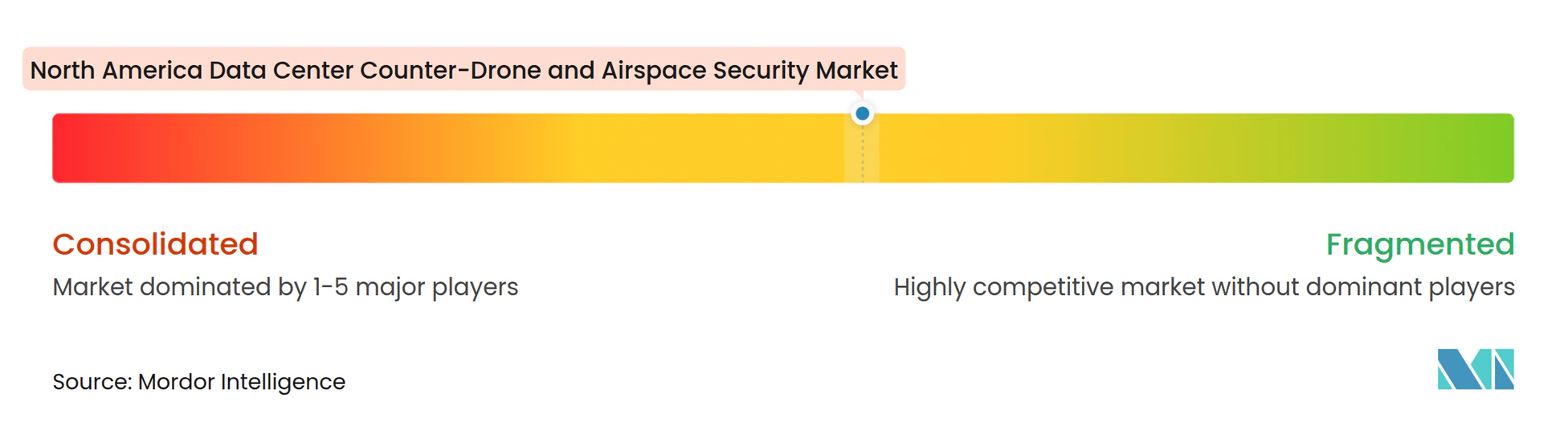
The North America data center counter-drone and airspace security market is moderately concentrated in platforms and command-and-control software. Hardware sensors remain more fragmented. Anduril Industries, RTX Corporation, Lockheed Martin Corporation, Northrop Grumman Corporation, and L3Harris Technologies have strong government procurement positions. Their program relationships can shape the architecture used in critical infrastructure programs. Anduril received an Army enterprise C-UAS award valued at USD 20 billion in March 2026. The related USD 87 million Lattice task order strengthened its software presence in government C-UAS operations. Commercial buyers can adapt parts of this software-led model.
Specialized vendors include DroneShield, Dedrone, Fortem Technologies, Echodyne, Epirus, and D-Fend Solutions. They compete on interoperability, false-positive performance, deployment speed, and total cost of ownership. DroneShield received a USD 500 million, 3-year Domestic Shield IDIQ contract in September 2026. Fortem was selected as the only small business among 7 DHS C-UAS IDIQ prime contractors in August 2026. Small and medium data centers remain a gap because many platform offerings are designed for hyperscale budgets. Managed detection services can offer an alternative channel for these operators. Competition in this part of the North America data center counter-drone and airspace security market remains active. No single supplier covers every detection-to-defeat need within the present legal framework.
Partnerships are central because customers need linked sensing, tracking, and response functions. Fortem integrated DroneHunter interceptors and TrueView radar with Lockheed Martin's Sanctum mission-management software in March 2026. DroneShield and Terma signed a memorandum of understanding in May 2026 to combine radar and EO/IR systems with RF detection and DroneSentry-C2 software. Epirus was selected for a directed-energy pilot program in October 2026. Its Leonidas system had previously defeated a 49-drone swarm with a single pulse in a 2025 demonstration. These moves show continued investment in non-kinetic response technologies. Their commercial use at data centers will remain dependent on regulatory authorization. The competitive picture is therefore shaped by platform integration, specialist partnerships, and evolving policy.
North America Data Center Counter-Drone and Airspace Security Industry Leaders
-
RTX Corporation
-
Anduril Industries, Inc.
-
Lockheed Martin Corporation
-
Dedrone, Inc.
-
Fortem Technologies, Inc.
- *Disclaimer: Major Players sorted in no particular order
North America Data Center Counter-Drone and Airspace Security Market Companies Covered in this Report
- Anduril Industries, Inc.
- RTX Corporation
- Lockheed Martin Corporation
- Northrop Grumman Corporation
- AeroVironment, Inc.
- Dedrone, Inc.
- Fortem Technologies, Inc.
- Echodyne Corp.
- DroneShield Limited
- Teledyne Technologies Incorporated
- Parsons Corporation
- BlueHalo LLC
- Epirus, Inc.
- D-Fend Solutions AD Ltd.
- Robin Radar Systems B.V.
- Black Sage Technologies, Inc.
- MatrixSpace, Inc.
- Liteye Systems, Inc.
- Leonardo DRS, Inc.
- L3Harris Technologies, Inc.
Recent Industry Developments in North America Data Center Counter-Drone and Airspace Security Market
- October 2026: The Department of War selected Epirus' Leonidas high-power microwave system for its directed energy pilot program under JIATF-401, established by the FY2026 National Defense Authorization Act. The selection marks the first operational assessment of high-power microwave technology in domestic airspace for critical infrastructure protection, directly expanding defeat mechanisms available for data center operators pending regulatory authorization.
- October 2026: The US Departments of Transportation, War, and Homeland Security jointly announced a temporary flight restriction banning unauthorized drone operations within 1 nautical mile of the US-Mexico border, from the surface to 400 feet above ground level. The coordinated TFR establishes a legal precedent for geofenced airspace denial zones at defined ground coordinates, a model with direct implications for future data center perimeter airspace classification.
- September 2026: DroneShield was awarded a USD 500 million, 3-year IDIQ contract under JIATF-401's Domestic Shield initiative, establishing a streamlined procurement pathway for the company's C-UAS systems to protect US defense critical infrastructure and other high-priority locations across the United States.
- August 2026: Fortem Technologies was selected as a prime contractor on the DHS 5-year, USD 1 billion-plus C-UAS IDIQ contract, the only small business among 7 awardees, enabling DHS components to issue task orders directly for DroneHunter autonomous interceptors, TrueView radars, and SkyDome C2 software.
North America Data Center Counter-Drone and Airspace Security Market Report Scope
The North America Data Center Counter-Drone and Airspace Security Market encompasses hardware, software, and services for detecting, identifying, tracking, monitoring, and mitigating unauthorized drones across data centers in the United States, Canada, and Mexico. The market is Segmented by Component (Hardware, Software and Analytics, and Integration and Support Services), Technology (Radar-Based Detection, Radio Frequency Detection, Electro-Optical and Infrared Detection, Acoustic Detection, and Integrated Multi-Sensor Systems), Solution Type (Drone Detection and Identification, Drone Tracking and Classification, Airspace Monitoring and Alerting, Drone Mitigation and Response, and Integrated Counter-Drone Platforms), Deployment Type (Fixed Installations, and Mobile and Portable Systems), Data Center Size (Small, Medium, Large, and Hyperscale), Data Center Type (Colocation, Cloud Service Providers (CSPs), and Enterprise and Edge), Geography (United States, Canada, and Mexico). The Market Forecasts are Provided in Terms of Value (USD).
Segmentation Overview
| Hardware |
| Software and Analytics |
| Integration and Support Services |
| Radar-Based Detection |
| Radio Frequency Detection |
| Electro-Optical and Infrared Detection |
| Acoustic Detection |
| Integrated Multi-Sensor Systems |
| Drone Detection and Identification |
| Drone Tracking and Classification |
| Airspace Monitoring and Alerting |
| Drone Mitigation and Response |
| Integrated Counter-Drone Platforms |
| Fixed Installations |
| Mobile and Portable Systems |
| Small |
| Medium |
| Large |
| Hyperscale |
| Colocation |
| Cloud Service Providers (CSPs) |
| Enterprise and Edge |
| United States |
| Canada |
| Mexico |
| By Component | Hardware |
| Software and Analytics | |
| Integration and Support Services | |
| By Technology | Radar-Based Detection |
| Radio Frequency Detection | |
| Electro-Optical and Infrared Detection | |
| Acoustic Detection | |
| Integrated Multi-Sensor Systems | |
| By Solution Type | Drone Detection and Identification |
| Drone Tracking and Classification | |
| Airspace Monitoring and Alerting | |
| Drone Mitigation and Response | |
| Integrated Counter-Drone Platforms | |
| By Deployment Type | Fixed Installations |
| Mobile and Portable Systems | |
| By Data Center Size | Small |
| Medium | |
| Large | |
| Hyperscale | |
| By Data Center Type | Colocation |
| Cloud Service Providers (CSPs) | |
| Enterprise and Edge | |
| By Geography | United States |
| Canada | |
| Mexico |
Key Questions Answered in the Report
What is the size of the North America data center counter-drone and airspace security market?
The market is valued at USD 165.08 million in 2026 and is expected to reach USD 515.55 million by 2032, at a 25.56% CAGR from 2027 to 2032.
Which component has the largest share in this sector?
Hardware leads with a 58.27% share in 2026 because fixed sensors are commonly installed during campus construction.
Which technology is expanding fastest for data center drone protection?
Integrated multi-sensor systems are projected to expand at a 26.71% CAGR through 2032 as operators seek coverage for RF-silent and low-visibility threats.
Why are private data center operators focused on drone detection?
US restrictions limit private use of jamming, kinetic, spoofing, and directed-energy actions, so detection and law enforcement notification remain central.
Which type of data center is the most important buyer?
Cloud service providers hold 42.34% of 2026 revenue and are projected to expand at a 26.83% CAGR through 2032.
What makes fixed counter-drone systems relevant for data centers?
Fixed installations account for 77.48% of 2026 revenue because campuses require continuous monitoring and permanent integration with perimeter security systems.