
North America Data Center Copper and Electrical Materials Market Size and Share
Market Overview
| Study Period | 2021 - 2032 |
|---|---|
| Forecast Data Period | 2027 - 2032 |
| Base Year Market Size (2026) | USD 6.98 Billion |
| Market Size (2027) | USD 7.74 Billion |
| Market Size (2032) | USD 11.62 Billion |
| Growth Rate (2027 - 2032) | 8.47 % |
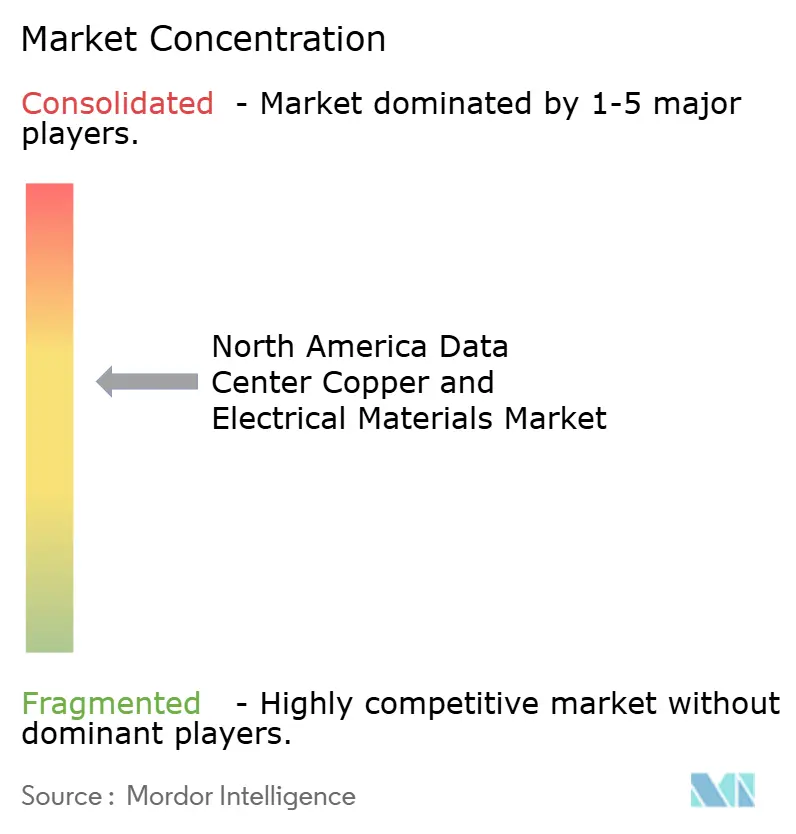
| Market Concentration | Medium |
Major Players *Disclaimer: Major Players sorted in no particular order Image © Mordor Intelligence. Reuse requires attribution under CC BY 4.0. | |
North America Data Center Copper and Electrical Materials Market Analysis by Mordor Intelligence
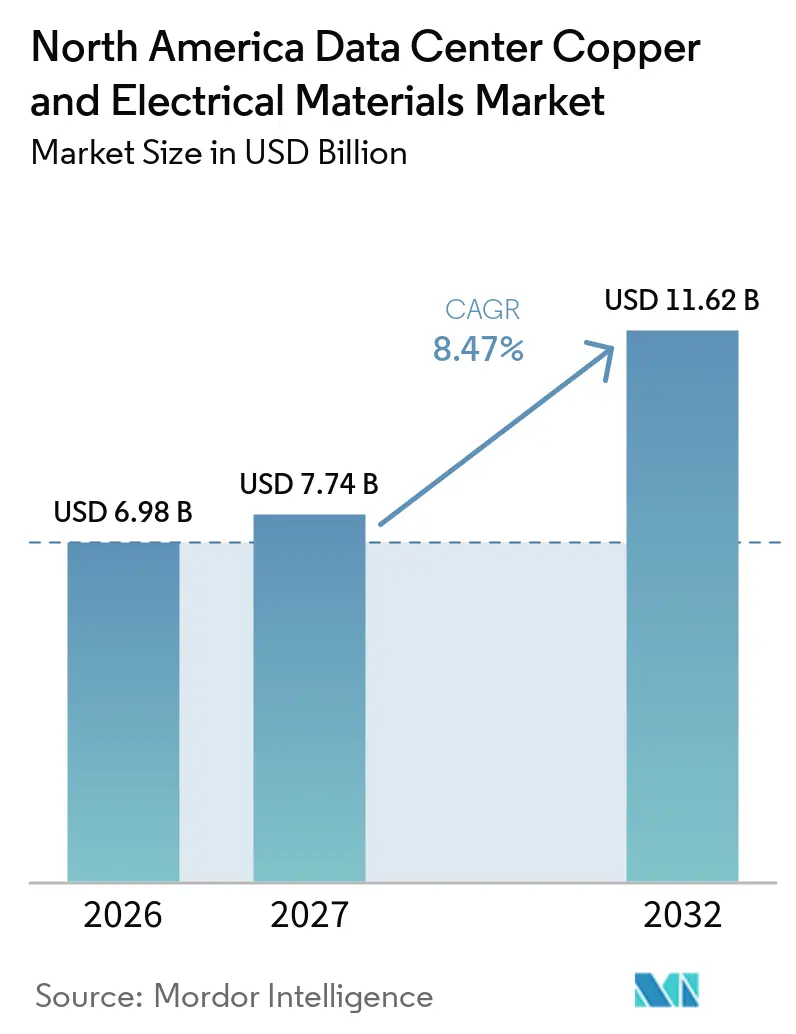
The North America data center copper and electrical materials market size is projected to expand from USD 6.98 billion in 2026 and USD 7.74 billion in 2027 to USD 11.62 billion by 2032, registering a CAGR of 8.47% between 2027 and 2032. AI computing is changing the electrical material requirements of new campuses, because high-density racks require more power delivery and thermal management equipment. Copper remains central to distribution, grounding, and liquid cooling, even as high-voltage direct current designs reduce conductor needs in some individual circuits. The North America data center copper and electrical materials market is also being shaped by larger hyperscale construction programs and longer procurement cycles for electrical equipment. Suppliers are responding with domestic manufacturing capacity, integrated power architectures, and products designed for higher current loads. Commodity price movements and delayed grid connections can defer project schedules, which makes lead-time certainty a major procurement consideration.
Key Report Takeaways
- By material type, copper held 71.56% of the North America data center copper and electrical materials market share in 2026, while aluminum is projected to expand at a 9.59% CAGR through 2032.
- By product type, electrical cables and conductors accounted for 39.81% of the North America data center copper and electrical materials market share in 2026, while busbars and busways are projected to expand at a 9.23% CAGR through 2032.
- By application, power distribution accounted for 44.17% of the market share in 2026 and is projected to expand at a 9.80% CAGR through 2032.
- By data center size, hyperscale facilities held 56.12% of the market share in 2026 and are projected to expand at a 10.19% CAGR through 2032.
- By data center type, cloud service providers held 43.22% of the market share in 2026 and are projected to expand at a 10.42% CAGR through 2032.
- By geography, the United States held 74.33% of the North America data center copper and electrical materials market share in 2026, while Canada is projected to expand at a 10.73% CAGR through 2032.
Note: Market numbers in this report are based on Mordor Intelligence's proprietary estimation framework, which combines nine months of actuals with Q4 projections for base year 2026.
Market Trends and Insights
Drivers Impact Analysis of North America Data Center Copper and Electrical Materials Market*
| Driver | (~) % Impact on CAGR Forecast | Geographic Relevance | Impact Timeline |
|---|---|---|---|
| AI and High-Performance Computing Rack Density Expansion | +3.2% | United States primary, with expansion into Canada and Mexico | Short term (≤ 2 years) |
| Hyperscale and Colocation Campus Expansion | +2.1% | United States core markets, Canada, and Mexico | Short term (≤ 2 years) |
| Grid Connection and Onsite Power Buildout | +0.8% | United States, Canada, with early gains in Texas and the PJM region | Medium term (2-4 years) |
| Liquid Cooling and Copper-Intensive Thermal Infrastructure | +0.7% | United States hyperscale hubs and Canada | Medium term (2-4 years) |
| Modular High-Ampacity Busway Adoption | +0.6% | North America, led by major hyperscale locations | Short term (≤ 2 years) |
| Edge and Inference Workload Decentralization | +0.3% | United States urban and suburban locations, Canada, and Mexico | Long term (≥ 4 years) |
| Source: Mordor Intelligence | |||
AI And High-Performance Computing Rack Density Expansion
Current Blackwell systems use 120 kW racks, compared with 10-20 kW for conventional CPU racks. A 120 kW rack contains more than 300 kg of copper, which equals 3 metric tons per MW of copper intensity. The Copper Development Association reported that hyperscale AI campuses can require up to 50,000 metric tons of copper per site, compared with 5,000-15,000 metric tons at conventional facilities. The North America data center copper and electrical materials market benefits because each layer of a high-density installation needs conductors, connections, and protection equipment. NVIDIA is developing an 800 VDC ecosystem for AI factories, which supports higher-voltage distribution while keeping the focus on campus-scale electrical capacity. NFPA 70 establishes the electrical installation framework that applies to conductor sizing, grounding, and protection for these deployments.
Hyperscale And Colocation Campus Expansion
Large campus construction creates demand for cable, busway, connectors, and copper feedstock before equipment reaches the white space. The Copper Development Association cited 11.6 metric tons of copper per MW across power and cooling systems for new primary-market capacity. The North America data center copper and electrical materials market therefore gains when development moves toward greenfield sites with complete utility and onsite electrical installations. These projects require new incoming cables, substations, distribution rings, backup equipment, and grounding systems. The shift toward locations such as West Texas, Alberta, and Pennsylvania increases the amount of infrastructure installed from the utility interconnect inward. This favors suppliers that can support a project through fabrication, delivery, and field installation without lengthy equipment lead times.
Grid Connection And Onsite Power Buildout
Long grid connection timelines are changing what developers buy and when they buy it. The Federal Energy Regulatory Commission issued orders in June 2026 requiring 6 regional grid operators to explain or reform large-load interconnection rules. The response recognizes that large electricity loads, including data centers, require more transparent and workable connection processes. Developers are also considering behind-the-meter power systems where grid timelines delay campus energization. Eaton and Siemens Energy announced a collaboration on integrated onsite power for data centers, including a modular 500 MW concept. These configurations add medium-voltage cable, buswork, switchgear connections, and grounding requirements to the North America data center copper and electrical materials market.
Liquid Cooling And Copper-Intensive Thermal Infrastructure
High-performance computing clusters exceed the rack densities that air cooling can manage efficiently. NVIDIA identifies liquid cooling as part of the infrastructure needed for high-density AI factories. Copper cold plates, manifolds, coolant distribution units, and heat-exchanger components create thermal demand that sits alongside power-distribution demand. The North America data center copper and electrical materials market gains from this additional material requirement because it does not replace the copper used in cables and busways. The Open Compute Project and ASHRAE are continuing to shape common approaches for liquid cooling equipment and operating practices.[1] Standardization can help operators deploy cooling equipment across larger AI clusters with more consistent specifications. Better thermal performance also supports the use of higher-density racks in new and retrofitted facilities.
Restraints Impact Analysis of North America Data Center Copper and Electrical Materials Market*
| Restraint | (~) % Impact on CAGR Forecast | Geographic Relevance | Impact Timeline |
|---|---|---|---|
| Copper Price and Refining-Supply Volatility | -1.8% | North America, exposed through global copper pricing | Short term (≤ 2 years) |
| Utility Interconnection and Energization Delays | -1.3% | United States, particularly PJM and ERCOT, and Canada | Medium term (2-4 years) |
| Long-Lead Electrical Equipment and Skilled-Labor Bottlenecks | -0.8% | North America, especially frontier hyperscale sites | Medium term (2-4 years) |
| High Upfront Cost of High-Voltage and DC Distribution Retrofits | -0.4% | United States and Canada enterprise and legacy colocation sites | Long term (≥ 4 years) |
| Source: Mordor Intelligence | |||
Copper Price And Refining-Supply Volatility
LME copper averaged USD 13,395 per metric ton in 2026, 35% above the 2025 average. Copper prices rose by one-third between January 2025 and April 2026, while supply deficits are expected to persist through 2035. Higher prices affect tender validity, project repricing, and escalation risk on multiyear campus programs. The North America data center copper and electrical materials market remains exposed because cable and busway contracts commonly reflect commodity prices. The International Energy Agency reported that new projects in the Democratic Republic of the Congo and Zambia reduced the projected 2035 copper supply deficit from 30% to 25%. Cable manufacturers are responding with forward purchasing and hedging programs, although those approaches require more working capital.
Utility Interconnection And Energization Delays
Grid delays can hold back a completed campus after electrical packages have been procured and installed. FERC has identified large-load interconnection practices as an immediate policy issue for transmission providers.[2] The North America data center copper and electrical materials market can experience uneven ordering when developers defer custom equipment until energization timing is clearer. Ontario and British Columbia also face growing pressure from large-load requests, which affects the timing of new Canadian data center capacity. Suppliers can reduce some project risk through modular equipment and closer coordination with developers. However, grid planning and utility approvals remain outside the control of material suppliers.
*Our forecasts treat driver/restraint impacts as directional, not additive. The impact forecasts reflect baseline growth, mix effects, and variable interactions.
North America Data Center Copper and Electrical Materials Market Segment Analysis
By Material Type:
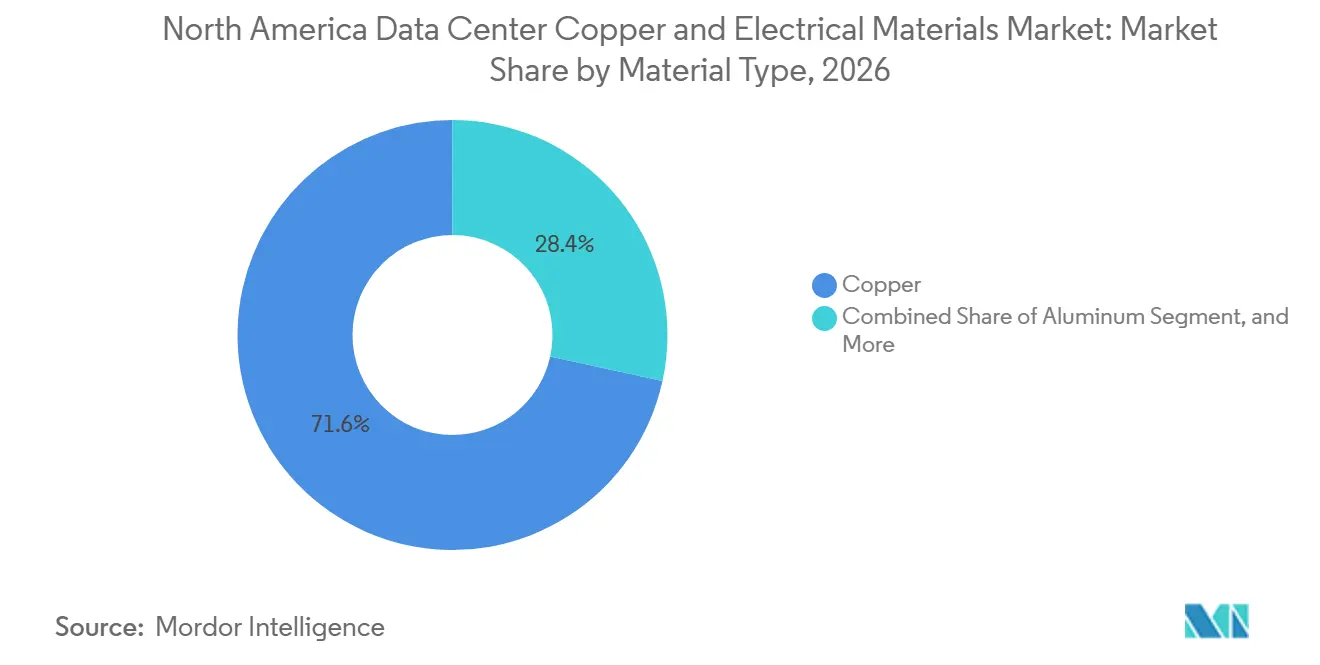
Copper Supports Primary Distribution While Aluminum Gains Secondary UseCopper held 71.56% of the market share in 2026. Copper is used in everything from incoming utility cables to the microchannels within liquid-cooling cold plates. The Copper Development Association reported that hyperscale AI campuses can require up to 50,000 metric tons of copper. Power distribution, thermal management, grounding, and bonding each add to its use at a large site. NFPA 70 provides the code framework for conductor ampacity and installation practices in these applications. Copper therefore retains an important position where conductivity, thermal performance, and reliability requirements are strict.
Aluminum is projected to expand at a 9.59% CAGR through 2032 within the North America data center copper and electrical materials market. It is gaining use in secondary busway runs and large-conductor feeders where installed cost and weight are more important than conductivity density. Aluminum busway can be suited to 400 A to 1,250 A backbone distribution runs in grey-space areas. Copper remains preferred in performance-critical primary distribution paths and dense cooling equipment. Designers must also manage galvanic corrosion at copper-aluminum junctions. This division makes purchasing decisions sensitive to the spread between copper and aluminum prices as well as site-specific electrical requirements.

By Product Type:
Cables Lead While Busways Change Grey-Space ArchitectureElectrical cables and conductors held 39.81% of the market share in 2026. They are used throughout the electrical path from utility connections to rack-level drops. Medium-voltage cable serves facilities that take power at transmission voltage and step it down on-site. Prysmian has invested USD 500 million in expanding the Encore Wire campus in McKinney, Texas, including medium-voltage cable production. The company also approved a second copper rod mill at the same campus in 2026 to support cable feedstock demand.[3] Connectors and terminations remain smaller categories, but higher-voltage direct current systems raise their performance and protection requirements.
Busbars and busways are projected to expand at a 9.23% CAGR through 2032. These systems replace traditional whip-cabling arrangements with modular overhead distribution in high-density AI rows. Vertiv launched its Double-Stack PowerBar Track in October 2024 with ratings up to 2,000 A under UL and 2,500 A under IEC. The product format allows rack-level power additions without running new home circuits from the main distribution board. Cable trays, conduit, and wiring accessories also rise with the physical footprint of new facilities. The North America data center copper and electrical materials market is consequently moving toward modular systems that speed changes inside grey-space environments.
By Application:
Power Distribution Leads Across Facility TypesPower distribution accounted for 44.17% of the North America data center copper and electrical materials market size in 2026. It is also projected to expand at a 9.80% CAGR through 2032. Utility cables, unit substations, busways, power distribution units, and rack wiring all consume copper as power throughput increases. NVIDIA is developing 800 VDC infrastructure to support the higher power levels required by AI factories. Higher voltage can reduce conductor needs per circuit, but larger facilities and more high-density racks sustain total material requirements. The category covers the full route from the grid connection to the computing load.
Power backup is the next major application because UPS and battery energy storage systems need bus connections, grounding, and inter-module cabling. AI facilities require strong redundancy because interruptions affect large computing workloads. Grid connection infrastructure also requires medium-voltage cable, switchgear, and protection equipment. Grounding and bonding remain necessary for every facility and are governed by NFPA 70. The North America data center copper and electrical materials market is therefore supported by applications that cannot be omitted even when a project adopts newer power architectures. These applications expand with facility capacity rather than with any single rack configuration.
By Data Center Size:
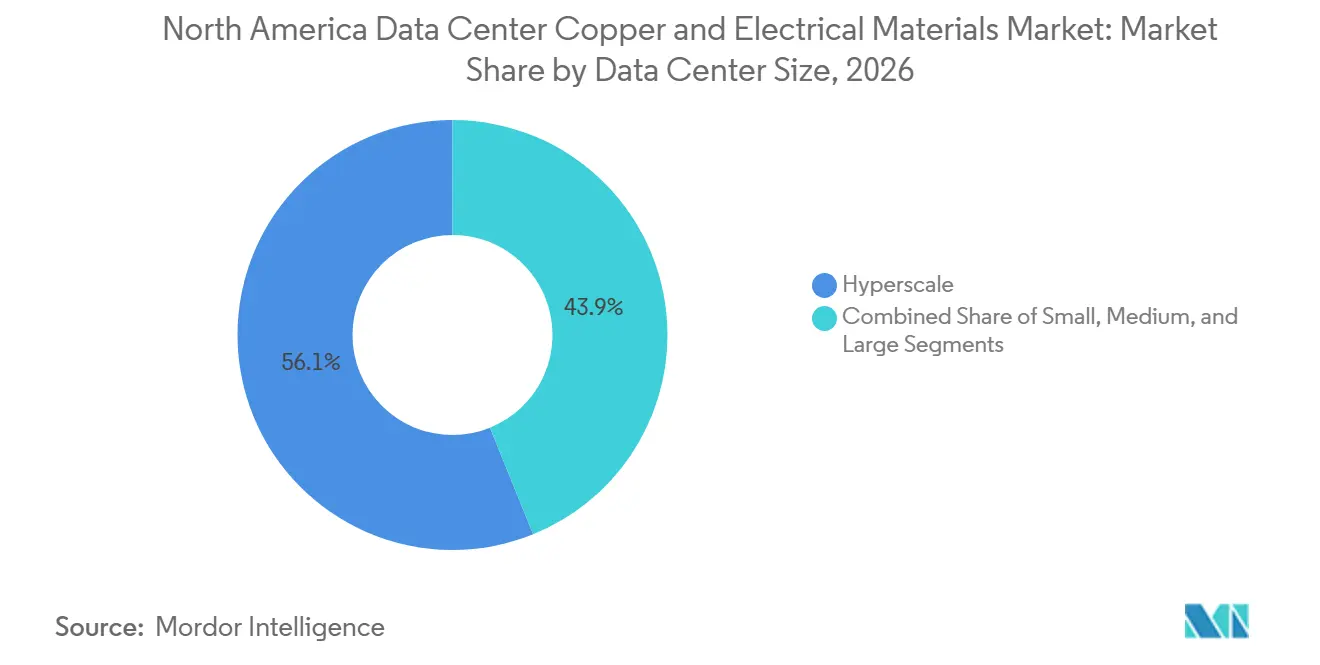
Hyperscale Facilities Hold the Largest Demand BaseHyperscale facilities held 56.12% of the market share in 2026. The segment is projected to expand at a 10.19% CAGR through 2032. These campuses can justify dedicated utility interconnects, onsite substations, campus-scale cooling loops, and extensive backup systems. The Copper Development Association stated that AI-focused hyperscale sites can require up to 50,000 metric tons of copper. Their electrical needs are disproportionate to floor area because AI server clusters combine high power density with liquid cooling. This gives hyperscale developers a major influence over demand for cable, busway, connectors, and copper rod.
Large enterprise and multi-tenant facilities remain major material users as they accommodate higher-density computing workloads. Medium-sized sites are adding busways and connectors during grey-space retrofits, where modular installation limits disruption to operations. Small data centers and micro facilities use less copper per facility, but their aggregate count can rise as inference workloads move closer to end users. NVIDIA, EPRI, Prologis, and InfraPartners announced plans to study 5-20 MW micro data centers at utility substations. This approach shows how smaller facilities can still require substantial electrical integration at the local grid edge. The North America data center copper and electrical materials market captures demand across all facility sizes, although hyperscale campuses remain the central volume source.
By Data Center Type:
Cloud Service Providers Set the Procurement PaceCloud service providers held 43.22% of the market share in 2026. They are projected to expand at a 10.42% CAGR through 2032. Their facilities have high power-density targets, long construction schedules, and large procurement programs. These characteristics allow cloud service providers to purchase electrical materials earlier and in larger volumes than smaller operators. Their build programs support demand visibility for cable and busway suppliers. The segment also accelerates the move toward validated, integrated power systems for AI infrastructure.
Colocation providers are important buyers because AI-ready tenants require higher rack densities than legacy spaces support. These operators are upgrading grey-space busway from 600 A to 2,000 A systems in some facilities. Vertiv's high-density busway design illustrates the product direction for these upgrades. Enterprise and edge operators face tighter budgets for full liquid-cooling retrofits. They retain demand for conventional cables and power distribution units while selectively introducing modular busway in AI-ready pods. This broad mix of facility types gives the North America data center copper and electrical materials market both large new-build orders and retrofit demand.
Geography Analysis
United States
The United States held 74.33% of the market share in 2026. Northern Virginia remains a major cloud and AI location, while Texas is attracting large hyperscale construction programs. The United States also has the most mature concentration of electrical infrastructure suppliers and data center customers in the region. FERC's 2026 action on large-load interconnection rules shows that transmission planning and connection processes are central regulatory influences on new capacity. NFPA 70 provides the principal electrical code framework for facility wiring, grounding, and protection. ABB and NVIDIA are collaborating on power solutions for gigawatt-scale AI data centers, which demonstrates the move toward 800 VDC architecture. This supports demand for higher-capacity distribution systems and certified equipment. Domestic manufacturing investment by cable and electrical equipment companies also improves supply availability near large construction markets.
Canada
Canada is projected to expand at a 10.73% CAGR through 2032. Renewable power availability, land costs, and hyperscaler location decisions support campus development in Alberta and Ontario. Microsoft announced a CAD 5.5 billion (USD 3.9 billion) investment in cloud and AI infrastructure in Canada.[4] At the 2025 average exchange rate provided in the draft, this equals USD 3.9 billion. Alberta's energy structure has also attracted interest in large data center campuses with dedicated onsite generation. Electrical installations must comply with CSA C22.1, which influences cable ratings and installation requirements. The need for both UL and CSA-certified equipment creates a distinction for manufacturers serving facilities on both sides of the border. Ontario and British Columbia face growing large-load connection pressure, which can delay project energization and reinforce the value of on-site electrical solutions.
Mexico And Emerging Markets
Mexico had 279 MW of installed data center capacity in 2025, compared with 115.5 MW in 2024. The Mexican Data Center Association expects the country to require 1.5 GW of data center capacity by 2030. Querétaro is the leading location and concentrates a large share of national development, which drives demand for conductors, busways, and grounding systems. SENER identified USD 18 billion in direct data center investment through 2030. Energy infrastructure is the binding issue because operators are investing in dedicated electrical infrastructure where grid capacity is limited. The North America data center copper and electrical materials market benefits from this construction, although imported high-voltage and custom cable assemblies remain an important procurement channel. Mexico's energy authorities and local permitting conditions will influence the pace of new campus construction. Nearshoring demand can strengthen the case for suppliers that offer regional fabrication and predictable delivery schedules.
Competitive Landscape
The North America data center copper and electrical materials market is moderately consolidated among diversified electrical infrastructure companies and specialized manufacturers. ABB, Eaton, Legrand, Prysmian, Schneider Electric, Siemens, Southwire, LS Cable and System, Hubbell, and nVent compete across different product and geographic niches. Companies are expanding production capacity to reduce lead times and serve AI-density applications with differentiated power products. Prysmian committed USD 500 million to the Encore Wire expansion in Texas, which includes a medium-voltage cable facility expected to operate in 2027. Siemens committed more than USD 200 million to manufacturing expansion in Georgia and Texas for electrical infrastructure. These moves strengthen local supply options for large data center programs.
Technology partnerships are becoming more important than stand-alone component sales. ABB announced a collaboration with NVIDIA to develop 800 VDC power solutions for gigawatt-scale AI data centers. Eaton introduced an 800 VDC reference architecture for AI power infrastructure in October 2025. These efforts focus on a validated grid-to-chip power stack rather than a single cable or busway product. Eaton and Siemens Energy also announced integrated onsite power concepts that respond to delayed grid connections. Suppliers with broad engineering, fabrication, and service capabilities are positioned to address these system-level requirements.
Factory-assembled electrical rooms and intelligent busway systems are potential areas for product differentiation. Vertiv's Double-Stack PowerBar Track provides a high-current overhead distribution option for dense AI deployments. Direct-to-rack high-voltage DC modules also address the space between utility transformers and server rack inlets. UL 857, IEC 60439-2, and NFPA 70 remain important compliance factors for busway and electrical installation design. Certified products and established North American customer relationships create a barrier for new entrants. The competitive emphasis remains on delivery reliability, technical validation, and the ability to supply multiple electrical systems for one campus.
North America Data Center Copper and Electrical Materials Industry Leaders
-
ABB Ltd
-
Amphenol Corporation
-
Belden Inc.
-
Nexans S.A.
-
Eaton Corporation plc
- *Disclaimer: Major Players sorted in no particular order
North America Data Center Copper and Electrical Materials Market Companies Covered in this Report
- ABB Ltd
- Amphenol Corporation
- Belden Inc.
- Nexans S.A.
- Eaton Corporation plc
- EAE ELECTRIC
- Encore Wire Corporation
- Furukawa Electric Co., Ltd.
- Hubbell Incorporated
- Legrand SA
- LS Cable & System Ltd.
- Molex LLC
- nVent Electric plc
- Panduit Corporation
- Prysmian S.p.A.
- Schneider Electric SE
- Siemens AG
- Southwire Company, LLC
- Sumitomo Electric Industries, Ltd.
- TE Connectivity Ltd.
- Vertiv Holdings Co
- Atkore International Group, Inc.
Recent Industry Developments in North America Data Center Copper and Electrical Materials Market
- October 2026: The United States aluminum producer Alcoa Corporation has sold its former Massena East smelter in upstate New York to an unnamed data center firm. In its Q3 2026 results, the aluminum company announced that it had entered into definitive agreements with an unnamed data center firm to sell portions of the Massena East site for up to USD 315 million.
- July 2026: The North American copper products supplier Pantheon Electric announced its plan to expand through acquisitions to meet rising demand from artificial intelligence data centers and grid upgrades.
- June 2026: FERC issued show cause orders directing 6 regional grid operators in the United States to justify or reform large-load interconnection rules across 5 reform categories, including transparency on transmission upgrade costs. The action responds to data center interconnection queues that have extended commercial operation timelines to 5 years or more and will shape the pace of facility energization across the forecast period.
- March 2026: Prysmian S.p.A.'s board of directors approved a second copper rod mill at the McKinney, Texas campus, representing a USD 100-200 million investment intended to double or triple existing copper rod output. The expansion builds on Prysmian's acquisition of Encore Wire and directly addresses sustained North American demand for power and data center cable feedstock.
North America Data Center Copper and Electrical Materials Market Report Scope
The North America data center copper and electrical materials market encompasses the procurement, regional manufacturing, and deployment of specialized copper, aluminum, and alternative conducting materials tailored for high-density computing infrastructure within the United States and Canada. The market tracks the distribution of critical electrical cables, busbars, rods, and grounding components utilized in power distribution, backup systems, and grid connections across small, medium, large, and hyperscale facilities operating under colocation, enterprise, and cloud service frameworks.
The North America Data Center Copper and Electrical Materials Market Report is Segmented by Material Type (Copper, Aluminum, and Other Electrical Conductive Materials), Product Type (Electrical Cables and Conductors, Busbars and Busways, Copper Rods and Strips, Electrical Connectors and Termination Materials, and Other Electrical Materials), Application (Power Distribution, Power Backup Systems, Grid Connection and Electrical Infrastructure, Grounding and Bonding, and Other Electrical Applications), Data Center Size ( Small, Medium, Large, and Hyperscale), Data Center Type (Colocation, Cloud Service Providers [CSPs], and Enterprise / Edge), and Country (United States, Canada, and Mexico). The Market Forecasts are Provided in Terms of Value (USD).
Segmentation Overview
| Copper |
| Aluminum |
| Other Electrical Conductive Materials |
| Electrical Cables and Conductors |
| Busbars and Busways |
| Copper Rods and Strips |
| Electrical Connectors and Termination Materials |
| Other Electrical Materials |
| Power Distribution |
| Power Backup Systems |
| Grid Connection and Electrical Infrastructure |
| Grounding and Bonding |
| Other Electrical Applications |
| Small |
| Medium |
| Large |
| Hyperscale |
| Colocation |
| Cloud Service Providers (CSPs) |
| Enterprise / Edge |
| United States |
| Canada |
| Mexico |
| By Material Type | Copper |
| Aluminum | |
| Other Electrical Conductive Materials | |
| By Product Type | Electrical Cables and Conductors |
| Busbars and Busways | |
| Copper Rods and Strips | |
| Electrical Connectors and Termination Materials | |
| Other Electrical Materials | |
| By Application | Power Distribution |
| Power Backup Systems | |
| Grid Connection and Electrical Infrastructure | |
| Grounding and Bonding | |
| Other Electrical Applications | |
| By Data Center Size | Small |
| Medium | |
| Large | |
| Hyperscale | |
| By Data Center Type | Colocation |
| Cloud Service Providers (CSPs) | |
| Enterprise / Edge | |
| By Country | United States |
| Canada | |
| Mexico |
Key Questions Answered in the Report
What is the North America data center copper and electrical materials market size?
The market is projected to expand from USD 6.98 billion in 2026 and USD 7.74 billion in 2027 to USD 11.62 billion by 2032, at an 8.47% CAGR.
What is driving copper use in North American data centers?
AI racks require more electrical capacity and liquid cooling, increasing demand for copper in power distribution, grounding, and cooling equipment.
Which material holds the largest share?
Copper held 71.56% share in 2026 because it is used in primary power distribution, grounding, and liquid-cooling systems.
Which product category is projected to expand the fastest?
Busbars and busways are projected to expand at a 9.23% CAGR through 2032 as high-density AI rows adopt modular power distribution.
Why are grid delays important for data center electrical materials?
Connection delays can defer electrical equipment procurement, while onsite power systems add demand for medium-voltage cable, buswork, and grounding.
Which country is projected to expand the fastest?
Canada is projected to expand at a 10.73% CAGR through 2032, supported by hyperscale campus development and power availability.