
North America Data Center Construction Materials Supply Chain Market Size and Share
Market Overview
| Study Period | 2021 - 2032 |
|---|---|
| Forecast Data Period | 2027 - 2032 |
| Base Year Market Size (2026) | USD 7.31 Billion |
| Market Size (2027) | USD 8 Billion |
| Market Size (2032) | USD 12.42 Billion |
| Growth Rate (2027 - 2032) | 9.20 % |
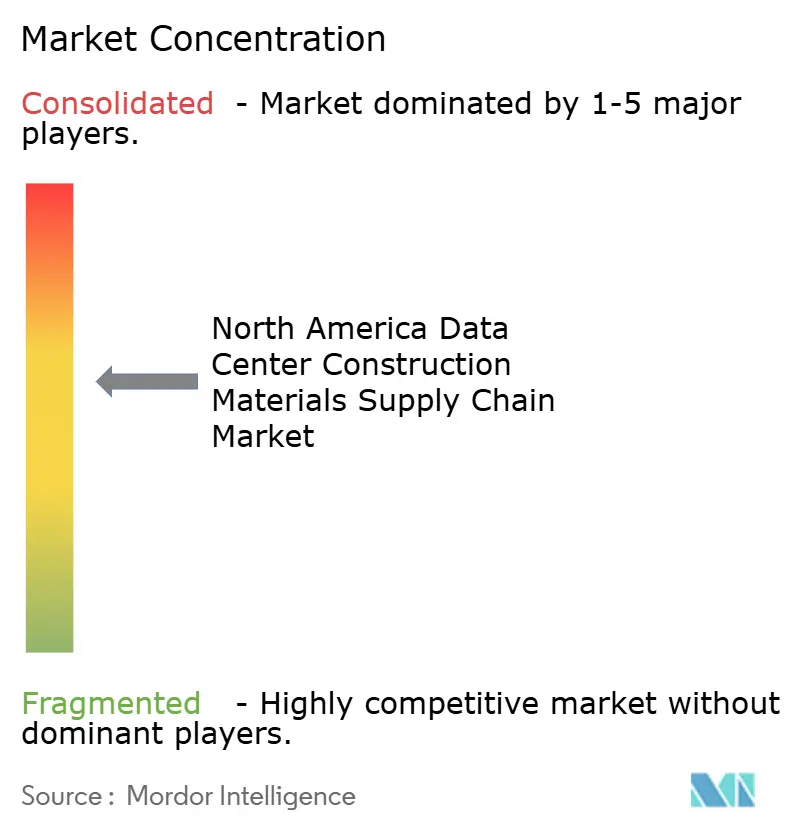
| Market Concentration | Medium |
Major Players *Disclaimer: Major Players sorted in no particular order Image © Mordor Intelligence. Reuse requires attribution under CC BY 4.0. | |
North America Data Center Construction Materials Supply Chain Market Analysis by Mordor Intelligence
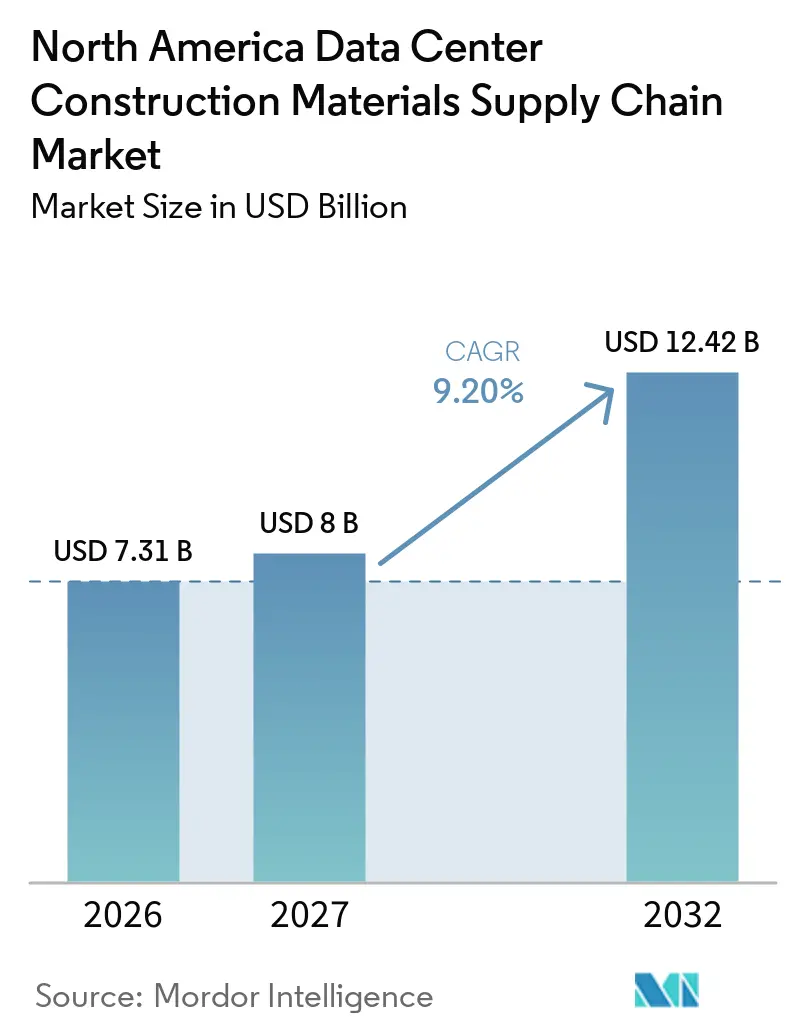
The North America data center construction materials supply chain market size is projected to expand from USD 7.31 billion in 2026 and USD 8.00 billion in 2027 to USD 12.42 billion by 2032, registering a CAGR of 9.20% between 2027 and 2032. The North America data center construction materials supply chain market is being shaped by sustained investment in AI-ready capacity, which increases demand for structural systems, precast elements, envelope products, and critical electrical packages. Developers are placing orders earlier because large campuses require coordinated deliveries across several construction stages, while work continues on other buildings within the same site. This is strengthening the role of procurement models that can secure long-lead equipment and materials before final installation schedules are fixed and before changing availability affects commercial terms. Off-site fabrication is also becoming more important because it can reduce site labor needs, improve construction sequencing, and allow suppliers to prepare components before site conditions are ready for installation. Power availability, labor shortages, materials price exposure, delivery capacity, the need to coordinate suppliers across distant project locations, and pressure on regional fabrication capacity remain practical limits on the pace of project delivery, particularly where several large developments rely on the same regional supply base.
Key Report Takeaways
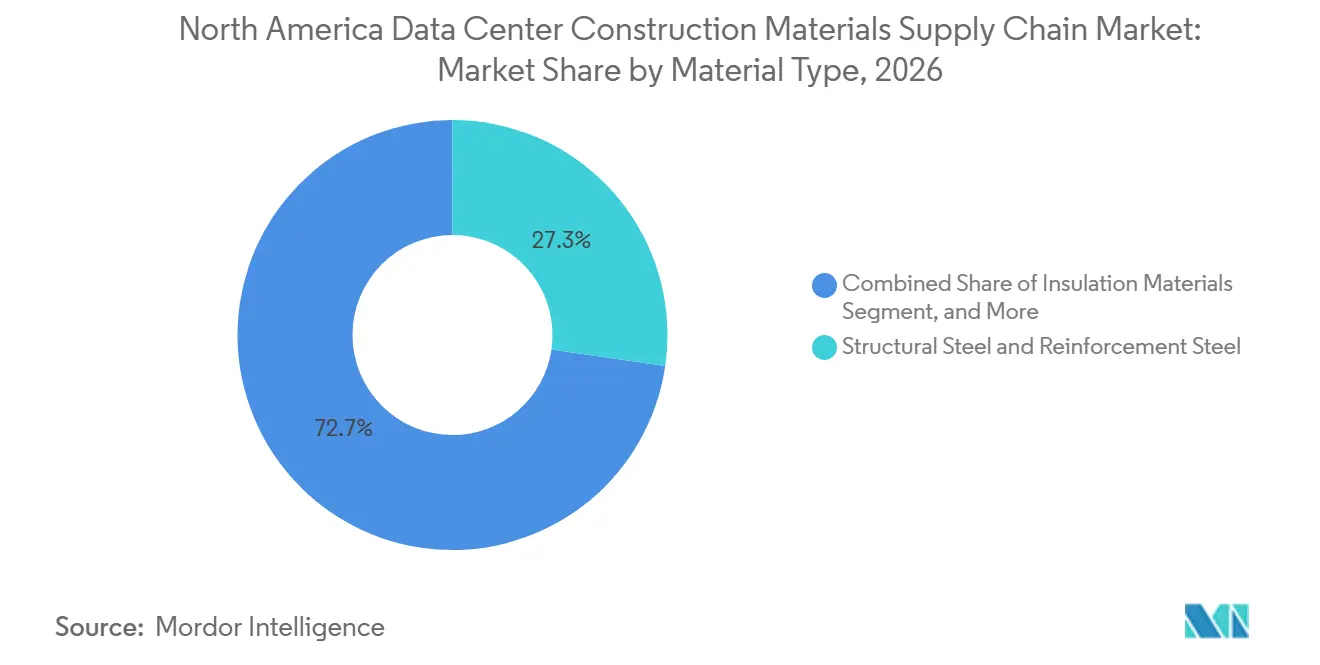
- By material type, Structural Steel and Reinforcement Steel held 27.30% of the North America data center construction materials supply chain market share in 2026, while Precast Concrete Products are projected to expand at a 9.98% CAGR through 2032.
- By construction phase, Structural Construction accounted for 43.19% of the North America data center construction materials supply chain market size in 2026 and is projected to advance at a 10.27% CAGR through 2032.
- By procurement model, EPC-led procurement held 47.51% of the market in 2026, while Direct Procurement by Data Center Developers and Operators is projected to expand at a 10.57% CAGR through 2032.
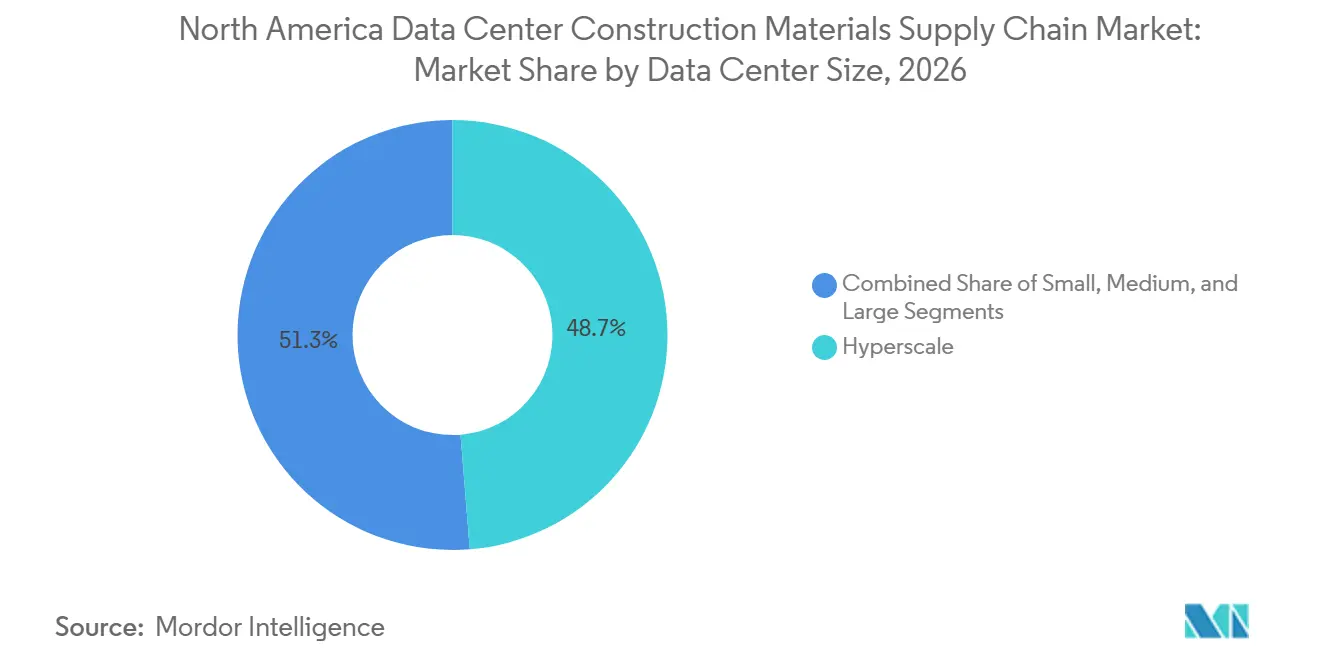
- By data center size, Hyperscale held 48.72% of the market in 2026 and is projected to advance at an 11.34% CAGR through 2032.
- By data center type, Cloud Service Providers held 52.67% of the market in 2026 and are projected to expand at an 11.78% CAGR through 2032.
- By geography, the United States held 80.42% of the North America data center construction materials supply chain market in 2026, while Canada is projected to advance at a 12.10% CAGR through 2032.
Note: Market numbers in this report are based on Mordor Intelligence's proprietary estimation framework, which combines nine months of actuals with Q4 projections for base year 2026.
Market Trends and Insights
Drivers Impact Analysis of North America Data Center Construction Materials Supply Chain Market*
| Driver | (~) % Impact on CAGR Forecast | Geographic Relevance | Impact Timeline |
|---|---|---|---|
| AI Workload Expansion and Hyperscale Campus Build-Out | +3.5% | United States, including Northern Virginia, Texas, Indiana, and Atlanta, and Canada, including Alberta and Saskatchewan | Short term (≤ 2 years) |
| Cloud Migration, Colocation Demand, and Digital Infrastructure Investment | +2.0% | United States, Canada, and Mexico, including Querétaro | Medium term (2-4 years) |
| Modular and Prefabricated Building Components | +1.5% | Core United States markets and Canadian hyperscale campuses | Medium term (2-4 years) |
| Brownfield Power-Site Reuse and Frontier-Market Development | +0.8% | Pennsylvania, Ohio, Kentucky, Canada, and Mexico | Medium term (2-4 years) |
| Low-Carbon, High-Performance Building Materials | +0.7% | United States and Canada | Long term (≥ 4 years) |
| Owner-Furnished, Contractor-Installed Procurement for Critical Packages | +0.4% | United States hyperscale markets and Alberta and Saskatchewan in Canada | Short term (≤ 2 years) |
| Source: Mordor Intelligence | |||
AI Workload Expansion and Hyperscale Campus Build-Out
AI capacity programs are increasing the volume and complexity of materials required for large data center campuses. The North America data center construction materials supply chain market benefits when operators commit to multi-building sites because each project requires repeated purchases of structural steel, reinforcement, concrete, roofing, and electrical systems. Schneider Electric stated that each MW of AI compute capacity requires 275 tons of steel, which makes the physical materials requirement significant even before equipment is installed.[1] Large campuses can also draw on local labor, transport, and fabrication capacity for several years. DPR Construction described Meta's Richland Parish campus as a 2,250-acre project expected to require more than 5,000 workers at peak construction. This scale favors suppliers that can provide traceability, dependable delivery windows, and materials that meet project-specific design standards. It also raises the cost of procurement disruptions because a delay in one structural package can affect work across adjacent buildings.
Cloud Migration, Colocation Demand, and Digital Infrastructure Investment
Cloud migration and colocation demand keep procurement active across projects that do not follow the same schedule as owner-operated campuses. The North America data center construction materials supply chain market, therefore, includes a steady flow of projects that require staged purchases rather than one large initial order. Digital Realty reported 3.0 GW of in-place IT capacity and 6.3 GW of buildable capacity under active development as of March 2026. This type of development pipeline calls for supplies to be available over multiple construction phases. Operators also need greater flexibility when tenant commitments and equipment plans change before a building is complete. Distributed AI inference capacity can add demand for smaller facilities near users, where standardized components and shorter build schedules are useful. These patterns create opportunities for distributors and fabricators that can support both large campuses and regional deployments.
Accelerated Deployment of Modular and Prefabricated Building Components
Modular construction changes which materials are purchased, when they are delivered, and where value is created. The North America data center construction materials supply chain market is seeing stronger demand for precast elements, factory-built electrical rooms, and ready-to-install cooling modules. AFCOM reported that more than 80% of operators planned to use prefabricated IT and cooling modules in upcoming projects, compared with 39% in the preceding year. Factory production can reduce pressure on site crews and make delivery timing more predictable. Vertiv reported material waste of 1.8% for off-site construction, compared with 30% for conventional field-built work. Schneider Electric also found that a prefabricated 5 MW deployment reduced construction-phase embodied carbon by 80% compared with a conventional electrical room. These outcomes make modular approaches relevant to both schedule control and sustainability reporting.
Brownfield Power-Site Reuse and Frontier-Market Development
Brownfield redevelopment can move a project toward structural procurement faster because sites may already have transmission access, roads, and industrial infrastructure. This can support the North America data center construction materials supply chain market by bringing forward demand for steel, concrete, and envelope systems. GE Vernova announced that the former Homer City coal plant in Pennsylvania will be redeveloped as a 3,200-acre, 4.5 GW natural gas-powered data center campus, with turbine deliveries beginning in 2026 and power production targeted for 2027. Fluor received a Limited Notice to Proceed for a 480 MW campus at the former Century Aluminum smelter in Kentucky. Existing infrastructure may shorten civil works, but it also leaves less time to respond to higher input costs or limited fabrication capacity. Regional suppliers can gain access to new demand centers when projects shift beyond traditional data center hubs. The model also places greater emphasis on coordination between power development, materials releases, and installation crews.
Restraints Impact Analysis of North America Data Center Construction Materials Supply Chain Market*
| Restraint | (~) % Impact on CAGR Forecast | Geographic Relevance | Impact Timeline |
|---|---|---|---|
| Structural Steel and Electrical-Grade Material Capacity Constraints | -1.0% | United States, with stronger pressure in Northern Virginia and Texas | Short term (≤ 2 years) |
| Tariff, Trade-Route, and Commodity-Price Volatility | -0.8% | United States, with stronger exposure in Canada and Mexico border markets | Short term (≤ 2 years) |
| Power, Water, and Permitting Constraints Delaying Material Release | -0.7% | Northern Virginia, Texas, California, Ontario, and Alberta | Medium term (2-4 years) |
| Skilled Mission-Critical Construction Labor Shortages | -0.6% | United States, especially rural and frontier markets | Medium term (2-4 years) |
| Source: Mordor Intelligence | |||
Structural Steel and Electrical-Grade Material Capacity Constraints
Structural steel and electrical-grade materials remain central constraints for large projects. The North America data center construction materials supply chain market depends on fabricated steel, transformer components, copper busbars, switchgear housings, and other products that serve more than one infrastructure sector. Lead times for a structural package can leave limited room for a contractor to replace a supplier after construction starts. Alternative electrical components must also comply with National Electrical Code requirements and carry appropriate UL listings, which can extend qualification processes. The Associated General Contractors of America reported that 58% of firms doing data center work faced more competition for skilled workers, and 49% reported higher wage pressure in September 2026.[2] These conditions can affect steel erection and mechanical, electrical, and plumbing work at the same time. Contractors with qualified supplier networks and early procurement processes are better placed to manage those risks.
Tariff, Trade-Route, and Commodity-Price Volatility
Changes in steel, aluminum, and copper costs can affect project budgets after designs are approved. The North America data center construction materials supply chain market is especially exposed because these inputs are used in primary structures, electrical distribution, cooling systems, and generators. Cushman and Wakefield reported that metals on data center projects faced tariff rates of up to 50% and that some facilities required as much as 50,000 tons of copper. Owner-Furnished, Contractor-Installed programs can be sensitive when equipment is ordered before the final construction budget is established. Equipment assembled in the United States may still include components from several countries, which can pass trade exposure through the supply chain. Clear commercial terms, earlier price locks, and more domestic sourcing can reduce uncertainty, but cannot remove commodity risk completely.
*Our forecasts treat driver/restraint impacts as directional, not additive. The impact forecasts reflect baseline growth, mix effects, and variable interactions.
North America Data Center Construction Materials Supply Chain Market Segment Analysis
By Material Type:
Structural Steel Remains Central as Precast Demand AdvancesStructural Steel and Reinforcement Steel held 27.30% of the North America data center construction materials supply chain market share in 2026. Steel is used in primary frames, foundations, equipment platforms, and mechanical mezzanines across most facility formats. This makes availability and fabrication capacity important to project schedules. Nucor stated that it operates more than 300 facilities in North America and offers traceability from recycled scrap through finished components for data center construction.[3] Traceability can help owners assess carbon reporting needs and supplier reliability. Cement, concrete, and aggregates remain essential for foundations, slabs, and site works. Roofing, insulation, façade, flooring, and interior materials support operational resilience and the protection of sensitive equipment.
Precast Concrete Products are projected to advance at a 9.98% CAGR through 2032. Precast systems support faster assembly because components are made in a controlled factory setting before delivery. ConstructConnect Canada reported that some panels exceeding 18 meters can support floor loads near 400 lb/ft². This can reduce the number of field operations required to produce high-performance walls and floors. Demand for precast applications is also supported by the need to reduce site labor exposure. Low-carbon concrete is gaining attention as operators include embodied carbon in their procurement expectations. The Open Compute Project field pilot involving Google, Meta, and Microsoft reported mixes with up to 57% lower embodied carbon than control mixes. Suppliers that combine performance documentation with dependable regional delivery have a clearer route into these programs.

By Construction Phase:
Structural Work Sets the Procurement SequenceStructural Construction accounted for 43.19% of the North America data center construction materials supply chain market size in 2026. This phase requires large volumes of steel, reinforcement, concrete, and precast products before most technical equipment can be installed. Hyperscale developers often start new buildings while fit-out continues in completed buildings on the same campus. This creates overlapping procurement windows rather than a single sequential build process. Materials teams must coordinate delivery dates with crane availability, site access, and building readiness. This situation rewards suppliers that can manage complex release schedules. It also creates more value for contractors who coordinate design, sourcing, and installation within one project controls system.
Structural Construction is projected to advance at a 10.27% CAGR through 2032. Site Preparation and Civil Works can move more quickly at former industrial sites where roads, water systems, or transmission connections already exist. Building Envelope and Roofing follows with insulated cladding, waterproofing, and roofing systems that protect facilities from weather and support cooling efficiency. Operators are increasingly considering product declarations and embodied-carbon documentation when specifying these materials. Interior and Fit-Out Works then require fast and repeated deliveries as data halls are commissioned building by building. The North America data center construction materials supply chain market uses this rolling construction model to keep campuses moving, but it can expose contractors to late deliveries. Project teams therefore place more importance on available inventory and predictable transport than on unit price alone.
By Procurement Model:
EPC Delivery Holds Scale While Direct Buying ExpandsEPC-led procurement held 47.51% of the market in 2026. Large operators use this approach because it places responsibility for design, sourcing, and construction under an integrated delivery structure. It can simplify communication when schedule changes affect material orders. EPC teams also have a greater ability to combine packages for steel, precast, and prefabricated systems. This can support clearer accountability on a campus with several buildings and contractors. The North America data center construction materials supply chain market is supported by this model because large programs need centralized control over long-lead supply risks. Distributor and supplier-led procurement remains useful for standardized goods such as aggregates, insulation, and catalog roofing products.
Direct Procurement by Data Center Developers and Operators is projected to expand at a 10.57% CAGR through 2032. Owners use Owner-Furnished, Contractor-Installed arrangements to order generators, transformers, switchgear, and cooling systems ahead of a general contractor appointment. This can provide greater control over technical specifications and manufacturing slots. It can also shift delivery, storage, and interface risks back to the owner. Contractors are responding by forming direct relationships with domestic steel mills, precast producers, and module suppliers. The North America data center construction materials supply chain industry is therefore moving toward hybrid structures that blend EPC coordination with owner-style early procurement. These structures can reduce exposure to long manufacturing cycles, but require clear responsibilities for warranties and installation.
By Data Center Size:
Hyperscale Projects Concentrate Materials DemandHyperscale held 48.72% of the market in 2026 and represented the largest data center size segment. This segment's share reflects the large physical footprint and high power requirements of multi-building campuses. These projects frequently require custom steel fabrication, specialized precast molds, and site-specific envelope systems. Their buying power can help secure materials early, but it can also tighten capacity for medium and large projects. Large data centers that serve enterprise cloud tenants and regional colocation providers use more standardized designs. They can sometimes accept alternate materials or suppliers when cost or schedule conditions change. Small and edge facilities create a separate opportunity for repeatable modular designs.
Hyperscale is projected to advance at an 11.34% CAGR through 2032. Large campus activity can affect local fabrication queues, freight availability, and skilled construction labor. AFCOM reported that operators planned a sixfold increase in construction activity over 3 years, with an average new facility size of 32 MW. This indicates that even facilities outside the hyperscale category require substantial material volumes. Modular methods are particularly relevant for smaller and edge facilities because their designs can use standardized factory-built systems. The North America data center construction materials supply chain market benefits when suppliers can serve both customized campus work and repeatable regional projects. A balanced portfolio may help suppliers manage the uneven timing of large project awards.
By Data Center Type:
Cloud Service Providers Shape Material StandardsCloud Service Providers held 52.67% of the market in 2026. Their purchasing requirements influence material specifications for performance, traceability, and sustainability across the North America data center construction materials supply chain market. Large cloud campuses require coordinated purchases across structures, building envelopes, electrical equipment, and cooling systems. Those requirements can become reference standards for contractors and suppliers seeking follow-on work. Colocation providers are also asking for greater disclosure on the sourcing of structural materials. These requests are becoming more important in commercial discussions, even where they are not formal compliance obligations. Enterprise and edge data centers are smaller individually, but together they support demand in places where cloud adoption is expanding.
Cloud Service Providers are projected to expand at an 11.78% CAGR through 2032. Their expansion encourages suppliers to develop low-carbon product options and better chain-of-custody records. The Open Compute Project pilot shows that major technology companies are testing material changes that can be written into future construction specifications. Colocation facilities need similar capabilities because tenants increasingly consider resilience and reporting requirements when selecting capacity. Enterprise and edge deployments may rely more heavily on modular products due to their dispersed locations and smaller build sizes. The North America data center construction materials supply chain industry can therefore serve different buyer types with distinct purchasing cycles. Suppliers must match product documentation and delivery models to the needs of each facility type.
Geography Analysis
United States
The United States accounted for 80.42% of the regional materials supply chain in 2026. The country has established contractor networks, domestic materials producers, and large clusters of cloud infrastructure investment. New build activity is spreading beyond established hubs, which increases demand for regional fabrication, trucking, and distribution capacity. Mortenson began work on Meta's USD 10 billion campus in Lebanon, Indiana, designed for up to 1 GW of capacity and supported by Turner Construction and Faith Technologies. The project illustrates how new interior hubs can require significant local structural and civil materials capability. Brownfield redevelopment is also expanding the regional construction map. GE Vernova's Homer City redevelopment in Pennsylvania illustrates the role of sites that already have energy infrastructure. National Electrical Code requirements and UL listings influence the approval of electrical materials, while operator standards can add requirements for product documentation. These compliance factors favor suppliers that can show tested performance and dependable records.
Canada
Canada is projected to advance at a 12.10% CAGR through 2032. The country is attracting larger AI-focused campuses, particularly in Alberta and Saskatchewan, which broadens demand for steel, precast concrete, and enclosure materials. Alberta Major Projects reported that Meta broke ground on a 1 GW campus in Sturgeon County in July 2026, with investment exceeding CAD 13 billion (USD 9.17 billion) and construction continuing through 2029.[4] Bell Canada also committed CAD 1.7 billion (USD 1.23 billion) for a 300 MW AI data center in Sherwood, Saskatchewan, with first-phase completion targeted for H1 2027. Alberta Regulation 117/2026 introduced a bring-your-own-power framework that gives dedicated generation capacity greater relevance in site selection. This regulatory influence can concentrate construction demand in locations that can support power arrangements. Canadian suppliers are responding to a higher level of demand than past domestic projects required. Canadian demand is consequently tied to both campus investment and power planning. Suppliers that meet local code requirements and can support large orders will have a stronger position.
Mexico and Regional Markets
Mexico held a smaller share in 2026, but its development pipeline is bringing new demand into the regional supply network. The Mexican Data Center Association projected USD 82.5 billion in combined construction and equipment spending from 2026 to 2031, with 98,366 related construction jobs. Querétaro is becoming a focal point for large projects. CloudHQ announced a USD 4.8 billion investment in a 6-building, 900 MW campus with waterless cooling and a private substation. KIO Data Centers also reported more than USD 200 million in 2026 commitments across Mexico City, Monterrey, and Querétaro. The broader North America data center construction materials supply chain market will depend on local availability of structural steel, cement, and aggregates as these sites progress. Waterless cooling is an important design response in areas where water constraints affect site planning. Private substations and on-site power infrastructure add demand for specialized electrical products. This mixed regional picture creates opportunities for suppliers that can meet local standards while coordinating with cross-border procurement networks.
Competitive Landscape
The North America data center construction materials supply chain market has a moderately consolidated upper tier of general contractors and EPC firms that manage major campus programs. A broader group of regional specialists, material distributors, and prefabricators supports mid-sized and edge projects. Established contractors are differentiated by their ability to coordinate engineering, purchasing, and installation across several buildings. This reduces the handoffs that can create schedule problems on complex sites. Compliance with ASHRAE thermal guidance, Uptime Institute Tier requirements, and operator-specific embodied-carbon standards can also favor experienced mission-critical contractors. These requirements increase the value of suppliers that can provide documentation for performance and environmental attributes.
Kiewit's role at the Homer City Energy Campus demonstrates a model in which power development and data center construction are coordinated within one delivery structure. GE Vernova stated that Kiewit Power Constructors is involved in the redevelopment of the former Homer City coal plant as a 4.5 GW campus. This approach can align civil work, structural materials, and mechanical and electrical procurement with power availability. Nucor is also positioning traceable domestic steel supply as a response to schedule and sourcing concerns. Schneider Electric and Compass Datacenters introduced the EcoStruxure Pod, a prefabricated white-space module that integrates power, cooling, and IT networking. These moves show that suppliers and contractors are competing on deployment certainty as well as materials availability.
Low-carbon concrete, Environmental Product Declarations, and integrated logistics are becoming useful points of differentiation. The Open Compute Project pilot gives material suppliers a reference point for testing lower-carbon concrete against data center performance needs. Companies that can combine verified product information with dependable regional transport can be better positioned for hyperscale procurement programs. Smaller contractors can still compete where local relationships, rapid delivery, and specialized installation knowledge matter more than national scale. The North America data center construction materials supply chain market remains competitive because project owners use both integrated firms and regional providers. No combined market-share data for the top contractors or suppliers is provided, so the concentration level cannot be quantified from the available information.
North America Data Center Construction Materials Supply Chain Industry Leaders
-
DPR Construction Inc.
-
Turner Construction Company
-
Nucor Corporation
-
Jacobs Solutions Inc.
-
Gilbane Building Company
- *Disclaimer: Major Players sorted in no particular order
North America Data Center Construction Materials Supply Chain Market Companies Covered in this Report
- DPR Construction Inc.
- AECOM
- Turner Construction Company
- Whiting-Turner Contracting Company
- Jacobs Solutions Inc.
- Skanska USA
- Balfour Beatty US
- Hensel Phelps
- McCarthy Building Companies Inc.
- Gilbane Building Company
- Brasfield and Gorrie LLC
- Holder Construction
- Mortenson Construction
- Fluor Corporation
- Clark Construction Group
- Walsh Construction
- JE Dunn Construction
- Webcor Builders
- Kiewit Corporation
- Layton Construction
- Compass Datacenters
- STACK Infrastructure
- Nucor Corporation
- Vulcan Materials Company
- Martin Marietta Materials
Recent Industry Developments in North America Data Center Construction Materials Supply Chain Market
- October 2026: Clayco and Kiewit New Mexico Co. announced the topping out of the first 855,000-square-foot portion of Project Jupiter in Doña Ana County, New Mexico, commissioned by Oracle and STACK Infrastructure, completing the building's primary structural framework and marking a milestone for a campus projected to reach 2.5 GW at full build-out, deliver USD 13 billion in long-term economic impact, and support over 7,000 construction jobs.
- August 2026: KIO Data Centers completed phases 2 and 3 of its QRO2 campus in Querétaro with total investment of USD 170 million, committed more than USD 200 million to new projects across Mexico City, Monterrey, and Querétaro in 2026, and announced an evaluation of a potential USD 1.3 billion investment for QRO3, a 100 MW campus that would become the largest data center in KIO's portfolio.
- July 2026: Meta announced its first Canadian data center, a 1 GW AI-optimized campus in Sturgeon County, Alberta, with investment exceeding CAD 13 billion (USD 9.17 billion), and broke ground with Clark Builders and PCL Construction as joint general contractors. Site grading began under a county permit issued in May 2026 with full construction targeted through 2029, creating approximately 3,000 peak construction jobs.
- March 2026: Fluor Corporation's Advanced Technologies business signed a Limited Notice to Proceed with TeraWulf for a USD 3-4 billion, 480 MW brownfield data center campus at the former Century Aluminum smelter in Hawesville, Kentucky, covering master planning and pre-construction services to be led from Fluor's North American Data Center Execution Hub in Greenville, South Carolina.
North America Data Center Construction Materials Supply Chain Market Report Scope
The North America data center construction materials supply chain market encompasses the commercial ecosystem of sourcing, fabricating, and delivering specialized structural and architectural inputs required for data center facility development across the United States, Canada, and Mexico.
The North America Data Center Construction Materials Supply Chain Market Report is Segmented by Material Type (Structural Steel and Reinforcement Steel, Cement, Concrete, and Aggregates, Precast Concrete Products, Roofing and Waterproofing Materials, Insulation Materials, Façade and Cladding Materials, Flooring and Interior Construction Materials, and Other Construction Materials), Construction Phase (Site Preparation and Civil Works, Structural Construction, Building Envelope and Roofing, and Interior and Fit-Out Works), Procurement Model (Direct Procurement by Data Center Developers and Operators, Engineering, Procurement, and Construction-Led Procurement, and Distributor and Supplier-Led Procurement), Data Center Size (Small, Medium, Large, and Hyperscale), Data Center Type (Colocation, Cloud Service Providers [CSPs], and Enterprise / Edge), and Country (United States, Canada, and Mexico). The Market Forecasts are Provided in Terms of Value (USD).
Segmentation Overview
| Structural Steel and Reinforcement Steel |
| Cement, Concrete, and Aggregates |
| Precast Concrete Products |
| Roofing and Waterproofing Materials |
| Insulation Materials |
| Façade and Cladding Materials |
| Flooring and Interior Construction Materials |
| Other Construction Materials |
| Site Preparation and Civil Works |
| Structural Construction |
| Building Envelope and Roofing |
| Interior and Fit-Out Works |
| Direct Procurement by Data Center Developers and Operators |
| Engineering, Procurement, and Construction-Led Procurement |
| Distributor and Supplier-Led Procurement |
| Small |
| Medium |
| Large |
| Hyperscale |
| Colocation |
| Cloud Service Providers (CSPs) |
| Enterprise / Edge |
| United States |
| Canada |
| Mexico |
| By Material Type | Structural Steel and Reinforcement Steel |
| Cement, Concrete, and Aggregates | |
| Precast Concrete Products | |
| Roofing and Waterproofing Materials | |
| Insulation Materials | |
| Façade and Cladding Materials | |
| Flooring and Interior Construction Materials | |
| Other Construction Materials | |
| By Construction Phase | Site Preparation and Civil Works |
| Structural Construction | |
| Building Envelope and Roofing | |
| Interior and Fit-Out Works | |
| By Procurement Model | Direct Procurement by Data Center Developers and Operators |
| Engineering, Procurement, and Construction-Led Procurement | |
| Distributor and Supplier-Led Procurement | |
| By Data Center Size | Small |
| Medium | |
| Large | |
| Hyperscale | |
| By Data Center Type | Colocation |
| Cloud Service Providers (CSPs) | |
| Enterprise / Edge | |
| By Country | United States |
| Canada | |
| Mexico |
Key Questions Answered in the Report
What is the size of the North America data center construction materials supply chain market?
The market is projected to expand from USD 7.31 billion in 2026 and USD 8.00 billion in 2027 to USD 12.42 billion by 2032, at a 9.20% CAGR. This reflects demand for AI-ready construction capacity and the materials needed to deliver large campuses.
Which material category leads data center construction demand in North America?
Structural Steel and Reinforcement Steel led with a 27.30% share in 2026 because it is required for primary frames, foundations, equipment platforms, and mechanical mezzanines. Its availability can directly influence the timing of structural work.
Why are precast concrete products gaining use in data center construction?
Precast Concrete Products are projected to advance at a 9.98% CAGR through 2032 because factory production can improve schedule control and reduce site labor requirements. The approach also supports repeatable quality and more predictable project sequencing.
Which data center size category has the strongest outlook?
Hyperscale held 48.72% of the market in 2026 and is projected to advance at an 11.34% CAGR through 2032. Large campuses concentrate demand for custom structural systems, electrical packages, and specialized building envelopes.
Why is Canada becoming more important for construction materials suppliers?
Canada is projected to advance at a 12.10% CAGR through 2032 as large projects in Alberta and Saskatchewan increase demand for structural, concrete, and electrical materials. Power rules and major cloud commitments are shaping the locations of new projects.
What factors can delay material deliveries for data center projects?
Steel and electrical component availability, tariff-related cost changes, power and permitting constraints, and skilled labor shortages can all delay procurement and installation. Early contracting and qualified supplier relationships can reduce, but not eliminate, these risks.