
North America Data Center Battery Energy Storage Market Size and Share
Market Overview
| Study Period | 2021 - 2032 |
|---|---|
| Forecast Data Period | 2027 - 2032 |
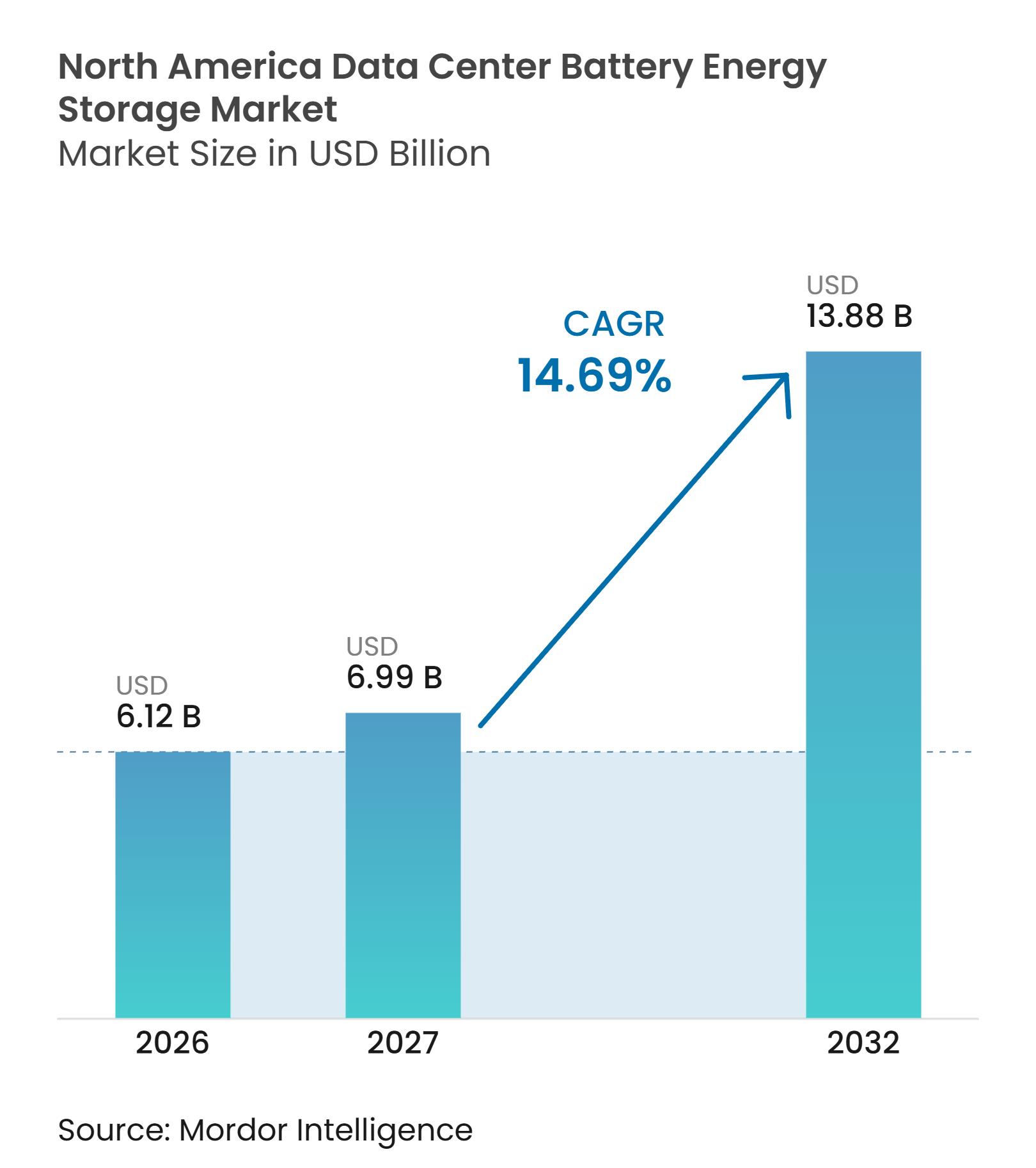
| Base Year Market Size (2026) | USD 6.12 Billion |
| Market Size (2027) | USD 6.99 Billion |
| Market Size (2032) | USD 13.88 Billion |
| Growth Rate (2027 - 2032) | 14.69 % |
| Market Concentration | Medium |
Major Players *Disclaimer: Major Players sorted in no particular order Image © Mordor Intelligence. Reuse requires attribution under CC BY 4.0. | |
North America Data Center Battery Energy Storage Market Analysis by Mordor Intelligence
The North America data center battery energy storage market size was valued at USD 6.12 billion in 2026 and is estimated to increase from USD 6.99 billion in 2027 to reach USD 13.88 billion by 2032, at a CAGR of 14.69% during the forecast period 2027-2032. AI workloads are increasing electricity demand and raising the power density required inside data centers. Grid connection delays are making on-site storage more important for new campuses. Operators are also replacing diesel and valve-regulated lead-acid systems with battery-backed alternatives that can respond faster to changing loads. The North America data center battery energy storage market is moving toward systems that combine backup power, peak management, and renewable power balancing. Supplier selection is increasingly shaped by fire safety, domestic-content rules, and power conversion performance.
Key Report Takeaways
- By battery chemistry, LFP held 36.14% of the North America data center battery energy storage market share in 2026, while sodium-ion is projected to expand at a 15.27% CAGR through 2032.
- By system component, battery cells and modules accounted for 35.41% of the North America data center battery energy storage market in 2026, while energy management software is projected to expand at a 15.56% CAGR through 2032.
- By primary application, UPS and short-duration backup held 45.67% of the North America data center battery energy storage market in 2026, while renewable energy integration is projected to expand at a 15.89% CAGR through 2032.
- By storage duration, below 1 hour accounted for 58.19% of the North America data center battery energy storage market in 2026, while above 4 hours is projected to expand at a 16.21% CAGR through 2032.
- By data center size, hyperscale facilities held 56.88% of the North America data center battery energy storage market in 2026 and are projected to expand at a 16.55% CAGR through 2032.
- By data center type, colocation operators accounted for 65.21% of the North America data center battery energy storage market in 2026, while cloud service providers are projected to expand at a 16.84% CAGR through 2032.
- By geography, the United States held 62.16% of the North America data center battery energy storage market in 2026, while Mexico is projected to expand at a 17.23% CAGR through 2032.
Note: Market numbers in this report are based on Mordor Intelligence's proprietary estimation framework, which combines nine months of actuals with Q4 projections for base year 2026.
Market Trends and Insights
Drivers Impact Analysis of North America Data Center Battery Energy Storage Market*
| Driver | (~) % Impact on CAGR Forecast | Geographic Relevance | Impact Timeline |
|---|---|---|---|
| AI Workload Growth and Rising Data Center Power Density | +3.2% | Global, concentrated in U.S. hyperscale and colocation hubs | Short term (≤ 2 years) |
| Grid-Capacity Constraints and Extended Interconnection Queues | +2.7% | U.S. PJM, ERCOT, and MISO corridors, Canada Ontario and Alberta | Short term (≤ 2 years) |
| Expansion of Hyperscale and Colocation Data Centers | +2.3% | U.S.-led, with spillover to Mexico and Canada | Medium term (2-4 years) |
| Renewable Power Procurement and Grid-Interactive Data Center Strategies | +1.9% | U.S. ERCOT, PJM, and Pacific Northwest, Canada BC and Ontario, Mexico Querétaro | Medium term (2-4 years) |
| AI-Driven UPS Load Transients Requiring Fast-Response Storage | +1.6% | Global, concentrated in U.S. AI factory campuses | Short term (≤ 2 years) |
| Domestic Battery Manufacturing Incentives and Regional Supply-Chain Localization | +1.4% | U.S.-led, with spillover to Mexico and Canada | Medium term (2-4 years) |
| Source: Mordor Intelligence | |||
AI Workload Growth and Rising Data Center Power Density
AI training and inference are changing power requirements for the North America data center battery energy storage market. Rack density increased from 16 kW in 2025 to 27 kW in 2026, while some AI deployments exceeded 50-70 kW per rack. These loads can change within milliseconds, which creates a role for fast-response battery systems alongside conventional backup equipment. Battery systems can absorb short load swings before generators or grid resources respond. This favors LFP and sodium-ion systems that offer rapid discharge rates and improved thermal characteristics.
Grid-Capacity Constraints and Extended Interconnection Queues
Grid access is becoming a central constraint on the North America data center battery energy storage market. The U.S. interconnection queue contained nearly 2,600 GW of generation and storage projects at the end of 2025, and projects often require years to reach operation. Dominion Energy reported pending large-load delivery-point requests totaling 70,000 MW in Virginia for 2025. On-site storage can reduce peak grid demand and support the phased energization of projects. This makes battery storage relevant even when the final design retains a permanent utility connection.
Expansion of Hyperscale and Colocation Data Centers
Hyperscale and colocation development is concentrating battery procurement among large operators. Third-party facilities hosted 46% of IT workloads in 2026, placing more power in planning decisions in the hands of cloud and colocation providers. These operators use repeatable designs across several sites and can purchase batteries through multiyear supply agreements. They also have stronger reasons to use storage for demand response and frequency services. This pattern brings battery orders forward as operators prepare capacity before tenants move in.
Renewable Power Procurement and Grid-Interactive Data Center Strategies
Renewable procurement is widening the role of batteries from backup equipment to operating infrastructure. U.S. energy storage installations reached 9.7 GWh in the first quarter of 2026, and 48% of installed utility-scale capacity was co-located with solar generation. Storage helps data centers match variable renewable output with continuous computing loads. The U.S. Department of Energy identifies battery storage, solar, and wind among the scalable resources that can help meet rising data center electricity demand. The North America data center battery energy storage market, therefore, benefits when operators seek both reliable power and a cleaner electricity supply.
Restraints Impact Analysis of North America Data Center Battery Energy Storage Market*
| Restraint | (~) % Impact on CAGR Forecast | Geographic Relevance | Impact Timeline |
|---|---|---|---|
| High Upfront Capital Expenditure and Extended Payback Periods | -1.7% | Global, strongest among U.S. enterprise and mid-tier colocation operators | Medium term (2-4 years) |
| Thermal Runaway, Fire-Safety Requirements, and Siting Restrictions | -1.2% | U.S. Northern Virginia, California, and urban cores, Canada Ontario | Short term (≤ 2 years) |
| Shortage of High-Voltage Engineering and Commissioning Talent | -0.8% | U.S.-wide, concentrated in ERCOT, PJM, and MISO markets | Medium term (2-4 years) |
| Long Lead Times for Transformers, Switchgear, and Interconnection Equipment | -0.7% | U.S. and Canada, with spillover to Mexico | Long term (≥ 4 years) |
| Source: Mordor Intelligence | |||
High Upfront Capital Expenditure and Extended Payback Periods
High upfront costs limit adoption among enterprise operators and smaller colocation sites. Large LFP installations require power conversion equipment, thermal controls, and fire protection systems in addition to the battery itself. Federal production incentives can support domestic cell manufacturing, but supply requirements can reduce access to lower-cost imported cells. The Section 45X production credit provides USD 35/kWh for qualifying U.S.-produced battery cells. Long procurement cycles also make it harder for operators to judge project returns when equipment and interconnection requirements are still changing.
Thermal Runaway, Fire-Safety Requirements, and Siting Restrictions
Thermal runaway risk remains a major siting issue for lithium-ion storage in dense data center areas. NFPA 855 provides a safety framework for stationary energy storage systems, including requirements that influence installation design and emergency response planning. UL 9540A testing is widely used to assess thermal runaway propagation in battery energy storage systems.[1] These requirements add engineering work and can extend approval schedules. Sodium-ion alternatives are attracting attention where operators place a high value on safety documentation and reduced dependence on lithium supply chains.
*Our forecasts treat driver/restraint impacts as directional, not additive. The impact forecasts reflect baseline growth, mix effects, and variable interactions.
North America Data Center Battery Energy Storage Market Segment Analysis
By Battery Chemistry:
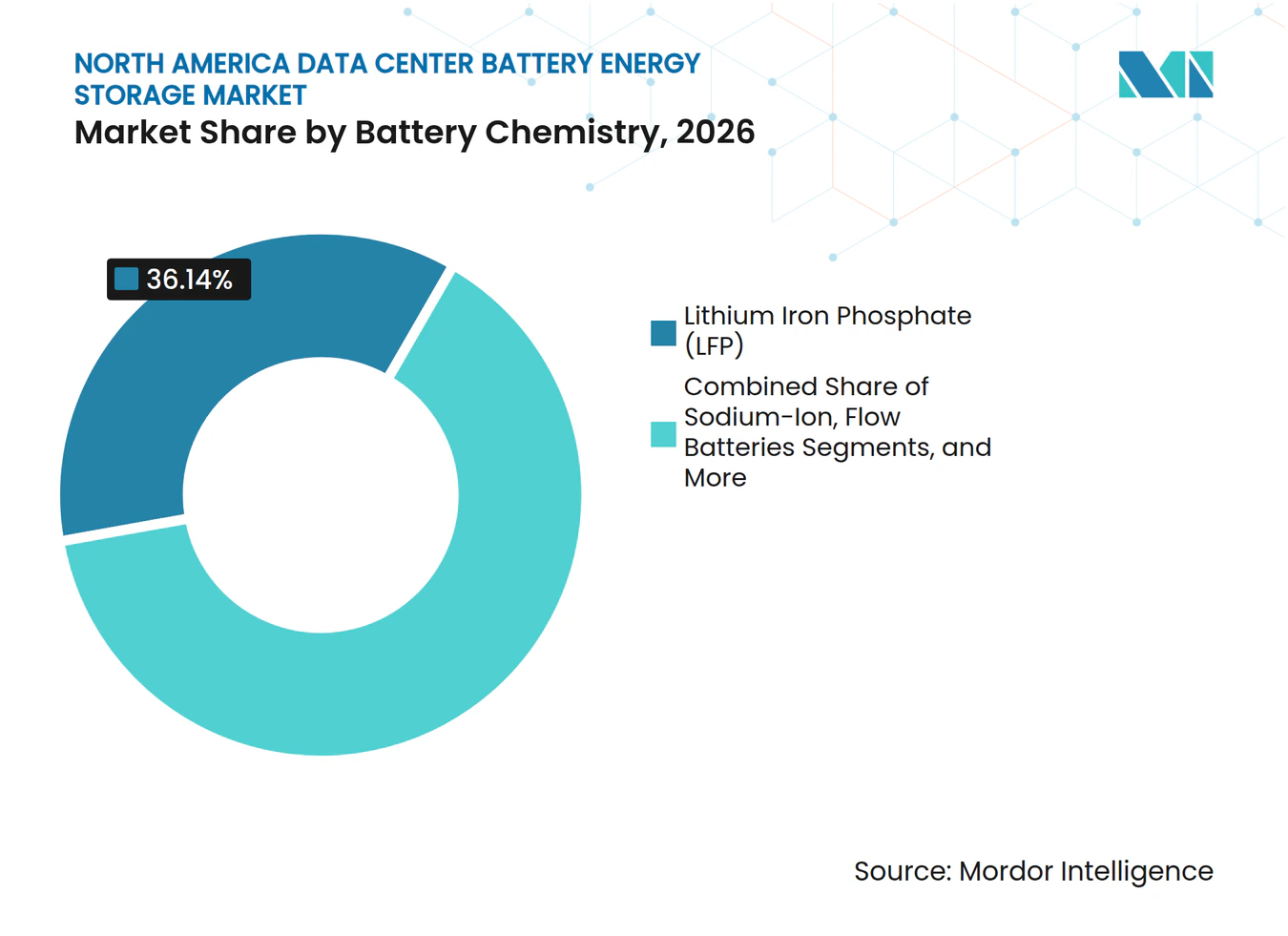
LFP Leads While Sodium-Ion Gains RelevanceLFP held 36.14% of the North America data center battery energy storage market in 2026. The chemistry is widely used because it supports long cycle life, fast discharge, and a more stable thermal profile. LFP systems are suitable for UPS switching in facilities with changing AI loads. Saft introduced its Flex'ion Gen3 LFP UPS battery in July 2026, delivering 268 kW from a 67 kWh cabinet. The product showed continued performance improvements within the established LFP segment.
Sodium-ion is projected to expand at a 15.27% CAGR through 2032. Operators are considering it where fire safety and supply-chain exposure are important procurement factors. NMC remains useful where available space places a premium on energy density. Lead-acid systems continue to serve older facilities, although replacement programs are progressing. Flow batteries retain a limited role in longer-duration renewable integration projects.



By System Component:
Software Adds a Faster-Growing Value LayerBattery cells and modules accounted for 35.41% of the North America data center battery energy storage market in 2026. They remain the highest-cost and highest-volume element in a storage installation. Racks and cabinets are becoming more standardized to shorten installation time at large campuses. Battery management systems and power conversion systems determine how safely the hardware performs. NVIDIA’s DSX Ready program has increased attention on power conversion behavior at AC terminals.
Energy management software is projected to expand at a 15.56% CAGR through 2032. Software can coordinate backup power, peak shaving, and grid service dispatch from a single operating platform. FlexGen and Rosendin announced a 2025 BESSUPS collaboration that combined storage hardware with HybridOS controls. Interoperability also matters when operators use hardware from multiple suppliers. IEC 62933 supports common approaches to electrical energy storage system performance and safety.
By Primary Application:
UPS Retains Its Lead as Renewable Integration ExpandsUPS and short-duration backup systems accounted for 45.67% of the North America data center battery energy storage market in 2026. The segment benefits from replacing lead-acid UPS strings with lithium-ion systems. AI loads can change sharply and require a battery system to respond before other backup resources become available. This requirement supports higher-rate UPS products and medium-voltage designs. Extended backup and load shifting are becoming more common within facilities that already use lithium-ion batteries.
Renewable energy integration is projected to expand at a 15.89% CAGR through 2032. Storage helps firm variable solar and wind output against a data center’s continuous demand profile. The Department of Energy recognizes storage as a useful complement to renewable resources serving data center demand.[2] Storage can also help a project operate while permanent grid upgrades remain incomplete. This creates a practical link between renewable contracts, interconnection planning, and resilience investments.
By Storage Duration:
Short Systems Lead While Longer Systems Gain SupportBelow 1 hour held 58.19% of the North America data center battery energy storage market in 2026. This reflects the historical role of UPS systems that bridge a grid disruption until generators start. Five-minute and 15-minute LFP systems also serve fast AI load-transient buffering. The 1-2 hour and above 2-4 hour ranges are gaining use where operators combine backup power with peak reduction. Urban siting requirements can limit the practical size of very large battery installations.
The above 4-hour segment is projected to expand at a 16.21% CAGR through 2032. Hyperscale operators need longer-duration firm power to reduce reliance on constrained grid connections. Meta’s 2026 reservation agreement with Noon Energy covered up to 1 GW/100 GWh of ultra-long-duration storage. Form Energy also announced a 12 GWh iron-air battery supply agreement with Crusoe for deliveries beginning in 2027. These commitments indicate greater interest in systems that can support renewable energy for several hours or longer.
By Data Center Size:
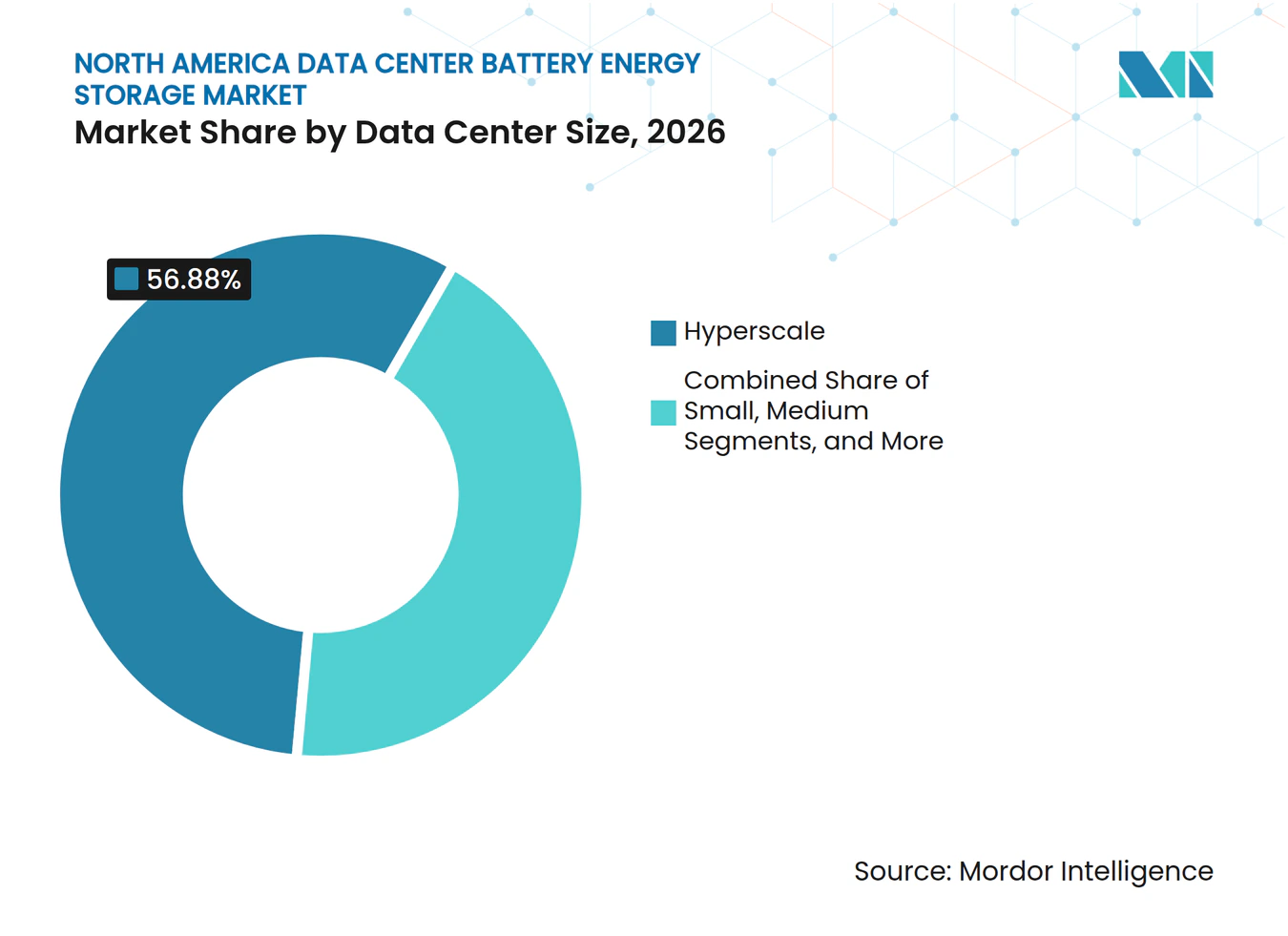
Hyperscale Facilities Lead Demand and ExpansionHyperscale facilities captured 56.88% of the North America data center battery energy storage market in 2026. The segment is projected to expand at a 16.55% CAGR through 2032, making it both the largest and fastest-moving size category. Large operators can fund complex power systems and arrange multiyear battery supply agreements. Fluence signed master supply agreements with 2 major hyperscale data center developers in 2026. These buyers also place more weight on documented power conversion performance and engineering support.
Large data centers remain important because colocation sites and regional cloud zones are increasing capacity for AI workloads. Medium and small facilities face higher installed costs per kilowatt-hour and less purchasing leverage. Their existing equipment often includes older lead-acid backup strings. Average rack density rose from 9 kW in 2025 to 11 kW in 2026 across facility sizes. Some organizations are shifting AI computing to hyperscale providers rather than rebuilding their own power infrastructure.

By Data Center Type:
Colocation Holds the Largest Base While CSPs AccelerateColocation operators accounted for 65.21% of the North America data center battery energy storage market in 2026. Their service commitments require dependable power systems capable of supporting high-density customer loads. They also have a large retrofit opportunity as existing sites replace legacy UPS configurations. Battery-backed designs can support service-level commitments and improve power flexibility. Enterprise and edge sites generally procure smaller systems and retain lead-acid equipment for longer.
Cloud service providers are projected to expand at a 16.84% CAGR through 2032. Their procurement needs include backup power, renewable matching, and demand management. Storage enables these operators to align power purchase agreements with data center load timing. Their scale also supports longer-duration designs and advanced energy management software. The North America data center battery energy storage industry is therefore increasingly shaped by cloud-led infrastructure planning.
Geography Analysis
United States
The United States held 62.16% of the North America data center battery energy storage market share in 2026. The country has the region’s largest concentration of hyperscale, colocation, and cloud facilities. U.S. data center electricity consumption is projected to rise by 240 TWh by 2030 from 2024 levels.[3] This demand is driving large storage decisions in Virginia, Texas, Oregon, Arizona, and Georgia. Federal tax incentives and Foreign Entity of Concern rules are redirecting procurement toward U.S. and South Korean cell supply.
Mexico
Mexico is projected to expand at a 17.23% CAGR through 2032. Nearshoring investment and limited grid capacity are increasing the case for on-site storage at data center projects. The national plan includes 2,216 MW of battery storage by 2030 through the Comisión Federal de Electricidad. Panasonic announced a USD 2 billion investment in battery manufacturing to support AI data center applications, with Mexico serving as a regional module hub. Projects that pair renewable power agreements with storage can reduce exposure to extended conventional connection timelines.
Canada and Regional Power Planning
Canada’s installed battery storage capacity more than doubled in 2025 to nearly 1 GW. The Hagersville Energy Storage Project reached commercial operation in February 2026 with 300 MW/1,200 MWh of capacity. The Canada Energy Regulator projects national battery storage capacity could reach 15-23 GW by 2050, depending on the scenario. The Alberta Electric System Operator is developing a flexible interconnection approach that could allow data centers to combine grid access with on-site battery systems.
Competitive Landscape
Market Concentration
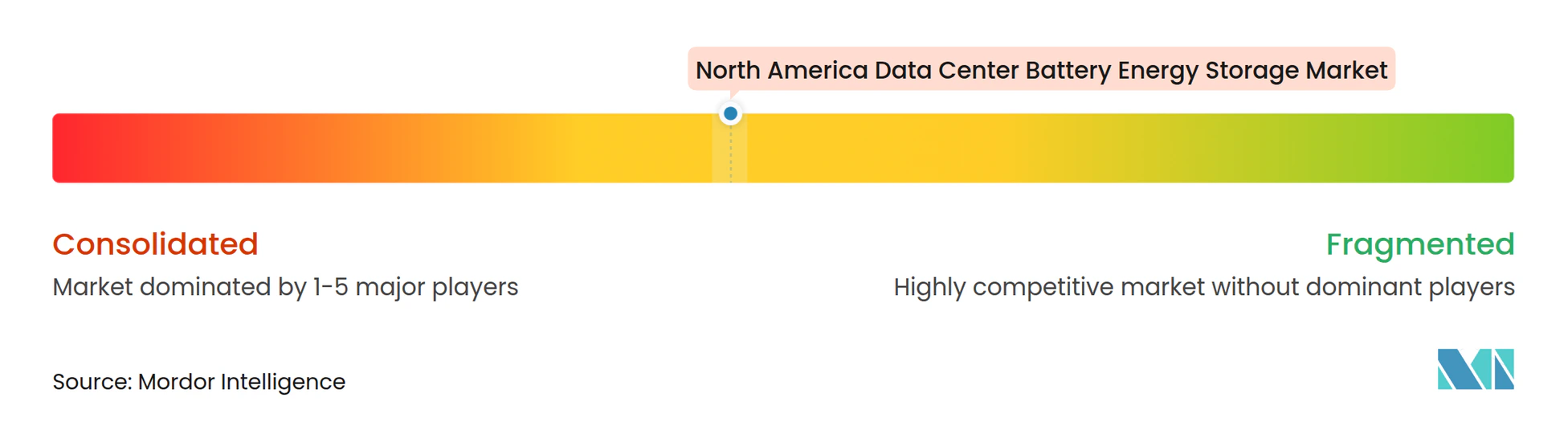
The North America data center battery energy storage market has a moderately concentrated cell supply layer. CATL, LG Energy Solution, Samsung SDI, Tesla, and BYD are prominent battery suppliers. System integration is more fragmented, with Fluence Energy, EnerSys, Hithium Energy Storage Technology, Saft Groupe, Eos Energy Enterprises, ESS Tech, and Form Energy active across different use cases. Competition now extends beyond cell price to power conversion performance, safety evidence, and domestic sourcing. NVIDIA’s DSX Ready program raised the importance of documented system performance for AI data center procurement.
LG Energy Solution reported a large ESS order pipeline and announced plans to expand its regional manufacturing footprint in 2026. Tesla’s Megapack 2XL and LG Energy Solution’s Vertech JF2 AC Link were among the first systems certified under the DSX Ready program. Saft launched the Flex'ion Gen3 UPS battery with a higher power-density design in July 2026. Fluence introduced Smartstack, a 10 MWh product designed to improve site density and lower balance-of-plant costs. These moves show that suppliers are competing through certified systems, more compact equipment, and production capacity closer to customers.
Sodium-ion, iron-air, and flow battery providers are targeting applications where safety, duration, or supply-chain requirements differ from conventional lithium-ion projects. Independent software providers also offer controls that can operate hardware from several vendors. This may reduce the advantage of closed proprietary platforms. Compliance with NFPA 855 and UL 9540A has become a visible procurement consideration for new projects.
North America Data Center Battery Energy Storage Industry Leaders
-
GS Yuasa International Ltd.
-
BYD Company Limited
-
LG Energy Solution, Ltd.
-
Samsung SDI Co., Ltd.
-
Panasonic Energy Co., Ltd.
- *Disclaimer: Major Players sorted in no particular order
North America Data Center Battery Energy Storage Market Companies Covered in this Report
- Contemporary Amperex Technology Co., Limited
- Tesla, Inc.
- LG Energy Solution, Ltd.
- Samsung SDI Co., Ltd.
- Panasonic Energy Co., Ltd.
- BYD Company Limited
- EnerSys
- Exide Technologies, Inc.
- East Penn Manufacturing Co., Inc.
- GS Yuasa International Ltd.
- Saft Groupe S.A.S.
- HOPPECKE Batterien GmbH and Co. KG
- EVE Energy Co., Ltd.
- Hithium Energy Storage Technology Co., Ltd.
- Fluence Energy, Inc.
- Eos Energy Enterprises, Inc.
- Form Energy, Inc.
- Invinity Energy Systems plc
- ESS Tech, Inc.
- Electrovaya Inc.
Recent Industry Developments in North America Data Center Battery Energy Storage Market
- October 2026: LG Energy Solution formally established 5 ESS production hubs across North America. Its Lansing, Michigan facility exceeded 35 GWh of annual cell production capacity for LFP ESS and NMC EV cells. The company secured more than KRW 3 trillion (USD 2.2 billion) in new ESS orders in H1 2026 and targeted more than 50 GWh of regional ESS production capacity by year-end.
- October 2026: Tesla began operations at its Megapack production plant in Brookshire, Texas. The plant expanded North American ESS system production capacity to 90 GWh annually. LG Energy Solution and Samsung SDI were identified as primary cell suppliers targeting 23 GWh of annual supply to the facility beginning in Q4 2026.
- September 2026: Nvidia launched its DSX Ready BESS qualification program for AI data center infrastructure. Hitachi Energy’s WD4 PCS and battery storage system at 5 MW/10 MWh, LG Energy Solution’s LGES Vertech JF2 AC Link at 5 MW/10 MWh, and Tesla’s Megapack 2XL at 1.93 MW/3.85 MWh were named as the first 3 certified systems. The program introduced PCS-level technical compliance as a baseline requirement for BESS procurement at hyperscale accounts.
- August 2026: Noon Energy and Sabanci Renewables signed a joint venture agreement to co-develop up to 1 GW of ultra-long-duration energy storage for AI data center applications. The venture combines reversible solid oxide fuel cell technology with utility-scale solar and wind resources. Commercial deployment is targeted as early as 2027.
North America Data Center Battery Energy Storage Market Report Scope
The North America Data Center Battery Energy Storage Market refers to the deployment of battery energy storage technologies in data centers across the United States, Canada, and Mexico to support backup power, renewable energy integration, peak demand management, microgrid operations, and grid service participation. The market is driven by hyperscale expansion, AI-related growth in power demand, increasing grid constraints, resilience requirements, and growing investments in sustainable energy infrastructure.
The North America Data Center Battery Energy Storage Market Report is Segmented by Battery Chemistry (Lithium Iron Phosphate [LFP], Nickel Manganese Cobalt [NMC], Lead-Acid, Sodium-Ion, Flow Batteries, and Other Battery Chemistries), System Component (Battery Cells and Modules, Battery Racks and Cabinets, Battery Management Systems [BMS], Power Conversion Systems [PCS], Thermal Management and Safety Systems, and Energy Management Software), Primary Application (UPS and Short-Duration Backup, Extended-Duration Backup Power, Peak Shaving and Load Shifting, Renewable Energy Integration, and Microgrid and Grid Services), Storage Duration (Below 1 Hour, 1-2 Hours, Above 2-4 Hours, and Above 4 Hours), Data Center Size (Small, Medium, Large, and Hyperscale), Data Center Type (Colocation, Cloud Service Providers [CSPs], and Enterprise and Edge), and Geography (United States, Canada, and Mexico). The Market Forecasts are Provided in Terms of Value (USD).
Segmentation Overview
| Lithium Iron Phosphate (LFP) |
| Nickel Manganese Cobalt (NMC) |
| Lead-Acid |
| Sodium-Ion |
| Flow Batteries |
| Other Battery Chemistries |
| Battery Cells and Modules |
| Battery Racks and Cabinets |
| Battery Management Systems (BMS) |
| Power Conversion Systems (PCS) |
| Thermal Management and Safety Systems |
| Energy Management Software |
| UPS and Short-Duration Backup |
| Extended-Duration Backup Power |
| Peak Shaving and Load Shifting |
| Renewable Energy Integration |
| Microgrid and Grid Services |
| Below 1 Hour |
| 1-2 Hours |
| Above 2-4 Hours |
| Above 4 Hours |
| Small |
| Medium |
| Large |
| Hyperscale |
| Colocation |
| Cloud Service Providers (CSPs) |
| Enterprise and Edge |
| United States |
| Canada |
| Mexico |
| By Battery Chemistry | Lithium Iron Phosphate (LFP) |
| Nickel Manganese Cobalt (NMC) | |
| Lead-Acid | |
| Sodium-Ion | |
| Flow Batteries | |
| Other Battery Chemistries | |
| By System Component | Battery Cells and Modules |
| Battery Racks and Cabinets | |
| Battery Management Systems (BMS) | |
| Power Conversion Systems (PCS) | |
| Thermal Management and Safety Systems | |
| Energy Management Software | |
| By Primary Application | UPS and Short-Duration Backup |
| Extended-Duration Backup Power | |
| Peak Shaving and Load Shifting | |
| Renewable Energy Integration | |
| Microgrid and Grid Services | |
| By Storage Duration | Below 1 Hour |
| 1-2 Hours | |
| Above 2-4 Hours | |
| Above 4 Hours | |
| By Data Center Size | Small |
| Medium | |
| Large | |
| Hyperscale | |
| By Data Center Type | Colocation |
| Cloud Service Providers (CSPs) | |
| Enterprise and Edge | |
| By Geography | United States |
| Canada | |
| Mexico |
Key Questions Answered in the Report
What is the North America data center battery energy storage market size?
The market was valued at USD 6.12 billion in 2026, is estimated at USD 6.99 billion in 2027, and is projected to reach USD 13.88 billion by 2032.
What is driving battery storage adoption in North American data centers?
AI power demand, constrained grid connections, replacement of older backup systems, and renewable power integration are supporting adoption.
Which battery chemistry leads data center storage demand?
LFP held 36.14% share in 2026 because it offers fast discharge, long cycle life, and strong thermal characteristics.
Which application is expanding fastest for data center batteries?
Renewable energy integration is projected to expand at a 15.89% CAGR through 2032 as operators seek firm power for continuous computing loads.
Which country is expanding fastest in the regional data center storage sector?
Mexico is projected to expand at a 17.23% CAGR through 2032, supported by nearshoring activity and constrained grid capacity.
Why are longer-duration battery systems becoming more relevant?
Above 4-hour systems are projected to expand at a 16.21% CAGR through 2032 as hyperscale operators seek multi-hour firm power and stronger renewable energy support.