
North America Data Center Automation Market Size and Share
Market Overview
| Study Period | 2021 - 2032 |
|---|---|
| Forecast Data Period | 2027 - 2032 |
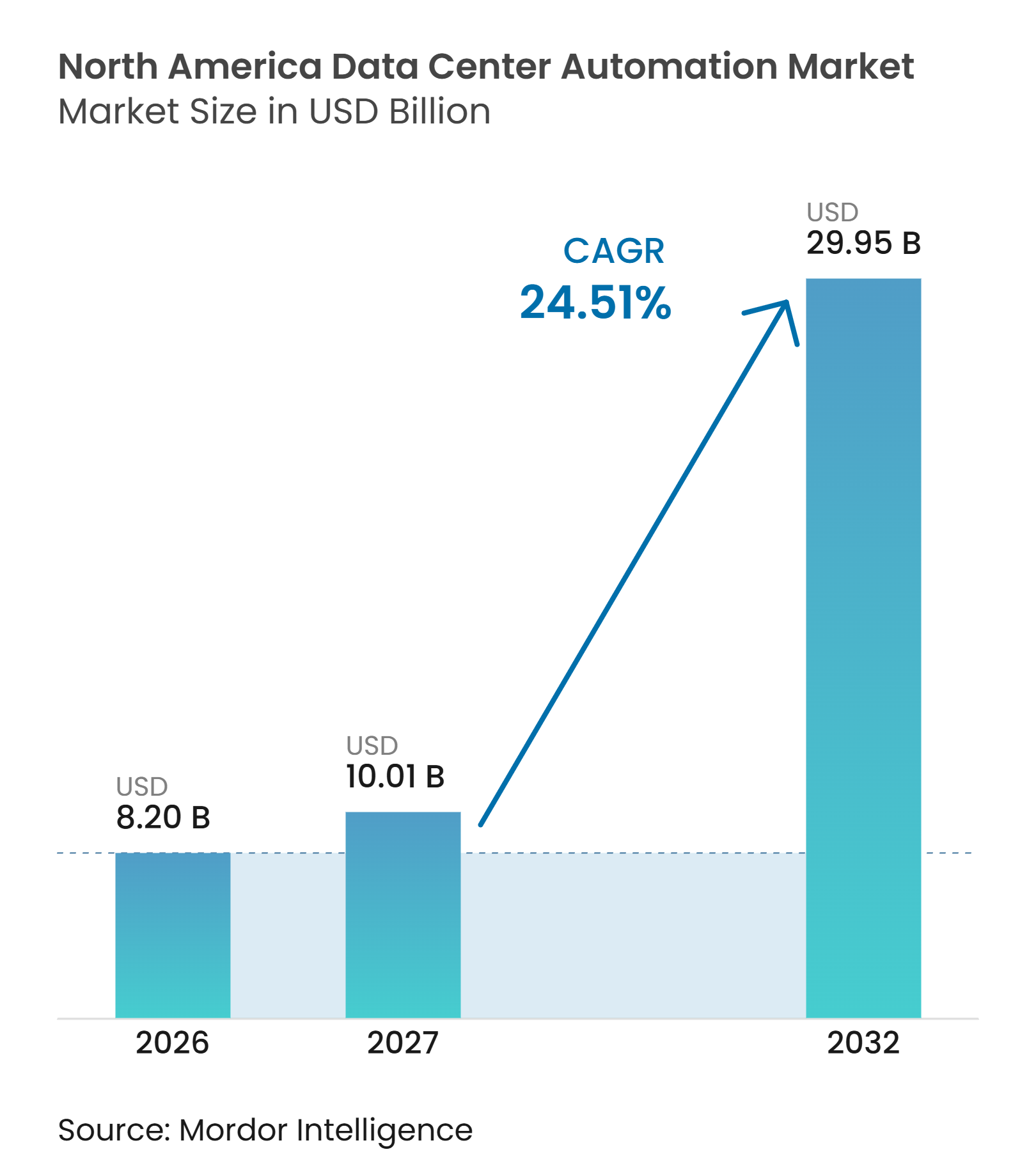
| Base Year Market Size (2026) | USD 8.20 Billion |
| Market Size (2027) | USD 10.01 Billion |
| Market Size (2032) | USD 29.95 Billion |
| Growth Rate (2027 - 2032) | 24.51 % |
| Market Concentration | Medium |
Major Players *Disclaimer: Major Players sorted in no particular order Image © Mordor Intelligence. Reuse requires attribution under CC BY 4.0. | |
North America Data Center Automation Market Analysis by Mordor Intelligence
The North America data center automation market size was valued at USD 8.20 billion in 2026 and is estimated to increase to USD 29.95 billion by 2032, at a CAGR of 24.51% during the forecast period 2027-2032. The North America data center automation market is supported by denser AI workloads, which place greater demands on power distribution, cooling, and facility control. New capacity is also being built across more locations, so operators need consistent control systems across established and emerging campuses. The North America data center automation market is moving from separate monitoring tools toward connected power, cooling, building management, and data center infrastructure management platforms. Energy use, reliability, and cybersecurity requirements are raising the value of real-time visibility and automated response. Hardware remains important because field devices provide the physical control layer, while software can extend automation into predictive and remote operations.
Key Report Takeaways
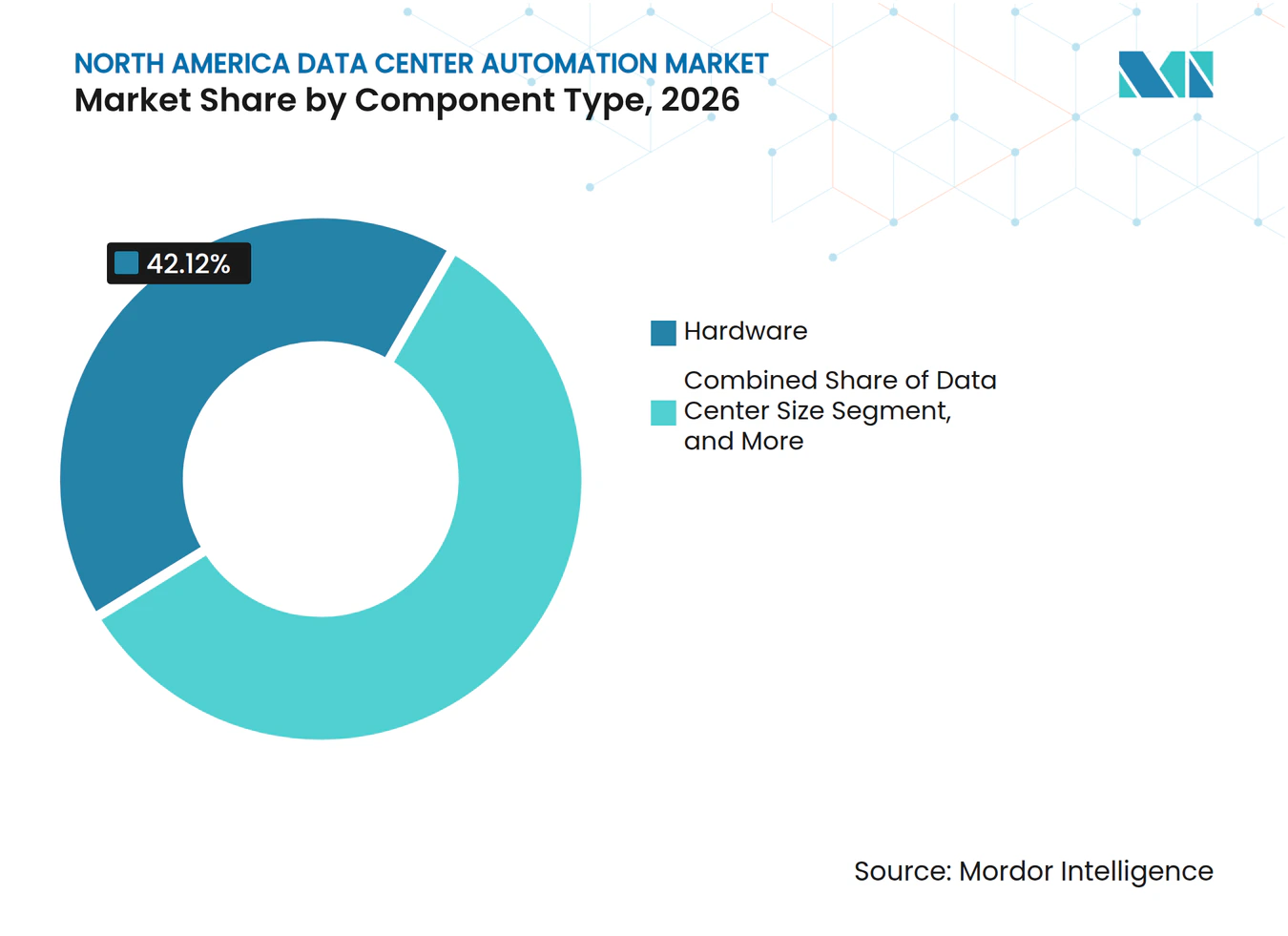
- By component type, hardware held 42.12% of the North America data center automation market share in 2026, while software is projected to expand at a 25.11% CAGR through 2032.
- By data center size, hyperscale facilities accounted for 41.78% of revenue in 2026 and are expected to advance at a 25.32% CAGR through 2032.
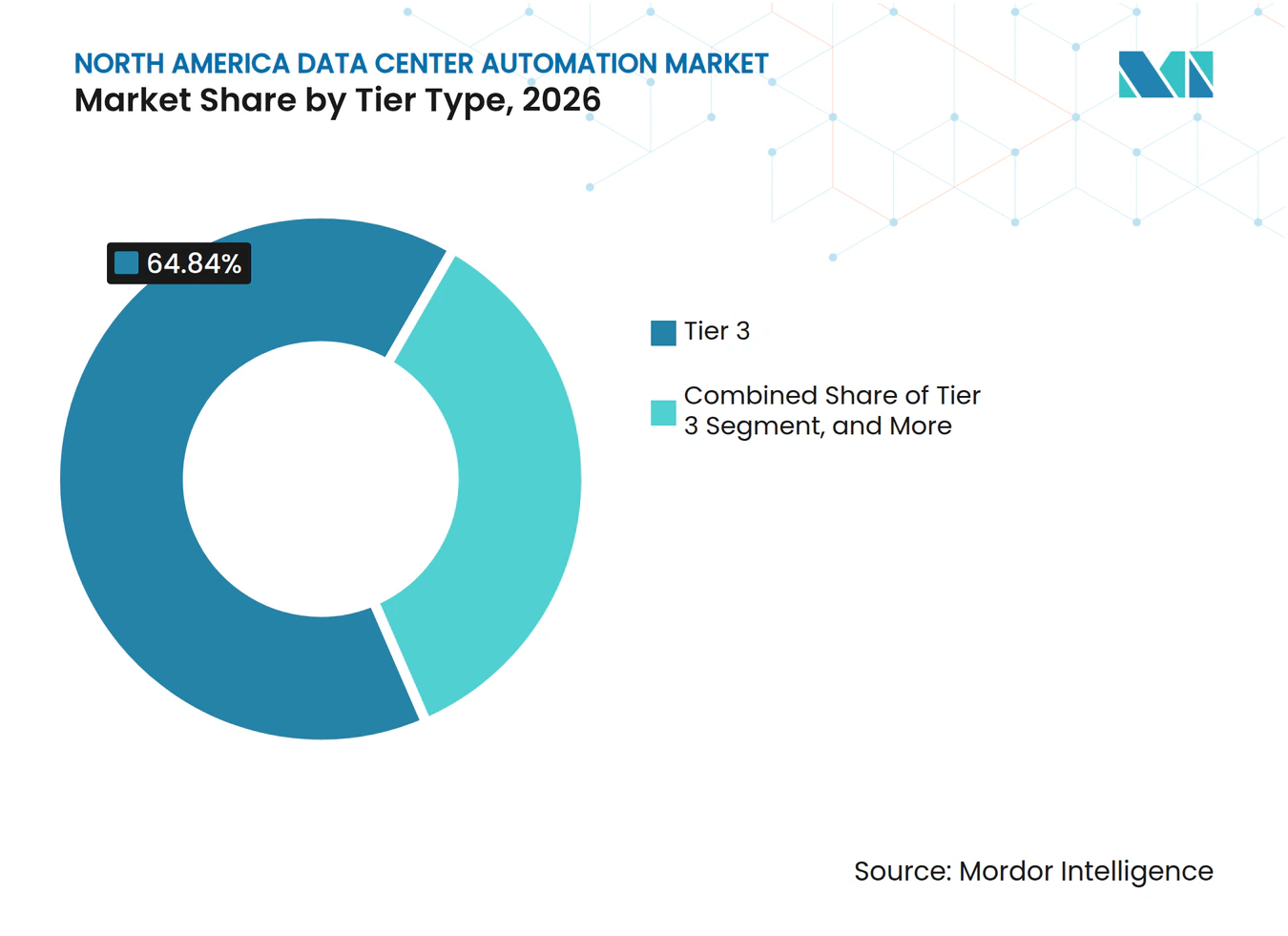
- By tier type, Tier 3 accounted for 64.84% of revenue in 2026, while Tier 4 is projected to grow at a 25.08% CAGR through 2032.
- By geography, the United States held 78.19% of regional revenue in 2026, while Canada is projected to expand at a 24.87% CAGR through 2032.
Note: Market numbers in this report are based on Mordor Intelligence's proprietary estimation framework, which combines nine months of actuals with Q4 projections for base year 2026.
Market Trends and Insights
Drivers Impact Analysis of North America Data Center Automation Market*
| Driver | (~) % Impact on CAGR Forecast | Geographic Relevance | Impact Timeline |
|---|---|---|---|
| AI and High-Performance Computing Workload Expansion | +6.8% | North America, concentrated in US primary markets | Short term (≤ 2 years) |
| Hyperscale and Colocation Capacity Expansion | +4.5% | US primary and secondary markets, Canada | Short term (≤ 2 years) |
| Hybrid-Cloud and Multi-Cloud Operational Complexity | +3.2% | US enterprise and colocation segments, Canadian and Mexican cloud-adjacent operators | Medium term (2-4 years) |
| Energy Optimization and Sustainability Requirements | +2.4% | North America, with standards-related spillover from Europe | Medium term (2-4 years) |
| Integrated SCADA, DCIM, and BMS Convergence | +1.8% | US hyperscale and large colocation facilities | Medium term (2-4 years) |
| Edge and Modular Data Center Deployment | +1.4% | United States, Canada secondary and tertiary markets | Long term (≥ 4 years) |
| Source: Mordor Intelligence | |||
AI and High-Performance Computing Workload Expansion
AI workloads are increasing the density and variability of power and cooling demand inside facilities. This places limits on manual procedures because operators must respond quickly to changing conditions across electrical and thermal systems. The North America data center automation market, therefore, benefits from automated power distribution, predictive thermal management, and coordinated facility controls. The Oak Ridge National Laboratory selected HPE and AMD for a successor exascale system and a separate AI cluster, showing continued public support for high-performance computing infrastructure.[1] AI inference workloads can also require distributed deployments closer to users, which increases the number of sites that need standardized monitoring and control. This supports demand for systems that can operate reliably across both large campuses and smaller edge locations, while helping operators record equipment conditions, coordinate alarms, and maintain consistent procedures when workloads move between sites.
Hyperscale and Colocation Capacity Expansion
Hyperscale and colocation development increases the need to automate commissioning, monitoring, and routine facility operations. Large projects must bring power, cooling, security, and control equipment into service with less operational disruption. The North America data center automation market gains when operators use common platforms across multiple campuses and construction phases. High levels of preleasing can reinforce this need because capacity must become usable soon after it is commissioned. The build cycle is also extending beyond traditional primary markets, which creates opportunities for vendors and integrators in secondary locations. Automation can help new operators apply repeatable operating practices when they enter these locations and provide facility teams with a clearer operating record as new campuses move from commissioning to steady service.
Hybrid-Cloud and Multi-Cloud Operational Complexity
Hybrid and multi-cloud deployments connect on-premises systems to multiple cloud environments. This creates dependencies among power circuits, cooling equipment, network links, and workload placement. The North America data center automation market benefits when facility platforms give operators a shared view of these dependencies. Modern DCIM can connect operational data to the needs of IT teams managing distributed workloads. Cloud-hosted analytics can reduce the initial burden of deploying these capabilities for some operators. Subscription delivery can also make advanced control tools more accessible to mid-sized colocation providers that previously relied on separate monitoring systems, helping teams use analytics and reporting without operating separate software infrastructure at each location.
Energy Optimization and Sustainability Requirements
Energy performance has become an important procurement consideration for data center operators. Manual tracking can limit the quality and speed of energy reporting across complex facilities. ISO/IEC 30134-2:2026 provides a framework for measuring and reporting power usage effectiveness. The North America data center automation market can support continuous measurement of power usage, water use, and carbon-related operating data. These capabilities are relevant where customers, investors, and regulators expect more consistent environmental reporting. They also help operators identify conditions that can raise energy use or strain cooling equipment, support maintenance planning, and ease performance comparisons across a portfolio.
Restraints Impact Analysis of North America Data Center Automation Market*
| Restraint | (~) % Impact on CAGR Forecast | Geographic Relevance | Impact Timeline |
|---|---|---|---|
| Legacy Protocol and Interoperability Constraints | -2.8% | North America, intensified in older US East Coast and Midwest clusters | Short term (≤ 2 years) |
| OT and IT Cybersecurity Exposure | -2.1% | North America, concentrated in US facilities with internet-connected BAS and OT assets | Short term (≤ 2 years) |
| High Implementation Cost and Skilled Labor Shortage | -1.6% | United States, with pressure in secondary markets | Medium term (2-4 years) |
| Power Availability, Grid Connection, and Cooling Constraints | -1.2% | US primary markets and emerging Canadian markets | Medium term (2-4 years) |
| Source: Mordor Intelligence | |||
Legacy Protocol and Interoperability Constraints
Legacy facilities often contain controllers and devices that use different communication protocols. Connecting these assets to a common BMS, SCADA, or DCIM platform can require gateways, integration work, and testing. The North America data center automation market faces slower adoption when these steps add cost or extend project schedules. Proprietary control systems can make modernization more difficult for operators who want to retain existing equipment. Industrial cybersecurity requirements can add another layer of work when old equipment is connected to newer platforms. These conditions make phased upgrades and systems integration services important in established data center clusters, where operators may also prioritize open interfaces for future expansion or mixed-generation equipment.
OT and IT Cybersecurity Exposure
Connected building and operational technology systems increase the number of assets that require protection. Claroty reported that 88% of surveyed building management systems used insecure protocol communication, while 40% had outdated firmware. The North America data center automation market must address security alongside automation because operators cannot separate the two in connected facilities. The Cybersecurity and Infrastructure Security Agency has published guidance for applying zero-trust principles to operational technology environments.[2] Segmentation, access control, secure configuration, and asset visibility can increase implementation complexity. They can also create demand for platforms and services designed for secure integration, making security controls part of implementation rather than a separate technical add-on.
*Our forecasts treat driver/restraint impacts as directional, not additive. The impact forecasts reflect baseline growth, mix effects, and variable interactions.
North America Data Center Automation Market Segment Analysis
By Component Type:
Software Platforms Extend Facility ControlHardware held 42.12% of the North America data center automation market share in 2026. Sensors, programmable logic controllers, gateways, and direct digital controllers provide the sensing and actuation layer for power distribution, thermal management, and other equipment that must respond to changing operating conditions. New hyperscale and Tier 3 construction requires dense field-level control equipment before higher software layers can be used, while older sites add monitoring points or replace legacy controllers. This gives equipment suppliers a role in both new construction and modernization work, while providing data inputs for software that identifies exceptions, performance reports, and directs operational actions.
Software is projected to expand at a 25.11% CAGR through 2032. DCIM, SCADA, BMS, and digital twin functions are increasingly being combined into broader operational platforms. Schneider Electric stated that EcoStruxure IT integrates ETAP and computational fluid dynamics capabilities for power and cooling scenario analysis.[3] The North America data center automation software market size is driven by the need to turn facility data into actionable operational decisions. Cloud-hosted delivery can lower the need for a large upfront software deployment, while services remain important for integration, retrofits, configuration, and optimization across mixed equipment estates. Service providers can help translate facility processes into digital workflows and align the operating teams that use these systems each day.



By Data Center Size:
Hyperscale Facilities Set the PaceHyperscale facilities accounted for 41.78% of the North America data center automation market share in 2026. Their high electrical and cooling loads necessitate consistent automation across the facility. These operators also have the scale to standardize equipment and operating procedures across multiple locations. Factory-assembled, modular infrastructure can incorporate more controls into the construction process rather than adding them after the building is complete. This approach can reduce commissioning time and support more repeatable deployments. It also favors vendors that can integrate hardware, software, and services into a common design. A consistent design can support training, spare parts planning, and operating procedures across a portfolio with several active construction sites.
Hyperscale is projected to expand at a 25.32% CAGR through 2032. Large and medium facilities need upgrades to meet tenant requirements and improve energy performance, whereas smaller locations have historically relied on less dedicated control infrastructure. Distributed AI inference can change this pattern when edge sites require reliable power, cooling, and remote oversight, while modular deployment can make standardized automation more practical in smaller locations. The North America data center automation industry can serve both dense campuses and distributed deployments with products that retain core control functions while remaining practical for smaller engineering teams.
By Tier Type:
Fault Tolerance Raises Automation NeedsTier 3 facilities held 64.84% of revenue in 2026. This design is widely used by colocation operators that need N+1 redundancy for enterprise customers, and its installed base supports continued demand for monitoring and modernization. Tier 1 and Tier 2 facilities can face pressure when tenants require more resilient environments. Operators may use SCADA and DCIM overlays to extend the life of legacy equipment, creating work for integrators to connect existing systems to newer control platforms. The work can include mapping equipment data, improving alarm management, and documenting control logic before facilities make broader changes.
Tier 4 is projected to expand at a 25.08% CAGR through 2032. These facilities serve workloads for which unplanned downtime can have significant operational and financial consequences. The Uptime Institute reported that high-density rack deployments are increasing and that modern facilities require capable power and cooling systems. Concurrent maintainability and fault tolerance require close coordination among electrical, thermal, and building systems, supported by real-time system visibility and controlled responses. The North America data center automation market benefits when operators build to these resilience requirements, and vendors must support disciplined testing, maintenance, and recovery across the facility.

Geography Analysis
United States Data Center Automation Market
The United States held 78.19% of regional revenue in 2026. The North America data center automation market size in the country reflects its large hyperscale base and concentration of established data center markets. Operators in these markets need automation to manage dense electrical and thermal infrastructure. Compliance requirements also affect procurement among federal contractors and regulated industries. The Cybersecurity and Infrastructure Security Agency's guidance on zero trust for operational technology is relevant to this need for more secure facility control.
Canada Data Center Automation Market
Canada is projected to expand at a 24.87% CAGR through 2032. Meta broke ground on a 1 GW AI-optimized data center in Sturgeon County, Alberta, in July 2026. Bell AI Fabric also announced a 300 MW data center in Saskatchewan in March 2026. These projects support demand for DCIM, SCADA, and BMS deployment at scale. Canadian operators are also building capacity for sovereign AI and high-density computing.
Mexico Data Center Automation Market
Mexico has a smaller regional revenue position but provides a developing destination for cross-border, latency-sensitive workloads. Querétaro and Monterrey offer locations for facilities serving customers in North America. KIO Data Centers announced a USD 1.3 billion expansion plan for its QR03 project in Querétaro. The North America data center automation market can benefit as new sites need integrated control systems from the start. Older Mexican facilities can also represent retrofit opportunities where SCADA or DCIM platforms were not included in the original design.
Competitive Landscape
Market Concentration
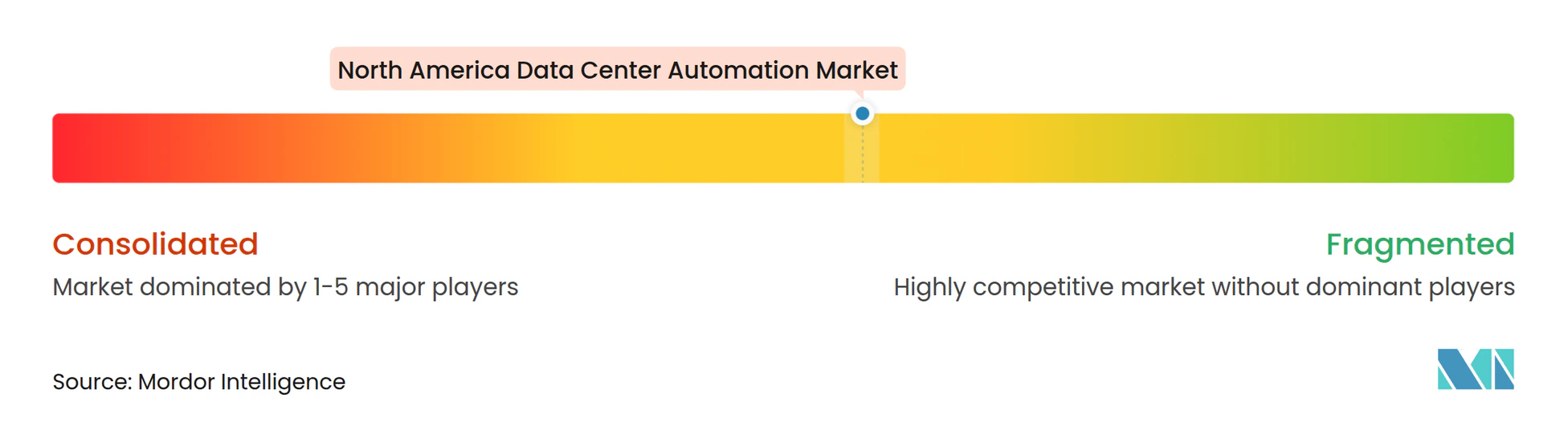
The North America data center automation market is moderately concentrated, and it includes integrated technology suppliers, specialized software providers, and systems integrators. Schneider Electric, Vertiv, ABB, Honeywell, Emerson, and Siemens have broad positions across equipment, software, and services. Cisco, IBM, Oracle, Nlyte, and Sunbird are active in software and digital infrastructure management. These offerings can reduce switching barriers for customers moving from separate tools to broader software environments. Vendors must show that their platforms can connect equipment from multiple suppliers without compromising control or cybersecurity.
Schneider Electric introduced EcoStruxure Foresight Operation in November 2025 and made it available to early adopters in 2026. The platform brings building management, energy management, and electrical systems into a single AI-powered environment. ABB announced its agreement to acquire Rotork in July 2026, expanding its automation portfolio for mission-critical infrastructure. ABB had also completed the IPEC acquisition in December 2025 to strengthen electrical diagnostics and monitoring capabilities.[4] These moves show competition around the full cycle of sensing, controlling, monitoring, and acting on facility conditions.
Modular data center builders are integrating automation into factory-assembled systems. Cisco launched its Cloud Control platform in June 2026 to help people and AI agents manage, monitor, and defend critical IT infrastructure. The North America data center automation market is also moving toward more autonomous identification and resolution of operating issues. The strongest opportunities remain with vendors that can link IT operations with facility controls while meeting industrial cybersecurity expectations.
North America Data Center Automation Industry Leaders
-
Schneider Electric SE
-
Vertiv Holdings Co
-
Johnson Controls International plc
-
Siemens Aktiengesellschaft
-
Honeywell International Inc.
- *Disclaimer: Major Players sorted in no particular order
North America Data Center Automation Market Companies Covered in this Report
- ABB Ltd.
- Carrier Global Corporation
- Cisco Systems, Inc.
- Delta Electronics, Inc.
- Eaton Corporation plc
- Emerson Electric Co.
- Fujitsu Limited
- Hewlett Packard Enterprise Company
- Honeywell International Inc.
- International Business Machines Corporation
- Johnson Controls International plc
- Microsoft Corporation
- Nlyte Software Limited
- Oracle Corporation
- Rockwell Automation, Inc.
- Schneider Electric SE
- Siemens Aktiengesellschaft
- Sunbird Software, Inc.
- Vertiv Holdings Co
- VMware, Inc.
Recent Industry Developments in North America Data Center Automation Market
- October 2026: Schneider Electric launched the Motivair by Schneider Electric WCDU coolant distribution unit, integrating liquid and air cooling for high-density AI data centers. The unit began shipping in select regions in October 2026, with U.S. pre-orders opening in early 2027, extending the company's hybrid cooling portfolio for AI-scale workloads.
- September 2026: Schneider Electric unveiled the world's first Software-Defined Medium Voltage switchgear at YOTTA 2026, already deployed live in a colocation data center with Equinix. The RM AirSeT 38 extends the platform to 38 kV and was designed for next-generation AI data centers.
- August 2026: Emerson launched the DeltaV Automation Platform for Data Centers on August 3, 2026, delivering a unified automation system for monitoring and controlling thermal, mechanical, and electrical subsystems at AI scale. Both DeltaV DCS and DeltaV PLCs incorporate context-specific AI solutions to accelerate engineering workflows and advanced process control.
- July 2026: Meta broke ground on its first Canadian data center, a 1 GW AI-optimized campus in Sturgeon County, Alberta, representing an investment of more than CAD 13 billion (USD 9.4 billion). The facility is Meta's 33rd globally and underscores Canada's emergence as a primary hyperscale destination.
North America Data Center Automation Market Report Scope
The North America Data Center Automation Market refers to the market for hardware, software, and services used to automate and optimize data center operations, including infrastructure management, monitoring, power and cooling management, and IT resource allocation. The market covers data centers of different sizes and tiers, with market estimates.
The North America Data Center Automation Report is Segmented by Component Type (Hardware, Software, and Services), Data Center Size (Hyperscale, Large, Medium, and Small), Tier Type (Tier 1 and 2, Tier 3, and Tier 4), and Geography (United States, Canada, and Mexico). The Market Forecasts are Provided in Terms of Value (USD).
Segmentation Overview
| Hardware | Programmable Logic Controllers (PLCs) |
| Direct Digital Controllers (DDCs) | |
| Remote I/O and Field Controllers | |
| Sensors and Monitoring Devices | |
| Gateways and Communication Devices | |
| Human Machine Interface (HMI) Panels | |
| Other Automation Hardware | |
| Software | Building Management and Automation Systems (BMS/BAS) |
| Supervisory Control and Data Acquisition (SCADA) | |
| Data Center Infrastructure Management (DCIM) | |
| Digital Twin Platforms | |
| Analytics and Optimization Software | |
| Other Automation Software | |
| Services | Design and Consulting Services |
| System Integration Services | |
| Installation and Commissioning Services | |
| Monitoring, Maintenance, and Support Services | |
| Retrofit and Modernization Services |
| Hyperscale |
| Large |
| Medium |
| Small |
| Tier 1 and 2 |
| Tier 3 |
| Tier 4 |
| United States |
| Canada |
| Mexico |
| By Component Type | Hardware | Programmable Logic Controllers (PLCs) |
| Direct Digital Controllers (DDCs) | ||
| Remote I/O and Field Controllers | ||
| Sensors and Monitoring Devices | ||
| Gateways and Communication Devices | ||
| Human Machine Interface (HMI) Panels | ||
| Other Automation Hardware | ||
| Software | Building Management and Automation Systems (BMS/BAS) | |
| Supervisory Control and Data Acquisition (SCADA) | ||
| Data Center Infrastructure Management (DCIM) | ||
| Digital Twin Platforms | ||
| Analytics and Optimization Software | ||
| Other Automation Software | ||
| Services | Design and Consulting Services | |
| System Integration Services | ||
| Installation and Commissioning Services | ||
| Monitoring, Maintenance, and Support Services | ||
| Retrofit and Modernization Services | ||
| By Data Center Size | Hyperscale | |
| Large | ||
| Medium | ||
| Small | ||
| By Tier Type | Tier 1 and 2 | |
| Tier 3 | ||
| Tier 4 | ||
| By Geography | United States | |
| Canada | ||
| Mexico | ||
Key Questions Answered in the Report
What is the North America data center automation market size?
It was valued at USD 8.20 billion in 2026 and is estimated to reach USD 29.95 billion by 2032, at a 24.51% CAGR during 2027-2032. The forecast reflects continuing demand for connected facility controls that manage power, cooling, equipment operations, maintenance activity, and response procedures across increasingly dense facilities with more connected infrastructure and tighter operating requirements.
What is driving demand for data center automation in North America?
AI workloads, hyperscale construction, hybrid operating environments, energy management needs, and cybersecurity requirements are increasing adoption. These needs make real-time visibility, coordinated responses, documented alarm handling, and consistent facility procedures more important for daily operations across large and distributed sites that operate with limited room for disruptions.
Which component leads data center automation revenue in North America?
Hardware leads with 42.12% of revenue in 2026, supported by demand for sensors, controllers, and gateways that provide the field-level data and actuation needed for facility automation.
Which data center size segment is expanding fastest?
Hyperscale facilities are projected to expand at a 25.32% CAGR through 2032 and held 41.78% of revenue in 2026, reflecting their dense infrastructure requirements and multi-campus development activity.
Which country leads regional demand?
The United States leads with 78.19% of regional revenue in 2026, while Canada is projected to expand at a 24.87% CAGR through 2032 as AI-focused capacity additions support demand for integrated facility control systems.
Why is cybersecurity important for automated facilities?
Connected operational technology can increase exposure to insecure protocols, outdated firmware, and unauthorized access risks, so security controls must be considered during system design, integration, monitoring, ongoing maintenance, and operational recovery planning during critical events consistently nationwide.