
North America Construction Technical Textile Market Size and Share
Market Overview
| Study Period | 2021 - 2032 |
|---|---|
| Forecast Data Period | 2027 - 2032 |
| Base Year Market Size (2026) | USD 4.53 Billion |
| Market Size (2027) | USD 4.78 Billion |
| Market Size (2032) | USD 5.97 Billion |
| Growth Rate (2027 - 2032) | 4.55 % |
| Market Concentration | Medium |
Major Players *Disclaimer: Major Players sorted in no particular order Image © Mordor Intelligence. Reuse requires attribution under CC BY 4.0. | |
North America Construction Technical Textile Market Analysis by Mordor Intelligence
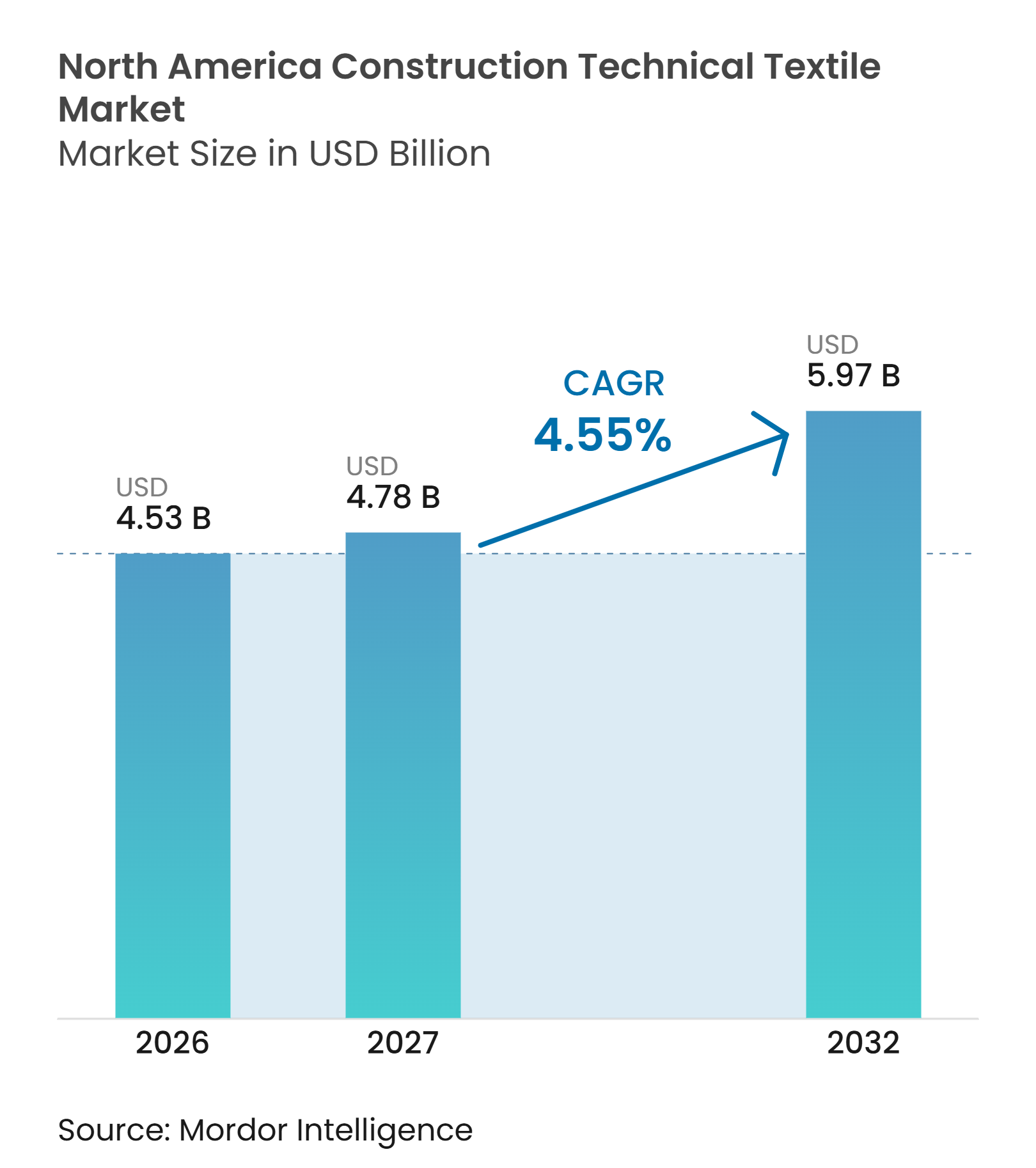
The North America Construction Technical Textile Market size was valued at USD 4.53 billion in 2026 and is estimated to grow from USD 4.78 billion in 2027 to reach USD 5.97 billion by 2032, at a CAGR of 4.55% during the forecast period (2027-2032).
Federal procurement rules and tighter building-envelope standards are changing product selection across infrastructure and building projects. The end of the General Applicability Waiver for manufactured products on federal-aid highway projects requires final assembly in the United States from October 1, 2025, while the domestic component threshold rises to 55% from October 1, 2026. These rules encourage demand for compliant geosynthetics, membrane systems, air barriers, and reinforcement fabrics, while favoring suppliers with domestic sourcing, domestic component records, product certificates, and documented environmental performance, and moving decisions toward systems that meet project specifications without adding complex installation steps for highway, water, building-envelope, and rehabilitation work. Cost volatility, limited domestic capacity for specialized grades, separate approval regimes, and shortages of installation labor remain material constraints on the North America construction technical textile market, which can delay qualification for laminated systems, raise delivered costs for imported specialty inputs, and limit the speed at which project-led demand converts into completed installations across federally aided infrastructure, commercial reroofing, resilient reconstruction, and large industrial building programs.
Key Report Takeaways
- By product type, roofing and waterproofing textiles held 29.5% of the North America construction technical textile market share in 2026, while architectural membranes and tensile fabrics are forecast to grow at a 6.2% CAGR through 2032.
- By material type, polyester held 31.6% of the North America construction technical textile market size in 2026, while carbon, aramid, and other high-performance fibers are forecast to grow at a 6.5% CAGR through 2032.
- By construction project type, commercial construction held a 33.6% share in 2026, while industrial and logistics construction is forecast to grow at a 5.9% CAGR through 2032.
- By geography, the United States held an 82.8% share in 2026, while Mexico is forecast to grow at a 5.8% CAGR through 2032.
Note: Market numbers in this report are based on Mordor Intelligence's proprietary estimation framework, which combines nine months of actuals with Q4 projections for base year 2026.
Market Trends and Insights
Drivers Impact Analysis of North America Construction Technical Textile Market*
| Driver | (~) % Impact on CAGR Forecast | Geographic Relevance | Impact Timeline |
|---|---|---|---|
| Federally Funded Infrastructure Modernization and Domestic Sourcing Requirements | +1.2% | United States primary, Canada through cross-border supply chains | Medium term (2-4 years) |
| Building Envelope Decarbonization and Energy Code Tightening | +1.0% | United States and Canada, with spillover to Mexico | Long term (≥ 4 years) |
| Climate Resilience Spending for Flood, Erosion, Heat, and Wildfire Exposure | +0.8% | United States primary and coastal Mexico | Medium term (2-4 years) |
| Retrofit Demand from Aging Roofs, Roads, Bridges, and Water Assets | +0.7% | North America-wide | Long term (≥ 4 years) |
| Lightweight and Rapid Installation Systems for Labor Constrained Projects | +0.5% | United States and Canada, with the United States Sun Belt primary | Short term (≤ 2 years) |
| Fiber Optic Sensing Embedded in Geosynthetics and Structural Fabrics | +0.2% | United States and Canada | Long term (≥ 4 years) |
| Source: Mordor Intelligence | |||
Federally Funded Infrastructure Modernization and Domestic Sourcing Requirements
The North America construction technical textile market benefits from a substantial shift in federal procurement. The Federal Highway Administration published its final Buy America rule on January 14, 2025, ending the longstanding General Applicability Waiver for manufactured products on federal-aid highway projects.[1] Final assembly of permanently incorporated manufactured products must occur in the United States from October 1, 2025, and United States-sourced components must exceed 55% of total component cost from October 1, 2026.[2] Polymer geosynthetics with minor additions can be classed as construction materials under Build America, Buy America requirements, which can require all manufacturing processes to occur in the United States. State transportation agencies can prequalify suppliers that provide certificates for complex systems, raising barriers for import-dependent converters. This favors producers that can trace components through domestic production and meet documentation needs in United States highway work, with Canada relevant through cross-border supply chains.
Building Envelope Decarbonization and Energy Code Tightening
The North America construction technical textile market is gaining support from energy-code adoption and building-envelope upgrades. The Department of Energy issued an affirmative determination on the 2024 IECC in December 2024, requiring states to review their residential energy codes within 2 years.[3] The department found that the 2024 edition achieves 7.8% site energy savings over the 2021 edition. Its continuous air-barrier and thermal-bridge provisions support façade membranes, housewraps, and weather-resistive barriers. DuPont issued an updated environmental product declaration for Tyvek products in July 2025 that reported a 7% reduction in A1-A3 embodied carbon since 2022. These product attributes can give owners a documented basis for higher-performance retrofit specifications.
Climate Resilience and Retrofit Demand from Aging Assets
The North America construction technical textile market is supported by reconstruction and rehabilitation needs across climate hazards and aging infrastructure. FEMA reported USD 62.5 billion in Disaster Relief Fund budget authority for fiscal year 2025, including USD 29 billion in supplemental appropriations under Public Law 118-158, Division B. FEMA ended the Building Resilient Infrastructure and Communities program in April 2025, shifting emphasis toward reconstruction managed through transportation, housing, and state agencies. These projects use erosion blankets, turf reinforcement mats, slope systems, debris nets, drainage fabrics, and high-performance nonwovens. Birdair contracted in April 2025 to replace the PTFE tensile membrane roof it installed in 1994 at the Rita Rossi Colwell Center with a Tensotherm system. Longer service-life documentation and lightweight, self-adhering systems strengthen the case for products that can be installed quickly with limited crews.
Smart Structural Fabrics and Monitoring Systems
The North America construction technical textile market is beginning to include products that provide monitoring as well as reinforcement. A peer-reviewed study published in Smart Materials and Structures in April 2025 reported a 93.88% strain transfer coefficient for Fiber Bragg Grating-embedded geogrids. The result supports sensorized geosynthetics in bridge and slope monitoring programs in the United States and Canada. ASTM issued D8538/D8538M-25 in 2025 for aramid composite mesh reinforcement used to prevent concrete spalling. Technical systems that reduce installation time also address workforce constraints. The Associated General Contractors of America reported in August 2025 that 92% of hiring firms had difficulty filling positions, supporting demand for simpler installation systems.
Restraints Impact Analysis of North America Construction Technical Textile Market*
| Restraint | (~) % Impact on CAGR Forecast | Geographic Relevance | Impact Timeline |
|---|---|---|---|
| Synthetic Fiber Resin and Energy Cost Volatility | -0.8% | North America-wide, with United States exposure to tariff-driven import disruption | Short term (≤ 2 years) |
| Qualified Domestic Capacity Constraints Under Buy America Rules | -0.6% | United States primary, with supply-chain implications for Canada | Medium term (2-4 years) |
| Fragmented Approval and Testing Requirements Across North American Jurisdictions | -0.4% | North America-wide | Long term (≥ 4 years) |
| Specialist Installation, Welding, and Detailing Labor Shortages | -0.3% | United States and Canada urban markets | Medium term (2-4 years) |
| Source: Mordor Intelligence | |||
Synthetic Fiber Resin, Energy Cost, and Labor Volatility
The North America construction technical textile market remains exposed to resin, energy, and labor cost changes. Polypropylene prices in North America declined 2.7% in August 2025, while polyester and polypropylene can move on different cycles because of their different feedstock links. Heat setting, calendering, and extrusion coating add exposure to industrial electricity costs. Smaller specialty converters face greater risk when they lack long-term supply contracts or energy hedging. The Associated General Contractors of America linked workforce shortages to project delays in August 2025. Self-adhering systems and methods that reduce hot-air welding can lower scheduling pressure when labor and weather windows are limited.
Domestic Capacity and Fragmented Approval Requirements
The North America construction technical textile market faces a capacity gap for specialty grades that must meet Buy America rules. Final United States assembly is required from October 2025, and the 55% domestic component cost threshold applies from October 2026. The Federal Highway Administration estimated annual increased material costs of USD 41 million to USD 980 million across covered manufactured products. Compliance can extend to raw fiber sourcing and polymer compounding, while domestic supply may not yet have enough certified capacity for every required grade. Canada uses the Canadian Construction Materials Centre system alongside United States evaluation routes, creating dual certification needs for cross-border suppliers. Separate testing pathways and interpretation questions for laminated assemblies can slow qualification even when products meet technical performance requirements. The North America construction technical textile market rewards producers that can support testing, certificates, and jurisdiction-specific submittals.
*Our forecasts treat driver/restraint impacts as directional, not additive. The impact forecasts reflect baseline growth, mix effects, and variable interactions.
North America Construction Technical Textile Market Segment Analysis
By Product Type:
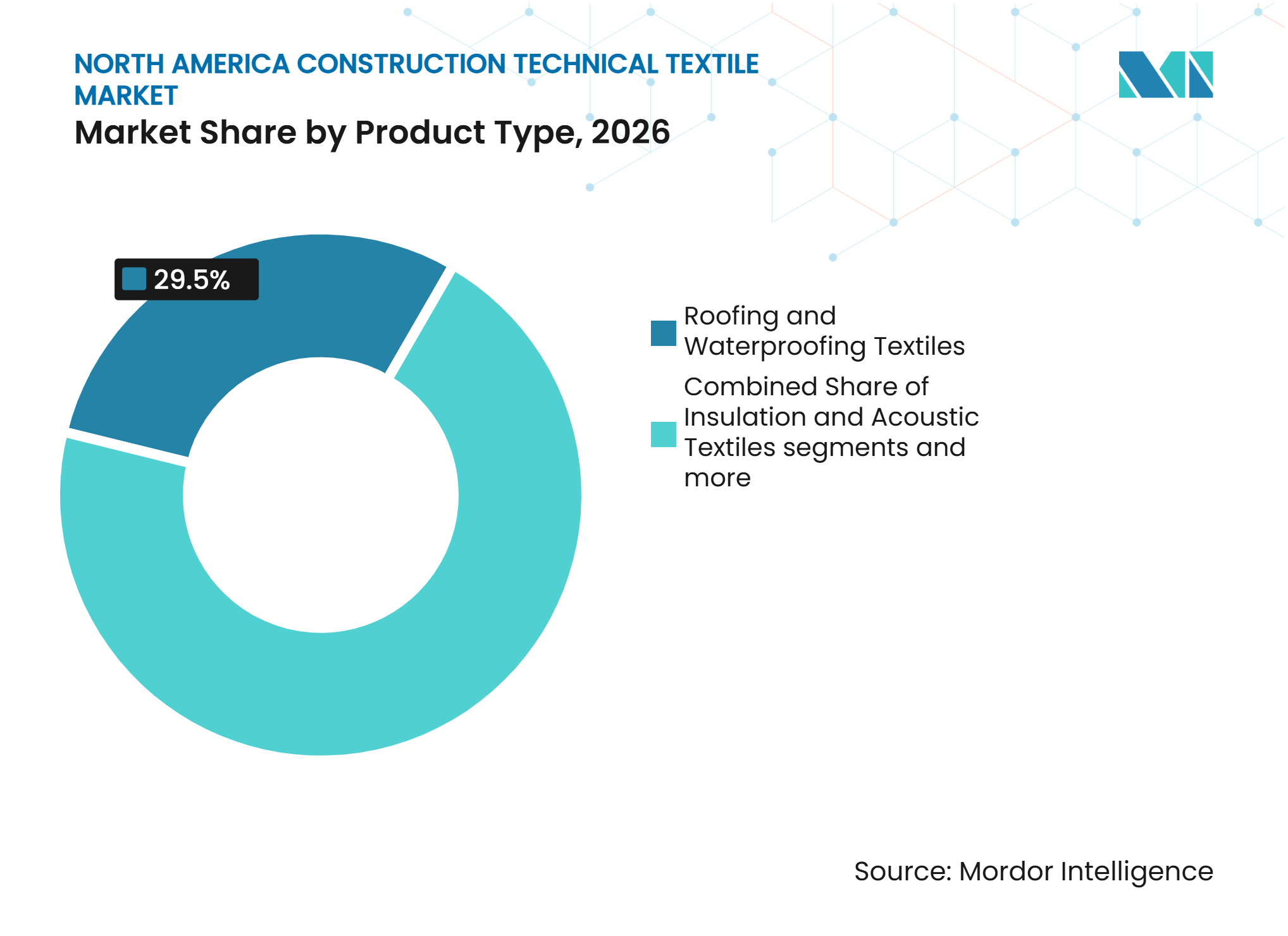
Roofing and Waterproofing Textiles Hold the Largest Position While Architectural Membranes Grow FastestRoofing and waterproofing textiles held 29.5% of the North America construction technical textile market size in 2026, making this the largest product category. Commercial re-roofing, climate-event replacements, and energy-code upgrades support demand. TPO-reinforced single-ply membranes are widely used in commercial low-slope roofing because polyester scrims provide tensile performance in mechanically fastened and fully adhered systems. Self-adhering TPO products reduce hot-air welding and can expand workable installation conditions. This is important in labor-constrained markets where crew availability and weather windows affect schedules.
Architectural membranes and tensile fabrics have the highest forecast growth at 6.2% CAGR through 2032. Public infrastructure and mixed-use developments use PTFE-coated fiberglass for shading, acoustic performance, energy-modulating translucency, and long service life. Sports facilities, transit canopies, convention center upgrades, and amphitheaters are relevant demand settings. Birdair received an October 2025 contract to design, engineer, fabricate, and install 59 tensile membrane canopy structures across 150,000 sq ft at the Ontario Sports Empire Complex in California. Façade, reinforcement, insulation, acoustic, shading, and site-protection textiles serve both new construction and retrofit work.



By Material Type:
Polyester Leads in Volume While High Performance Fibers Advance in Rehabilitation WorkPolyester held 31.6% of the North America construction technical textile market share in 2026. Its position reflects its use as a reinforcing scrim in commercial roofing membranes, waterproofing underlays, and geotextile nonwovens. Its cost efficiency, tensile consistency, and compatibility with thermoplastic and bituminous coating systems make replacement difficult in high-volume products. Polypropylene is important for drainage, separation, and erosion-control nonwovens. Glass fiber supports reinforcement meshes for stucco, plaster backing, and composite structural applications.
Carbon, aramid, and other high-performance fibers are forecast to grow at 6.5% CAGR through 2032. Their use in bridge and concrete rehabilitation reflects high strength-to-weight performance and corrosion resistance. ASTM D8538/D8538M-25 provides a specification for aramid composite mesh used in concrete spalling prevention. Owens Corning agreed in February 2025 to sell its global glass reinforcements business to Praana Group for USD 755 million, while retaining its vertically integrated glass nonwovens business in the Roofing segment. Acrylic, polyamide, natural, and regenerated fibers serve UV-stable shading applications and projects seeking recycled-content or bio-based certification.
By Construction Project Type:
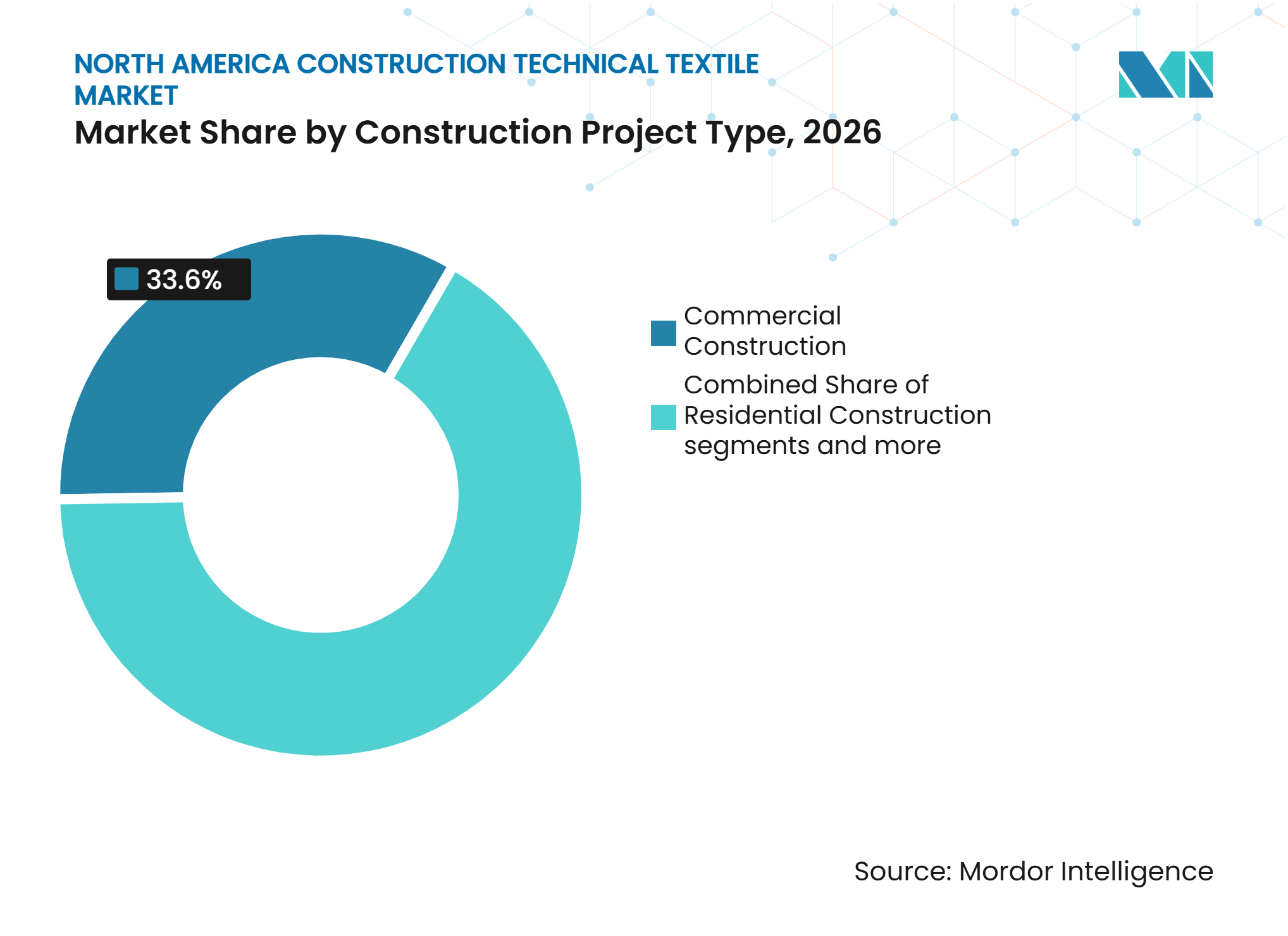
Commercial Construction Leads While Industrial and Logistics Projects Expand FasterCommercial construction held 33.6% of the North America construction technical textile market size in 2026. New institutional and health-care facilities contribute to demand, along with roof and envelope rehabilitation across aging offices, retail properties, and warehouses. High vacancy levels in major United States commercial markets can encourage owners to invest in re-roofing and full envelope rehabilitation instead of new construction. Continuous air barriers and reflective roofing membranes are increasingly important in green building specifications. Residential construction remains relevant for housewrap, breathable membrane volumes, and state consideration of 2024 IECC air-barrier provisions.
Industrial and logistics construction is forecast to grow at 5.9% CAGR through 2032. Manufacturing facilities and distribution centers in Texas, Arizona, and the Southeast need large roofing membranes, waterproofing underlays, and vapor-control barriers. Nearshoring supports this construction pattern in the United States Sun Belt and northern Mexico. Large single-story formats make installation speed and labor cost important. The North America construction technical textile industry benefits when these systems offer lower installed cost without compromising performance requirements.

Geography Analysis
The United States accounted for 82.8% of the North America construction technical textile market share in 2026. Federal infrastructure funding, diverse commercial construction, and Buy America requirements give the country a clear scale advantage. Water, wastewater, power, highways, and utility projects use geotextiles, drainage fabrics, erosion-control materials, and containment systems. Texas, Florida, Georgia, and the Carolinas support demand through industrial development, roof replacement after climate events, and highway rehabilitation. United States Buy America milestones create a domestic sourcing premium that makes documentation and local capacity central to federally funded work.
Canada holds the second-largest country-level position, although elevated mortgage rates and lower building starts are restricting near-term construction activity. Civil programs funded by the Canada Infrastructure Bank and provincial transportation authorities support infrastructure applications. The Canadian Construction Materials Centre evaluates weather-resistive barriers, geosynthetics, and other construction products. Its system runs alongside United States evaluation routes, requiring dual certification pathways for cross-border sales. Demand for insulated metal panels remains a relative strength where data center and EV battery projects require fire-rated building systems.
Mexico is forecast to grow at 5.8% CAGR through 2032, the highest geographic rate in the North America construction technical textile market. The United Nations Economic Commission for Latin America and the Caribbean identified nearshoring as a significant industrial scaling opportunity for Mexico in February 2025. Industrial development in Monterrey, Juárez, and Querétaro supports demand for roofing fabrics, waterproofing membranes, and vapor barriers. The Mexican Chamber of the Construction Industry identifies energy, water, and logistics infrastructure as key investment needs under nearshoring and Plan México priorities.
Competitive Landscape
Market Concentration
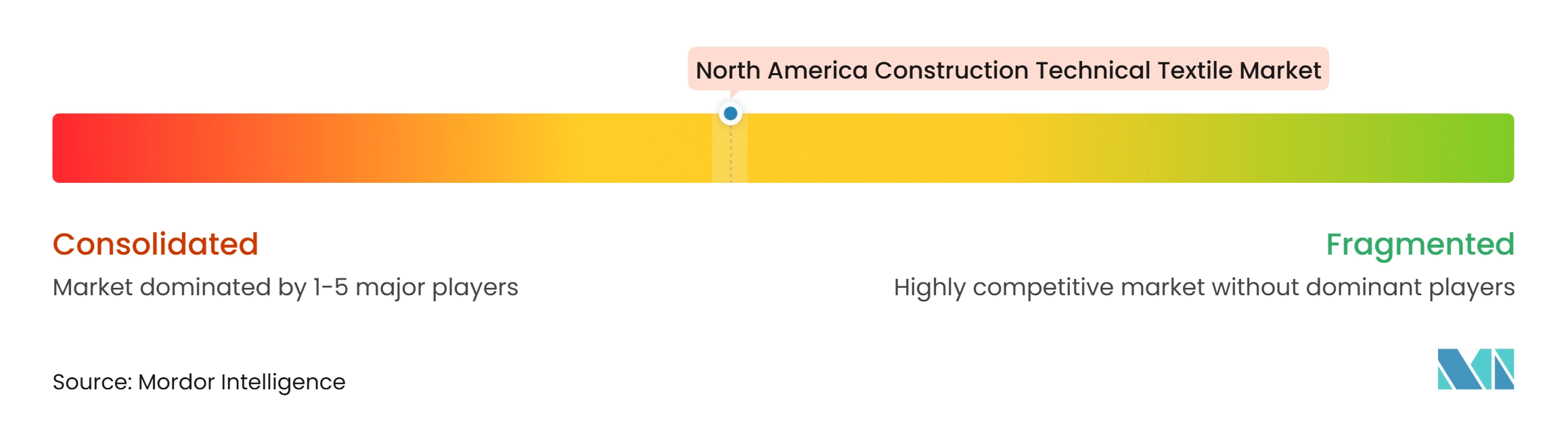
The North America construction technical textile market exhibits a medium level of market concentration. DuPont, Freudenberg Performance Materials, Berry Global Group, Solmax, and other global materials companies have positions in housewraps, nonwoven underlays, and geotextile nonwovens. Specialist producers and vertically integrated converters compete in products that need defined performance, certification, or system warranties. Concentration is greater in roofing membranes, while geosynthetics serve many transportation agencies, engineering firms, and contractors. Product selection in geosynthetics can change with project-specific design standards and approval requirements.
Companies are investing in capacity, environmental documentation, and system performance. DuPont updated the environmental product declaration for Tyvek building wrap in July 2025 and reported a 7% reduction in A1-A3 embodied carbon since 2022. Seaman Corporation secured a 40-year reference service life rating for FiberTite roof membranes in January 2025. Kingspan increased its committed United States roofing investment to USD 1 billion in June 2025, with new production facilities in Maryland and Oklahoma targeted for 2026. These moves support suppliers that can offer local capacity, verified product attributes, and established distribution.
Technology adds a further point of differentiation for the North America construction technical textile market. Smart geosynthetics with embedded sensing can combine material supply with structural monitoring and data services. Buy America-certifiable specialty-grade production remains an important opening because supply has not yet matched policy-led demand. Simpler installation systems also address the shortage of skilled welding and detailing labor.
North America Construction Technical Textile Industry Leaders
-
Milliken & Company
-
Berry Global Group, Inc.
-
DuPont de Nemours, Inc.
-
Saint-Gobain ADFORS
-
Owens Corning
- *Disclaimer: Major Players sorted in no particular order
North America Construction Technical Textile Market Companies Covered in this Report
- Milliken & Company
- Berry Global Group, Inc.
- DuPont de Nemours, Inc.
- Saint-Gobain ADFORS
- Owens Corning
- Solmax
- GAF Materials Corporation
- Freudenberg Performance Materials
- Seaman Corporation
- Sika AG
- Propex Operating Company, LLC
- Fibertex Nonwovens A/S
- AGRU America, Inc.
- HUESKER Group
- NAUE GmbH & Co. KG
- Officine Maccaferri S.p.A.
- TYPAR
- Nilex, Inc.
- Low & Bonar
- Carlisle Companies Incorporated
- Johns Manville
- Kingspan Group plc
Recent Industry Developments in North America Construction Technical Textile Market
- June 2026: Officine Maccaferri officially inaugurated its new North American manufacturing facility in Fort Lawn, South Carolina. The facility integrates multiple production technologies and strengthens the company's regional manufacturing capabilities for civil and environmental engineering applications, including geotechnical infrastructure solutions.
- January 2026: Messe Frankfurt opened submissions for the Techtextil North America 2026 Innovation Awards, covering new materials, products, applications, recycled materials, and production technologies. The initiative supports innovation across technical textiles and nonwovens, including materials used in construction and infrastructure applications.
- November 2025: Sika begins construction of a USD 25 million roofing production facility in Sealy, Texas (130,847 sq ft, covering manufacturing and warehouse), reflecting strategic investment in North American TPO and waterproofing membrane production capacity ahead of anticipated demand growth in the Sun Belt industrial corridor.
North America Construction Technical Textile Market Report Scope
The North America Construction Technical Textile Market Report is Segmented by Product Type (Roofing and Waterproofing Textiles, Insulation and Acoustic Textiles, and More), by Material Type (Polyester (PET), Polypropylene (PP), and More), by Construction Project Type (Residential Construction, Commercial Construction, and More), and by Geography (United States, and More). The Market Forecasts are Provided in Terms of Value (USD).
Segmentation Overview
| Architectural Membranes and Tensile Fabrics (PVC-Coated Membranes, PTFE-Coated Fiberglass Membranes, etc.) |
| Roofing and Waterproofing Textiles |
| Façade and Building Envelope Textiles (Wraps & weather-Resistive Barriers, Façade Membrane Fabrics, etc.) |
| Construction Reinforcement Textiles (Fiberglass Plaster, Reinforcement Fabric & Meshes, Scrims, etc.) |
| Insulation and Acoustic Textiles |
| Architectural Shading and Canopy Textiles |
| Construction Site Protection Textiles (Debris Nets, Dust and Containment Fabrics, etc.) |
| Other Construction Technical Textiles |
| Polyester (PET) |
| Polypropylene (PP) |
| Polyethylene (PE) |
| Glass Fiber |
| Acrylic and Polyamide Fibers |
| Carbon, Aramid and Other High-Performance Fibers |
| Natural and Regenerated Fibers |
| Other Specialty Materials |
| Residential Construction |
| Commercial Construction |
| Industrial and Logistics Construction |
| Institutional and Other Building Construction |
| United States |
| Canada |
| Mexico |
| By Product Type | Architectural Membranes and Tensile Fabrics (PVC-Coated Membranes, PTFE-Coated Fiberglass Membranes, etc.) |
| Roofing and Waterproofing Textiles | |
| Façade and Building Envelope Textiles (Wraps & weather-Resistive Barriers, Façade Membrane Fabrics, etc.) | |
| Construction Reinforcement Textiles (Fiberglass Plaster, Reinforcement Fabric & Meshes, Scrims, etc.) | |
| Insulation and Acoustic Textiles | |
| Architectural Shading and Canopy Textiles | |
| Construction Site Protection Textiles (Debris Nets, Dust and Containment Fabrics, etc.) | |
| Other Construction Technical Textiles | |
| By Material Type | Polyester (PET) |
| Polypropylene (PP) | |
| Polyethylene (PE) | |
| Glass Fiber | |
| Acrylic and Polyamide Fibers | |
| Carbon, Aramid and Other High-Performance Fibers | |
| Natural and Regenerated Fibers | |
| Other Specialty Materials | |
| By Construction Project Type | Residential Construction |
| Commercial Construction | |
| Industrial and Logistics Construction | |
| Institutional and Other Building Construction | |
| By Geography | United States |
| Canada | |
| Mexico |
Key Questions Answered in the Report
What is the forecast for North America construction technical textiles?
The sector is projected to grow from USD 4.53 billion in 2026 to USD 5.97 billion by 2032 at a 4.55% CAGR from 2027 to 2032.
Which product category has the largest revenue position?
Roofing and waterproofing textiles lead with 29.5% share in 2026, supported by commercial re-roofing and building-envelope upgrades.
Which material category is growing the fastest?
Carbon, aramid, and other high-performance fibers are forecast to expand at a 6.5% CAGR through 2032, supported by bridge and concrete rehabilitation work.
What is driving demand for technical textiles in infrastructure projects?
Buy America requirements, reconstruction work, and demand for erosion control, drainage, reinforcement, and containment applications support infrastructure demand.
Which country is expected to record the fastest growth?
Mexico is forecast to grow at a 5.8% CAGR through 2032 as nearshoring supports industrial, logistics, energy, water, and transport investment.
How do Buy America rules affect suppliers?
From October 2026, covered manufactured products need United States sourced components above 55% of total component cost, making domestic sourcing and documentation essential.