
North America Commercial Water Heater Market Size and Share
Market Overview
| Study Period | 2021 - 2032 |
|---|---|
| Forecast Data Period | 2027 - 2032 |
| Base Year Market Size (2026) | USD 2.53 Billion |
| Market Size (2027) | USD 2.65 Billion |
| Market Size (2032) | USD 3.59 Billion |
| Growth Rate (2027 - 2032) | 6.26 % |
| Market Concentration | Medium |
Major Players *Disclaimer: Major Players sorted in no particular order Image © Mordor Intelligence. Reuse requires attribution under CC BY 4.0. | |
North America Commercial Water Heater Market Analysis by Mordor Intelligence
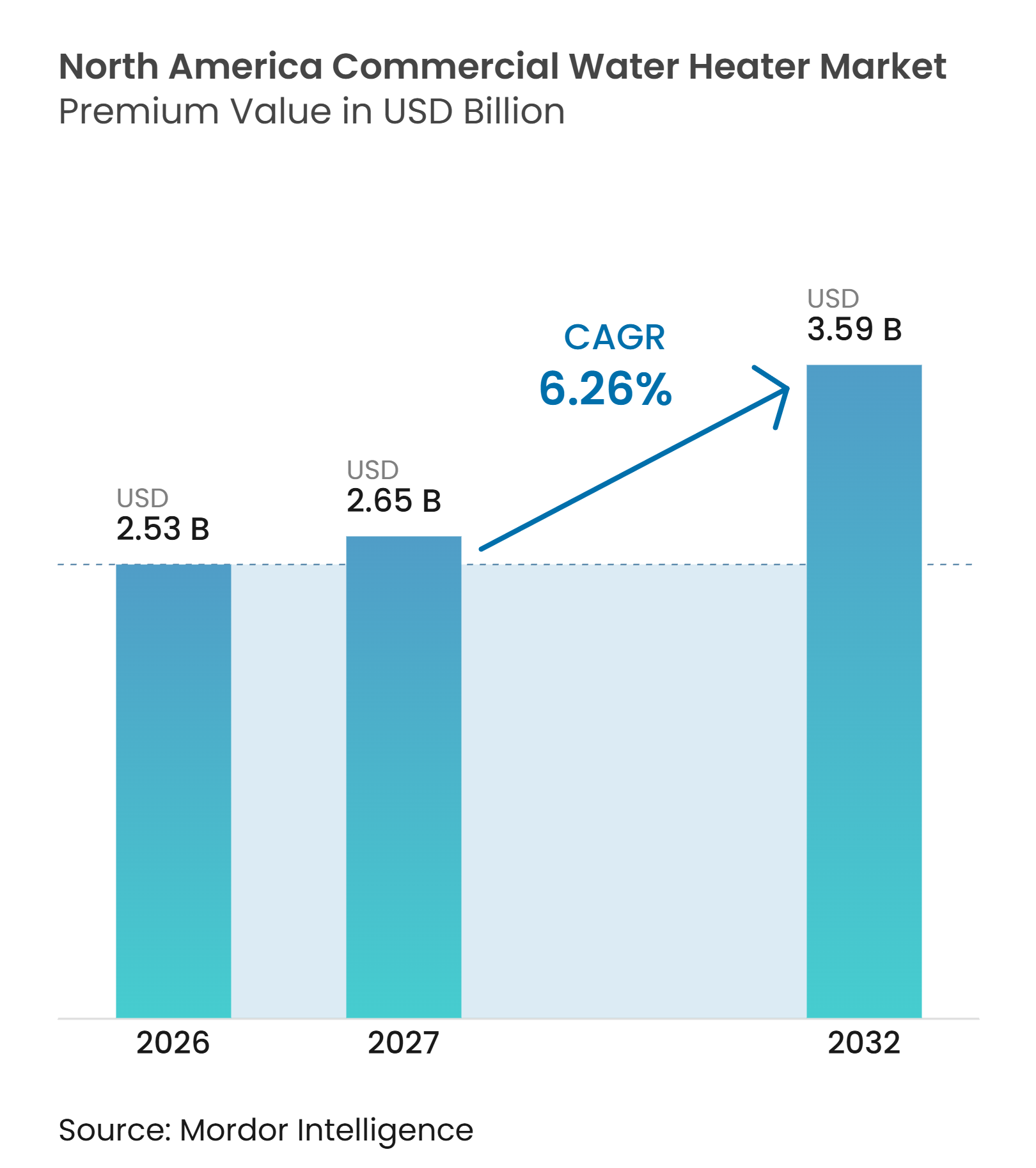
The North America commercial water heater market size is projected to expand from USD 2.53 billion in 2026 to USD 2.65 billion in 2027 and is forecast to reach USD 3.59 billion by 2032, registering a CAGR of 6.29% between 2027 and 2032. The North America commercial water heater market is supported by replacement demand across hotels, healthcare facilities, foodservice sites, and multifamily properties. Federal efficiency rules are changing replacement specifications for gas-fired equipment, while state building rules and utility programs are encouraging electric and heat-pump systems. Facilities are also placing more value on remote monitoring, building automation compatibility, and reliable hot-water supply. This favors suppliers that can provide equipment, controls, commissioning support, and service coverage. The shortage of qualified refrigeration and controls technicians remains a practical constraint on adoption of more complex systems.
Key Report Takeaways
-
By product type, storage water heaters held 44.5% of the North America commercial water heater market share in 2026, while heat pump and hybrid water heaters are projected to grow at a 9.1% CAGR through 2032.
-
By energy source, natural gas and LPG held 47.6% of the North America commercial water heater market share in 2026, while electric systems are projected to grow at a 7.2% CAGR through 2032.
-
By capacity, below-500-liter systems held 40.1% of sales in 2026, while above-3,000-liter systems are projected to grow at a 7.5% CAGR through 2032.
-
By end user, hospitality held 24.1% of sales in 2026, while manufacturing, laundries, and other industrial facilities are projected to grow at a 6.9% CAGR through 2032.
-
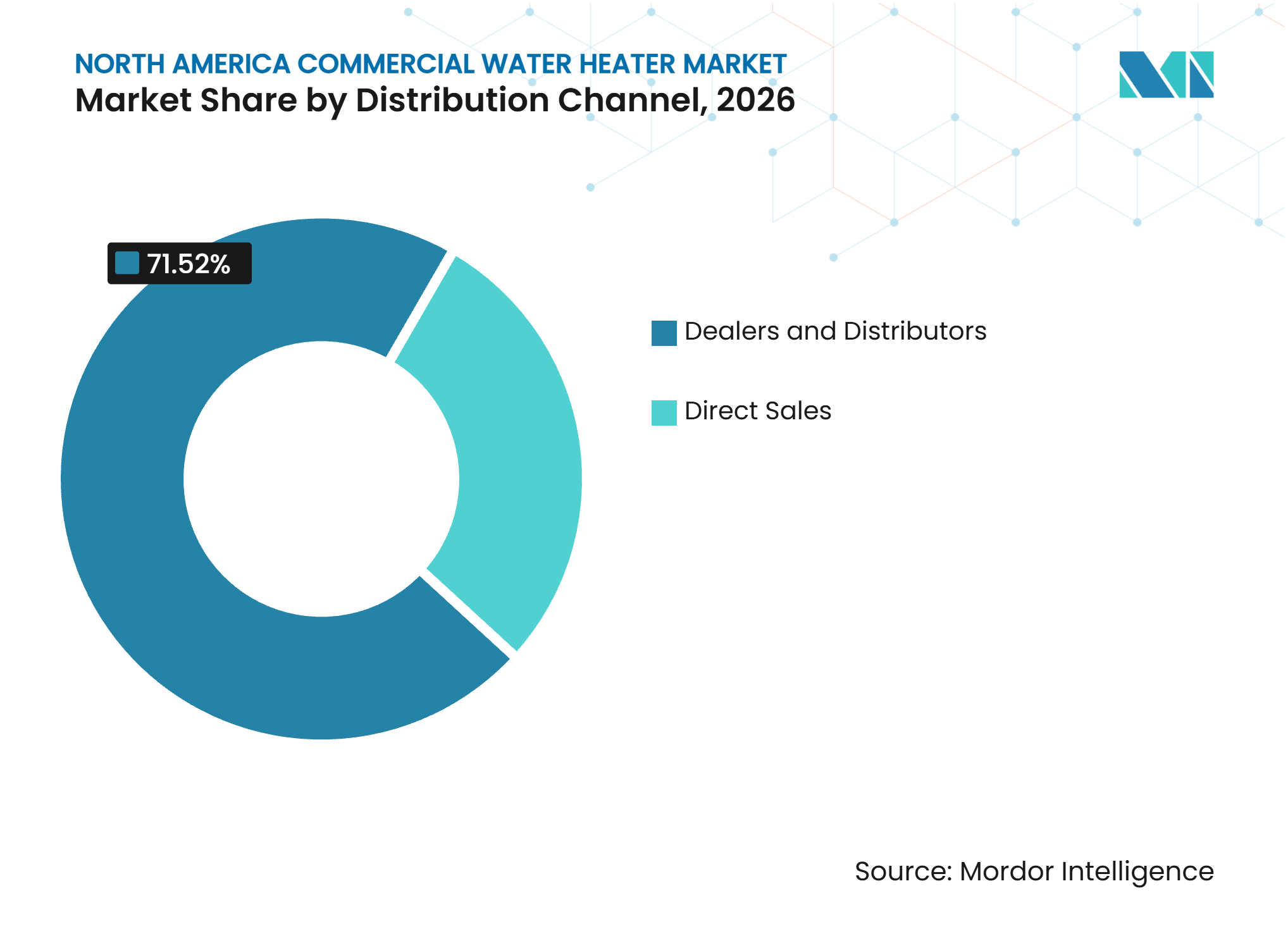
By distribution channel, dealers and distributors held 71.5% of sales in 2026, while direct sales are projected to grow at a 6.8% CAGR through 2032.
-
By geography, the United States held 78.2% of sales in 2026, while Mexico is projected to grow at a 6.8% CAGR through 2032.
Note: Market numbers in this report are based on Mordor Intelligence's proprietary estimation framework, which combines nine months of actuals with Q4 projections for base year 2026.
Market Trends and Insights
Drivers Impact Analysis of North America Commercial Water Heater Market*
| Driver | (~) % Impact on CAGR Forecast | Geographic Relevance | Impact Timeline |
|---|---|---|---|
| Commercial Replacement of Aging Water Heating Equipment | +1.5% | National, with early gains in high-density urban markets | Short term (≤ 2 years) |
| Hospitality, Healthcare, and Institutional Construction | +1.2% | National, strongest in Sun Belt states and Mexico border regions | Medium term (2-4 years) |
| DOE Efficiency Standards and State-Level Building Codes | +1.4% | National, with early impact in California and New York | Medium term (2-4 years) |
| Commercial Heat-Pump Adoption Supported by Utility Rebates | +1.0% | California, Pacific Northwest, and Northeast, with expansion into the Southeast and Mid-Atlantic | Medium term (2-4 years) |
| Building Automation Integration and Load Flexibility for Commercial Facilities | +0.6% | Northeastern and Western U.S. office and institutional facilities | Long term (≥ 4 years) |
| N+1 Redundancy Requirements in Hospitality and Healthcare Facilities | +0.3% | National, concentrated in hospital campuses and urban hotel complexes | Medium term (2-4 years) |
| Source: Mordor Intelligence | |||
Commercial Replacement of Aging Water Heating Equipment
The North America commercial water heater market benefits from recurring replacement demand because an equipment failure requires a rapid response in hotels, hospitals, and other sites that depend on continuous hot water. The replacement cycle is becoming more complex because new gas equipment must meet higher efficiency requirements. The United States Department of Energy postponed enforcement of the updated commercial gas water-heater standards to October 2027, giving operators a defined compliance date for future specifications[1]. The rule requires condensing-grade equipment for relevant gas storage and instantaneous product categories, which can change venting and condensate-management needs[2]. This adds engineering work to replacement projects and strengthens demand for suppliers with contractor and technical-service support. The North America commercial water heater market therefore draws demand from essential replacements as well as from equipment upgrades.
Hospitality, Healthcare, and Institutional Construction
New construction supports water-heater demand because hotels, hospitals, schools, and institutions need reliable central hot-water systems. Hotels require substantial hot-water capacity for guest rooms, kitchens, laundry operations, and amenity areas. Healthcare facilities have tighter operating requirements because water temperature control, recirculation, and system reliability affect service delivery. The American Institute of Architects expected hotel construction spending to increase 6% in 2026, supporting the project pipeline for commercial mechanical equipment[3]. These facilities often use redundant system designs, which increase the number of installed units beyond basic load requirements. This construction activity also creates an opportunity for suppliers that can help engineers specify equipment for complex facility needs.
DOE Efficiency Standards and State-Level Building Codes
Federal efficiency requirements are a central factor in product selection across the North America commercial water heater market. The Department of Energy’s rules set higher performance thresholds for affected commercial gas-fired equipment, pushing future replacement specifications toward condensing technology[4]. California Title 24 and New York Local Law 97 add local compliance factors that encourage building owners to evaluate electrified and high-efficiency options. These requirements can create two procurement paths, with some facilities favoring highly efficient gas equipment and others prioritizing electric or heat-pump systems. Compliance planning is particularly important for facilities with large central plants because changes may require ventilation, drainage, controls, or electrical work. Manufacturers that provide compliant equipment with clear application support are better positioned to participate in this upgrade cycle.
Commercial Heat-Pump Adoption Supported by Utility Rebates
Commercial heat-pump water heaters are gaining attention because they can reduce on-site fossil-fuel use and support building electrification plans. Incentives can narrow the upfront-cost gap for projects that would otherwise choose conventional gas equipment. Heat-pump installations require refrigeration-cycle knowledge, electrical capacity, and careful commissioning, which makes contractor capability important. Lochinvar states that its Veritus commercial heat-pump water-heater system can be arranged in cascaded installations of up to 64 units, addressing the scale required by larger facilities. This type of system design can make heat-pump equipment more relevant for high-demand users that previously relied on larger gas plants. The North America commercial water heater market has room for providers that pair product supply with installation guidance and long-term service support.
Restraints Impact Analysis of North America Commercial Water Heater Market*
| Restraint | (~) % Impact on CAGR Forecast | Geographic Relevance | Impact Timeline |
|---|---|---|---|
| High Equipment, Installation, and Commissioning Costs | -0.9% | National, with greater pressure in higher-labor-cost regions | Medium term (2-4 years) |
| Shortage of Refrigeration-Cycle and Commercial Controls Technicians | -0.8% | National, with severe constraints in rural markets and secondary cities | Medium term (2-4 years) |
| Gas-Infrastructure Lock-In in Cold-Climate Markets | -0.5% | Northeastern United States and Canada | Long term (≥ 4 years) |
| Legacy BACnet and Proprietary Building-Control Integration Barriers | -0.3% | National, particularly older urban commercial and institutional buildings | Long term (≥ 4 years) |
| Source: Mordor Intelligence | |||
High Equipment, Installation, and Commissioning Costs
High-efficiency commercial water heaters can impose costs that do not arise in a straightforward replacement. Condensing equipment may require condensate neutralization, compatible venting, and related mechanical changes. Hybrid and heat-pump units may also need electrical-panel upgrades, space planning, and specialist commissioning. These requirements make the project cost more difficult for independent hotels, regional clinics, and other mid-size operators to absorb. Financing conditions can lead some operators to defer elective upgrades until existing equipment reaches end of life. The North America commercial water heater market still benefits from mandatory replacement needs, but costs can slow voluntary adoption of premium products.
Shortage of Refrigeration-Cycle and Commercial Controls Technicians
The shortage of trained technicians restricts the deployment of equipment that relies on refrigeration-cycle and controls expertise. The United States Bureau of Labor Statistics projects 40,100 annual openings for heating, air-conditioning, and refrigeration mechanics and installers between 2023 and 2033. Standard plumbing capability is not always sufficient for commercial heat-pump commissioning or integration with building controls. The constraint is especially relevant in rural markets and secondary cities with smaller specialist labor pools. Carrier launched TechVantage Ignite in 2025 to expand technician and controls-engineer training, which shows how manufacturers are responding to workforce needs. Workforce development will remain important as the product mix moves toward heat pumps and connected equipment.
*Our forecasts treat driver/restraint impacts as directional, not additive. The impact forecasts reflect baseline growth, mix effects, and variable interactions.
North America Commercial Water Heater Market Segment Analysis
By Product Type:
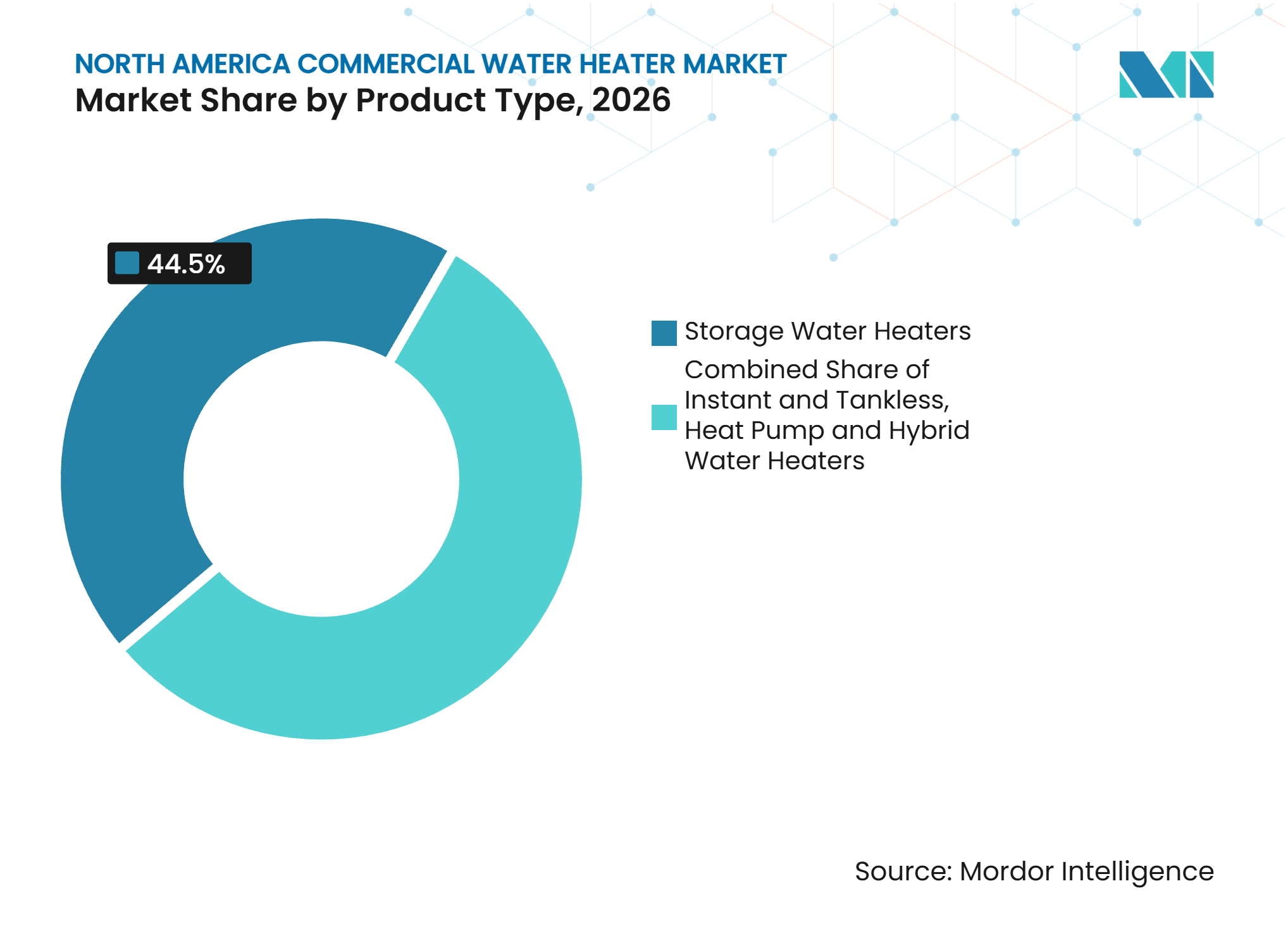
Heat Pump Categories Outpace Legacy Storage During the Forecast PeriodStorage water heaters held 44.5% of the North America commercial water heater market size in 2026, reflecting their entrenched use in hotels, restaurants, foodservice operations, multifamily buildings, and other facilities where sustained hot-water draw favors tank-based central systems. Their position rests on established contractor familiarity, the ability to manage high-volume demand, and the practical fit of storage systems in properties with adequate mechanical-room space. The October 2027 federal compliance date changes the replacement path for affected gas-storage products because newly manufactured equipment must meet higher efficiency requirements, which can alter heat-exchanger design, venting arrangements, condensate handling, and contractor installation practices. Instantaneous and tankless systems continue to serve retrofit settings where floor space is constrained, while modular installations can give facility operators more flexibility in matching capacity to changing demand. These choices keep the North America commercial water heater industry focused on equipment performance, installation practicality, controls compatibility, and dependable service rather than on initial product availability alone.
Heat pump and hybrid water heaters are forecast to grow at a 9.1% CAGR through 2032, making them the fastest-growing product group as electrification plans and efficiency requirements encourage facilities to consider alternatives to conventional gas systems. Their use becomes more practical when manufacturers can configure multiple units as a coordinated system, allowing a larger property to pursue heat-pump technology without relying on one oversized asset. Lochinvar states that its Veritus commercial heat-pump water-heater platform can support cascaded configurations of up to 64 units, illustrating how suppliers are addressing the scalability needs of hotels, institutional users, and other high-demand facilities. The category still requires suitable electrical infrastructure, thoughtful space planning, and technicians who understand refrigeration-cycle equipment, so product adoption is closely linked to the ability to execute the full installation. Manufacturers that can combine application engineering, controls integration, contractor training, and service support will be better able to address the operational concerns that shape commercial buying decisions.



By Energy Source:
Electric Systems Gain Momentum on a Gas-Dominant Installed BaseNatural gas and LPG held 47.6% of the North America commercial water heater market in 2026, reflecting deep fuel infrastructure, widespread contractor familiarity, and the continuing need for high recovery rates in many commercial settings. Gas-fired equipment remains relevant in facilities with large central plants, in regions with established gas networks, and in cold climates where operators may value a gas-based or hybrid backup arrangement. Federal standards are raising the performance threshold for affected commercial gas water heaters, favoring condensing technology in future installations and requiring building owners to consider the related venting and drainage needs. This does not remove the role of gas equipment, but it changes the replacement decision from a simple like-for-like purchase into a broader assessment of efficiency, facility infrastructure, and future compliance. The North America commercial water heater market will therefore continue to include gas products, although their value proposition will increasingly depend on condensing performance and project-level system design.
Electric systems are forecast to grow at a 7.2% CAGR through 2032, the highest rate in the energy-source category, as utility incentives and state building requirements improve the case for electrified water heating. Heat-pump technology broadens the range of commercial sites that can use electric systems, especially when projects have adequate electrical capacity and owners are working toward lower on-site emissions. System design is increasingly important because the selection of refrigerants, controls, storage capacity, and backup equipment can affect both performance and compliance. Oil-fired systems remain less competitive outside limited cold-climate applications because they face fuel-price uncertainty and a narrower supporting supply base, while solar water heating remains specialized because its suitability depends on site conditions and project complexity. These factors indicate that the North America commercial water heater industry will retain several energy pathways, with regional code requirements and facility operating needs determining which one is selected.
By Capacity:
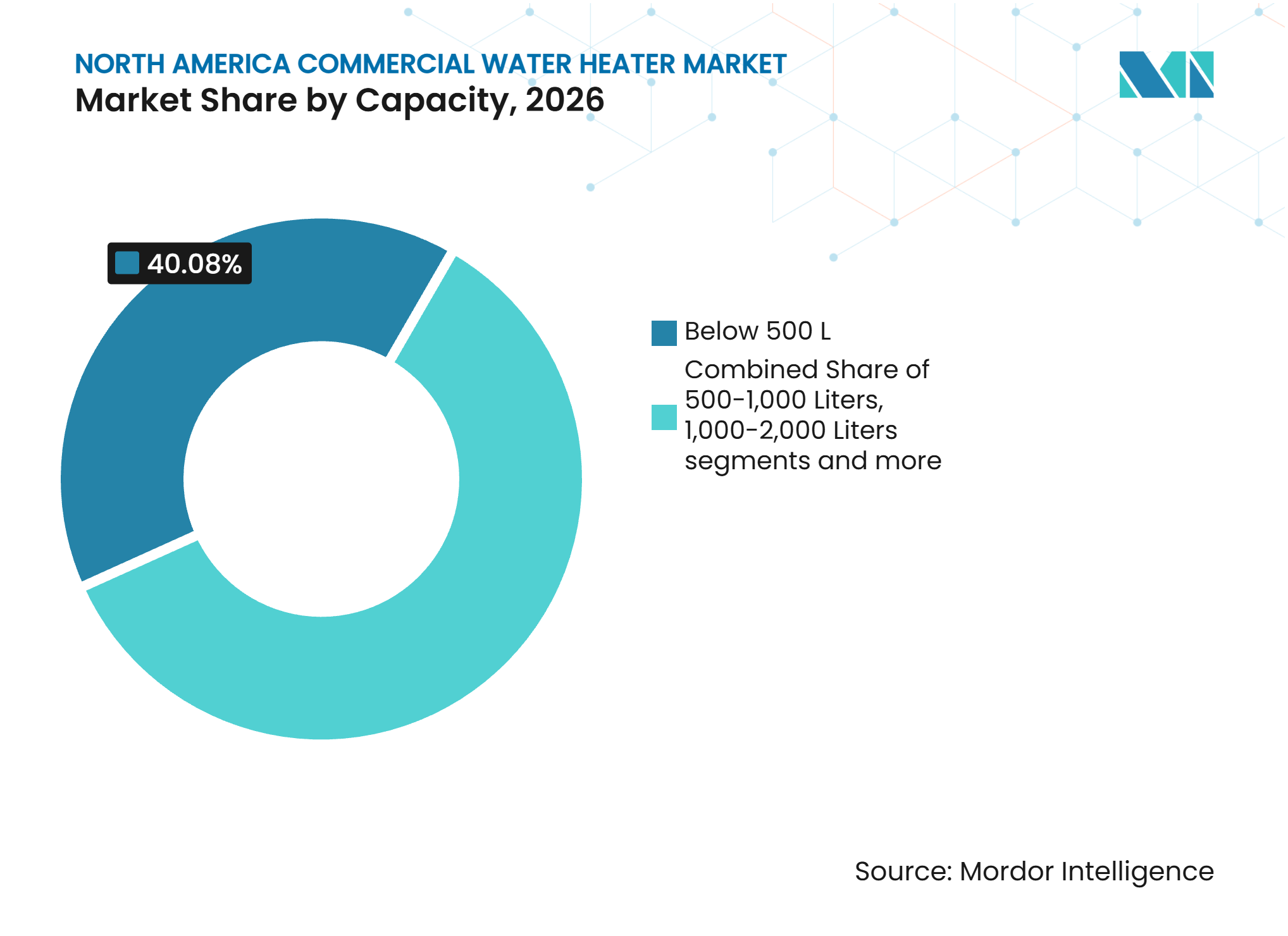
Large-Format Systems Support Industrial and Institutional DemandBelow-500-liter systems accounted for 40.1% of sales in 2026, serving independent hotels, restaurants, clinics, smaller institutional facilities, and other users that can work with compact single-unit configurations. The segment has a broad installed base because its equipment footprint and capacity align with many routine commercial applications, particularly where operators are replacing existing systems within established mechanical rooms. Facilities can also use more than one smaller system when they want operational redundancy without shifting to one large central asset, which can help maintain service during maintenance events. Product selection in this range depends on peak hot-water demand, recovery needs, available floor area, fuel or electrical supply, and local installation requirements. Dealers and contractors remain important to the North America commercial water heater market in this capacity band because they help owners translate these site conditions into an appropriate product and installation plan.
Above-3,000-liter systems are forecast to grow at a 7.5% CAGR through 2032 as industrial sites, laundries, major hotels, and other facilities with continuous sanitation or process-water demand require more substantial hot-water infrastructure. These projects typically involve engineering consultants, direct manufacturer engagement, tailored mechanical design, and careful planning for redundancy, commissioning, and lifecycle service. Capacity groups between 500 liters and 2,000 liters continue to meet the requirements of mid-scale hotel properties, hospital wings, large foodservice operations, and institutional sites that need more capacity than a compact system can offer. The decision to use multiple units rather than one central asset can strengthen resilience in facilities where hot-water interruption would disrupt guest services, hygiene procedures, or daily operations. This capacity mix supports direct manufacturer involvement in larger projects while preserving the role of distributors and contractors in routine commercial replacement work.

By End User:
Hospitality Anchors Value While Industrial Facilities Gain SpeedHospitality held 24.1% of 2026 sales, making it the largest end-user group because hotels need dependable domestic hot water across guest rooms, kitchens, laundry operations, fitness facilities, pools, and other amenity areas. These varied loads favor durable central systems with dependable recovery capacity and controls that can accommodate shifts in occupancy, meal service, and housekeeping schedules. The American Institute of Architects forecast 6% growth in hotel-sector construction spending for 2026, supporting the development pipeline for commercial mechanical equipment. Healthcare facilities also place high demands on water-temperature control, recirculation, system reliability, and the ability to maintain service continuity during maintenance or equipment issues. These requirements give suppliers an advantage when they can support redundant plant designs, application-specific controls, commissioning, and long-term maintenance programs.
Manufacturing, laundries, and other industrial facilities are forecast to grow at a 6.9% CAGR through 2032 because their processes create sustained requirements for sanitation, cleaning, process water, and large-volume hot-water delivery. Such users often need higher-capacity equipment and can place more value on direct application engineering, particularly where the system must fit a wider plant design or operate alongside specialized production equipment. Foodservice and institutional users continue to provide dependable replacement demand even when their structural growth drivers are less pronounced than those of industrial facilities. Multifamily projects form a related opportunity because developers may consider commercial-grade heat-pump systems where building performance requirements and central domestic-hot-water needs align. This mix allows the North America commercial water heater market to draw on stable hospitality replacement demand while also participating in industrial expansion and the gradual adoption of higher-efficiency equipment.
By Distribution Channel:
Direct Sales Gain Ground in a Distributor-Led NetworkDealers and distributors held 71.5% of sales in 2026 because commercial water-heater purchases are shaped by technical specifications, contractor preference, local stock availability, and the need to obtain replacement equipment without long delays. These channel partners provide product choice, local inventory, contractor relationships, and credit arrangements that can help mechanical contractors respond to urgent replacement needs. The model is particularly important for mainstream commercial projects and smaller sites where building owners rely on their contractor to identify a compliant product and arrange installation. Distributors can also support product selection by helping contractors navigate local code considerations, space limitations, and the compatibility of a replacement system with existing mechanical infrastructure. The dealer-led route will remain central to the North America commercial water heater market even as manufacturers seek deeper relationships with larger facility owners.
Direct sales are forecast to grow at a 6.8% CAGR through 2032 as hospital networks, hotel chains, university systems, and other multi-site buyers have sufficient procurement scale to work directly with manufacturers through service agreements and digital platforms. Connected equipment can reinforce this approach by giving manufacturers and owners better visibility into operating conditions, maintenance needs, and the performance of water-heating assets across several locations. A.O. Smith offers iCOMM connectivity for commercial water heaters, illustrating how equipment controls can support direct customer engagement beyond the initial purchase. Direct involvement is most relevant for large and complex systems where commissioning, control integration, maintenance planning, and lifecycle support are central to the purchase decision. Distribution and direct sales will therefore coexist, with the channel choice reflecting facility size, system complexity, procurement practices, and the level of technical support required.
Geography Analysis
United States
The United States accounted for 78.2% of the North America commercial water heater market size in 2026. Its position reflects a large commercial building base and substantial demand from hospitality, healthcare, institutional, foodservice, and multifamily properties. The federal compliance date of October 2027 creates a defined planning horizon for affected gas-fired commercial water-heater replacements. California Title 24 and New York Local Law 97 add regional compliance factors that can favor higher-efficiency and electrified equipment. Facilities are also adopting connected assets that can fit wider building-management practices. The result is a market where equipment choice increasingly depends on energy rules, facility controls, and contractor capability rather than on first cost alone.
Mexico
Mexico is forecast to grow at a 6.8% CAGR through 2032. Industrial and hospitality construction supports demand for large-capacity systems used for process water, sanitation, laundry, and guest services. Nearshoring activity supports the development of facilities that need reliable mechanical infrastructure. This increases the relevance of commercial systems that can serve continuous operating loads. Suppliers with direct specification support and product ranges for larger applications are positioned to participate in these projects. The North America commercial water heater market size in Mexico remains smaller than in the United States, but its growth rate points to a stronger construction-led opportunity.
Canada and the Wider Region
Canada contributes steady demand through retrofit replacement and institutional construction. Cold conditions can limit the suitability of some heat-pump installations and increase the value of hybrid configurations with reliable backup capacity. The American Council for an Energy-Efficient Economy identifies difficult building end uses as an important consideration in decarbonization planning. This makes local climate, building design, and fuel availability important when systems are selected. Across the region, energy codes and facility-management practices are encouraging more efficient and connected water-heating systems. The North American commercial water heater market continues to show distinct national patterns, with regulation and installed-base replacement shaping demand in the United States, construction activity in Mexico, and climate conditions in Canada.
Competitive Landscape
Market Concentration
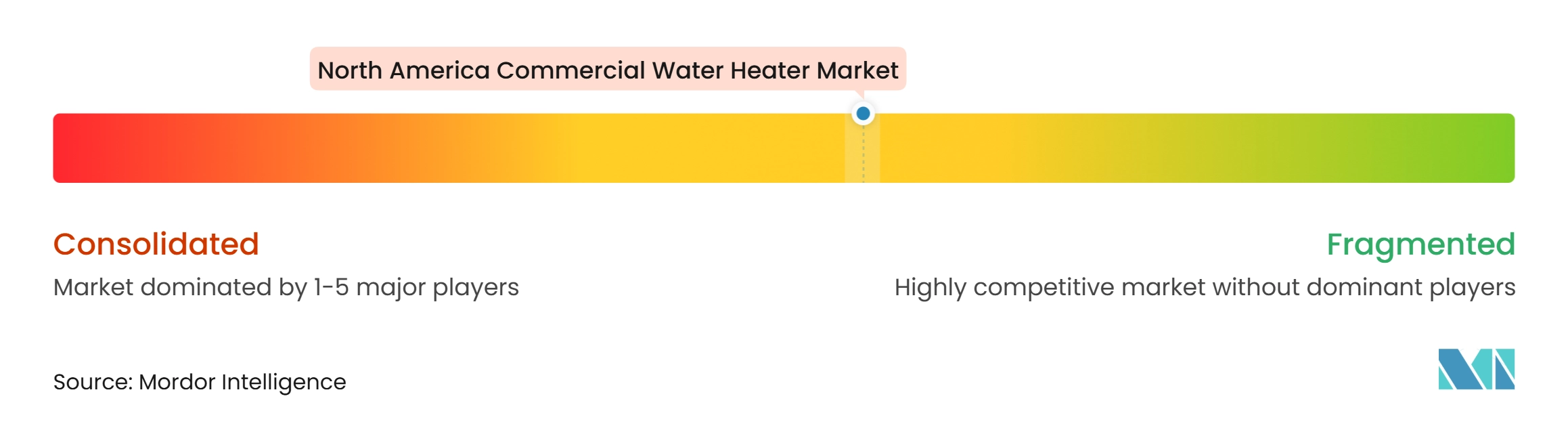
The North America commercial water heater market has several well-established manufacturers alongside specialist suppliers in high-efficiency and institutional applications. A.O. Smith, Rheem, and Bradford White hold leading positions across gas storage, tankless, condensing, and related product categories. Lochinvar, AERCO, Navien, PVI Industries, and other specialists compete in premium systems and complex projects. Competition increasingly depends on system capability, contractor support, remote monitoring, and compliance with efficiency rules. ENERGY STAR and ASHRAE compatibility can be important procurement requirements for government and healthcare applications. This leaves a meaningful role for manufacturers that can meet technical specifications and provide reliable field support.
Product development shows how suppliers are competing for high-efficiency applications. A.O. Smith introduced the Adapt Premium Condensing Commercial Water Heater in May 2026 with a stainless-steel helical heat exchanger and a uniform energy factor of 0.95 at 199,000 BTU input. Lochinvar launched its Regent commercial tankless line in March 2026 with models from 500,000 BTU per hour to 1,000,000 BTU per hour, up to 97% thermal efficiency, and a 25:1 turndown ratio. Rheem launched its IKONIC commercial tankless gas water-heater line in March 2025 with 98% thermal efficiency and manifold-control connectivity for up to 32 units. These moves address demand for efficient equipment that can serve large and variable loads.
Digital service capability is becoming a more important part of competition. Remote monitoring can help facility owners identify operating issues and plan maintenance across multiple sites. A.O. Smith’s iCOMM platform reflects this shift toward connected commercial equipment. Navien opened an Innovation Center and Training Academy in Irvine, California, in October 2026, combining product development, engineering, testing, and contractor training. Training investment is relevant because the market needs more technicians who can install and commission advanced systems. Competitive positions will depend on the ability to combine equipment performance with training, specification support, and after-sales service.
North America Commercial Water Heater Industry Leaders
-
A. O. Smith Corporation
-
Rheem Manufacturing Company
-
Bradford White Corporation
-
Rinnai America Corporation
-
Navien Inc.
- *Disclaimer: Major Players sorted in no particular order
North America Commercial Water Heater Market Companies Covered in this Report
- A. O. Smith Corporation
- Rheem Manufacturing Company
- Bradford White Corporation
- Navien Inc.
- Rinnai America Corporation
- GE Appliances
- Hubbell Water Heaters
- NORITZ America Corporation
- Laars Heating Systems
- Bosch Thermotechnology
- Ariston Holding N.V.
- Lochinvar, LLC
- AERCO International, Inc.
- Intellihot Inc.
- PVI Industries, LLC
- Lync by Watts
- Nyle Systems
- Stiebel Eltron, Inc.
- Mitsubishi Electric Corporation
- Daikin Applied
Recent Industry Developments in North America Commercial Water Heater Market
- October 2026: Navien, Inc. opened its Innovation Center & Training Academy in Irvine, California, integrating product development, engineering, testing, and contractor training into a single facility. Classes begin in December 2026. The center accelerates product localization for the United States market conditions and expands collaboration with utilities and research organizations.
- May 2026: A.O. Smith released the Adapt® Premium Condensing Commercial Water Heater, featuring the company’s patented stainless-steel helical heat exchanger from its Cyclone® technology platform and delivering a uniform energy factor of 0.95 at 199,000 BTU input, targeting high-volume commercial applications requiring DOE-compliant performance.
- March 2026: Lochinvar launched the Regent™ commercial tankless water heater in 3 models from 500,000 to 1,000,000 BTU per hour with up to 97% thermal efficiency and a 25:1 turndown ratio, minimizing standby losses during low-occupancy periods.
- February 2026: Rinnai America Corporation debuted the RECT Series™ commercial electric tank water heaters in 50- and 80-gallon models at AHR Expo 2026, marking the company’s formal entry into the commercial electric tank segment alongside its established gas tankless portfolio.
North America Commercial Water Heater Market Report Scope
Segmentation Overview
| Storage Water Heaters |
| Instant and Tankless Water Heaters |
| Heat Pump and Hybrid Water Heaters |
| Electric |
| Natural Gas and LPG |
| Oil-Fired |
| Solar |
| Other Energy Sources |
| Below 500 Liters |
| 500-1,000 Liters |
| 1,000-2,000 Liters |
| 2,000-3,000 Liters |
| Above 3,000 Liters |
| Hospitality — Hotels, Resorts, Accommodation |
| Healthcare — Hospitals, Clinics, Care Facilities |
| Institutional — Education, Public Buildings |
| Foodservice — Restaurants, Commercial Kitchens |
| Multifamily / Commercial Residential Buildings |
| Manufacturing, Laundries and Other Facilities |
| Direct Sales |
| Dealers and Distributors |
| United States |
| Canada |
| Mexico |
| By Product Type | Storage Water Heaters |
| Instant and Tankless Water Heaters | |
| Heat Pump and Hybrid Water Heaters | |
| By Energy Source | Electric |
| Natural Gas and LPG | |
| Oil-Fired | |
| Solar | |
| Other Energy Sources | |
| By Capacity | Below 500 Liters |
| 500-1,000 Liters | |
| 1,000-2,000 Liters | |
| 2,000-3,000 Liters | |
| Above 3,000 Liters | |
| By End User | Hospitality — Hotels, Resorts, Accommodation |
| Healthcare — Hospitals, Clinics, Care Facilities | |
| Institutional — Education, Public Buildings | |
| Foodservice — Restaurants, Commercial Kitchens | |
| Multifamily / Commercial Residential Buildings | |
| Manufacturing, Laundries and Other Facilities | |
| By Distribution Channel | Direct Sales |
| Dealers and Distributors | |
| By Geography | United States |
| Canada | |
| Mexico |
Key Questions Answered in the Report
What is the forecast for the North America commercial water heater market?
The North America commercial water heater market is projected to increase from USD 2.53 billion in 2026 to USD 3.59 billion by 2032, registering a 6.3% CAGR from 2027 to 2032. Demand is supported by the replacement of installed equipment and by upgrades to systems that meet new efficiency and operating requirements.
Which product category is growing fastest in North America?
Heat pump and hybrid water heaters are forecast to grow at a 9.1% CAGR through 2032. Their adoption is supported by electrification planning, commercial-scale product configurations, utility incentives, and a wider need for equipment that can work with modern facility energy-management approaches.
Which energy source leads commercial water-heater sales in North America?
Natural gas and LPG held 47.6% of 2026 sales, although electric systems are forecast to grow faster at a 7.2% CAGR through 2032. Gas remains important where fuel infrastructure, high recovery requirements, and cold-climate operating conditions favor a gas-based or hybrid configuration.
Why are commercial facilities replacing water heaters?
Equipment failures require a prompt replacement in facilities that depend on continuous hot water. The October 2027 federal compliance date is also changing future gas-equipment specifications, causing owners to assess efficiency, venting, drainage, controls, and related mechanical work when they plan a replacement
Which end user has the largest demand for commercial water heaters?
Hospitality held 24.1% of 2026 sales because hotels need reliable hot water for rooms, kitchens, laundry operations, pools, fitness areas, and other amenities. The segment also values recovery capacity, redundant system design, and service support that limits disruption to guests and facility operations.