
North America Commercial Roofing Market Size and Share
Market Overview
| Study Period | 2021 - 2032 |
|---|---|
| Forecast Data Period | 2027 - 2032 |
| Base Year Market Size (2026) | USD 15.54 Billion |
| Market Size (2027) | USD 16.56 Billion |
| Market Size (2032) | USD 21.64 Billion |
| Growth Rate (2027 - 2032) | 5.50 % |
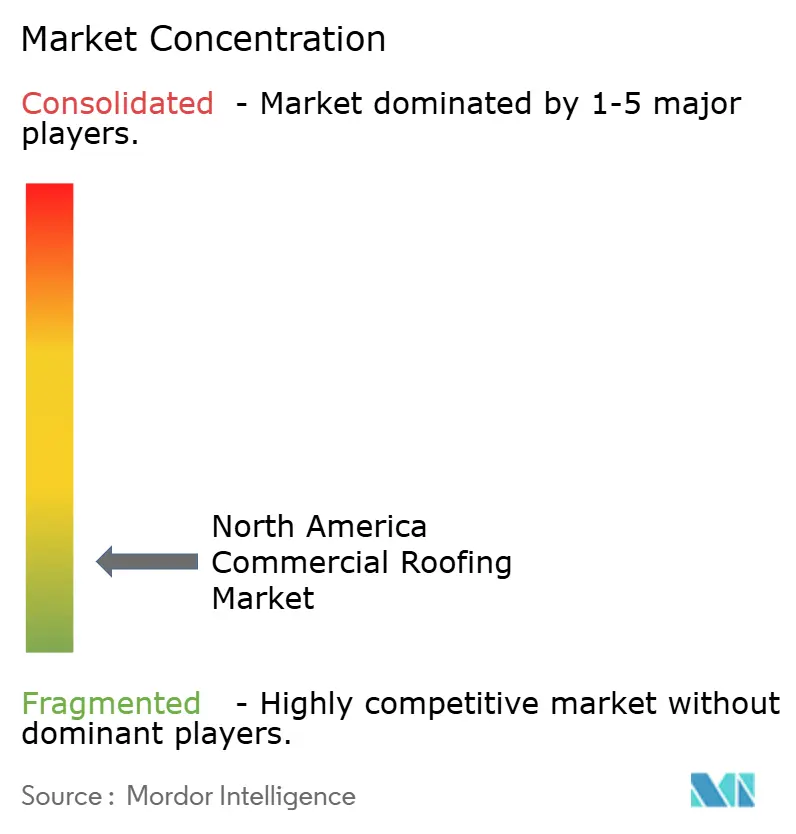
| Market Concentration | Medium |
Major Players *Disclaimer: Major Players sorted in no particular order Image © Mordor Intelligence. Reuse requires attribution under CC BY 4.0. | |
North America Commercial Roofing Market Analysis by Mordor Intelligence
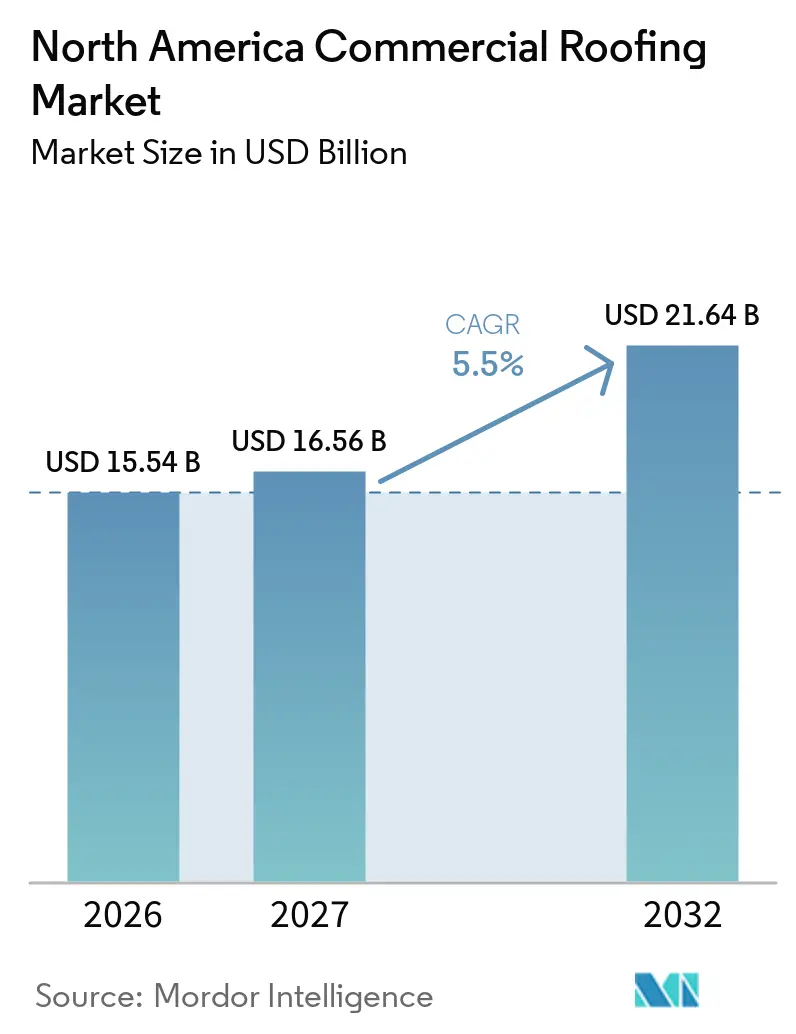
The North America Commercial Roofing Market size is projected to be USD 15.54 billion in 2026, USD 16.56 billion in 2027, and reach USD 21.64 billion by 2032, growing at a CAGR of 5.5% from 2027 to 2032.
The North America commercial roofing market is supported by an aging nonresidential building base, which creates recurring replacement work even when new construction is uneven. Carlisle reported that reroofing represented a material share of its commercial roofing activity and helped support revenue while new commercial construction remained soft in 2025. Premium roofing specifications for logistics properties, data centers, healthcare sites, and other high-demand buildings can raise project values because owners require stronger membranes, insulation, detailed edge systems, and reliable coordination with other rooftop work. Supply relationships are becoming more organized as institutional owners seek dependable product availability across large portfolios and want clearer planning for repair and replacement work. The North America commercial roofing market also faces higher input costs, longer procurement planning, and more complex project conditions in older buildings, which can affect contract timing and the type of work owners authorize.
Key Report Takeaways
- By material type, single-ply membranes held 50.00% of the North America commercial roofing market share in 2026 and are forecast to expand at a 6.80% CAGR through 2032.
- By construction type, reroofing and replacement accounted for 72.00% of the North America commercial roofing market size in 2026, while it is projected to grow at a 6.33% CAGR through 2032.
- By application, retail held 20.00% of the North America commercial roofing market share in 2026, while the other categories are forecast to record an 8.50% CAGR through 2032.
- By geography, the United States held 72.00% of the North America commercial roofing market size in 2026, while Mexico is forecast to grow at a 7.00% CAGR through 2032.
Note: Market numbers in this report are based on Mordor Intelligence's proprietary estimation framework, which combines nine months of actuals with Q4 projections for base year 2026.
North America Commercial Roofing Market Trends and Insights
Drivers Impact Analysis*
| Drivers | (~) % Impact on CAGR Forecast | Geographic Relevance | Impact Timeline |
|---|---|---|---|
| Data-Center Campus Expansion and Redundant Roof Specifications | +1.1% | United States, Canada | Short term (≤ 2 years) |
| Hail, Wind, Wildfire, and Freeze-Thaw Resilience Requirements | +0.9% | United States, Canada | Medium term (2-4 years) |
| Warehouse Modernization and Fulfillment Growth | +0.8% | United States, Mexico | Medium term (2-4 years) |
| Public-Sector and Healthcare Reroofing Programs | +0.7% | United States, Canada, Mexico | Medium term (2-4 years) |
| Solar-Ready Commercial Roof Upgrades | +0.5% | United States, Canada | Short term (≤ 2 years) |
| Distributor Consolidation and Contractor Network Expansion | +0.4% | United States, Canada, Mexico | Long term (≥ 4 years) |
| Source: Mordor Intelligence | |||
Data-Center Campus Expansion and Redundant Roof Specifications
Data center development is increasing the need for high-performance roof assemblies across the North America commercial roofing market. These facilities operate continuously and may carry dense rooftop cooling equipment, which makes waterproofing, drainage, safe access, and roof durability critical to daily operations. Owners often require thicker membranes, tapered insulation, detailed edge systems, and backup waterproofing measures that exceed standard commercial specifications. Higher-value roof assemblies are also needed where a leak could disrupt sensitive computing equipment or cooling systems. The demand extends beyond very large campuses to regional colocation and artificial intelligence training facilities in key United States technology corridors. This work gives contractors with technical design knowledge and experience around complex rooftop equipment a stronger position on premium projects.
Hail, Wind, Wildfire, and Freeze-Thaw Resilience Requirements
Severe weather exposure is raising the performance requirements for commercial roofs in several parts of North America. Building owners are placing more weight on wind resistance, hail protection, durable cover boards, secure edge details, and material systems that perform under repeated freeze-thaw cycles. These requirements can add work to replacement projects because the owner must improve the roof assembly instead of only replacing the visible membrane. The effect is strongest in the South, Midwest, and wildfire-prone western areas of the United States, as well as Canadian regions exposed to hail and cold weather. Insurance documentation and building standards can also influence how the system is designed and what records the contractor must provide. Resilience requirements therefore support specification upgrades alongside the normal replacement cycle.
Warehouse Modernization and Fulfillment Growth
Warehouse modernization continues to add demand to the North America commercial roofing market, particularly where owners need high-performing roof assemblies for large logistics buildings that operate for long hours and carry extensive rooftop mechanical equipment. Large facilities require dependable waterproofing, insulation, drainage, safe access, and a roof design that can be maintained without disrupting warehouse operations. This work is valuable because a single building can have a broad roof surface, a complex installation scope, and a meaningful cost of service interruption if the roof fails. SRS Distribution entered an exclusive arrangement with Prologis in November 2025 to supply commercial roofing products across Prologis facilities in the United States, demonstrating the growing importance of portfolio-level procurement[1]. The arrangement can make supply planning more predictable for building owners and contractors, especially when similar facilities need common products, standard delivery processes, and scheduled maintenance. In Mexico, industrial development associated with nearshoring supports demand for membrane roof installations in manufacturing and logistics locations, where large buildings are added as production and distribution networks expand.
Public-Sector and Healthcare Reroofing Programs
Public buildings and healthcare properties create a steadier source of roofing work because maintenance cannot be delayed indefinitely without operational risk to patients, staff, students, public services, and the equipment inside the building. Schools, hospitals, courthouses, transit assets, and other institutional buildings require planned roof replacement as systems reach the end of their service lives and repairs no longer provide a durable solution. Georgia State University issued a February 2026 solicitation to replace a modified bitumen roof with a single-ply polyvinyl chloride, or PVC, system at its Atlanta Commerce Building[2]. Such projects favor contractors that can work around occupied facilities, safety requirements, formal purchasing procedures, security rules, and limited access periods. In Canada, the Green Buildings Strategy supports energy-efficient building upgrades and provides a policy setting that favors better-insulated and reflective roofing systems[3]. These programs help maintain reroofing activity when private construction schedules are less certain and give owners a reason to combine a replacement project with building-envelope improvements.
Restraints Impact Analysis*
| Restraints | (~) % Impact on CAGR Forecast | Geographic Relevance | Impact Timeline |
|---|---|---|---|
| Legacy Deck, Asbestos, and Moisture Remediation Costs | -0.8% | United States, Canada | Medium term (2-4 years) |
| Prevailing-Wage and Union Labor Requirements | -0.6% | United States, Canada | Long term (≥ 4 years) |
| State and Provincial Code Fragmentation | -0.5% | United States, Canada, Mexico | Long term (≥ 4 years) |
| Insurance Documentation and Liability Exposure | -0.4% | United States, Canada | Medium term (2-4 years) |
| Source: Mordor Intelligence | |||
Legacy Deck, Asbestos, and Moisture Remediation Costs
Legacy deck conditions, asbestos, and hidden moisture can make reroofing projects slower and more expensive because the original scope can change after contractors remove existing materials. A contractor may begin with a membrane replacement scope and find that deck repair, removal work, insulation replacement, drainage correction, or additional drying time is also necessary. The extra work affects budgets, project schedules, and the ability of owners to proceed with planned upgrades, particularly when a building must remain open and access is restricted. These conditions are most challenging in older industrial, institutional, and commercial properties where records may be incomplete, and several generations of roof systems can exist below the current membrane. Well-capitalized owners can usually address the wider scope, while smaller owners may defer work despite the age of their existing roof and the increasing chance of future leaks. This pattern can delay demand in the short term while increasing the stock of buildings that will need replacement later, creating a backlog that is more difficult and costly to address.
Prevailing-Wage and Union Labor Requirements
Labor requirements can constrain margins and bid participation in publicly funded roofing work, particularly where project schedules, wage rules, and site safety expectations are fixed before a contractor submits a price. Contractors must account for local wage rules, skilled crew availability, safety practices, training needs, and schedule commitments when pricing a project that may involve an occupied building or a sensitive public service. The National Roofing Contractors Association reported continuing expansion in its low-slope project contracts index in the first quarter of 2026, which indicates that contractors were managing active work backlogs. Strong demand can make qualified labor more difficult to schedule, especially where public work has fixed procurement requirements, narrow closure periods, and limited flexibility for weather-related delays. In Canada, institutional projects can face similar pressure from local labor conditions, formal project standards, and the need to coordinate with building users. These constraints can lead contractors to favor projects with clearer scheduling and risk profiles, while owners may need to allow more time for estimating, award decisions, and mobilization.
*Our forecasts treat driver/restraint impacts as directional, not additive. The impact forecasts reflect baseline growth, mix effects, and variable interactions.
Segment Analysis
By Material Type: Single-Ply Membranes Lead Demand and Growth
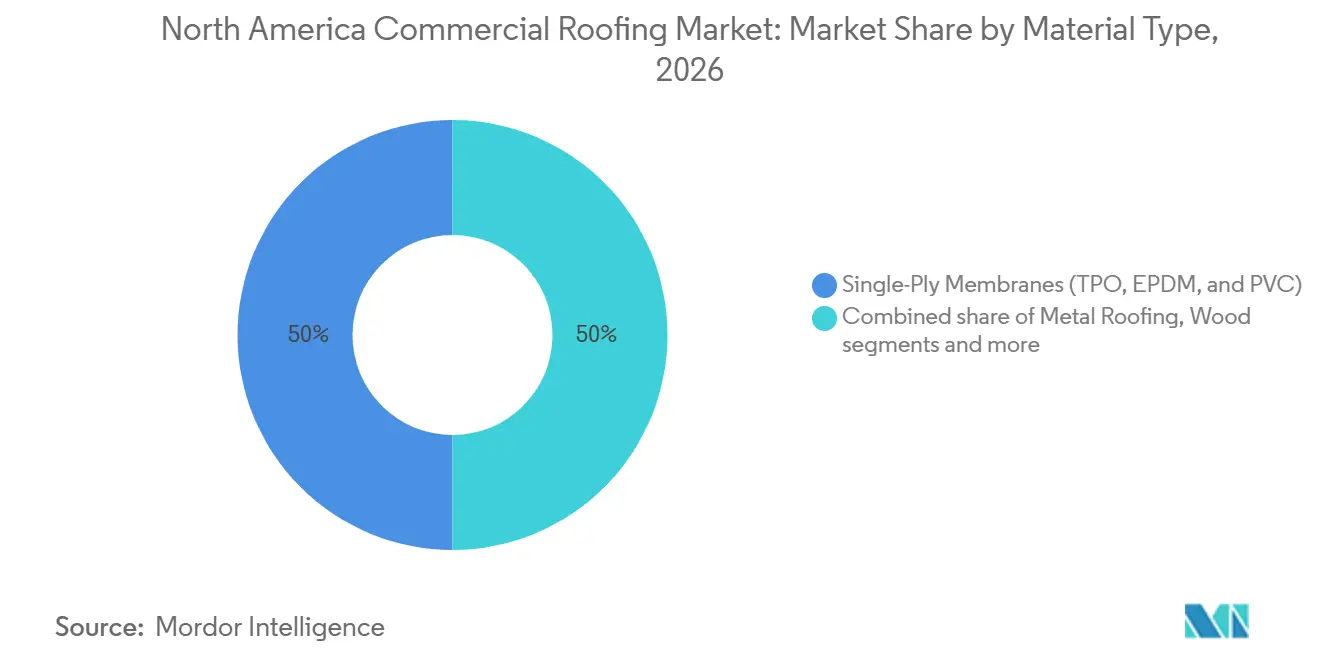
Single-ply membranes held 50.00% of the North America commercial roofing market share in 2026 and are forecast to grow at a 6.80% CAGR through 2032. The segment includes thermoplastic polyolefin, or TPO, ethylene propylene diene monomer, or EPDM, and PVC systems. Its scale reflects broad use on low-slope commercial buildings, where owners value welded seams, repairability, reflective surface options, and consistent membrane coverage over large roof areas. TPO is widely used for reflective applications in warm locations, while PVC is used where owners require resistance to chemicals or a higher-specification system. EPDM remains relevant in Canadian locations that experience demanding freeze-thaw conditions.
The North America commercial roofing market size for single-ply systems is also supported by replacement work that upgrades older built-up or modified bitumen roofs. This substitution can increase project value because installation often includes insulation, cover boards, flashings, drainage work, improved edge details, and a warranty-supported system design. Metal roofing remains important for steep-slope commercial properties and sites exposed to severe weather. At the same time, bituminous membranes continue to serve the large installed base of low-slope buildings, including established use in Quebec. Asphalt shingles, coatings, and spray polyurethane foam remain relevant in specific commercial settings, especially where roof geometry, building appearance, or occupied-facility constraints shape the system choice. These alternatives ensure that material selection remains tied to building condition, operating needs, climate, and the owner's planned maintenance approach.

By Construction Type: Reroofing and Replacement Provide the Main Volume
Reroofing and replacement accounted for 72.00% of the North America commercial roofing market size in 2026 and are forecast to grow at a 6.33% CAGR through 2032. This construction type is driven by lifecycle needs rather than a discretionary expansion of building space. Carlisle stated that reroofing demand supported its commercial roofing business in 2025 as new construction faced weaker conditions. Reroofing allows owners to improve insulation, drainage, waterproofing, and weather resistance while replacing an aging membrane. The continuing low-slope project contracts index reported by the National Roofing Contractors Association supports the view that contract activity remains active.
New construction represented the remaining 28% of the North America commercial roofing market in 2026. Its activity is concentrated in properties that need specialized roof systems, including data centers, industrial logistics facilities, and healthcare buildings. These projects can generate high value per square foot because they require detailed assemblies and close coordination with rooftop equipment, building services, site safety, and the owner's operational schedule. Standard office and retail construction remains less favorable where vacancies limit capital spending, but Mexico provides an exception through new manufacturing and logistics sites connected with nearshoring. The mix of replacement work and selective high-value new construction gives contractors several routes to maintain demand while balancing routine service work with more complex project delivery.
By Application: Retail Leads Volume While Others Grow Fastest
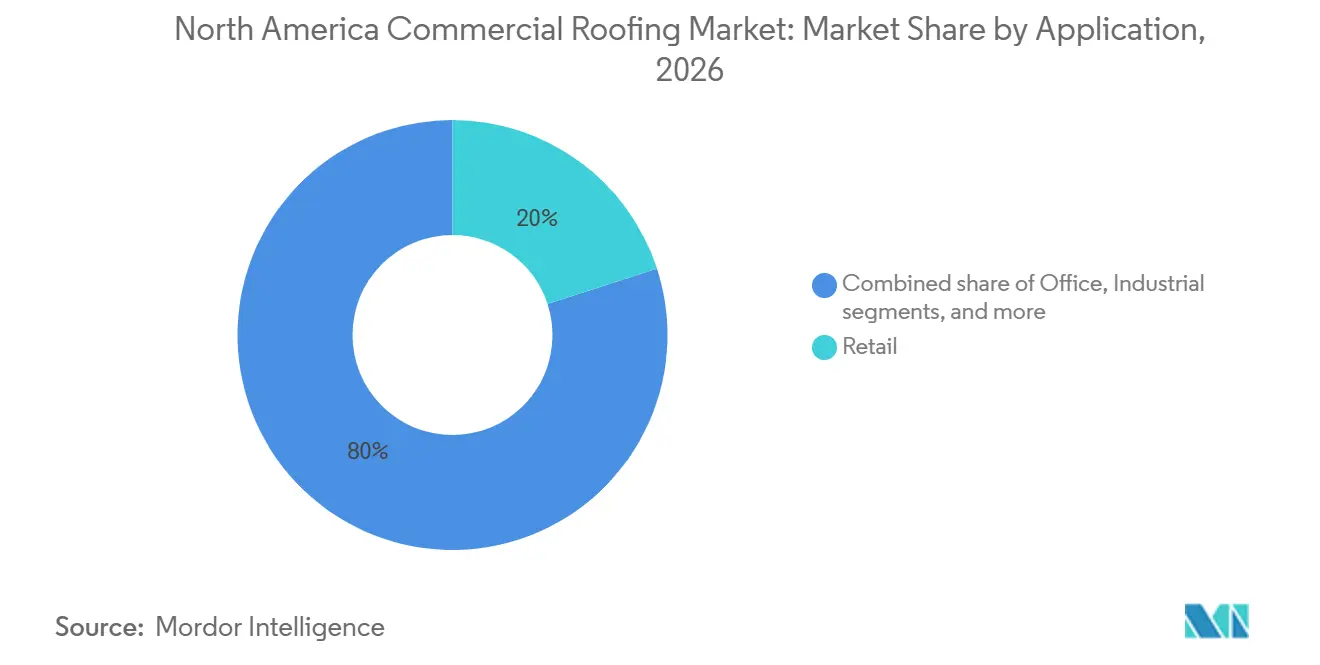
Retail held 20.00% of the North America commercial roofing market share in 2026, making it the largest application category. Shopping centers, big-box stores, and other large retail properties have significant existing roof areas that require periodic maintenance, repair, and eventual replacement. Their roof systems are often low-slope and suited to single-ply membranes or modified bitumen products. The category offers a recurring pipeline because owners must protect tenants, inventory, customer access, and normal trading activity. Retail owners may also incorporate reflective membranes, better insulation, and drainage repairs when a roof reaches replacement age.
The Others application category is forecast to grow at an 8.50% CAGR through 2032, the fastest rate among the applications provided. It includes data centers and cold-storage facilities, which require high-value assemblies and careful treatment of penetrations, rooftop equipment, waterproofing layers, and ongoing maintenance access. Industrial properties also support demand through warehouse construction and Mexican manufacturing expansion, while office activity is comparatively weaker where vacancies reduce building investment. The strongest opportunities combine a large roof area with a high consequence of failure, as seen in logistics, food-related, cold-storage, and digital infrastructure facilities. This pattern creates demand for contractors that can combine sound installation practice with careful coordination across several building trades.
Geography Analysis
The United States held 72.00% of the North America commercial roofing market share in 2026, making it the largest geographic segment. Replacement demand is particularly important in areas where aging commercial buildings and frequent weather exposure overlap. The South Atlantic, Gulf Coast, and Midwest provide notable activity because they contain broad commercial building stocks and varied climate conditions, including storm exposure that can turn a planned replacement into an urgent repair decision. Carlisle Construction Materials generated USD 3,721.7 million in 2025 revenue, and the company linked its commercial roofing performance to solid reroofing demand. High-specification projects in logistics and data center corridors also require products and installation expertise that can support stronger contract values and give qualified contractors a reason to invest in specialized crews, safer installation procedures, and close coordination with mechanical and electrical teams.
Canada represents a smaller but important part of the North America commercial roofing market. Its commercial and institutional reroofing work is shaped by cold weather, freeze-thaw cycles, and building-envelope efficiency requirements that influence material selection and the need for reliable insulation. The Canadian Green Buildings Strategy supports emissions reductions in buildings and encourages upgrades that improve energy performance. This setting supports reflective membranes, more insulation, and roof retrofits that can improve building performance without a full building overhaul, especially where owners want to reduce energy use and limit disruption to normal building operations.
Mexico is forecast to record a 7.00% CAGR through 2032, the fastest growth rate in the North America commercial roofing market. Nearshoring-related manufacturing and logistics construction supports demand for large membrane installations in northern industrial corridors, where new facilities often have extensive roof areas and need consistent water management. Building owners in these locations can value reflective systems because controlling interior heat can reduce the burden on cooling systems and improve conditions for equipment and workers. Mexico also provides a route for new-construction roofing work that partly offsets softer office construction elsewhere in the region. The country remains connected to North American manufacturers and distribution channels for many specialized membrane products, so cross-border supply planning remains important where equipment, product availability, tariffs, freight schedules, and project timelines are closely linked.
Competitive Landscape
The North America commercial roofing market is fragmented at the contractor level, while the manufacturing and distribution tiers are more concentrated. Large contractors compete on geographic reach, technical capability, service capacity, safety performance, and their ability to complete work at occupied facilities. Carlisle describes its commercial roofing platform as a significant participant in single-ply systems and reported USD 3,721.7 million in 2025 revenue for its Construction Materials segment. Manufacturers compete through membrane performance, insulation systems, accessory portfolios, warranties, and contractor relationships. The market also includes independent roofing contractors that are closely tied to local building owners, local codes, climate conditions, and emergency repair requirements.
Distribution consolidation is changing how products move through the North America commercial roofing market. SRS Distribution partnered with Prologis in November 2025 as the exclusive commercial roofing product distributor for the landlord’s United States facilities. This strategy aligns product supply with the requirements of a large logistics portfolio and provides a model for more standardized purchasing. QXO completed the acquisition of Beacon Building Products in April 2025, further highlighting interest in roofing distribution scale. Kingspan increased its planned United States roofing investment to USD 1 billion in June 2025 and identified new Maryland and Oklahoma facilities for production in 2026.
Contractor acquisitions also show that firms seek technical specialization and broader regional coverage. Latite Roofing and Sheet Metal combined with Roof Management in August 2025, adding capabilities that included demanding roofing installations. Tecta America acquired Alpine Roofing in January 2025 to expand its commercial roofing footprint in Nevada and northern California. Carlisle’s reported unsolicited offers for Owens Corning in 2026 would combine commercial single-ply strength with other building-material categories if a transaction occurs.
North America Commercial Roofing Industry Leaders
-
GAF Materials Corporation
-
Owens Corning
-
Carlisle Companies Incorporated
-
Johns Manville
-
Duro-Last Inc.
- *Disclaimer: Major Players sorted in no particular order
Recent Industry Developments
- October 2026: Roof Restoration Group completed its first partnership with Exterior Solutions Group, an Edmond, Oklahoma, commercial roofing contractor specializing in institutional roof replacement and restoration for K-12 schools and public-sector clients. The platform provides capital, procurement, and national sales infrastructure while preserving local brands and leadership.
- October 2026: Polyglass entered the United States single-ply commercial roofing market with Mapeplan PVC, an integrated low-slope system that combines PVC membranes, bonding adhesives, prefabricated accessories, and polyiso insulation. The system supports adhered, mechanically attached, and induction-welded assemblies, with hybrid compatibility with modified bitumen systems.
- September 2026: Guaranteed Roof joined LB Capital's EM Exteriors platform, gaining access to shared technology, purchasing, and operating resources. The partnership supports multi-state expansion from Georgia into Tennessee, North Carolina, and South Carolina while retaining Guaranteed Roof's brand and local leadership.
North America Commercial Roofing Market Report Scope
| Asphalt Shingles |
| Clay & Concrete Tiles |
| Metal Roofing |
| Bituminous / Modified Bitumen Membranes |
| Single-Ply Membranes (TPO, EPDM, and PVC) |
| Wood |
| Others |
| New Construction |
| Reroofing and Replacement |
| Retail |
| Office |
| Industrial |
| Others |
| United States |
| Canada |
| Mexico |
| By Material Type | Asphalt Shingles |
| Clay & Concrete Tiles | |
| Metal Roofing | |
| Bituminous / Modified Bitumen Membranes | |
| Single-Ply Membranes (TPO, EPDM, and PVC) | |
| Wood | |
| Others | |
| By Construction Type | New Construction |
| Reroofing and Replacement | |
| By Application | Retail |
| Office | |
| Industrial | |
| Others | |
| By Countries | United States |
| Canada | |
| Mexico |
Key Questions Answered in the Report
What is the 2026 value of the North America commercial roofing market?
The North America commercial roofing market was valued at USD 15.54 billion in 2026 and is forecast to reach USD 21.64 billion by 2032. The forecast period is 2027 through 2032, with a CAGR of 5.50%. This outlook reflects both broad reroofing needs and selective high-value construction in logistics, healthcare, data center, and institutional properties.
What is driving commercial reroofing demand in North America?
Aging building stock, building-envelope upgrades, institutional maintenance needs, and specialized logistics and data center projects support replacement work. Reroofing and replacement represented 72.00% of demand in 2026, giving the North America commercial roofing market a base of work that is less dependent on standard office construction.
Which commercial roofing material leads North America?
Single-ply membranes led with a 50.00% share in 2026 and are forecast to grow at a 6.80% CAGR through 2032. TPO, EPDM, and PVC are the principal single-ply system types discussed in this report, and each meets different climate, roof-use, and specification needs.
Why is Mexico growing faster than other North American countries?
Mexico is projected to expand at a 7.00% CAGR through 2032, supported by manufacturing and logistics construction linked to nearshoring. Large industrial projects support demand for broad membrane roof installations.
Which application has the strongest forecast growth?
The Others category, which includes data centers and cold-storage facilities, is forecast to grow at an 8.50% CAGR through 2032. These facilities can require more detailed waterproofing and maintenance access.
How concentrated is commercial roofing competition in North America?
The market is fragmented at the contractor level, although manufacturing and distribution are more concentrated and large platforms are expanding through acquisitions and partnerships. Competition also depends on local service reach and technical capability.