
Market Overview
| Study Period | 2020 - 2031 |
|---|---|
| Forecast Data Period | 2026 - 2031 |
| Historical Data Period | 2020 - 2024 |
| Growth Rate | 14.86 % |
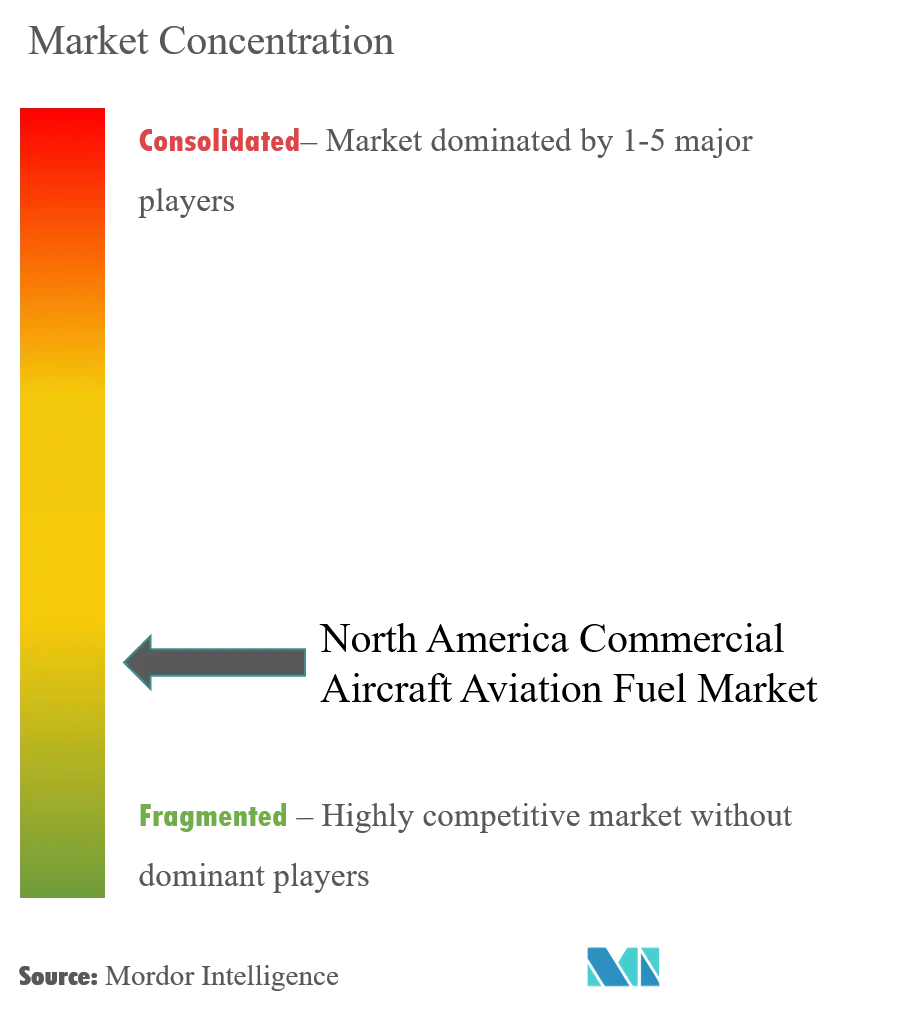
| Market Concentration | Medium |
Major Players *Disclaimer: Major Players sorted in no particular order Image © Mordor Intelligence. Reuse requires attribution under CC BY 4.0. | |
North America Commercial Aircraft Aviation Fuel Market Analysis by Mordor Intelligence
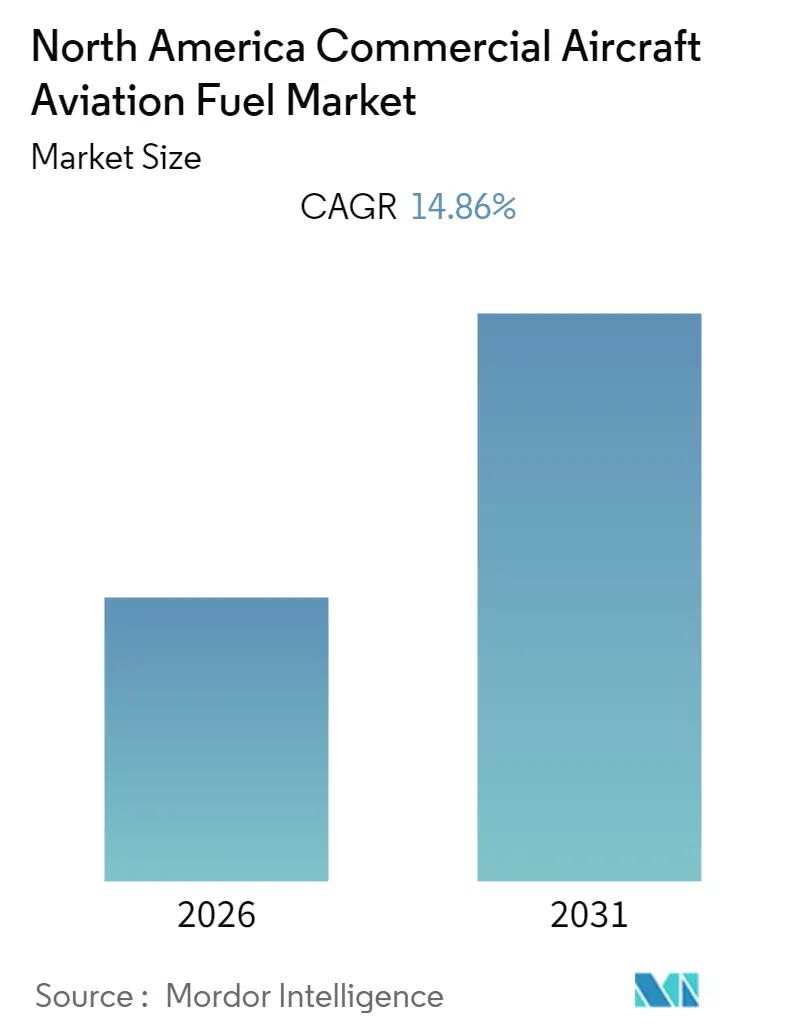
The North America Commercial Aircraft Aviation Fuel Market size is expected to register a CAGR of 14.86% during the forecast period (2026-2031).
The market has been negatively impacted by the outbreak of COVID-19 due to regional lockdowns and flight restrictions. Currently, the market has reached pre-pandemic levels.
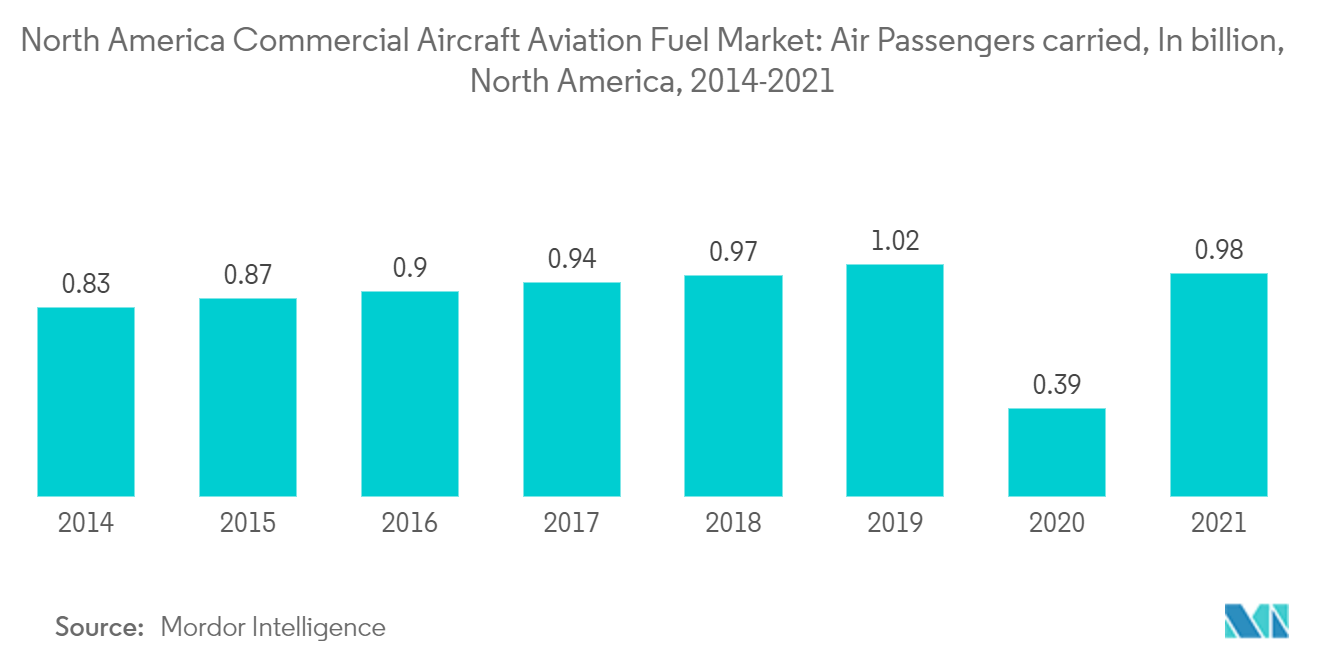
- Factors such as increasing air passenger traffic, increasing the number of low-cost carriers (LCC) across the region, and growing demand for air cargo transportation, are expected to drive the market over the forecast period.
- However, volatile crude oil and jet fuel prices are expected to restrain the target market.
- The commercial aviation industry aims to increase domestic renewable jet fuel supply to reduce carbon emissions. Thus, there is an increasing demand for alternatives, such as renewable aviation fuel, which will likely provide an opportunity in the near future.
- The United States is expected to dominate the North American commercial aircraft aviation fuel market over the forecast period.
Note: Market size and forecast figures in this report are generated using Mordor Intelligence’s proprietary estimation framework, updated with the latest available data and insights as of 2026.
North America Commercial Aircraft Aviation Fuel Market Trends and Insights
Air Turbine Fuel (ATF) Segment is Expected to Dominate the Market
- Aviation turbine fuel (ATF) or jet fuel is a type of aviation fuel designed for use in aircraft powered by gas-turbine engines. Jet A1 and Jet A are two primary grades of aviation fuel used in commercial aircraft.
- Factors such as growth in air traffic passenger, global economic scenario, and improvement in aircraft fuel-burning efficiency are influencing demand for jet fuel in the commercial aircraft aviation fuel market.
- Jet A1 is likely to remain a dominant aviation fuel in terms of consumption, followed by the Jet A type, for locations outside the United States. Jet A-1 must have a freeze point of minus 47°C or below. This fuel normally contains a static dissipator additive.
- Jet A specification fuel is mainly used in the United States, and it is usually not available outside the United States and a few Canadian airports, such as Toronto and Vancouver. Jet A fuel must have a freeze point of minus 40oC or below and does not typically contain a static dissipator additive.
- LanzaTech's ethanol-based ATJ-SPK (alcohol-to-jet synthetic paraffinic kerosene) was made eligible for use as a blending component with standard Jet A for commercial airline use in the United States. Under the revised ASTM D7566, LanzaTech ATJ-SPK is eligible to be used up to a 50% blend in conventional jet fuel for commercial flights.
- Hence, such ongoing developments are expected to increase the demand for Jet A fuel (air turbine fuel) during the forecast period.
- Moreover, according to IATA, passengers traveling by air from Canada are expected to increase to 118 million by 2037. Therefore, the demand for aviation turbine fuel for commercial aircraft is expected to increase in the coming years.


The United States is Expected to Dominate the Market
- General Aviation included a total of 440,000 general aircraft flying worldwide (GAMA) as of 2021, ranging from two-seat training aircraft and utility helicopters to intercontinental business jets. Over 211,000 general planes are based in the United States, which makes the nation dominate the sector.
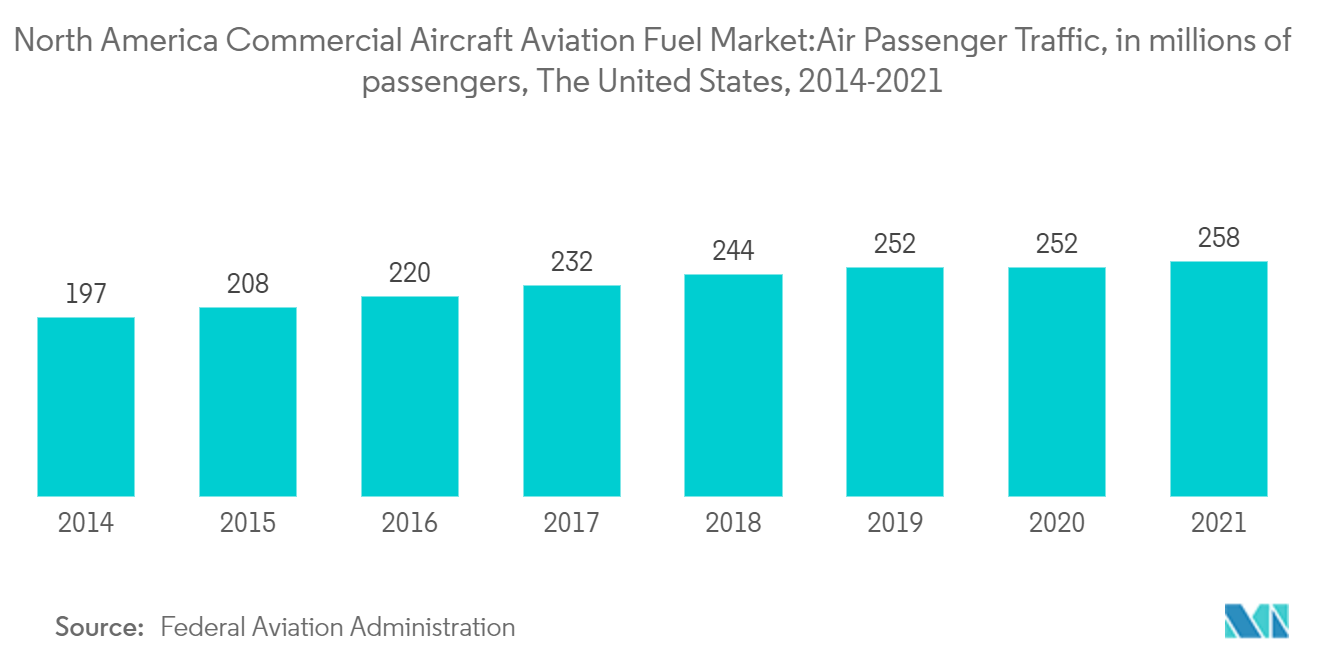
- According to the Airlines for America (A4A), in 2021, the country's airlines carried 2.5 million passengers worldwide daily, which was an all-time high number of passengers in the country's airline history. Moreover, 68,000 metric tons of cargo per day were ferried by the country's airlines in 2020 (A4A).
- Therefore, the country's robust air travel and cargo volume growth has resulted in greater demand for aviation fuel in the past years.
- Air travel in the country has increased as real airfares have plunged in the past. Therefore, the increased propensity of people to prefer domestic and international air travel has led to increased consumption of aviation fuel.
- Hence, due to factors such as high air traffic passenger and cargo, the United States is expected to dominate in the North American commercial aircraft fuel market over the forecast period.
Regulatory Landscape
In the United States, policy momentum around aviation fuels is increasingly tied to decarbonization and fuel quality compliance. The Sustainable Aviation Fuel (SAF) Grand Challenge, led by the U.S. Department of Energy in coordination with other federal agencies, sets a national production ambition of 3 billion gallons per year by 2030 and 35 billion gallons by 2050. This framework is shaping how refiners, blenders, and airlines discuss SAF supply-chain buildout and credit eligibility.
In Canada, Transport Canada frames sector decarbonization through its Aviation Climate Action Plan (net-zero by 2050, with an aspirational 10% SAF use by 2030). Public-sector procurement is also being used as a demand signal through the Treasury Board Secretariat's Low-carbon Fuel Procurement Program, backed by CAD 134.9 million in funding for fiscal years 2023-2024 through 2030-2031. In February 2025, the Canadian Department of National Defence issued an advisory authorizing the use of ASTM D7566 synthetic aviation turbine fuels on DND/CAF aircraft without additional certification, reinforcing ASTM pathways as a practical compliance route for drop-in fuels.
Value Chain Analysis
The North American commercial aviation fuel value chain covers crude and feedstock supply, refining and SAF production, blending and certification, wholesale marketing, airport storage, and into-plane fueling. Conventional jet fuel supply remains anchored in refinery output and established distributors and into-plane service providers at major airports, while SAF adds upstream steps such as feedstock aggregation (including waste oils, biomass, and ethanol/ATJ intermediates), qualified conversion pathways, and controlled blending with Jet A/Jet A-1 to meet specification requirements such as ASTM D7566.
Scaling SAF shifts some bottlenecks toward logistics and airport-adjacent infrastructure. Industry and government discussions repeatedly flag constrained pipeline and storage capacity as a limiting factor for moving blended volumes into hub airports, which has pushed projects toward hub-centric models that co-locate production, blending, and distribution. On the supply side, pathway and project progress continues to influence investability and throughput: in January 2026, the U.S. EPA issued a Renewable Fuel Standard pathway determination enabling Summit Next Gen's Houston sugarcane process to generate D-code 4 RINs for renewable jet fuel. Separately, new project builds and technology licensing, including a planned 3,200 barrels per day wood-waste-to-SAF project in Canada supported by Topsoe and Sasol technologies, highlight growing participation from technology providers, developers, and offtakers.
Competitive Landscape
The North American commercial aircraft aviation fuel market is moderately fragmented. Some of the major players in the market (in no particular order) include Chevron Corporation, World Fuel Services Corp, Total S.A., Vitol Holding BV, and Royal Dutch Shell Plc.
North America Commercial Aircraft Aviation Fuel Industry Leaders
Chevron Corporation
World Fuel Services Corp
Vitol Holding BV
Shell PLC
TotalEnergies SE
- *Disclaimer: Major Players sorted in no particular order

Market Opportunities and Future Outlook
The clearest opportunity in North America is bridging the gap between SAF policy ambition and operational availability at commercial hubs, where airport logistics, blending capacity, and contracting structures are still forming. This is visible in multi-airport programs and longer-duration agreements that bundle SAF supply with infrastructure and delivery work, moving beyond isolated demonstration flights. The U.S. SAF Grand Challenge target of 3 billion gallons per year by 2030 also provides a concrete benchmark that keeps airlines, fuel suppliers, and project developers focused on near-term capacity additions and qualified pathways.
Opportunities are also tied to new feedstock and pathway approvals and how they interact with incentives, which can make projects more bankable and standardize purchasing. In 2026, the U.S. House passed H.R. 7567 (Farm, Food, and National Security Act of 2026), writing SAF into federal biofuels policy and directing USDA support toward SAF feedstock development. On the supply side, announced projects and technology selections point to active capacity build plans, including Southern Energy Renewables' announced USD 1.4 billion biomass-to-methanol and SAF complex in Louisiana (March 2026) and SUSTAERO GP Inc.'s technology licensing for a planned Canadian SAF facility (3,200 barrels per day, July 2026). Gevo's April 2026 withdrawal from the DOE financing process for its ATJ-30 project also highlights a financing and execution whitespace, where alternative capital structures and offtake-linked funding can help differentiate developers that can still reach financial close.
Recent Industry Developments
- July 2026: Delta Air Lines and Shell Aviation entered a five-year agreement to expand SAF supply and related infrastructure across multiple U.S. hubs, including LAX, PDX, JFK, BOS, and MSP. The scope goes beyond volumes into delivery, blending, and logistics, tying procurement to operational integration at airports. The deal supports repeatable SAF uplift across a network rather than single-location supply arrangements.
- April 2026: Legislation directs USDA support toward SAF feedstock development, linking agriculture programs more directly to aviation fuel decarbonization. It expands federal policy scope to include SAF feedstock development within mainstream biofuel programs.
- November 2024: DOE publishes the SAF Grand Challenge Implementation Framework to accelerate domestic SAF production and adoption. The framework coordinates interagency priorities around supply growth, conversion technologies, and enabling infrastructure.


Research Methodology Framework and Report Scope
Market Definition and Coverage
This market tracks the value of aviation fuel sold for use in commercial aircraft operations across North America, counted at the fuel product level and linked to observed flying activity and fuel supply patterns.
Scope exclusions: We exclude military aviation fuel demand, general aviation fueling, and non-aviation refinery products that are not used to power aircraft.
Segmentation Overview
- Fuel Type
- Air Turbine Fuel (ATF)
- Aviation Biofuel
- Others
- Geography
- The United States
- Canada
- Rest of North America
Data Sources, Market Sizing, and Validation
Desk Research
Desk research helped us set the activity baseline and price context before we moved into interviews. We used public aviation and energy statistics such as those from the US Energy Information Administration for jet fuel supply and pricing, the Bureau of Transportation Statistics for traffic and flight activity, Transport Canada for aviation indicators, and airport and aviation authority publications for throughput and operating trends.
We also referred to company annual reports, investor presentations, and reputable press coverage to understand contracting structures and typical fuel procurement behavior. For trade flows and supply balancing, government customs statistics and, where relevant, an import-export shipment-level database were used to sanity check volumes moving across North America. The sources named here are illustrative only, and additional public datasets and documents were reviewed to collect inputs, validate assumptions, and clarify data gaps.
Primary Interviews and Surveys
Primary work focused on confirming what desk sources could not fully quantify, mainly the practical split between conventional jet fuel and aviation biofuel, typical blending and credit pass-through behavior, and how pricing is indexed in contracts. We spoke with a mix of fuel suppliers, airport fuel storage and handling stakeholders, airline procurement teams, and logistics participants across the United States and Canada, and more broadly across North America, so the model reflects real buying and supply patterns.
Distribution of primary research fieldwork respondents
| Company type | Respondent position |
|---|---|
| Top tier: 29% | CXOs: 19% |
| Mid tier: 50% | Functional/Unit leaders: 36% |
| Smaller Players: 21% | Managers: 45% |
Market-Sizing & Forecasting
The core sizing approach is a demand pool method, where flight activity and fuel intensity are used to reconstruct consumption, and then spending is derived using an average selling price series aligned to the same calendar period. We built the demand view using indicators such as passenger traffic and available seat miles, flight departures and stage-length mix, observed jet fuel supply and implied consumption signals, and the share of commercial aircraft operations versus other aviation uses.
To keep totals realistic, we corroborated the results with selective bottom-up approximations, mainly by checking sampled airport fueling throughput, running supplier channel checks, and doing volume times price calculations for key corridors where information is clearer. When local gaps appeared, missing pieces were filled using proxy relationships such as traffic growth to fuel burn and country-level scaling, and then the outputs were discussed again with industry participants.
For forecasting, we used scenario analysis because the market is sensitive to passenger demand cycles, fleet utilization, and fuel price swings. The forward view was built using expert-agreed ranges for commercial traffic growth, efficiency improvements (fuel burn per seat mile), sustainable fuel adoption pace, and refinery supply conditions, and then the model was run under a base case with checks against upside and downside paths.
Data Validation & Update Cycle
Validation was done through cross-checks so the final value stays tied to observable market signals. We compared implied consumption against public jet fuel supply and pricing series, reviewed country-level splits against traffic statistics, and then investigated any large variance before numbers were finalized.
A second analyst review was used to challenge input choices such as price timing, conversion factors, and adoption assumptions, followed by targeted re-contacts when a parameter moved the model beyond reasonable bounds. Reports are refreshed annually, with interim updates when material events occur, and a final pre-delivery check is performed so clients receive the most current view available.
Mordor Intelligence's North America Commercial Aircraft Aviation Fuel Market Size Measured Against Other Published Estimates
Published market values for commercial aircraft aviation fuel in North America often vary because the counted demand pool is not the same and because fuel pricing is timed and converted differently. In practice, the largest spread usually comes from whether the estimate stays commercial-only, how aviation biofuel blending is treated in value terms, and which calendar window is used for the price series.
By rechecking the jet fuel price curve against the same historical months used in the activity inputs, and then reconciling implied consumption to public jet fuel supply signals, a refresh-led model like Mordor Intelligence lands closer to the commercial aircraft demand base than estimates that blend multiple aviation end uses.
Benchmark comparison
| Source | Market Size | Gaps in Research Methodology |
|---|---|---|
| Mordor Intelligence | USD 64.34 B (2024) | |
| Trade Journal A | USD 70.07 B (2024) | This figure appears to cover a wider aviation fuel pool in North America, which can include non-commercial flying activity, and that wider volume base lifts total value even if pricing assumptions are similar. |
| Industry Publisher B | USD 79.09 B (2035) | This number is a long-horizon projection for a broader aviation fuel market, and differences in price escalation, fuel mix, and alternative fuel inclusion make it not directly comparable to a current-year commercial-only value. |
The table shows that scope and timing explain most of the spread, more than any single growth assumption does. When commercial flight activity is tied to a consistent consumption check and the price series is applied to the same calendar period, the resulting value stays traceable to inputs that can be reviewed and updated each year.


Key Questions Answered in the Report
What is the current North America Commercial Aircraft Aviation Fuel Market size?
The North America Commercial Aircraft Aviation Fuel Market is projected to register a CAGR of 14.86% during the forecast period (2026-2031)
Who are the key players in North America Commercial Aircraft Aviation Fuel Market?
Chevron Corporation, World Fuel Services Corp, Vitol Holding BV, Shell PLC and TotalEnergies SE are the major companies operating in the North America Commercial Aircraft Aviation Fuel Market.
What years does this North America Commercial Aircraft Aviation Fuel Market cover?
The report covers the North America Commercial Aircraft Aviation Fuel Market historical market size for years: 2019, 2020, 2021, 2022, 2023 and 2024. The report also forecasts the North America Commercial Aircraft Aviation Fuel Market size for years: 2026, 2027, 2028, 2029, 2030 and 2031.
Page last updated on:





