
North America Building Inspection Services Market Size and Share
Market Overview
| Study Period | 2020 - 2031 |
|---|---|
| Forecast Data Period | 2026 - 2031 |
| Base Year Market Size (2025) | USD 3.73 Billion |
| Market Size (2026) | USD 3.98 Billion |
| Market Size (2031) | USD 5.53 Billion |
| Growth Rate (2026 - 2031) | 6.80 % |
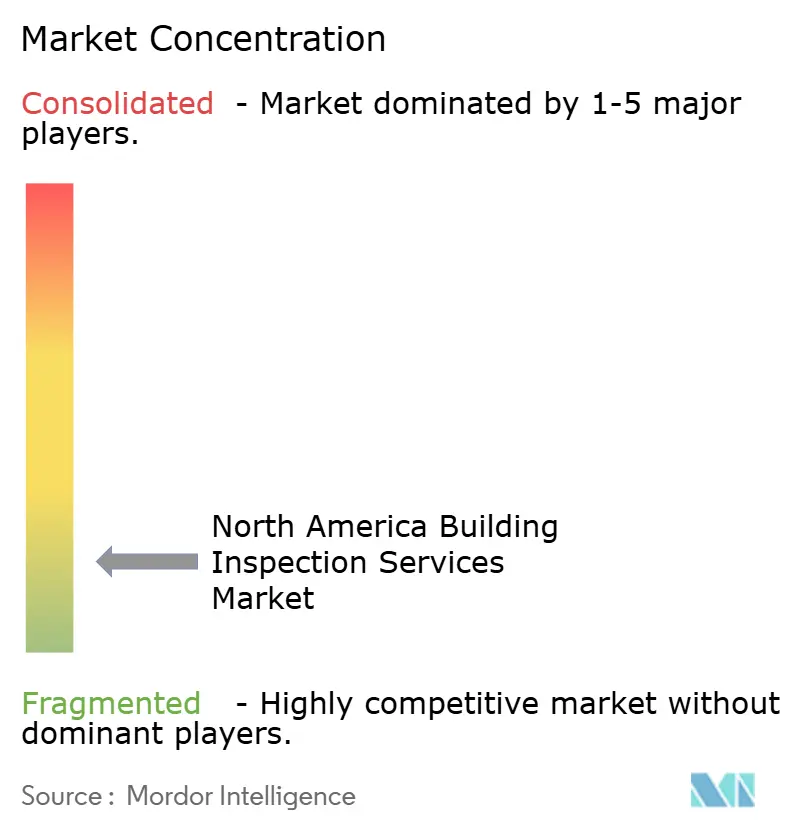
| Market Concentration | Low |
Major Players *Disclaimer: Major Players sorted in no particular order Image © Mordor Intelligence. Reuse requires attribution under CC BY 4.0. | |
North America Building Inspection Services Market Analysis by Mordor Intelligence
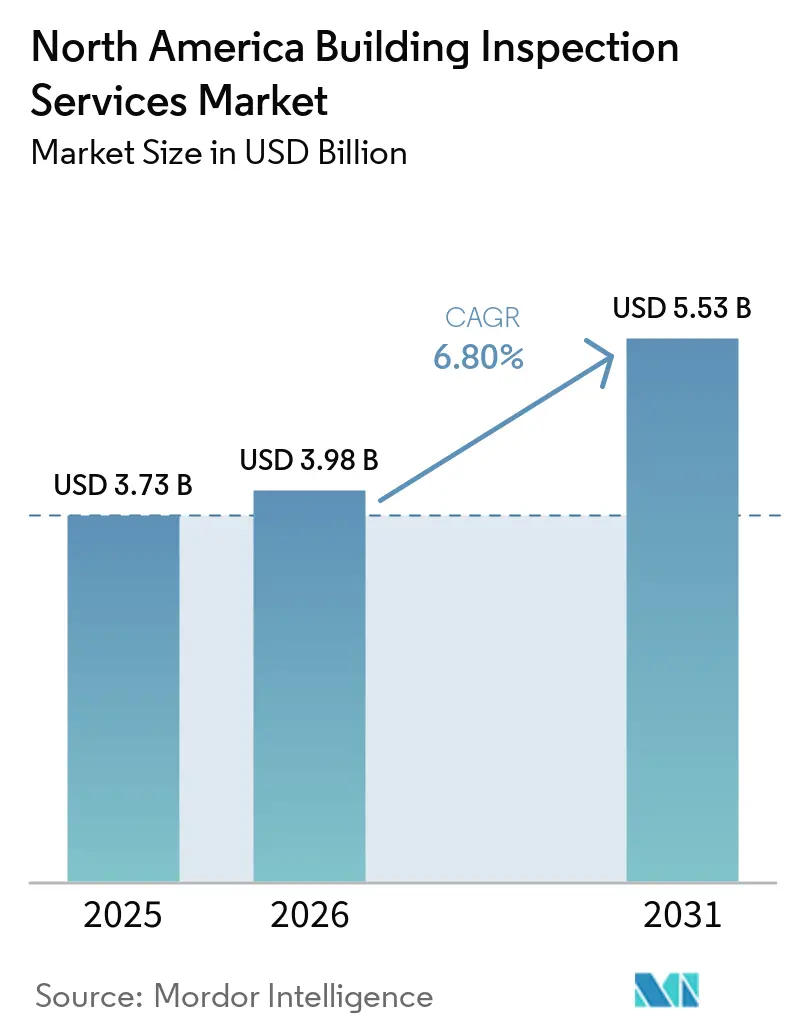
The North America Building Inspection Services Market size was valued at USD 3.73 billion in 2025 and is estimated to grow from USD 3.98 billion in 2026 to reach USD 5.53 billion by 2031, at a CAGR of 6.80% during the forecast period (2026-2031).
The North America building inspection services market benefits from inspection requirements that are embedded in home purchases, commercial financing, and construction approvals. New code cycles are also increasing the need for plan reviews, documented compliance, and follow-up assessments. Aging homes, commercial buildings, and public assets create recurring work related to repairs, safety, and energy performance. Providers are responding with broader service coverage, digital reporting, and specialized technical capabilities. Workforce shortages and different local licensing rules limit available capacity, which favors operators with trained staff and established compliance systems.
Key Report Takeaways
- By service, Home Inspection Services held 45.6% of the North America building inspection services market share in 2025, while Other Specialized Services is forecast to grow at an 8.9% CAGR through 2031.
- By sourcing type, In-House Services held 57.8% of the North America building inspection services market share in 2025, while Outsourced Services is forecast to grow at an 8.4% CAGR through 2031.
- By application, Residential held 53.6% of the North America building inspection services market size in 2025, while Other Applications is forecast to grow at a 10.8% CAGR through 2031.
- By end user, Real-Estate Agencies and Brokers held 39.8% of the North America building inspection services market share in 2025, while Government and Municipalities are forecast to grow at an 8.9% CAGR through 2031.
- By geography, the United States held 82.5% of the North America building inspection services market share in 2025, while Mexico is forecast to grow at an 8.5% CAGR through 2031.
Note: Market size and forecast figures in this report are generated using Mordor Intelligence’s proprietary estimation framework, updated with the latest available data and insights as of January 2026.
North America Building Inspection Services Market Trends and Insights
Drivers Impact Analysis*
| Drivers | (~) % Impact on CAGR Forecast | Geographic Relevance | Impact Timeline |
|---|---|---|---|
| Real-Estate Transaction Due Diligence | +1.8% | United States and Canada, especially high-volume metropolitan areas | Short term (≤ 2 years) |
| Stricter State and Municipal Building Codes | +1.5% | United States, including states adopting new code cycles in 2025 and 2026 | Medium term (2-4 years) |
| Aging Residential and Commercial Building Stock | +1.2% | United States and Canada, with pressure in older Midwest and Northeast metropolitan areas | Long term (≥ 4 years) |
| Renovation, Retrofit, and Climate-Resiliency Projects | +1% | Canada and the United States, including urban and coastal areas | Medium term (2-4 years) |
| Portfolio-Level Property Intelligence Subscriptions | +0.6% | United States, particularly real estate investment trusts, landlords, and insurers | Medium term (2-4 years) |
| Digitally Auditable Inspection Evidence | +0.5% | United States and Canada, especially compliance-intensive commercial assets | Medium term (2-4 years) |
| Source: Mordor Intelligence | |||
Real-Estate Transaction Due Diligence
Pre-purchase inspections remain part of the normal residential transaction process in the United States and Canada. The National Association of Realtors reported that the typical agent completed 9 transaction sides during 2025, which supports a regular referral base for inspection providers[1]. Buyers face greater financial exposure when property prices are high. That exposure increases scrutiny of repair needs, building systems, and concealed defects. Inspection reports can therefore remain relevant even when affordability reduces transaction volumes. Commercial lenders also use property condition assessments before financing, which supports demand outside the housing resale cycle.
The North America building inspection services market is supported by the role of inspection reports in negotiations and underwriting. Buyers use findings to evaluate repair obligations before closing. Lenders and insurers use reports to assess property condition and risk. These uses create demand that is tied to the quality of a transaction, not only its number. Agent referrals also reduce customer-acquisition costs for established residential providers. This relationship makes service quality, report speed, and local reputation important competitive factors.
Stricter State and Municipal Building Codes
New building and energy code editions increase plan-review requirements and create new inspection steps. New York City began enforcing its 2025 Energy Conservation Code for relevant building applications filed from March 30, 2026[2]. The change expands the documentation needed for affected projects. Building owners must demonstrate compliance during planning and construction. Inspectors can support this process through reviews, site visits, and records. The North America building inspection services market gains steadier work when compliance deadlines replace one-time project decisions.
Building performance requirements can also create repeat work over several years. Owners must track building energy performance, corrective actions, and verification needs. This changes inspection from an event linked only to a sale or permit. It becomes part of a compliance schedule for some large properties. Firms with code knowledge and digital evidence systems are better placed to handle repeat assignments. The resulting work is less dependent on short-term real estate sentiment.
Aging Residential and Commercial Building Stock
Older buildings require condition assessments before owners can prioritize major repairs. The American Society of Civil Engineers identified aging infrastructure and climate-related deterioration as critical concerns in its 2025 report card[3]. Aging electrical systems, roofs, mechanical equipment, and exterior walls require closer inspection. Deferred maintenance can also raise the cost and urgency of repairs. Owners use assessments to plan capital work and reduce safety risks. These needs support recurring visits across both residential and commercial properties.
Natural Resources Canada states that Canada has nearly 16 million homes and 500,000 other buildings, with much of this stock expected to remain in use through 2050. Long-lived assets create repeated inspection opportunities at key maintenance points. A roof replacement, heating system upgrade, or exterior renovation can require a new evaluation. Providers can also combine condition assessments with energy and resilience reviews. This broadens the role of the North America building inspection services market beyond a single transaction. It also supports longer client relationships with owners and facility managers.
Renovation, Retrofit, and Climate-Resiliency Projects
Canada’s green buildings strategy identifies a need to retrofit nearly 11 million buildings, increasing the importance of baseline assessments and post-work verification. Each retrofit begins with information on the condition and performance of the asset. Inspectors help identify defects, energy losses, and work priorities. Verification is also needed after work is completed. This gives inspection firms a role before, during, and after renovation activity. The North America building inspection services market, therefore, benefits from projects that improve both safety and energy performance.
The Canada Mortgage and Housing Corporation reported meaningful housing supply additions during 2025, especially in rental construction. New supply creates demand for construction-stage inspections. Existing buildings create a second source of work through upgrades. A 2025 Scientific Reports study found that assessments help identify performance gaps before retrofit decisions. This supports inspection as a practical part of retrofit planning. Coastal and storm-prone locations also require assessments that address damage exposure and resilience measures.
Restraints Impact Analysis*
| Restraints | (~) % Impact on CAGR Forecast | Geographic Relevance | Impact Timeline |
|---|---|---|---|
| Shortage of Qualified Inspectors | -1.4% | United States, especially high-growth states and jurisdictions with active construction pipelines | Long term (≥ 4 years) |
| State-by-State Licensing and Code Complexity | -0.8% | United States, particularly local code jurisdictions | Long term (≥ 4 years) |
| Professional-Liability Exposure From Digital and AI-Assisted Findings | -0.5% | United States and Canada, especially institutional and commercial work | Medium term (2-4 years) |
| Price Competition From Local and Franchise Operators | -0.4% | The United States and Canada, particularly residential markets | Medium term (2-4 years) |
| Source: Mordor Intelligence | |||
Shortage of Qualified Inspectors
The supply of qualified inspectors remains a central limit on service capacity. The Bureau of Labor Statistics projects 14,800 annual openings for construction and building inspectors from 2024 to 2034, as cited by Wisconsin’s apprenticeship announcement. Retirements increase the need for trained replacements. Many jurisdictions need staff who understand both code requirements and local approval processes. Delays can slow permits, inspections, and housing delivery. Providers with deeper inspector pools can gain assignments when municipal departments cannot meet demand.
Wisconsin introduced its first Commercial Building Inspector Registered Apprenticeship in the fall of 2026. The program combines 288 hours of instruction with more than 2,000 hours of work experience. Such programs can expand the workforce over time. They do not remove immediate shortages in high-demand locations. Training requirements and licensing pathways can deter workers from entering from other construction roles. The North America building inspection services market remains constrained when demand rises faster than qualified staff.
State-by-State Licensing and Code Complexity
Different licensing rules raise operating costs for firms that work across multiple states. Inspectors must maintain credentials and stay current with local building codes. Smaller providers may find it difficult to support this administrative work. The barrier is greater where cities apply distinct local requirements. This reduces labor mobility between high-demand and low-demand areas. It can also make geographic expansion slower and more expensive.
Inspection bodies may need to demonstrate independence, technical capability, and reliable processes. Accreditation under ISO/IEC 17020:2012 can support this expectation for third-party work. DEKRA received A2LA accreditation for field evaluation services in the United States during May 2026. These requirements can improve service quality and client confidence. They also favor firms that can maintain formal compliance systems. Digital findings add liability questions, while local and franchise operators maintain price pressure in residential assignments.
*Our forecasts treat driver/restraint impacts as directional, not additive. The impact forecasts reflect baseline growth, mix effects, and variable interactions.
Segment Analysis
By Service: Home Inspection Commands Residential Cycle, Specialized Services Accelerate
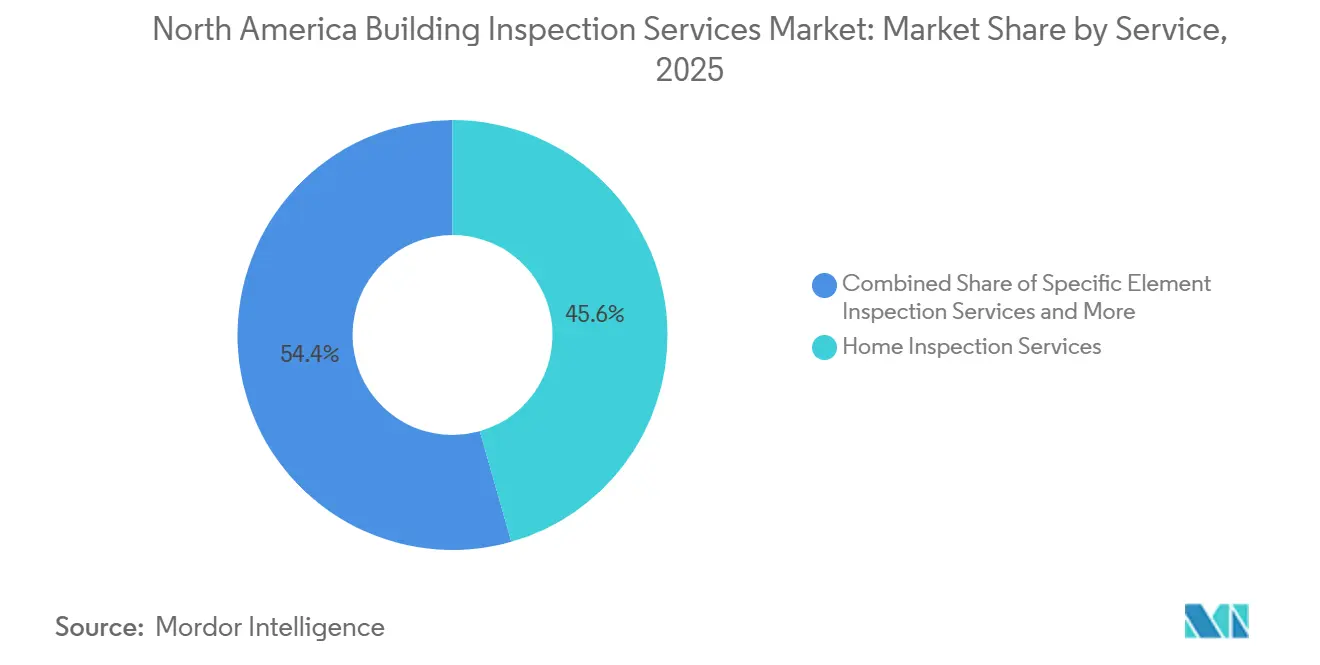
Home Inspection Services held 45.6% of the North America building inspection services market size in 2025. The segment is linked to residential purchases, lender expectations, and agent referrals. Buyers use home inspections to identify visible defects and maintenance needs. Reports can influence repair negotiations before a sale closes. This makes speed, clarity, and local knowledge important service attributes. Standard home inspections remain a high-volume entry point for many providers. Specific Element Inspection Services add work related to radon, mold, pests, structures, and other hidden risks. Commercial Building Inspection Services support acquisitions, lender reviews, and facility management. Together, these services broaden provider exposure beyond a single property type.
Other Specialized Services is forecast to grow at an 8.9% CAGR through 2031. This area includes energy audits, thermal imaging, and drone-based reviews of roofs and exterior walls. EagleView launched its Horizon property intelligence platform in April 2026. The company said the platform uses a library of more than 3.5 billion aerial images. It also stated that coverage reaches 96% of the U.S. population. These tools can shift some work from single projects toward portfolio monitoring. Asset managers and insurers may value more consistent property data across large portfolios. This supports specialized service demand within the North America building inspection services market. Providers still need experienced inspectors to interpret complex findings and address site-specific conditions.

By Sourcing Type: In-House Retains Scale Advantage While Outsourcing Gains Structural Momentum
In-House Services held 57.8% of the North America building inspection services market size in 2025. Large municipalities and institutional owners use internal teams to control work quality and scheduling. National companies may also retain in-house professionals for complex facilities. Internal teams have direct familiarity with their assets and operating standards. They can coordinate closely with capital planning and maintenance functions. This model is most practical for organizations with a large, stable inspection workload. It can become difficult when hiring needs rise quickly. Inspector shortages increase the cost of maintaining full internal coverage. The North America building inspection services market continues to include this model because many large asset owners value direct control.
Outsourced Services is forecast to grow at an 8.4% CAGR through 2031. Municipalities use third-party providers when they cannot recruit or retain enough inspectors. SAFEbuilt operates across 41 states and the District of Columbia, demonstrating the reach of a pooled municipal services model. External providers can also supply specialists in structures, energy audits, and drone operations. This access can be difficult for each municipality to build separately. Accreditation and formal quality procedures can strengthen confidence in outsourced work. The sourcing shift is therefore more than a staffing response. It gives clients access to specialized capabilities and common reporting systems. Credentialed firms can use these strengths to compete for larger contracts.
By Application: Residential Anchors Volumes, Other Applications Drive the Fastest Incremental Growth
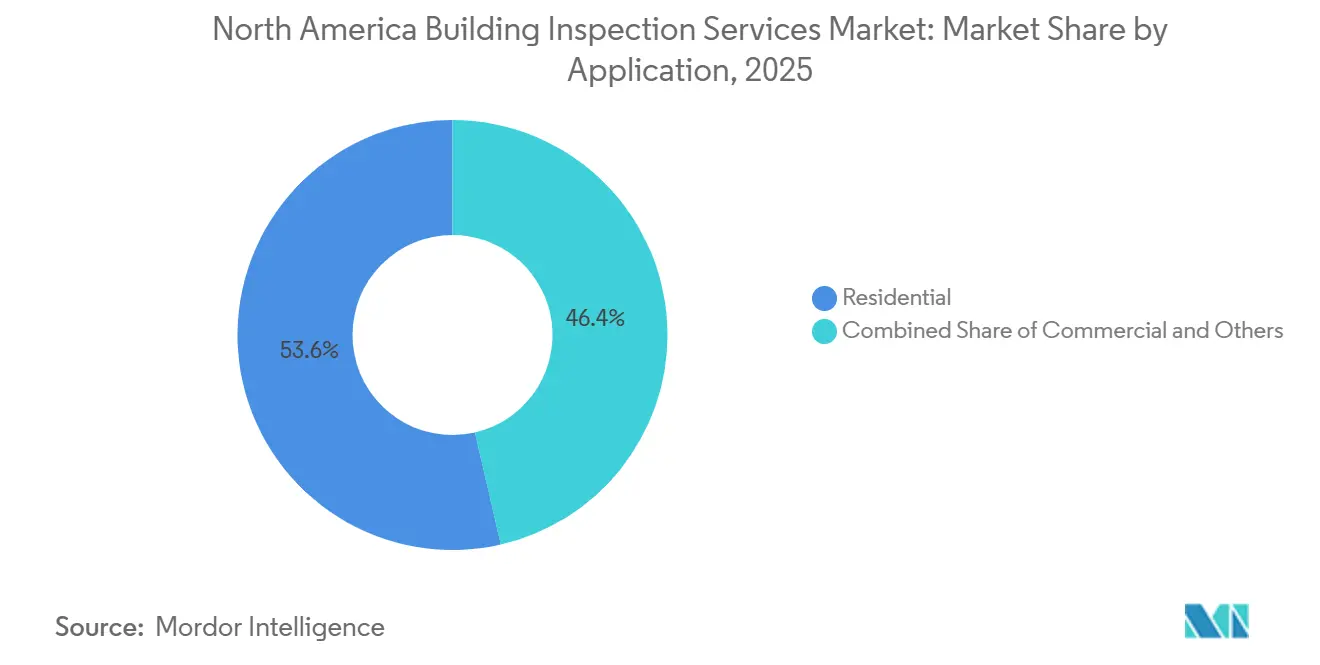
Residential held 53.6% of the North America building inspection services market size in 2025. Home purchases create demand for pre-purchase, pre-listing, and construction-stage inspections. Multifamily development also creates work during project delivery. The Canada Mortgage and Housing Corporation reported meaningful rental and condominium supply additions during 2025. This supports construction-stage requirements alongside resale inspections. Residential work often depends on clear reports, quick appointments, and trusted agent relationships. Commercial properties require more detailed reviews due to their asset value and technical systems. Commercial clients also use assessments for acquisitions and planned maintenance. These activities provide a broader base for the North America building inspection services market.
Other Applications is forecast to grow at a 10.8% CAGR through 2031. The category includes data centers, energy infrastructure, government assets, and transportation facilities. Bureau Veritas reported 30% organic growth in data-center commissioning during 2025. Data-center work involves long project timelines and demanding commissioning requirements. Large providers can combine inspection, testing, certification, and monitoring. This can simplify delivery for customers with complex projects. Government and infrastructure assignments may also require formal records and independent reviews. These requirements create opportunities for firms with technical depth. They also raise the importance of specialized staff and recognized processes.
By End User: Real-Estate Agencies Lead, Government Shift Accelerates Outsourcing Demand
Real-Estate Agencies and Brokers held 39.8% of the North America building inspection services market size in 2025. Agents commonly refer to inspectors during buyer transactions. This makes relationships and service reliability central to residential demand. Digital scheduling and report delivery can place the inspection process within the wider transaction workflow. Providers benefit when agents can book appointments and receive reports without delays. Property Owners and Investors are another important client group. They order assessments for acquisitions, insurance, and capital planning. Facility-Management Firms also need recurring property reviews to track maintenance issues. These end users give the North America building inspection services market both transaction-based and contract-based revenue sources.
Government and Municipalities are forecast to grow at an 8.9% CAGR through 2031. Staffing shortages lead building departments to seek outside inspection and plan-review support. SAFEbuilt’s scale across U.S. jurisdictions shows why municipalities may use providers with broad code knowledge. Insurance and Financial Institutions use inspections to support property coverage and mortgage decisions. These clients value consistent evidence and established professional standards. Facility managers use periodic reports to prioritize repair budgets. Government demand can be less dependent on home sale cycles because it is linked to permits and local compliance. This makes outsourced public-sector work attractive to multi-jurisdiction providers. The segment also requires an understanding of local rules and public-service timelines.
Geography Analysis
The United States held 82.5% of the North America building inspection services market size in 2025. Professional inspection is well established in residential sales and commercial lending. Building departments also require plan reviews and site inspections for construction activity. New code editions increase documentation and verification work in many jurisdictions. New York City’s energy code enforcement began in 2026 for relevant new applications. This adds compliance work beyond basic construction checks. Municipal outsourcing is important where local departments face recruitment challenges. The United States also has a large base of commercial and institutional assets. These factors give the country a broad mix of demand sources.
Canada held the second-largest regional position, although no share was provided. Housing starts are expected to moderate through 2026 to 2028 after the 2025 supply increase, according to the Canada Mortgage and Housing Corporation. This can limit new-construction inspection volumes. Retrofit activity offers an offset because existing buildings require condition assessments and performance verification. Natural Resources Canada identifies a large building retrofit requirement in the country. The country’s building stock creates recurring work related to safety, energy performance, and renovation. Canada, therefore, combines short-term construction variability with long-term retrofit needs. Multi-city providers can benefit where demand is uneven across provinces.
Mexico is forecast to grow at an 8.5% CAGR through 2031, the fastest rate in the North America building inspection services market. Professional inspection is less established than in the United States. This creates room for service providers as the practice becomes more formal. Mexico City requires structural safety certification for relevant commercial establishments. Such requirements create a defined need for professional assessment. Industrial development in Monterrey, Guadalajara, and border manufacturing locations increases the number of addressable facilities. Huella Estructural offers structural monitoring services in Mexico City, Guadalajara, and Monterrey. Early providers can build relationships before inspection practices become more standardized. The country’s opportunity is strongest where regulatory needs and industrial construction develop together.
Competitive Landscape
The North America building inspection services market is moderately fragmented across global testing, inspection, and certification firms, municipal specialists, and residential franchise networks. These groups often serve different customers rather than competing for identical assignments. Bureau Veritas, SGS Group, and Intertek compete for large commercial, infrastructure, and institutional work. Their wider testing and certification services support complex client requirements. Bureau Veritas reported 7.1% organic growth in its Buildings and Infrastructure business during the third quarter of 2025. Municipal providers such as SAFEbuilt focus on plan reviews, permits, and building department support. Residential franchises compete through local coverage, agent relationships, and standardized report delivery. Pillar To Post and HomeTeam are examples of networks that use this model.
Consolidation is increasing the scale of some mid-tier providers. Acuren completed its merger with NV5 Global in August 2025. The combined company reported more than USD 2 billion in revenue, more than 11,000 employees, and over 230 locations. This move expands its ability to serve industrial assets, public infrastructure, and the built environment. DEKRA secured A2LA accreditation for U.S. field evaluation services in May 2026. The accreditation supports its position in specialized electrical and industrial assignments. These moves show that scale, technical credentials, and broader service offerings are becoming competitive tools. Smaller firms may respond by concentrating on local knowledge or a specialized inspection niche.
Technology is changing how providers collect and present inspection evidence. EagleView released Horizon in April 2026 to support property intelligence across insurance, construction, infrastructure, and property management. Veros launched VeroVISION in June 2026 for property condition scoring from photographs. Veros stated that the tool achieved 93% correlation with human appraiser and inspector scores. These tools may improve speed for lower-complexity assessments. They also increase the need to manage the reliability and liability of digital findings. The competitive opportunity remains strongest in Mexico, portfolio monitoring, and inspection evidence used in insurance workflows. Traditional site expertise remains important for complex assets and code-specific decisions.
North America Building Inspection Services Industry Leaders
-
SGS Group
-
Bureau Veritas
-
Intertek Group plc
-
DEKRA SE
-
NV5 Global
- *Disclaimer: Major Players sorted in no particular order
Recent Industry Developments
- September 2026: The Wisconsin Department of Safety and Professional Services, Milwaukee Area Technical College, and the Wisconsin Department of Workforce Development launched the state's first Commercial Building Inspector Registered Apprenticeship program in fall 2026, combining 288 hours of virtual instruction with more than 2,000 hours of on-the-job training, directly addressing the structural inspector workforce gap flagged by the BLS's projection of approximately 14,800 annual building inspector openings from 2024 to 2034.
- June 2026: Veros launched VeroVISION, turning property photos into objective condition scores via computer vision with a 93% correlation to human appraiser and inspector evaluations and 97% US residential property coverage. The tool targets lenders, servicers, and investors seeking scalable, standardized property condition intelligence, and signals that AI is entering the residential inspection workflow as a complement and potential partial substitute for traditional visits.
- May 2026: DEKRA Certification Inc. received American Association for Laboratory Accreditation recognition as a Type A third-party inspection body under ISO/IEC 17020:2012 and A2LA R332, Certificate No. 2764.05, authorizing field evaluations of modified and custom-built electrical equipment across US jurisdictions where authorities having jurisdiction require such evaluations under National Electrical Code requirements.
North America Building Inspection Services Market Report Scope
| Home Inspection Services |
| Specific Element Inspection Services |
| Commercial Building Inspection Services |
| Other Specialised Services |
| In-House Services |
| Outsourced Services |
| Residential |
| Commercial |
| Other Applications |
| Real-Estate Agencies and Brokers |
| Property Owners and Investors |
| Government and Municipalities |
| Insurance and Financial Institutions |
| Facility-Management Firms |
| United States |
| Canada |
| Mexico |
| By Service | Home Inspection Services |
| Specific Element Inspection Services | |
| Commercial Building Inspection Services | |
| Other Specialised Services | |
| By Sourcing Type | In-House Services |
| Outsourced Services | |
| By Application | Residential |
| Commercial | |
| Other Applications | |
| By End User | Real-Estate Agencies and Brokers |
| Property Owners and Investors | |
| Government and Municipalities | |
| Insurance and Financial Institutions | |
| Facility-Management Firms | |
| By Countries | United States |
| Canada | |
| Mexico |
Key Questions Answered in the Report
What is the projected value of North America's building inspection services by 2031?
The sector is forecast to reach USD 5.53 billion by 2031, expanding at a 6.8% CAGR from 2026.
Which service category led revenue in 2025?
Home Inspection Services led with 45.6% of revenue in 2025, supported by residential transactions and lender requirements.
Which application is growing fastest through 2031?
Other Applications is forecast to grow at a 10.8% CAGR, led by data centers, energy infrastructure, government facilities, and transportation assets.
Why are municipalities outsourcing building inspection work?
Inspector shortages and permitting needs encourage municipalities to use external providers with trained staff, local code knowledge, and specialized capabilities.
Which country is expected to grow fastest in the region?
Mexico is forecast to grow at an 8.5% CAGR through 2031, supported by formalizing inspection practices and industrial development.
How is technology changing property inspection services?
Aerial imagery, digital reporting, and property condition scoring can improve report speed and support portfolio monitoring, while complex work still needs on-site expertise.