
Market Overview
| Study Period | 2020 - 2031 |
|---|---|
| Forecast Data Period | 2026 - 2031 |
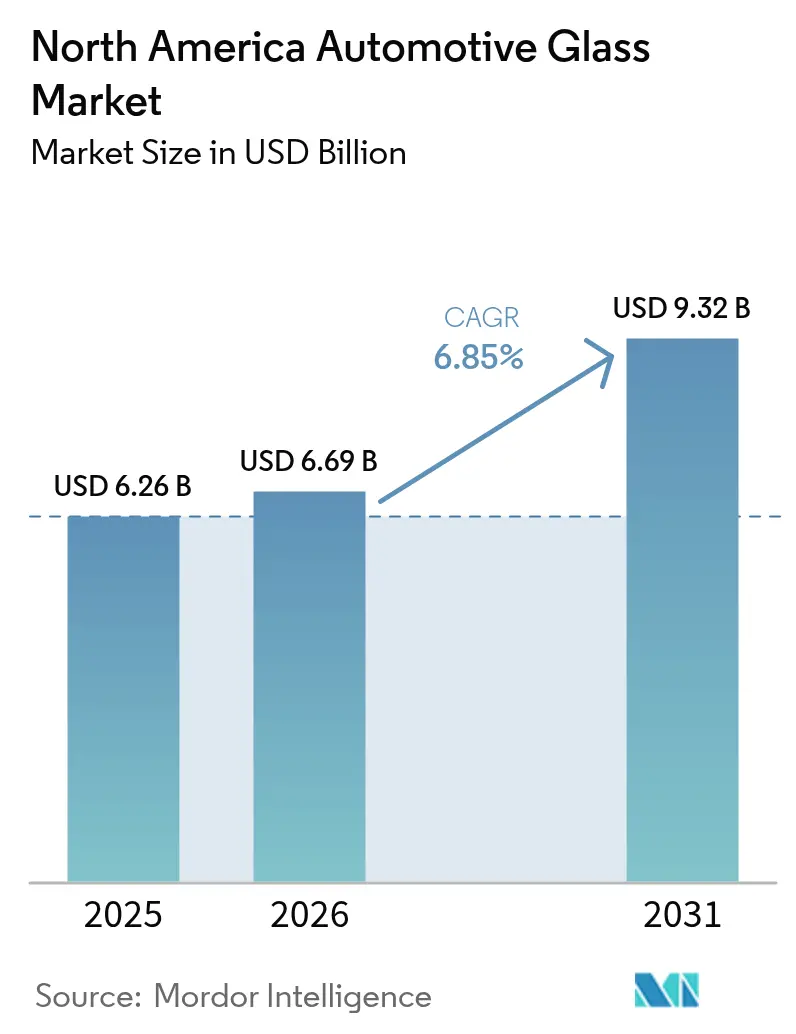
| Base Year Market Size (2025) | USD 6.26 Billion |
| Market Size (2026) | USD 6.69 Billion |
| Market Size (2031) | USD 9.32 Billion |
| Growth Rate (2026 - 2031) | 6.85 % |
| Market Concentration | Medium |
Major Players *Disclaimer: Major Players sorted in no particular order Image © Mordor Intelligence. Reuse requires attribution under CC BY 4.0. | |
North America Automotive Glass Market Analysis by Mordor Intelligence
The North America automotive glass market size is expected to grow from USD 6.26 billion in 2025 to USD 6.69 billion in 2026 and is forecast to reach USD 9.32 billion by 2031 at 6.85% CAGR over 2026-2031. The trajectory reflects a shift away from rounded glazing that meets tougher Federal Motor Vehicle replacement cycles toward value-added Safety Standards, supports the thermal and acoustic needs of battery-electric platforms, and aligns with OEM near-shoring strategies that limit Asia-Pacific supply risk.[1]National Highway Traffic Safety Administration, “Federal Motor Vehicle Safety Standards Overview,” nhtsa.gov Demand is sustained by bundled Advanced Driver Assistance Systems (ADAS) recalibration services, which turn every windshield replacement into a technical procedure and create new aftermarket revenue. Laminated glazing retains the largest position, yet smart or switchable glass gains traction as premium brands mainstream electrochromic features. Windshield units remain the primary volume driver, while panoramic roof innovations lift sunroof demand. Overall, the North America automotive glass market benefits from electrification mandates, regulatory harmonization, and an expanding network of localized float lines that shorten lead times.
Key Report Takeaways
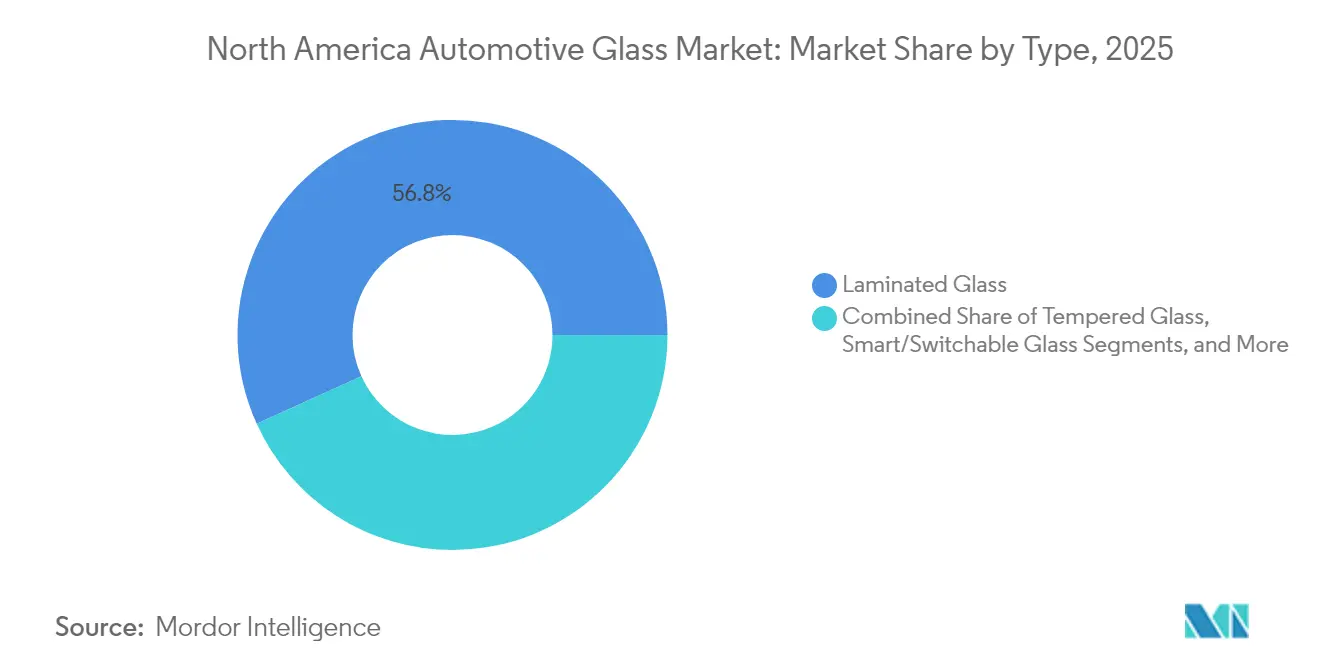
- By type, laminated glazing held 56.78% of the North America automotive glass market share in 2025; smart/switchable glass registers the fastest 8.28% CAGR through 2031.
- By application, windshields accounted for 48.10% share of the North America automotive glass market size in 2025, while sunroof and rooflite units are set to grow at 7.62% CAGR to 2031.
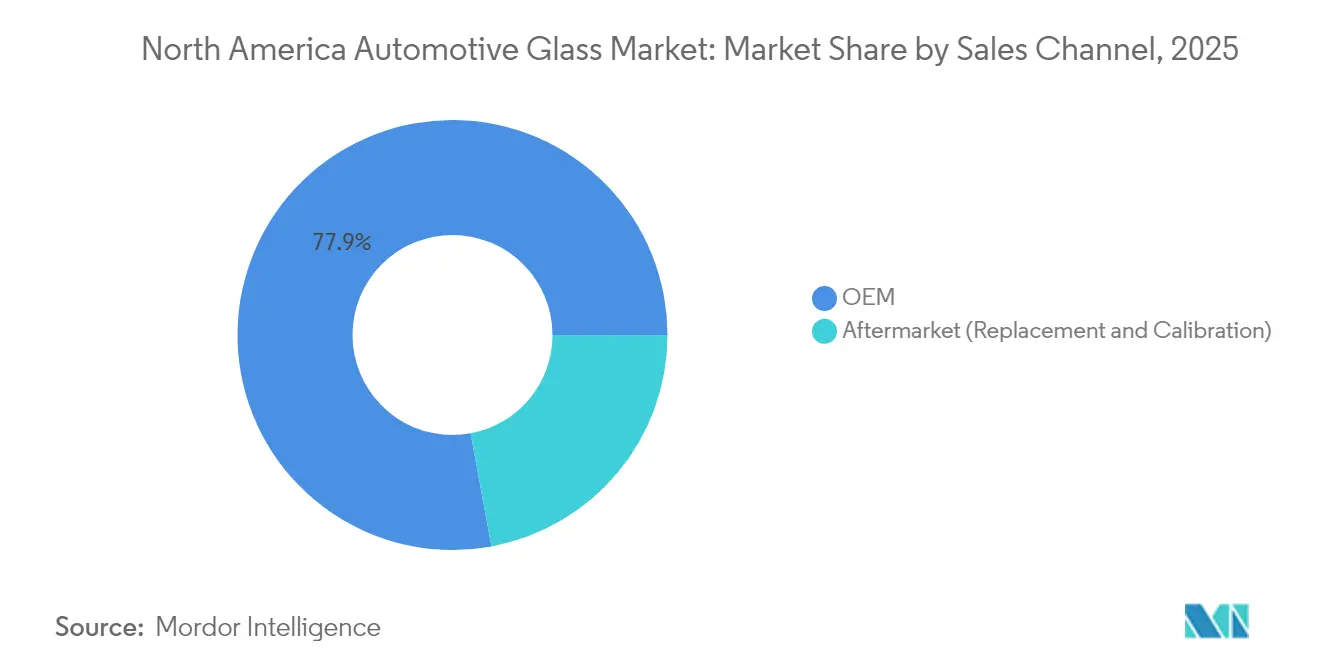
- By sales channel, OEM installations dominated with 77.90% share in 2025, yet the aftermarket is expanding at 8.78% CAGR on the back of ADAS recalibration needs.
- By vehicle type, passenger cars captured 64.60% of volume and are expected to grow at a 6.98% CAGR as electrification reshapes glazing specifications.
- By country, the United States supplied 74.80% of regional revenue in 2025; Canada represents the fastest-growing market with a 7.34% CAGR supported by large-scale EV investments.
Note: Market size and forecast figures in this report are generated using Mordor Intelligence’s proprietary estimation framework, updated with the latest available data and insights as of 2026.
North America Automotive Glass Market Trends and Insights
Drivers Impact Analysis*
| Driver | (~) % Impact on CAGR Forecast | Geographic Relevance | Impact Timeline |
|---|---|---|---|
| Smart/Switchable Glass Adoption | +1.5% | Premium vehicle segments | Medium term (2-4 years) |
| Bundled ADAS Recalibration Services | +1.3% | Aftermarket channels | Short term (≤ 2 years) |
| Rising Light-Vehicle Production | +1.2% | United States, Canada, Mexico | Medium term (2-4 years) |
| Electrification Push for Lightweight Glass | +1.1% | EV manufacturing hubs | Long term (≥ 4 years) |
| OEM Near-shoring of Glass Supply | +0.9% | United States, Canada, Mexico | Medium term (2-4 years) |
| Stringent FMVSS and Transport Canada Rules | +0.8% | United States, Canada | Long term (≥ 4 years) |
| Source: Mordor Intelligence | |||
Rapid adoption of smart/switchable glass in premium trims
Electrochromic sunroofs, dimmable sidelites, and in-glass displays are crossing from luxury badges into upper-mid trims as OEMs seek cabin differentiation. Gentex ships more than 50 million dimmable devices annually, demonstrating manufacturing maturity that lowers cost barriers.[2]Gentex Corporation, “Dimmable Glass Technologies,” gentex.com Film-based electrochromic stacks trim weight compared with traditional glass-glass cell construction, aligning smart glazing with EV range targets. Added digital layers accommodate heads-up images and driver-monitoring sensors, letting manufacturers bundle safety and infotainment. As regulatory bodies encourage driver-monitoring technology, smart glass adoption rises in parallel, strengthening the North America automotive glass market.
Bundled ADAS recalibration services boosting replacement demand
Camera-based systems mounted on windshields must be recalibrated after glass replacement, turning a once-simple job into an electronics service visit. Insurers now require certified procedures, raising the skill floor for technicians and allowing chains that own calibration equipment to charge premiums. Windshield units grow in billable complexity, and complementary sensor modules on sidelites are also entering the aftermarket mix. The heightened technical barrier lifts revenue per job and helps sustain the North America automotive glass market beyond natural vehicle parc growth.
Rising light-vehicle production across North America
Production is stabilizing near 15.8 million units annually through 2030, reversing earlier trade-related volatility. Battery-electric models are forecast to account for 44.4% of regional output by 2029, up from 7.2% in 2023, while internal-combustion variants will fall below one-third of production. The move toward electric platforms requires thinner laminated assemblies that improve thermal management and reduce drag. Concentrated manufacturing corridors in the so-called auto alley create scale for just-in-time deliveries, further anchoring the North America automotive glass market to domestic output. Although tariffs still pose planning uncertainty, electrification mandates guarantee a long runway for advanced glazing demand.
Electrification push favoring lightweight laminated glazing
Every kilogram removed from an electric vehicle translates into higher usable range, driving OEMs to swap tempered sidelites for thin laminated alternatives that retain strength while cutting mass. Eastman’s Evoca interlayer example highlights how acoustic, solar, and impact performance can be combined in a single laminate aimed at battery-electric side windows. Solar-control coatings reduce HVAC loads that drain batteries, and acoustic layers compensate for the absence of engine noise. Suppliers able to co-extrude multi-function interlayers capture disproportionate growth as the North America automotive glass market shifts toward EV-specific designs.
Restraints Impact Analysis*
| Restraint | (~) % Impact on CAGR Forecast | Geographic Relevance | Impact Timeline |
|---|---|---|---|
| Volatility in Soda Ash and Interlayer Prices | -0.9% | Global to North America | Short term (≤ 2 years) |
| High Incremental Cost of Smart Glass | -0.7% | Premium segments | Medium term (2-4 years) |
| Capacity Constraints in Low-Iron Float Lines | -0.6% | North America facilities | Medium term (2-4 years) |
| Insurance Preference for Low-cost Glass | -0.5% | United States, Canada aftermarket | Long term (≥ 4 years) |
| Source: Mordor Intelligence | |||
Volatility in soda ash, PVB, and EVA interlayer prices
Sekisui Chemical raised PVB prices by 6–15% in late 2024, citing energy and logistics inflation.[3]Sekisui Chemical Co. Ltd., “PVB Interlayer Price Revision,” sekisuichemical.com Sisecam’s acquisition of Ciner Group’s U.S. soda-ash assets concentrates supply at a time when demand is rising toward 83 million tons by 2030. Limited natural soda-ash mines and a small group of global PVB producers give upstream vendors pricing power, squeezing float margins and forcing processors to hedge or vertically integrate. Sudden cost spikes erode profitability across the North America automotive glass market when price pass-throughs lag.
High incremental cost of smart and coated glass solutions
Electrochromic and solar-control packages command price premiums that exceed mainstream willingness-to-pay outside luxury segments. Although film-based assemblies are cheaper than earlier vacuum devices, a panoramic roof equipped with dimmable layers can still add thousands of USD to a build sheet, slowing penetration rates in cost-sensitive trims. Suppliers must subsidize initial programs or bundle the glass with profitable feature packs to achieve scale. Until unit economics improve, the North America automotive glass market will see uneven smart glass adoption.
*Our forecasts treat driver/restraint impacts as directional, not additive. The impact forecasts reflect baseline growth, mix effects, and variable interactions.
Segment Analysis
By Type: Smart glass innovation drives premium segment transformation
Laminated glazing generated 56.78% of 2025 revenue in the North America automotive glass market, anchored by its indispensable role in windshields and the growing use of laminated sidelites for security and acoustic comfort. Smart or switchable glass leads to growth with an 8.28% CAGR as electrochromic sunroofs migrate into broader vehicle lines. Tempered panes, once dominant for cost reasons, are slowly being displaced in non-critical areas as manufacturers chase mass savings and higher thermal performance. Coated glass segments expand in parallel, propelled by EV programs that demand low solar heat gain to protect battery range.
Continuous innovation underpins segment momentum. Gentex’s film-based approach trims thickness while enabling large geometric freedom for roof modules. Integrated display technology merges glare control with infotainment, opening new revenue pools for glass makers. Laminated constructions now embed multiple interlayers—acoustic, solar, and structural—demonstrating how a single part can satisfy safety, comfort, and energy efficiency. As technology complexity climbs, suppliers with chemistry, coating, and electronics capabilities deepen their hold on the North America automotive glass market.



By Application: Sunroof innovation accelerates premium feature adoption
Windshields retained a 48.10% share of the North America automotive glass market in 2025, supported by mandatory fitment and strict impact regulations. Sunroof and rooflite modules, however, clock the fastest 7.62% CAGR through 2031 as panoramic roofs become a mainstream styling element. Laminated roof panels integrate electrochromic dimming, UV filtration, and heating grids, enhancing the cabin experience without adding opaque shades.
Sidelites transition from tempered to laminated formats in higher trims, providing burglary resistance and quieter cabins—attributes prized in near-silent EVs. Backlites remain stable in volume, yet see incremental smart features like integrated antennas and defog lines evolve. Exterior mirror glass migrates toward camera-based e-mirrors, reshaping the hardware stack but still relying on precision-polished substrates. Larger apertures and multi-functional coatings raise the engineering bar and reinforce OEM dependency on experienced glazing partners within the North America automotive glass market.
By Sales Channel: Aftermarket complexity drives service premiums
OEM installations delivered 77.90% of unit demand in 2025, a natural outcome of every new vehicle needing factory glass. Even so, the aftermarket’s 8.78% CAGR outpaces OEM growth because ADAS calibration turns replacements into high-ticket procedures. Calibration rigs, target boards, and software subscriptions create steep capital requirements, steering volume toward chains with nationwide footprints and insurance partnerships.
Specialty service packages bundle windshield replacement, camera recalibration, and sometimes wheel alignment, reflecting the interdependence of modern safety systems. Independent shops must invest or exit, accelerating consolidation. At the same time, e-commerce-enabled mobile installers thrive on convenience, but they must still subcontract calibration to licensed centers. The shift from commodity glass to integrated service explains why the North America automotive glass market commands higher average revenue per job than a decade ago.
By Vehicle Type: Passenger-car electrification drives glass innovation
Passenger cars captured 64.60% of the 2025 share and are forecast to advance at a 6.98% CAGR, steered by the rapid electrification of sedans, hatchbacks, and SUVs. The passenger cohort’s appetite for panoramic roofs and dimmable glass elevates value per vehicle. Sport-utility models, in particular, allocate more roof real estate to glass, rewarding suppliers able to laminate large, curved panels.
Light commercial vans benefit from fleet electrification and last-mile delivery growth, demanding thermal coatings that moderate cabin heat during frequent stops. Medium and heavy trucks follow regulatory upgrades requiring laminated side windows for rollover integrity. Across everybody styles, EV platforms impose new constraints on mass and thermal behavior, leading OEMs to specify advanced laminates with multi-function coatings. These shifts feed steady demand into the North America automotive glass market over the next five years.
Geography Analysis
The United States anchors the North America automotive glass market with 74.80% revenue in 2025. Domestic production is steady at roughly 15.8 million light vehicles per year, while regulatory rigor under FMVSS 205 nurtures continuous product upgrades. ADAS proliferation, high sunroof take-rates, and strong aftermarket networks enable premium glazing adoption. U.S. float lines also enjoy Buy America preference for federal fleet procurements, making them the go-to source for OEMs that want to avoid potential tariff exposure.
Canada records the fastest expansion at a 7.34% CAGR to 2031. Massive EV commitments—Honda’s CAD 15 billion value-chain build-out and Volkswagen’s CAD 7 billion battery plant—will lift local glass demand across windshields, roof modules, and sensor-ready sidelites. Transport Canada’s near-mirror alignment with FMVSS cuts duplicate testing costs, letting suppliers qualify parts once for sales in both countries. Provincial incentives for zero-emission vehicles further accelerate model launches, deepening the growth of the North America automotive glass market in Canada.
Mexico rounds out the region as a cost-competitive production base under the USMCA framework. Although its domestic sales are smaller, export-oriented assembly lines require synchronized glazing supply. Low labor costs attract additional lamination and back-lite lines, and proximity to U.S. distribution hubs reduces shipping lead times. As OEMs diversify supply chains, Mexico remains integral to the operational backbone of the North America automotive glass market.
Regulatory Landscape
In the United States, automotive glazing is regulated primarily under Federal Motor Vehicle Safety Standard (FMVSS) No. 205 (49 CFR 571.205), administered by the National Highway Traffic Safety Administration (NHTSA). Glazing makers and vehicle manufacturers self-certify compliance under 49 U.S.C. 30115, keeping performance, marking, and traceability requirements central to OEM sourcing and aftermarket replacement quality.
In June 2026, NHTSA issued a final rule removing the obsolete FMVSS No. 205(a) provisions that applied to glazing equipment and vehicles manufactured before late 2006, which streamlines the standard set used in current programs. In Canada, Transport Canada oversees compliance through the Motor Vehicle Safety Act and the Motor Vehicle Safety Regulations. Canada Motor Vehicle Safety Standard (CMVSS) 205 incorporates ANSI/SAE Z26.1-1996 requirements and allows certain alternatives via UN regulation references, supporting cross-border part qualification for suppliers serving both markets.
Value Chain Analysis
The value chain starts upstream with soda ash and other batch materials, float glass production (including low-iron where required for solar-control and premium roof applications), and interlayers such as PVB/EVA that enable laminated safety glazing. Midstream processing includes cutting, bending/tempering, lamination, coating (solar-control/IR), printing, and integration of features such as antennas, heating grids, and sensor-compatible frit bands, where differentiation increases for EV-oriented thermal and acoustic specifications.
Downstream, OEM programs are supplied through just-in-time networks that favor regional footprint and proximity to assembly corridors across the United States, Canada, and Mexico. Aftermarket channels add service layers such as ADAS recalibration tied to windshield replacement. The chain is shaped by regional manufacturing concentration among players such as Fuyao Glass, Vitro Autoglass, AGC Automotive Americas, and Pilkington North America, alongside distribution and installation networks that are consolidating through footprint expansion, for example, PGW Auto Glass adding Canadian locations via acquisition. Single-site disruption risk remains a practical constraint in a concentrated footprint, so OEMs and glass suppliers maintain contingency routing, dual sourcing, and localized inventory buffers for high-run-rate parts.
Competitive Landscape
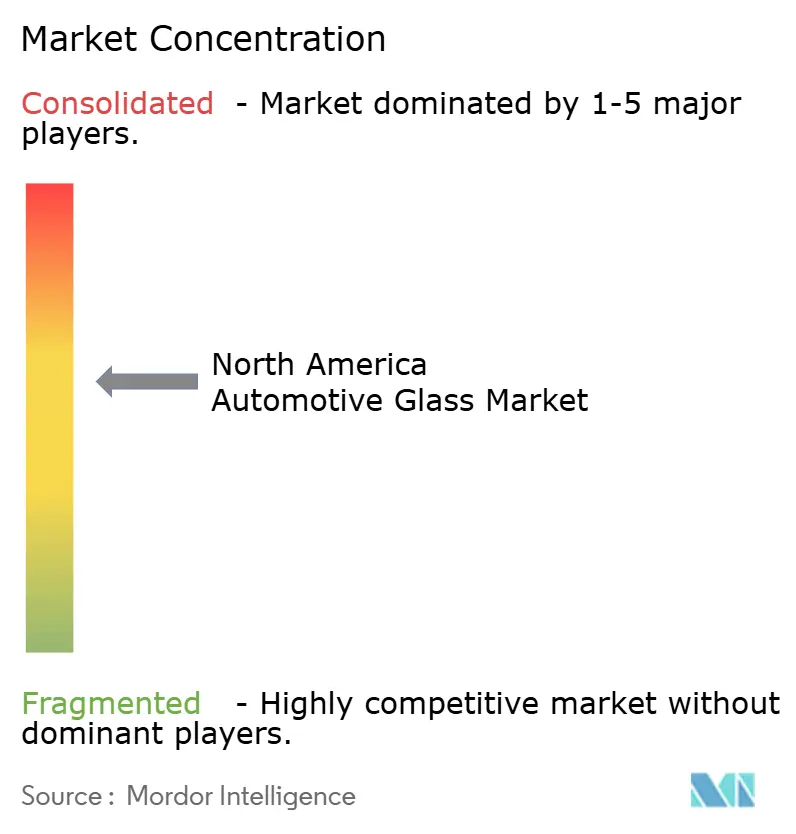
The North America automotive glass market displays moderate concentration. AGC Inc., Saint-Gobain Sekurit, Fuyao Glass, and NSG Group collectively control a majority of OEM volume, leveraging global scale and local float furnish. Technology specialists such as Gentex focus on smart‐glass niches, shipping electrochromic modules that command premium margins.
Capacity expansion underscores strategic intent. Fuyao’s USD 400 million upgrade in Illinois, announced in March 2025, adds 280,000 tons of float output, supporting both OEM and aftermarket customers. Gentex’s acquisition of VOXX International’s automotive assets, completed in April 2025, augments its roof-module and in-vehicle display capabilities, positioning it to bundle glass, electronics, and software in integrated offerings. AGC and Saint-Gobain invest heavily in solar-control and low-iron glass lines to capture EV demand.
Competition is evolving along two axes: cost leadership in commodity panes and technology leadership in multi-function laminates. Commodity suppliers chase throughput and yield, while tech leaders race to embed displays, antennas, and heating elements. OEM procurement increasingly values system integration expertise, favoring suppliers who can certify ADAS compatibility and provide data for digital vehicle-health platforms. This feature race defines the trajectory of the North America automotive glass market.
North America Automotive Glass Industry Leaders
AGC Inc.
Saint-Gobain Sekurit
Fuyao Glass Industry Group Co., Ltd.
Vitro S.A.B. de C.V.
Gentex Corporation
- *Disclaimer: Major Players sorted in no particular order

Market Opportunities and Future Outlook
An opportunity is emerging at the intersection of advanced windshields and software-defined cockpit features, as suppliers and tier partners industrialize display-capable glazing. The February 2026 QuadAlliance involving Saint-Gobain Sekurit, ZEISS, tesa, and Hyundai Mobis to accelerate holographic windshield display mass production highlights the active push toward value-added windshields, creating whitespace for glass makers that can combine lamination, optical quality, and integration support for ADAS and in-glass display functions.
Manufacturing footprint optimization and localized capacity decisions are also affecting supplier selection across North America. Carlex Glass America’s July 2026 announced closure plan for its Vonore, Tennessee plant, paired with consolidation at its Nashville facility, points to a shift toward fewer, more capable sites. It favors suppliers able to support stable lead times, advanced fabrication, and coordinated logistics for fragile, high-volume parts. In parallel, serial production proof points for smart roofs are starting to appear, including Gauzy reporting first customer deliveries of the Cadillac CELESTIQ featuring SPD smart glass in 2025. This reinforces a path for smart/switchable roof modules beyond showcase builds, provided suppliers can meet automotive-grade quality, scale, and cost targets.
Recent Industry Developments
- July 2026: Carlex Glass America announced plans to close its Vonore, Tennessee manufacturing plant, with operations scheduled to cease by the end of September 2026 and impacts reported for roughly 325 employees. The move consolidates production into the company’s Nashville footprint, tightening the regional supply base and increasing the strategic value of high-capability North American fabrication sites for OEM and aftermarket continuity.
- May 2026: Fuyao Glass announced a major expansion proposal for its Mt. Zion, Illinois facility, outlining two new production lines including an automotive glass line alongside a solar glass line, and a potential step-up in daily output if completed. The proposal highlights ongoing near-shoring of float and fabrication capacity in the United States, while also indicating how suppliers are diversifying across end markets within the same melt and downstream processing workflow.
- September 2024: PGW Auto Glass acquired PH Vitres d’Autos, adding 22 locations across Canada. The expanded footprint strengthens distribution reach and installation capacity in a market where replacement work increasingly includes ADAS-related procedures, supporting higher service content per windshield job.


Research Methodology Framework and Report Scope
Market Definition and Coverage
For this study, the market covers revenue earned from automotive glass supplied and installed in vehicles used across North America, including OEM fitment and replacement demand tied to on-road vehicles.
Scope exclusions: We exclude non-automotive flat glass uses and accessory glass parts like mirror glass unless they are sold as part of an automotive glazing pane or module.
Segmentation Overview
- By Type
- Laminated Glass
- Tempered Glass
- Coated and Solar-Control Glass
- Smart/Switchable Glass
- By Application
- Windshield
- Sidelite
- Backlite
- Sunroof/Rooflite
- Rear-view and Exterior Mirrors
- By Sales Channel
- OEM
- Aftermarket (Replacement and Calibration)
- By Vehicle Type
- Passenger Cars
- Hatchback
- Sedan
- Sport Utility Vehicle
- Multi-purpose Vehicle
- Light Commercial Vehicles
- Medium and Heavy Commercial Vehicles
- Passenger Cars
- By Country
- United States
- Canada
- Rest of North America
Data Sources, Market Sizing, and Validation
Desk Research
We start by mapping the demand pool using public vehicle and trade signals, then we align that picture with glass-specific supply information. Our sources include publications and datasets such as U.S. Bureau of Transportation Statistics, U.S. International Trade Commission data, NHTSA safety standards and defect notices, Statistics Canada vehicle and manufacturing tables, and Mexico INEGI vehicle production releases. For repair and replacement patterns, we also refer to insurance and road-safety publications, along with technical papers in journals that describe laminated and tempered glazing performance.
After the demand-side base is built, the model is checked against company filings, investor presentations, and reputable press coverage on capacity additions, pricing actions, and technology adoption like acoustic and solar-control glazing. Where available, paid subscription sources are used for company financials and for patent databases, mainly to confirm product mix changes and the timing of new glazing features. The desk research list is not exhaustive, and we also consult other public sources to collect, validate, and clarify data points.
Primary Interviews and Surveys
We validate assumptions through interviews and short surveys with participants across the value chain, including glass processors, OEM-facing distributors, installers, and aftersales decision-makers. For the North America scope, we keep coverage balanced across the United States, Canada, and Mexico so differences in vehicle parc, replacement rates, and pricing can be captured, then converted into consistent model inputs.
Distribution of primary research fieldwork respondents
| Company type | Respondent position |
|---|---|
| Top tier: 25% | CXOs: 14% |
| Mid tier: 59% | Functional/Unit leaders: 35% |
| Smaller Players: 16% | Managers: 51% |
Market-Sizing & Forecasting
The core sizing logic uses a top-down build that reconstructs demand from the vehicle population and repair cycle, then converts it into value using typical glass content per vehicle and price bands by pane type. To keep totals realistic, we corroborate this with selective bottom-up checks, including rolling up sampled supplier revenues by country and validating average selling prices using channel checks for windshields and sidelites.
Key inputs that shape the model include light vehicle production and registrations, the on-road vehicle parc, crash and replacement incidence (including weather-related breakage), penetration of laminated glazing beyond windshields, and the mix shift toward panoramic roof glass and ADAS-ready windshields. We also track trade flows of laminated and tempered safety glass and known capacity or line additions, which helps explain supply tightening or easing and the resulting price movement.
For forecasting, scenario analysis is used so growth is linked to vehicle production outlook, parc aging, and penetration of advanced glazing features, then adjusted with expert views on price pass-through and repair cycle normalization. Where bottom-up data is missing for small local installers or fragmented aftermarket activity, the gap is handled using calibrated ratios tied to parc and replacement intensity by country.
Data Validation & Update Cycle
Model outputs are cross-checked against independent signals, including import trends for safety glass, vehicle production swings, and implied glass-per-vehicle ranges that should remain stable over time. Outliers are flagged for review, and any large variance is reworked by revisiting assumptions and, when needed, re-contacting market participants to confirm what changed.
Before sign-off, the work is reviewed in steps so calculation logic, units, and currency treatment stay consistent across years and countries. Reports are refreshed annually, and interim updates are made when material events occur, such as major pricing shocks, regulatory changes affecting glazing, or large capacity announcements. Right before delivery, we do a fresh pass so clients receive the latest updated view.
Mordor Intelligence's North America Automotive Glass Market Size Measured Against Other Published Estimates
Published market sizes for automotive glass in North America can look far apart, even when they appear to cover the same category, because the scope and the price build often differ. In practice, the gaps usually come from what is counted as automotive glazing, whether aftermarket services are added, and how country-level pricing is normalized to the base year.
Some published figures include broader flat-glass manufacturing or generic auto glass services without separating vehicle glazing panes from adjacent items. In Mordor Intelligence, the value is counted around automotive glazing used in windshields, windows, and roof glass when it is part of the pane or module, and the totals are kept aligned to vehicle parc and replacement intensity across the United States, Canada, and Mexico.
Benchmark comparison
| Source | Market Size | Gaps in Research Methodology |
|---|---|---|
| Mordor Intelligence | USD 6.26 B (2025) | |
| Trade Journal A | USD 5.20 B (2023) | Often reported as a quick current-value snapshot using limited country breakouts, and it may treat roof glass and smart glazing as optional add-ons without modeling penetration and price progression. |
| Industry Data Publisher B | USD 7.70 B (2026) | Sometimes closer to a manufacturing revenue view for the United States, which can include non-vehicle output and intercompany transfers, and it may not net out cross-border flows within North America. |
The spread across the table is mainly explained by scope choices and the way prices and volumes are linked to the demand pool. When the model is anchored to the vehicle parc, replacement cadence, and glazing feature penetration, the resulting market size becomes easier to audit and to reproduce year to year.


Key Questions Answered in the Report
What is the size of the North America automotive glass market in 2026?
The market is valued at USD 6.69 billion in 2026.
Which glass type is growing the fastest in this market?
Smart/switchable glass leads with an 8.28% CAGR through 2031.
Why is the aftermarket segment expanding quicker than OEM sales?
ADAS-equipped vehicles require precise calibration after glass replacement, boosting aftermarket service demand and driving a 8.78% CAGR.
Which country shows the highest growth rate in North America?
Canada records the fastest growth, advancing at a 7.34% CAGR due to major EV investments.
Page last updated on:





