
North America Athleisure Market Size and Share
Market Overview
| Study Period | 2022 - 2032 |
|---|---|
| Forecast Data Period | 2027 - 2032 |
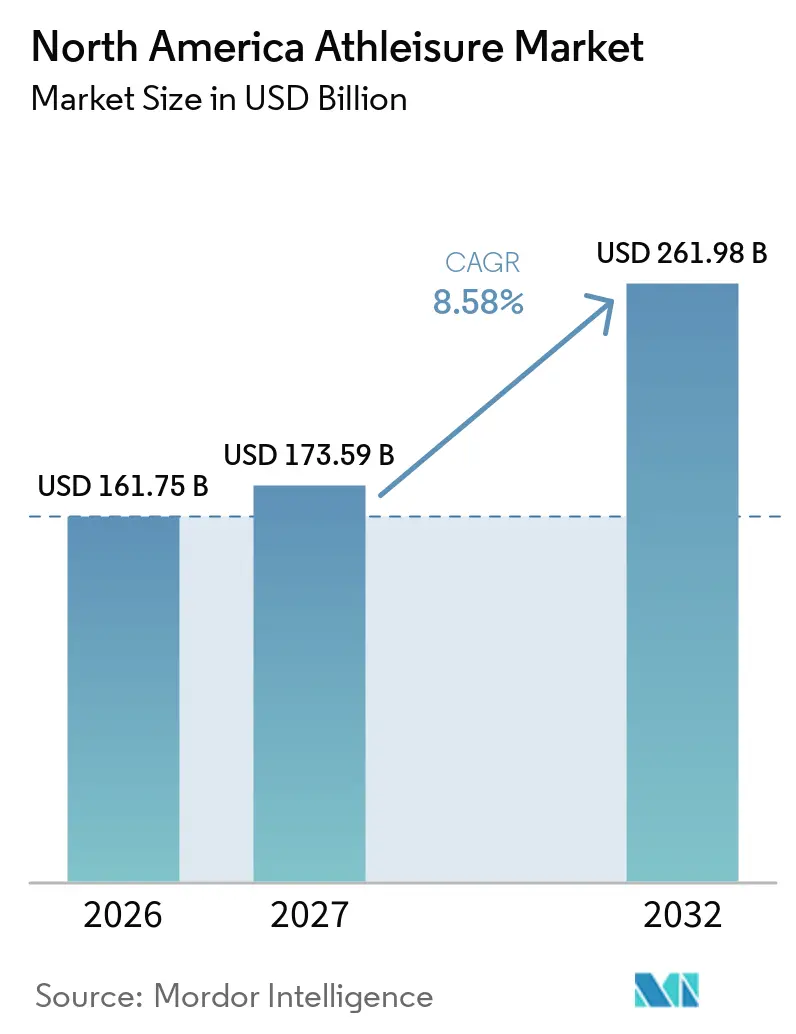
| Base Year Market Size (2026) | USD 161.75 Billion |
| Market Size (2027) | USD 173.59 Billion |
| Market Size (2032) | USD 261.98 Billion |
| Growth Rate (2027 - 2032) | 8.58 % |
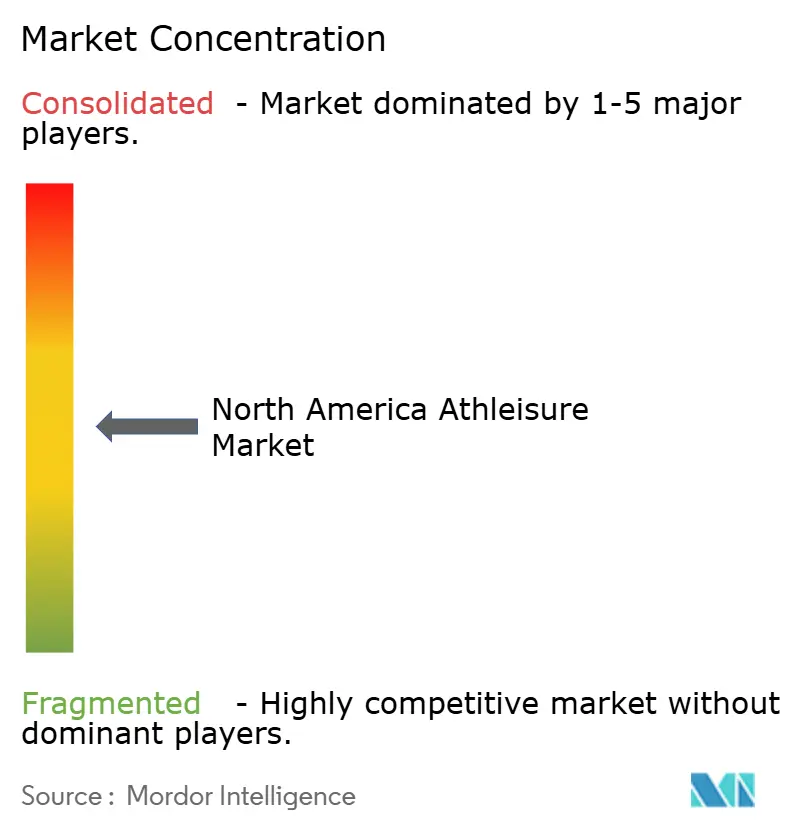
| Market Concentration | Medium |
Major Players *Disclaimer: Major Players sorted in no particular order Image © Mordor Intelligence. Reuse requires attribution under CC BY 4.0. | |
North America Athleisure Market Analysis by Mordor Intelligence
The North America athleisure market size is projected to expand from USD 161.75 billion in 2026 to USD 261.98 billion by 2032, registering a CAGR of 8.58% between 2027 and 2032. The category has moved well beyond workout clothing because consumers now use performance apparel in daily routines, informal work settings, errands, and social activities. The North America athleisure market is supported by a broad base of active consumers and by repeat purchasing across both exercise and non-exercise occasions. Fitness participation, digital discovery, and technical product features are raising expectations for comfort, durability, and versatility. Retailers and brands are responding with stronger direct online operations, more focused product launches, and price-tier strategies that separate mass offerings from premium products. Tariffs, material rules, and design imitation remain important constraints because they can raise costs and reduce the room to compete on price.
Key Report Takeaways
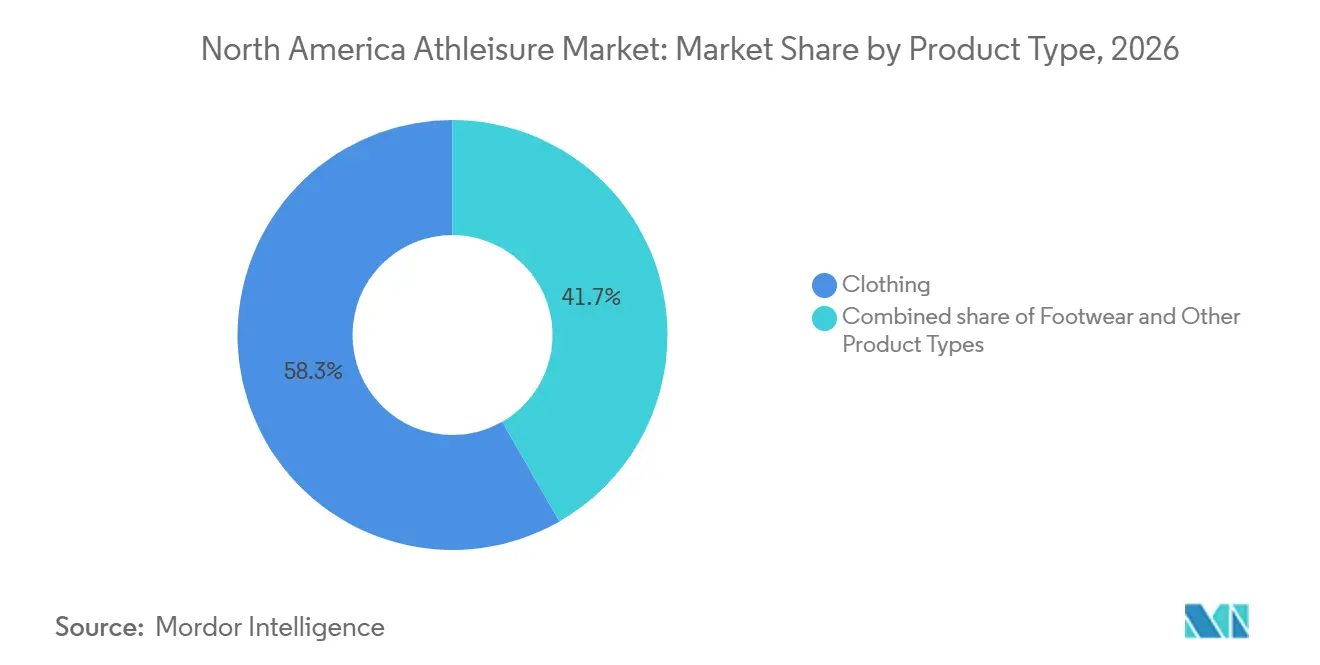
- By product type, Clothing held a 58.3% share in 2026, while Footwear is forecast to grow at a 9.7% CAGR through 2032.
- By end user, Adults held an 86.7% share in 2026, while Kids/Children is forecast to grow at a 10.6% CAGR through 2032.
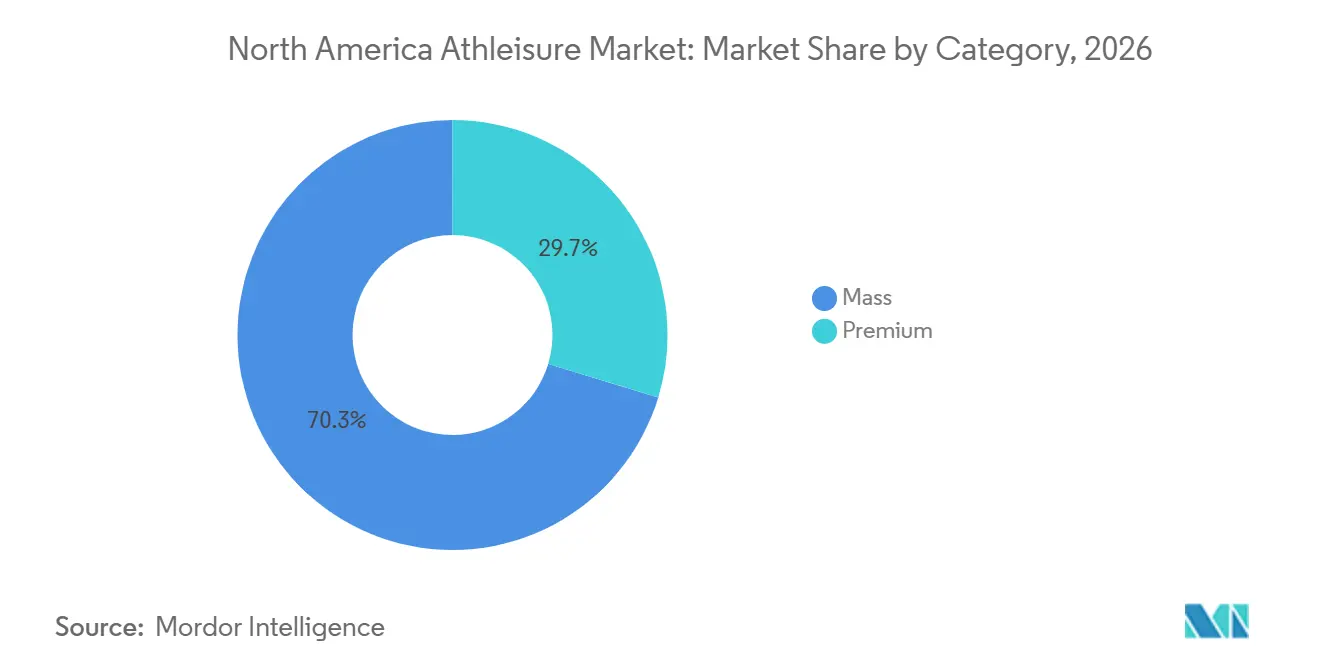
- By category, Mass held a 70.3% share in 2026, while Premium is forecast to grow at a 9.8% CAGR through 2032.
- By distribution channel, Sports and Athletic Good Stores held a 36.9% share in 2026, while Online Retail Stores is forecast to grow at a 10.4% CAGR through 2032.
- By geography, the United States held an 81.2% share in 2026, while Mexico is forecast to grow at a 9.9% CAGR through 2032.
Note: Market numbers in this report are based on Mordor Intelligence's proprietary estimation framework, which combines nine months of actuals with Q4 projections for base year 2026.
Market Trends and Insights
Drivers Impact Analysis of North America Athleisure Market*
| Driver | (~) % Impact on CAGR Forecast | Geographic Relevance | Impact Timeline |
|---|---|---|---|
| Rising health and fitness awareness | +1.9% | Global; highest intensity in United States and Canada | Medium term (2–4 years) |
| Technological integration in garments | +1.2% | United States and Canada; early spillover to Mexico | Long term (≥ 4 years) |
| Influence of athletes, celebrities, and fitness influencers | +1.4% | Global; concentrated in US urban and suburban markets | Short term (≤ 2 years) |
| Sustainability and eco-friendly fashion trends | +0.8% | United States and Canada; Mexico gaining early traction | Medium term (2–4 years) |
| Growing popularity among Gen Z and millennials | +1.5% | North America-wide; strongest in urban US and Canadian markets | Medium term (2–4 years) |
| Versatility and multifunctional appeal | +1.2% | North America-wide | Short term (≤ 2 years) |
| Source: Mordor Intelligence | |||
Rising Health and Fitness Awareness
The North America athleisure market benefits from a larger base of people participating in organized and informal exercise. SFIA’s 2025 report described broad gains in strength training and stated that running and jogging participation exceeded 50 million people[1]. This pattern supports recurring demand for training clothing, footwear, and replacement purchases. Cotton Incorporated found that active U.S. consumers wear athleisure at home, while running errands, and while shopping. This broad use gives brands more opportunities to sell products that combine function with everyday comfort. It also makes the category less dependent on a consumer completing a specific sport or fitness activity before deciding to buy.
Technological Integration in Garments
Product technology is creating a clearer distinction between basic apparel and performance-led athleisure. A 2025 study in Advanced Fiber Materials demonstrated a textile that served as an angle sensor and fitness tracker across 2,600 cycles and 10 wash rounds while maintaining electrical output. A separate 2025 review found that graphene, MXene, and conductive polymer composites can support biometric monitoring in fibers while preserving breathable construction. These developments give the North America athleisure market a path toward products that offer measurable functional value instead of relying only on appearance. Brands with research capability can use those features to support premium pricing and stronger customer retention. Smaller businesses may find it harder to fund testing, material sourcing, and production changes at the same pace.
Influence of Athletes, Celebrities, and Fitness Influencers
Athletes, creators, and entertainment partnerships continue to shape the way consumers discover activewear. Nike and SKIMS introduced NikeSKIMS in 2025 as a women’s brand designed around apparel, footwear, and accessories, using a broad athlete-led launch platform. The first NikeSKIMS collection was built around 58 silhouettes in seven collections, showing how brand partnerships can reach performance and lifestyle audiences at the same time. The North America athleisure market therefore rewards companies that pair recognizable ambassadors with product claims that consumers can understand. Smaller fitness creators are also important because their content can feel more relevant to niche training communities and local audiences. A balanced approach can help brands avoid relying on celebrity reach alone while still gaining visibility in digital shopping journeys.
Growing Popularity Among Gen Z and Millennials
Younger shoppers have increased the importance of online discovery, fast product feedback, and changing silhouettes. The North America athleisure market must serve consumers who want both performance pieces and styles suitable for everyday settings. Cotton Incorporated’s 2025 consumer research shows that activewear is worn across exercise and non-exercise settings, which supports broader product assortments. Brands need to use demand signals carefully because preferences within younger age groups do not move in the same direction. A product strategy focused on only one silhouette or one social trend can leave inventory exposed if consumers shift quickly. Businesses that combine timely digital merchandising with dependable core products are better placed to manage this change.
Restraints Impact Analysis of North America Athleisure Market*
| Restraint | (~) % Impact on CAGR Forecast | Geographic Relevance | Impact Timeline |
|---|---|---|---|
| Supply chain volatility and raw material cost inflation | -1.8% | Global; most acute in US import-dependent brands | Short term (≤ 2 years) |
| Counterfeiting and knock-off products | -0.9% | United States and Mexico; border proximity amplifies circulation | Medium term (2–4 years) |
| Regulatory compliance complexity | -0.5% | United States primarily; PFAS and chemical regulations cascading to Canada | Medium term (2–4 years) |
| Low demand in rural and less fitness-oriented regions | -0.7% | Mexico's rural states; interior US and Canadian markets | Long term (≥ 4 years) |
| Source: Mordor Intelligence | |||
Supply Chain Volatility and Raw Material Cost Inflation
Import costs and supply chain changes are placing pressure on brands that depend on foreign sourcing. The American Apparel & Footwear Association highlighted the importance of tariffs to apparel import costs in 2025[2]. The North America athleisure market is especially exposed when companies lack the scale to absorb higher duty, transport, and compliance costs. Brands that compete mainly on price have limited room to raise retail prices without making private-label alternatives more attractive. Supply chain documentation under the Uyghur Forced Labor Prevention Act also adds process requirements for importers. Companies with established supplier records and diversified sourcing can respond more quickly than businesses with a narrow vendor base.
Counterfeiting and Knock-off Products
Design imitation affects brand trust, product differentiation, and legal spending across the category. In June 2025, lululemon filed a lawsuit against Costco alleging that certain Kirkland products copied patented and trademarked designs. Miami-Dade County authorities also reported a 2025 operation involving counterfeit Adidas apparel with a stated value of more than USD 530,000. These cases show why premium companies need consistent monitoring across stores, marketplaces, and social commerce channels. Counterfeits can weaken the perceived value of recognizable designs when similar-looking goods reach consumers at much lower prices. Legal protection and product authentication can reduce that risk, but they require resources that are difficult for smaller brands to match.
*Our forecasts treat driver/restraint impacts as directional, not additive. The impact forecasts reflect baseline growth, mix effects, and variable interactions.
North America Athleisure Market Segment Analysis
By Product Type:
Clothing Anchors Revenue as Footwear Gains MomentumClothing held 58.3% of the North America athleisure market size in 2026, making it the largest product pool in the region. Its position reflects demand for garments that consumers can wear during exercise, commuting, working informally, and meeting friends. The segment spans leggings, tops, hoodies, joggers, and training layers, giving retailers several ways to refresh assortments. Kohl’s launched FLX apparel for children in 300 stores in September 2025, with products priced from USD 14.99 to USD 50. The clothing segment benefits when product design balances softness, durability, stretch, and a presentable daily appearance.
Footwear is projected to record a 9.7% CAGR from 2027 to 2032, the fastest rate among product types in the North America athleisure market. Consumers increasingly use performance-inspired shoes across fitness and daily routines, supporting demand for styles that move between outdoor, gym, and urban settings. Technical features and recognizable design help brands remain relevant even when apparel purchasing slows. Footwear also provides frequent opportunities for new colorways, limited releases, and activity-specific models. Accessories and other product types remain smaller, but they can widen customer relationships through bags, headwear, socks, and equipment-adjacent products.

By End User:
Adults Sustain Scale While Kids Deliver Faster GrowthAdults accounted for 86.7% of the North America athleisure market share in 2026, giving this group the largest revenue base. Adult demand spans consumers who prioritize comfort, sport-specific performance, durability, and changing lifestyle preferences. Cotton Incorporated reported in 2025 that active consumers own multiple athleisure tops and bottoms for exercise and non-exercise use. That wardrobe depth supports replacement purchases and allows brands to sell across several occasions. Adults also provide a large audience for premium products with material credentials, targeted fits, and established brand recognition.
Kids and children are projected to grow at a 10.6% CAGR from 2027 to 2032, the fastest rate among end users. Demand is linked to school activity, organized sports, family spending, and frequent replacement as children grow. Parents value products that can handle repeated use, but price remains important in a household budget. Kohl’s FLX introduction illustrates retailer interest in dedicated products for younger consumers. Brands that offer reliable quality, inclusive sizing, and clear value can build family loyalty early.
By Category:
Mass Sustains Volume Dominance as Premium Gains Margin PotentialMass held 70.3% of the North America athleisure market size in 2026, reflecting availability across income groups and retail formats. Large retailers and private-label ranges have made performance-inspired clothing easier to find at accessible prices. This segment benefits from high foot traffic and the ability to offer familiar staples in multiple colors and sizes. It also faces greater exposure to tariff and material-cost changes because shoppers are sensitive to price increases. Cotton Incorporated’s 2025 research found that consumers value demonstrable performance features in activewear.
Premium is forecast to grow at a 9.8% CAGR through 2032, supported by technical features, brand prestige, and greater attention to product longevity. Premium customers are more likely to reward fabric innovation, thoughtful construction, repair programs, and direct brand relationships. Amer Sports stated that Arc’teryx grew revenue by more than 30% in 2025 across regions and channels, while operating 43 ReBIRD circularity centers globally. Material choices and clear product claims remain important considerations for higher-value products. Premium brands need to ensure that their claims remain clear and can be supported with evidence.
By Distribution Channel:
Specialty Retail Leads While Online Commerce Grows FastestSports and Athletic Good Stores held 36.9% of the North America athleisure market share in 2026. These stores offer product trial, staff advice, and context on fit or activity-specific use that can be difficult to reproduce online. Specialty locations are especially useful for technical footwear and higher-priced apparel where customers want reassurance before purchasing. Amer Sports announced an Arc’teryx partnership with Dick’s Sporting Goods for premium House of Sport locations beginning in the Fall/Winter 2026 season. Supermarkets, hypermarkets, department stores, and brand stores continue to serve different price tiers and shopping missions.
Online Retail Stores are projected to grow at a 10.4% CAGR through 2032, making them the fastest-growing distribution route. The North America athleisure market gains from online tools that make it easier to compare styles, find sizes, and receive personalized product suggestions. Digital channels allow brands to reach consumers outside major retail centers and to test smaller collections with less store inventory risk. Adidas reported that its direct-to-consumer business grew 20% on a currency-neutral basis in the first quarter of 2025, while e-commerce revenue grew 34%. The channel must still address returns, fulfillment costs, and the challenge of replicating the physical fit experience.
Geography Analysis
United States Athleisure Market
The United States accounted for 81.2% of the North America athleisure market size in 2026, making it the region’s central demand base. Its scale is supported by a broad sports participation base, mature retail coverage, and deep investment by international and domestic brands. SFIA’s 2025 reporting highlights continuing interest in physical activity, including strength training and running. The United States has a dense mix of specialty stores, large retailers, direct brand sites, and marketplace platforms. This gives brands several ways to reach consumers with different shopping habits.
Canada and Mexico Athleisure Market
Canada remains a premium-oriented part of the North America athleisure market because outdoor activity, fitness culture, and sustainability considerations support technical product demand. Brands that offer weather-ready layers, durable footwear, and clear sustainability information are well suited to this environment. Mexico is forecast to expand at a 9.9% CAGR through 2032, the fastest pace among the region’s country markets. Cotton Incorporated’s 2025 Mexico study reported that active consumers regularly participate in walking, cardio training, and weight training. International brands entering Mexico need to consider price sensitivity, local distribution, and textile compliance requirements.
Broader North America Athleisure Market
The Rest of North America is smaller in the North America athleisure market but is gaining access through e-commerce and cross-border digital commerce. These markets can be served efficiently through online inventories, regional logistics, and focused partnerships. Consumers increasingly buy performance-oriented clothing for errands, travel, and social use, not only for workouts. Retailers need to match inventory depth to local demand because a uniform regional assortment may not perform equally well in every market.
Competitive Landscape
The North American athleisure market is moderately consolidated, with two leading incumbents accounting for more than half of U.S. monthly consumer spending. The competitive landscape includes global sportswear groups, premium specialists, direct-to-consumer brands, retailers, and private-label suppliers. Brands compete on fit, fabric performance, design, price, and online experience. Large companies benefit from wholesale relationships and advertising scale, while challengers build loyalty through focused product identities and digital engagement.
Collaboration is a key strategy for combining performance credibility with cultural relevance. Nike and SKIMS launched NikeSKIMS in 2025, featuring 58 silhouettes across 7 collections. lululemon and the NFL announced an officially licensed apparel collection for all 32 teams in October 2025, expanding the brand into sports fan apparel. PUMA renewed its HYROX partnership through 2030 as title partner for the HYROX World Championships, linking product development with a growing fitness community.
Technology and regulatory compliance are growing sources of competitive advantage. Better inventory planning, personalized retail, and material innovation improve customer experience and reduce product risk. PFAS regulations and supply chain documentation raise the value of established compliance systems. lululemon's 2025 lawsuit against Costco highlights intellectual property protection as an active competitive tool. The strongest competitors will combine clear product value with disciplined sourcing and a consistent experience across physical and digital channels.
North America Athleisure Industry Leaders
-
Nike, Inc.
-
adidas AG
-
Lululemon Athletica Inc.
-
Under Armour, Inc.
-
PUMA SE
- *Disclaimer: Major Players sorted in no particular order
North America Athleisure Market Companies Covered in this Report
- Nike, Inc.
- adidas AG
- Lululemon Athletica Inc.
- Under Armour, Inc.
- PUMA SE
- Columbia Sportswear Company
- VF Corporation
- Amer Sports, Inc.
- ASICS Corporation
- New Balance Athletics, Inc.
- Skechers U.S.A., Inc.
- Anta Sports Products Limited
- Li Ning Company Limited
- Mizuno Corporation
- Deckers Outdoor Corporation
- Gap Inc.
- Wolverine World Wide, Inc.
- Fila Holdings Corp.
- Hanesbrands Inc.
- Patagonia, Inc.
Recent Industry Developments in North America Athleisure Market
- October 2026: Addison Bay, a Philadelphia-based athleisure brand, has expanded from an initial four-piece collection into a national apparel business shipping across all 50 U.S. states. The brand now releases around 20 collections annually, operates four stores in Dallas alongside other locations, and has strengthened its visibility through a partnership with the Philadelphia Eagles.
- September 2026: Old Navy, a subsidiary of Gap Inc., launched Old Navy Sport on September 15, 2026, establishing a dedicated activewear sub-brand focused on combining style, performance, comfort, and affordability. The launch spans its website, app, and nationwide stores, with 42 select locations featuring dedicated shop-in-shop environments, building on the brand’s No. 5 ranking in the U.S. activewear market according to Circana.
- May 2026: Hugo Boss opened its first standalone athleisure store in the U.S. at Fashion Show Las Vegas, featuring golf-inspired apparel, tenniswear, technical performance clothing, and casual lifestyle essentials. The launch supports Boss’s U.S. retail expansion and strengthens its presence in the premium athleisure segment through a dedicated store concept combining performance-focused products with its signature tailored aesthetic.
- March 2026: PUMA partnered with designer J.L-A.L to release an adaptable, uniform-inspired collection centered on the CELL Geo sneaker. The collection draws inspiration from functional workwear, blending practicality with modern design. It became available globally from March 2026.
North America Athleisure Market Report Scope
The North America Athleisure Market refers to the market for clothing, footwear, and related products designed to combine athletic functionality with casual, everyday wear, catering to consumers seeking comfort, flexibility, and versatility for physical activities and daily use. By product type, the market is segmented into clothing, footwear, and other product types. By end-user, the market is divided into adults and kids/children. By category, the market is segmented into premium and mass-market products. By distribution channel, the market is divided into supermarkets/hypermarkets, sports and athletic goods stores, online retail stores, and other distribution channels. Geographically, the market covers the United States, Canada, Mexico, and the rest of North America. Market forecasts are presented in terms of value (USD).
Segmentation Overview
| Clothing |
| Footwear |
| Other Product Types |
| Adults |
| Kids / Children |
| Premium |
| Mass |
| Supermarkets / Hypermarkets |
| Sports and Atheletic Good Stores |
| Online Retail Stores |
| Other Distribution Channels |
| United States |
| Canada |
| Mexico |
| Rest of North America |
| By Product Type | Clothing |
| Footwear | |
| Other Product Types | |
| By End User | Adults |
| Kids / Children | |
| By Category | Premium |
| Mass | |
| By Distribution Channel | Supermarkets / Hypermarkets |
| Sports and Atheletic Good Stores | |
| Online Retail Stores | |
| Other Distribution Channels | |
| By Geography | United States |
| Canada | |
| Mexico | |
| Rest of North America |
Key Questions Answered in the Report
What is the projected value of the North America athleisure sector by 2032?
The North America athleisure market is projected to reach USD 261.98 billion by 2032, expanding at an 8.58% CAGR from 2027 to 2032.
Which product type leads athleisure demand in North America?
Clothing leads, with 58.3% share in 2026, because consumers use it for exercise, informal work, errands, and social occasions.
Which end-user group is growing fastest in North America athleisure?
Kids and children are projected to grow at a 10.6% CAGR through 2032, supported by sports participation and replacement needs.
Why are online retail stores important for athleisure brands?
Online Retail Stores are the fastest-growing channel at a 10.4% CAGR through 2032, helping brands improve reach, customer data, and product discovery.