
North America and Middle East Lentil Market Size and Share
North America and Middle East Lentil Market Analysis by Mordor Intelligence
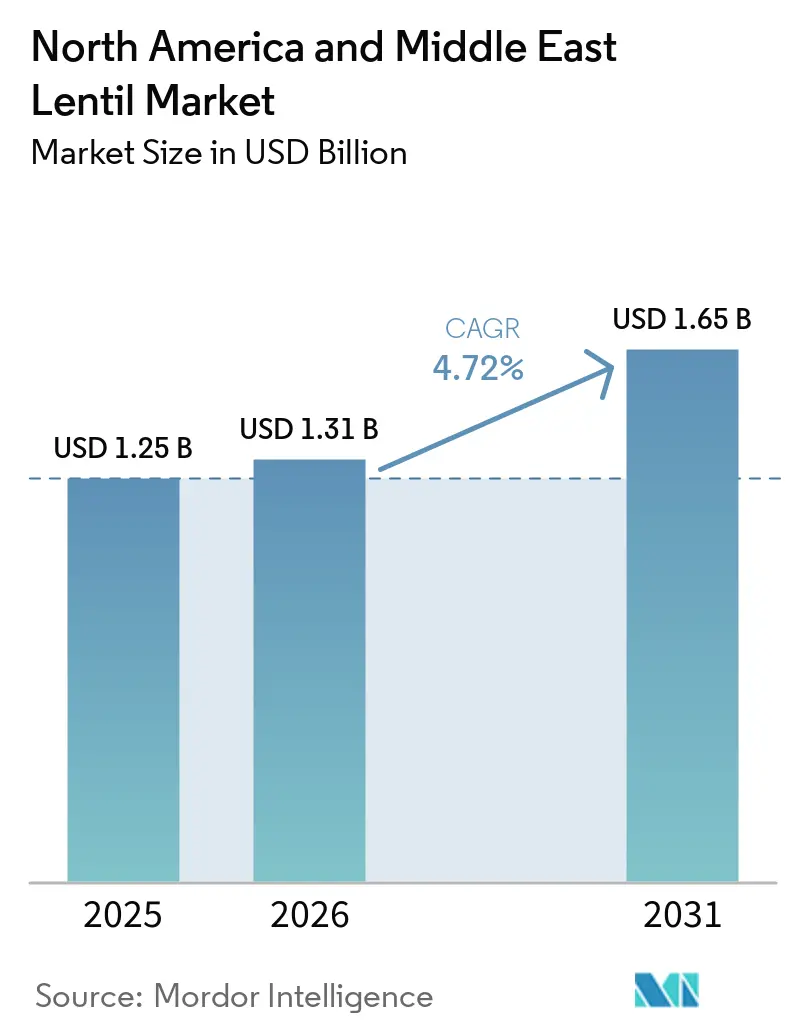
The North America and Middle East lentil market size was valued at USD 1.25 billion in 2025 and is estimated at USD 1.31 billion in 2026. The market is forecast to reach USD 1.65 billion by 2031, growing at a CAGR of 4.72% from 2026 to 2031. Demand across the market is supported by plant-based food formulation, food-security procurement, and expanding processing capacity. Canada's large crop has increased available export supply, while lower Turkish production has reinforced import demand in the Middle East. Processors are seeking higher returns from cleaning, splitting, milling, and protein ingredient production rather than selling whole lentils alone. The market also faces pressure from crop disease, trade-policy changes, and export logistics constraints.
Key Report Takeaways
- By geography, the Middle East held 83.3% of the North America and Middle East lentil market share in 2025, while North America is forecast to be the fastest-growing region, with a CAGR of 7.4% from 2026 to 2031.
Note: Market size and forecast figures in this report are generated using Mordor Intelligence’s proprietary estimation framework, updated with the latest available data and insights as of January 2026.
Market Trends and Insights
Drivers Impact Analysis of North America and Middle East Lentil Market*
| Driver | (~) % Impact on CAGR Forecast | Geographic Relevance | Impact Timeline |
|---|---|---|---|
| Rising demand for plant-based proteins | +1.1% | North America and Middle East, with highest concentration in the United States, Canada, Turkey, and the United Arab Emirates (UAE) | Medium term (2-4 years) |
| Government nutrition and food security programs | +0.9% | Strongest in Egypt and Turkey, with secondary relevance in the United States | Long term (≥ 4 years) |
| Expansion of climate-smart crop-rotation incentives | +0.7% | Canada and the United States, with limited spillover to Mexico | Medium term (2-4 years) |
| Optical-sorting upgrades boosting premium-grade recovery | +0.6% | Canada, the United States, Turkey, and emerging United Arab Emirates processing facilities | Short term (≤ 2 years) |
| Cross-border re-export hubs in the Middle East | +0.7% | Turkey and the United Arab Emirates, with Egypt as a secondary redistribution point | Long term (≥ 4 years) |
| Lentil flour and protein reformulation in North America | +0.5% | The United States and Canada, with limited early-stage exposure in Mexico | Medium term (2-4 years) |
| Source: Mordor Intelligence | |||
Rising Demand for Plant-Based Proteins
Lentils are gaining relevance as a plant-based protein ingredient because they can be incorporated directly into a broad range of food formulations rather than being limited to protein-isolate applications. A 2024 review in Advances in Colloid and Interface Science identified lentil proteins as an affordable, protein-rich, nutritious, and functional alternative to animal-derived proteins, with potential applications across foods and beverages, including meat analogs and other value-added products. The versatility of lentils also supports applications in bakery products, pasta, extruded snacks, protein drinks, and plant-based meat alternatives, creating additional demand for both whole lentils and processed forms such as lentil flour and protein concentrates. In the United States, the United States Department of Agriculture (USDA) MyPlate framework includes beans, peas, and lentils within the Protein Foods Group and identifies them as vegetarian and vegan protein options, supporting their established role as plant-based protein foods. The expansion of these applications creates value-added demand for lentils in the North America and Middle East lentil market, while encouraging processors to develop capabilities in splitting, milling, flour production, and other ingredient-processing activities. This broadens the demand base beyond traditional whole-lentil consumption and supports greater use of lentils as an ingredient in mainstream food manufacturing
Government Nutrition and Food Security Programs
Government food-security and nutrition programs can support lentil demand by reducing financing and affordability constraints around staple-food procurement. In March 2026, Egypt extended the exemption of lentils, rice, and beans from the 100% cash-cover requirement for imports through March 15, 2027, helping reduce the upfront financing burden for importers and supporting the continuity of staple-food supply[1]. In addition, Egypt's FY2026/27 budget allocated EGP 175.3 billion (USD 3.4 billion) to food subsidies, a 10% increase from the previous year, benefiting more than 60 million citizens, according to Egypt's Ministry of Finance[2]. These measures support lentil demand by improving the ability of importers to maintain supplies and helping consumers access subsidized staple foods despite price and financing pressures. For the North America and Middle East lentil market, such government interventions are particularly relevant because Middle Eastern markets rely on imported pulses to supplement domestic supply, making import financing conditions and food-subsidy programs important demand-support mechanisms.
Expansion of Climate-Smart Crop-Rotation Incentives
Government support for climate-smart agriculture is increasing the economic value of lentils within crop-rotation systems, particularly in Canada. In February 2025, Agriculture and Agri-Food Canada announced CAD 35.3 million (USD 25.4 million) in funding to support farmers adopting practices that improve environmental sustainability, including crop diversification and nutrient management[3]. Crop rotation is particularly relevant to lentils because pulse crops fix atmospheric nitrogen, potentially reducing fertilizer requirements and associated emissions in subsequent crops. Genome Canada's ACTIVATing project further estimates that improved lentil-wheat rotation systems could generate more than USD 1.2 billion in fertilizer-cost savings and reduce 3 million metric tons of fertilizer-related greenhouse gas emissions over 20 years. These incentives and research initiatives strengthen the role of lentils beyond their direct crop value, supporting producer adoption and increasing the potential demand for traceable, lower-emission lentil supply in the North America and Middle East lentil market.
Lentil Flour and Protein Reformulation in North America
North American food manufacturers are increasingly incorporating lentil flour and other pulse ingredients into pasta, bakery products, snacks, cereals, and other packaged foods, supported by consumer preference for plant-based and vegan food options in developed food markets. Lentil ingredients allow manufacturers to improve the nutritional profile of familiar food formats while meeting demand for convenient, protein-rich products. Pulse Canada notes that wheat pasta containing 25% lentil flour can qualify for a “Good Source of Protein” claim in the United States under Food and Drug Administration (FDA) requirements, providing a defined formulation opportunity for lentil flour in conventional packaged foods. This supports the use of lentils beyond traditional whole-pulse consumption and creates additional demand from food manufacturers seeking plant-based protein and fiber ingredients. The trend also increases the importance of consistent flour quality, functional performance, and reliable supply, supporting value-added processing and providing Canadian and the United States lentil suppliers with additional routes to market.
Restraints Impact Analysis of North America and Middle East Lentil Market*
| Restraint | (~) % Impact on CAGR Forecast | Geographic Relevance | Impact Timeline |
|---|---|---|---|
| Intensifying pest and disease outbreaks | -0.6% | Canada and the United States, with secondary impact in Turkey | Short term (≤ 2 years) |
| Tariff-driven price volatility in key import hubs | -0.8% | Turkey, Egypt, the United Arab Emirates, and the Canada-United States trade channel | Medium term (2-4 years) |
| Container and inland logistics bottlenecks | -0.5% | Canada, the United States, and United Arab Emirates import timing | Short term (≤ 2 years) |
| Limited commercialization of heat-tolerant varieties | -0.3% | Turkey, Egypt, the United Arab Emirates, and southern United States production zones | Long term (≥ 4 years) |
| Source: Mordor Intelligence | |||
Intensifying Pest and Disease Outbreaks
Disease pressure can reduce yields and increase crop-protection costs for lentil growers. The 2025 Saskatchewan Pulse Growers survey report identified root-rot complex symptoms in 84% of the 61 lentil crops surveyed, while the report's field-level prevalence measure indicated 86% overall occurrence across the surveyed fields. Anthracnose was also detected in 69% of the surveyed crops. These findings highlight the production risks faced by Canadian lentil-growing regions, which can constrain marketable output for the North American and Middle Eastern lentil markets. Ascochyta blight further requires integrated management through crop rotation, seed treatment, and foliar fungicide applications. Persistent disease pressure can increase production costs, reduce crop quality, and affect growers' returns, potentially influencing future acreage decisions and the availability of lentils for export markets.
Limited Commercialization of Heat-Tolerant Varieties
Heat stress remains a production constraint in warmer lentil-growing regions, where high temperatures can reduce crop performance and limit production stability. A 2025 study published in Scientific Reports evaluated lentil genotypes for heat tolerance using stress-tolerance indices, highlighting the continued need to identify and develop varieties capable of maintaining performance under elevated temperatures. The findings indicate that heat tolerance remains an active breeding priority rather than a fully resolved commercial solution. Production areas in Turkey, Egypt, and the southern United States are particularly exposed to higher-temperature conditions, while limited availability of improved heat-tolerant varieties can restrict local production options and increase reliance on imports from cooler growing regions. Research organizations such as International Center for Agricultural Research in the Dry Areas (ICARDA) continue to develop climate-smart lentil varieties to improve resilience to heat and other environmental stresses. Wider commercialization will depend on seed multiplication, grower adoption, and validation under local production conditions. Until these varieties become more widely available, heat stress and associated production variability are likely to remain constraints for the North America and Middle East lentil market.
*Our forecasts treat driver/restraint impacts as directional, not additive. The impact forecasts reflect baseline growth, mix effects, and variable interactions.
Geography Analysis
Middle East
The Middle East accounted for 83.3% of the North America and Middle East lentil market share in 2025, driven by high regional consumption and reliance on imports. Turkey is the region’s largest consumer and has become more dependent on imports after domestic production declined to 260,000 metric tons in 2025 from 476,000 metric tons in 2024. Egypt supports lentil imports through its food-subsidy system and the March 2026 Central Bank of Egypt (CBE) cash-cover exemption, while the United Arab Emirates supports food redistribution through Jebel Ali Port and its broader logistics network. These countries combine domestic demand, processing, and trade functions, reinforcing the Middle East’s dominant position in the North America and Middle East lentil market.
North America
North America is the fastest-growing geographic region, forecast to expand at a CAGR of 7.4% from 2026 to 2031. According to the Canada Grain Commission, Canada produced a record 3.4 million metric tons of lentils in 2025, 38.2% above 2024 output and 40.6% above the 10-year average, with Saskatchewan accounting for 86.2% of western Canadian output. According to the United States Department of Agriculture Economic Research Service (USDA ERS), the United States increased lentil acreage by 8% in 2025. North America’s growth is supported by its large production base and expanding use of lentils in value-added applications, including flour, protein ingredients, and other food inputs.
North America’s role in the market is strengthened by its position as both a major production base and a source of processed lentil ingredients. Canada’s large-scale production provides substantial exportable supply, while the United States contributes to domestic processing and food-ingredient demand. The combination of agricultural output and value-added processing creates additional demand beyond whole-lentil consumption and supports the region’s faster growth through 2031.
Competitive Landscape
The North America and Middle East lentil market includes independent growers, agricultural traders, processors, exporters, importers, and food-ingredient companies across the two regions. In North America, competition is centered on lentil origination, processing, merchandising, export logistics, and value-added ingredient production, particularly in Canada and the United States. Canada is a major supply base, with India, Turkey, and the United Arab Emirates among its principal lentil export markets, linking North American producers directly with Middle Eastern demand centers. In the Middle East, competition is more closely associated with import procurement, commodity trading, processing, distribution, and re-export, with Turkey and the United Arab Emirates serving as important commercial markets. Egypt is also an important import market, sourcing lentils from Canada, Australia, Russia, Turkey, and Kazakhstan. These different market roles create competition across the supply chain, with companies competing on procurement cost, product quality, processing capabilities, supply reliability, and access to international and regional distribution networks.
Trading companies with operations spanning producing and consuming regions are strengthening their competitive position. In August 2024, Louis Dreyfus Company established a dedicated global pulses business unit, initially focusing on yellow peas, chickpeas, red lentils, fava beans, and pigeon peas. The company specifically identified the Middle East as a major importing market and highlighted its origination capabilities in Australia and Canada alongside its trading presence in key consumption markets. This type of integrated trading model allows companies to connect North American and other origins with Middle Eastern buyers while managing procurement, logistics, and market risk. In Egypt, the Central Bank's March 2026 extension of the cash-cover exemption for lentils, beans, and rice through March 15, 2027 also supports the operating environment for food importers by reducing the upfront financing burden on qualifying transactions.
Processing and value-added ingredients are emerging as additional competitive differentiators across the two regions. North American companies are investing in processing capabilities that allow lentils to move beyond whole-seed trade into flour, protein ingredients, concentrates, and other food applications, while Middle Eastern processors and traders benefit from their proximity to large consumer markets and established import-distribution networks. Canada's export infrastructure remains particularly important because large volumes of lentils move to overseas markets, including Turkey and the UAE. Companies with access to efficient cleaning, splitting, grading, milling, sorting, storage, and logistics infrastructure can therefore compete on both product quality and delivered cost. Overall, the competitive landscape is shaped by North American production and export strength, Middle Eastern import and distribution networks, cross-regional agricultural trading, and increasing investment in value-added pulse processing.
Recent Industry Developments in North America and Middle East Lentil Market
- July 2026: The Government of Canada announced the Port of Vancouver Gateway Strategy, proposing a 50% expansion of the port's container-handling capacity, directly benefiting pulse exporters reliant on containerized lentil shipments.
- March 2026: Protein Industries Canada invested CAD 3.99 million (USD 2.88 million) with AGT Foods and Sweet Nutrition to develop improved pea, lentil, and faba bean ingredients using heat-moisture treatment, blending, and extrusion technologies at AGT Foods’ Regina extrusion facility in Saskatchewan, Canada.
- March 2026: Egypt's Central Bank extended the exemption allowing importers of lentils, rice, and beans to avoid the 100% cash-cover requirement for commercial imports through March 15, 2027. The measure reduces the upfront financing burden for importers and was introduced to support the continued flow of essential food commodities.
North America and Middle East Lentil Market Report Scope
Lentil is the edible seed of a legume plant (Lens culinaris), cultivated primarily for human consumption. Lentils are rich in plant-based protein, dietary fiber, vitamins, and minerals, making them an important ingredient in soups, stews, curries, salads, and other food products. Lentils are valued for their nutritional content, versatility in food applications, and role in sustainable agriculture through their ability to fix atmospheric nitrogen and improve soil fertility.
The North America and Middle East lentil market report is segmented by geography (North America and the Middle East). The report includes production analysis (volume), consumption analysis (value and volume), import analysis (value and volume), export analysis (value and volume), wholesale price trend analysis and forecast, a list of key players, and more. The market forecasts are provided in terms of value (USD) and volume (metric tons).
Segmentation Overview
| United States | Production Analysis (Area Harvested, Yield, and Production Volume) | Consumption Analysis (Consumption Value and Volume) |
| Import Market Analysis (Import Value, Volume, and Key Supplying Markets) | ||
| Export Market Analysis (Export Value, Volume, and Key Destination Markets) | ||
| Wholesale Price Trend Analysis and Forecast | ||
| Regulatory Framework | ||
| List of Key Players | ||
| Logistics and Infrastructure | ||
| Seasonality Analysis | ||
| Canada | Production Analysis (Area Harvested, Yield, and Production Volume) | |
| Consumption Analysis (Consumption Value and Volume) | ||
| Import Market Analysis (Import Value, Volume, and Key Supplying Markets) | ||
| Export Market Analysis (Export Value, Volume, and Key Destination Markets) | ||
| Wholesale Price Trend Analysis and Forecast | ||
| Regulatory Framework | ||
| List of Key Players | ||
| Logistics and Infrastructure | ||
| Seasonality Analysis | ||
| Mexico | Production Analysis (Area Harvested, Yield, and Production Volume) | |
| Consumption Analysis (Consumption Value and Volume) | ||
| Import Market Analysis (Import Value, Volume, and Key Supplying Markets) | ||
| Export Market Analysis (Export Value, Volume, and Key Destination Markets) | ||
| Wholesale Price Trend Analysis and Forecast | ||
| Regulatory Framework | ||
| List of Key Players | ||
| Logistics and Infrastructure | ||
| Seasonality Analysis | ||
| Middle East | Egypt | Production Analysis (Area Harvested, Yield, and Production Volume) |
| Consumption Analysis (Consumption Value and Volume) | ||
| Import Market Analysis (Import Value, Volume, and Key Supplying Markets) | ||
| Export Market Analysis (Export Value, Volume, and Key Destination Markets) | ||
| Wholesale Price Trend Analysis and Forecast | ||
| Regulatory Framework | ||
| List of Key Players | ||
| Logistics and Infrastructure | ||
| Seasonality Analysis | ||
| United Arab Emirates | Production Analysis (Area Harvested, Yield, and Production Volume) | |
| Consumption Analysis (Consumption Value and Volume) | ||
| Import Market Analysis (Import Value, Volume, and Key Supplying Markets) | ||
| Export Market Analysis (Export Value, Volume, and Key Destination Markets) | ||
| Wholesale Price Trend Analysis and Forecast | ||
| Regulatory Framework | ||
| List of Key Players | ||
| Logistics and Infrastructure | ||
| Seasonality Analysis | ||
| Turkey | Production Analysis (Area Harvested, Yield, and Production Volume) | |
| Consumption Analysis (Consumption Value and Volume) | ||
| Import Market Analysis (Import Value, Volume, and Key Supplying Markets) | ||
| Export Market Analysis (Export Value, Volume, and Key Destination Markets) | ||
| Wholesale Price Trend Analysis and Forecast | ||
| Regulatory Framework | ||
| List of Key Players | ||
| Logistics and Infrastructure | ||
| Seasonality Analysis | ||
| North America | United States | Production Analysis (Area Harvested, Yield, and Production Volume) | Consumption Analysis (Consumption Value and Volume) |
| Import Market Analysis (Import Value, Volume, and Key Supplying Markets) | |||
| Export Market Analysis (Export Value, Volume, and Key Destination Markets) | |||
| Wholesale Price Trend Analysis and Forecast | |||
| Regulatory Framework | |||
| List of Key Players | |||
| Logistics and Infrastructure | |||
| Seasonality Analysis | |||
| Canada | Production Analysis (Area Harvested, Yield, and Production Volume) | ||
| Consumption Analysis (Consumption Value and Volume) | |||
| Import Market Analysis (Import Value, Volume, and Key Supplying Markets) | |||
| Export Market Analysis (Export Value, Volume, and Key Destination Markets) | |||
| Wholesale Price Trend Analysis and Forecast | |||
| Regulatory Framework | |||
| List of Key Players | |||
| Logistics and Infrastructure | |||
| Seasonality Analysis | |||
| Mexico | Production Analysis (Area Harvested, Yield, and Production Volume) | ||
| Consumption Analysis (Consumption Value and Volume) | |||
| Import Market Analysis (Import Value, Volume, and Key Supplying Markets) | |||
| Export Market Analysis (Export Value, Volume, and Key Destination Markets) | |||
| Wholesale Price Trend Analysis and Forecast | |||
| Regulatory Framework | |||
| List of Key Players | |||
| Logistics and Infrastructure | |||
| Seasonality Analysis | |||
| Middle East | Egypt | Production Analysis (Area Harvested, Yield, and Production Volume) | |
| Consumption Analysis (Consumption Value and Volume) | |||
| Import Market Analysis (Import Value, Volume, and Key Supplying Markets) | |||
| Export Market Analysis (Export Value, Volume, and Key Destination Markets) | |||
| Wholesale Price Trend Analysis and Forecast | |||
| Regulatory Framework | |||
| List of Key Players | |||
| Logistics and Infrastructure | |||
| Seasonality Analysis | |||
| United Arab Emirates | Production Analysis (Area Harvested, Yield, and Production Volume) | ||
| Consumption Analysis (Consumption Value and Volume) | |||
| Import Market Analysis (Import Value, Volume, and Key Supplying Markets) | |||
| Export Market Analysis (Export Value, Volume, and Key Destination Markets) | |||
| Wholesale Price Trend Analysis and Forecast | |||
| Regulatory Framework | |||
| List of Key Players | |||
| Logistics and Infrastructure | |||
| Seasonality Analysis | |||
| Turkey | Production Analysis (Area Harvested, Yield, and Production Volume) | ||
| Consumption Analysis (Consumption Value and Volume) | |||
| Import Market Analysis (Import Value, Volume, and Key Supplying Markets) | |||
| Export Market Analysis (Export Value, Volume, and Key Destination Markets) | |||
| Wholesale Price Trend Analysis and Forecast | |||
| Regulatory Framework | |||
| List of Key Players | |||
| Logistics and Infrastructure | |||
| Seasonality Analysis | |||
Key Questions Answered in the Report
What is the North America and Middle East lentil market size?
The North America and Middle East lentil market size is estimated at USD 1.31 billion in 2026 and is forecast to reach USD 1.65 billion by 2031.
What CAGR is forecasted for lentils in North America and the Middle East?
The market is forecast to grow at a CAGR of 4.72% from 2026 to 2031.
What factors support lentil processing in North America?
Lentil flour use, protein-focused food reformulation, optical sorting, and processing investments support higher-value uses of lentils.
What challenges affect lentil supply and trade?
Disease pressure, tariff uncertainty, logistics constraints, and limited heat-tolerant varieties can affect output, costs, and delivery reliability.