
North America 5G Core Network Market Size and Share
Market Overview
| Study Period | 2020 - 2031 |
|---|---|
| Forecast Data Period | 2026 - 2031 |
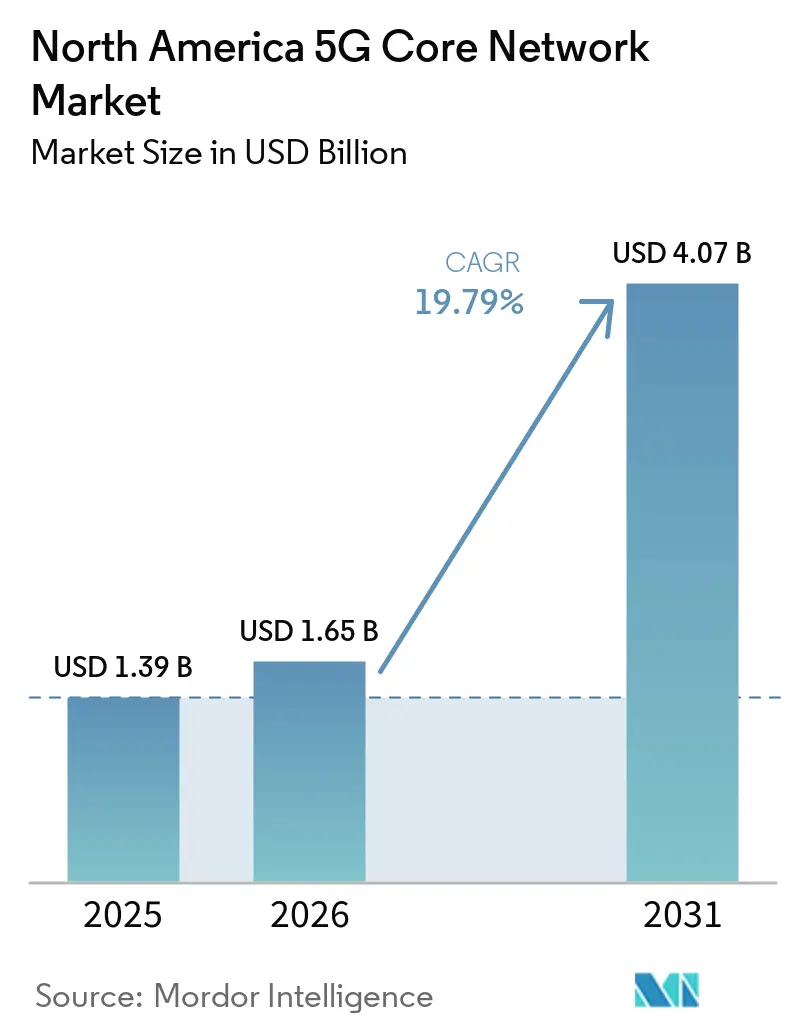
| Base Year Market Size (2025) | USD 1.39 Billion |
| Market Size (2026) | USD 1.65 Billion |
| Market Size (2031) | USD 4.07 Billion |
| Growth Rate (2026 - 2031) | 19.79 % |
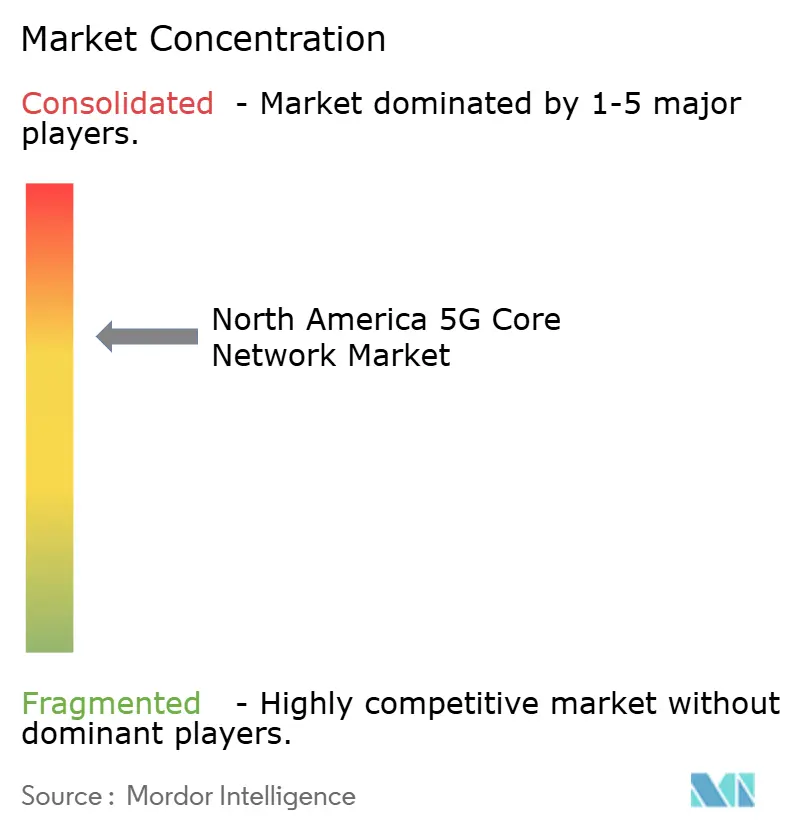
| Market Concentration | Medium |
Major Players *Disclaimer: Major Players sorted in no particular order Image © Mordor Intelligence. Reuse requires attribution under CC BY 4.0. | |
North America 5G Core Network Market Analysis by Mordor Intelligence
The North America 5G core network market size is expected to grow from USD 1.39 billion in 2025 to USD 1.65 billion in 2026 and is forecast to reach USD 4.07 billion by 2031 at 19.79% CAGR over 2026-2031. Completion of nationwide standalone 5G core deployments by the 3 United States Tier-1 operators during 2025 shifted investment from initial network construction toward service delivery and operational scale. The North America 5G core network market now benefits from a larger base of standalone subscribers, which allows carriers to spread fixed core costs across more services. Voice over New Radio, network slicing, and application programming interfaces create new ways to serve public agencies and enterprise customers. Cloud-native software is also changing procurement decisions because operators can select software, integration, and cloud capabilities separately. The North America 5G core network market faces ongoing execution pressure, as operators must operate legacy Evolved Packet Core networks alongside 5G cores and build cloud operations skills.
Key Report Takeaways
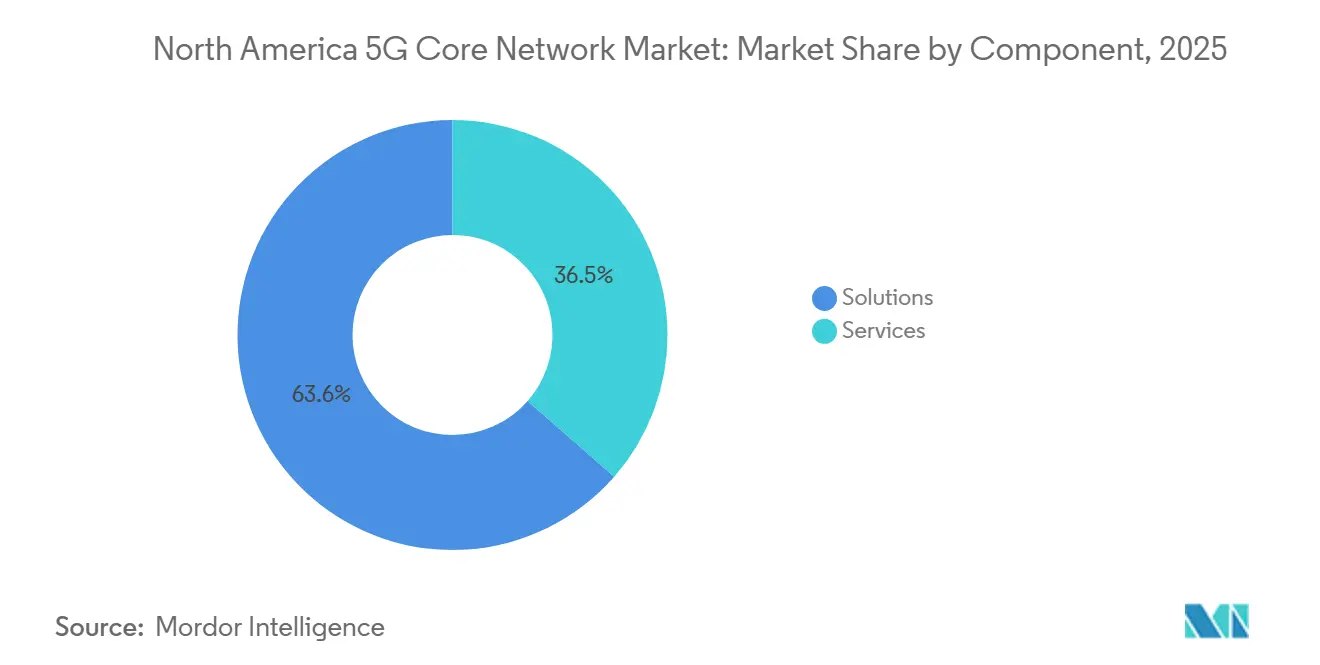
- By component, solutions held 63.55% of the North America 5G core network market share in 2025, while services in the North America 5G core network market are projected to expand at a 21.21% CAGR through 2031.
- By deployment model, on-premise/dedicated held 51.95% of the North America 5G core network market share in 2025, while public cloud in the North America 5G core network market is projected to expand at a 24.76% CAGR through 2031.
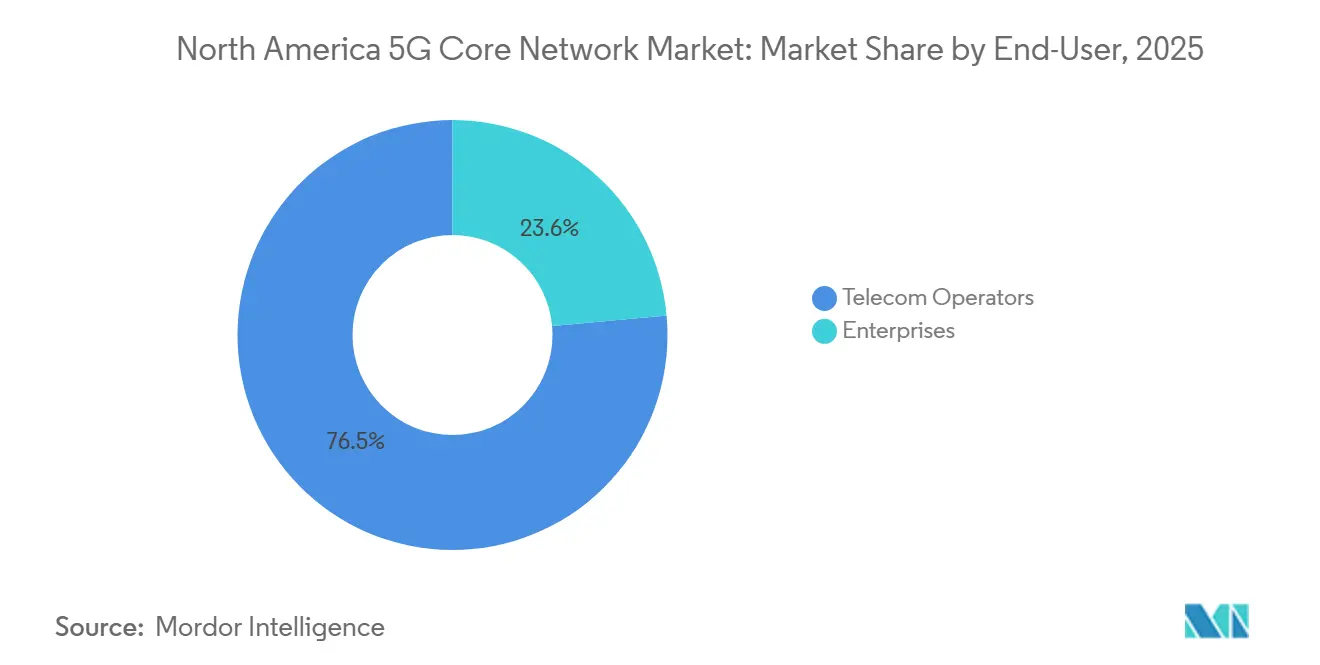
- By end-user, telecom operators accounted for 76.45% of the North America 5G core network market share in 2025, while enterprises in the North America 5G core network market are projected to expand at a 24.26% CAGR through 2031.
- By network function, the user plane function held 22.10% of the North America 5G core network market share in 2025, while the network exposure function is projected to expand at a 27.98% CAGR through 2031.
- By country, the United States held 86.50% of the North America 5G core network market share in 2025, while Mexico is projected to expand at a 21.30% CAGR through 2031.
Note: Market size and forecast figures in this report are generated using Mordor Intelligence’s proprietary estimation framework, updated with the latest available data and insights as of January 2026.
North America 5G Core Network Market Trends and Insights
Drivers Impact Analysis*
| Driver | (~) % Impact on CAGR Forecast | Geographic Relevance | Impact Timeline |
|---|---|---|---|
| Standalone 5G Rollouts Reach an Inflection Point | +4.8% | United States primary, Canada secondary | Short term (≤ 2 years) |
| Cloud-Native Core Adoption Across North American Operators | +3.9% | United States and Canada | Medium term (2-4 years) |
| Enterprise Private 5G Demand in Manufacturing and Logistics | +2.7% | United States primary, with early gains in Ontario industrial corridors, Canada | Medium term (2-4 years) |
| Network Slicing Requirements for Mission-Critical Services | +2.3% | United States, Canada | Medium term (2-4 years) |
| Open RAN and Interoperability Programs Require Flexible Core Architectures | +1.6% | United States, including the NSF PAWR program and CBRS ecosystem | Long term (≥ 4 years) |
| AI-Driven Automation and Policy Control Modernization | +1.4% | United States Tier-1 operators, with spillover to Canada | Long term (≥ 4 years) |
| Source: Mordor Intelligence | |||
Standalone 5G Rollouts Reach an Inflection Point
AT&T and Verizon launched standalone cores in late 2025, joining T-Mobile and giving all 3 United States Tier-1 carriers commercially differentiated standalone services. This shift increased pressure to move subscribers and service development onto standalone architectures. AT&T described its platform as an open, virtualized architecture that runs across Microsoft Azure and its own data centers. VTel Wireless selected Ericsson in March 2026 for a dual-mode 5G core and radio access network that supports end-to-end standalone Voice over New Radio roaming with nationwide providers. This demonstrates that the North America 5G core network market is extending beyond large urban carriers. ATIS identified limited dedicated spectrum and the remaining economics of non-standalone upgrades as important barriers for smaller carriers.
Cloud-Native Core Adoption Across North American Operators
Cloud-native core adoption has progressed from a strategic objective to an operating model among major regional operators. Software can be deployed on Kubernetes-compatible infrastructure, which broadens the supplier base to include software vendors, systems integrators, and cloud platform providers. Ericsson launched its On-Demand 5G Core-as-a-Service platform with Google Cloud in June 2025.[1]Ericsson and Google Cloud, “Ericsson and Google Cloud Team Up to Deliver Carrier-Grade 5G Core-as-a-Service, Built with AI at the Foundation,” Google Cloud Press Corner, googlecloudpresscorner.com Boost Mobile deployed Nokia's cloud-native 5G Voice Core on a public cloud in March 2025 and consolidated multiple IMS voice functions into 1 cloud-native network function. Mavenir reported that 82% of surveyed operators either operated cloud-native cores or planned to do so by the end of 2026. The North America 5G core network market, therefore, has a wider range of implementation models, but operators still need the skills to manage them.
Enterprise Private 5G Demand in Manufacturing and Logistics
Private 5G is moving from limited pilots into multi-site infrastructure programs, particularly in manufacturing and logistics. Citizens Broadband Radio Service spectrum gives United States enterprises a cost advantage for private deployment compared with countries that require premium industrial spectrum licenses. NTT DATA announced in February 2026 that Cargill's private 5G network had reached 50 sites, largely in the United States. The program supports connected robotics, automation, and digital operations, with more sites planned during 2026. These deployments require dedicated standalone core platforms rather than merely moving consumer traffic off public networks. Manufacturing, energy and utilities, transportation and logistics, public safety and emergency services, and smart cities and municipalities each create separate integration and support requirements for the North America 5G core network market.
Network Slicing Requirements for Mission-Critical Services
Network slicing is becoming a commercial feature for mission-critical communications, with public safety providing the most visible use case. AT&T and the First Responder Network Authority activated a dedicated FirstNet 5G standalone core in July 2026. The core is physically separate from AT&T's commercial infrastructure and serves more than 27,500 public-safety agencies and 5.5 million connections across 56 United States states and territories. The investment exceeded USD 8 billion, including a USD 6.3 billion network contract and a USD 2 billion commitment announced in March 2026. AT&T, Verizon, and T-Mobile now offer distinct mission-critical slice products, increasing the need for standards work and interoperability through 2031. Rogers, Bell, and Telus tested slicing applications for broadcast, public safety, and first responders during 2025, while Bell's 5G+ Advanced standalone core supports future service differentiation.[2]Bell Canada, “Bell Introduces 5G+ Advanced, Its Fastest and Most Advanced Network Yet,” BCE Newsroom, bce.ca
Restraints Impact Analysis*
| Restraint | (~) % Impact on CAGR Forecast | Geographic Relevance | Impact Timeline |
|---|---|---|---|
| High Upfront Core Modernization Costs | -2.8% | United States regional operators, Canada mid-tier carriers, Mexico all operators | Short term (≤ 2 years) |
| Legacy EPC Integration Complexity | -2.1% | United States and Canada operators running parallel EPC and 5GC stacks | Medium term (2-4 years) |
| Cloud-Native Skills Shortage in Telecom Operations | -1.3% | United States and Canada core operator markets | Medium term (2-4 years) |
| Security, Sovereignty, and Compliance Constraints | -1.0% | United States FCC and DOJ frameworks, Mexico CRT spectrum and data regulations | Long term (≥ 4 years) |
| Source: Mordor Intelligence | |||
High Upfront Core Modernization Costs
Core modernization places pressure on carriers of all sizes to reduce capital and operating costs. Regional and rural carriers often face similar per-site integration costs to those of Tier-1 operators, despite having smaller subscriber bases. Running Evolved Packet Core and 5G core stacks during a multi-year migration can also raise post-migration support costs. Mexico faces further uncertainty because Congress sets spectrum fees annually. AT&T Mexico indicated that it might not participate in the upcoming industrial 5G spectrum auction. Mavenir found that planned standalone adoption depends on vendors providing credible total cost of ownership evidence for cloud-native core migration.
Legacy EPC Integration Complexity
Parallel Evolved Packet Core and 5G core networks make migration schedules more difficult to execute. Ericsson noted that migration from EPS to 5GS requires user data and policies to support 2 networks while maintaining inbound roaming services. Telus built its own cloud-native stack to maintain consistency across a multi-vendor environment, showing the engineering effort needed to migrate legacy customers without reducing service quality. A single-vendor cloud platform can simplify operations, but it can also increase vendor dependence. A horizontal cloud environment improves flexibility but raises design and skills requirements. The Federal Communications Commission's equipment authorization supply-chain security rules add another compliance consideration to supplier selection.[3]Federal Communications Commission, “Protecting Against National Security Threats to the Communications Supply Chain Through the Equipment Authorization Program,” Federal Register, federalregister.gov
*Our forecasts treat driver/restraint impacts as directional, not additive. The impact forecasts reflect baseline growth, mix effects, and variable interactions.
Segment Analysis
By Component: Services Point to a Shift Toward Managed Operations
Solutions accounted for 63.55% of the North America 5G core network market revenue in 2025. The segment includes packet-core software, network function virtualization infrastructure, and orchestration and management platforms. Its position reflected software-led spending on Tier-1 standalone buildouts by AT&T, Verizon, T-Mobile, Bell, Rogers, and Telus. Packet-core software remained central because operators need cloud-native network functions to replace hardware-based legacy systems.
Services in the North America 5G core network market are projected to expand at a 21.21% CAGR through 2031. The segment covers integration and deployment, consulting and advisory, and support and maintenance. Cloud-native standalone cores require frequent software updates, while operators continue to face a shortage of cloud-native operations skills. Ericsson agreed in April 2025 to deploy and operate a dual-mode 5G core for GCI Communication Corp in Alaska, including cloud-core technology, AI tools, and ongoing network management. Support and maintenance demand is expected to continue as operators retire parallel Evolved Packet Core systems.


By Deployment Model: On-Premise Control Competes With Public Cloud Flexibility
On-Premise/Dedicated deployments accounted for 51.95% of North America's 5G core network market revenue in 2025. Operators and enterprises selected this model when they required low latency, data-handling compliance, and infrastructure control. Dedicated deployments are particularly relevant for factory environments with strict service-level requirements. Verizon's Intelligent Edge Network strategy reflects its preference for end-to-end ownership in critical core areas and Level 4 autonomy.
Public Cloud in the North America 5G core network market is projected to expand at a 24.76% CAGR through 2031. AT&T deployed its nationwide standalone core on Microsoft Azure in October 2025, running more than 60 containerized network functions for hundreds of millions of subscribers. This deployment demonstrated that public cloud infrastructure can meet Tier-1-scale and reliability requirements. Ericsson's platform with Google Cloud gives carriers a managed option when internal cloud engineering capacity is limited. Hybrid and Telco Edge Cloud combines local infrastructure with cloud-native orchestration and is relevant to mid-tier Canadian and Mexican operators, helping them replace legacy packet-core systems.
By End-User: Enterprise Private 5G Adds Demand Beyond Carriers
Telecom Operators accounted for 76.45% of the North America 5G core network market revenue in 2025. This result reflected carrier-led spending during the first standalone build cycle. The group includes Tier-1 carriers and regional operators purchasing network functions, managed operations, orchestration licenses, and lifecycle management. User Plane Function distribution, Policy Control Function modernization, and network slicing remain important areas of operator spending.
Enterprises in the North America 5G core network market are projected to expand at a 24.26% CAGR through 2031. Manufacturing and logistics are the most developed enterprise deployment areas. NTT DATA reported that Cargill reduced cabling and setup costs by 70% compared with comparable Wi-Fi infrastructure across its 50-site private 5G program. Energy and utilities use private 5G for remote monitoring and automation, while transportation and logistics use it for asset tracking and autonomous vehicle infrastructure. Public safety, emergency agencies, smart cities, and municipalities use it for mission-critical and sensor-dense systems, supported by 3GPP Release 15-17 specifications and O-RAN Alliance frameworks.
By Network Function: UPF Supports Traffic and NEF Enables Service Exposure
User Plane Function held 22.10% of the North America 5G core network market revenue in 2025. Every standalone core requires it for data-plane session anchoring, traffic routing, and quality-of-service enforcement. Operators add distributed edge instances as standalone subscribers, and as data traffic increases, this reduces latency for enterprise and consumer applications. NEC demonstrated in February 2026 that agentic AI could manage the full User Plane Function lifecycle from design through operational monitoring and reduce deployment time from several weeks to hours.
Network Exposure Function is projected to expand at a 27.98% CAGR through 2031. It exposes quality-of-service controls, location services, and network analytics through standardized application programming interfaces. T-Mobile outlined plans for 2026 to enable enterprise customers to create end-to-end network slices via API-driven provisioning. Oracle's cloud-native Policy Control Function supports continuous deployment pipelines and 4G-to-5G policy migration. Access and Mobility Management Function, Session Management Function, Network Slice Selection Function, Unified Data Management, Authentication Server Function, Network Repository Function, and Application Function provide related control-plane and data-management roles.
Geography Analysis
The United States held 86.50% of the North America 5G core network market share in 2025. Nationwide standalone deployments by the 3 Tier-1 carriers supported its position. The federal first-responder core investment exceeded USD 8 billion. The country also has the region's broadest private 5G pipeline. FirstNet activated a dedicated 5G standalone core in July 2026 for more than 27,500 agencies across 56 states and territories. Citizens Broadband Radio Service spectrum also lowers private 5G entry costs for enterprises.
Canada retained the second-largest regional position in 2025. Bell launched its 5G+ Advanced network on a new standalone core in March 2026. It provided theoretical peak download speeds of 4.3 Gbps across the Greater Toronto and Hamilton Area. Telus continued its Ericsson core migration and developed a cloud-native orchestration stack for a multi-vendor environment. Samsung deployed a 5G Non-Standalone core and a 4G LTE Core Gateway for Videotron in February 2026. Bell and Nokia also expanded their Cloud RAN and Open RAN partnership in February 2025.
Mexico is projected to expand at a 21.30% CAGR through 2031. The earlier stage of core modernization leaves substantial scope for operators to move from non-standalone to standalone architectures. América Móvil reported that Telcel ended 2025 with 5G coverage reaching 60% of Mexico's population. AT&T Mexico maintained 5G coverage in 56 cities, while Movistar exited the country, with AT&T becoming its successor. High spectrum costs remain a structural barrier, as documented by GSMA. The planned industrial 5G spectrum auction could support private-network deployment, but spectrum policy is expected to affect investment through 2028.
Competitive Landscape
The North America 5G core network market combines a concentrated installed base among established infrastructure suppliers with increasing competition from cloud-native software providers. Ericsson and Nokia have broad positions with large operators, while Samsung has a meaningful position through Verizon and its February 2026 Videotron deployment in Canada. Ericsson supports AT&T's Azure-hosted standalone core and secured VTel Wireless and GCI Communication Corp contracts in 2026 and 2025. Nokia retained relevance in core software through its Cloud Native Communication Suite, as demonstrated by Boost Mobile's March 2025 cloud-native 5G Voice Core deployment.
Mavenir partnered with TextNow in February 2026 to provide a cloud-native core and mobile business support system stack for an 8 million-user United States mobile virtual network operator. It also received BSI NESAS certification for its 5G Packet Core Network Repository Function in June 2026. NEC demonstrated agentic AI for User Plane Function lifecycle management in February 2026, making AI-enabled automation a visible area of competition. Cisco Systems, Oracle, and Hewlett Packard Enterprise provide policy, security, and private-network platforms for adjacent operator and enterprise needs. These positions show that competition occurs at the software, cloud, integration, and network-function levels.
Parallel Wireless, Druid Software, and Athonet focus on specialized enterprise private-network deployments. Their long-term position depends on integration with wider 5G core environments through open APIs and O-RAN Alliance interoperability. Ribbon Communications and Ciena operate in voice-core and optical-transport areas that increasingly connect with unified cloud-native cores. Established vendors retain advantages from installed relationships, while software-focused providers can compete where operators prioritize portability, automation, or specialized integration.
North America 5G Core Network Industry Leaders
Telefonaktiebolaget LM Ericsson
Nokia Corporation
Amdocs Limited
Cisco Systems, Inc.
Oracle Corporation
- *Disclaimer: Major Players sorted in no particular order

Recent Industry Developments
- August 2026: AT&T and Ericsson announced a 600 MHz spectrum deployment initiative using dual-band radios with 8-receiver (8RX) uplink technology, supporting AT&T's AI-era network capacity roadmap with capital expenditure incorporated into AT&T's Q2 2026 financial guidance.
- July 2026: AT&T and the First Responder Network Authority activated the nationwide dedicated FirstNet 5G SA core, physically isolated from AT&T's commercial infrastructure, serving more than 27,500 public-safety agencies and approximately 5.5 million connections across all 56 United States states and territories, backed by a USD 2 billion March 2026 Commerce Department-AT&T commitment.
- June 2026: Mavenir received Germany's BSI NESAS security certification for its 5G Packet Core Network Repository Function, becoming the first tier-1 network software vendor to achieve this milestone under mandatory requirements that took effect on January 1, 2026, pursuant to the German Telecommunications Act.
- May 2026: T-Mobile and Ericsson advanced AI-native Scheduler with Link Adaptation into large-scale commercial trials on live 5G Advanced traffic, improving spectral efficiency on the first United States operator to achieve nationwide 5G Advanced deployment.


North America 5G Core Network Market Report Scope
The North America 5G core network market comprises software-based core network solutions and associated services that enable the deployment, management, orchestration, and operation of 5G standalone and cloud-native networks across telecom and enterprise environments in the United States, Canada, and Mexico. Market revenue is generated through the sale, licensing, and subscription of packet core software, NFV infrastructure, orchestration and management solutions, and 5G network functions, along with integration and deployment, consulting, support, and maintenance services delivered across on-premise, public cloud, hybrid, and telco edge cloud deployments.
The North America 5G core network market report is segmented by component (solutions (packet-core software, NFV infrastructure, and orchestration and management), and services (integration and deployment, consulting and advisory, and support and maintenance)), deployment model (on-premise /dedicated, public cloud, and hybrid and telco edge cloud), end-user (telecom operators and enterprises (manufacturing, energy and utilities, transportation and logistics, public safety and emergency, and smart cities and municipalities)), network function (network exposure function (NEF), user plane function (UPF), application function (AF), unified data management (UDM), session management function (SMF), network slice selection function (NSSF), policy control function (PCF), network repository function (NRF), authentication server function (AUSF), and access and mobility management function (AMF)), and country (United States, Canada, and Mexico). The market forecasts are provided in terms of value (USD).
| Solutions | Packet-Core Software |
| NFV Infrastructure | |
| Orchestration and Management | |
| Services | Integration and Deployment |
| Consulting and Advisory | |
| Support and Maintenance |
| On-Premise/Dedicated |
| Public Cloud |
| Hybrid and Telco Edge Cloud |
| Telecom Operators | |
| Enterprises | Manufacturing |
| Energy and Utilities | |
| Transportation and Logistics | |
| Public Safety and Emergency | |
| Smart Cities and Municipalities |
| Network Exposure Function (NEF) |
| User Plane Function (UPF) |
| Application Function (AF) |
| Unified Data Management (UDM) |
| Session Management Function (SMF) |
| Network Slice Selection Function (NSSF) |
| Policy Control Function (PCF) |
| Network Repository Function (NRF) |
| Authentication Server Function (AUSF) |
| Access and Mobility Management Function (AMF) |
| United States |
| Canada |
| Mexico |
| By Component | Solutions | Packet-Core Software |
| NFV Infrastructure | ||
| Orchestration and Management | ||
| Services | Integration and Deployment | |
| Consulting and Advisory | ||
| Support and Maintenance | ||
| By Deployment Model | On-Premise/Dedicated | |
| Public Cloud | ||
| Hybrid and Telco Edge Cloud | ||
| By End-User | Telecom Operators | |
| Enterprises | Manufacturing | |
| Energy and Utilities | ||
| Transportation and Logistics | ||
| Public Safety and Emergency | ||
| Smart Cities and Municipalities | ||
| By Network Function | Network Exposure Function (NEF) | |
| User Plane Function (UPF) | ||
| Application Function (AF) | ||
| Unified Data Management (UDM) | ||
| Session Management Function (SMF) | ||
| Network Slice Selection Function (NSSF) | ||
| Policy Control Function (PCF) | ||
| Network Repository Function (NRF) | ||
| Authentication Server Function (AUSF) | ||
| Access and Mobility Management Function (AMF) | ||
| By Country | United States | |
| Canada | ||
| Mexico | ||


Key Questions Answered in the Report
What is the North America 5G core network market size?
The North America 5G core network market size is estimated at USD 1.65 billion in 2026 and is projected to reach USD 4.07 billion by 2031.
What is driving demand for 5G standalone cores in North America?
Nationwide standalone deployments, private 5G programs, cloud-native adoption, and mission-critical network slicing are supporting demand.
Which component is expanding fastest through 2031?
Services is projected to expand at a 21.21% CAGR, supported by integration, managed operations, and continuing support needs.
Which deployment model is expanding fastest?
Public Cloud is projected to expand at a 24.76% CAGR through 2031 as operators use managed cloud-native core platforms.
Which end user is expanding fastest?
Enterprises are projected to expand at a 24.26% CAGR, with manufacturing and logistics among the more mature use cases.
Which country is expected to expand fastest?
Mexico is projected to expand at a 21.30% CAGR through 2031 as its operators move from non-standalone to standalone cores.
Page last updated on:





