
Non-Woven Adhesives Market Size and Share
Market Overview
| Study Period | 2021 - 2031 |
|---|---|
| Market Size (2026) | USD 3.72 Billion |
| Market Size (2031) | USD 5.63 Billion |
| Growth Rate (2026 - 2031) | 8.67 % |
| Fastest Growing Market | Asia-Pacific |
| Largest Market | Asia-Pacific |
| Market Concentration | Medium |
Major Players *Disclaimer: Major Players sorted in no particular order Image © Mordor Intelligence. Reuse requires attribution under CC BY 4.0. | |
Non-Woven Adhesives Market Analysis by Mordor Intelligence
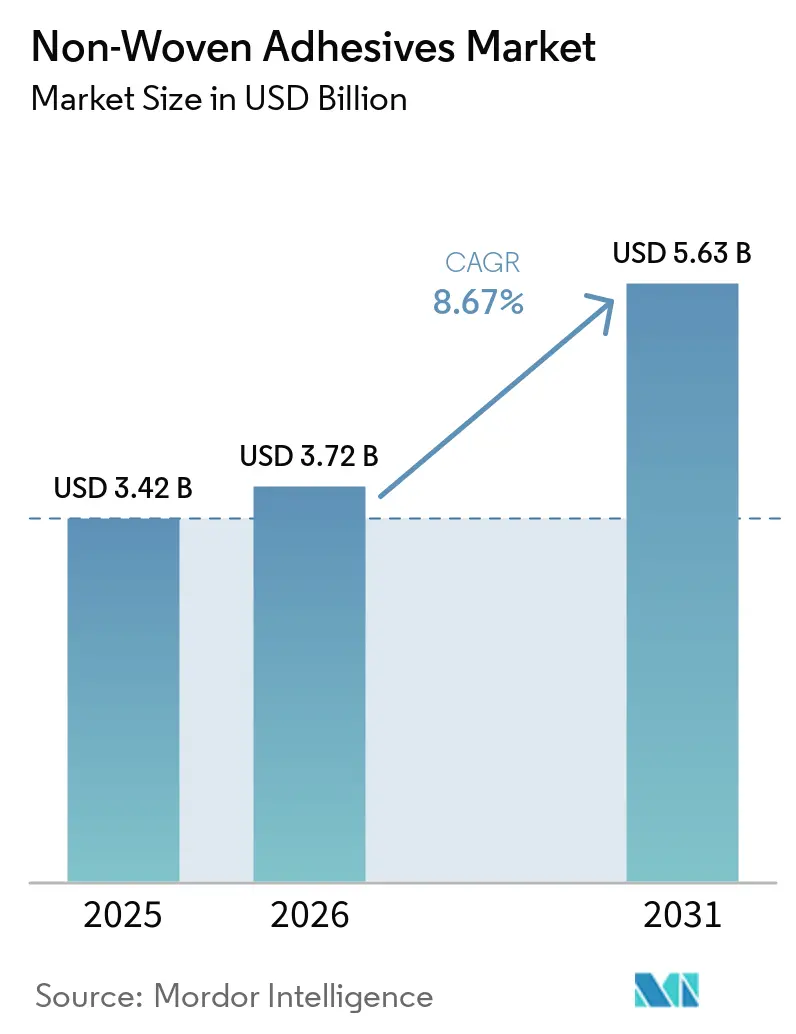
The Non-Woven Adhesives Market size was valued at USD 3.42 billion in 2025 and is estimated to grow from USD 3.72 billion in 2026 to reach USD 5.63 billion by 2031, at a CAGR of 8.67% during the forecast period (2026-2031). Disposable hygiene products remain the main demand base because adhesives support structural integrity, comfort, and continuous production in diapers and related products. Demand is expanding as consumers in developing regions move from reusable cloth products toward disposable formats. Premium hygiene designs also use more adhesive application zones, even when the finished product becomes lighter and thinner. This pattern supports adhesive demand per unit and gives suppliers scope to develop lower-odor, lower-temperature, and skin-compatible products. Medical non-wovens provide a more stable source of demand because procurement standards and longer contracts can partly offset margin pressure in hygiene applications.
Key Report Takeaways
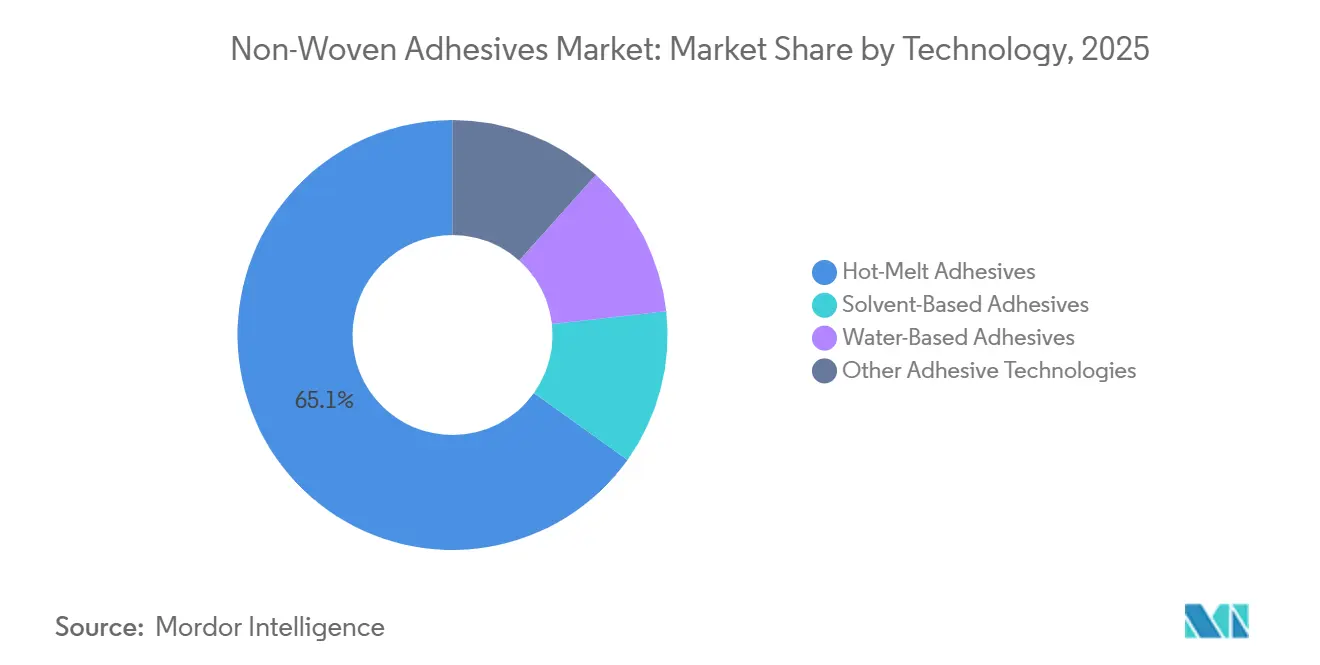
- By technology, hot-melt adhesives held 65.13% of the non-woven adhesives market share in 2025 and are projected to advance at a 9.14% CAGR through 2031.
- By polymer type, styrenic block copolymers held 70.45% of the non-woven adhesives market share in 2025, while amorphous poly alpha olefin is projected to advance at a 9.43% CAGR through 2031.
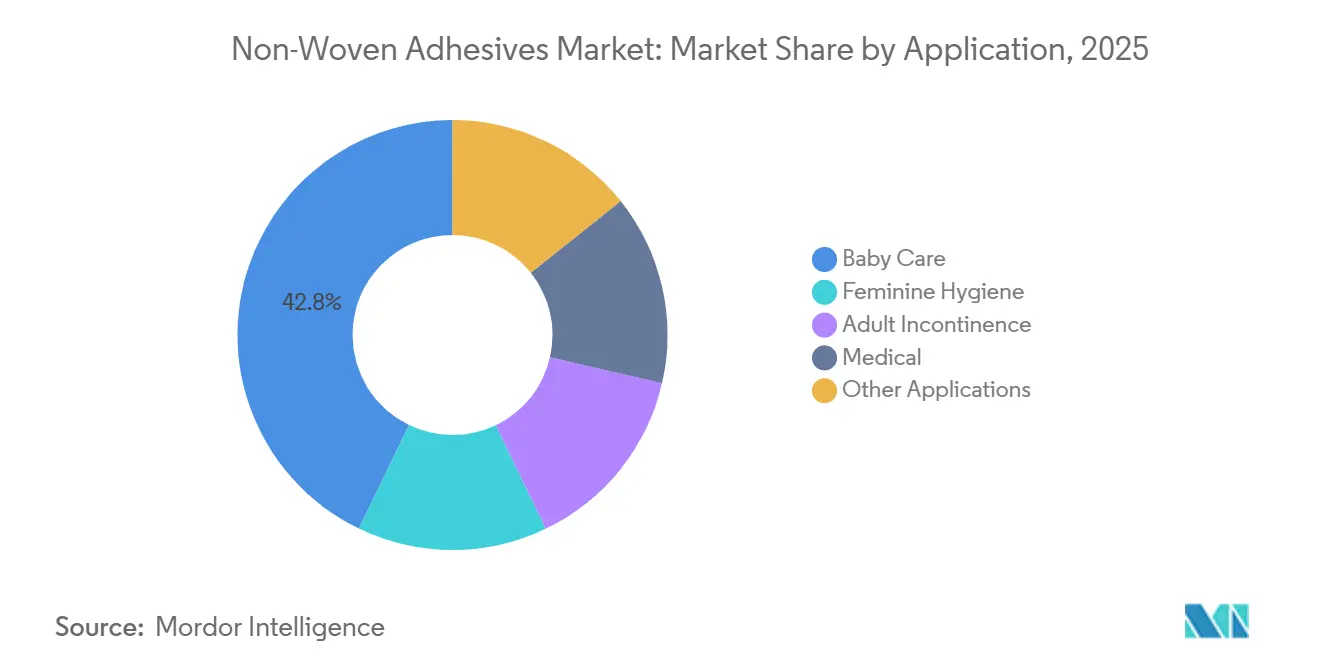
- By application, baby care held 42.84% of the non-woven adhesives market share in 2025, while adult incontinence is projected to advance at a 9.56% CAGR through 2031.
- By geography, Asia-Pacific held 33.26% of the non-woven adhesives market share in 2025 and is projected to advance at a 9.37% CAGR through 2031.
Note: Market size and forecast figures in this report are generated using Mordor Intelligence’s proprietary estimation framework, updated with the latest available data and insights as of January 2026.
Global Non-Woven Adhesives Market Trends and Insights
Drivers Impact Analysis*
| Driver | (~) % Impact on CAGR Forecast | Geographic Relevance | Impact Timeline |
|---|---|---|---|
| Expansion of Disposable Hygiene Consumption | +2.1% | Global, with highest intensity in Asia-Pacific, MEA, and South America | Short term (≤ 2 years) |
| Growth of High-Speed Hygiene Manufacturing | +1.6% | Asia-Pacific core, spillover to MEA and South America | Medium term (2–4 years) |
| Rising Adult Incontinence Product Adoption | +1.2% | Global, with concentration in North America, Europe, and Japan | Long term (≥ 4 years) |
| Increasing Medical Non-Woven Consumption | +0.8% | North America, Europe, Asia-Pacific | Medium term (2–4 years) |
| Premiumization of Thin and Comfortable Hygiene Products | +0.5% | North America, Europe, Japan, China | Medium term (2–4 years) |
| Source: Mordor Intelligence | |||
Expansion of Disposable Hygiene Consumption
Birth rates in South Asia, Southeast Asia, Sub-Saharan Africa, and parts of Latin America support continued demand for disposable hygiene products. India’s diaper penetration remained below 30%, while Indonesia and the Philippines together represented nearly 300 million consumers moving toward modern hygiene formats as income and retail access improved. This broadening consumer base supports the non-woven adhesives market because every disposable product requires dependable bonding across several layers of material. Premium thin-core diapers commonly use 8 to 12 adhesive application zones for topsheet bonding, core stabilization, elastic attachment, and waistband construction. That higher adhesive intensity means value demand can rise faster than unit shipments in the non-woven adhesives market.
Growth of High-Speed Hygiene Manufacturing
Modern diaper lines can operate above 1,000 units per minute, which favors hot-melt systems that set quickly and maintain bonding consistency. A high-speed converting line can require USD 15 million to USD 25 million of capital, making unplanned adhesive-related stoppages costly for manufacturers. This operating requirement strengthens the non-woven adhesives market position of suppliers that provide line support, application engineering, and dependable supply arrangements. Henkel AG & Co. KGaA presented its EasyFlow system at INDEX 2026, combining mini-chub packaging and automated feeding to support continuous production with less manual handling. New high-speed lines in ASEAN and South Asia can increase adhesive throughput well beyond the production of smaller legacy lines. H.B. Fuller Company’s Full-Care 5000 range was designed to support bonding across rubber-based and olefin-based chemistries, helping converters manage substrate changes without disrupting production.
Rising Adult Incontinence Product Adoption
The global population aged 65 and above exceeded 761 million in 2025, providing a durable demand base for adult incontinence products[1]World Health Organization, “Integrated Care for Older People Guidelines on Community-Level Interventions to Manage Declines in Intrinsic Capacity,” World Health Organization, who.in. Adult incontinence products need adhesives that can maintain performance during wear periods of 8 to 12 hours. Their low-odor, low-sensitization, and moisture-resistant requirements are stricter than those for many baby care products. Pull-up designs also require added bonding zones for elastic waistbands and garment construction. H.B. Fuller Company identified adult incontinence as the fastest-growing global retail hygiene category in 2024, with real value rising 3.1%. These needs help explain why this application is growing faster than the wider non-woven adhesives market.
Increasing Medical Non-Woven Consumption
Medical non-woven demand is linked to healthcare use and infection-control requirements rather than discretionary consumer spending. The estimated 310 million major surgeries performed each year globally create demand for surgical drapes, disposable gowns, wound dressings, and medical tapes. Single-use product protocols have strengthened the role of non-woven materials in hospital infection-control practices. Consumer-purchased wound care and incontinence products also require comfort, appearance, and long-wear performance beyond many institutional products. These applications can provide higher adhesive value where suppliers meet skin-contact and performance specifications. International Organization for Standardization (ISO) 10993 biocompatibility requirements create a barrier for producers without established toxicological testing and regulatory capabilities.
Restraints Impact Analysis*
| Restraint | (~) % Impact on CAGR Forecast | Geographic Relevance | Impact Timeline |
|---|---|---|---|
| Petroleum-Based Raw-Material Price Volatility | -1.1% | Global, with heightened exposure in Europe and East Asia | Short term (≤ 2 years) |
| Complex Chemical Safety and Skin-Contact Compliance | -0.6% | EU, North America, Japan | Medium term (2–4 years) |
| Performance Trade-Offs Across Thinner and Recyclable Substrates | -0.3% | EU, North America | Long term (≥ 4 years) |
| Source: Mordor Intelligence | |||
Petroleum-Based Raw-Material Price Volatility
Petrochemical feedstocks such as styrene, propylene, and naphtha-based tackifying resins account for a large share of hot-melt adhesive inputs. This exposure leaves the non-woven adhesives market vulnerable to supply disruptions that may not follow crude oil price movements. Hygiene converter contracts often have long-term volume commitments, limiting how quickly formulators can pass input-cost increases to customers. Supply pressure during geopolitical tensions in 2026 increased concern over the availability of C5 and C9 feedstocks for tackifier production. Conventional petroleum-based hot-melt adhesives averaged USD 2,200 to USD 3,100 per metric ton in mid-2025, while ethylene-vinyl acetate (EVA)-based formulations ranged from USD 2,400 to USD 2,700 per metric ton. These cost movements can constrain margins and complicate procurement planning across the non-woven adhesives market.
Complex Chemical Safety and Skin-Contact Compliance
Hygiene adhesives can remain close to the skin for extended periods, so formulation safety is a central product requirement. The European Union’s Registration, Evaluation, Authorisation and Restriction of Chemicals (REACH) framework requires ongoing review of substances of very high concern and related supply-chain information[2]European Commission, “REACH Regulation,” European Commission, environment.ec.europa.eu. Each new substance listing can lead to material tracing, reformulation work, and documentation across adhesive and hygiene product supply chains. The June 2025 restriction on N, N-dimethylacetamide added further compliance requirements for products using the solvent above the permitted threshold. Smaller producers can face a heavier administrative burden when they lack dedicated regulatory resources. Certification programs also restrict substances beyond legal minimums, increasing the practical standard for products sold into Nordic and wider European hygiene applications.
*Our forecasts treat driver/restraint impacts as directional, not additive. The impact forecasts reflect baseline growth, mix effects, and variable interactions.
Segment Analysis
By Technology: Hot-Melt Adhesives Sustain Hygiene Manufacturing Dominance
Hot-melt adhesives held 65.13% of the non-woven adhesives market share in 2025 and are projected to expand at a 9.14% CAGR through 2031. Their rapid-setting behavior suits high-speed hygiene production, where water-based and solvent-based systems cannot consistently match industrial converting speeds. Hot-melt formulations can support topsheet bonding, backsheet lamination, elastic attachment, and core integrity within the same product family. This reduces qualification work and simplifies supplier management for converters. Water-based adhesives serve a developing area in washable diaper shells and reusable menstrual underwear. European and Japanese converters are considering these systems where circularity requirements and consumer preferences are encouraging reusable product formats.
Solvent-based adhesives and other technologies continue to serve specialty medical laminates, filtration materials, and industrial non-woven applications. These uses require specific chemical resistance or substrate compatibility that solvent-free options do not always provide. The non-woven adhesives market size for hot-melt systems is supported by more adhesive zones per hygiene product and the spread of high-speed converting lines. Formulators are also moving toward polyolefin and metallocene chemistries that can lower volatile organic compound content and work at reduced coat weights. In March 2026, Henkel AG & Co. KGaA introduced Technomelt DM Advance for absorbent hygiene applications with very low volatile organic compound content, low odor, and strong bonding at low application weights. Skin-contact and medical-grade products also need compliance with ISO 10993 and relevant United States Food and Drug Administration requirements, supporting established technology leaders.



By Polymer Type: Styrenic Block Copolymers Lead Demand, Amorphous Poly Alpha Olefin Leads Growth
Styrenic block copolymers accounted for 70.45% of the non-woven adhesives market share by polymer type in 2025. Their elasticity, substrate compatibility, and established supply chains support use across a range of hygiene products. The material can serve construction, elastic attachment, and positioning functions within a single product range. This flexibility makes it a common choice in baby care applications where manufacturers value broad performance. Ethylene vinyl acetate is losing share as converters seek lower-odor and lower-volatile organic compound formulations for thinner hygiene products. These performance requirements are more difficult for ethylene vinyl acetate to meet at application weights below 10 grams per square meter.
Amorphous poly alpha olefin is projected to advance at a 9.43% CAGR through 2031. Its thermal stability, low odor profile, and lower application temperature support thin and heat-sensitive non-woven substrates. The chemistry also fits the skin-contact needs within the non-woven adhesives market for adult incontinence products. Lower application temperatures can reduce manufacturing energy use while protecting the non-woven structure. Other polymer types include bio-based formulations and reactive polyurethane hot melts, which may gain relevance as converters set recyclability roadmaps. The non-woven adhesives industry is, therefore, balancing established polymer platforms with materials designed for circularity, lower odor, and skin compatibility.
By Application: Baby Care Anchors Revenue, Adult Incontinence Drives Value Creation
Baby care held 42.84% of the non-woven adhesives market share in 2025, supported by nearly 140 million global births each year. Premium diaper construction increases the need for bonding across multiple product layers and attachment points. Birth rates have moderated in China, Japan, and South Korea, but training pants and thin-core designs have increased adhesive value per unit in these countries. This combination keeps baby care central to the non-woven adhesives market. Feminine hygiene is moving toward menstrual pants and daily liners. These formats require repositionable pressure-sensitive adhesives with performance needs different from conventional core-bonding products.
Adult incontinence is projected to advance at a 9.56% CAGR through 2031. Pull-up styles, discreet product designs, and stretchable waistbands require specialized adhesive performance. Metallocene polyolefin and multi-zone amorphous poly alpha olefin systems can address bonding requirements that commodity formulations may not meet consistently. Dermatological testing, ISO-certified skin-compatibility documentation, and moisture resistance support a higher value for premium products. Medical applications include wound dressings, surgical drapes, and disposable procedure gowns. These products command high adhesive value because infection-control requirements and biocompatibility documentation limit participation by less specialized suppliers.
Geography Analysis
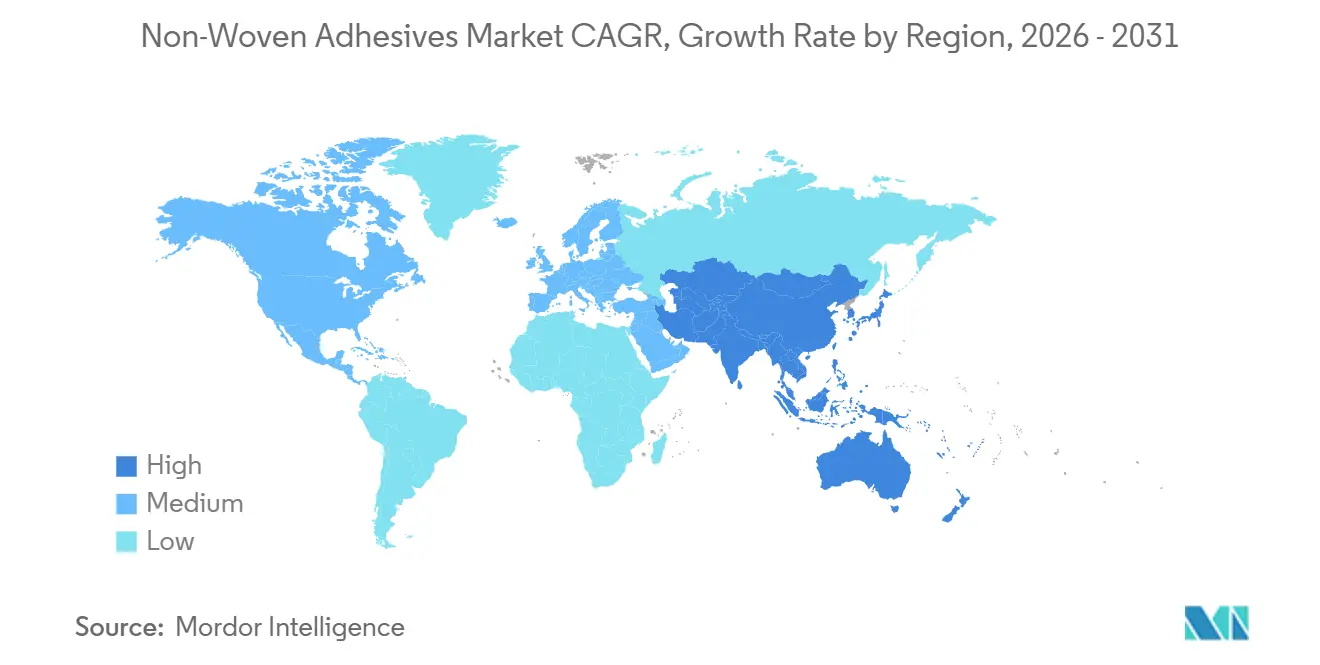
Asia-Pacific held 33.26% of the non-woven adhesives market share in 2025 and is projected to advance at a 9.37% CAGR through 2031. China’s thermal-bonded non-woven production capacity reached 1.86 million metric tons in 2024. Domestic producers Kangda New Material, Gaomeng New Material, and Huitian New Material are expanding mid-tier hot-melt production. Their growth increases competition for multinational suppliers in China’s premium segment. India adds a major regional demand increment because diaper penetration remained below 30% in rural markets, and the country adds nearly 10 million births annually.
North America and Europe are more value-intensive parts of the non-woven adhesives market because product specifications and medical demand are more advanced. United States converters have adopted low-odor, low-volatile organic compound hot melts and biocompatible medical adhesives early, shaping product specifications in other regions. European converters are seeking adhesives that can support material separation and recycling as circularity requirements advance. The European Union restriction on synthetic polymer microparticles is relevant to adhesive input discussions where polymer materials may be involved. Germany, France, and the United Kingdom remain key European manufacturing locations, while Nordic countries are early users of water-based and bio-based systems. Arkema is investing EUR 130 million (approximately USD 150.8 million) at its Carling, France site to install a new acrylic acid purification unit, improving energy efficiency by 25% and reducing carbon intensity by 20%.
South America, the Middle East and Africa are expanding as local hygiene manufacturing and urban purchasing power rise. Brazil supports South American demand through its disposable hygiene consumer base, retail modernization, and domestic diaper production. Henkel AG & Co. KGaA opened a facility in Cairo, Egypt, and expanded a site in the United Arab Emirates in May 2025, bringing supply closer to regional hygiene manufacturing clusters. Saudi Arabia’s Vision 2030 program is supporting industrial diversification and new hygiene production capacity. South Africa provides a formal-sector base for Sub-Saharan Africa, while informal retail remains important across the region. Local supply and technical support will be important where value-tier hygiene products shape demand.

Competitive Landscape
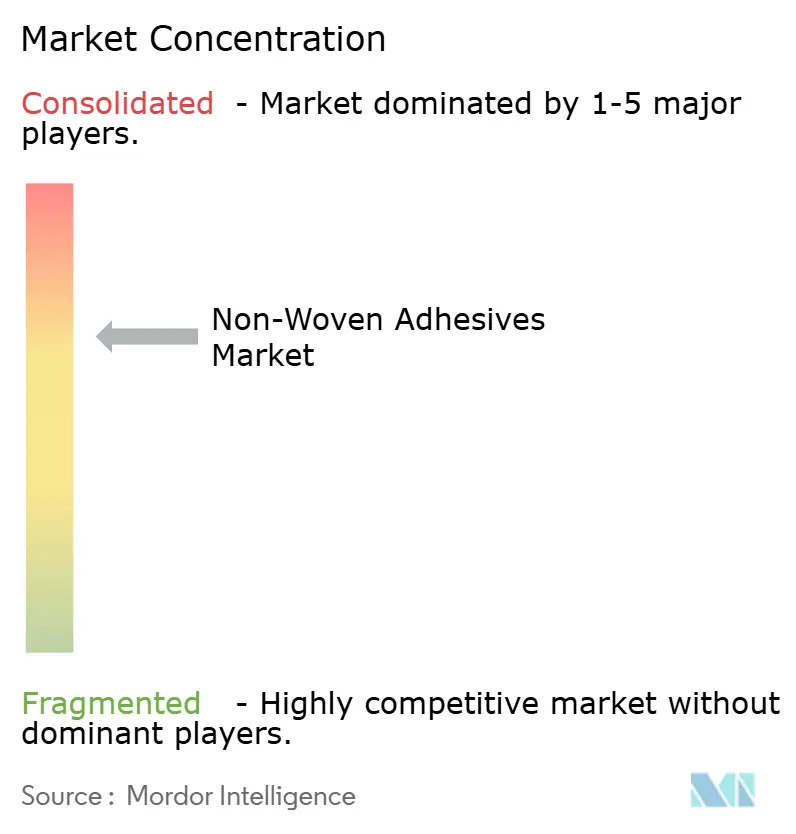
The non-woven adhesives market is moderately concentrated, with the top five players including Henkel AG & Co. KGaA, Arkema, H.B. Fuller Company, Savare Specialty Adhesives LLC, and Lohmann-koester. Their strengths include broad formulations, manufacturing scale, and application engineering capabilities. Savare Specialty Adhesives LLC, Beardow Adams, MORESCO Corporation, and Lohmann-koester compete through specialized formulations, local inventory, and close technical support. These regional relationships can matter as much as unit price for converter customers. Competition in the non-woven adhesives market remains differentiated by technical service, product qualification, and regional supply access.
Leading companies are adding sustainable adhesive capabilities alongside their existing product portfolios. Henkel AG & Co. KGaA’s acquisition of ATP Adhesive Systems AG in the first half of 2026 added water-based specialty tape capabilities that can reduce volatile organic compound emissions by up to 90% compared with solvent-based alternatives. At INDEX 2026, Henkel AG & Co. KGaA also introduced automated feeding through Easyflow and launched Technomelt DM Advance for absorbent hygiene products. H.B. Fuller Company continues to position Full-Care 5000 around flexibility across substrate and chemistry changes. These strategies address converter needs for reliable output, lower emissions, and simpler material transitions. Product development is increasingly centered on low-odor, low-temperature, and skin-compatible chemistries.
Bio-based hot melts for adult incontinence and adhesives compatible with recyclable substrates remain areas of product development. Patent US 12521752 describes nozzle and application-head designs that can maintain bonding precision at high web speeds. Evonik Industries AG and Kraton Corporation are important upstream suppliers of amorphous poly alpha olefin and styrenic block copolymers, respectively. Their pricing, supply allocation, and co-development relationships affect the competitive position of adhesive formulators. This value-chain dependence leaves suppliers focused on both polymer access and direct customer service.
Non-Woven Adhesives Industry Leaders
Henkel AG & Co. KGaA
Arkema
H.B. Fuller Company
Savare Specialty Adhesives LLC
Lohmann-koester
- *Disclaimer: Major Players sorted in no particular order

Recent Industry Developments
- June 2026: Arkema commissioned a 15% expansion of its Polyvinylidene Fluoride (PVDF) production capacity at its Calvert City, Kentucky, site, increasing the availability of high-performance fluoropolymer materials. The additional capacity strengthens Arkema’s specialty materials portfolio and supports adhesive applications requiring chemical resistance, durability, and high-performance bonding properties.
- April 2026: Henkel AG & Co. KGaA completed the acquisition of ATP Adhesive Systems AG, strengthening its portfolio of high-performance specialty tapes and adhesive solutions. The expanded specialty adhesive portfolio supports applications in non-woven products where tapes and adhesive systems are used for bonding, assembly, and functional performance.


Global Non-Woven Adhesives Market Report Scope
Non-woven adhesives are bonding materials used to join layers and components in non-woven products while providing flexibility, adhesion, and resistance to moisture and mechanical stresses. They enable the assembly of absorbent hygiene products, medical materials, and other non-woven structures while supporting product integrity and manufacturing efficiency.
The Non-Woven Adhesives Market is segmented by technology, polymer type, application, and geography. By technology, the market is segmented into hot-melt adhesives, water-based adhesives, solvent-based adhesives, and other adhesive technologies. By polymer type, the market is segmented into styrenic block copolymers, amorphous poly alpha olefin, ethylene vinyl acetate, and other polymer types. By application, the market is segmented into baby care, feminine hygiene, adult incontinence, medical, and other applications. The report also covers the market size and forecasts for non-woven adhesives in 15 countries across major regions. For each segment, the market sizing and forecasts have been done on the basis of value (USD).
| Hot-Melt Adhesives |
| Water-Based Adhesives |
| Solvent-Based Adhesives |
| Other Adhesive Technologies |
| Styrenic Block Copolymers |
| Amorphous Poly Alpha Olefin |
| Ethylene Vinyl Acetate |
| Other Polymer Types |
| Baby Care |
| Feminine Hygiene |
| Adult Incontinence |
| Medical |
| Other Applications |
| Asia-Pacific | China |
| India | |
| Japan | |
| South Korea | |
| ASEAN Countries | |
| Rest of Asia-Pacific | |
| North America | United States |
| Canada | |
| Mexico | |
| Europe | Germany |
| United Kingdom | |
| France | |
| Italy | |
| NORDIC Countries | |
| Rest of Europe | |
| South America | Brazil |
| Argentina | |
| Rest of South America | |
| Middle East and Africa | Saudi Arabia |
| South Africa | |
| Rest of Middle East and Africa |
| By Technology | Hot-Melt Adhesives | |
| Water-Based Adhesives | ||
| Solvent-Based Adhesives | ||
| Other Adhesive Technologies | ||
| By Polymer Type | Styrenic Block Copolymers | |
| Amorphous Poly Alpha Olefin | ||
| Ethylene Vinyl Acetate | ||
| Other Polymer Types | ||
| By Application | Baby Care | |
| Feminine Hygiene | ||
| Adult Incontinence | ||
| Medical | ||
| Other Applications | ||
| By Geography | Asia-Pacific | China |
| India | ||
| Japan | ||
| South Korea | ||
| ASEAN Countries | ||
| Rest of Asia-Pacific | ||
| North America | United States | |
| Canada | ||
| Mexico | ||
| Europe | Germany | |
| United Kingdom | ||
| France | ||
| Italy | ||
| NORDIC Countries | ||
| Rest of Europe | ||
| South America | Brazil | |
| Argentina | ||
| Rest of South America | ||
| Middle East and Africa | Saudi Arabia | |
| South Africa | ||
| Rest of Middle East and Africa | ||


Key Questions Answered in the Report
What is the size of the non-woven adhesives market?
The non-woven adhesives market stands at USD 3.72 billion in 2026 and is projected to reach USD 5.63 billion by 2031.
What is driving demand for non-woven adhesives?
Disposable hygiene consumption, high-speed converting lines, adult incontinence products, and medical non-wovens support demand. Premium thin-core product designs also use more adhesive application zones per finished unit.
Which technology led the market demand in 2025?
Hot-melt adhesives held a 65.13% share in 2025. Their rapid-setting behavior supports line speeds above 1,000 units per minute and several bonding functions within one hygiene product.
Which polymer type is expected to grow fastest through 2031?
Amorphous poly alpha olefin is projected to advance at a 9.43% CAGR through 2031.
Page last updated on:





