
Non-GMO Soy Protein Market Size and Share
Market Overview
| Study Period | 2027 - 2032 |
|---|---|
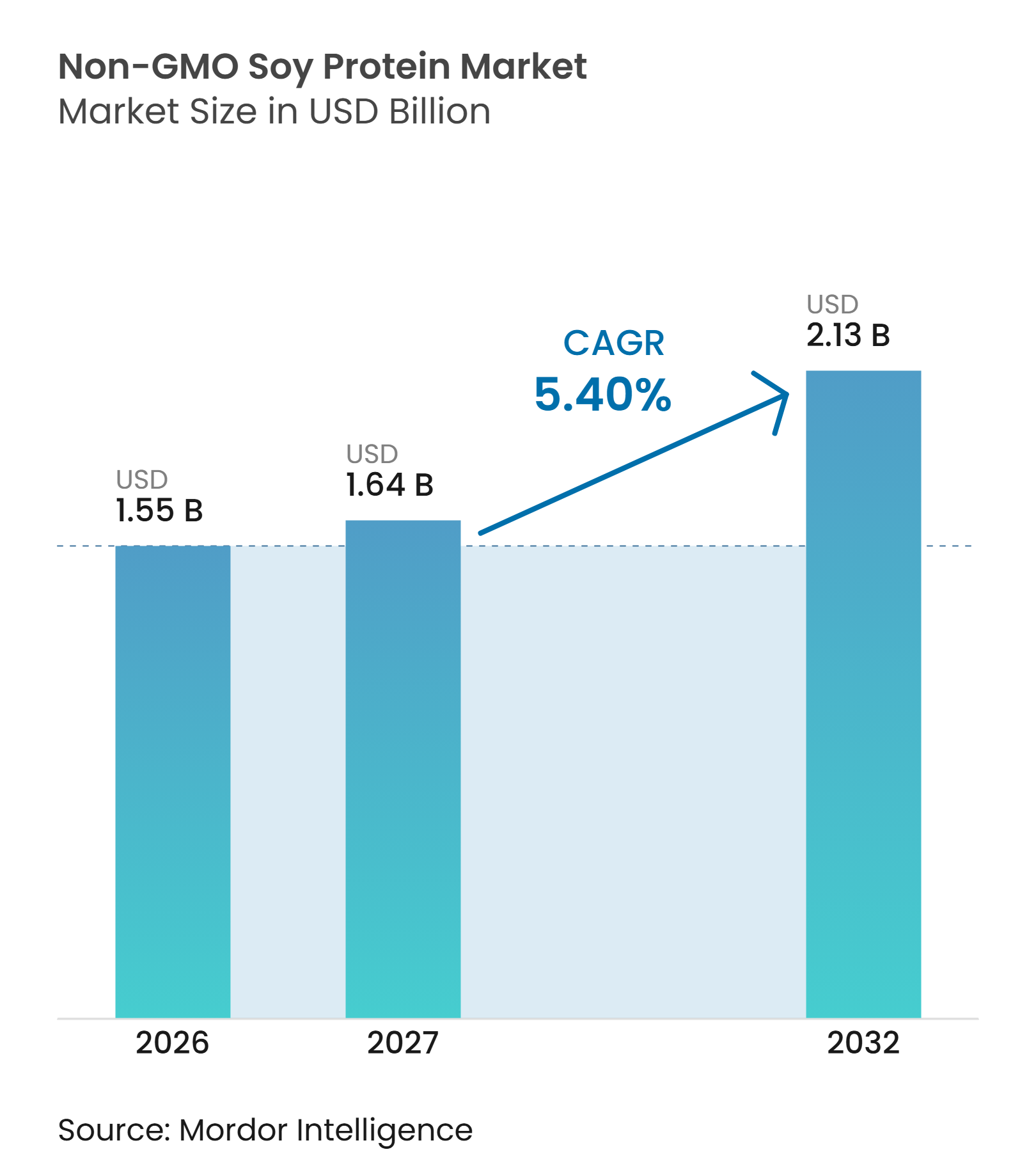
| Market Size (2027) | USD 1.64 Billion |
| Market Size (2032) | USD 2.13 Billion |
| Growth Rate (2027 - 2032) | 5.40 % |
| Fastest Growing Market | Asia-Pacific |
| Largest Market | Europe |
| Market Concentration | Medium |
Major Players *Disclaimer: Major Players sorted in no particular order Image © Mordor Intelligence. Reuse requires attribution under CC BY 4.0. | |
Non-GMO Soy Protein Market Analysis by Mordor Intelligence
The Non-GMO Soy Protein Market size is expected to increase from USD 1.55 billion in 2026 to USD 1.64 billion in 2027 and reach USD 2.13 billion by 2032, growing at a CAGR of 5.4% over 2027–2032. Growth is supported by rising consumer preference for non-GMO and clean-label protein ingredients, alongside increasing demand for plant-based meat and dairy alternatives. Food and beverages remain the primary application area, supported by the use of non-GMO soy protein in functional foods, beverages, bakery products, and other food formulations. Growing adoption in sports nutrition and dietary supplements further supports demand, while strengthening requirements for traceable and identity-preserved soybean supply chains create opportunities for certified ingredient suppliers. However, higher procurement costs, limited availability of certified non-GMO soybeans, and the risk of GMO cross-contamination present supply-side challenges. Competition from pea, rice, and other non-GMO plant protein alternatives also influences market expansion. Growth therefore favors producers that can secure reliable certified soybean supplies, maintain identity-preserved processing systems, and deliver consistent protein functionality across food, beverage, and nutritional applications.
Key Report Takeaways
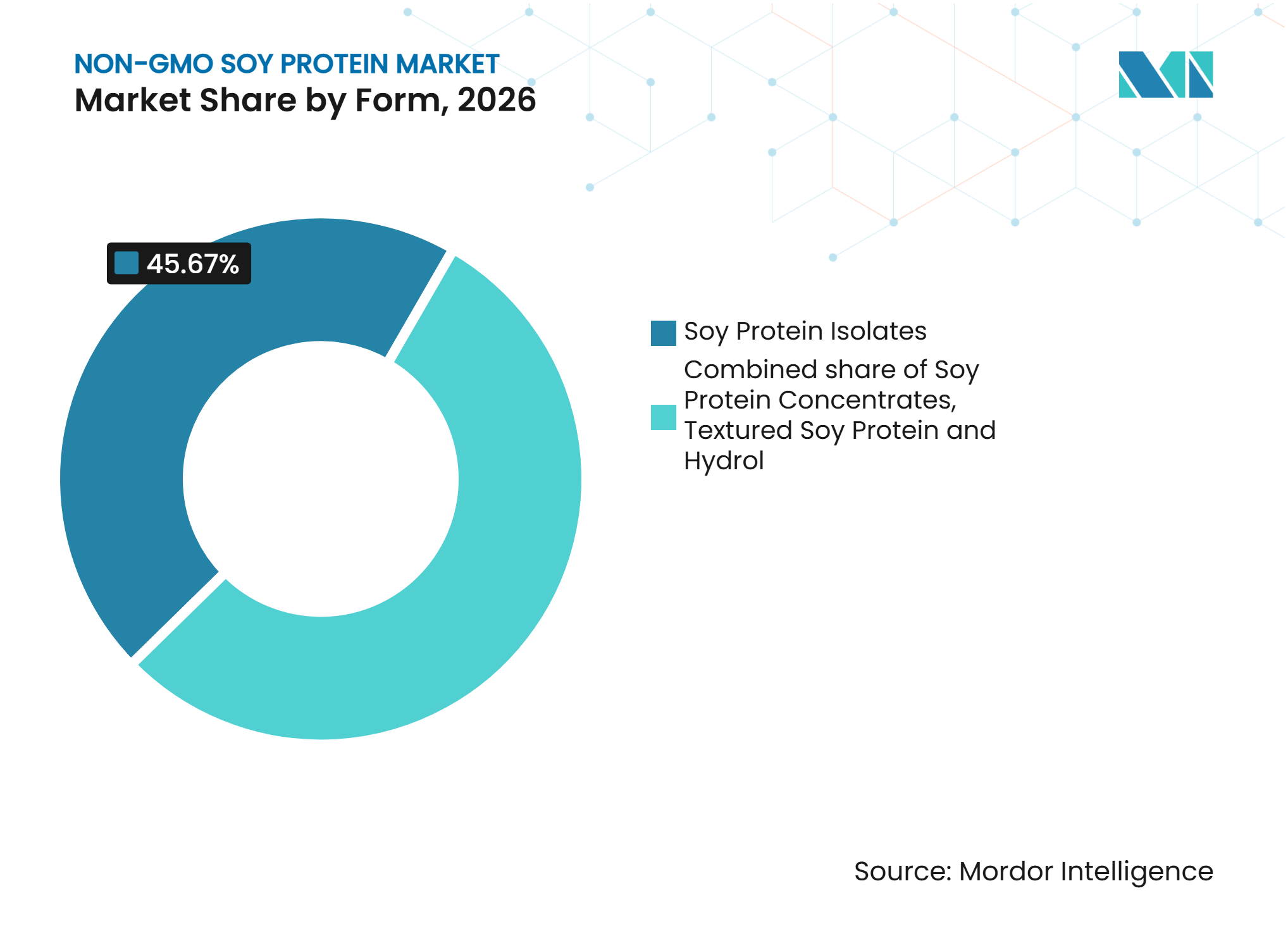
- By form, Soy Protein Isolates accounted for the largest share of the Non-GMO Soy Protein Market at 45.67% in 2026, while Hydrolyzed Soy Protein is forecast to grow fastest at a 6.20% CAGR over 2027–2032.
- By end user, Food and Beverages dominated with a 67.45% market share in 2026, while Nutritional Supplements are projected to record the fastest growth at a 6.80% CAGR over 2027–2032.
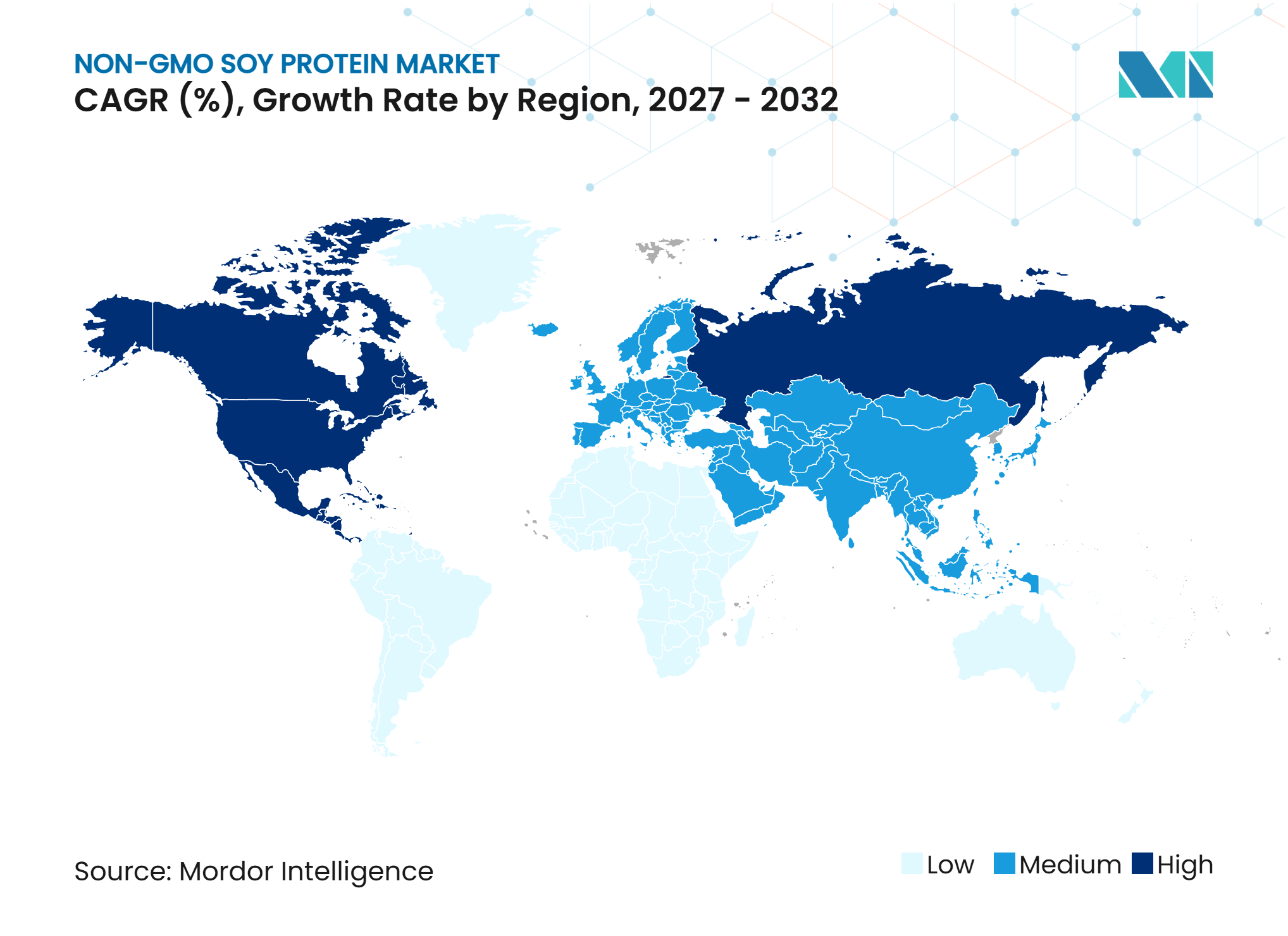
- Among geographies, Europe led with a 46.89% share of the Non-GMO Soy Protein Market in 2026, while Asia-Pacific is forecast to grow fastest at a 6.70% CAGR over 2027–2032.
Note: Market numbers in this report are based on Mordor Intelligence's proprietary estimation framework, which combines nine months of actuals with Q4 projections for base year 2026.
Market Trends and Insights
Drivers of Non-GMO Soy Protein Market*
| Driver | (~) % Impact on CAGR Forecast | Geographic Relevance | Impact Timeline |
|---|---|---|---|
| Rising consumer preference for non-GMO and clean-label protein ingredients | +0.9% | Global, particularly North America and Europe, where demand for transparent ingredient sourcing and non-GMO food products is established | 2–4 years |
| Increasing demand for plant-based meat and dairy alternatives using non-GMO soy protein | +0.8% | Global, particularly North America and Europe, with expanding opportunities across Asia-Pacific | 2–4 years |
| Growing adoption of non-GMO soy protein in sports nutrition and dietary supplements | +0.7% | Global, particularly North America and Europe, with increasing demand across urban markets in Asia-Pacific | 2–4 years |
| Expansion of non-GMO soy protein applications across functional foods and beverages | +0.6% | Global, particularly North America, Europe and Asia-Pacific, where food manufacturers are expanding plant-based product formulations | 2–4 years |
| Strengthening demand for traceable and identity-preserved soybean supply chains | +0.5% | Global, particularly Europe and North America, where non-GMO certification and ingredient traceability influence procurement | More than 4 years |
| Increasing incorporation of non-GMO soy protein in bakery, cereals and processed food applications | +0.4% | Global, particularly Asia-Pacific and North America, supported by expanding processed food manufacturing | Less than 2 years |
| Source: Mordor Intelligence | |||
Rising Consumer Preference for Non-GMO and Clean-Label Protein Ingredients
Consumer interest in ingredient transparency and production-related food attributes is creating opportunities for non-GMO soy protein ingredients across packaged foods, beverages, and nutritional products. Non-GMO positioning allows manufacturers to differentiate soy protein products through sourcing practices and ingredient specifications, particularly where buyers seek greater visibility into the agricultural origins of food ingredients. The United States Department of Agriculture (USDA) Economic Research Service (ERS) explains that food labels communicate product attributes, including nutrition and production characteristics, and can increase demand for brands by helping consumers make informed purchasing decisions [1]. Additionally, the USDA's National Bioengineered Food Disclosure Standard establishes disclosure requirements for foods containing detectable bioengineered ingredients, reinforcing the importance of ingredient documentation and supply-chain information. These developments create opportunities for suppliers offering verified non-GMO soy protein ingredients, although non-GMO claims must be supported by appropriate sourcing records and evidence.
Increasing Demand for Plant-Based Meat and Dairy Alternatives Using Non-GMO Soy Protein
The expansion of plant-based meat and dairy alternatives is creating additional application opportunities for soy protein ingredients. Soy protein is used in plant-based food formulations because it can provide protein content and contribute to the structural and functional properties required in meat and dairy alternatives. The OECD identifies plant-based meat alternatives as an emerging category within the broader transition toward alternative protein sources, highlighting their potential role in responding to changing protein consumption patterns and food-system requirements [2]. Soy-based ingredients also have an established role in plant-based beverages. The U.S. Food and Drug Administration (FDA) recognizes soy beverages among plant-based milk alternatives and notes that their nutritional composition varies according to the plant source, processing methods, and added ingredients. This creates opportunities for non-GMO soy protein manufacturers to supply ingredient solutions for meat analogues, dairy alternatives, and protein-enriched food formulations.
Growing Adoption of Non-GMO Soy Protein in Sports Nutrition and Dietary Supplements
Increasing participation in fitness activities and demand for protein-enriched nutritional products are creating opportunities for soy protein ingredients in sports nutrition and dietary supplements. Soy protein isolates and concentrates can be incorporated into protein powders, ready-to-drink beverages, nutrition bars, and other formulations designed to increase dietary protein intake. According to the National Institutes of Health (NIH) Office of Dietary Supplements, protein is among the commonly used ingredients in sports nutrition supplements, while protein powders, drinks, and fortified foods and beverages are available to help individuals meet their protein requirements. The NIH also identifies soy as a plant-based protein source, although its amino acid composition differs from that of whey protein [3]. This creates opportunities for non-GMO soy protein suppliers to serve manufacturers developing plant-based sports nutrition products and alternative protein formulations.
Expansion of Non-GMO Soy Protein Applications Across Functional Foods and Beverages
The expanding use of protein ingredients in processed foods and beverages is creating additional opportunities for non-GMO soy protein manufacturers. Soy protein ingredients can serve different formulation requirements depending on their processing characteristics and protein concentration. For example, hydrolyzed soy protein is recognized by the U.S. Food and Drug Administration (FDA) as a flavor enhancer used in many processed foods, demonstrating its application beyond conventional protein supplementation. The FDA also identifies ingredients used for nutritional fortification in products such as breads, cereals, energy bars, and beverages. These applications allow soy protein manufacturers to serve a broader range of food-processing industries, including bakery, beverages, cereals, sauces, and convenience foods. Continued product development and formulation requirements create opportunities for suppliers offering soy protein ingredients with consistent functional characteristics and documented non-GMO sourcing.
Strengthening Demand for Traceable and Identity-Preserved Soybean Supply Chains
The need to maintain ingredient integrity and verify agricultural sourcing is increasing the importance of traceability and identity-preserved supply chains in the non-GMO soy protein industry. Maintaining the non-GMO identity of soybeans requires appropriate identification, segregation, documentation, and monitoring throughout procurement, storage, transportation, and processing. The USDA Agricultural Marketing Service (AMS) operates an Identity Preservation Program that provides independent third-party verification of product identification, segregation, and traceability across seed, production, processing, and distribution stages. The program also requires documented quality management systems and incorporates laboratory testing to verify specified product characteristics [4]. Such verification mechanisms provide buyers with greater confidence in the identity of specialty agricultural ingredients and create opportunities for non-GMO soy protein suppliers that maintain documented sourcing and processing controls. As food manufacturers increasingly require ingredient-level verification, identity-preserved supply chains can become an important competitive capability.
Restraints of Non-GMO Soy Protein Market*
| Restraint | (~) % Impact on CAGR Forecast | Geographic Relevance | Impact Timeline |
|---|---|---|---|
| Higher procurement costs and price premiums for non-GMO soybeans | −0.8% | Global, particularly North America and Europe, where certified non-GMO soybean sourcing and identity-preserved processing can increase ingredient procurement costs | Medium term (2–4 years) |
| Limited availability of certified non-GMO soybean supplies | −0.7% | Global, particularly regions dependent on imports of certified non-GMO soybeans, including parts of Europe and Asia-Pacific | Long term (More than 4 years) |
| Risk of GMO cross-contamination during soybean cultivation, processing and transportation | −0.6% | Global, particularly major soybean-producing and exporting regions where conventional and non-GMO soybean supply chains operate alongside each other | Medium term (2–4 years) |
| Competition from pea, rice and other non-GMO plant protein alternatives | −0.5% | Global, particularly North America and Europe, where food manufacturers have access to multiple plant-based protein ingredients and alternative protein formulations | Medium term (2–4 years |
| Source: Mordor Intelligence | |||
Higher Procurement Costs and Price Premiums for Non-GMO Soybeans
Non-GMO soy protein production can involve higher raw-material procurement costs than conventional soy protein, particularly when manufacturers require certified non-GMO soybean supplies and identity-preserved sourcing arrangements. Maintaining the non-GMO identity of soybeans may require additional segregation, cleaning, storage, testing, and documentation throughout agricultural production and processing. Research published by the University of Illinois' farmdoc daily indicates that non-GMO soybean production systems can incur higher non-land production costs than GMO systems, alongside additional cleaning, segregation, and storage expenses. The analysis found that non-GMO systems had approximately USD 15 per acre higher non-land costs in the period examined. These additional expenses can increase the cost of producing non-GMO soy protein concentrates, isolates, and textured soy protein. Manufacturers may need to pass some of these costs to food processors and other buyers, potentially limiting adoption among price-sensitive customers and narrowing the price competitiveness of non-GMO soy protein against conventional and alternative plant protein ingredients.
Limited Availability of Certified Non-GMO Soybean Supplies
The availability of certified non-GMO soybeans can constrain procurement flexibility for manufacturers requiring consistent raw-material volumes and verified ingredient specifications. Non-GMO soybean sourcing depends on farmers producing suitable varieties, maintaining production records, and preserving crop identity through harvesting, storage, and transportation. Suppliers may also need to maintain separate handling arrangements to prevent conventional and non-GMO soybean supplies from being mixed. The USDA Agricultural Marketing Service (AMS), through its National Bioengineered Food Disclosure Standard, identifies supply-chain records, country-of-origin documentation, process verification, organic certifications, and laboratory testing as examples of records that can establish whether food ingredients are bioengineered. These documentation and verification requirements can increase sourcing complexity for manufacturers purchasing non-GMO soybeans across multiple origins. Limited availability of suitable suppliers and difficulties securing consistent volumes can affect procurement planning, production continuity, and the ability to expand non-GMO soy protein manufacturing.
*Our forecasts treat driver/restraint impacts as directional, not additive. The impact forecasts reflect baseline growth, mix effects, and variable interactions.
Non-GMO Soy Protein Market Segment Analysis
By Form:
Soy Protein Isolates Lead While Hydrolyzed Soy Protein Expands FasterIn 2026, Soy Protein Isolates accounted for an estimated 45.67% of the Non-GMO Soy Protein Market, making them the leading form segment. Their position reflects their high protein concentration and suitability for applications requiring protein enrichment, including plant-based meat alternatives, dairy alternatives, beverages, nutritional products, and processed foods. According to the Food Safety and Standards Authority of India (FSSAI), soy protein isolates contain more than 90% crude protein on a dry-mass basis, compared with more than 65% and less than 90% for soy protein concentrates. This higher protein concentration supports their use in formulations requiring concentrated plant-based protein ingredients. Meanwhile, Hydrolyzed Soy Protein is projected to record the fastest growth, at an estimated CAGR of 6.20% through 2032. Hydrolysis breaks proteins into smaller peptides, supporting their use in specialised food formulations and flavour-enhancement applications.
Soy Protein Concentrates and Textured Soy Protein serve complementary applications across the food-processing industry. Concentrates provide protein-rich ingredients for food formulations, while textured soy protein is used in meat alternatives and other products requiring a fibrous or structured texture. Manufacturers across all four categories need to maintain consistent protein specifications, functional performance, and verified non-GMO sourcing. The ability to address different formulation requirements while maintaining ingredient quality will remain important for expanding demand across food and industrial applications.



By End User:
Food and Beverages Dominate While Nutritional Supplements Expand FasterIn 2026, Food and Beverages accounted for an estimated 67.45% of the Non-GMO Soy Protein Market, making it the leading end-user segment. Its position reflects the broad application of soy protein ingredients across bakery products, beverages, breakfast cereals, condiments and sauces, confectionery, and other processed foods. Soy protein isolates and concentrates provide protein enrichment, while textured soy protein supports the development of meat alternatives and other structured food products. The USDA Food and Nutrition Service recognises soy flour, soy protein concentrates, and soy protein isolates as alternative protein products that can be incorporated into qualifying food products, including vegetarian burgers and patties. These applications support demand from food manufacturers seeking plant-based protein ingredients for different product formulations.
Meanwhile, Nutritional Supplements are projected to record the fastest growth, at an estimated CAGR of 6.80% through 2032. Soy protein isolates are particularly relevant to this segment because of their high protein concentration and suitability for protein powders, nutrition beverages, and fortified products. The National Institutes of Health (NIH) identifies soy as a plant-based protein source and discusses protein supplements among products used in sports and exercise nutrition. Animal Feed and Other End Users provide additional application avenues for soy-derived protein ingredients, although their requirements differ from those of human food and nutrition manufacturers. Growth across end-user categories will depend on ingredient functionality, protein quality, formulation compatibility, and reliable non-GMO sourcing.
Geography Analysis
North America Non-GMO Soy Protein Market
North America accounted for an estimated 34.00% of the Non-GMO Soy Protein Market in 2026. The region benefits from an established soybean-processing industry, a strong supply base, and demand for plant-based protein ingredients across food and beverage applications. The United States and Canada have established capabilities in producing soy protein concentrates and isolates for meat alternatives, dairy alternatives, nutritional products, and processed foods. These capabilities support the availability of functional soy protein ingredients, while demand for traceable and identity-preserved non-GMO raw materials creates opportunities for manufacturers to serve customers with specific sourcing requirements.
Asia-Pacific Non-GMO Soy Protein Market
Asia-Pacific is projected to be the fastest-growing regional market, with an estimated CAGR of 6.70% over 2027–2032. Japan provides an established demand base for soy protein ingredients: according to Agriculture and Agri-Food Canada, soy protein concentrate accounted for 58.10% of Japan’s non-animal-derived protein ingredient market by volume in 2024, followed by soy protein isolate at 25.00%. This existing use of soy protein across food applications creates opportunities for non-GMO ingredient suppliers. China, India, Japan, and other regional markets also offer potential through food processing, meat alternatives, and protein-enriched products. However, manufacturers must address differences in consumer preferences, sourcing requirements, and non-GMO verification standards across individual countries.
Europe, South America, and Middle East and Africa
Europe offers opportunities through established demand for non-GMO ingredients and a developed identity-preserved soybean supply chain. According to ENGA, EU non-GMO soybean production was estimated at approximately 2.9–3.0 million tonnes in the 2025/26 marketing year, with domestic production supplemented by imports from Brazil, Canada, Argentina, and other origins. South America benefits from its large soybean-processing and export industry, particularly in Brazil; however, only a portion of regional production is segregated as non-GMO, making certified sourcing important for ingredient manufacturers. In the Middle East and Africa, opportunities are linked to the development of food processing, demand for plant-based protein ingredients, and the use of soy protein in processed foods and nutritional applications. Across these regions, manufacturers must manage raw-material traceability, identity preservation, certification requirements, import costs, and local application needs.
Competitive Landscape
Market Concentration
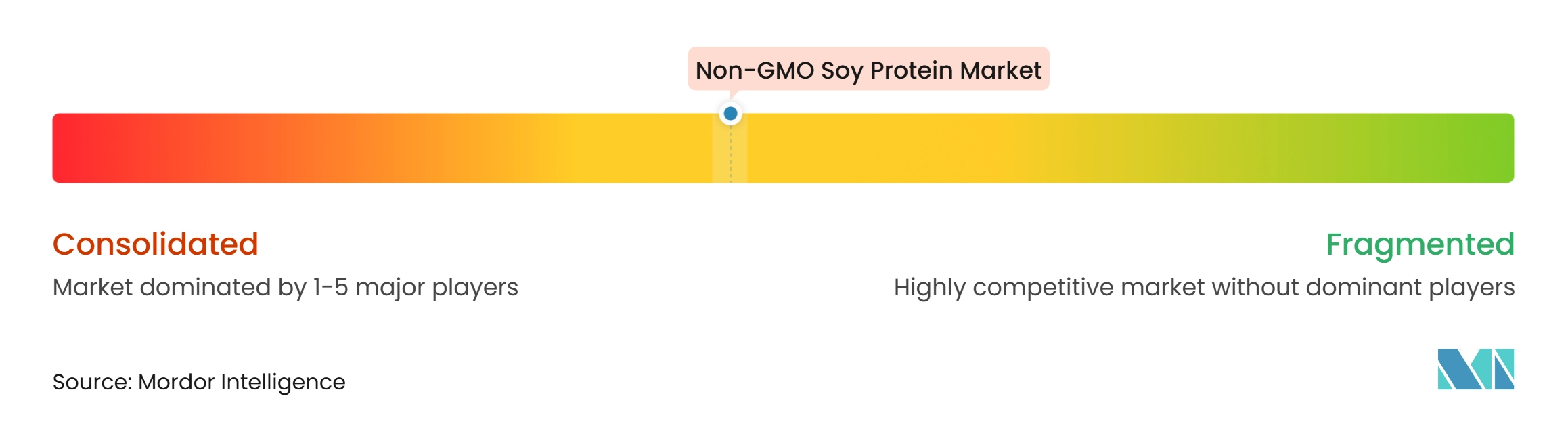
The Non-GMO Soy Protein Market includes multinational agricultural processors, integrated soybean suppliers, specialty protein ingredient manufacturers, and regional soy protein producers competing through product innovation, raw-material sourcing, processing capabilities, and distribution reach. The companies have varying levels of exposure to non-GMO soy protein through soy protein isolates, concentrates, textured soy protein, and other functional protein ingredients. Large agricultural processors can leverage established soybean procurement networks and manufacturing infrastructure, while specialist manufacturers can differentiate through non-GMO sourcing, ingredient specifications, and application-focused product portfolios.
Competitive strategies in the Non-GMO Soy Protein Market focus on expanding plant-based protein portfolios, improving protein functionality, and strengthening access to identity-preserved non-GMO soybean supplies. For example, Archer Daniels Midland Company (ADM) offers soy protein isolates and concentrates under its ProFam and Arcon brands, while Cargill provides soy protein ingredients for food and beverage applications. Bunge Limited participates in soy protein concentrates and textured protein ingredients, while Fuji Oil Holdings offers soy-based protein ingredients for meat alternatives and other food applications. These product strategies allow manufacturers to address demand across meat alternatives, dairy alternatives, bakery products, beverages, and nutritional applications. However, broader soy protein portfolios should not automatically be considered entirely non-GMO, as product-level sourcing and certification requirements determine their inclusion in the market.
Sourcing and supply-chain management remain important competitive considerations. Companies with access to reliable non-GMO soybean supplies, identity-preserved processing facilities, and traceability systems can strengthen ingredient consistency and meet customer sourcing requirements. Established processors can leverage integrated soybean crushing, refining, and protein extraction capabilities, while specialized manufacturers can target customers seeking verified non-GMO ingredients. However, higher procurement costs, potential GMO cross-contamination, certification requirements, raw-material price fluctuations, and supply-chain complexity can affect operating costs and production continuity. Manufacturers must also maintain appropriate documentation and comply with applicable non-GMO labelling and food safety regulations in their target markets. These factors make reliable sourcing, product quality, processing efficiency, traceability, and distribution capabilities important areas of competition.
Non-GMO Soy Protein Industry Leaders
-
Archer Daniels Midland Company (ADM)
-
Cargill, Incorporated
-
Bunge Limited
-
Wilmar International Limited
-
CHS Inc.
- *Disclaimer: Major Players sorted in no particular order
Non-GMO Soy Protein Market Companies Covered in this Report
- Archer Daniels Midland Company (ADM)
- Cargill, Incorporated
- Bunge Limited
- Wilmar International Limited
- CHS Inc.
- Fuji Oil Holdings Inc.
- International Flavors & Fragrances Inc.
- Kerry Group plc
- Ingredion Incorporated
- Sonic Biochem Extractions Pvt. Ltd.
- Sojaprotein AD
- Shandong Yuwang Ecological Food Industry Co., Ltd.
- Gushen Biotechnology Group Co., Ltd.
- Farbest Brands
- Crown Soya Protein Group
- House Foods Group Inc.
- MGP Ingredients, Inc.
- Zeeland Farm Services, Inc.
- Soy Austria
- Grain Millers, Inc.
Recent Industry Developments in Non-GMO Soy Protein Market
- July 2026: The Technology Development Board (TDB), under India's Department of Science and Technology, extended financial assistance to Sonic Biochem Extractions Pvt. Ltd. to commercialize indigenous functional and textured soya protein concentrates. The project involved establishing a manufacturing facility using locally developed technology and non-GMO soybeans, with the objective of reducing dependence on imported soy protein isolates and expanding domestic production for processed foods, meat alternatives and nutritional supplements.
- May 2026: Archer Daniels Midland Company (ADM) introduced eight new plant-based protein ingredients across North America and Europe, including ProFam 883 and ProFam 894 soy protein isolates, Arcon IH, Arcon SB and Arcon 412 soy protein concentrates, and European-sourced Arcon R and Arcon T. The portfolio expansion targeted applications in protein beverages, dairy alternatives, meat products and plant-based foods, strengthening ADM's functional soy protein offerings.
- March 2026: Bunge Limited completed its acquisition of International Flavors & Fragrances' soy protein concentrate, lecithin and soy crushing businesses. The transaction added Response, Alpha, Procon and Solec brands to Bunge's portfolio, expanding its textured, functional and powdered soy protein concentrate offerings for bakery, snacks, meat and alternative meat applications.
- January 2026: The European Non-GMO Industry Association (ENGA), in collaboration with Donau Soja and The ProTerra Foundation, reported that European non-GMO soybean supply remained broadly stable during the 2025/26 marketing year, with production estimated at 2.9–3.0 million tonnes
Global Non-GMO Soy Protein Market Report Scope
For this study, the Non-GMO Soy Protein Market is defined as the sales value of commercially produced soy protein ingredients derived from non-genetically modified (non-GMO) soybeans. The market covers soy protein concentrates, soy protein isolates, textured soy protein, and hydrolyzed soy protein, segmented by end user into food and beverages, nutritional supplements, animal feed, and other end users. Food and beverage applications include meat and dairy alternatives, bakery products, beverages, snacks, and other processed food products. The market also considers non-GMO soybean sourcing, identity-preserved supply chains, traceability, and relevant certification requirements to distinguish non-GMO soy protein from conventional soy protein ingredients. The market is analyzed across North America, Europe, Asia-Pacific, South America, and the Middle East and Africa, with country-level coverage as specified in the report. Market sizing and forecasts are presented in value terms (USD) across the defined segments and geographies.
Segmentation Overview
| Soy Protein Concentrates |
| Soy Protein Isolates |
| Textured Soy Protein |
| Hydrolyzed Soy Protein |
| Food and Beverages | Bakery |
| Beverages | |
| Breakfast Cereals | |
| Condiments and Sauces | |
| Confectionery | |
| Others | |
| Nutritional Supplements | |
| Animal Feed | |
| Other End Users |
| North America | United States |
| Canada | |
| Mexico | |
| Rest of North America | |
| Europe | United Kingdom |
| Germany | |
| France | |
| Italy | |
| Spain | |
| Sweden | |
| Belgium | |
| Poland | |
| Netherlands | |
| Europe | |
| Asia-Pacific | China |
| Japan | |
| India | |
| Thailand | |
| Indonesia | |
| South Korea | |
| Australia | |
| Rest of Asia-Pacific | |
| South America | Brazil |
| Argentina | |
| Rest of South America | |
| Middle East and Africa | South Africa |
| Saudi Arabia | |
| Rest of Middle East and Africa |
| By Form | Soy Protein Concentrates | |
| Soy Protein Isolates | ||
| Textured Soy Protein | ||
| Hydrolyzed Soy Protein | ||
| By End User | Food and Beverages | Bakery |
| Beverages | ||
| Breakfast Cereals | ||
| Condiments and Sauces | ||
| Confectionery | ||
| Others | ||
| Nutritional Supplements | ||
| Animal Feed | ||
| Other End Users | ||
| By Geography | North America | United States |
| Canada | ||
| Mexico | ||
| Rest of North America | ||
| Europe | United Kingdom | |
| Germany | ||
| France | ||
| Italy | ||
| Spain | ||
| Sweden | ||
| Belgium | ||
| Poland | ||
| Netherlands | ||
| Europe | ||
| Asia-Pacific | China | |
| Japan | ||
| India | ||
| Thailand | ||
| Indonesia | ||
| South Korea | ||
| Australia | ||
| Rest of Asia-Pacific | ||
| South America | Brazil | |
| Argentina | ||
| Rest of South America | ||
| Middle East and Africa | South Africa | |
| Saudi Arabia | ||
| Rest of Middle East and Africa | ||
Key Questions Answered in the Report
What is the estimated size of the Non-GMO Soy Protein Market in 2026?
The Non-GMO Soy Protein Market is estimated at USD 1.55 billion in 2026.
What is the expected growth rate of the Non-GMO Soy Protein Market?
The market is projected to grow at a CAGR of 5.4% during 2027–2032, reaching USD 2.13 billion by 2032.
Which segment dominates the Non-GMO Soy Protein Market?
Soy protein isolates dominate the market by form, supported by their high protein concentration and wide applications in food, beverages and nutritional products.
What are the key factors driving the Non-GMO Soy Protein Market?
Growing demand for clean-label ingredients, increasing adoption of plant-based meat and dairy alternatives, rising consumption of protein-enriched products, and greater preference for traceable non-GMO ingredients are supporting market growth.