
Non Dairy Frozen Desserts Market Size and Share
Market Overview
| Study Period | 2022 - 2032 |
|---|---|
| Market Size (2027) | USD 9.32 Billion |
| Market Size (2032) | USD 13.81 Billion |
| Growth Rate (2027 - 2032) | 8.18 % |
| Fastest Growing Market | Asia-Pacific |
| Largest Market | North America |
| Market Concentration | Medium |
Major Players *Disclaimer: Major Players sorted in no particular order Image © Mordor Intelligence. Reuse requires attribution under CC BY 4.0. | |
Non Dairy Frozen Desserts Market Analysis by Mordor Intelligence
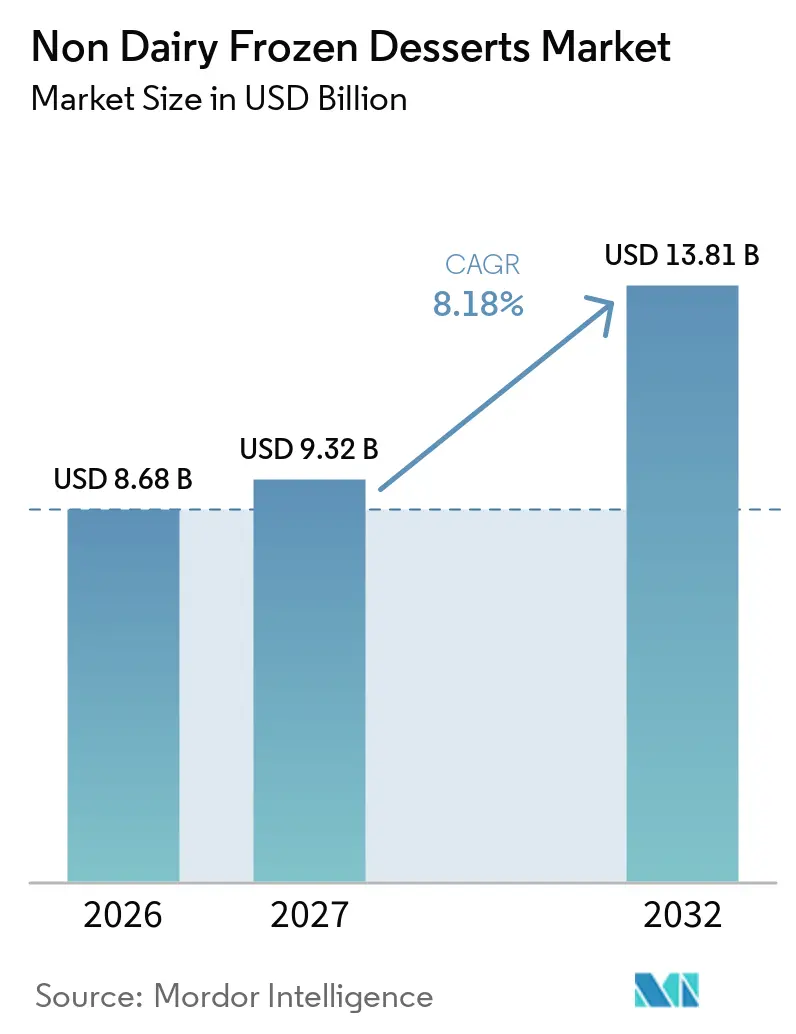
The non dairy frozen desserts market size is projected to expand from USD 8.68 billion in 2026 and USD 9.32 billion in 2027 to USD 13.81 billion by 2032, registering a CAGR of 8.18% between 2027 to 2032. Lactose malabsorption creates a demand base that extends beyond temporary food preferences, while flexitarian diets are widening the buyer base to include consumers who still purchase conventional dairy products. Environmental concerns around conventional dairy supply chains are also supporting interest in plant-based choices, especially where shoppers evaluate animal welfare, sourcing, and ingredient claims together. Improvements in oat, pea, and cashew formulations are helping brands compete on taste and texture rather than dietary need alone, which can make the category more relevant in everyday dessert occasions. Companies are using premium products, freezer access, online delivery, and foodservice partnerships to reach repeat buyers, health-conscious households, and consumers seeking indulgent formats. The non dairy frozen desserts market therefore has scope for growth where cold-chain capacity, clear labeling, reliable distribution, recognizable product formats, varied package sizes, and product quality support broader access across retail, foodservice, and direct delivery channels as consumer awareness grows and the non dairy frozen desserts market becomes easier to access for households, restaurants, caterers, retailers, and online shoppers across both established and emerging consumer regions.
Key Report Takeaways
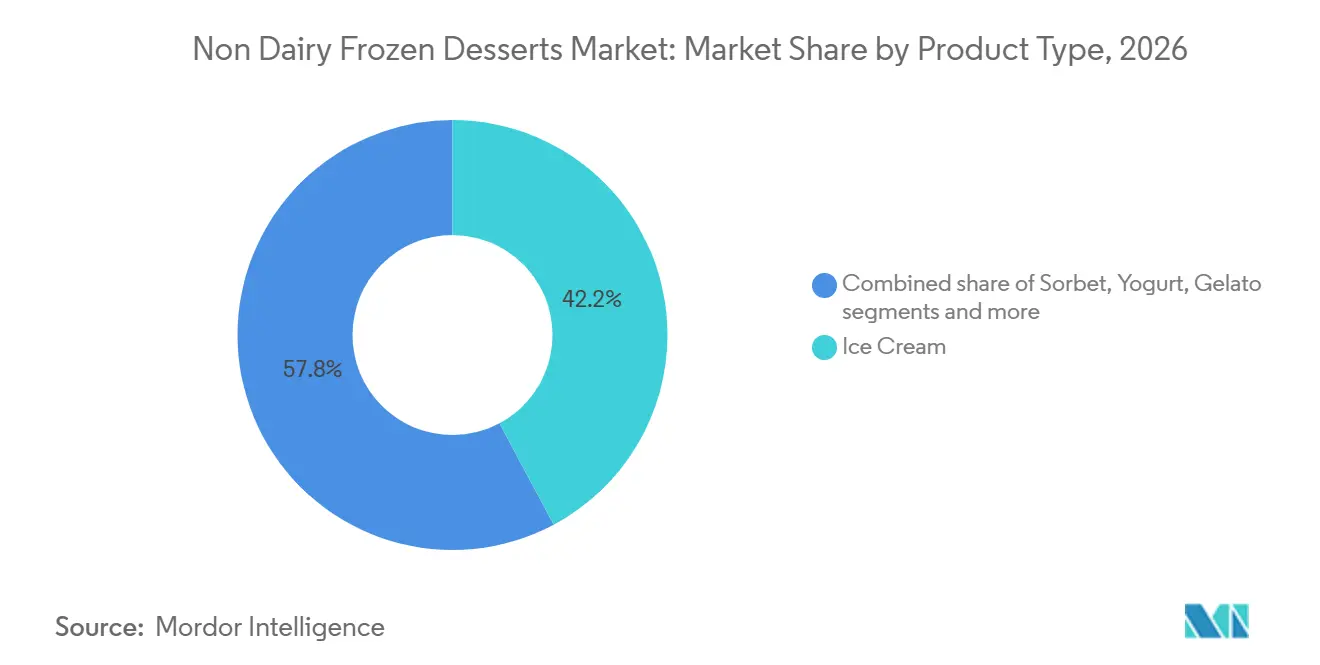
- By product type, ice cream held 42.2% of revenue in 2026, while cakes and pastries are forecast to expand at a 9.2% CAGR through 2032.
- By category, conventional products held 78.4% of revenue in 2026, while organic products are forecast to expand at a 10.1% CAGR through 2032.
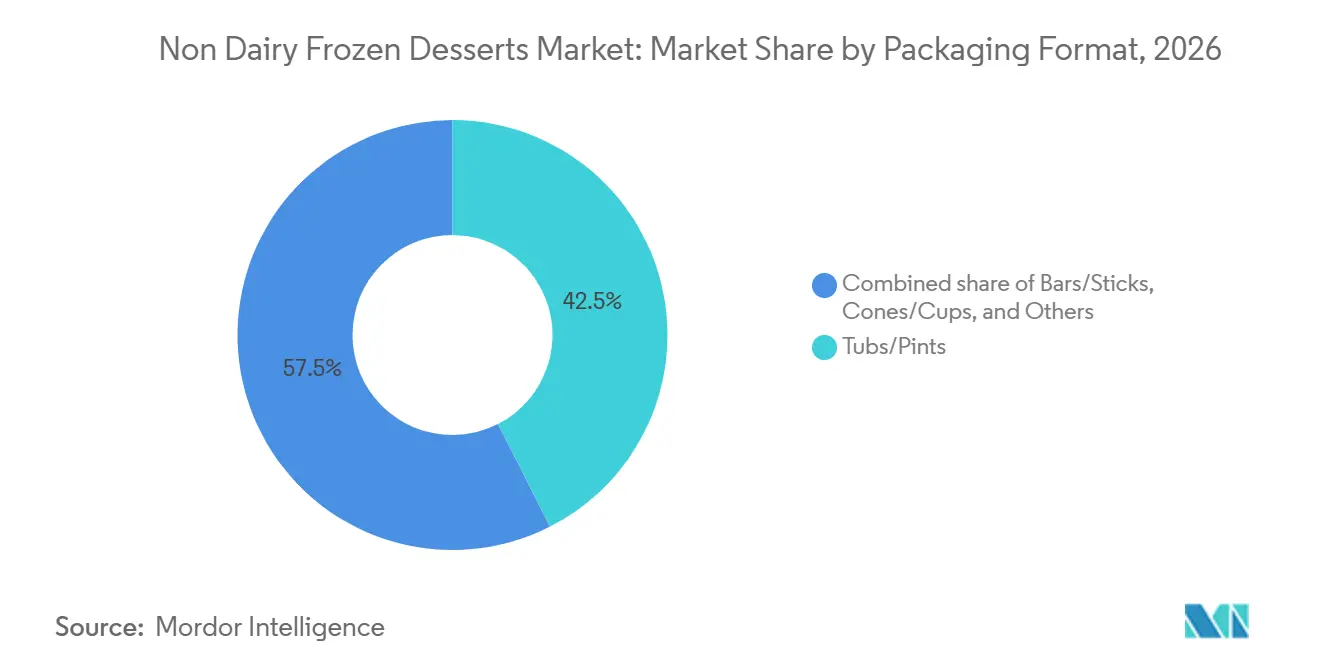
- By packaging format, tubs and pints held 42.5% of revenue in 2026, while cones and cups are forecast to expand at an 8.9% CAGR through 2032.
- By distribution channel, retail held 65.3% of revenue in 2026, while foodservice and HoReCa are forecast to expand at a 9.5% CAGR through 2032.
- By geography, North America held 38.8% of revenue in 2026, while Asia-Pacific is forecast to expand at a 9.7% CAGR through 2032.
Note: Market numbers in this report are based on Mordor Intelligence's proprietary estimation framework, which combines nine months of actuals with Q4 projections for base year 2026.
Market Trends and Insights
Drivers Impact Analysis of Non Dairy Frozen Desserts Market*
| Driver | (~) % Impact on CAGR Forecast | Geographic Relevance | Impact Timeline |
|---|---|---|---|
| Rising prevalence of lactose intolerance and milk allergies | +2.0% | Global, particularly APAC (India, China) and Latin America | Long term (≥ 4 years) |
| Premiumization and artisanal positioning | +1.2% | North America and Europe, spill-over to APAC premium tier | Medium term (2–4 years) |
| Diverse flavor innovation | +0.8% | Global, with regional localization in APAC and MEA | Short term (≤ 2 years) |
| Product innovation and improved taste/texture | +1.0% | Global, led by North America and Europe R&D hubs | Medium term (2–4 years) |
| Environmental and ethical concerns | +0.6% | Europe and North America core, emerging in APAC | Long term (≥ 4 years) |
| Growth of e-commerce and direct-to-consumer channels | +0.9% | North America, Europe; rapid acceleration in APAC | Short term (≤ 2 years) |
| Source: Mordor Intelligence | |||
Rising Prevalence of Lactose Intolerance and Milk Allergies
Lactose intolerance is a sustained demand driver for the non-dairy frozen desserts market, as it is linked to digestive needs, repeat consumption, and household food choices rather than short-lived preferences. Many consumers in the United States and Canada choose dairy-free products for comfort without a formal diagnosis, which broadens demand beyond medically recorded cases. Lactose sensitivity affects 59% of Canada's population, supporting the use of non-dairy alternatives within the country's developed retail environment. Cold-chain expansion in South and Southeast Asia can extend product availability in markets where lactose intolerance is prevalent and packaged frozen products are still gaining reach. The US Food and Drug Administration lists milk, eggs, tree nuts, soy, wheat, fish, shellfish, peanuts, and sesame among the major allergens requiring clear labeling, which shapes product claims and shared-facility practices. This framework supports informed consumer choice while raising the compliance threshold for new brands entering the non-dairy frozen desserts market[1].
Premiumization and Artisanal Positioning
Premium formats help the non dairy frozen desserts market move beyond the earlier association between plant-based products and dietary restriction. Brands are using layered textures, indulgent flavors, recognizable dessert formats, and more elaborate toppings to justify higher price points. Unilever introduced Cornetto Max across Europe and Türkiye in August 2025 with dual ice cream bases, layered sauces, and a chocolatey disc topping aimed at Gen Z consumers. Such launches show how established companies are applying premium cues to familiar frozen-dessert formats rather than treating dairy-free choices as a separate niche. Artisanal gelato, craft sorbet, and single-origin pints are particularly relevant in North America and Western Europe, where specialty channels can support differentiated offerings. A wider price range gives the non dairy frozen desserts market more room to retain value when ingredient costs move upward.
Product Innovation and Improved Taste and Texture
Taste and texture remain central to repeat purchases in the non dairy frozen desserts market because shoppers compare plant-based products directly with conventional ice cream. Research on soy- and pea-protein frozen desserts found that emulsifier and stabilizer choices affect microstructure, rheology, and melting behavior. These findings support manufacturers working to improve creaminess, air incorporation, stability, and melt behavior in products that must remain appealing after frozen storage. Oat bases are gaining attention because their neutral taste can reduce the need for flavor masking and allow familiar flavor profiles to remain recognizable. Atlante introduced oat-based Vegamo Vanilla and Matcha ice creams in Italy in July 2025, responding to consumer interest in oat formats. Better sensory performance can strengthen repeat demand in the non dairy frozen desserts market and reduce the need for frequent reformulation.
E-Commerce and Direct-to-Consumer Growth
E-commerce provides smaller brands with access to buyers when retail freezer space is limited and physical listings are concentrated among established companies. Direct-to-consumer models can be useful for premium and specialty products that need to establish demand before securing broad retail distribution, particularly in cities where app-based grocery and restaurant delivery is common. Brooklyn Creamery's delivery-platform activity in the UAE and India illustrates multi-platform reach across markets with different retail structures and consumer habits. Subscription and repeat-order models can give brands clearer demand signals, recurring orders, direct customer feedback, and more predictable product planning in markets with developing retail infrastructure. Online selling also allows niche companies to communicate ingredients, dietary claims, storage requirements, serving options, and delivery practices directly to consumers before a purchase is made. The channel can support non-dairy frozen desserts market expansion when a reliable temperature-controlled delivery network maintains product quality from warehouse to doorstep.
Restraints Impact Analysis of Non Dairy Frozen Desserts Market*
| Restraint | (~) % Impact on CAGR Forecast | Geographic Relevance | Impact Timeline |
|---|---|---|---|
| Allergen concerns with certain plant-based milks | −0.4% | Global, most acute in North America and Europe where allergen labeling is strictest | Medium term (2–4 years) |
| Regulatory and labeling restrictions | −0.3% | North America and EU core; compliance cost higher in fragmented APAC markets | Medium term (2–4 years) |
| Shelf life and formulation stability limitations | −0.3% | Global, with higher impact in markets lacking consistent cold-chain infrastructure | Short to medium term |
| Cold chain infrastructure limitations | −0.2% | Africa, South and Southeast Asia, inland South America | Long term (≥ 4 years) |
| Source: Mordor Intelligence | |||
Allergen Concerns With Plant-Based Milks
Plant-based frozen desserts avoid dairy, but many formulations use ingredients that can create other allergen concerns for consumers seeking alternatives. Almonds, cashews, soy, oats with gluten exposure, and sesame can limit suitability for consumers managing multiple food allergies or avoiding cross-contact risks. This creates a practical constraint for brands seeking broad allergen-free positioning and reduces the number of consumers who can use a single formulation. Soy and pea protein can present sensory challenges, including bitterness and astringency, alongside allergen considerations that complicate recipe modifications. The Food and Drug Administration's 2025 guidance on plant-based alternatives reinforces the need for careful labeling and disclosure in products made on shared manufacturing lines. Formulation work in the non-dairy frozen desserts market must therefore address both dairy avoidance and the allergen risks associated with substitute bases[2].
Cold-Chain Infrastructure Limitations
Cold-chain constraints slow the expansion of the non dairy frozen desserts market in regions where refrigerated storage, transportation, and retail freezer access are uneven. Spoilage in India's broader ice cream category can reach 20% outside leading cities, creating a material risk for products that require continuous temperature control from factory to consumer. This can reduce margins for brands trying to serve distant markets from urban production centers, especially when delivery routes are long, demand volumes are uncertain, and smaller retailers have limited freezer capacity. Reliable storage, refrigerated transportation, dependable electricity, and freezer access are essential because frozen desserts lose value quickly when temperature control fails at any point in distribution. Brands that partner with distributors or invest in cold-chain systems can improve access in markets such as Indonesia, Nigeria, and Colombia, where consumer interest may develop ahead of infrastructure. Those investments can create a barrier for later entrants and shape the pace of non dairy frozen desserts market growth in these regions.
*Our forecasts treat driver/restraint impacts as directional, not additive. The impact forecasts reflect baseline growth, mix effects, and variable interactions.
Non Dairy Frozen Desserts Market Segment Analysis
By Product Type:
Ice Cream Anchors Revenue While Cakes and Pastries Grow FastestIce cream held 42.2% of revenue in 2026, supported by broad freezer visibility, familiar flavors, and strong consumer recognition. Its established position makes it an effective first purchase for shoppers testing dairy-free products, while its range of flavors and formats supports repeat buying across households, individual treats, and foodservice menus. Major companies are increasing oat-based choices in existing ice cream portfolios, including Breyers Non-Dairy Chocolate on an oat-milk base in 2025 and Handel's permanent oat-milk line with Oatly in 2026. Sorbet, yogurt, gelato, sherbet, custard and pudding, novelty desserts, and other formats meet different price points and consumption occasions. Sorbet can provide an accessible entry product, whereas non-dairy gelato supports premium pricing through specialty retail, restaurant menus, and foodservice outlets that can explain distinctive flavor and ingredient choices.
Cakes and pastries are forecast to grow at a 9.2% CAGR through 2032, making them the fastest-growing product type in the non dairy frozen desserts market. This growth is linked to foodservice operators that need reliable, commercially made dessert options that meet dietary requirements without extensive kitchen reformulation, separate ingredient storage, or time-consuming production. TableMark's February 2026 BEYOND FREE soy cream cupcake, developed for restaurant and catering use, reflects this demand. Standardized frozen formats can reduce preparation time, simplify ordering, and help operators offer consistent products across locations. The non dairy frozen desserts industry can gain from bakery formats as restaurants replace manual preparation with frozen products that are easier to store, portion, serve, and include within menus that cater to mixed dietary preferences.

By Category:
Conventional Products Retain Scale While Organic Products AdvanceConventional products accounted for 78.4% of the non dairy frozen desserts market share in 2026, reflecting their accessible pricing, broad retail distribution, and manufacturing scale. Supermarkets and hypermarkets remain important because shoppers often select frozen desserts at the shelf and may favor products with a familiar price point, brand, package size, and flavor. Conventional products can use dairy-free or plant-based claims without the certification requirements associated with organic ranges. Bars, sticks, and novelty items extend their reach into convenience stores, online delivery, and impulse-led purchases. This combination of formats and channels keeps conventional products relevant for everyday consumption, family purchases, and occasional treats without limiting brands to a narrow premium audience.
Organic products are projected to grow at a 10.1% CAGR through 2032, which is the highest rate across the segmentation data. This growth is linked to premium retail demand, ingredient transparency, and consumer interest in certified sourcing that gives shoppers a clearer basis for comparing products. Organic certification gives manufacturers a clear way to explain ingredient choices and support a higher price position. NadaMoo! and Cado Ice Cream are examples of brands associated with organic and premium positioning. USDA Organic, EU Organic, and comparable national programs can become more influential in premium retail even as conventional products continue to provide most category volume and remain the leading option for price-sensitive shoppers.
By Packaging Format:
Tubs and Pints Support Household Use While Cones and Cups Build Foodservice DemandTubs and pints accounted for 42.5% of packaging revenue in 2026, reflecting household stocking behavior and the appeal of multi-serve formats. A 473 mL pint can carry craft branding, ingredient information, and flavor descriptions that help artisanal brands establish a distinct identity and differentiate their products from mass-market alternatives. Temperature-controlled delivery can support multi-serve sales in Asia-Pacific without relying entirely on supermarket freezer space. Bars and sticks continue to serve single-serve and impulse occasions through convenience-led retail. Together, these formats allow companies to address planned household consumption, sharing occasions, and immediate individual purchases through a varied packaging portfolio.
Cones and cups are projected to grow at an 8.9% CAGR through 2032, driven by foodservice demand, portability, and premium soft-serve occasions. Plant-based mixes designed for professional dispensing equipment can make these products easier for quick-service restaurants and dessert chains to include on regular menus, rather than limiting them to occasional promotional activity. The format also supports portion-controlled snacking and allows consumers to evaluate product claims before purchase. Gluten-free and allergen-related claims can be particularly prominent on cups and novelty products, where portability aligns with health-oriented consumption. The non-dairy frozen desserts market size for cones and cups is therefore closely linked to menu adoption, single-serve demand, reliable foodservice operations, and consumer willingness to try dairy-free formats away from home.
By Distribution Channel:
Retail Leads Revenue While Foodservice and HoReCa Expand FasterRetail accounted for 65.3% of distribution revenue in 2026, supported by supermarket and hypermarket freezer networks developed by established brands. These outlets provide frequent household shopping occasions and the freezer capacity needed for multi-serve products, seasonal assortment changes, and brand visibility. Convenience and grocery stores extend the reach of single-serve formats in dense urban locations. Online retail helps specialty brands reach health-conscious shoppers without the slotting fees and limited shelf access associated with large physical retailers. Higher vegan ice cream orders through Knuspr in Germany during June 2025 illustrate how routine online baskets can include dairy-free frozen desserts alongside other grocery purchases.
Foodservice and HoReCa are forecast to grow at a 9.5% CAGR through 2032 as restaurants, cafés, and caterers add non-dairy desserts as permanent menu options. Recurring business-to-business orders can offer more predictable demand for suppliers than seasonal or limited-time retail activity, particularly when chains standardize products across multiple outlets. Flora Professional launched a plant-based ice cream mix for foodservice in December 2025 that was dairy-free, free of declarable allergens, and certified Halal and Kosher. Delivery applications can shorten the path between a menu launch and consumer trial in India and Southeast Asia. This channel gives both established suppliers and smaller specialty brands an opportunity to build volume through menu partnerships, repeat orders, and formats that customers encounter during regular dining occasions.
Geography Analysis
North America Non Dairy Frozen Desserts Market
North America accounted for 38.8% of the non-dairy frozen desserts market share in 2026, driven by strong cold-chain infrastructure, wide plant-based retail availability, and consumer familiarity with oat, cashew, and pea-protein bases. The United States leads the region, with household penetration rising steadily between 2018 and 2025. As the category matures, repeat purchases among existing buyers are becoming a key demand driver, supporting both standard retail pints and newer products with recognizable bases and indulgent formats. Canada contributes manufacturing capacity and export potential, while Mexico benefits from proximity to United States retail networks and rising urban consumption. In September 2025, Chapman's announced an investment of over CAD 200 million (USD 148 million) in Ontario, adding a 175,000 square-foot facility, 6 production lines, and 200 jobs, reflecting the importance of domestic capacity for regional and international growth.
Europe Non Dairy Frozen Desserts Market
Europe's market is shaped by clean-label preferences, artisanal food culture, and strict food regulations. Germany, the United Kingdom, Italy, France, and the Netherlands are key markets, with Spain, Poland, Belgium, and Sweden offering additional retail opportunities. EU Organic and Novel Food Regulations affect product timelines for manufacturers and exporters. Italy shows a clear shift toward oat-based products, as seen in Atlante's July 2025 Vegamo launch. Companies that combine familiar dessert formats with transparent labeling and consistent quality are well-positioned in this market.
APAC, South America and MEA Non Dairy Frozen Desserts Market
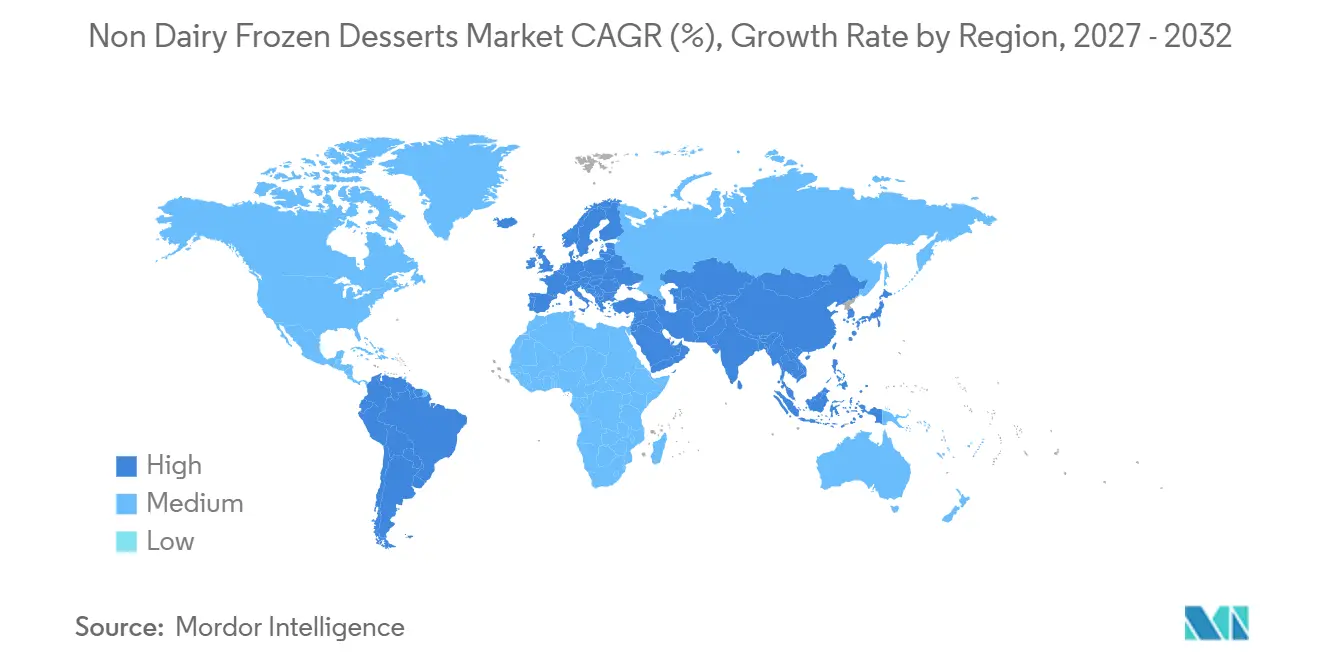
Asia-Pacific is forecast to grow at a 9.7% CAGR through 2032, making it the fastest-growing region in the non-dairy frozen desserts market. Australia and New Zealand act as innovation hubs, while China and India offer large volume potential as packaged distribution expands into smaller cities and foodservice outlets. In India, high lactose intolerance prevalence supports demand, though affordability and cold-chain gaps limit conversion. In South America, Brazil and Chile show growth potential among urban consumers seeking premium and health-oriented options. The United Arab Emirates, Saudi Arabia, and South Africa represent early-stage opportunities, where modern retail and health-conscious consumers are driving initial product adoption.
Competitive Landscape
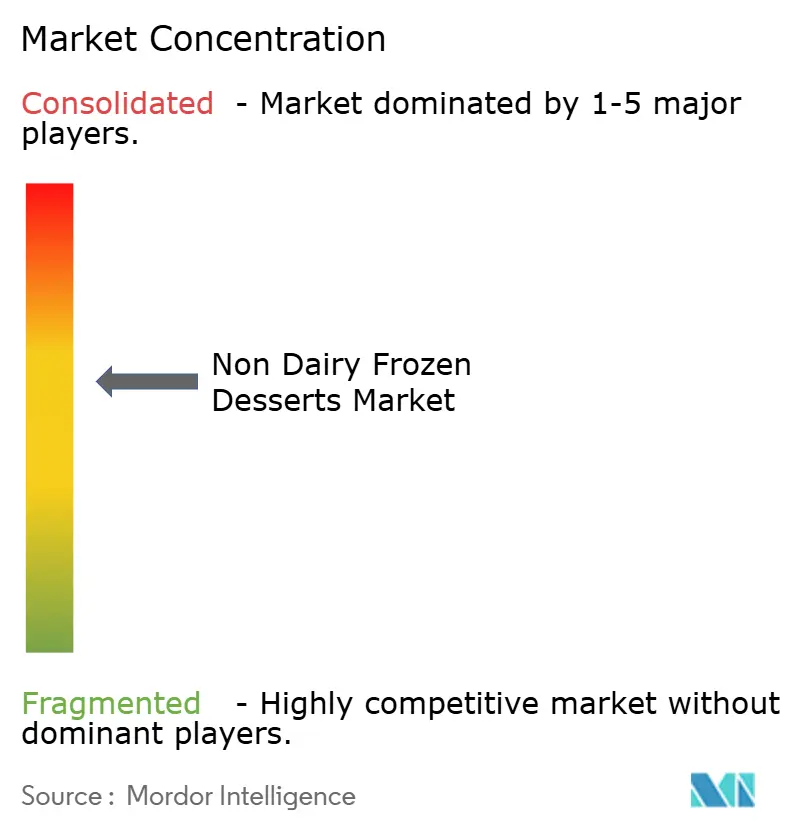
The non-dairy frozen desserts market has a moderately consolidated structure, with Unilever, Danone, Nestlé, and Froneri holding significant retail freezer space through broad brand portfolios. Unilever covers multiple price points and consumption occasions through Ben & Jerry's, Breyers, Magnum, and Talenti, spanning formats such as the Talenti oat-milk gelato range and Breyers Non-Dairy products. Danone competes through So Delicious Dairy Free within its wider plant-based portfolio. Froneri expanded its European footprint through agreements in October 2025 with acquisition of Food Union's ice cream operations in Norway, Denmark, Lithuania, Latvia, and Romania, adding local brands and distribution infrastructure.
Formulation expertise is a key competitive factor, as freeze-thaw stability, texture, and melt behavior directly affect repeat purchase decisions. Companies with strong stabilizer and emulsifier capabilities can build product differentiation beyond flavor and packaging. Specialist brands such as KLIMON, EatKinda, and Frönen are using novel bases, including pea milk, upcycled cauliflower, and honey sweetening, to gain credibility in premium natural channels ahead of larger players, though scaling still depends on reliable freezer distribution.
Recent moves highlight the market's focus on capacity, portfolio growth, and channel access. Unilever launched Cornetto Max in 2025, targeting younger consumers with premium features in a mainstream cone format. Marubeni acquired 100% of Bubbies Homemade Ice Cream & Desserts in June 2025, entering US ice cream manufacturing through a mochi-focused brand. ITOCHU acquired a 20% stake in NISSEI in December 2025 to develop plant-based soft-serve in Asia. These actions confirm that manufacturing, distribution, and foodservice access are as critical as product innovation in driving market coverage and repeat demand.
Non Dairy Frozen Desserts Industry Leaders
-
Unilever PLC
-
Danone S.A.
-
Nestlé S.A.
-
Oatly Group AB
-
Froneri International Limited
- *Disclaimer: Major Players sorted in no particular order
Non Dairy Frozen Desserts Market Companies Covered in this Report
- Unilever PLC
- Danone S.A.
- Nestlé S.A.
- Oatly Group AB
- Froneri International Limited
- Oregon Ice Cream Company
- The Hain Celestial Group, Inc.
- Van Leeuwen Ice Cream LLC
- General Mills, Inc.
- Wells Enterprises, Inc.
- The Coca-Cola Company
- SunOpta Inc.
- Daiya Foods Inc.
- Tofutti Brands, Inc.
- Perfect Day, Inc.
- Eclipse Foods
- Jeni’s Splendid Ice Creams, LLC
- NadaMoo!
- Bliss Unlimited LLC
- Arctic Zero, Inc.
Recent Industry Developments in Non Dairy Frozen Desserts Market
- October 2026: Carvel partnered with plant-based frozen dessert brand KLIMON to introduce a permanent non-dairy menu across its 300+ U.S. locations, including soft serve, scooped desserts, shakes, and Flying Saucers sandwiches in nine flavors and over 25 toppings, one of the broadest QSR non-dairy menu commitments in the sector.
- July 2026: Handel's Ice Cream launched a dairy-free oat-milk ice cream line in partnership with Oatly, the first use of Oatly's Full Fat Oatmilk in a brand collaboration, introducing three permanent flavors (Coffee Truffle, Chocolate Peanut Butter Brownie, Peanut Butter) across all Handel's Scoop Shop locations.
- March 2026: Morinaga & Co., Ltd. entered a definitive agreement to acquire My/Mochi Ice Cream, the largest mochi ice cream brand in the United States, for USD 130 million, marking Morinaga's full-scale U.S. frozen dessert entry and combining two complementary premium-snack portfolios.
- March 2026: Hextar Industries Bhd announced plans to acquire a 51% stake in Woodpeckers Group Sdn Bhd, master franchisee of the llaollao frozen yogurt chain in Malaysia, for approximately RM177.48 million (approximately USD 45.12 million), adding 131 outlets to its portfolio in a strategic Food and Beverage diversification.
Global Non Dairy Frozen Desserts Market Report Scope
The Non-Dairy Frozen Desserts Market refers to the market for frozen dessert products formulated without dairy-derived ingredients, typically using plant-based alternatives such as coconut, almond, soy, oat, or other non-dairy ingredients. By product type, the market is segmented into ice cream, sorbet, yogurt, gelato, sherbet, custard and pudding, cakes and pastries, novelty desserts, and other product types. By category, the market is divided into conventional and organic products. By packaging format, the market is segmented into tubs/pints, bars/sticks, cones/cups, and other packaging formats. By distribution channel, the market is divided into foodservice/HoReCa and retail. Geographically, the market covers North America, Europe, Asia-Pacific, South America, and the Middle East and Africa, with country-level coverage across major markets within each region. Market size and growth forecasts are presented in terms of value (USD) and volume (Tons).
Segmentation Overview
| Ice Cream |
| Sorbet |
| Yogurt |
| Gelato |
| Sherbet |
| Custard and Pudding |
| Cakes and Pastries |
| Novelty Desserts |
| Other Product Types |
| Conventional |
| Organic |
| Tubs/Pints |
| Bars/Sticks |
| Cones/Cups |
| Others |
| Foodservice/HoReCa | |
| Retail | Supermarkets/Hypermarkets |
| Convenience/Grocery Stores | |
| Online Retail Stores | |
| Other Distribution Channels |
| North America | United States |
| Canada | |
| Mexico | |
| Rest of North America | |
| Europe | Germany |
| United Kingdom | |
| Italy | |
| France | |
| Spain | |
| Netherlands | |
| Poland | |
| Belgium | |
| Sweden | |
| Rest of Europe | |
| Asia-Pacific | China |
| India | |
| Japan | |
| Australia | |
| Indonesia | |
| South Korea | |
| Thailand | |
| Singapore | |
| Rest of Asia-Pacific | |
| South America | Brazil |
| Argentina | |
| Colombia | |
| Chile | |
| Peru | |
| Rest of South America | |
| Middle East and Africa | South Africa |
| Saudi Arabia | |
| United Arab Emirates | |
| Nigeria | |
| Egypt | |
| Morocco | |
| Turkey | |
| Rest of Middle East and Africa |
| By Product Type | Ice Cream | |
| Sorbet | ||
| Yogurt | ||
| Gelato | ||
| Sherbet | ||
| Custard and Pudding | ||
| Cakes and Pastries | ||
| Novelty Desserts | ||
| Other Product Types | ||
| By Category | Conventional | |
| Organic | ||
| By Packaging Format | Tubs/Pints | |
| Bars/Sticks | ||
| Cones/Cups | ||
| Others | ||
| By Distribution Channel | Foodservice/HoReCa | |
| Retail | Supermarkets/Hypermarkets | |
| Convenience/Grocery Stores | ||
| Online Retail Stores | ||
| Other Distribution Channels | ||
| By Geography | North America | United States |
| Canada | ||
| Mexico | ||
| Rest of North America | ||
| Europe | Germany | |
| United Kingdom | ||
| Italy | ||
| France | ||
| Spain | ||
| Netherlands | ||
| Poland | ||
| Belgium | ||
| Sweden | ||
| Rest of Europe | ||
| Asia-Pacific | China | |
| India | ||
| Japan | ||
| Australia | ||
| Indonesia | ||
| South Korea | ||
| Thailand | ||
| Singapore | ||
| Rest of Asia-Pacific | ||
| South America | Brazil | |
| Argentina | ||
| Colombia | ||
| Chile | ||
| Peru | ||
| Rest of South America | ||
| Middle East and Africa | South Africa | |
| Saudi Arabia | ||
| United Arab Emirates | ||
| Nigeria | ||
| Egypt | ||
| Morocco | ||
| Turkey | ||
| Rest of Middle East and Africa | ||
Key Questions Answered in the Report
What is the projected value of non-dairy frozen desserts by 2032?
The non dairy frozen desserts market is projected to reach USD 13.81 billion by 2032, following growth from USD 9.32 billion in 2027 at an 8.18% CAGR, with demand supported by dietary needs and wider product availability.
Which product type leads non-dairy frozen dessert sales?
Ice cream leads product-type revenue with a 42.2% share in 2026, supported by broad consumer familiarity, freezer visibility, and a wide range of familiar flavor choices across retail and foodservice.
Which non-dairy frozen dessert category is growing fastest?
Organic products are forecast to grow at a 10.1% CAGR through 2032, faster than other category segments, as premium buyers seek certified sourcing, ingredient transparency, and more clearly differentiated products.
Which region is expected to grow fastest through 2032?
Asia-Pacific is projected to expand at a 9.7% CAGR in the non dairy frozen desserts market, supported by urban distribution growth, foodservice expansion, and a large consumer base with lactose intolerance.