
Non-Contact Thickness Measurement Systems Market Size and Share
Market Overview
| Study Period | 2020 - 2031 |
|---|---|
| Market Size (2026) | USD 1.33 Billion |
| Market Size (2031) | USD 1.93 Billion |
| Growth Rate (2026 - 2031) | 7.73 % |
| Fastest Growing Market | Asia-Pacific |
| Largest Market | Asia-Pacific |
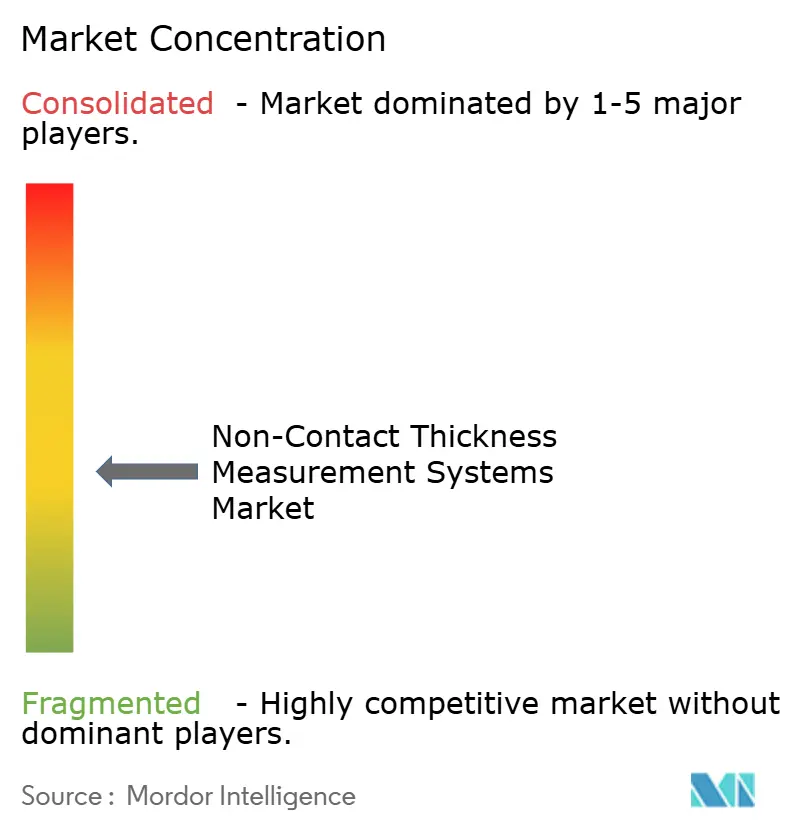
| Market Concentration | Medium |
Major Players *Disclaimer: Major Players sorted in no particular order Image © Mordor Intelligence. Reuse requires attribution under CC BY 4.0. | |
Non-Contact Thickness Measurement Systems Market Analysis by Mordor Intelligence
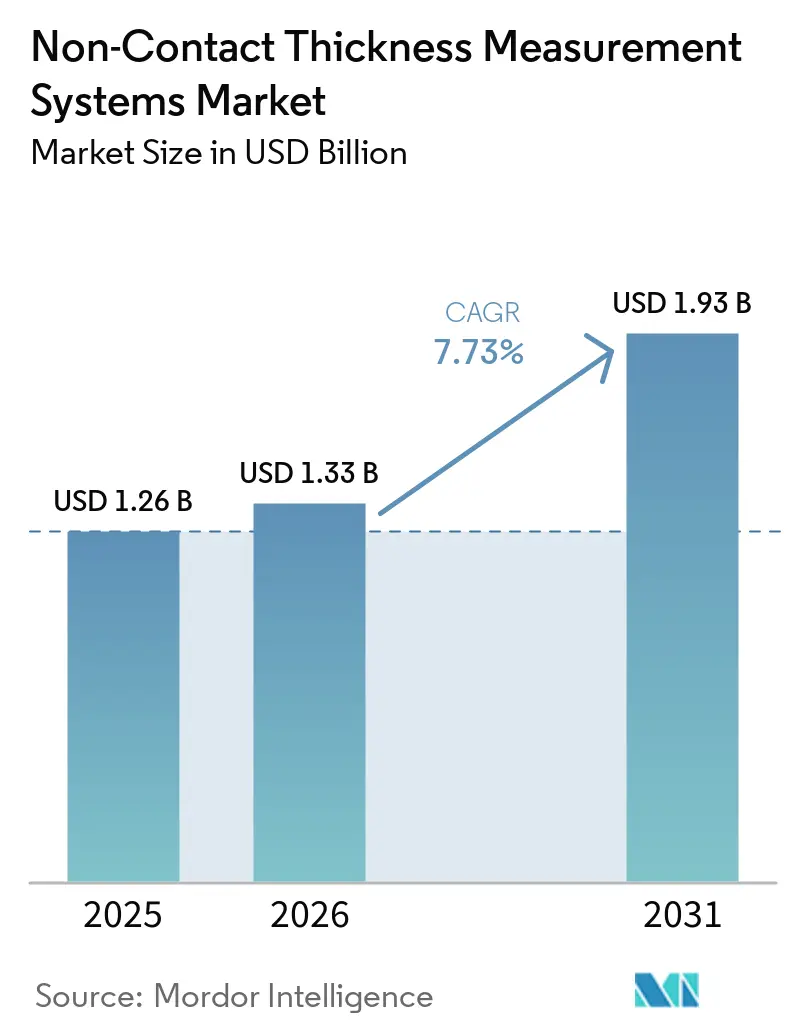
The Non-Contact Thickness Measurement Systems Market size was valued at USD 1.26 billion in 2025 and estimated to expand from USD 1.33 billion in 2026 to reach USD 1.93 billion by 2031, at a CAGR of 7.73% during the forecast period 2026-2031. The Non-Contact Thickness Measurement Systems Market is supported by manufacturers' need to prevent defects in the production of thinner, layered, and sensitive materials. Demand increasingly follows investment in new battery plants and semiconductor facilities rather than the replacement of older gauges. This pattern can make orders more visible when capacity projects proceed, while exposing suppliers to pauses in battery and semiconductor capital spending. The Non-Contact Thickness Measurement Systems Market also benefits from the replacement of aging nuclear gauges in paper, plastics, and flexible packaging plants.
Key Report Takeaways
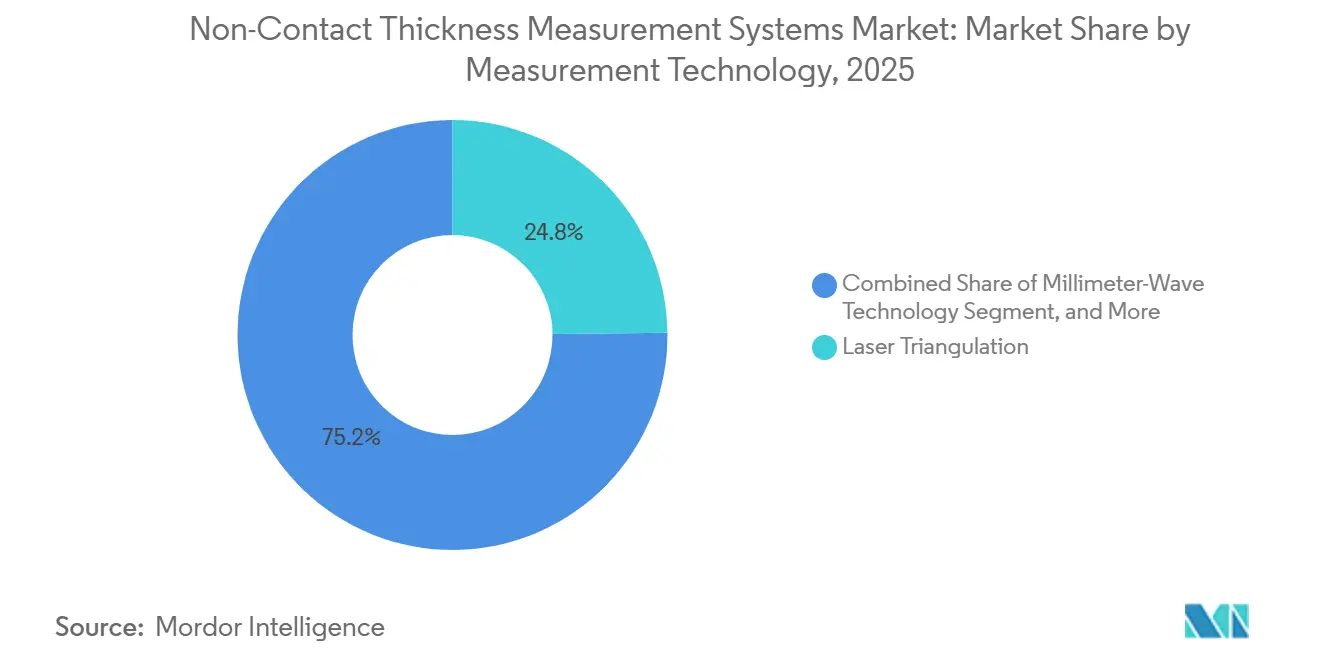
- By measurement technology, laser triangulation held 24.83% of the Non-Contact Thickness Measurement Systems Market share in 2025, while millimeter-wave technology is projected to expand at a 10.83% CAGR through 2031.
- By measurement mode, inline and online systems accounted for 54.67% of revenue in 2025, while at-line measurement is expected to expand at a 9.17% CAGR through 2031.
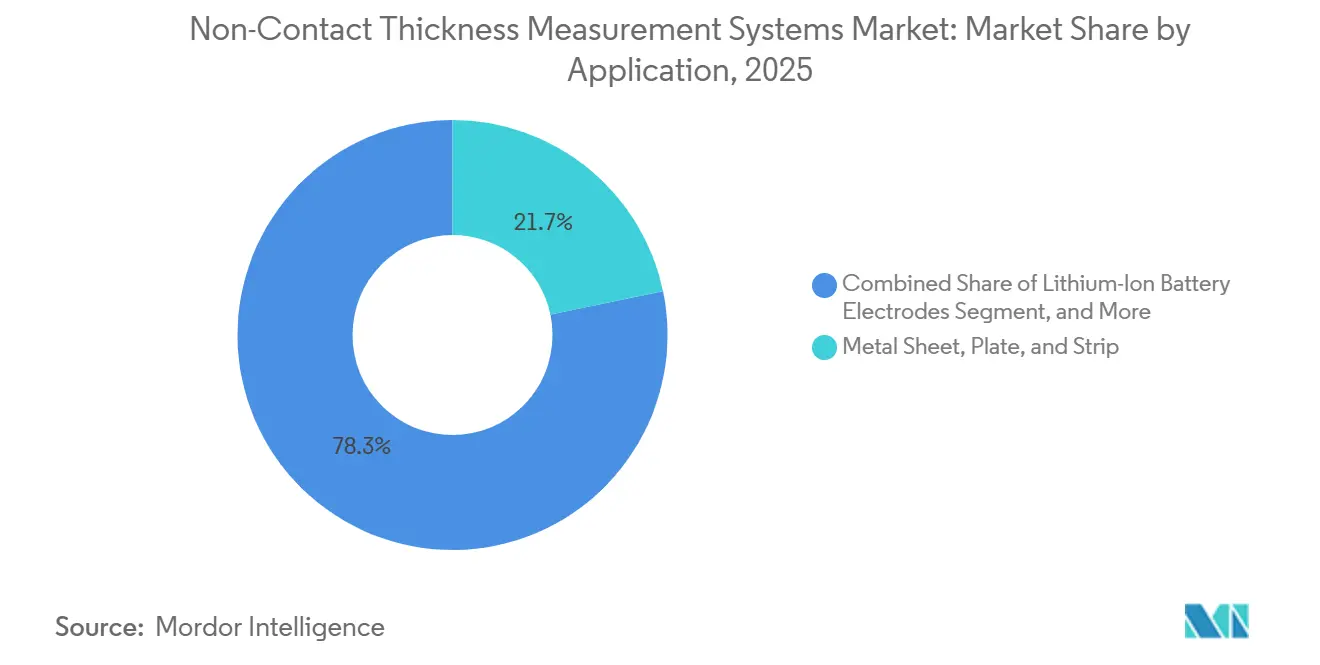
- By application, metal sheet, plate, and strip held 21.73% of Non-Contact Thickness Measurement Systems Market revenue in 2025, while lithium-ion battery electrodes and separators are projected to expand at a 10.93% CAGR through 2031.
- By end-user industry, metals and metal processing accounted for 22.94% of revenue in 2025, while batteries and energy storage are expected to expand at a 10.47% CAGR through 2031.
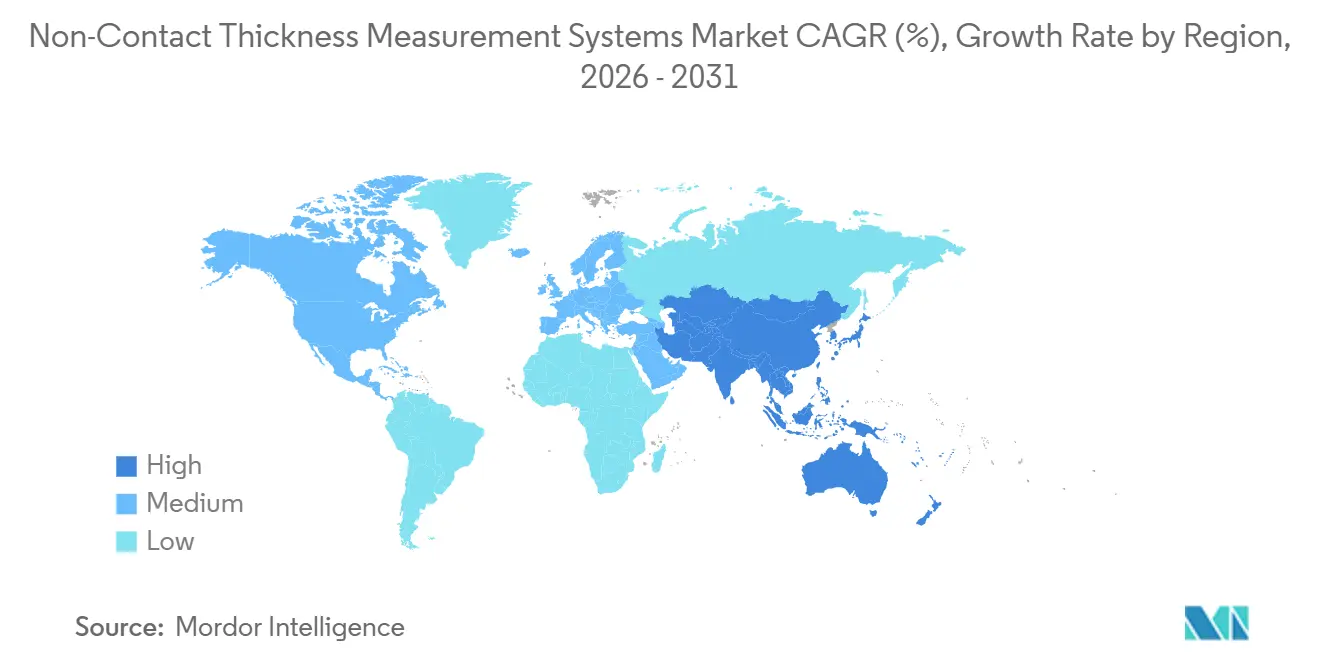
- By geography, Asia-Pacific held 39.86% of the Non-Contact Thickness Measurement Systems Market revenue in 2025 and is projected to expand at a 10.26% CAGR through 2031.
Note: Market size and forecast figures in this report are generated using Mordor Intelligence’s proprietary estimation framework, updated with the latest available data and insights as of January 2026.
Global Non-Contact Thickness Measurement Systems Market Trends and Insights
Drivers Impact Analysis*
| Driver | (~) % Impact on CAGR Forecast | Geographic Relevance | Impact Timeline |
|---|---|---|---|
| Inline Quality Control and Industry 4.0 Adoption | +2.1% | Global, concentrated in DACH, the United States, China, and Japan | Short term (≤ 2 years) |
| Semiconductor and Electronics Precision Requirements | +1.6% | Asia-Pacific, with effects in the United States and Europe | Medium term (2-4 years) |
| Lithium-Ion Battery Electrode and Separator Production | +1.5% | Asia-Pacific, North America, and Europe | Short term (≤ 2 years) |
| Tighter Tolerances in Metals, Films, and Packaging | +1.1% | Global, with early gains in Germany, Japan, and South Korea | Medium term (2-4 years) |
| Nuclear Gauge Replacement | +0.8% | North America and Europe | Long term (≥ 4 years) |
| Sensor Fusion and AI-Based Uniformity Control | +0.6% | Global, with early adoption in DACH and the United States | Long term (≥ 4 years) |
| Source: Mordor Intelligence | |||
Expansion of Inline Quality Control and Industry 4.0 Adoption
The Non-Contact Thickness Measurement Systems Market is gaining from the shift away from end-of-line sampling toward continuous inspection. When thickness data feeds process controls, manufacturers can correct deviations before the material reaches later production stages. This makes a gauge part of operating control rather than a separate inspection device. Quality teams are also using artificial intelligence to interpret sensor data and identify patterns that ordinary threshold checks can miss. Automotive and battery supply chains therefore place greater value on full-line coverage and traceable process records. These requirements favor systems that maintain high data rates while operating continuously in demanding factory conditions.
Rising Precision Requirements in Semiconductor and Electronics Manufacturing
Advanced semiconductor structures require measurement tools capable of resolving thinner, more complex films at production speed. Onto Innovation introduced its Atlas G6 system in 2025 for process control of advanced devices, including gate-all-around logic structures that can shrink by up to 30% per generation. The Non-Contact Thickness Measurement Systems Market, therefore, needs optical methods that combine physical models with software-assisted analysis. A 2025 study found that a revised full-spectrum fitting approach improved computational efficiency by 50% and reduced measurement error by 20%. Nova presented wafer-edge imaging methods in 2026 that convert detailed edge images into thickness maps for chemical mechanical polishing and hybrid-bonding control. These needs raise the value of certified measurement platforms and regular calibration for advanced films.[1]Nova Ltd., “Advancing 3D Integration and BEOL Scaling: Nova’s Metrology Innovations at SPIE 2026,” Nova Ltd., novami.com.
Increasing Lithium-Ion Battery Electrode and Separator Production
Lithium-ion separator production requires close control of coating thickness at high line speeds, which limits the usefulness of contact methods. Siemens documented separator-film production requirements of plus or minus 0.3 µm at line speeds of 150-200 meters per minute[2]Siemens, “Microporous - Lithium-Ion Separator Production Reference,” Siemens, assets.new.siemens.com.. The Non-Contact Thickness Measurement Systems Market is positioned to benefit because electrode and separator uniformity affects cell performance and production yield. Research published in 2025 linked separator thickness to ionic conductivity, thermal stability, and cell life, noting changes of up to 2 µm. Dry-electrode production increases the need for inline control because there is no solvent-driven surface leveling after coating. Thermo Fisher Scientific made its LInspector BAX-ray system available in July 2026 for simultaneous two-sided dry-electrode coating measurement with a 1 ms sampling time.[3]“Automated Contactless Characterization of Local Thin Film Thickness and Film Stress With Standard MEMS Structures at Wafer Level,” Journal of Sensors and Sensor Systems, jsss.copernicus.org.
Tighter Thickness Tolerances in Metal, Plastic Film, and Packaging Production
Metal producers and film converters are reducing material use while maintaining product performance, which narrows acceptable thickness bands. In certain rolling operations, temperature-induced dimensional changes can exceed the specification range, increasing the need for thermal compensation and continuous mapping. The Non-Contact Thickness Measurement Systems Market is consequently moving beyond basic traverse profiles toward cross-profile and longitudinal data. Chino's IRMT01 infrared gauge uses a 3-wavelength P-polarized reflectance method and has a 28 ms output cycle for films thinner than 10 µm. Micro-Epsilon released thicknessGAUGE in July 2025 for inline strip and sheet measurement, including structured and embossed materials that can challenge conventional sensors. These requirements strengthen demand for systems that remain stable across surface textures and changing production conditions.[4]Micro-Epsilon, “High-Precision Inline Measurement of Thin Layers, IMS5200-TH,” Micro-Epsilon, micro-epsilon.com.
Restraints Impact Analysis*
| Restraint | (~) % Impact on CAGR Forecast | Geographic Relevance | Impact Timeline |
|---|---|---|---|
| High Initial System and Integration Costs | -1.4% | Global, particularly South America, Southeast Asia, and the Middle East and Africa | Short term (≤ 2 years) |
| Complexity of Reflective, Transparent, and Multilayer Materials | -0.9% | Global, especially semiconductor and glass hubs | Medium term (2-4 years) |
| Limited Calibration Standards for Emerging Materials | -0.5% | Global, especially battery and advanced semiconductor materials | Long term (≥ 4 years) |
| Retrofit Disruption on Legacy Lines | -0.3% | North America and Europe | Medium term (2-4 years) |
| Source: Mordor Intelligence | |||
High Initial System and Integration Costs
A complete inline installation can include sensor heads, frames, motion equipment, software, and integration work. This cost is especially difficult for mid-sized film, packaging, and nonwoven processors operating on narrow margins. Wider multi-track C-Frame and O-Frame systems provide greater process visibility but require a higher initial investment. Procurement teams can also struggle to separate savings from a gauge installation from gains caused by other process changes. Suppliers are responding with modular systems and software upgrades that keep installed hardware useful for longer. This approach supports customer retention, but it can defer new equipment orders at existing sites.
Measurement Complexity for Reflective, Transparent, and Multilayer Materials
Reflective metal, transparent film, and multilayer laminates produce distinct signal responses that no single measurement principle can resolve in every setting. A sensor optimized for bright aluminum may require recalibration when production switches to a matte or textured alloy. The Non-Contact Thickness Measurement Systems Market must also address high temperatures, vibration, and line speeds that can reduce measurement stability. Multilayer battery films and display substrates add processing demands because similar refractive or dielectric properties make interfaces harder to distinguish. A study in Physica Status Solidi (a) found that four-layer reflectometry modeling with surface-bending corrections was needed for consistent results on nanostructures with 100-500 nm air gaps. These technical conditions extend qualification periods and can slow adoption in demanding applications.
*Our forecasts treat driver/restraint impacts as directional, not additive. The impact forecasts reflect baseline growth, mix effects, and variable interactions.
Segment Analysis
By Measurement Technology: Laser Retains Its Lead While Millimeter-Wave Expands
Laser triangulation held 24.83% of global revenue in 2025. It remains widely used in metal strip and plastic film production because it combines practical cost, high operating speed, and established service support. Laser systems can reach measurement speeds of up to 392 kHz in suitable applications. Their installed base also benefits from familiar calibration practices and trained maintenance teams. However, applications requiring multilayer penetration or very fine-scale semiconductor measurements use other technologies.
Millimeter-wave technology is projected to expand at a 10.83% CAGR from 2026 to 2031 in the Non-Contact Thickness Measurement Systems Market. It can measure opaque and multilayered materials without ionizing radiation or contact with the media. SIKORA's PLANOWAVE 6000 operates at 80-300 GHz and specifies 50 µm accuracy with 10 µm repeatability without operator calibration. Spectroscopic reflectometry and ellipsometry support semiconductor films, while chromatic confocal systems suit moving battery webs. Hybrid platforms are becoming more relevant because combining optical, millimeter-wave, eddy-current, or other readings can address limits that a single sensor principle cannot solve.



By Measurement Mode: Inline Systems Lead While At-Line Systems Broaden Access
Inline and online systems accounted for 54.67% of the Non-Contact Thickness Measurement Systems Market size in 2025. High-volume manufacturers use these systems for continuous feedback and full inspection coverage. Battery plants and semiconductor facilities are increasingly designing gauges into new lines rather than adding them after commissioning. Offline and laboratory tools continue to support materials development, prototype qualification, and audit work. Portable equipment also serves aerospace inspection, pipeline wall checks, and incoming-material verification.
At-line measurement is expected to expand at a 9.17% CAGR from 2026 to 2031. It provides a middle path for film, coating, and specialty-nonwoven producers that need faster feedback than periodic sampling but cannot justify a full inline installation. At-line data can also be compared with inline readings to identify sensor drift and verify performance. Renishaw introduced the RUP60 on-machine ultrasonic probe in September 2026 for single-sided measurement, specifying accuracy better than 10 µm and repeatability of 2 µm. This type of portable validation tool can help users move toward more automated inspection in stages.
By Application: Metal Strip Leads While Battery Electrodes Drive Expansion
Metal sheet, plate, and strip accounted for 21.73% of revenue in 2025. Steel rolling, aluminum processing, annealing, and galvanizing lines have used non-contact gauging for decades. Plastic films and sheets constitute another major application group, as packaging producers need thinner barrier materials with consistent performance. Coatings and paints measurement supports automotive, coil-coating, and architectural-glass applications. Semiconductor films and wafers need the highest precision, with spectroscopic ellipsometry capable of 0.1-1 nm film measurements in reported use cases.
Lithium-ion battery electrodes and separators are projected to expand at a 10.93% CAGR from 2026 to 2031. Manufacturers need to measure both sides of coated material without disturbing partially dried layers. A 2026 Nature Communications study reported terahertz Fabry-Perot interferometry precision of 70.1 nm on an anode and 465.5 nm on a cathode at 0.2-second integration. Ceramic tape and solid-electrolyte layers pose another challenge because they may require thickness tolerances below 10 µm with low optical contrast. This is creating a specialized use case linking battery materials, ceramic tapes, and advanced measurement methods.
By End-User Industry: Metals Provide Scale While Batteries Add New Demand
Metals and metal processing held 22.94% of revenue in 2025. Thickness gauging is integral to hot rolling, cold rolling, galvanizing, and precision slitting across steel and aluminum production. Plastics and flexible packaging are another large customer group, as producers are reducing material weight without compromising barrier properties. Semiconductor and electronics users accept higher system prices for demanding wafer-level and advanced-packaging measurements. Automotive, aerospace, glass, optical products, and research institutions remain smaller but technically demanding customer groups.
Batteries and energy storage are expected to expand at a 10.47% CAGR from 2026 to 2031. Cathode coatings commonly range from 50-200 µm, while thinner asymmetric anode coatings require independent measurement on both faces. This production requirement favors multi-track inline systems with sub-micron precision. Micro-Epsilon and the UK Battery Industrialization Center reported in August 2026 that thicknessCONTROL systems maintained an accuracy of ≤0.3 µm across cathode and anode calendering lines up to 750 mm wide. Reliable operating results are important because battery manufacturers must balance measurement accuracy with continuous line availability.
Geography Analysis
Asia-Pacific accounted for 39.86% of global revenue in 2025 and is projected to grow at a 10.26% CAGR through 2031. China supports volume demand through battery capacity additions and automotive steel production. Japan supports premium demand in precision electronics, semiconductor packaging, and advanced-material measurement. South Korea combines DRAM and NAND fabrication with major battery-cell production. India is developing semiconductor packaging and automated inspection capacity, which can add demand for precision measurement equipment.
Europe and North America had a substantial installed base in 2025 across automotive steel, aluminum rolling, specialty chemicals, and pharmaceutical packaging. Germany remains an important supply center for industrial measurement equipment and has a dense customer base in precision engineering and specialty films. North America benefits from semiconductor fabrication construction and from suppliers serving advanced process control. Replacement of nuclear gauges is a near-term opportunity in North American paper, plastics, and flexible packaging plants because licensing and handling create continuing compliance obligations. The United Kingdom's battery pilot facilities also provide reference sites for inline electrode measurement systems.
South America, the Middle East, and Africa, and other Asia-Pacific markets are at earlier stages of adoption. Brazil's automotive and mining sectors support demand for metal strips and equipment inspection. Saudi Arabia and the United Arab Emirates are adding downstream petrochemical capacity, where pipeline and vessel monitoring are established applications. South Africa's mining and steel sectors add baseline demand, while regional service partnerships allow suppliers to reach customers without local manufacturing.

Competitive Landscape
The Non-Contact Thickness Measurement Systems Market is moderately fragmented because suppliers lead in different measurement principles and applications. KLA Corporation, Onto Innovation, Nova Ltd., HORIBA Ltd., and Thermo Fisher Scientific compete in high-precision semiconductor and battery metrology. Micro-Epsilon, SICK AG, Keyence Corporation, and Marposs serve a wider range of industrial gauging applications. No supplier leads across all technologies, measurement modes, and end-use industries. This keeps competition active even among companies with recognized technical positions.
Software and artificial intelligence are becoming important differentiators in the Non-Contact Thickness Measurement Systems Market. KLA published a May 2026 patent application for a feature-transformer approach that uses correlated optical, X-ray, and electron signals to improve metrology workflows. SICK highlighted its Nova Intelligent Inspection AI tools in June 2026 for industrial 3D inspection, in which objects may share similar colors or patterns. Thermo Fisher Scientific introduced a BAX-ray system for dry-electrode measurement, targeting an important production change in battery manufacturing. These actions indicate that suppliers are combining sensing hardware with analysis software and application-specific process control.
Opportunities are also forming around sensor fusion and process analytics. Hammer-IMS markets its M-Ray platform as a nuclear-free alternative for plastics, nonwovens, and paper applications. Novacam Technologies and Lumetrics have optical coherence tomography capabilities for transparent multilayer films. Terahertz interferometry has also moved closer to industrial use, supported by the 2026 battery-electrode results published in Nature Communications. The Non-Contact Thickness Measurement Systems Market will continue to reward companies that can combine measurement accuracy, reliable line integration, and practical calibration support.
Non-Contact Thickness Measurement Systems Industry Leaders
Thermo Fisher Scientific Inc.
Marposs S.p.A.
Micro-Epsilon Messtechnik Gmbh & Co. Kg
KLA Corporation
Onto Innovation Inc.
- *Disclaimer: Major Players sorted in no particular order

Recent Industry Developments
- September 2026: Renishaw unveiled the RUP60, its first on-machine ultrasonic thickness measurement probe, at IMTS 2026 and AMB 2026. The probe measures metal thickness of 0.7-30 mm from 1 accessible side with accuracy better than 10 µm and repeatability of 2 µm, enabling automated and traceable in-process inspection without removing the workpiece. It targets large aerospace and automotive components where 1-sided access had required manual offline measurement. The system was presented at IMTS in Chicago from September 14-19 and at AMB in Stuttgart from September 15-19. It brings ultrasonic measurement into a machine-tool workflow where the inspection result can remain connected to the workpiece and production process.
- August 2026: The UK Battery Industrialisation Centre in Coventry validated Micro-Epsilon's thicknessCONTROL inline battery electrode measurement technology after 12 months of continuous operation. Two triple-track C-Frame traversing systems on cathode and anode calendering lines and a twin-track system on the Flexible Pilot Line maintained system accuracy of ≤0.3 µm and passed annual recalibration without performance degradation. The deployment covered lines up to 750 mm wide and provided a referenced operating case for electrode manufacturers assessing inline gauging. The result also showed that a production system can sustain performance after a full year rather than only during initial commissioning.
- August 2026: Thermo Fisher Scientific made its LInspector BAX-ray In-Line Dry Electrode Coating Measurement System, catalog IBAX-233000, available for purchase. Using backscatter X-ray technology with a 1 ms sampling time, it performs real-time simultaneous dual-side dry-electrode coating measurement on copper or aluminum substrates. The product addresses the shift from solvent-based coating toward binder-free dry-electrode production at electric-vehicle battery plants. Its two-sided configuration is intended to identify coating variation while the material remains in the production flow.
- May 2026: KLA Corporation published patent application US20260147282A1 for a Feature Transformer Architecture for advanced semiconductor metrology. The approach uses a transformer attention mechanism to extract correlated features from optical, X-ray, and electron measurement signal combinations and is designed to reduce recipe-development time and improve measurement robustness. It also targets shorter signal-acquisition time for optical critical-dimension and film measurements. The filing illustrates how semiconductor metrology suppliers are applying machine-learning methods to difficult process variations.


Global Non-Contact Thickness Measurement Systems Market Report Scope
Non-Contact Thickness Measurement Systems are advanced industrial instruments that use optical, electromagnetic, or acoustic technologies to precisely measure material thickness without physical contact, enabling high-speed quality control, material conservation, and process optimization in continuous manufacturing environments.
The Non-Contact Thickness Measurement Systems Market Report is Segmented by Measurement Technology (Laser Triangulation, Spectroscopic Reflectometry and Ellipsometry, Chromatic Confocal, Optical Interferometry, Eddy Current and Capacitive, Ultrasonic and Picosecond Ultrasonic, X-Ray and Other Radiation-Based Technologies, Millimeter-Wave Technology, and Hybrid Multisensor Technology), Measurement Mode (Inline and Online Measurement, At-Line Measurement, Offline and Laboratory Measurement, and Portable and Handheld Measurement), Application (Metal Sheet, Plate, and Strip, Plastic Films and Sheets, Coatings and Paints, Semiconductor Films and Wafers, Lithium-Ion Battery Electrodes and Separators, Glass and Transparent Materials, Nonwoven Materials and Textiles, Rubber, Foam, and Insulation Materials, Ceramic Tapes and Advanced Materials, and Other Applications), End-User Industry (Metals and Metal Processing, Plastics and Flexible Packaging, Semiconductors and Electronics, Batteries and Energy Storage, Automotive and Transportation, Aerospace and Defense, Glass and Optical Products, Research Institutions and Contract Laboratories, and Other End-User Industries), and Geography (North America, South America, Europe, Asia-Pacific, Middle East and Africa). The Market Forecasts are Provided in Terms of Value (USD).
| Laser Triangulation |
| Spectroscopic Reflectometry and Ellipsometry |
| Chromatic Confocal |
| Optical Interferometry |
| Eddy Current and Capacitive |
| Ultrasonic and Picosecond Ultrasonic |
| X-Ray and Other Radiation-Based Technologies |
| Millimeter-Wave Technology |
| Hybrid Multisensor Technology |
| Inline and Online Measurement |
| At-Line Measurement |
| Offline and Laboratory Measurement |
| Portable and Handheld Measurement |
| Metal Sheet, Plate, and Strip |
| Plastic Films and Sheets |
| Coatings and Paints |
| Semiconductor Films and Wafers |
| Lithium-Ion Battery Electrodes and Separators |
| Glass and Transparent Materials |
| Nonwoven Materials and Textiles |
| Rubber, Foam, and Insulation Materials |
| Ceramic Tapes and Advanced Materials |
| Other Applications |
| Metals and Metal Processing |
| Plastics and Flexible Packaging |
| Semiconductors and Electronics |
| Batteries and Energy Storage |
| Automotive and Transportation |
| Aerospace and Defense |
| Glass and Optical Products |
| Research Institutions and Contract Laboratories |
| Other End-User Industries |
| North America | United States | |
| Canada | ||
| Mexico | ||
| South America | Brazil | |
| Argentina | ||
| Rest of South America | ||
| Europe | Germany | |
| United Kingdom | ||
| France | ||
| Italy | ||
| Spain | ||
| Rest of Europe | ||
| Asia-Pacific | China | |
| Japan | ||
| India | ||
| South Korea | ||
| Rest of Asia-Pacific | ||
| Middle East and Africa | Middle East | Saudi Arabia |
| United Arab Emirates | ||
| Turkey | ||
| Rest of the Middle East | ||
| Africa | South Africa | |
| Nigeria | ||
| Rest of Africa | ||
| By Measurement Technology | Laser Triangulation | ||
| Spectroscopic Reflectometry and Ellipsometry | |||
| Chromatic Confocal | |||
| Optical Interferometry | |||
| Eddy Current and Capacitive | |||
| Ultrasonic and Picosecond Ultrasonic | |||
| X-Ray and Other Radiation-Based Technologies | |||
| Millimeter-Wave Technology | |||
| Hybrid Multisensor Technology | |||
| By Measurement Mode | Inline and Online Measurement | ||
| At-Line Measurement | |||
| Offline and Laboratory Measurement | |||
| Portable and Handheld Measurement | |||
| By Application | Metal Sheet, Plate, and Strip | ||
| Plastic Films and Sheets | |||
| Coatings and Paints | |||
| Semiconductor Films and Wafers | |||
| Lithium-Ion Battery Electrodes and Separators | |||
| Glass and Transparent Materials | |||
| Nonwoven Materials and Textiles | |||
| Rubber, Foam, and Insulation Materials | |||
| Ceramic Tapes and Advanced Materials | |||
| Other Applications | |||
| By End-User Industry | Metals and Metal Processing | ||
| Plastics and Flexible Packaging | |||
| Semiconductors and Electronics | |||
| Batteries and Energy Storage | |||
| Automotive and Transportation | |||
| Aerospace and Defense | |||
| Glass and Optical Products | |||
| Research Institutions and Contract Laboratories | |||
| Other End-User Industries | |||
| By Geography | North America | United States | |
| Canada | |||
| Mexico | |||
| South America | Brazil | ||
| Argentina | |||
| Rest of South America | |||
| Europe | Germany | ||
| United Kingdom | |||
| France | |||
| Italy | |||
| Spain | |||
| Rest of Europe | |||
| Asia-Pacific | China | ||
| Japan | |||
| India | |||
| South Korea | |||
| Rest of Asia-Pacific | |||
| Middle East and Africa | Middle East | Saudi Arabia | |
| United Arab Emirates | |||
| Turkey | |||
| Rest of the Middle East | |||
| Africa | South Africa | ||
| Nigeria | |||
| Rest of Africa | |||


Key Questions Answered in the Report
What is the size of the Non-Contact Thickness Measurement Systems Market?
The market is estimated at USD 1.33 billion in 2026 and is forecast to reach USD 1.93 billion by 2031, at a 7.73% CAGR.
Which measurement technology leads revenue?
Laser triangulation led with a 24.83% revenue share in 2025 because of its broad use in metal strip and plastic film applications.
Which application is expanding fastest?
Lithium-ion battery electrodes and separators are projected to expand at a 10.93% CAGR through 2031.
Which region has the strongest outlook?
Asia-Pacific led with 39.86% of revenue in 2025 and is projected to expand at a 10.26% CAGR through 2031.
Why are manufacturers replacing nuclear gauges?
Non-nuclear systems can reduce licensing, source-management, and compliance burdens while supporting continuous process measurement.
Which end-user group has the fastest forecast?
Batteries and energy storage is expected to expand at a 10.47% CAGR through 2031 as electrode and separator production needs more precise inline control.
Page last updated on:


 Your data is secure and never sold or shared.


