
Laser Triangulation Displacement Sensors For Industrial Metrology Market Size and Share
Market Overview
| Study Period | 2020 - 2031 |
|---|---|
| Market Size (2026) | USD 6.46 Billion |
| Market Size (2031) | USD 10.13 Billion |
| Growth Rate (2026 - 2031) | 9.41 % |
| Fastest Growing Market | Asia-Pacific |
| Largest Market | Asia-Pacific |
| Market Concentration | Medium |
Major Players *Disclaimer: Major Players sorted in no particular order Image © Mordor Intelligence. Reuse requires attribution under CC BY 4.0. | |
Laser Triangulation Displacement Sensors For Industrial Metrology Market Analysis by Mordor Intelligence
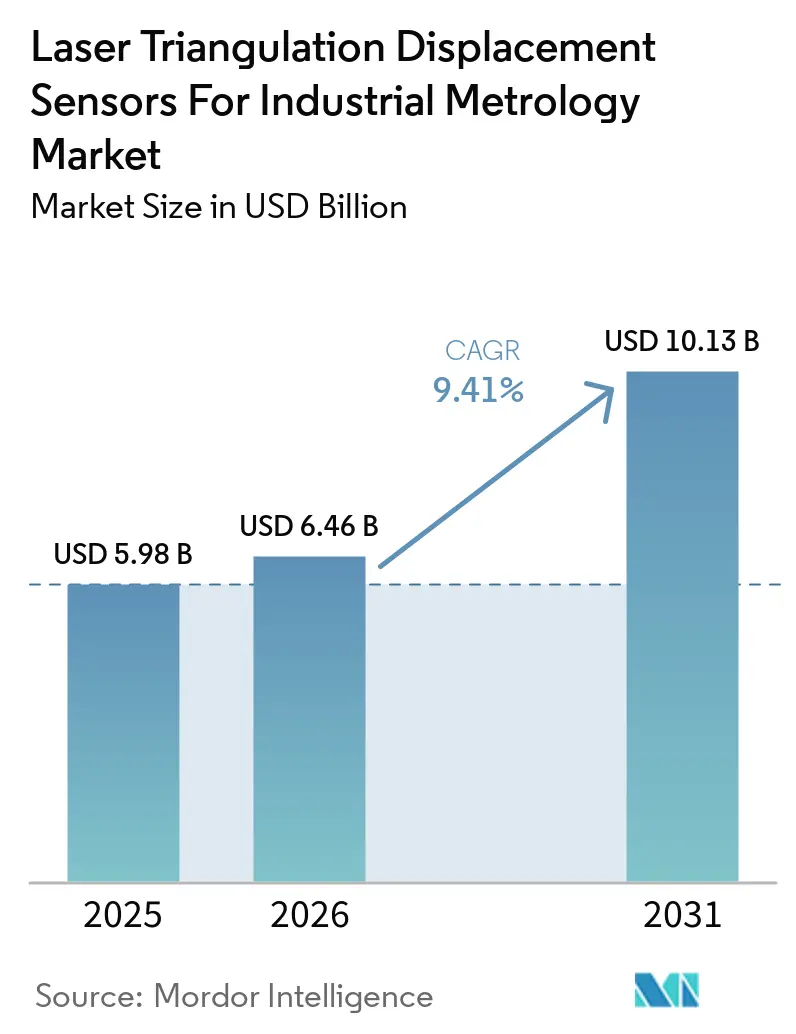
The Laser triangulation displacement sensors for industrial metrology market size is expected to increase from USD 5.98 billion in 2025 to USD 6.46 billion in 2026 and reach USD 10.13 billion by 2031, expanding at a CAGR of 9.41% over 2026-2031. The market is being shaped by new production lines that build noncontact dimensional verification into their operating design. Electric vehicle battery plants, advanced semiconductor packaging lines, and robotic cells are central to this demand. Inline measurement is becoming more common because it checks parts at production speed without removing them from the line. This change raises system complexity and revenue per installation compared with retrofit work. It also favors suppliers that combine optical hardware, calibration, software, and production-system connectivity.
Key Report Takeaways
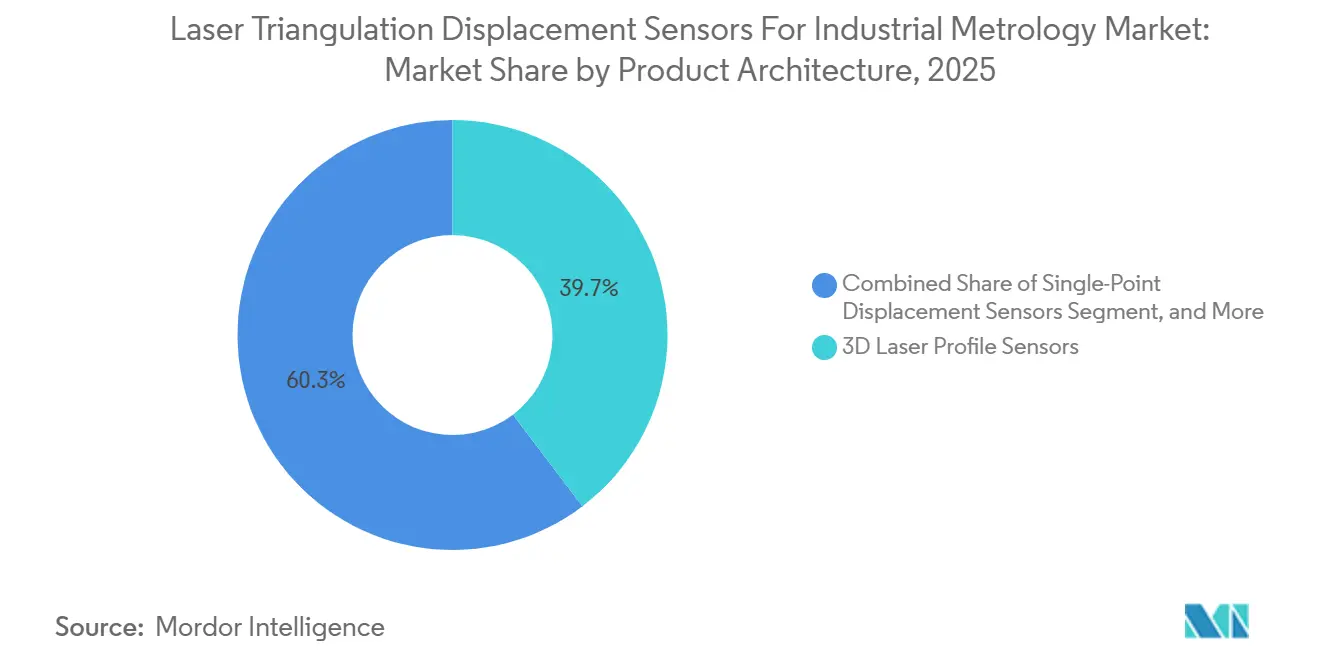
- By product architecture, 3D laser profile sensors held 39.67% of the laser triangulation displacement sensors for the industrial metrology market share in 2025, while multi-point and array-based sensors are projected to expand at a 9.83% CAGR through 2031.
- By output and integration, Ethernet-based output held 34.83% of the laser triangulation displacement sensors for the industrial metrology market share in 2025, while IO-Link and Industrial Fieldbus outputs are projected to expand at a 9.66% CAGR through 2031.
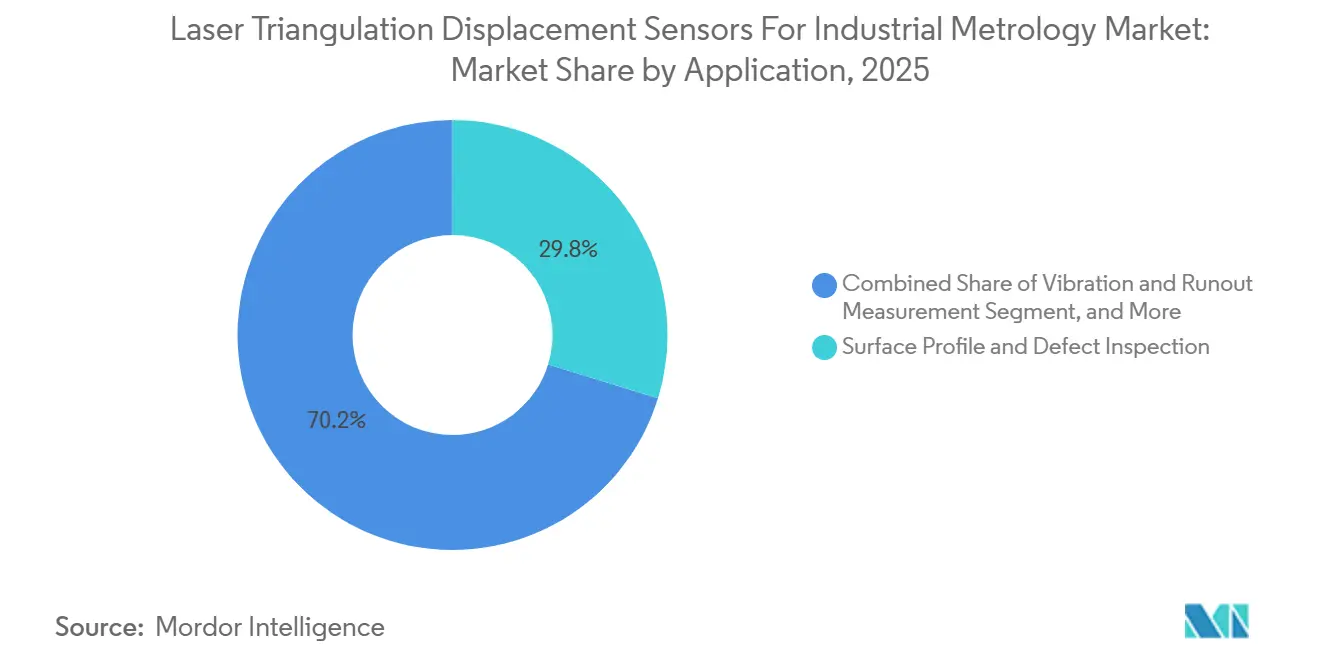
- By application, surface profile and defect inspection accounted for 29.76% of the market size in 2025 and is projected to expand at a 9.89% CAGR through 2031.
- By end-user industry, automotive and electric vehicles held 24.67% revenue share in 2025, while electronics and semiconductors are projected to expand at a 10.14% CAGR through 2031.
- By geography, Asia-Pacific held 43.27% revenue share in 2025 and is projected to expand at a 10.22% CAGR through 2031.
Note: Market size and forecast figures in this report are generated using Mordor Intelligence’s proprietary estimation framework, updated with the latest available data and insights as of January 2026.
Global Laser Triangulation Displacement Sensors For Industrial Metrology Market Trends and Insights
Drivers Impact Analysis*
| Driver | (~) % Impact on CAGR Forecast | Geographic Relevance | Impact Timeline |
|---|---|---|---|
| EV Battery Gigafactory Inline Quality Control | +2.2% | Global, concentrated in China, Germany, and North America | Short term (≤ 2 years) |
| Semiconductor Node Shrink and Advanced Packaging Inspection | +1.8% | Asia-Pacific core, including Taiwan, South Korea, and Japan, with spillover to North America | Medium term (2-4 years) |
| Industrial Robot and Machine Tool Deployment | +1.5% | Global, led by China, Germany, Japan, and the United States | Short term (≤ 2 years) |
| Digital Twin and Closed-Loop Manufacturing Adoption | +1.2% | North America and Europe, accelerating in Asia-Pacific | Medium term (2-4 years) |
| High-Speed Blue-Laser Measurement on Reflective Materials | +0.9% | Global, with the highest effect in automotive and electronics | Medium term (2-4 years) |
| Edge Processing for High-Throughput Inspection | +0.7% | Global, concentrated in semiconductor and EV battery lines | Long term (≥ 4 years) |
| Source: Mordor Intelligence | |||
EV Battery Gigafactory Inline Quality Control
The laser triangulation displacement sensors for the industrial metrology market are supported by battery plants that require inline checks at electrode coating, cell stacking, module welding, and pack closure. These steps require reliable geometric control because a single deviation can affect battery quality and safety. Plants that make cylindrical, prismatic, and pouch cells need modular sensor arrays rather than fixed single-point instruments. That requirement increases the value and technical scope of each installation. Automation W+R GmbH launched BATTERYSPECT-3D in March 2026 for inline inspection of more than 1,000 battery geometry features in under 1 minute at speeds up to 400 mm/s. Its OPC UA connection shows why standardized data exchange is important in European battery plant tenders.[1]Automation W+R GmbH, “New Standards for Battery Production: Automation W+R Presents 100% Inline Inspection for High-Voltage Batteries,” Battery Tech Association, batterytechassociation.org
Semiconductor Node Shrink and Advanced Packaging Inspection
Advanced packaging is increasing the dimensional control needs in the laser triangulation displacement sensors for the industrial metrology market. Interposers, 3D die stacks, and hybrid bonding require measurement across complex surfaces at production throughput. Laser systems with submicron Z-repeatability are used for wafer-level and package-level inspection. LMI Technologies introduced the Gocator 6300 Series in March 2025 with more than 6,500 points per profile, 2.1 µm X-interval resolution, 0.15 µm Z-repeatability, and scan rates up to 1.8 kHz.[2]LMI Technologies, “LMI Technologies Launches New Class of Powerhouse Smart 3D Laser Line Profilers,” LMI Technologies, lmi3d.com Semiconductor stacks combine copper bumps, organic materials, and photoresist layers with different optical behavior. This supports demand for multi-wavelength and multi-point configurations instead of single-wavelength, single-point designs.
Industrial Robot and Machine Tool Deployment
The wider use of six-axis robots and collaborative robots is increasing demand for compact laser sensors that provide real-time positional feedback. The laser triangulation displacement sensors for the industrial metrology market benefit when these devices are mounted near tooling or integrated into robotic inspection cells. Precision assembly and machining need measurements at millisecond response times. Robot-mounted equipment also needs to tolerate shock, vibration, and repeated thermal cycling. These conditions support demand for IP67-rated, short-baseline optical designs. Suppliers with application experience in robot integration can address requirements that laboratory-grade instruments do not meet. This need extends from positioning and guidance to correction, inspection, and process validation.
Digital Twin and Closed-Loop Manufacturing Adoption
Digital twin systems use continuous dimensional information from physical assets to update production decisions. Laser triangulation displacement sensors supply dense measurement data at sub-second intervals for closed-loop control. The laser triangulation displacement sensors for the industrial metrology market, therefore, benefit from systems that process calibrated information near the measurement point. Suppliers that provide outputs accepted by digital twin platforms can reduce integration work for customers. A 2026 study reported that a digital twin coupled with real-time laser scanning achieved surrogate-model fidelity above 95% and reduced computational latency by 85-90% compared with physics-only simulation. The result supports practical, real-time process control in applications that require rapid dimensional feedback.[3]“Physics-Driven Digital Twin Based Architecture of Wire Arc Additive Manufacturing,” International Journal of Advanced Manufacturing Technology, link.springer.com
Restraints Impact Analysis*
| Restraint | (~) % Impact on CAGR Forecast | Geographic Relevance | Impact Timeline |
|---|---|---|---|
| Measurement Uncertainty on Mixed-Reflectivity and Transparent Surfaces | -1.0% | Global, with the highest effect in electronics and battery manufacturing | Short term (≤ 2 years) |
| Shortage of Metrology Integration Specialists | -0.8% | Global, acute in North America, Germany, and Japan | Medium term (2-4 years) |
| Fragmented Measurement Software and Industrial Protocols | -0.6% | Global, concentrated in multivendor automation environments | Medium term (2-4 years) |
| Export Controls and Volatility in Precision Optics Components | -0.5% | North America and Europe, with an indirect effect on Asia-Pacific supply chains | Short term (≤ 2 years) |
| Source: Mordor Intelligence | |||
Measurement Uncertainty on Mixed-Reflectivity and Transparent Surfaces
Mixed-reflectivity surfaces remain a practical limit for the laser triangulation displacement sensors for the industrial metrology market. Partially anodized battery casings, electroplated copper traces, and clear films can cause signal dropout and speckle noise. Transparent separator films, optical adhesives, and photoresist layers can also refract the beam and create systematic bias. Surface-specific calibration can address some cases, but it can interrupt production cycles. Micro-Epsilon launched the scanCONTROL LLT8x00 in April 2026 with a 520 nm green laser to improve measurement on shiny metal, PCBs, and translucent surfaces.[4]Micro-Epsilon, “Micro-Epsilon Launches Next-Generation 4K Laser Scanners with Breakthrough Green Laser Technology,” Micro-Epsilon, micro-epsilon.co.uk Specular reflection still limits pure triangulation on some high-value targets, which preserves roles for confocal and interferometric alternatives.
Shortage of Metrology Integration Specialists
Complex inline installations require knowledge of optical calibration, robot kinematics, industrial networks, and measurement uncertainty. This combination of skills is limited in the laser triangulation displacement sensors for the industrial metrology industry. The scarcity can raise staffing costs and reduce system integrator margins. Experienced professionals are concentrated in major precision manufacturing centers, including Stuttgart, Osaka, and Boston. In-house teams may operate multi-point arrays in basic single-measurement modes when they lack detailed application experience. This limits the measurement capacity realized by a customer and can delay follow-on purchases. The constraint affects deployment speed even where hardware demand remains strong.
*Our forecasts treat driver/restraint impacts as directional, not additive. The impact forecasts reflect baseline growth, mix effects, and variable interactions.
Segment Analysis
By Product Architecture: 3D Profile Sensors Lead Revenue While Arrays Advance
3D laser profile sensors held 39.67% of the laser triangulation displacement sensors for industrial metrology market share in 2025. Their position reflects use in weld seam verification, electrode geometry inspection, and robotic end-effector guidance. A scan line supplies cross-sectional data that a single-point device cannot provide. These sensors are relevant where a production process needs continuous shape information. The laser triangulation displacement sensors for the industrial metrology market size for profile systems are supported by applications that combine inspection and guidance. This architecture also fits cells that transfer dense measurement data to industrial control systems.
Single-point displacement sensors remain important for vibration monitoring, spindle runout, and tool positioning. Micro-Epsilon stated that its optoNCDT 5500 reached a 150 kHz measurement rate with 8 nm repeatability in 2025. Multi-point and array-based sensors are projected to expand at a 9.83% CAGR through 2031. They serve battery cell geometry checks and round-component inspection that need simultaneous measurements at several positions. Micro-Epsilon described profileGAUGE X.LP-3D as a system using 4 scanners at 90-degree intervals for 360-degree capture with ±5 µm system accuracy. The product mix is expected to shift toward profile and array configurations, increasing system value per installed line.



By Output and Integration: Ethernet Leads While IO-Link Gains Ground
Ethernet-based output held 34.83% of the laser triangulation displacement sensors for the industrial metrology market share in 2025. Ethernet carries dense 3D point-cloud data from profile sensors to industrial PCs, SCADA layers, and manufacturing execution systems. This capacity is important for time-sensitive inspection loops. It also supports production environments where several measurement streams must remain available at once. Ethernet-based links fit high-bandwidth data requirements in new automated manufacturing cells.
IO-Link and Industrial Fieldbus Output is projected to expand at a 9.66% CAGR through 2031. The format supports digitally addressable networks standardized under IEC 61131-9. Micro-Epsilon added IO-Link interfaces to the optoNCDT 1220 and ILR3800-100 during 2024 and 2025. Digital connections can allow automatic re-parameterization when a sensor is replaced. They can also reduce commissioning time on production lines. Analog output remains relevant for legacy retrofits, while RS422 and USB continue to serve laboratory applications. Their combined addressable base is narrowing as new specifications favor digital connectivity.
By Application: Surface Inspection Holds Scale and Momentum
Surface profile and defect inspection held 29.76% of the laser triangulation displacement sensors for the industrial metrology market size in 2025. The application is projected to expand at a 9.89% CAGR through 2031. Electric vehicle battery quality requirements and semiconductor packaging both require complete surface coverage at production speed. Weld pores, coating voids, die warpage contours, and adhesive bead geometry all require verification. The number of relevant surface features per unit rises as product geometries become smaller.
Continuous inline measurement is replacing sampling-based checks in these applications. Coordinate measuring machine workflows cannot support every high-volume inspection need at production speed. Height, thickness, and width measurement remain core applications for single-point sensors in metal stamping, electrode calendering, and glass processing. Position, alignment, and gap measurement support robotic calibration and mixed-material vehicle assembly. Vibration and runout measurement serve spindle and precision bearing producers. Completeness and presence inspection checks parts and connector engagement in high-volume electronics assembly. The laser triangulation displacement sensors for the industrial metrology market also benefit where tactile inspection is too slow for the required throughput.
By End-User Industry: Automotive Provides Scale While Semiconductors Lead Growth
Automotive and electric vehicles held 24.67% of the laser triangulation displacement sensors for industrial metrology market share in 2025. Demand is supported by long-established use across body stamping, powertrain machining, and battery assembly. A single gigafactory line can require hundreds of profile sensors. These sensors support electrode slitting, cell stacking, module welding, and pack sealing. The installed base creates repeat demand for replacement, expansion, and system upgrades.
Electronics and semiconductors is projected to expand at a 10.14% CAGR through 2031. Its demand is linked to advanced packaging, silicon carbide power devices, and memory stacking applications. AT Sensors and ASMPT deployed a Coplan C6-3070CS laser profiler with 3,072 measurement points per profile at 12.5 kHz for inline BGA coplanarity inspection. Industrial machinery and robotics remain steady users as machine-tool builders integrate on-machine measurement. Aerospace and defense, energy and battery materials, and medical devices have lower volume but higher unit values. Their certification requirements can extend sales cycles and support premium margins for established suppliers.
Geography Analysis
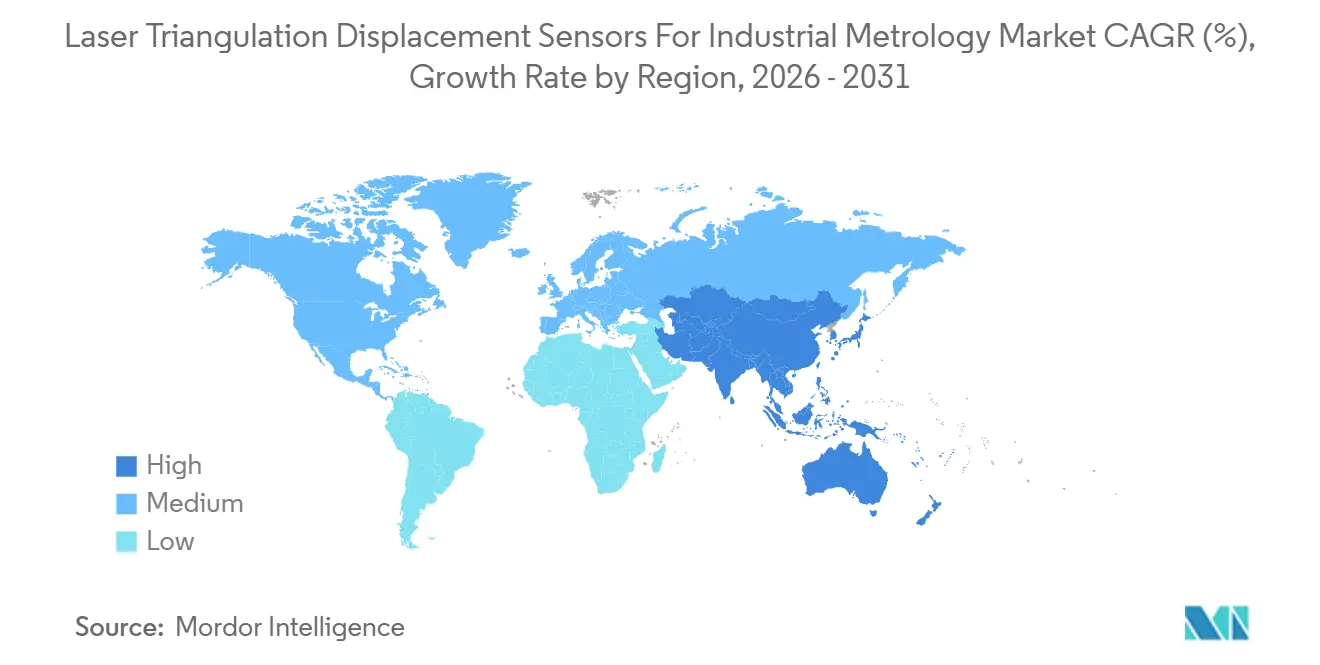
Asia-Pacific held 43.27% of the laser triangulation displacement sensors for industrial metrology market share in 2025 and is projected to expand at a 10.22% CAGR through 2031. China, Japan, South Korea, Taiwan, and India hold substantial metrology-intensive manufacturing capacity. China’s T/AIIA 001-2026 technical specification for laser displacement sensors took effect on March 20, 2026. The standard covers linearity, repeatability, resolution, temperature drift, and electromagnetic compatibility. These criteria influence procurement standards in China. Japan and South Korea remain important precision manufacturing centers with close links to machinery and semiconductor equipment supply chains.
Europe holds the second-largest regional position in the laser triangulation displacement sensors for industrial metrology market. Germany’s precision machinery sector and automotive supply chain provide a large application base. ISO 9001 and IATF 16949 frameworks make calibration traceability a core manufacturing requirement. Stuttgart, Munich, and Ingolstadt are active automotive centers for inline laser profiling deployment. Battery production requires geometric verification at each process station. The United Kingdom, France, Italy, and Spain add demand from aerospace structures, medical devices, and railway inspection. European manufacturers also need systems that can work within established automation and quality frameworks.
North America holds the third-largest regional position. The United States concentrates demand in semiconductor locations in Arizona, Oregon, and New York, along with battery sites in Nevada, Tennessee, and Michigan. These production investments create multiyear sensor procurement requirements through 2031. Canada and Mexico contribute through automotive tier-1 and tier-2 manufacturing. Mexico’s Bajío corridor hosts German and Japanese supplier operations that use established sensor ecosystems. South America and the Middle East and Africa are smaller in aggregate. Brazil leads South American adoption through industrial automation, while Saudi Arabia and the United Arab Emirates support demand through energy automation and industrial development programs.

Competitive Landscape
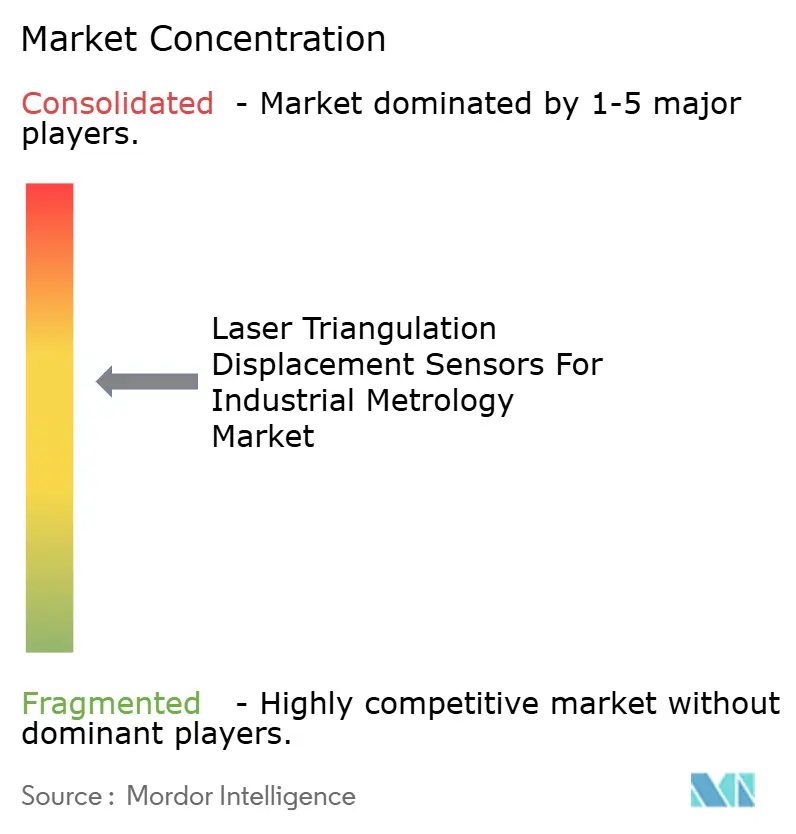
The laser triangulation displacement sensors for the industrial metrology market are moderately concentrated. KEYENCE Corporation, Micro-Epsilon Messtechnik GmbH and Co. KG, SICK AG, and LMI Technologies hold strong positions through optical engine design, calibration algorithms, and application software. Their offerings combine sensor hardware with tools for complex measurement tasks. This is difficult for hardware-only suppliers to match quickly. KEYENCE uses a direct-sales model that provides close customer engagement and rapid feedback on applications. Micro-Epsilon covers single-point optoNCDT sensors and multi-scanner profileGAUGE systems. This range serves both laboratory applications and demanding inline industrial work.
Competition is also shaped by system integration and surface-specific measurement capability. The laser triangulation displacement sensors for the industrial metrology market create opportunities for edge processing, multi-wavelength sensing, and platforms that contribute data to enterprise quality systems. LMI Technologies launched Gocator 2D Smart Cameras in January 2026 with NVIDIA Jetson Orin NX processing and browser-based GoPxL programming. The company positioned the system to reduce deployment time and limit dependence on external computers or cloud services. Micro-Epsilon introduced its scanCONTROL LLT8x00 with green-laser technology in April 2026 to improve high-speed measurement across reflective and translucent materials. These moves show a focus on quicker integration and broader surface coverage.
Smaller specialists can win contracts through application-specific engineering. AT Sensors demonstrated this approach through the custom BGA profiler deployed with ASMPT. AT SENSORS Such systems can address precise semiconductor packaging requirements that broad portfolios may not configure for each customer. Chinese manufacturers, including SinceVision and AKUSENSE, are narrowing the mid-range gap with CMOS-based sensors for semiconductor and battery lines. China’s 2026 technical specification creates clearer procurement benchmarks for these suppliers. The competitive environment remains centered on measurement accuracy, application expertise, integration support, and data handling. The leading suppliers maintain differentiation through their installed base and technical sales relationships.
Laser Triangulation Displacement Sensors For Industrial Metrology Industry Leaders
KEYENCE CORPORATION
SICK AG
Panasonic Holdings Corporation
Micro-Epsilon Messtechnik GmbH & Co. KG
OMRON Corporation
- *Disclaimer: Major Players sorted in no particular order

Recent Industry Developments
- April 2026: Micro-Epsilon launched the scanCONTROL LLT8x00 Series with 520 nm Green Laser Technology, delivering up to 4,224 points per profile, Z-axis linearity below 0.8 µm, and a 10 kHz profile frequency with full 3D onboard processing, targeting EV battery cell geometry verification, PCB inspection, weld seam measurement, and semiconductor packaging.
- March 2026: Automation W+R GmbH in Munich launched BATTERYSPECT-3D, enabling 100% inline surface inspection and geometry measurement of automotive high-voltage batteries at scanning speeds up to 400 mm/s, inspecting more than 1,000 geometry features per battery in under 1 minute with OPC UA integration to manufacturing execution systems.
- March 2026: China’s T/AIIA 001-2026, Technical Specifications for Laser Displacement Sensors, entered into effect on March 20, 2026. The country’s first systematic group standard for the category was drafted by AKUSENSE under the Shenzhen Artificial Intelligence Industry Association and covers linearity, repeatability, resolution, temperature drift, and electromagnetic compatibility.
- January 2026: LMI Technologies launched Gocator 2D Smart Cameras with 5 MP and 12 MP global-shutter models at up to 84 fps, onboard NVIDIA Jetson Orin NX edge AI compute, and browser-based GoPxL drag-and-drop software, removing external PC and cloud dependencies for factory-floor inspection deployments.


Global Laser Triangulation Displacement Sensors For Industrial Metrology Market Report Scope
Laser Triangulation Displacement Sensors for Industrial Metrology Market refers to non-contact optical sensors that use the laser triangulation principle to measure distance, displacement, position, and surface profile with micrometer-level accuracy in manufacturing and quality-control environments. These systems include single-point and line laser triangulation sensors, 2D/3D profile sensors, and multi-sensor setups for thickness, height, gap/flush, step height, vibration, and runout measurement, often integrated into inline inspection stations and closed-loop control systems.
The Laser Triangulation Displacement Sensors for Industrial Metrology Market Report is Segmented by Product Architecture (Single-Point, 3D Profile, Multi-Point, and Array-Based), Output and Integration (Analog, Ethernet, IO-Link, and Digital Interface), Application (Height, Thickness, and Width Measurement, Surface Profile and Defect Inspection, Position, Alignment, and Gap Measurement, Vibration and Runout Measurement, Completeness and Presence Inspection, and Other Applications), End-User Industry (Automotive and Electric Vehicles, Electronics and Semiconductors, Industrial Machinery and Robotics, Aerospace and Defense, Energy, Power, and Battery Materials, Medical Devices, and Other End-User Industries), and Geography (North America, South America, Europe, Asia-Pacific, and Middle East and Africa). The Market Forecasts are Provided in Terms of Value (USD).
| Single-Point Displacement Sensors |
| 3D Laser Profile Sensors |
| Multi-Point and Array-Based Sensors |
| Analog Output |
| Ethernet-Based Output |
| IO-Link and Industrial Fieldbus Output |
| Digital Interface (RS422/USB) Output |
| Height, Thickness, and Width Measurement |
| Surface Profile and Defect Inspection |
| Position, Alignment, and Gap Measurement |
| Vibration and Runout Measurement |
| Completeness and Presence Inspection |
| Other Applications |
| Automotive and Electric Vehicles |
| Electronics and Semiconductors |
| Industrial Machinery and Robotics |
| Aerospace and Defense |
| Energy, Power, and Battery Materials |
| Medical Devices |
| Other End-User Industries |
| North America | United States | |
| Canada | ||
| Mexico | ||
| South America | Brazil | |
| Argentina | ||
| Rest of South America | ||
| Europe | Germany | |
| United Kingdom | ||
| France | ||
| Italy | ||
| Spain | ||
| Rest of Europe | ||
| Asia-Pacific | China | |
| Japan | ||
| India | ||
| South Korea | ||
| ASEAN | ||
| Rest of Asia-Pacific | ||
| Middle East and Africa | Middle East | Saudi Arabia |
| United Arab Emirates | ||
| Turkey | ||
| Rest of the Middle East | ||
| Africa | South Africa | |
| Nigeria | ||
| Rest of Africa | ||
| By Product Architecture | Single-Point Displacement Sensors | ||
| 3D Laser Profile Sensors | |||
| Multi-Point and Array-Based Sensors | |||
| By Output and Integration | Analog Output | ||
| Ethernet-Based Output | |||
| IO-Link and Industrial Fieldbus Output | |||
| Digital Interface (RS422/USB) Output | |||
| By Application | Height, Thickness, and Width Measurement | ||
| Surface Profile and Defect Inspection | |||
| Position, Alignment, and Gap Measurement | |||
| Vibration and Runout Measurement | |||
| Completeness and Presence Inspection | |||
| Other Applications | |||
| By End-User Industry | Automotive and Electric Vehicles | ||
| Electronics and Semiconductors | |||
| Industrial Machinery and Robotics | |||
| Aerospace and Defense | |||
| Energy, Power, and Battery Materials | |||
| Medical Devices | |||
| Other End-User Industries | |||
| By Geography | North America | United States | |
| Canada | |||
| Mexico | |||
| South America | Brazil | ||
| Argentina | |||
| Rest of South America | |||
| Europe | Germany | ||
| United Kingdom | |||
| France | |||
| Italy | |||
| Spain | |||
| Rest of Europe | |||
| Asia-Pacific | China | ||
| Japan | |||
| India | |||
| South Korea | |||
| ASEAN | |||
| Rest of Asia-Pacific | |||
| Middle East and Africa | Middle East | Saudi Arabia | |
| United Arab Emirates | |||
| Turkey | |||
| Rest of the Middle East | |||
| Africa | South Africa | ||
| Nigeria | |||
| Rest of Africa | |||


Key Questions Answered in the Report
What is the size of the laser triangulation displacement sensors for industrial metrology market?
The market size is expected to increase from USD 5.98 billion in 2025 to USD 6.46 billion in 2026 and reach USD 10.13 billion by 2031 at a 9.41% CAGR. The outlook reflects expanding use of noncontact dimensional verification in battery, semiconductor, and robotic production environments.
Which product architecture led revenue in 2025?
3D laser profile sensors led product architecture revenue with a 39.67% share in 2025. Their use in weld verification, electrode geometry inspection, and robotic guidance supports their leading position.
Which application is expected to expand fastest through 2031?
Surface profile and defect inspection is projected to expand at a 9.89% CAGR through 2031. It is used to verify features such as weld pores, coating voids, die warpage contours, and adhesive bead geometry.
Which end-user sector has the highest projected CAGR?
Electronics and semiconductors is projected to expand at a 10.14% CAGR through 2031. Advanced packaging, silicon carbide power devices, and memory stacking require thickness and flatness verification at production speed.
Which region leads demand for these sensors?
Asia-Pacific held 43.27% revenue share in 2025 and is projected to expand at a 10.22% CAGR through 2031. Its position reflects manufacturing capacity across China, Japan, South Korea, Taiwan, and India.
What limits adoption in challenging inspection environments?
Mixed-reflectivity and transparent surfaces can cause signal noise, dropout, and measurement bias in pure triangulation systems. The constraint is relevant to battery casings, electroplated traces, clear films, separator films, optical adhesives, and photoresist layers.
Page last updated on:





