
Non-Concentrating Solar Collector Market Size and Share
Market Overview
| Study Period | 2022 - 2032 |
|---|---|
| Market Size (2027) | USD 15.67 Billion |
| Market Size (2032) | USD 28.07 Billion |
| Growth Rate (2027 - 2032) | 12.36 % |
| Fastest Growing Market | Middle East and Africa |
| Largest Market | Asia-Pacific |
| Market Concentration | Medium |
Major Players *Disclaimer: Major Players sorted in no particular order Image © Mordor Intelligence. Reuse requires attribution under CC BY 4.0. | |
Non-Concentrating Solar Collector Market Analysis by Mordor Intelligence
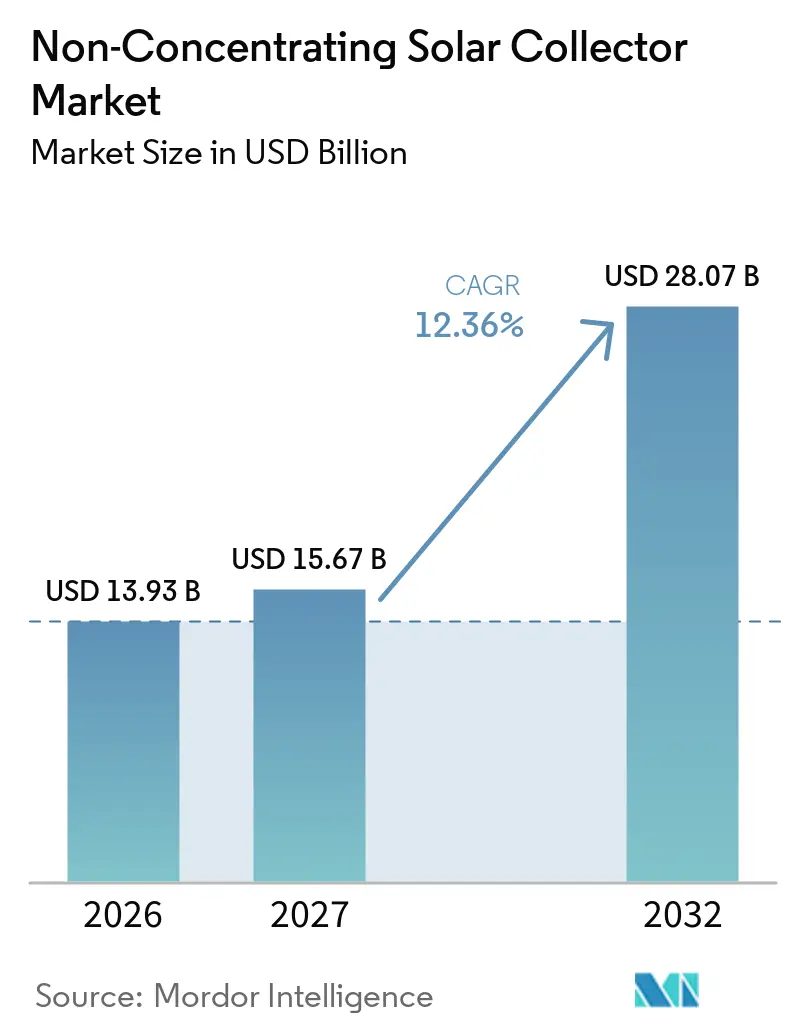
The Non-Concentrating Solar Collector Market size is projected to expand from USD 13.93 billion in 2026 and USD 15.67 billion in 2027 to USD 28.07 billion by 2032, registering a CAGR of 12.36% between 2027 and 2032. The non-concentrating solar collector market is supported by building rules, industrial heat needs, and interest in energy security. The non-concentrating solar collector market serves domestic water heating, commercial hot water, district networks, and lower-temperature industrial processes. The non-concentrating solar collector market has an installed base that creates future replacement and retrofit demand, while larger systems are opening opportunities for commercial and industrial projects. Global solar thermal capacity reached 544 GWth across 777 million m² at the end of 2024, with annual output of 443 TWh and cumulative carbon dioxide savings of 153.5 million metric tons.[1] Competition from heat pumps and solar photovoltaic (PV) is strongest in homes, but solar thermal remains well suited to facilities with steady demand for heat and limited roof space.
Key Report Takeaways
- By collector type, evacuated-tube collectors held 61.3% in 2026, while solar air collectors are forecast to grow at a 12.8% CAGR through 2032.
- By system type, thermosiphon systems held 42.6% in 2026, while pumped active systems are forecast to grow at a 12.7% CAGR through 2032.
- By end user, residential users held 64.8% in 2026, while industrial users are forecast to grow at a 13.2% CAGR through 2032.
- By geography, Asia-Pacific held 55.4% in 2026, while the Middle East and Africa are forecast to grow at a 12.5% CAGR through 2032.
Note: Market numbers in this report are based on Mordor Intelligence's proprietary estimation framework, which combines nine months of actuals with Q4 projections for base year 2026.
Market Trends and Insights
Drivers Impact Analysis of Non-Concentrating Solar Collector Market*
| Driver | (~) % Impact on CAGR Forecast | Geographic Relevance | Impact Timeline |
|---|---|---|---|
| Heating-Sector Decarbonization Mandates | +2.8% | Europe, North America, Asia-Pacific core | Medium term (2-4 years) |
| Industrial Solar Process Heat Adoption | +2.2% | Europe, Asia-Pacific, South America, Middle East and Africa | Long term (≥ 4 years) |
| Large, Consistent Commercial Hot-Water Loads | +1.5% | Global, concentrated in North America and Europe | Short term (≤ 2 years) |
| Solar Thermal and Heat Pump Hybridization | +1.3% | Europe, North America | Medium term (2-4 years) |
| Solar District Heating and Seasonal Thermal Storage | +1.4% | Europe, China, and the Middle East and Africa | Long term (≥ 4 years) |
| PVT Collector Integration for Dual Energy Output | +1.2% | Europe, Asia-Pacific, North America | Long term (≥ 4 years) |
| Source: Mordor Intelligence | |||
Heating-Sector Decarbonization Mandates
The non-concentrating solar collector market benefits where renewable heat is tied to building permits or public incentives. Article 10 of the recast Energy Performance of Buildings Directive requires Member States to introduce solar deployment measures for new and substantially renovated buildings. Solar Heat Europe states that national implementation should treat solar thermal and photovoltaic-thermal collectors equally, which broadens the compliance base for both technologies.[2] The Renewable Energy Directive requires annual increases of at least 1.1 percentage points in renewable energy used for heating and cooling from 2026 through 2030.[3] These rules place more weight on developers, contractors, and property owners than on individual household purchasers. The resulting pipeline is likely to favor suppliers that can provide certified systems, technical design support, and documentation for public programs.
Industrial Solar Process Heat Adoption
The non-concentrating solar collector market has a larger opportunity in industrial process heat than in most household projects. Global solar heat for industrial processes capacity reached 1,071 MWth across around 1,315 commissioned systems by early 2025. New plants installed in 2024 added 120 MWth across 106 projects.[4] A 2025 Fraunhofer ISE study found that solar thermal can be economical in a range of low- and medium-temperature processes in German industry, including a 34 MWth parabolic trough example in Würzburg with a 5.5-year payback period. Smaller drying and barn-heating applications broaden the customer base, while larger collector fields require complex project development and financing. This favors suppliers that can combine collector supply with engineering, storage, and long-term heat contracts.
Solar Thermal and Heat Pump Hybridization
The non-concentrating solar collector market is increasingly linked with heat-pump systems in cold and mixed climates. Water-based photovoltaic-thermal systems have reported electrical efficiencies of 8% to 22% and thermal efficiencies of 30% to 70% in a 2025 review. Germany recorded Europe’s largest volume of newly installed photovoltaic-thermal collectors in 2024. A shared roof installation can produce electricity and heat, which is useful where roof area is limited. This configuration can support heat-pump operation rather than position solar thermal as a separate alternative. Manufacturers that offer compatible collector, controls, and heat-pump interfaces can retain more of the value created by a retrofit project.
Solar District Heating and Seasonal Thermal Storage
The non-concentrating solar collector market gains from municipal and cooperative projects where existing district heating networks can use large volumes of renewable heat. Viessmann Climate Solutions (Viessmann Deutschland GmbH) completed a 3,076 m² solar thermal installation on Föhr in 2025, with a 500 m³ buffer tank and planned output above 1 GWh annually. The project is designed to cover more than 23% of the cooperative’s annual heating needs over a 30-year service life. Research on aquifer thermal energy storage found that pairing it with solar thermal can increase integrable solar heat by 178% to 276% compared with systems without seasonal storage. Storage allows collector fields to contribute beyond short daily demand cycles. This supports larger projects in locations where land, network access, and long-term heat demand are available.
Restraints Impact Analysis of Non-Concentrating Solar Collector Market*
| Restraint | (~) % Impact on CAGR Forecast | Geographic Relevance | Impact Timeline |
|---|---|---|---|
| Competition from Heat Pumps and Solar PV | -2.1% | Europe, North America, Asia-Pacific | Short term (≤ 2 years) |
| High Upfront Capital and Financing Sensitivity | -1.5% | Global, especially South America and the Middle East and Africa | Medium term (2-4 years) |
| Copper, Glass and Coating Input Volatility | -1.2% | Global | Medium term (2-4 years) |
| Installer, Design and Certification Capacity Gaps | -0.8% | Europe, North America, Asia-Pacific | Medium term (2-4 years) |
| Source: Mordor Intelligence | |||
Competition from Heat Pumps and Solar Photovoltaic (PV)
The non-concentrating solar collector market faces intense competition in residential heating from air-source heat pumps and PV systems connected to electric water heating. These alternatives can appear simpler to installers and may benefit from more established grant programs. Their advantage is most apparent in colder regions with limited winter sunlight. Solar thermal systems offer a different performance profile in applications requiring large, consistent volumes of hot water. Solar thermal collectors can deliver an annual thermal output of approximately 400–500 kWh/m², compared with 150–200 kWh/m² from an equivalent-area PV panel. Commercial swimming pools, hotels, laundries, and low-temperature industrial facilities can therefore remain strong use cases where available roof area is limited.
High Upfront Capital and Financing Sensitivity
The non-concentrating solar collector market faces constraints from high upfront costs associated with pumped systems, thermal storage, and site integration. These costs present a particular challenge for smaller companies with limited access to affordable project financing. Industrial adoption rates have been reported at 82% among large firms and 87% among medium-sized firms, compared with less than 37% among small firms, where initial investment remains a major concern. Solar Heat Europe has highlighted uncertainty caused by inconsistent national subsidy programs, which can delay investment decisions even when long-term operating economics are favorable. Service contracts and energy service company (ESCO) financing models can help reduce upfront capital requirements and improve the financial feasibility of industrial solar thermal projects.
*Our forecasts treat driver/restraint impacts as directional, not additive. The impact forecasts reflect baseline growth, mix effects, and variable interactions.
Non-Concentrating Solar Collector Market Segment Analysis
By Collector Type:
Evacuated-Tube Collectors Lead While Solar Air Collectors Gain GroundEvacuated-tube collectors held 61.3% of the non-concentrating solar collector market share in 2026. Their vacuum-insulated construction supports performance in cold and overcast conditions. A 2025 review in the International Journal of Heat and Technology describes how these designs reduce heat loss and retain output in variable irradiance. This helps explain their broad use in China, Central Asia, and Central and Eastern Europe. Large-scale production has also reduced their cost in high-volume residential applications. The non-concentrating solar collector market continues to rely on evacuated tubes where annual operating conditions make thermal retention important.
Within the non-concentrating solar collector market, solar air collectors are the fastest-growing collector category, with a forecast CAGR of 12.8% through 2032. They are used for agricultural drying, ventilation preheating, and lower-temperature industrial heating. Their design can avoid the liquid circuits and freeze risks associated with water-based systems. This gives them a practical role in farms, warehouses, and industrial buildings with significant airflow requirements. Flat-plate collectors remain competitive in Mediterranean climates and other lower-temperature applications because of their simple installation. Unglazed water collectors continue to serve pool heating in North America and Australia, where low cost is more important than high operating temperatures.
By System Type:
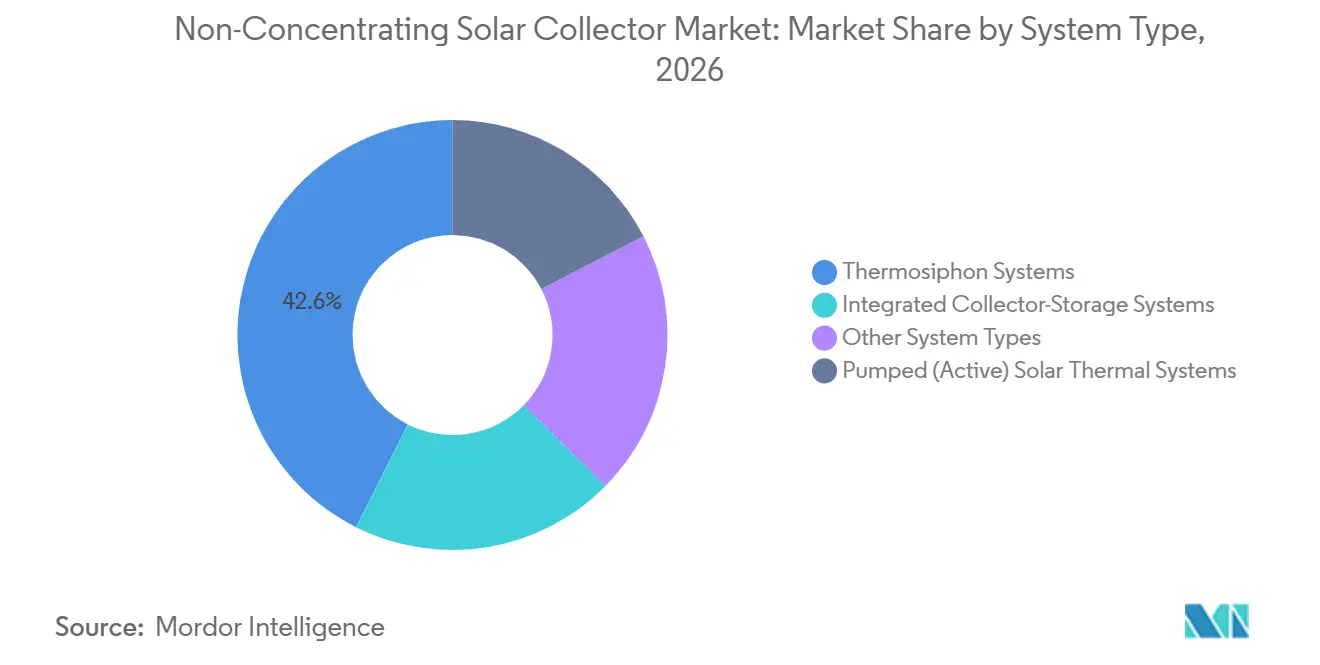
Thermosiphon Systems Retain Residential Strength While Active Systems ScaleThermosiphon systems accounted for 42.6% of total demand in 2026. They use natural circulation and require little maintenance. Their electricity-free operation is attractive for homes in high-irradiance regions. Integrated roof-mounted storage can also keep installed complexity low in suitable climates. These conditions make thermosiphon systems a durable option for households where space and building design permit them. Their role remains strongest in straightforward hot-water applications rather than large multi-building systems.
Pumped active systems are expected to expand to a 12.7% CAGR through 2032. They can serve larger collector areas and control heat movement between collectors, heat exchangers, and storage units. This makes them more appropriate for commercial facilities, industrial sites, and district networks. The non-concentrating solar collector market size for active systems is supported by projects that require seasonal storage and precise operating control. Aquifer thermal energy storage can materially increase the amount of solar heat that can be integrated into a district energy system. The shift toward active systems increases the importance of engineering, control design, and commissioning services.
By End User:
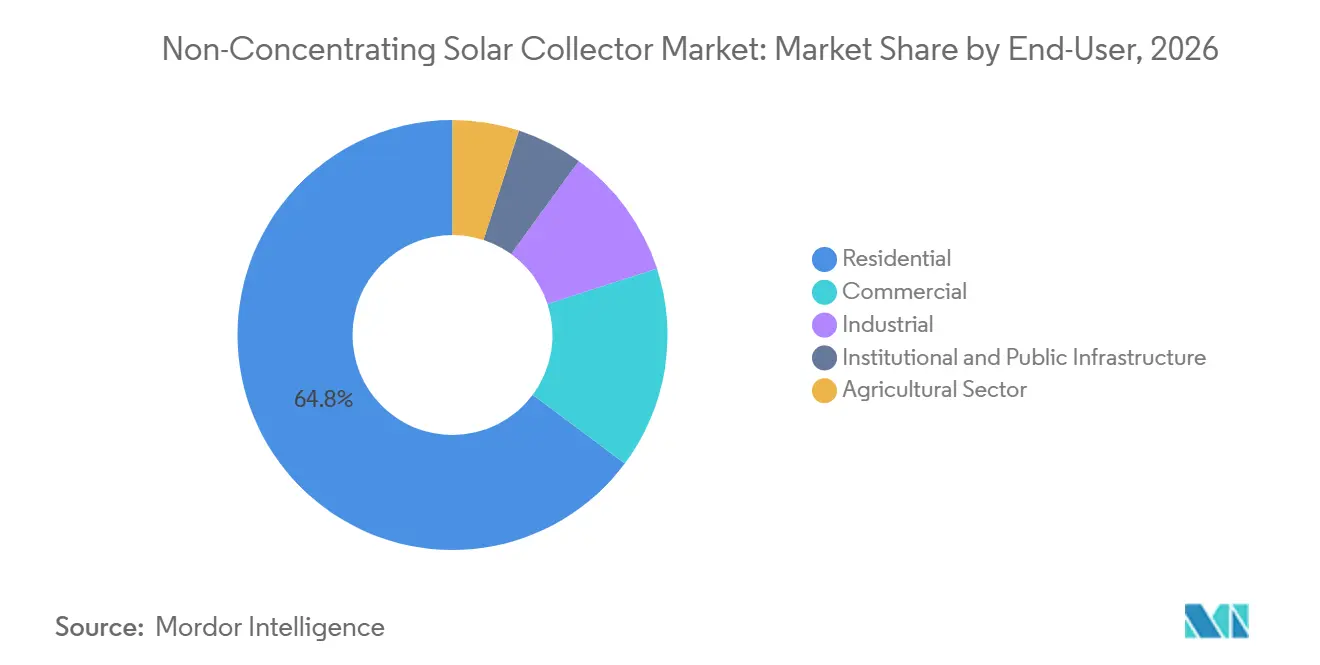
Residential Demand Provides Volume While Industrial Users Expand FasterResidential users held 64.8% of total demand in 2026. China’s installed base is largely made up of residential evacuated-tube water heaters. Household demand is often supported by public programs and by the appeal of reducing conventional water-heating use. Residential programs in sun-rich markets help sustain sales volumes where household budgets remain sensitive to installed cost. Residential demand remains price-sensitive, which favors proven products and simple installation models. The non-concentrating solar collector market remains anchored by this high-volume segment even as project values rise elsewhere.
Industrial end-users represent the fastest-growing demand segment within the non-concentrating solar collector market (or similar restructuring), with a projected CAGR of 13.2% through 2032. Process heat below 200 °C is a practical use case where solar thermal can displace fossil-fuel heating. Food processing, laundry operations, drying, and similar activities have regular daytime heat requirements. Larger sites can also support long-term heat supply contracts that avoid direct capital purchases. Commercial customers such as hotels, hospitals, sports centers, and retail sites occupy a useful middle position because they combine larger loads with stable utilization. Public and institutional projects add another source of demand where procurement rules prioritize renewable heat solutions.
Geography Analysis
APAC Non-Concentrating Solar Collector Market
Asia-Pacific held 55.4% of the non-concentrating solar collector market share in 2026. China’s manufacturing scale and extensive residential base are the main reasons for this position. The region also includes expanding commercial and industrial demand in Vietnam, Thailand, Indonesia, and South Korea. China accounts for a large share of regional installation volume by collector area, which has reduced global price levels for evacuated-tube products. India’s policy support maintains residential water-heater deployment in sun-rich states. The non-concentrating solar collector market in Asia-Pacific therefore combines mature household demand with newer opportunities in service and industrial facilities.
Europe Non-Concentrating Solar Collector Market
Europe has strong policy support, but near-term demand is sensitive to the timing of incentive programs. The Energy Efficiency Directive establishes renewable heat thresholds for district heating networks from 2027 through 2045. Germany’s market contracted in 2024 during a regulatory transition, while Turkey and Cyprus grew, according to the International Energy Agency Solar Heating and Cooling Programme (IEA-SHC) report. Spain, Italy, and Greece retain a resource advantage as solar requirements move into national building regulations. District heating, certified collector supply, and photovoltaic-thermal retrofits are central areas for suppliers in this region. The non-concentrating solar collector market in Europe depends on policy continuity as much as solar resource availability.
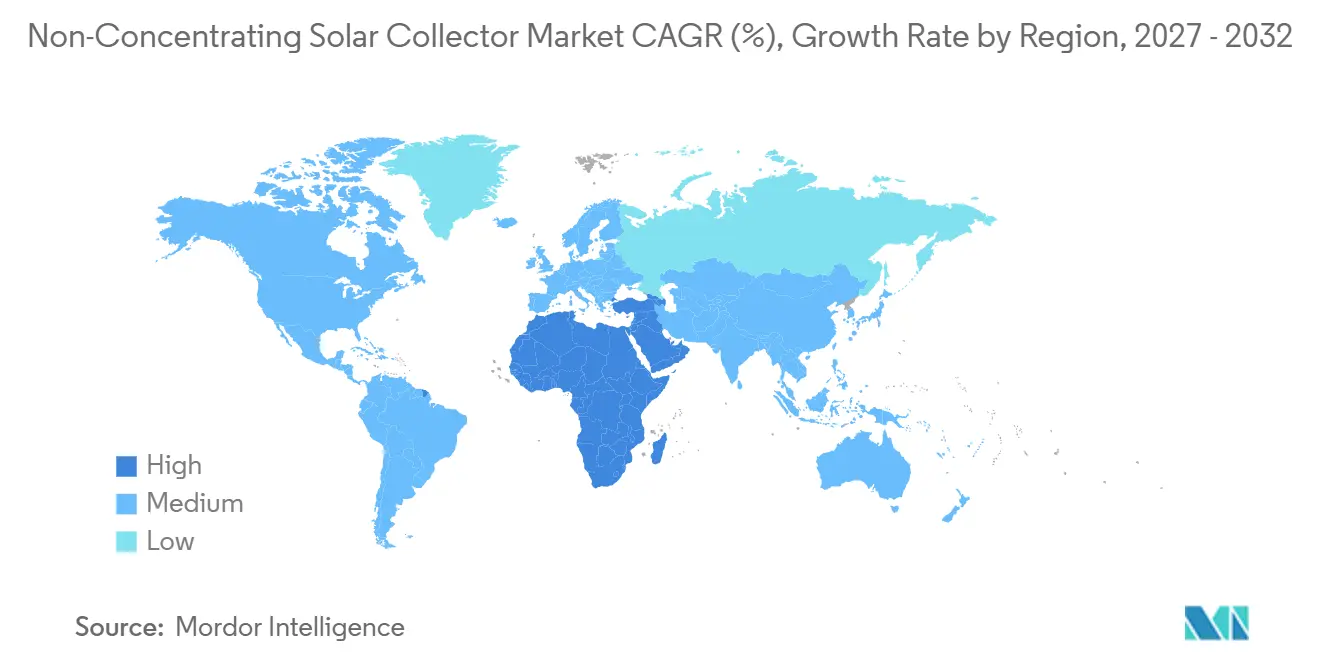
The Americas and MEA Non-Concentrating Solar Collector Market
North America combines residential water heating in the US Sun Belt, commercial pool heating, and emerging industrial use. Mexico expanded 14% in 2024, while the US declined 31% in the same year, according to International Energy Agency (IEA) Solar Heating and Cooling Programme (IEA-SHC) data. The Middle East and Africa is the fastest-growing regions at a 12.5% CAGR through 2032. Saudi Arabia’s renewable-energy goals and the UAE’s net-zero commitment support opportunities in hospitality, desalination, and infrastructure. South America also offers growing industrial applications, including food and mining operations that need lower-temperature heat. Chile remains a relevant location for industrial solar heat development.
Competitive Landscape
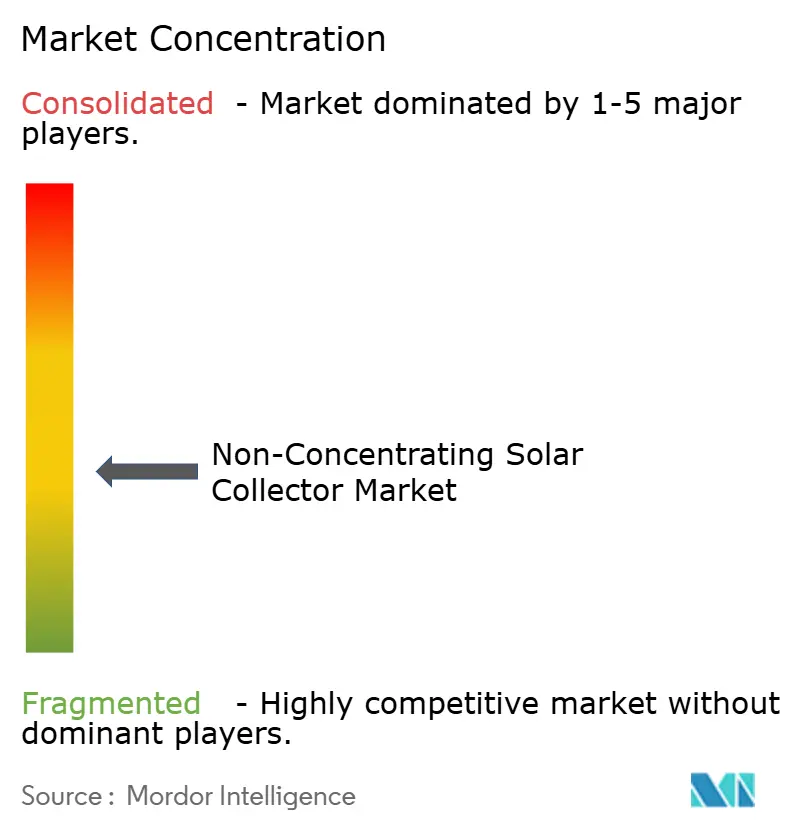
The non-concentrating solar collector market is moderately concentrated. Chinese producers, including Himin Solar and Sunrain, supply high-volume evacuated-tube products for residential applications. European firms, such as GREENoneTEC, Viessmann, Bosch Home Comfort, and BDR Thermea, focus on certified systems and complex integration. Their competitive positioning is supported by compliance with standards such as Solar Keymark and ISO 9806, alongside access to procurement opportunities requiring detailed technical documentation. GREENoneTEC has an annual flat-plate collector production capacity exceeding 1.6 million m². Overall, the market reflects a clear distinction between high-volume equipment suppliers and providers of higher-value system integration solutions.
European suppliers are targeting district heating and industrial projects where reliability, engineering expertise, and project execution matter as much as collector pricing. Viessmann Climate Solutions' 2025 installation on Föhr demonstrates this approach, featuring a 3,076 m² solar thermal collector field, buffer storage, and integration with a local heating cooperative. In Friesach, Austria, GREENoneTEC completed a 5,750 m² solar thermal system comprising 436 large-scale collectors and a 1,000 m³ storage tank operating at 90°C. Meanwhile, Sunrain expanded its partnership with Indonesia's Inti Solar in 2025 to include heat-pump products alongside solar water heaters. These developments illustrate how suppliers are broadening their equipment offerings to include integrated energy solutions, storage capabilities, and established local distribution partnerships.
Ariston maintains solar water-heater distribution in European and Middle Eastern residential channels. Its Kairos systems are listed by Dubai Municipality, which supports its route to the regional market. Rheem and A. O. Smith offer solar-compatible water-heating systems in North America and Australia. Solimpeks and Hewalex compete in price-sensitive and transition markets. The non-concentrating solar collector market also creates opportunities for photovoltaic-thermal systems, solar air collectors, and financing structures that reduce upfront cost.
Non-Concentrating Solar Collector Industry Leaders
-
GREENoneTEC Solarindustrie GmbH
-
Viessmann Group
-
Solimpeks Solar Energy Corp.
-
Sunrain Solar Energy Co., Ltd.
-
Bosch Thermotechnology GmbH
- *Disclaimer: Major Players sorted in no particular order
Non-Concentrating Solar Collector Market Companies Covered in this Report
- A. O. Smith Corporation
- Alternate Energy Technologies, LLC
- Apricus Solar Co., Ltd.
- Ariston Group
- BDR Thermea Group
- Bosch Thermotechnology GmbH
- Chromagen Ltd.
- Conserval Engineering Inc.
- GREENoneTEC Solarindustrie GmbH
- Hewalex Sp. z o.o. Sp. k.
- Himin Solar Co., Ltd.
- Kingspan Group
- Rheem Manufacturing Company
- Solimpeks Solar Energy Corp.
- SunEarth, Inc.
- SunMaxx Solar
- Sunrain Solar Energy Co., Ltd.
- Vaillant Group
- Viessmann Group
- WOLF GmbH
Recent Industry Developments in Non-Concentrating Solar Collector Market
- May 2026: Viessmann Climate Solutions and LichtBlick announced a strategic cooperation delivering integrated residential energy packages in Germany, combining Viessmann heat pumps, photovoltaic systems, energy storage units, and wallboxes with LichtBlick's power supply and automated price-optimized energy management, a move into residential energy-as-a-service that leverages Viessmann's heating and solar portfolio for recurring service revenue.
- May 2026: Sunrain Solar Energy Co., Ltd. expanded its partnership with Inti Solar in Indonesia to include heat-pump products alongside its solar water-heater range, extending a two-generation commercial relationship into new product categories
- November 2025: Solarwärme Bracht eG received the Energy Efficiency Award 2025 from the German Energy Agency in Berlin for its citizen-cooperative solar thermal local heating system built on Viessmann Climate Solutions technology.
- July 2025: Viessmann Deutschland GmbH completed a turnkey 3,076 m² solar thermal district heating system for Energiegenossenschaft Föhr eG on the North Sea island of Föhr, with a 500 m³ buffer tank, planned annual production above 1 GWh, and a 30-year service horizon covering more than 23% of the cooperative's heating requirements.
Global Non-Concentrating Solar Collector Market Report Scope
The Non-Concentrating Solar Collector Market comprises the manufacturing, distribution, and installation of solar thermal systems that capture and convert sunlight into thermal energy without optical magnification, such as mirrors or lenses. These systems feature a collection area (aperture) equal to the absorber area. This design enables continuous harvesting of both direct and diffuse (scattered) sunlight without requiring complex active sun-tracking mechanisms.
The global non-concentrating solar collector market is segmented by collector type, system type, end user, and geography. By collector type, the market is segmented into flat-plate, evacuated-tube, unglazed water, solar air, and other collector types. By system type, the market is segmented into thermosiphon, pumped/active, integrated collector storage (ICS), and other system types. By end user, the market is segmented into residential, commercial, industrial, institutional, and agricultural applications. The report also covers the market size and forecasts for the global non-concentrating solar collector market across 26 countries in key regions. For each segment, the market sizing and forecasts have been provided on the basis of value (USD).
Segmentation Overview
| Flat-Plate Collectors |
| Evacuated-Tube Collectors |
| Unglazed Water Collectors |
| Solar Air Collectors |
| Other Non-Concentrating Collector Types |
| Thermosiphon Systems |
| Pumped (Active) Solar Thermal Systems |
| Integrated Collector-Storage Systems |
| Other System Types |
| Residential |
| Commercial |
| Industrial |
| Institutional and Public Infrastructure |
| Agricultural Sector |
| North America | United States |
| Canada | |
| Mexico | |
| Europe | Germany |
| France | |
| Italy | |
| Spain | |
| United Kingdom | |
| Poland | |
| Russia | |
| Rest of Europe | |
| Asia-Pacific | China |
| India | |
| Japan | |
| South Korea | |
| Australia | |
| Indonesia | |
| Vietnam | |
| Thailand | |
| Rest of Asia-Pacific | |
| South America | Brazil |
| Argentina | |
| Chile | |
| Rest of South America | |
| Middle East and Africa | Saudi Arabia |
| United Arab Emirates | |
| Egypt | |
| South Africa | |
| Morocco | |
| Rest of Middle East and Africa |
| By Collector Type | Flat-Plate Collectors | |
| Evacuated-Tube Collectors | ||
| Unglazed Water Collectors | ||
| Solar Air Collectors | ||
| Other Non-Concentrating Collector Types | ||
| By System Type | Thermosiphon Systems | |
| Pumped (Active) Solar Thermal Systems | ||
| Integrated Collector-Storage Systems | ||
| Other System Types | ||
| By End User | Residential | |
| Commercial | ||
| Industrial | ||
| Institutional and Public Infrastructure | ||
| Agricultural Sector | ||
| By Geography | North America | United States |
| Canada | ||
| Mexico | ||
| Europe | Germany | |
| France | ||
| Italy | ||
| Spain | ||
| United Kingdom | ||
| Poland | ||
| Russia | ||
| Rest of Europe | ||
| Asia-Pacific | China | |
| India | ||
| Japan | ||
| South Korea | ||
| Australia | ||
| Indonesia | ||
| Vietnam | ||
| Thailand | ||
| Rest of Asia-Pacific | ||
| South America | Brazil | |
| Argentina | ||
| Chile | ||
| Rest of South America | ||
| Middle East and Africa | Saudi Arabia | |
| United Arab Emirates | ||
| Egypt | ||
| South Africa | ||
| Morocco | ||
| Rest of Middle East and Africa | ||
Key Questions Answered in the Report
What is the forecast growth rate for non-concentrating solar collectors?
The global non-concentrating solar collector market is projected to grow at a 12.36% CAGR from 2027 to 2032, reaching USD 28.07 billion by 2032. Growth is supported by renewable-heat rules, industrial process heat, and larger commercial applications.
Which collector type has the largest share?
Evacuated-tube collectors lead with 61.3% share in 2026. Their insulated design performs well in cold and variable-light conditions, which supports widespread use in China, Central Asia, and Central and Eastern Europe.
Why are industrial users adopting solar thermal systems?
Industrial users are forecast to grow at a 13.2% CAGR through 2032 because low- and medium-temperature processes can use solar heat effectively. Food processing, drying, laundry operations, and other regular daytime loads are relevant applications.
Which region leads global demand?
Asia-Pacific holds 55.4% share in 2026, supported by China's manufacturing scale and its extensive residential installed base. The region also has growing commercial and industrial demand in Southeast Asia and South Korea.
Which region is growing fastest?
The Middle East and Africa is projected to grow at a 12.5% CAGR through 2032. Renewable-energy investment supports demand from hospitality, desalination, infrastructure, and lower-temperature industrial applications.
How do heat pumps affect solar thermal demand?
Heat pumps and PV systems are important alternatives in homes. Solar thermal remains competitive in facilities with steady hot-water demand and limited roof area, including pools, hotels, laundries, and selected industrial sites.