
Non-AFIS Fingerprint Biometrics Market Size and Share
Market Overview
| Study Period | 2021 - 2032 |
|---|---|
| Market Size (2027) | USD 5.54 Billion |
| Market Size (2032) | USD 8.44 Billion |
| Growth Rate (2027 - 2032) | 8.80 % |
| Fastest Growing Market | Middle East |
| Largest Market | Asia-Pacific |
| Market Concentration | Medium |
Major Players *Disclaimer: Major Players sorted in no particular order Image © Mordor Intelligence. Reuse requires attribution under CC BY 4.0. | |
Non-AFIS Fingerprint Biometrics Market Analysis by Mordor Intelligence
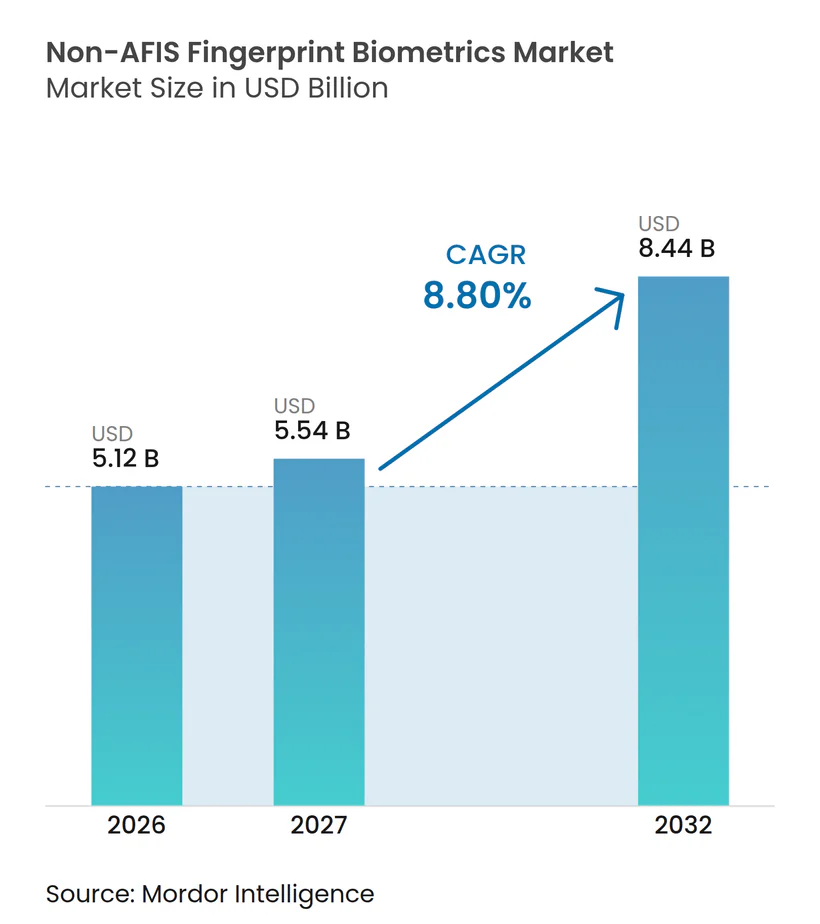
The non-AFIS fingerprint biometrics market size is projected to expand from USD 5.12 billion in 2026 to USD 5.54 billion in 2027, and to USD 8.44 billion by 2032, registering a CAGR of 8.80% between 2027 and 2032. The non-AFIS fingerprint biometrics market serves one-to-one verification uses, unlike automated fingerprint identification systems that support one-to-many forensic searches, which gives it a distinct role in commercial, civil, and consumer settings. Demand comes from consumer devices, financial authentication, government identity programs, workplace systems, border operations, and controlled access systems that require a direct confirmation of a person’s identity. The shift from standalone readers toward software that links sensors, liveness checks, identity records, workflow controls, and fraud analysis is changing how suppliers earn revenue and how institutional buyers assess their options. Hardware remains essential because deployment still depends on sensors and terminals at the point of verification, but software platforms can add recurring revenue, support multi-vendor environments, and simplify management across many locations. Privacy requirements, sensor reliability in difficult conditions, pricing pressure in consumer devices, and face or iris alternatives will continue to shape purchasing decisions in the non-AFIS fingerprint biometrics market.
Key Report Takeaways
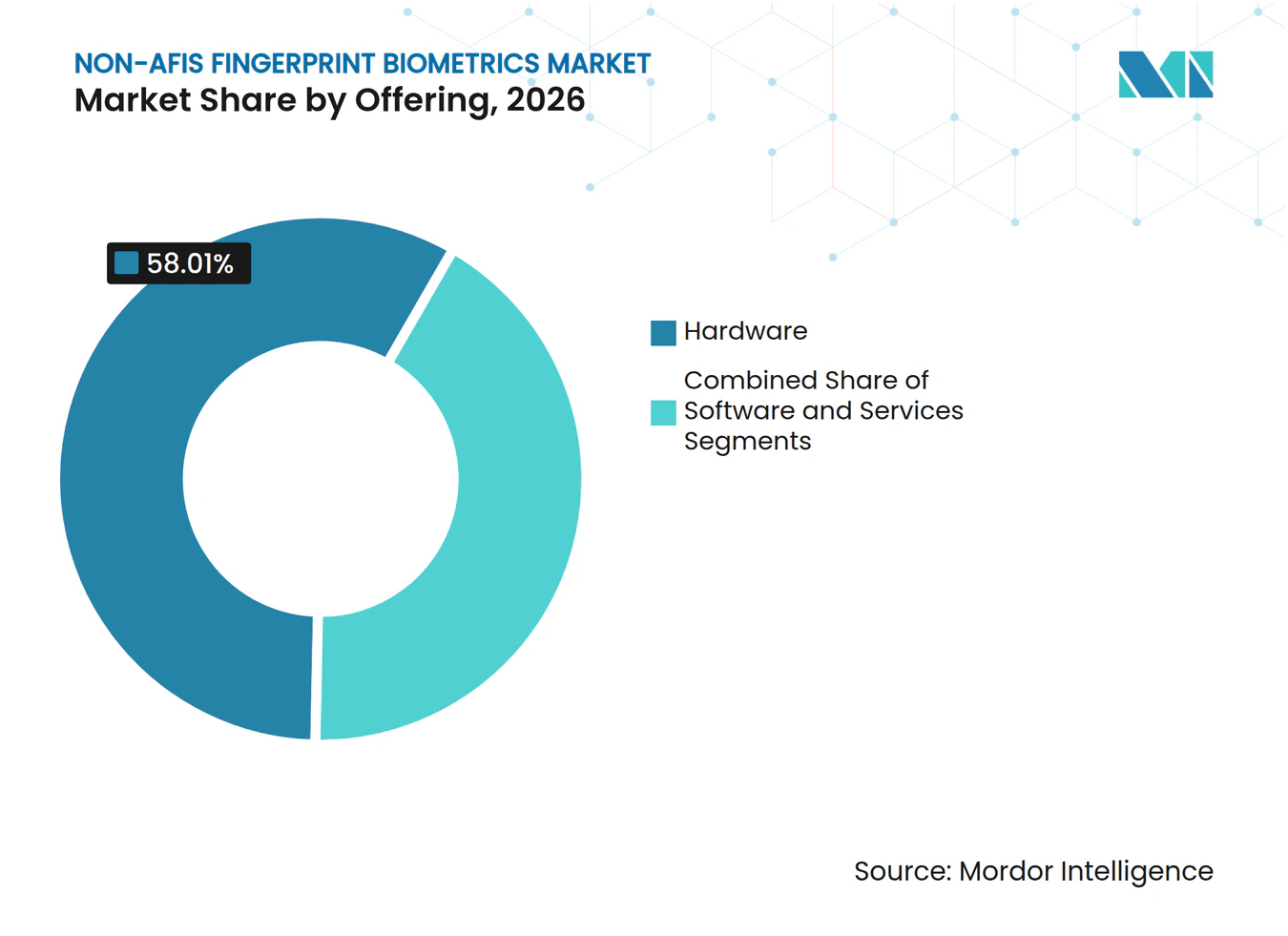
- By offering, hardware held 58.01% of the non-AFIS fingerprint biometrics market share in 2026, while software is projected to expand at a 9.95% CAGR through 2032.
- By sensor technology, capacitive sensors held 45.99% of revenue in 2026, while ultrasonic sensors are projected to expand at a 9.25% CAGR through 2032.
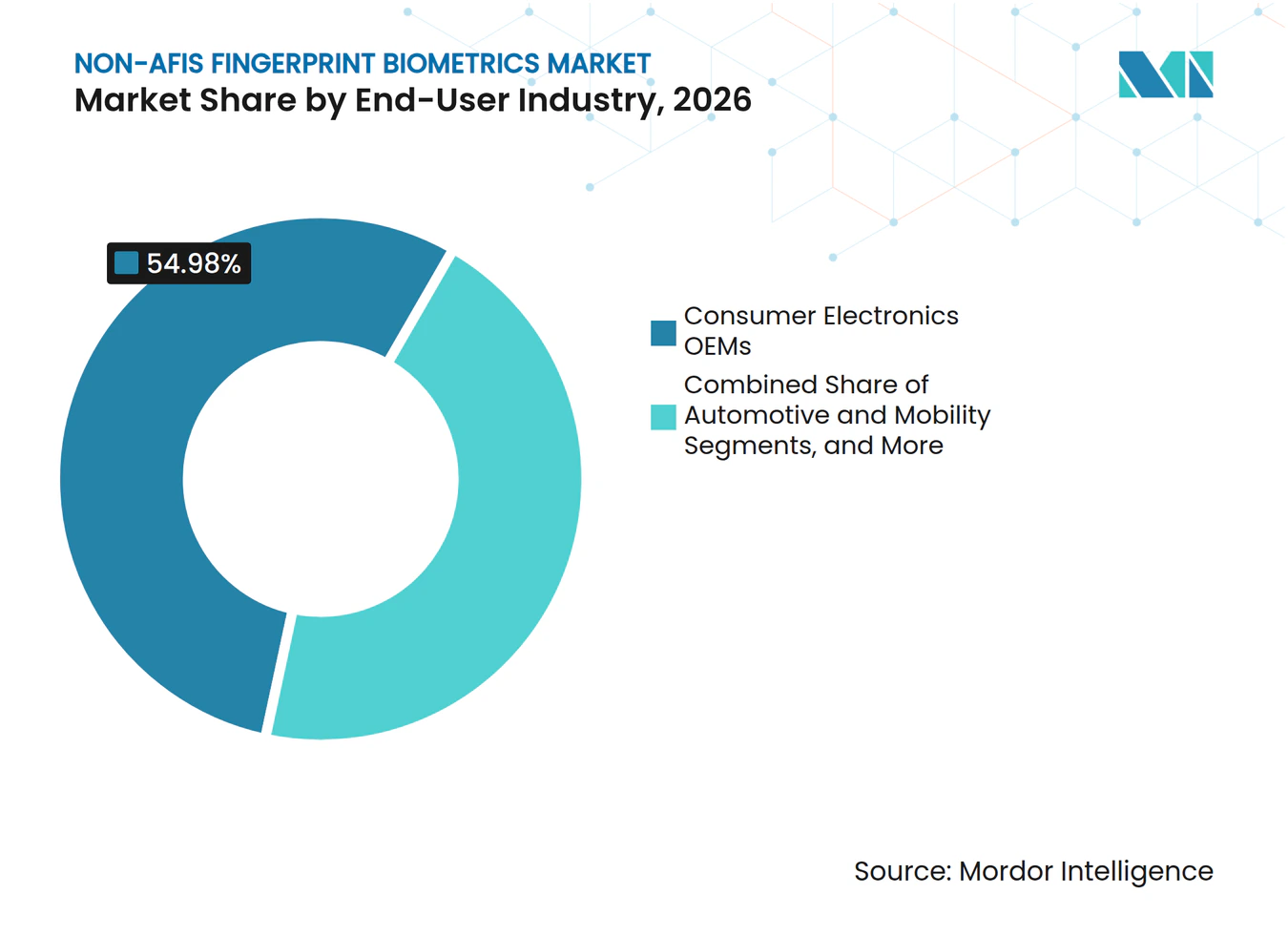
- By end-user industry, consumer electronics OEMs held 54.98% of revenue in 2026, while automotive and mobility is projected to expand at a 9.65% CAGR through 2032.
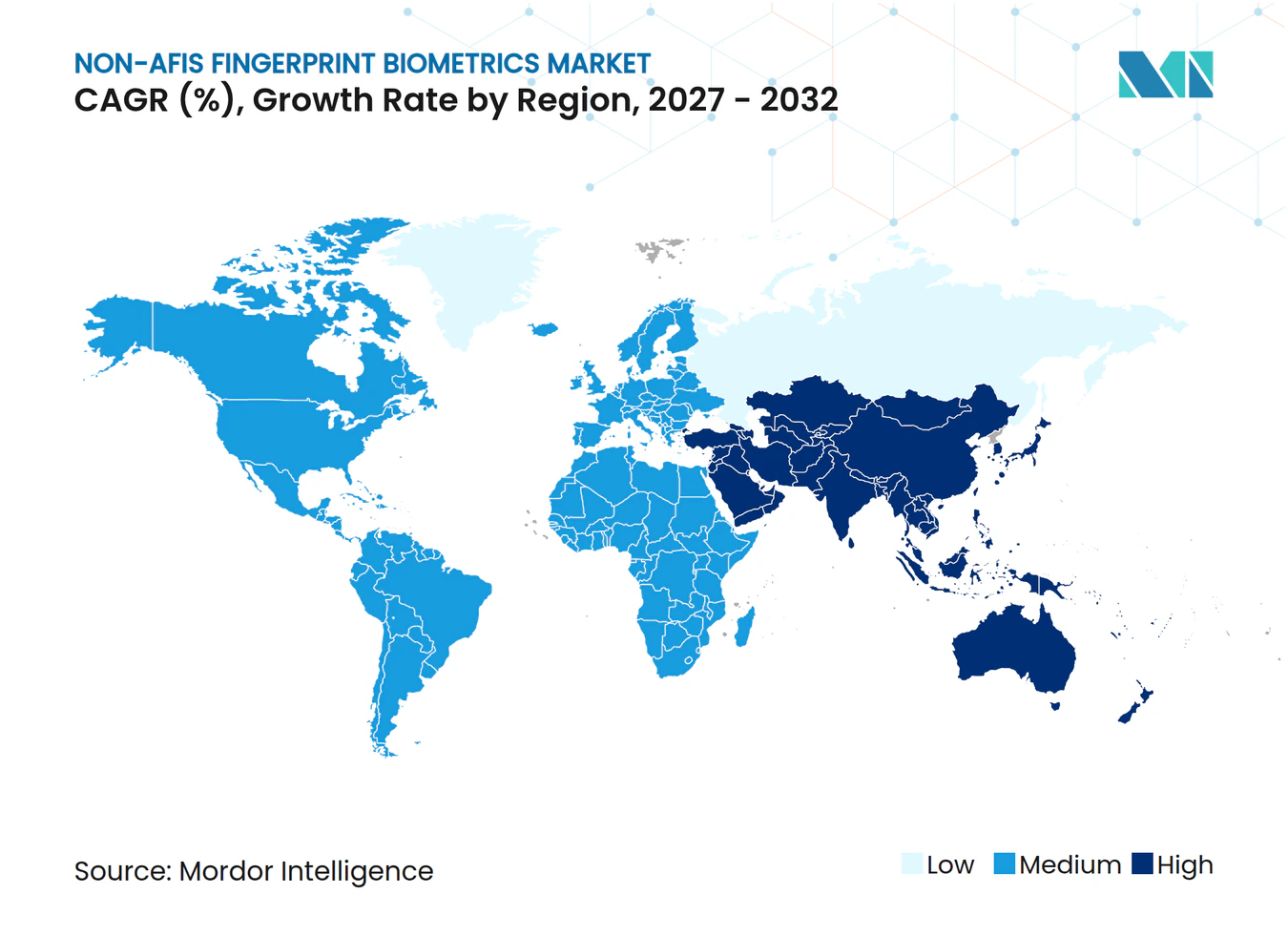
- By geography, Asia-Pacific held 41.99% of revenue in 2026, while the Middle East is projected to expand at a 9.45% CAGR through 2032.
Note: Market numbers in this report are based on Mordor Intelligence's proprietary estimation framework, which combines nine months of actuals with Q4 projections for base year 2026.
Market Trends and Insights
Drivers Impact Analysis of Non-AFIS Fingerprint Biometrics Market*
| Driver | (~) % Impact on CAGR Forecast | Geographic Relevance | Impact Timeline |
|---|---|---|---|
| Expansion of Digital Identity and e-KYC Programs | +2.3% | Global, concentrated in India, Southeast Asia, and the Middle East | Long term (≥ 4 years) |
| Rising Smartphone, PC, and Wearable Device Integration | +1.8% | Global, strongest in Asia-Pacific and North America | Long term (≥ 4 years) |
| Government Demand for Civil Identity, Border, and Workforce Authentication | +1.4% | North America, Europe, Middle East, and Africa | Long term (≥ 4 years) |
| Growth of Biometric Payment Cards and Secure Authentication Tokens | +1.2% | Asia-Pacific, Europe, South America, and Middle East | Medium term (2-4 years) |
| Growth of Contactless and Touchless Fingerprint Capture | +0.9% | Global, with early adoption in Europe and North America | Medium term (2-4 years) |
| Automotive In-Cabin Personalization and Keyless Access Adoption | +0.5% | Europe, East Asia, and North America premium vehicle segments | Medium term (2-4 years) |
| Source: Mordor Intelligence | |||
Expansion of Digital Identity and e-KYC Programs
Digital identity programs are broadening the settings in which fingerprint verification is used, particularly where citizens need to access payments, benefits, or regulated financial services. Governments are separating identity enrollment from physical branch networks and connecting authentication with payment and public service delivery. India has continued to expand biometric authentication across its identity and payment infrastructure, supporting demand for compliant devices and software at service points where users need a reliable alternative verification method. The European Commission launched the Shared Biometric Matching Service in May 2025 to support fingerprint matching across visa, border, and asylum systems, showing how public systems can create long-term integration, maintenance, and data-management work for certified suppliers.[1] Germany introduced the RegIWeb platform in January 2025 to digitize refugee registration and identity verification with fingerprint capture. These layered systems retain a role for fingerprint checks when another method cannot be used, requires a fallback, or needs an additional verification step.
Rising Smartphone, PC, and Wearable Device Integration
Smartphones, PCs, and wearables remain the largest volume outlet for fingerprint sensors because authentication is embedded directly into everyday devices. Device makers use fingerprints for screen unlocking, application access, payment authorization, account recovery, and user-specific device settings. The non-AFIS fingerprint biometrics market benefits when sensor functions are included in mid-range and premium devices rather than sold as separate accessories. Premium devices are moving toward larger sensing areas, faster recognition, and stronger liveness checks, which may favor ultrasonic technologies in selected models. At the same time, price competition in mobile and PC components limits supplier margins, especially where device makers have several qualified sources and high purchasing power. This combination keeps unit demand high while encouraging vendors to add software, security features, or combined touch and biometric interfaces that are harder to replace.
Government Demand for Civil Identity, Border, and Workforce Authentication
Government procurement provides a steadier source of demand than consumer device cycles because public identity systems often operate over long program periods. The U.S. Department of Homeland Security finalized a rule in October 2025 that expands biometric collection requirements for non-exempt noncitizens entering and departing the United States through airports, seaports, and land ports.[2] Border, visa, workforce, and civil identity programs require devices that meet established security, interoperability, and audit requirements. These projects often include installation, integration, maintenance, training, and support requirements in addition to the reader itself. The resulting certification burden can limit participation by low-cost suppliers that cannot meet the required standards or maintain documentation. It also increases the value of vendors that can support long procurement cycles and regulated operating environments.
Growth of Biometric Payment Cards and Secure Authentication Tokens
Biometric payment cards and secure tokens remain a smaller application area, but they have distinct value in payment and access use cases. Matching on the card or token can reduce the need to hold biometric templates in a central database, which directly addresses a concern for regulated institutions. This architecture may appeal to institutions that need stronger privacy controls or operate in markets with uneven digital infrastructure and elevated fraud exposure. It can also support combined physical and logical access credentials for employees, contractors, and other controlled users. The non-AFIS fingerprint biometrics market may benefit if issuers move beyond pilots into repeat card programs and expand the use of credentials beyond banking. Commercial adoption will still depend on card manufacturing capacity, issuer economics, customer enrollment, and compatibility with payment and access systems.
Restraints Impact Analysis of Non-AFIS Fingerprint Biometrics Market*
| Restraint | (~) % Impact on CAGR Forecast | Geographic Relevance | Impact Timeline |
|---|---|---|---|
| Biometric Data Privacy and Retention Restrictions | -1.1% | Europe under GDPR, United States under BIPA, and Canada | Long term (≥ 4 years) |
| Price Compression and Commoditization in Mobile and PC Sensors | -0.8% | Global, concentrated in Asia-Pacific and North America | Long term (≥ 4 years) |
| Competition from Face, Iris, and Multimodal Authentication | -0.7% | Global, intensifying in high-throughput access and payment channels | Medium term (2-4 years) |
| Sensor Performance Degradation on Wet, Dirty, or Damaged Fingers | -0.5% | Global, pronounced in healthcare, outdoor, and field logistics deployments | Short term (≤ 2 years) |
| Source: Mordor Intelligence | |||
Biometric Data Privacy and Retention Restrictions
Privacy and data retention rules add cost and delay to biometric deployments because organizations must govern sensitive information throughout collection, use, storage, and deletion. Organizations must establish a lawful basis, explain the purpose of collection, protect templates, and meet retention requirements that may vary by location. These obligations are particularly important in workplace systems, where employees may have limited choice over authentication methods and may challenge unnecessary collection. Centralized biometric databases can create additional legal and operational concerns because a breach may affect information that cannot simply be reset or replaced. On-device and on-card matching can reduce the amount of biometric information that leaves the user’s control and can narrow the risk of centralized retention. The non-AFIS fingerprint biometrics market therefore faces a higher compliance burden in Europe and North America, even as privacy-preserving product designs gain relevance.
Sensor Performance Degradation on Wet, Dirty, or Damaged Fingers
Sensor performance can limit use in healthcare, field work, food processing, construction, and outdoor public services where users cannot always present clean, dry fingers. Wet skin, calluses, cuts, dirt, and other conditions can reduce image quality and cause false rejections that interrupt access or require manual review. The issue is most difficult where users need fast access and cannot repeatedly clean or reposition a finger during a shift or service interaction. Suppliers are addressing the problem through improved hardware, liveness controls, and software that handles lower-quality prints through more adaptive extraction and matching. Suprema stated that its BioStation 3 Max uses a neural processing unit and deep-learning-based fingerprint extraction to improve matching for dry, low-quality, and distorted prints.[3] Even so, the installed base of lower-cost sensors means that this issue will remain relevant across parts of the non-AFIS fingerprint biometrics market.
*Our forecasts treat driver/restraint impacts as directional, not additive. The impact forecasts reflect baseline growth, mix effects, and variable interactions.
Non-AFIS Fingerprint Biometrics Market Segment Analysis
By Offering:
Software Platforms Change the Revenue MixHardware held 58.01% of the non-AFIS fingerprint biometrics market in 2026, reflecting the continuing weight of sensor and device sales in deployed systems. Sensors, readers, terminals, and embedded modules generate this revenue because each verification point needs physical capture hardware. Smartphone integrations, access control readers, and government enrollment equipment support the hardware base across consumer and institutional settings. Replacement cycles, new facility deployments, and expanded identity programs continue to sustain demand for these products. Services add installation, maintenance, integration, and managed identity support, particularly in public-sector and enterprise projects with multi-year operating requirements.
Software is projected to expand at a 9.95% CAGR through 2032, the highest rate among offering categories in the non-AFIS fingerprint biometrics market. Organizations increasingly need a common layer that connects sensor brands, identity sources, liveness checks, audit records, and fraud controls. Aware expanded its Awareness Platform in June 2026 with ROC and Mitek partnerships and configurable biometric workflows for identity decisions. Its stated product direction combines matching, liveness, and workflow management for financial services and government programs. Within the non-AFIS fingerprint biometrics industry, suppliers that only provide components face pressure to demonstrate fit within wider identity systems.



By Sensor Technology:
Ultrasonic Adoption Narrows the Capacitive LeadCapacitive sensors held 45.99% of the non-AFIS fingerprint biometrics market share in 2026, supported by their long deployment history and low unit cost. Their installed base includes PC readers, corporate access control hardware, and many mid-range smartphones. Optical sensors also serve high-volume Android devices and offer an accessible display-based authentication option. Thermal, pressure, and multispectral products address narrower needs in smart cards, high-security environments, and government programs. This mix lets buyers select technologies according to price, device design, spoof resistance, required accuracy, and the intended operating environment.
Ultrasonic sensors are projected to expand at a 9.25% CAGR through 2032. Their appeal lies in their ability to read below the skin surface and support stronger liveness-oriented checks. Larger active sensing areas can make finger placement easier and improve the premium device experience. These features suit flagship smartphones, where suppliers can justify a higher component cost. The non-AFIS fingerprint biometrics market will retain capacitive and optical products because many deployments still prioritize affordability and high shipment volumes.
By End-User Industry:
Automotive and Mobility Adds Premium DemandConsumer electronics OEMs held 54.98% of revenue in 2026, making them the largest end-user group in the non-AFIS fingerprint biometrics market. Smartphones drive this position because they pair high shipment volumes with regular device replacement cycles. PCs with Windows Hello-compatible readers and selected wearables provide additional demand. Banking, financial services, and insurance organizations use fingerprint tools for e-KYC, customer verification, and payment security. Government, healthcare, defense, enterprise, and industrial users add demand where controlled access, traceability, and identity assurance are required.
Automotive and mobility is projected to expand at a 9.65% CAGR through 2032. Vehicle suppliers are assessing fingerprints for driver profiles, infotainment settings, in-cabin purchases, and other personalized functions. FORVIA and Smart Eye demonstrated iris and facial authentication at Auto Shanghai in 2025 using driver-monitoring cameras, showing why camera-based methods may be preferred for exterior entry functions. Mercedes-Benz launched fingerprint-authenticated fuel payment in Belgium in February 2025 through its MBUX system in collaboration with Mastercard and Erste Bank. This gives fingerprint suppliers an opening in premium in-cabin services rather than a universal vehicle-entry solution.

Geography Analysis
APAC Non-AFIS Fingerprint Biometrics Market
Asia-Pacific held 41.99% of the non-AFIS fingerprint biometrics market share in 2026. The region combines large smartphone production capacity, substantial consumer device demand, and extensive government identity programs. India supports usage through digital identity and payment-linked authentication across a wide range of public and financial services. China is both a major manufacturing base and a large end market for fingerprint-equipped phones and access devices. Japan adds a relevant opportunity for secure cards, premium consumer electronics, and financial authentication.
The Americas, Europe and Africa Non-AFIS Fingerprint Biometrics Market
North America is a mature region with continued demand from border, government workforce, and enterprise access applications. The U.S. biometric collection rule supports procurement for operational settings that require verified identity at entry and departure points. Europe has more demanding privacy requirements, which can slow commercial deployments but support designs that keep templates on a device or card. The European Shared Biometric Matching Service creates a separate institutional use case for certified integration and matching tools. South America and Africa remain earlier-stage opportunities where civil identity and public-service programs can build demand for cost-conscious hardware.
Middle East Non-AFIS Fingerprint Biometrics Market
The Middle East is projected to expand at a 9.45% CAGR through 2032. National digital transformation programs and financial inclusion efforts support demand for identity verification in banking, border control, and workforce systems. Saudi Arabia, the United Arab Emirates, and Turkey are important because their identity initiatives connect public services with financial and access functions. The non-AFIS fingerprint biometrics market can serve both public programs and commercial deployments in these countries.
Competitive Landscape
Market Concentration
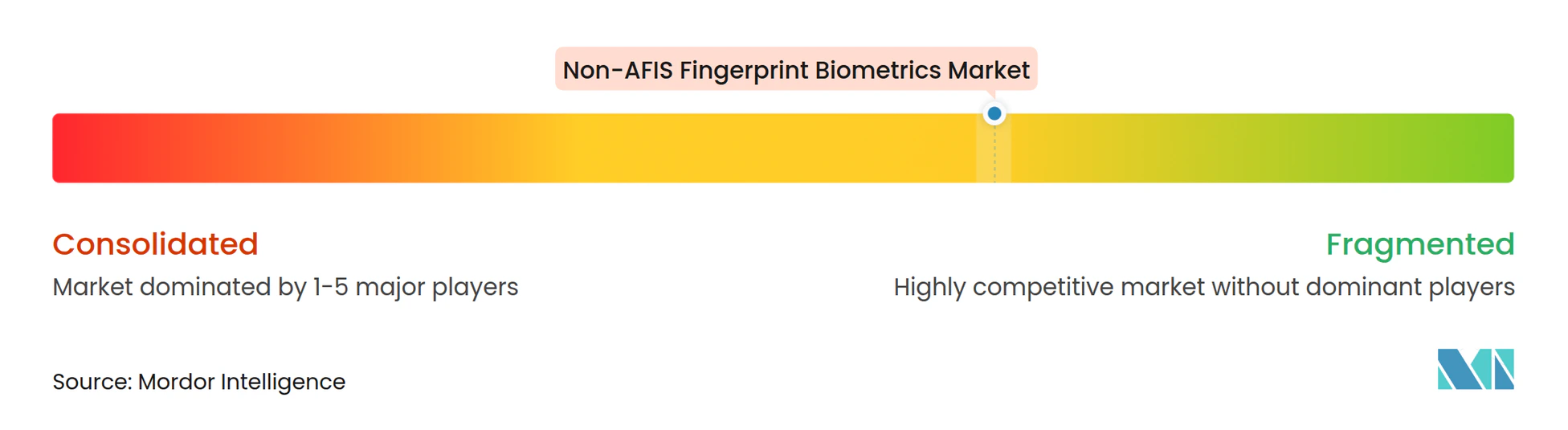
The non-AFIS fingerprint biometrics market is moderately fragmented because supplier structure differs by application and buyer type. Consumer electronics relies on a limited group of component vendors, while access control, civil identity, and enterprise projects have a broader supplier base. Qualcomm, Goodix, Synaptics, and Egis Technology are important in smartphone sensor supply. Aware, Suprema, SecuGen, ZKTeco, and other specialists address software, access control, security keys, and institutional deployments. This structure means that competitive strength cannot be assessed through consumer sensor shipments alone.
Strategy is moving beyond the sale of a single reader or sensor. Suppliers are combining hardware with liveness detection, matching software, encrypted credentials, and administration tools. Aware expanded its platform in June 2026 to add biometric technology partners and configurable workflows, supporting a multi-vendor software approach. Suprema launched BioStation 3 Max in May 2026 with fingerprint and face functions, a certified secure element, and capacity for 100,000 enrolled users. ZKTeco introduced its BioCV-D dual-modal biometric solution in August 2025 for enterprise and industrial authentication environments.
Certification has become central to competition in government and financial use cases. SecuGen received FIDO Alliance FIDO2 certification for its Unity 20 FIDO2 fingerprint security key in October 2026. Suppliers also see opportunities in on-card authentication, touchless capture, and inclusive designs for people who cannot rely on PINs. The non-AFIS fingerprint biometrics industry remains open to specialized suppliers because customer requirements vary widely by device, region, and security setting.
Non-AFIS Fingerprint Biometrics Industry Leaders
-
Fingerprint Cards AB
-
NEXT Biometrics Group ASA
-
IDEX Biometrics ASA
-
Egis Technology Inc.
-
Suprema Inc.
- *Disclaimer: Major Players sorted in no particular order
Non-AFIS Fingerprint Biometrics Market Companies Covered in this Report
- Fingerprint Cards AB
- NEXT Biometrics Group ASA
- IDEX Biometrics ASA
- Egis Technology Inc.
- CrucialTec Co., Ltd.
- SecuGen Corporation
- Integrated Biometrics, LLC
- Suprema Inc.
- ZKTeco Co., Ltd.
- DERMALOG Identification Systems GmbH
- BioEnable Technologies Pvt. Ltd.
- Aratek Biometrics Co., Ltd.
- Mantra Softech (India) Pvt. Ltd.
- BIO-key International, Inc.
- M2SYS Technology, Inc.
- Fulcrum Biometrics, LLC
- Aware, Inc.
- Innovatrics, s.r.o.
- Precise Biometrics AB
- id3 Technologies
- Anviz Global Inc.
- Invixium Access Inc.
- Bayometric, Inc.
- Papillon Systems, Inc.
Recent Industry Developments in Non-AFIS Fingerprint Biometrics Market
- October 2026: SecuGen received FIDO Alliance FIDO2 certification for its Unity 20 FIDO2 fingerprint security key, expanding its compliance portfolio for enterprise and government passkey authentication deployments.
- September 2026: Suprema debuted BioStation 3 Max in India for the first time at the Fire and Security India Expo 2026 in Mumbai, deepening its local ecosystem presence alongside its BioStation 3 terminal.
- June 2026: Aware Inc. expanded its Awareness Platform with integrated biometric partnerships from ROC and Mitek, introducing configurable biometric orchestration workflows, enhanced Intelligent Liveness with optical and spectral analysis for deepfake detection, and Intelligent Matching with 10× lower False Non-Match Rate than earlier generations, with general availability targeted for later 2026.
- May 2026: Suprema launched BioStation 3 Max, its flagship AI biometric access control terminal combining face and fingerprint biometrics on a platform with a CC EAL6+-certified secure element, sub-0.3-second face matching, and capacity for 100,000 enrolled users.
Global Non-AFIS Fingerprint Biometrics Market Report Scope
The Non-AFIS Fingerprint Biometrics Market refers to the industry focused on fingerprint-based biometric identification and authentication solutions that operate independently of Automated Fingerprint Identification Systems (AFIS), primarily serving verification, access control, attendance tracking, consumer electronics security, banking authentication, healthcare identity management, workforce management, and government credentialing applications.
The Non-AFIS Fingerprint Biometrics Market Report is Segmented by Offering (Hardware, Software, Services), Sensor Technology (Optical, Capacitive, Ultrasonic, Thermal, Pressure, Multispectral), End-User Industry (Consumer Electronics OEMs, Banking, Financial Services and Insurance, Government and Law Enforcement, Military and Defense, Healthcare, Automotive and Mobility, Enterprise and Industrial, Other End-User Industries), and Geography (North America [United States, Canada, Mexico], South America [Brazil, Argentina, Rest of South America], Europe [United Kingdom, Germany, France, Italy, Spain, Russia, Rest of Europe], Asia-Pacific [China, Japan, India, South Korea, Rest of Asia-Pacific], Middle East [Israel, Saudi Arabia, United Arab Emirates, Turkey, Rest of Middle East], Africa [South Africa, Egypt, Nigeria, Rest of Africa]). The Market Forecasts are Provided in Terms of Value (USD).
Segmentation Overview
| Hardware |
| Software |
| Services |
| Optical |
| Capacitive |
| Ultrasonic |
| Thermal |
| Pressure |
| Multispectral |
| Consumer Electronics OEMs |
| Banking, Financial Services and Insurance |
| Government and Law Enforcement |
| Military and Defense |
| Healthcare |
| Automotive and Mobility |
| Enterprise and Industrial |
| Other End-User Industries |
| North America | United States |
| Canada | |
| Mexico | |
| South America | Brazil |
| Argentina | |
| Rest of South America | |
| Europe | United Kingdom |
| Germany | |
| France | |
| Italy | |
| Spain | |
| Russia | |
| Rest of Europe | |
| Asia-Pacific | China |
| Japan | |
| India | |
| South Korea | |
| Rest of Asia-Pacific | |
| Middle East | Israel |
| Saudi Arabia | |
| United Arab Emirates | |
| Turkey | |
| Rest of Middle East | |
| Africa | South Africa |
| Egypt | |
| Nigeria | |
| Rest of Africa |
| By Offering | Hardware | |
| Software | ||
| Services | ||
| By Sensor Technology | Optical | |
| Capacitive | ||
| Ultrasonic | ||
| Thermal | ||
| Pressure | ||
| Multispectral | ||
| By End-User Industry | Consumer Electronics OEMs | |
| Banking, Financial Services and Insurance | ||
| Government and Law Enforcement | ||
| Military and Defense | ||
| Healthcare | ||
| Automotive and Mobility | ||
| Enterprise and Industrial | ||
| Other End-User Industries | ||
| By Geography | North America | United States |
| Canada | ||
| Mexico | ||
| South America | Brazil | |
| Argentina | ||
| Rest of South America | ||
| Europe | United Kingdom | |
| Germany | ||
| France | ||
| Italy | ||
| Spain | ||
| Russia | ||
| Rest of Europe | ||
| Asia-Pacific | China | |
| Japan | ||
| India | ||
| South Korea | ||
| Rest of Asia-Pacific | ||
| Middle East | Israel | |
| Saudi Arabia | ||
| United Arab Emirates | ||
| Turkey | ||
| Rest of Middle East | ||
| Africa | South Africa | |
| Egypt | ||
| Nigeria | ||
| Rest of Africa | ||
Key Questions Answered in the Report
What is the size of the non-AFIS fingerprint biometrics market?
The non-AFIS fingerprint biometrics market is valued at USD 5.12 billion in 2026 and is projected to reach USD 8.44 billion by 2032, growing at a CAGR of 8.80%. Growth is supported by continued demand from consumer devices, digital identity programs, financial verification systems, and controlled-access applications.
Which offering category leads non-AFIS fingerprint biometrics?
Hardware leads the market with a 58.01% share in 2026, while software is projected to register the fastest growth, expanding at a 9.95% CAGR through 2032. Hardware remains essential for fingerprint capture, whereas software enables enrollment, workflow orchestration, liveness detection, analytics, and multi-vendor interoperability.
Which fingerprint sensor technology is expanding fastest?
Ultrasonic sensors are projected to grow at a 9.25% CAGR through 2032, driven by demand for improved accuracy, larger sensing areas, and advanced liveness capabilities in premium devices. Capacitive sensors continue to dominate adoption with a 45.99% market share in 2026 due to their cost-effectiveness and broad deployment base.
Which end-user category creates the largest demand?
Consumer electronics OEMs account for 54.98% of market revenue in 2026, supported by widespread integration of fingerprint authentication in smartphones, tablets, laptops, and wearables. Automotive and mobility represents the fastest-growing end-user segment, projected to expand at a 9.65% CAGR through 2032 due to increasing use in vehicle access, driver personalization, and secure payment applications.
Which region leads demand for non-AFIS fingerprint solutions?
Asia-Pacific leads the market with a 41.99% share in 2026, driven by large-scale electronics manufacturing, strong smartphone penetration, and national identity initiatives. The Middle East is expected to experience the highest regional growth, recording a 9.45% CAGR through 2032 as investments in digital identity and smart government programs accelerate.
What limits wider adoption of fingerprint verification?
Key market restraints include biometric data privacy and retention regulations, price compression in mobile fingerprint sensors, competition from face, iris, and multimodal authentication technologies, and performance challenges on wet, dirty, or damaged fingers. These factors can slow deployment decisions despite the proven effectiveness of fingerprint-based identity verification.