
NFV MANO Software Market Size and Share
Market Overview
| Study Period | 2020 - 2031 |
|---|---|
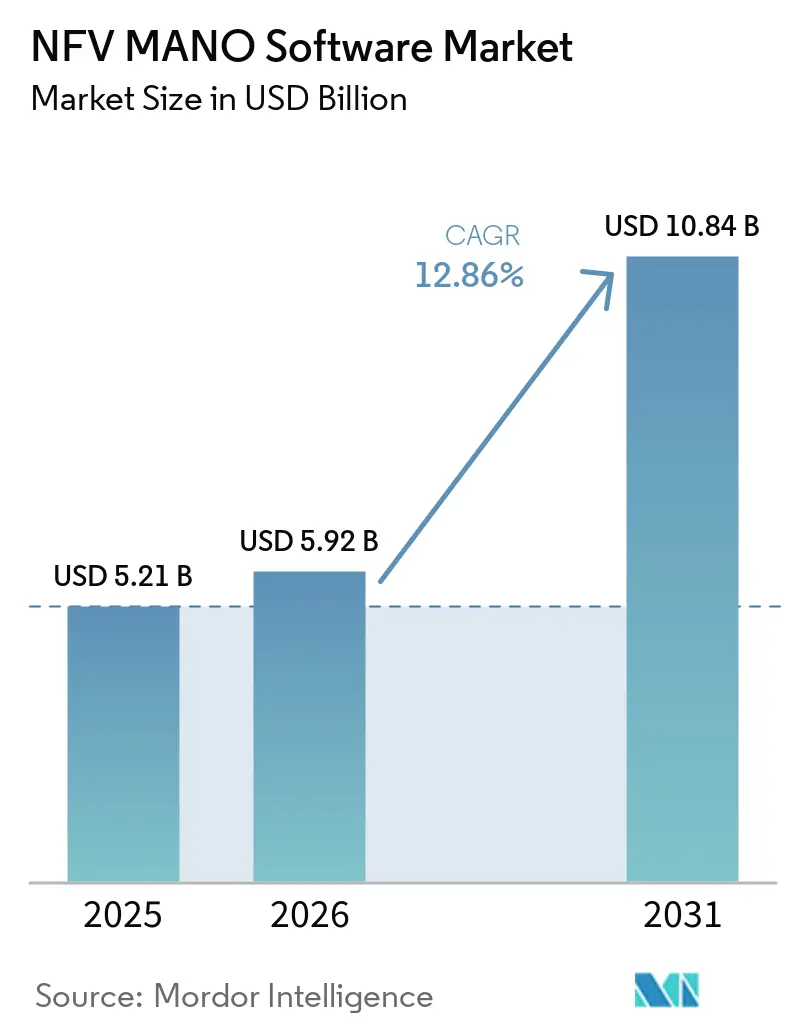
| Market Size (2026) | USD 5.92 Billion |
| Market Size (2031) | USD 10.84 Billion |
| Growth Rate (2026 - 2031) | 12.86 % |
| Fastest Growing Market | Africa |
| Largest Market | Asia-Pacific |
| Market Concentration | Medium |
Major Players *Disclaimer: Major Players sorted in no particular order Image © Mordor Intelligence. Reuse requires attribution under CC BY 4.0. | |
NFV MANO Software Market Analysis by Mordor Intelligence
The NFV MANO software market size is projected to expand from USD 5.21 billion in 2025 and USD 5.92 billion in 2026 to USD 10.84 billion by 2031, registering a CAGR of 12.86% between 2026 and 2031. Demand has moved beyond proof-of-concept programs as operators put 5G Standalone cores into broader commercial use. Orchestration platforms are increasingly evaluated as a control layer for autonomous network operations, rather than only as tools for replacing dedicated hardware. Buyers are assessing support for agentic AI, cloud-native network functions, and interoperability across multi-vendor environments. Hybrid VNF and CNF estates will keep unified lifecycle management important during the transition to cloud-native operations. The NFV MANO software market also presents opportunities for vendors that can combine open standards support with implementation and managed-service capabilities.
Key Report Takeaways
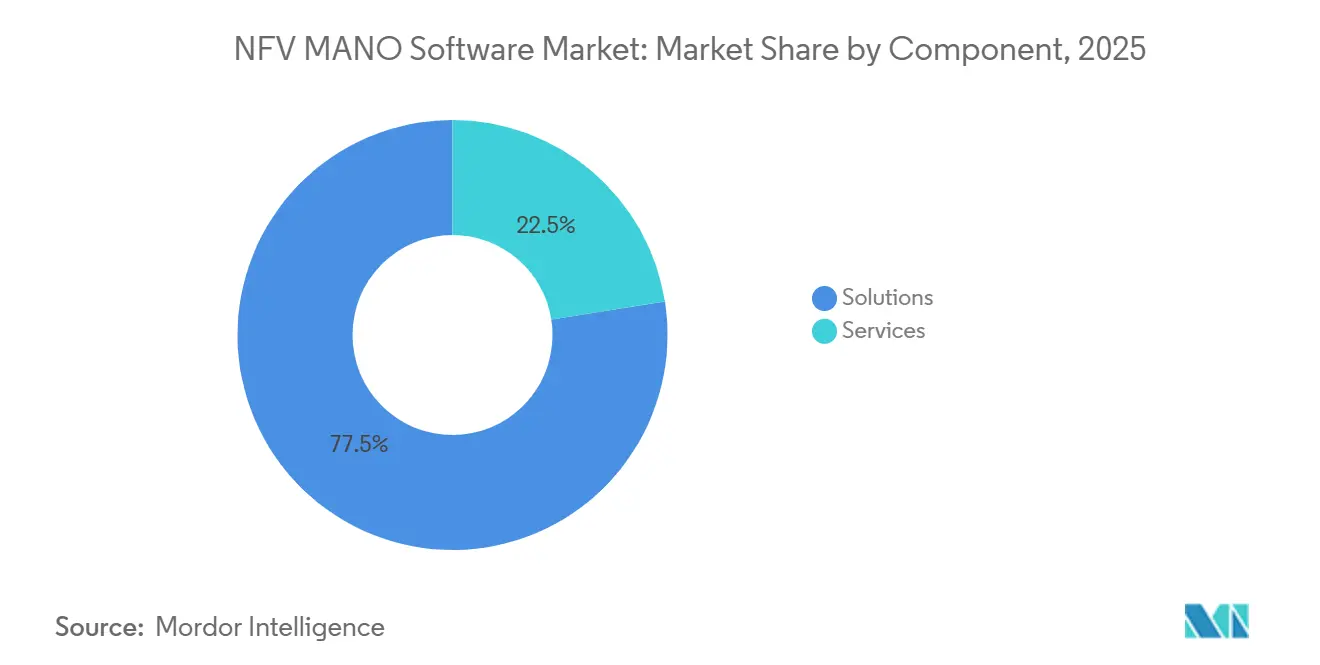
- By component, solutions held 77.72% of NFV MANO software demand in 2025, while services are projected to expand at a 13.86% CAGR through 2031 in the NFV MANO software market.
- By MANO function, NFV Orchestrator accounted for 27.18% of the NFV MANO software market size in 2025, while Container Infrastructure Service Manager is projected to expand at a 13.39% CAGR through 2031.
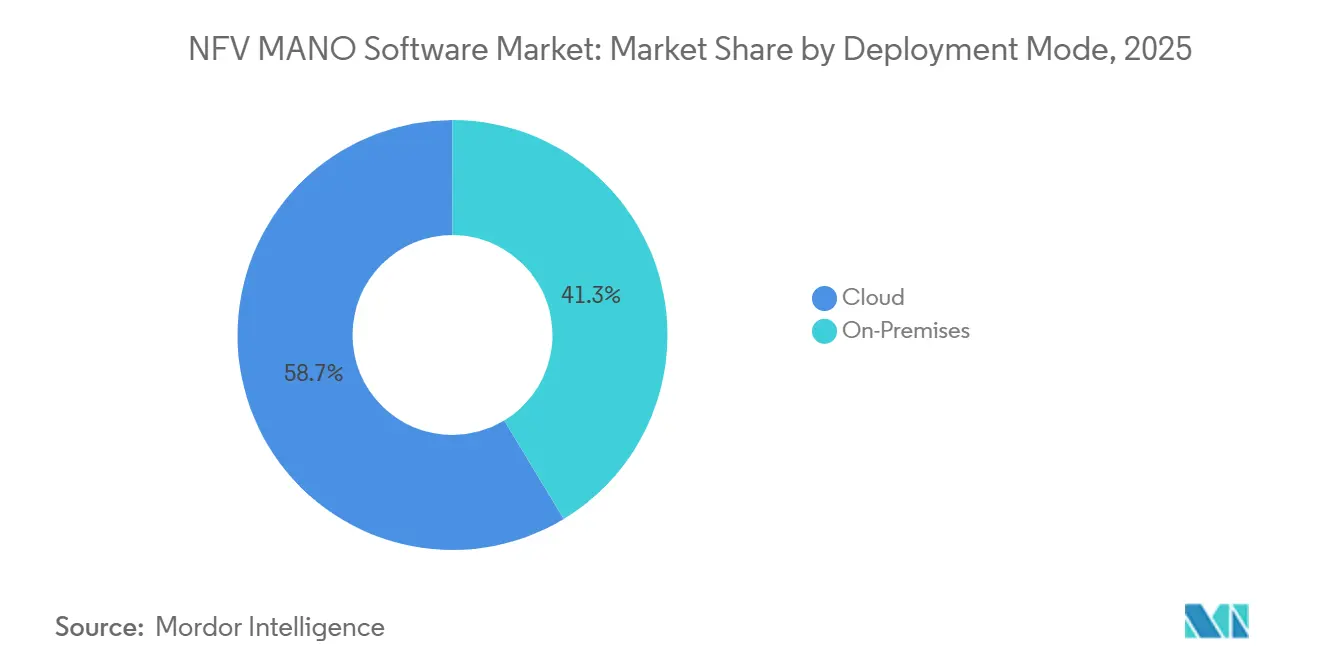
- By deployment mode, cloud held 58.66% share in 2025, while the same segment is projected to expand at a 13.94% CAGR through 2031 in the NFV MANO software market.
- By end user, Telecom Service Providers held 56.81% share in 2025, while Cloud Service Providers are projected to expand at a 13.74% CAGR through 2031.
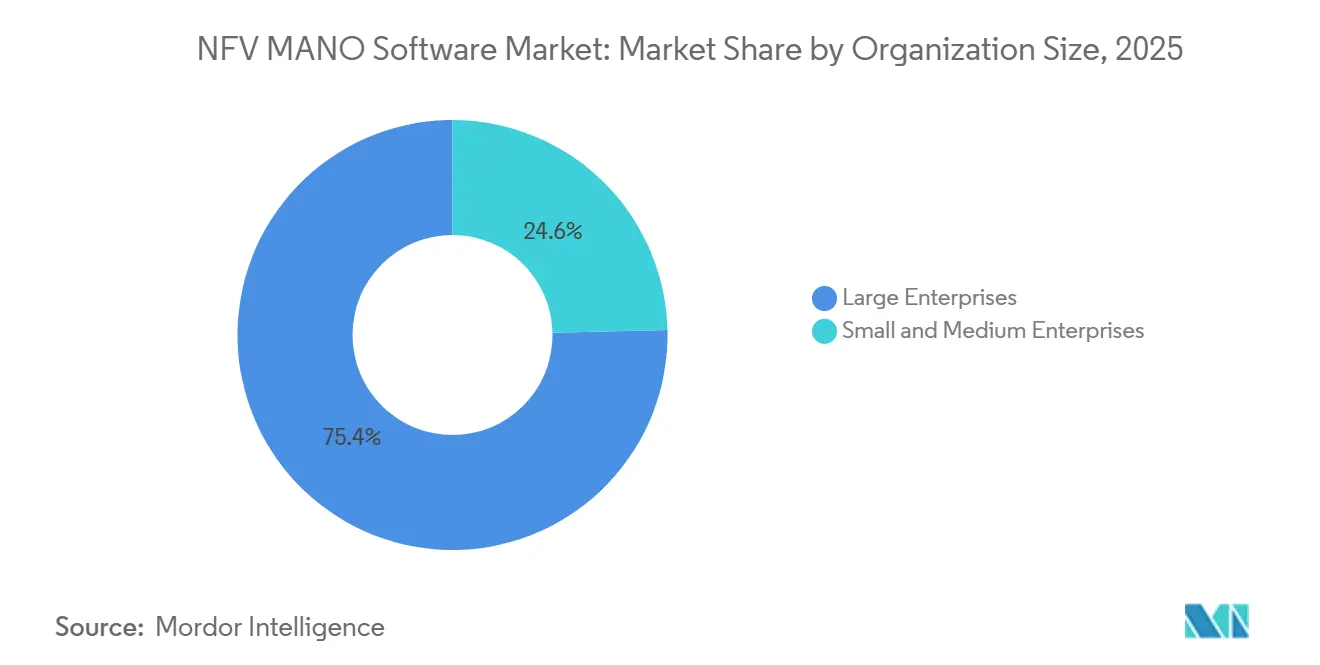
- By organization size, Large Enterprises held 75.37% share in 2025, while Small and Medium Enterprises are projected to expand at a 13.67% CAGR through 2031.
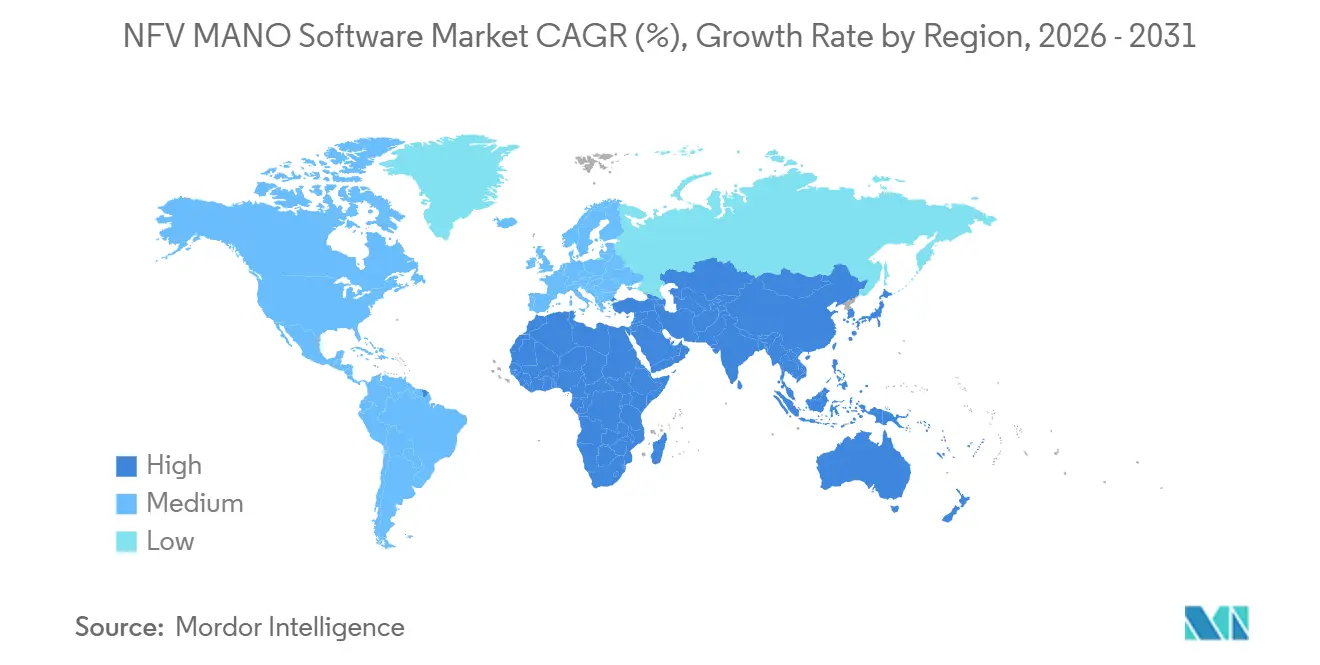
- By geography, Asia-Pacific held 32.07% share in 2025, while Africa is projected to expand at a 13.79% CAGR through 2031.
Note: Market size and forecast figures in this report are generated using Mordor Intelligence’s proprietary estimation framework, updated with the latest available data and insights as of January 2026.
Global NFV MANO Software Market Trends and Insights
Drivers Impact Analysis*
| Driver | (~) % Impact on CAGR Forecast | Geographic Relevance | Impact Timeline |
|---|---|---|---|
| 5G Standalone and Network Slicing Orchestration | +2.8% | Global, with highest intensity in Asia-Pacific, North America, and Europe | Medium term (2-4 years) |
| Telco CAPEX-to-OPEX Migration | +2.3% | Global, Europe, the Middle East and Africa leading, North America accelerating | Medium term (2-4 years) |
| Edge Cloud and Distributed Network Function Deployment | +1.9% | Asia-Pacific, North America, and Europe; Middle East and Africa core; early-stage in the Middle East and Africa and South America | Long term (≥ 4 years) |
| Closed-Loop Automation and AI-Assisted Service Assurance | +1.6% | Global; North America and Europe, the Middle East and Africa earliest adopters; Asia-Pacific scaling | Medium term (2-4 years) |
| Open RAN and Multi-Vendor Network Disaggregation | +1.2% | Europe, North America, Japan, and India | Long term (≥ 4 years) |
| Private 5G and Industry-Specific Network Virtualization | +0.9% | North America, Europe, the Middle East and Africa, and Asia-Pacific industrialized zones | Short term (≤ 2 years) |
| Source: Mordor Intelligence | |||
5G Standalone and Network Slicing Orchestration
5G Standalone deployment raises demand for orchestration because network slicing requires coordinated lifecycle management across radio, core, and transport domains. A slice is a logical end-to-end network on shared physical infrastructure, so operators need a platform that can manage its design, activation, scaling, assurance, and retirement across these domains. The NFV MANO software market benefits when operators need to create, modify, and retire slices without relying on manual workflows that can delay service delivery, consume specialist resources, and limit the practical use of differentiated service offers, particularly where enterprise customers expect reliable performance, rapid activation, and clear service-level commitments across a changing mix of applications. Orange selected Ericsson in June 2025 to deploy Service Orchestration and Assurance across its European affiliates after a 5G Standalone slicing trial in Belgium, supporting private networks, geofencing, and fixed wireless access.[1]European Commission, “Orange Selects Ericsson to Lead 5G Network Slicing Orchestration Across Europe,” European Commission Digital Strategy, digital-strategy.ec.europa.eu Faster slice activation can help operators offer enterprise services with specific performance commitments and respond to changes in user needs without rebuilding the underlying network, especially where private networks and fixed wireless access require distinct operating parameters, controlled coverage areas, and service-specific capacity rules, which broadens the role of the NFV MANO software market. O-RAN Alliance Specification Release 5, completed in November 2025, included AI-driven management specifications that extend orchestration requirements into disaggregated radio networks.
Telco CAPEX-to-OPEX Migration
Network virtualization is moving from VNF-based designs toward CNF-native horizontal cloud platforms. This change shifts attention from initial proprietary hardware purchases to shared infrastructure, automation, operating efficiency, and the ability to run workloads consistently across common cloud resources while reducing duplication among separate network domains. Deutsche Telekom documented a Horizontal TelCo Cloud architecture that supports 40 workloads on 200,000 vCPUs and targets 80 workloads by 2028. The company’s 2026 material projected a 16% CAGR for mobile core spending on horizontal cloud approaches between 2026 and 2030, compared with 8% for vertically integrated stacks. The NFV MANO software market therefore favors platforms that can automate lifecycle management across shared cloud resources while retaining the reliability, operational control, and service continuity required for telecom services, including complex workloads that span multiple domains and locations. ETSI expects VNF and CNF environments to coexist during the transition, which keeps unified management interfaces necessary and prevents a simple one-step migration.[2]ETSI ISG NFV, “GS NFV-IFA 031 V5.4.1 Management and Orchestration Requirements and Interfaces Specification for Management of NFV-MANO,” ETSI, etsi.org
Edge Cloud and Distributed Network Function Deployment
Distributed user-plane functions create placement and scaling requirements that were less important in centralized network designs. Orchestration tools must account for latency, resource availability, traffic conditions, and edge-cloud integration across sites that may have limited local capacity, different operational policies, and varying demand patterns. These requirements are important when an application needs processing close to a factory, campus, transport hub, or regional network node, rather than in a distant centralized data center. NEC demonstrated agentic AI-based autonomous lifecycle management of a 5G Core User Plane Function with AWS in February 2026.[3]NEC Corporation, “NEC Demonstrates Agentic AI-Driven Autonomous Network Operations in Collaboration with AWS,” NEC, nec.com NEC stated that the demonstration reduced the time from network design to initial service launch from several weeks to a few hours through AWS Kiro and GitOps automation. This model can shorten regional rollout cycles and reduce the level of specialist effort required at edge sites, while the NFV MANO software market favors platforms that handle edge infrastructure through native management interfaces instead of add-on connections and maintain consistent operating processes across distributed locations.
Closed-Loop Automation and AI-Assisted Service Assurance
Closed-loop automation links network observation, fault diagnosis, remediation decisions, and corrective actions in one operating process. It reduces the number of manual handoffs required to identify an issue, decide on a response, and carry out that response within defined operating controls, while keeping a documented role for human review where risk is higher. Huawei launched AUTINOps in March 2026 with more than 20 AI agents, including agents for mobile broadband faults and risk handling. Nokia and Google Cloud expanded their assurance partnership in June 2026 by embedding 6 Gemini-powered AI agents in Nokia Assurance Center, supporting event triage, anomaly analysis, and resolution across multi-vendor and multi-domain networks. Engineers retain authority at high-risk control points, while Mavenir’s June 2026 framework converts validated operational knowledge into explainable automation templates that can work with existing OSS investments. These offerings make service assurance a value layer alongside basic lifecycle management in the NFV MANO software market and shift competition toward measurable operational efficiency, repeatable fault handling, and more consistent service quality.
Restraints Impact Analysis*
| Restraint | (~) % Impact on CAGR Forecast | Geographic Relevance | Impact Timeline |
|---|---|---|---|
| Legacy OSS/BSS Integration Complexity | -1.8% | Global, most pronounced in North America and Europe, where incumbent operators carry decades of OSS/BSS debt | Long term (≥ 4 years) |
| VNF and CNF Interoperability Gaps | -1.3% | Global, heaviest in markets with multi-vendor core estates, including Europe, the Middle East and Africa, and Asia-Pacific | Medium term (2-4 years) |
| Cloud-Native Telco Operations Skills Shortage | -0.9% | Global, acute in developing markets across Africa, South America, and Southeast Asia | Medium term (2-4 years) |
| Security, Sovereignty, and Supply-Chain Exposure | -0.7% | Global, strategic priority in North America, Europe, India, and Australia | Long term (≥ 4 years) |
| Source: Mordor Intelligence | |||
Legacy OSS/BSS Integration Complexity
Legacy OSS/BSS environments remain a core limitation on adoption because many systems predate NFV architecture and were designed for static, hardware-based service processes. A modern MANO platform must connect with fault, configuration, accounting, performance, and security systems without interrupting established provisioning and charging workflows. This work often requires custom adapters across several vendor systems, which increases the time and coordination required for implementation, testing, maintenance, and ongoing change management. Parallel VNF and CNF operations add different data models, descriptor formats, and resource abstraction layers to the integration task. Integration teams must then support separate technical approaches while preserving service continuity and making sure that service events still reach downstream business systems, including provisioning, billing, charging, and customer-support processes. TM Forum Open API alignment can reduce this burden, but uneven adoption limits its role as a common solution across operator environments with different legacy estates, business processes, and supplier relationships.
VNF and CNF Interoperability Gaps
VNF and CNF coexistence will remain a multi-year operating reality for many network operators. ETSI has proposed a Telecoms Cloud MANO evolution to bring VNF and CNF lifecycle management under a more unified framework. Some CNF products still do not align fully with cloud-native design principles, which limits the benefit of Kubernetes-native orchestration and can force operators to retain separate practices. The O-RAN Alliance’s Spring 2026 PlugFest brought together 31 companies and 9 labs to test multi-vendor integration under practical deployment conditions. The work showed why descriptor compatibility alone cannot ensure end-to-end interoperability when functions, infrastructure, and management tools come from different suppliers and must work together during live network operations. These conditions preserve demand for platforms that can manage older and cloud-native functions without duplicating management systems or creating another disconnected tool chain, while allowing operators to modernize at a pace consistent with their installed base, risk controls, and available technical skills.
*Our forecasts treat driver/restraint impacts as directional, not additive. The impact forecasts reflect baseline growth, mix effects, and variable interactions.
Segment Analysis
By Component: Services Gain Momentum Alongside Solutions
Solutions accounted for 77.72% of the NFV MANO software market share in 2025. This leadership reflected spending on platform licenses, integration middleware, and proprietary descriptor toolchains during initial virtualization programs. Solutions remain central because operators need a common platform for service design, resource coordination, and lifecycle control. The NFV MANO software industry continues to rely on these platforms as networks become more distributed. Yet initial deployment work does not end the need for support. Operators are shifting attention toward daily operations, optimization, upgrades, and cloud-native migration.
Services are projected to expand at a 13.86% CAGR from 2026 to 2031. Managed services, professional services, training, and support are becoming more important as implementation requirements increase. Vendors can turn one-time software transactions into multi-year contracts by providing managed MANO services and automated upgrades. This arrangement can help operators sustain AI-driven assurance, multi-vendor service management, and GitOps workflows. ETSI Release 5 includes management data analytics functions and intent management interfaces that add operating requirements. The NFV MANO software market therefore gives greater weight to delivery capabilities alongside platform functionality.



By MANO Function: Container Infrastructure Changes the Orchestration Mix
NFV Orchestrator held 27.18% of NFV MANO software demand in 2025. It manages service packaging, instantiation, scaling, and termination across infrastructure and network-function management layers. The function also supports service-level commitments, slice management, and end-to-end resource allocation. These responsibilities make it central to operators that are creating differentiated enterprise services. Virtualized Infrastructure Manager and Virtualized Network Function Manager functions continue to cover much of the lifecycle automation in installed operator networks.
Container Infrastructure Service Manager is projected to expand at a 13.39% CAGR through 2031. The pace reflects the move from virtual network functions to cloud-native network functions. Deutsche Telekom reported that CNFs are expected to represent 76% of total mobile core network function expenditure by 2030, compared with 36% in 2025. Wide Area Network Infrastructure Manager is also becoming more relevant as edge deployments increase connectivity requirements among distributed infrastructure points. 3GPP’s Coordinated Closed Control Loop supports zero-touch automation across management functions. This framework is shaping MANO roadmaps for container and infrastructure management, particularly where operators need coordinated automation across cloud resources, network functions, and service-assurance processes.
By Deployment Mode: On-Premises Leads While Cloud Use Expands
Cloud deployment held 58.66% of the NFV MANO software market size in 2025, and the same segment grew at the fastest rate of 13.94% through 2031. These designs typically keep control-plane functions on-premises while moving analytics, AI workloads, and less latency-sensitive orchestration processes to cloud capacity. Nokia stated that its Autonomous Networks Fabric is available as a software-as-a-service offering on Google Cloud, on-premises through Google Distributed Cloud, and in hybrid configurations. The design gives operators flexibility, but it can increase reliance on underlying cloud services for AI workloads. Deutsche Telekom’s horizontal-cloud program supports this direction by favoring shared cloud operating models.
On-premises deployment held 41.34% of the NFV MANO software market size in 2025. Data sovereignty, latency, and compliance needs make a full public-cloud move difficult for many core network workloads. Operators also want core network software to run within national boundaries or on operator-controlled infrastructure. These factors continue to support local deployment of MANO platforms. The deployment model is particularly relevant for operators with strict security and service-continuity obligations. It also lets operators maintain direct control over sensitive network functions.
By End User: Telecom Providers Remain Central as Cloud Providers Advance
Telecom Service Providers held 56.81% of NFV MANO software demand in 2025. They own the largest and most complex multi-vendor network estates. Their telecom licenses also create obligations for service continuity and network reliability. This makes automation a practical requirement rather than a discretionary software purchase. Telecom providers remain the primary users of MANO for network transformation programs. Their spending priorities continue to shape the product roadmaps of leading vendors.
Cloud Service Providers are projected to expand at a 13.74% CAGR through 2031. Hyperscalers and regional cloud providers are deploying MANO capabilities for edge infrastructure and telco-cloud offerings. This shifts their role from infrastructure suppliers to operators of orchestration-enabled platforms. Enterprises, government and defense organizations, data center operators, and managed network service providers make up the rest of demand. Government and defense users value rapid network reconfiguration during crisis conditions. Data center operators need lifecycle management for virtual and containerized network appliances, while managed providers need multi-tenant control across customer environments.
By Organization Size: Large Enterprises Lead While SMEs Add Demand
Large Enterprises accounted for 75.37% of NFV MANO software demand in 2025. Their scale and implementation requirements favor feature-rich platforms that can handle large numbers of network functions. Major operators and cloud providers also need multi-domain orchestration across broad geographic footprints. Existing OSS/BSS estates add to the integration requirements for these users. These factors support the continued role of established MANO platforms in large enterprise environments. Large deployments also require deeper support for availability, security, and service-level control.
Small and Medium Enterprises are projected to expand at a 13.67% CAGR from 2026 to 2031. Private 5G use in factories, logistics hubs, stadiums, and campuses is supporting this demand. These users need simplified and cloud-managed lifecycle management without the staffing needs of a telecom operations center. Alcatel-Lucent Enterprise launched an updated private 5G offer with AerFlex in July 2026, using an access-point-only architecture that removes baseband units and dedicated packet cores. The company stated that the design reduces private 5G deployment from months to days, which can simplify initial implementation for users with limited telecom operations resources. Streamlined interfaces and preconfigured automation templates can make the NFV MANO software market more accessible to smaller users.
Geography Analysis
Asia-Pacific held 32.07% of the NFV MANO software market share in 2025. China, South Korea, Japan, and India supported this position through 5G Standalone rollout activity. India’s momentum in cloud-native core architecture supports continuing demand for orchestration tools. South Korean operators are focusing on network slicing monetization after initial Standalone deployments. This requires advanced NFV Orchestrator capabilities and enterprise service-level management.
North America and Europe, the Middle East, and Africa form another major demand concentration. Europe is modernizing core networks through horizontal cloud architectures and greater attention to standards compliance. Deutsche Telekom’s Horizontal TelCo Cloud supports 40 workloads on 200,000 vCPUs and targets 80 workloads by 2028. North American operators continue to extend 5G Standalone infrastructure after their initial investments. ETSI requirements and European cybersecurity frameworks influence procurement criteria for MANO platforms.
The Middle East and Africa presents different conditions across its markets. Gulf Cooperation Council operators in Saudi Arabia and the United Arab Emirates are investing in 5G Standalone and wider network modernization. Africa is projected to expand at a 13.79% CAGR through 2031, the highest regional rate. Greenfield 5G networks can avoid part of the OSS/BSS integration burden faced by operators with older 4G VNF estates. South America is smaller but has increasing demand as Brazil and Argentina advance their Standalone programs. Brazil’s 5G licensing commitments include coverage and quality obligations that support investment in automated assurance and orchestration.

Competitive Landscape
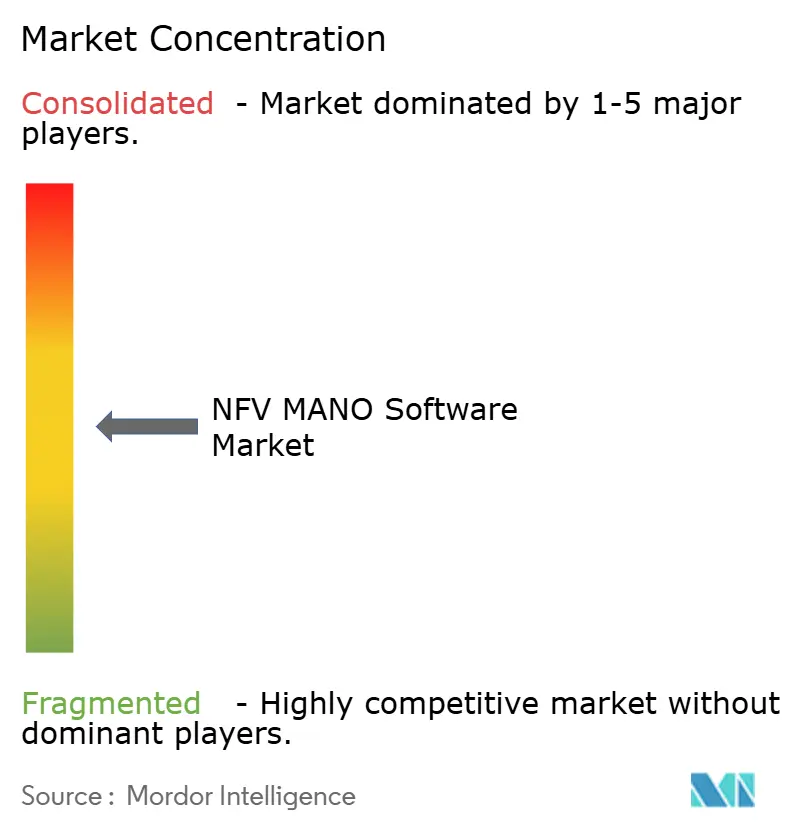
The NFV MANO software market is moderately concentrated among major telecommunications vendors but remains fragmented among specialists. Huawei, Ericsson, and Nokia have strengthened their positions in 5G mobile core systems. Their scale gives them an advantage in combining core networks, cloud infrastructure, service assurance, and automation. Ericsson has committed to a full-stack Cloud Native Infrastructure Solution. Nokia is focusing on open ecosystem orchestration and cloud-based autonomous network capabilities. These different approaches affect how operators assess integration, openness, and migration risk.
Nokia and Ericsson announced a cross-ecosystem automation collaboration in March 2026. Ericsson joined Nokia’s SMO Marketplace, while Nokia joined Ericsson’s rApp Ecosystem. The companies will publish rApps that communication service providers can access on both platforms through standardized R1-interface interoperability. Nokia also expanded its work with Google Cloud in June 2026 by adding 6 specialized AI agents to its Assurance Center platform. These moves aim to reduce friction in multi-vendor automation and advance assurance capabilities.
Mavenir, Netcracker, Oracle, Amdocs, and NEC compete through focused orchestration and AI capabilities. Mavenir’s June 2026 Agentic Service Assurance Framework works alongside existing OSS investments and uses explainable automation templates. NEC’s February 2026 demonstration with AWS used AI and GitOps automation for 5G UPF lifecycle management. Active participation in ETSI and O-RAN Alliance work can support interoperability in multi-vendor deployments. The remaining opportunity is for products that manage VNF and CNF lifecycles through a single operating environment. ETSI’s Telecoms Cloud MANO direction recognizes this continuing need.
NFV MANO Software Industry Leaders
Ericsson AB
Nokia Corporation
Huawei Technologies Co., Ltd.
Netcracker Technology Corporation
Cisco Systems, Inc.
- *Disclaimer: Major Players sorted in no particular order

Recent Industry Developments
- July 2026: Alcatel-Lucent Enterprise launched an updated private 5G offering featuring AerFlex, an AP-only deployment architecture that eliminates baseband units and dedicated packet cores, reducing enterprise private 5G deployment from months to days. The update deepens integration with the OmniVista Network Management Platform, unifying LAN, WLAN, and private 5G management on a single platform.
- June 2026: Nokia and Google Cloud expanded their autonomous network partnership, embedding six specialized Gemini-powered AI agents into Nokia Assurance Center. The agents execute event triage, anomaly reasoning, and cross-domain resolution, with Google Cloud's Vertex AI and BigQuery underpinning real-time assurance workflows. The integration supports both fully closed-loop automation for low-risk scenarios and advisory-mode recommendations for human-reviewed control points.
- June 2026: Nokia advanced its autonomous networks portfolio at DTW Copenhagen, releasing an upgraded Autonomous Networks Agent Library, an updated Autonomous Networks Suite, and a new Non-Real-Time RIC capability within its MantaRay SMO solution. The updated MantaRay SMO, aligned with Open RAN standards and featuring AI-enabled rApps for anomaly detection and dynamic network slicing, is ready for deployment at scale, with NTT DOCOMO cited as a partner for ongoing AutoPilot trials and Non-RT RIC development.
- June 2026: Mavenir launched its Agentic Service Assurance Framework, a TM Forum IG1251/IG1453-aligned multi-agent system that automates network operations across multi-vendor, multi-domain 5G, cloud-native, and IP networks. The framework's Intent Ops engine converts validated human workflows into explainable automation templates with audit trails, supporting operators in more than 120 countries.


Global NFV MANO Software Market Report Scope
The NFV MANO (Network Functions Virtualization Management and Orchestration) Software Market comprises software platforms and solutions that automate, manage, orchestrate, and coordinate virtualized network functions (VNFs), cloud-native network functions (CNFs), and the underlying network infrastructure across telecommunications, enterprise, and cloud environments.
The NFV MANO Software Market Report is Segmented by Component (Solutions, and Services), MANO Function (NFV Orchestrator, Virtualised Network Function Manager, Virtualised Infrastructure Manager, Wide Area Network Infrastructure Manager, and Container Infrastructure Service Manager), Deployment Mode (On-Premises, and Cloud), End User (Telecom Service Providers, Cloud Service Providers, Enterprises, Government and Defense Organizations, Data Center Operators, and Managed Network Service Providers), Organization Size (Large Enterprises, and Small and Medium Enterprises), and Geography (North America, Europe, Asia-Pacific, South America, Middle East, and Africa). The Market Forecasts are Provided in Terms of Value (USD).
| Solutions |
| Services |
| NFV Orchestrator |
| Virtualized Network Function Manager |
| Virtualized Infrastructure Manager |
| Wide Area Network Infrastructure Manager |
| Container Infrastructure Service Manager |
| On-Premises |
| Cloud |
| Telecom Service Providers |
| Cloud Service Providers |
| Enterprises |
| Government and Defense Organizations |
| Data Center Operators |
| Managed Network Service Providers |
| Large Enterprises |
| Small and Medium Enterprises |
| North America | United States |
| Canada | |
| Mexico | |
| Europe | United Kingdom |
| Germany | |
| France | |
| Italy | |
| Spain | |
| Russia | |
| Rest of Europe | |
| Asia-Pacific | China |
| India | |
| Japan | |
| South Korea | |
| Australia and New Zealand | |
| Rest of Asia-Pacific | |
| South America | Brazil |
| Argentina | |
| Rest of South America | |
| Middle East | Saudi Arabia |
| United Arab Emirates | |
| Turkey | |
| Rest of Middle East | |
| Africa | South Africa |
| Nigeria | |
| Rest of Africa |
| By Component | Solutions | |
| Services | ||
| By MANO Function | NFV Orchestrator | |
| Virtualized Network Function Manager | ||
| Virtualized Infrastructure Manager | ||
| Wide Area Network Infrastructure Manager | ||
| Container Infrastructure Service Manager | ||
| By Deployment Mode | On-Premises | |
| Cloud | ||
| By End-user | Telecom Service Providers | |
| Cloud Service Providers | ||
| Enterprises | ||
| Government and Defense Organizations | ||
| Data Center Operators | ||
| Managed Network Service Providers | ||
| By Organization Size | Large Enterprises | |
| Small and Medium Enterprises | ||
| By Geography | North America | United States |
| Canada | ||
| Mexico | ||
| Europe | United Kingdom | |
| Germany | ||
| France | ||
| Italy | ||
| Spain | ||
| Russia | ||
| Rest of Europe | ||
| Asia-Pacific | China | |
| India | ||
| Japan | ||
| South Korea | ||
| Australia and New Zealand | ||
| Rest of Asia-Pacific | ||
| South America | Brazil | |
| Argentina | ||
| Rest of South America | ||
| Middle East | Saudi Arabia | |
| United Arab Emirates | ||
| Turkey | ||
| Rest of Middle East | ||
| Africa | South Africa | |
| Nigeria | ||
| Rest of Africa | ||


Key Questions Answered in the Report
What is the size of the NFV MANO software market?
The NFV MANO software market was valued at USD 5.21 billion in 2025, is projected at USD 5.92 billion in 2026, and is forecast to reach USD 10.84 billion by 2031. The forecast reflects a 12.86% CAGR from 2026 to 2031, as operators move from limited trials toward wider commercial deployment of 5G Standalone core networks and cloud-native operating models.
What is driving adoption of NFV MANO software?
The NFV MANO software market is supported by 5G Standalone deployment, network slicing, cloud-native network functions, edge infrastructure, and AI-assisted assurance. These needs require coordinated lifecycle management across radio, core, transport, cloud, and service-assurance domains, particularly when an operator must support multiple suppliers and hybrid VNF and CNF workloads.
Which component is expanding fastest?
Services are projected to expand at a 13.86% CAGR through 2031 as operators need implementation, support, training, and managed operations. The requirement becomes more important when operators manage cloud-native migration, automated upgrades, AI-assisted assurance, and multi-vendor service environments that demand continuing skills, operational support, and structured implementation work.
Which MANO function leads demand?
NFV Orchestrator held a 27.18% share in 2025 because it coordinates service lifecycle management across network domains. The NFV MANO software market relies on this function for packaging, instantiation, scaling, termination, slice management, and resource allocation across infrastructure and network-function management layers.
Why are cloud MANO deployments becoming more common?
Cloud designs let operators retain sensitive control-plane workloads while using cloud capacity for analytics and AI workloads. This arrangement addresses data sovereignty and latency requirements while giving operators access to flexible cloud resources for suitable analytics, AI, and less latency-sensitive orchestration processes.
Which region is projected to expand fastest?
Africa is projected to expand at a 13.79% CAGR through 2031, supported by greenfield 5G deployment conditions. The NFV MANO software market can benefit where new networks avoid part of the legacy OSS/BSS integration burden carried by established operators and can adopt modern automation practices during their initial buildout.
Page last updated on:





