
Market Overview
| Study Period | 2020 - 2031 |
|---|---|
| Forecast Data Period | 2026 - 2031 |
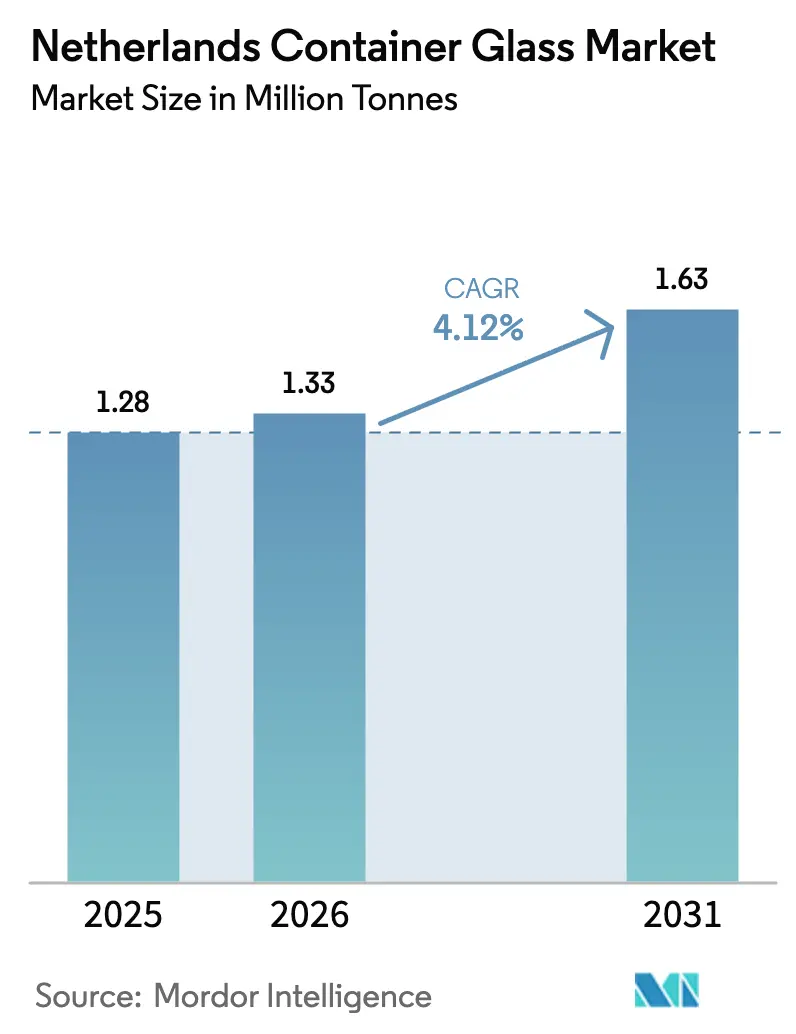
| Base Year Market Size (2025) | 1.28 Million tonnes |
| Market Volume (2026) | 1.33 Million tonnes |
| Market Volume (2031) | 1.63 Million tonnes |
| Growth Rate (2026 - 2031) | 4.12 % |
| Market Concentration | Medium |
Major Players *Disclaimer: Major Players sorted in no particular order Image © Mordor Intelligence. Reuse requires attribution under CC BY 4.0. | |
Netherlands Container Glass Market Analysis by Mordor Intelligence
The Netherlands Container Glass Market size was valued at 1.28 million tonnes in 2025 and estimated to grow from 1.33 million tonnes in 2026 to reach 1.63 million tonnes by 2031, at a CAGR of 4.12% during the forecast period (2026-2031). Rising demand for low-carbon packaging from beverage, cosmetics, and pharmaceutical brand owners, together with the country’s well-established recycling infrastructure, underpins steady volume expansion. Domestic consumption benefits from premiumization in beer, craft drinks, and luxury personal-care products, while export-oriented fillers leverage the Netherlands’ world-class logistics networks to serve adjacent European markets. Glass makers also gain a strategic advantage from regulatory tailwinds as the new EU Packaging and Packaging Waste Regulation incentivizes infinitely recyclable materials. Energy transition investments in hybrid or fully electric furnaces are gradually lowering production costs and carbon footprints, strengthening the competitive proposition of glass versus metal and paper alternatives.
Key Report Takeaways
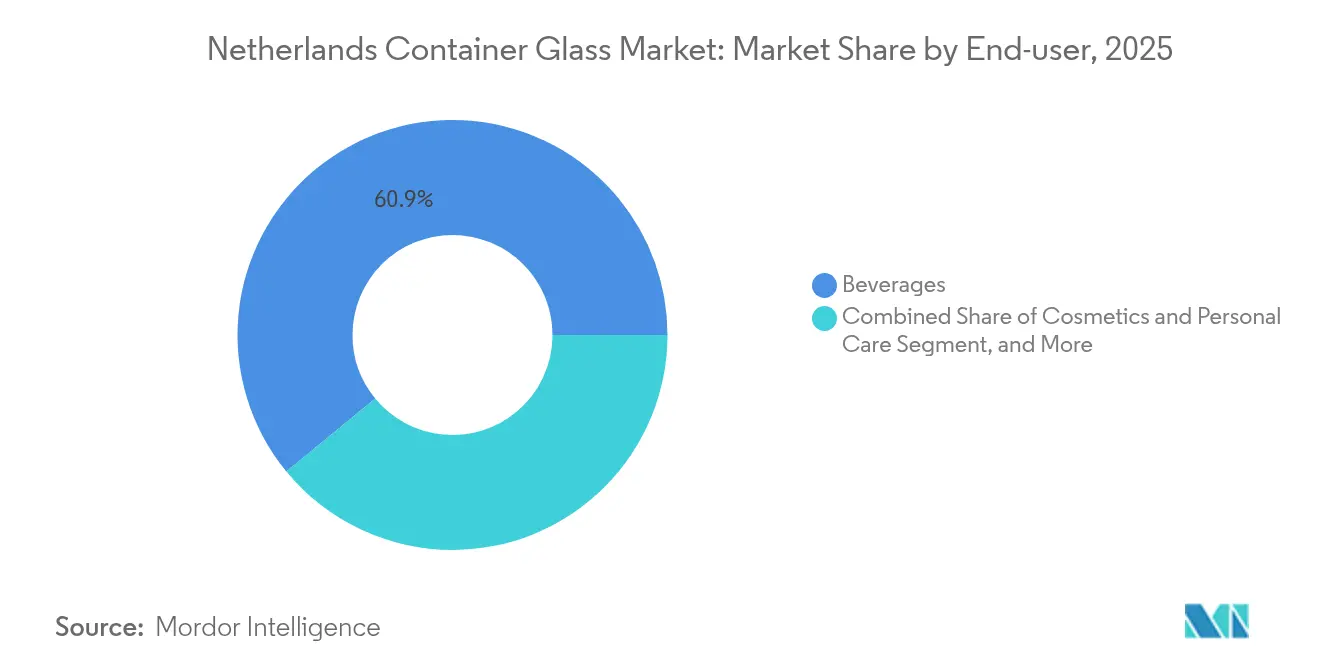
- By end-user, beverages captured 60.94% of the Netherlands container glass market share in 2025.
- By color, the Netherlands container glass market size for the amber glass segment is forecast to advance at a 5.4% CAGR through 2031.
Note: Market size and forecast figures in this report are generated using Mordor Intelligence’s proprietary estimation framework, updated with the latest available data and insights as of 2026.
Netherlands Container Glass Market Trends and Insights
Drivers Impact Analysis*
| Driver | (~) % Impact on CAGR Forecast | Geographic Relevance | Impact Timeline |
|---|---|---|---|
| Increasing Demand for Sustainable Packaging Solutions | +1.2% | Netherlands and EU-wide | Medium term (2-4 years) |
| Growth in Beverage and Food Industry | +0.8% | Netherlands domestic market | Short term (≤ 2 years) |
| Technological Advancements in Glass Manufacturing | +0.6% | Netherlands and regional EU | Long term (≥ 4 years) |
| Government Regulations Promoting Recycling | +0.7% | EU-wide with Netherlands implementation | Medium term (2-4 years) |
| Rising Consumer Awareness about Environmental Impact | +0.5% | Netherlands and Western Europe | Short term (≤ 2 years) |
| Expansion of Pharmaceutical and Cosmetic Industries | +0.9% | Netherlands and Benelux region | Medium term (2-4 years) |
| Source: Mordor Intelligence | |||
Increasing Demand for Sustainable Packaging Solutions
Glass enjoys infinite recyclability, absence of chemical migration and a premium look that resonates with eco-conscious Dutch and EU consumers. The EU Packaging and Packaging Waste Regulation pushes brands toward higher recycled content and stricter recyclability thresholds, effectively favoring glass over complex multilayer plastics.[1]European Union, “Regulation (EU) 2025/40 on Packaging and Packaging Waste,” europa.eu Dutch municipalities already collect 86% of glass packaging, supplying cullet that lowers furnace energy demand and furnace emissions. Heineken allocated EUR 583 million (USD 659 million) in returnable-glass deposits at end-2024, underscoring brand commitment to closed-loop solutions. Consumer surveys show 73% of Europeans consider glass ocean-friendly, bolstering retailer decisions to replace plastic jars with glass formats.[2]Consumer Goods Technology, “U.S. Glass Shortage Putting a Crack in CPG Sustainability Efforts,” consumergoods.com Collectively, these attitudes lift long-term demand in the Netherlands container glass market.
Growth in Beverage and Food Industry
The Netherlands hosts flagship breweries such as Heineken and AB InBev franchises, plus a vibrant craft-beer cluster that embraces distinctive bottle designs to reinforce brand identity. Heineken’s Texels brand grew 20% domestically in 2024 on premium positioning despite modest overall beer volume softness. On the logistics side, Dutch ports handled 545 million tonnes of freight in 2023, accelerating throughput of packaged beverages to Germany, France and Scandinavia. Organic foods packed in flint glass jars capture higher margins at supermarkets, reflecting consumer trust in the material’s inertness. E-commerce grocery channels further catalyze volume because glass survives parcel shipment with minimal product waste when properly designed.
Technological Advancements in Glass Manufacturing
Hybrid and fully electric furnaces unlock substantial CO₂ reductions and cost savings over time. Ardagh’s NextGen furnace in Obernkirchen achieves 60% renewable electricity input and 60% lower emissions per bottle. Verallia’s 100% electric furnace in Cognac operates at 180 tons per day with a 60% carbon cut, providing a template for Dutch glassworks targeting forthcoming zero-emission requirements.[3]Verallia, “2024 First Half Financial Report,” verallia.com Lightweighting breakthroughs, such as Vidrala’s 260-gram 75 cl bottle, trim raw material use and transport fuel burn. Vetropack’s Echovai process hardens bottles thermally so they can be reused longer while weighing 30% less. Adoption of these innovations cements the competitiveness of the Netherlands' container glass market.
Government Regulations Promoting Recycling
EU-wide targets require 90% collection of glass packaging by 2030, up from the 80.8% average achieved in 2023. Dutch policymakers already impose producer-responsibility fees linked to recyclability, lowering levies on mono-material glass and boosting its cost advantage over composite packaging. FEVE, the European container glass federation, has committed to net-zero roadmaps that align with Dutch climate policy, signaling regulatory certainty for investments in furnace electrification and high-cullet formulations. The Kennisinstituut Duurzaam Verpakken confirms glass safety for food contact, reinforcing its status in nutrient-sensitive applications.
Restraints Impact Analysis*
| Restraint | (~) % Impact on CAGR Forecast | Geographic Relevance | Impact Timeline |
|---|---|---|---|
| High Cost of Raw Materials | -0.9% | Netherlands and European supply chain | Short term (≤ 2 years) |
| Competition from Alternative Packaging Materials | -1.1% | Netherlands and broader EU markets | Medium term (2-4 years) |
| Energy-Intensive Production Process | -0.7% | Netherlands and European manufacturing | Medium term (2-4 years) |
| Stringent Environmental Regulations | -0.6% | EU-wide with Netherlands compliance focus | Long term (≥ 4 years) |
| Source: Mordor Intelligence | |||
High Cost of Raw Materials
Glass production remains energy-intensive, with furnace melting responsible for roughly 70% of manufacturing energy load. Verallia’s Northern and Eastern Europe EBITDA margin fell 747 basis points to 20% in 2024 amid high gas prices. Chinese flat-glass spot prices climbed 30% during early 2025, rippling into European soda ash and cullet markets. The Netherlands imported only USD 1.16 million of quartz in 2022, indicating exposure to supply disruptions from concentrated mining regions. Forward hedging eases some volatility, yet capital needed for hybrid furnaces competes with working-capital requirements, pressuring balance sheets in the Netherlands container glass industry.
Competition from Alternative Packaging Materials
Metal cans, paperboard cartons and advanced flexible films encroach on occasions historically reserved for glass. Ardagh Metal Packaging recorded 5% shipment growth in Europe in 2024 as beverage brands chased lighter formats. O-I Glass estimates brand owners begin shifting at a 15% price gap between glass and cans, with rapid migration once the gap exceeds 25%. EU weight-reduction targets exempt paper, accelerating paperization of certain food lines. To defend share, Dutch producers intensify lightweighting and develop refillable ecosystems that mitigate logistic cost disadvantages relative to one-way containers.
*Our forecasts treat driver/restraint impacts as directional, not additive. The impact forecasts reflect baseline growth, mix effects, and variable interactions.
Segment Analysis
By End-User - Beverages Anchor Demand while Cosmetics Accelerate Growth
The beverages segment contributed 60.94% of the Netherlands' container glass market volume in 2025. Domestically brewed beer, imported specialty wines, and export-bound spirits collectively absorb the bulk of furnace capacity, and the segment will still represent well above half of the Netherlands' container glass market size in 2031. Craft breweries specify embossed or bespoke bottles to differentiate shelf presence, sustaining value per tonne. Meanwhile, international drinks groups increasingly stipulate minimum cullet content or insist on returnable pool schemes, bolstering demand for high-grade flint bottles.
Cosmetics and personal care packaging are on course for a 5.12% CAGR between 2026 and 2031, the highest among end-users. Luxury skincare and fragrance houses favor heavy-wall flint or colored flacons that signal prestige and sustainability. SGD Pharma recently commercialized jars containing 20% post-consumer recycled glass, reducing energy use and helping brand owners hit Scope 3 targets. Pharmaceuticals also present upside: SCHOTT Pharma expanded syringe capacity across Central Europe to meet injectable biologics demand, channeling incremental orders to Dutch distributors. Overall, premium-focused categories underpin revenue resilience in the Netherlands container glass market.



By Color - Flint Maintains Leadership while Amber Gains Momentum
Flint bottles and jars accounted for 41.78 of % Netherlands' container glass market share in 2025. Transparent packaging enables shoppers to verify product quality visually, a decisive factor for organic sauces, craft beers, and vitamins. The Netherlands container glass market size for flint packaging is anticipated to expand steadily through 2031 as lightweighting lowers transport emissions without compromising clarity. Manufacturers now routinely produce 0.33-liter beer bottles under 190 grams, a 20% reduction relative to 2020 designs.
Amber glass, forecast to post a 5.4% CAGR, shields contents from ultraviolet degradation, making it ideal for light-sensitive spirits, nutraceuticals, and biologic drugs. Pharmaceutical fill-and-finish plants in Breda and Den Bosch increasingly request amber vials with tight dimensional tolerances. Vista bottles from Verallia, made with 100% post-consumer recycled amber cullet, demonstrate that color innovation can align with carbon neutrality ambitions. Green glass maintains a niche in continental lager and wine formats linked to heritage branding, while specialty blues and metallic sheens appear in ultra-premium gin launches, adding visual distinctiveness that commands price premiums.
Geography Analysis
Dutch container glass output benefits from the country’s central location within the European single market. Producers leverage short transit times to German fillers and French cosmetic hubs, keeping freight costs and carbon emissions competitive. Seamless highway and deep-sea port networks facilitate the import of soda ash and the export of finished bottles, reinforcing the logistics leadership of the Netherlands' container glass market.
Recycling infrastructure outperforms EU averages, with 86% collection, translating into abundant high-quality cullet for domestic furnaces. Alignment with EU deposit-return schemes ensures readiness for the 90% collection target by 2030, mitigating cullet supply disruptions. Regional technology spillovers are evident: Dutch plants evaluate Verallia’s electric furnace blueprint and Ardagh’s 60% renewable hybrid design to meet decarbonization roadmaps.
Cross-border market signals can still create volatility. German demand softened 2.5% in 2024, prompting capacity rationalization under O-I’s Fit to Win program that trims 14% of European. Conversely, high-growth Belgian investments such as Ciner’s 1,300 tons-per-day plant in Lommel will tighten skilled-labor supply along the Dutch border by 2026. These developments highlight the need for Dutch producers to safeguard energy hedges and automation funding to maintain regional cost leadership.
Regulatory Landscape
The Netherlands container glass market operates under EU and national packaging waste rules anchored by the Packaging Management Decree (Besluit beheer verpakkingen 2014), which sets extended producer responsibility obligations for packaging placed on the Dutch market. Companies placing 50,000 kg or more of packaging annually must report and contribute to the collective EPR scheme administered by Verpact (Afvalfonds Verpakkingen). Statutory recycling targets for glass packaging are set at 70% (as of 2021) and step up to 75% by 2030, reinforcing demand for high-quality cullet and traceable recycling flows.
For product safety, the Commodities Act Decree on packaging and consumer products (Warenwetbesluit verpakkingen en gebruiksartikelen) governs materials intended to come into contact with food. At the EU level, the Packaging and Packaging Waste Regulation (PPWR) provides the direction of travel for higher recyclability and collection performance, and it is a key reference point for Dutch implementation updates, alongside guidance and knowledge support from bodies such as the KIDV (Kennisinstituut Duurzaam Verpakken).
Value Chain Analysis
The Netherlands container glass value chain starts with procurement of silica sand, soda ash, limestone, and a high share of recycled cullet. This is followed by batch preparation and melting in energy-intensive furnaces, then forming, annealing, inspection, and palletized shipment. Domestic manufacturing is concentrated around major multi-plant operators, including Ardagh Group sites in Dongen and Moerdijk and O-I Glass operations in Leerdam and Maastricht, supplying bottles and jars to beverage, food, and personal care fillers and to export-oriented packing hubs.
Downstream, distribution runs through direct-to-filler contracts and packaging distributors, while end-of-life collection and recycling are shaped by EPR execution through Verpact. Verpact organizes financing and management of packaging waste streams, supporting a steady cullet loop back to glassmakers. Industry alignment and technical road-mapping are supported by the European Container Glass Federation (FEVE), which engages with manufacturers on sustainability and process improvements, linking plant-level decarbonization actions to broader policy and customer requirements.
Competitive Landscape
Global multinationals dominate but do not monopolize Dutch capacity, yielding a moderately concentrated arena. O-I Glass operates furnaces in Leerdam and Maastricht within its 34-plant European network, catering to beverage and food clients. Verallia strengthened its Benelux presence after purchasing Vidrala’s Italian business for EUR 230 million (USD 260 million) and is piloting 100% electric melting technology to raise sustainability credentials. Ardagh’s NextGen furnace showcases hybrid heating at scale, attracting marquee contracts like the Jägermeister 14 million-bottle agreement, evidence that decarbonization roadmaps win business in premium spirits.
Specialists thrive in higher-margin niches. SCHOTT Flat Glass in Tiel supplies specialty architectural panels and laboratory glassware, posting EUR 250.1 million (USD 270.6 million) in sales during its latest fiscal year. Vetropack advances thermal-hardening technology, enabling reusable bottles 30% lighter than conventional returnable glass, appealing to circular-economy retailers. TricorBraun’s acquisition spree of Euroglas and Glaspack expands the distribution of custom flacons to regional beauty brands, intensifying downstream competition.
Strategic themes center on footprint optimization, recycled content scalability and service innovation. O-I’s capacity closures free capital for furnace upgrades, while Verallia invests EUR 1.6 billion (USD 1.73 billion) across Europe through 2030 to decarbonize melt shops. White-space opportunities exist in digital printing, smart labeling and reusable infrastructure, segments where incumbents collaborate with technology startups to preserve glass’s premium status in the Netherlands container glass market.
Netherlands Container Glass Industry Leaders
Ardagh Group S.A.
O-I Glass, Inc.
Verallia SA
Vidrala S.A.
Vetropack Holding Ltd.
- *Disclaimer: Major Players sorted in no particular order


Market Opportunities and Future Outlook
Decarbonization and energy-management upgrades create a clear whitespace for Dutch container glass producers, since furnace melting dominates the cost and emissions profile. Dutch policy discussions are closely tied to EU packaging and climate agendas, and the PBL assessment of decarbonisation options for the Dutch container and tableware glass industry, along with FEVE's ongoing focus on sector roadmaps, keeps electrification and hybridization solutions central to investment conversations. This supports opportunities for equipment suppliers, renewable power contracting, and furnace rebuild programs aimed at lowering the carbon intensity of Dutch-made bottles and jars.
Circularity is also driving differentiation around higher cullet utilization, better cullet quality, and lightweighting. These efforts connect to the Netherlands EPR framework managed by Verpact and the country's established glass collection system. Commercial demand signals for lower-carbon glass are visible in premium beverage packaging, and the presence of large domestic producers, including Ardagh in Dongen and Moerdijk and O-I in Leerdam and Maastricht, provides a base for scaled offerings such as verified recycled-content flint and amber, refillable pools, and design-to-recycle solutions for food and personal care brands operating under tightening EU packaging requirements.
Recent Industry Developments
- May 2026: Ardagh Group S.A. announces the launch of Clearly Ardagh, a transformation initiative with capital deployment planned to rise to approximately 9 percent of revenues in 2026. The program signals a shift toward efficiency and targeted capital allocation, which may affect margins and investment in the Dutch container glass segment.
- February 2026: Verallia SA identifies subdued glass packaging demand in the Netherlands, Belgium, and Germany, prompting a strategic footprint review and capacity adaptation plan. This could result in capacity realignment and cost optimization, influencing Dutch container glass supply dynamics.
- July 2025: Ardagh Glass Packaging secures a contract to deliver 14 million low-carbon emerald bottles annually to Jägermeister using its hybrid NextGen furnace. The contract strengthens the premium, low-emission glass production footprint and supports a decarbonization narrative in the market.


Research Methodology Framework and Report Scope
Market Definition and Coverage
For this methodology, the market covers container glass produced and consumed in the Netherlands for packaging uses, measured in volume terms. It includes glass bottles and jars supplied into beverage, food, personal care, and pharmaceutical packaging demand pools.
Scope exclusions: It excludes flat glass, fiberglass, laboratory glassware, and other non-container glass products, even if they are made by similar manufacturers.
Segmentation Overview
- By End-user
- Beverages
- Alcoholic
- Beer
- Wine
- Spirits
- Other Alcoholic Beverages (Cider and Other Fermented Drinks)
- Non-Alcoholic
- Juices
- Carbonated Drinks (CSDs)
- Dairy Product Based Drinks
- Other Non-Alcoholic Beverages
- Alcoholic
- Food (Jam, Jelly, Marmalades, Honey, Sausages and Condiments, Oil, Pickles)
- Cosmetics and Personal Care
- Pharmaceuticals (excluding Vials and Ampoules)
- Perfumery
- Beverages
- By Color
- Green
- Amber
- Flint
- Other Colors
Data Sources, Market Sizing, and Validation
Desk Research
Desk work starts by mapping the Netherlands packaging and glass context so we do not build the model on assumptions alone. Public and official sources anchor basic demand signals, such as Statistics Netherlands (CBS) for manufacturing and consumption indicators, Eurostat for trade and industrial statistics, the European Commission for packaging and waste policy direction, and trade bodies such as FEVE and Close the Glass Loop for recycling and cullet-related context.
After that, broader secondary sources are used to cross-check direction and realism, including annual reports and investor presentations of relevant producers and fillers, customs and trade releases, and reputable industry press that tracks furnace upgrades and capacity events. Where needed, paid subscriptions for company financials and intelligence, patent databases, and shipment-level import-export views are used to verify timelines and improve consistency across sources. The desk sources listed here are illustrative, and many other public documents and datasets were also referenced to collect data, validate assumptions, and clarify open questions.
Primary Interviews and Surveys
Primary inputs were collected through expert interviews and targeted surveys with packaging decision-makers, glass industry specialists, and channel participants tied to beverage, food, and pharma packaging demand. These discussions were used to confirm what is actually shipped and used in-country, to sanity check cullet usage and lightweighting trends, and to align assumptions on capacity utilization and trade flows that can distort an apparent demand picture.
Distribution of primary research fieldwork respondents
| Company type | Respondent position |
|---|---|
| Top tier: 29% | CXOs: 12% |
| Mid tier: 50% | Functional/Unit leaders: 32% |
| Smaller Players: 21% | Managers: 56% |
Market-Sizing & Forecasting
The core sizing is built using a top-down approach where packaging demand in the Netherlands is reconstructed from end-use consumption indicators, production context, and trade direction, and then converted into container-glass tonnage using practical intensity factors. To keep the output grounded, selective bottom-up checks are also run, such as sampling typical container weights by application and validating implied volumes against supplier and channel feedback.
Key model inputs include filled beverage and food packaging demand signals, shifts in glass share versus alternative packaging where visible, cullet availability and recycled content direction (because it affects feasible output), furnace upgrade cycles that can temporarily reduce capacity, and import-export flows that can shift demand across borders even when Dutch consumption is steady. When direct data is missing for a niche application, conservative proxy ratios from similar end uses are used, and then the ratios are adjusted after expert review. Forecasts are developed using scenario analysis supported by a small set of drivers that can be explained and updated easily, such as expected packaging policy pressure, premiumization trends, and the pace of production modernization.
Data Validation & Update Cycle
Validation is handled through repeatable checks, so the numbers do not rely on a single source or one analyst judgment. Model outputs are compared with independent signals such as industry production direction, trade balance logic, and plausibility ranges for per-capita packaged consumption, and then anomalies are reviewed until the variance is understood.
Before sign-off, assumptions are rechecked in a multi-step review that includes peer review and follow-up outreach when a data point materially shifts the results. Reports are refreshed annually, and interim updates are made when major events occur, including capacity outages, new furnace lines, or policy changes that alter packaging economics. Right before delivery, an analyst performs a final pass so clients receive the latest updated view.
Mordor Intelligence's Netherlands Container Glass Market Sizing Compared With Other Published Estimates
Published market sizes for this space can look far apart because authors do not always measure the same thing, even when the market name sounds identical. Differences show up most often in whether the estimate is volume-based or value-based, how imports and exports are treated in a small, trade-connected country, and whether adjacent glass packaging categories are blended into the total.
The main gap comes from unit choice and scope mixing, where Mordor Intelligence keeps the Netherlands view strictly in container-glass tonnage and avoids converting into USD using generalized price assumptions that swing with energy costs and product mix. Another driver is how trade is handled, since some figures treat domestic production as demand even when shipment destinations are outside the country, and then the Netherlands number can be inflated. Timing also matters because some published totals are not refreshed after major furnace upgrades or short-term shutdowns, which can temporarily change available output and apparent consumption.
Benchmark comparison
| Source | Market Size | Gaps in Research Methodology |
|---|---|---|
| Mordor Intelligence | USD 0.00 B (2025) | |
| Industry Association A | USD 0.00 B (2025) | Often reported as broader glass packaging activity and then converted to value using blended price assumptions, which can overstate the Netherlands container-glass total when product mix skews to premium bottles. |
| Trade Journal B | USD 0.00 B (2026) | May rely on production-side commentary and capacity mentions without fully netting exports, and the timing can miss short-term furnace downtime that affects shipped tonnage. |
The comparison points to a consistent theme, where the spread is mostly created by mixing units, mixing adjacent categories, and treating production as a proxy for demand in a trade-heavy market. By keeping the steps traceable to demand indicators, trade logic, and repeatable conversion factors, we arrive at a total that is easier to explain and update when market conditions change.


Key Questions Answered in the Report
What is the current volume of the Netherlands container glass market?
The market stands at 1.33 million tonnes in 2026 and is projected to grow steadily through 2031.
Which end-user category drives the highest demand?
Beverages account for 60.94% of total volume, anchored by major breweries and premium drink producers.
Why is amber glass gaining popularity?
Amber glass blocks ultraviolet light, protecting pharmaceuticals and cosmetics that are sensitive to photodegradation, leading to a forecast 5.4% CAGR for the segment through 2031.
How are Dutch manufacturers reducing carbon emissions?
Firms are adopting hybrid or fully electric furnaces, boosting cullet use above 60% and pursuing lightweight bottle designs that cut transport fuel consumption.
What regulatory changes influence packaging choices?
The EU Packaging and Packaging Waste Regulation mandates higher recyclability and collection targets, favoring infinitely recyclable materials like glass.
Page last updated on:


 Your data is secure and never sold or shared.


