
Neon Gas Market Size and Share
Market Overview
| Study Period | 2022 - 2032 |
|---|---|
| Market Size (2027) | USD 389.19 Million |
| Market Size (2032) | USD 523.04 Million |
| Growth Rate (2027 - 2032) | 6.09 % |
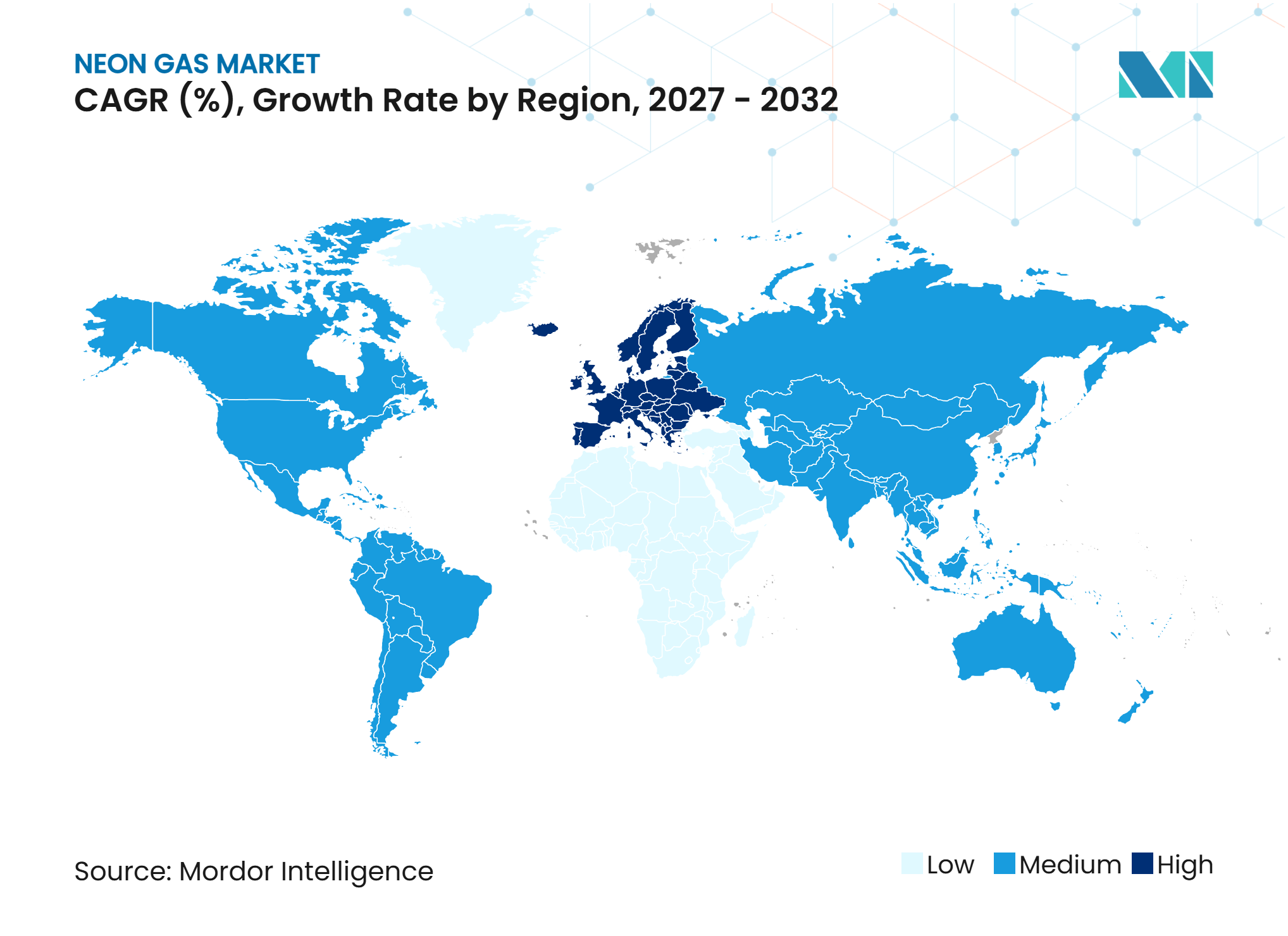
| Fastest Growing Market | Europe |
| Largest Market | Asia-Pacific |
| Market Concentration | Medium |
Major Players *Disclaimer: Major Players sorted in no particular order Image © Mordor Intelligence. Reuse requires attribution under CC BY 4.0. | |
Neon Gas Market Analysis by Mordor Intelligence
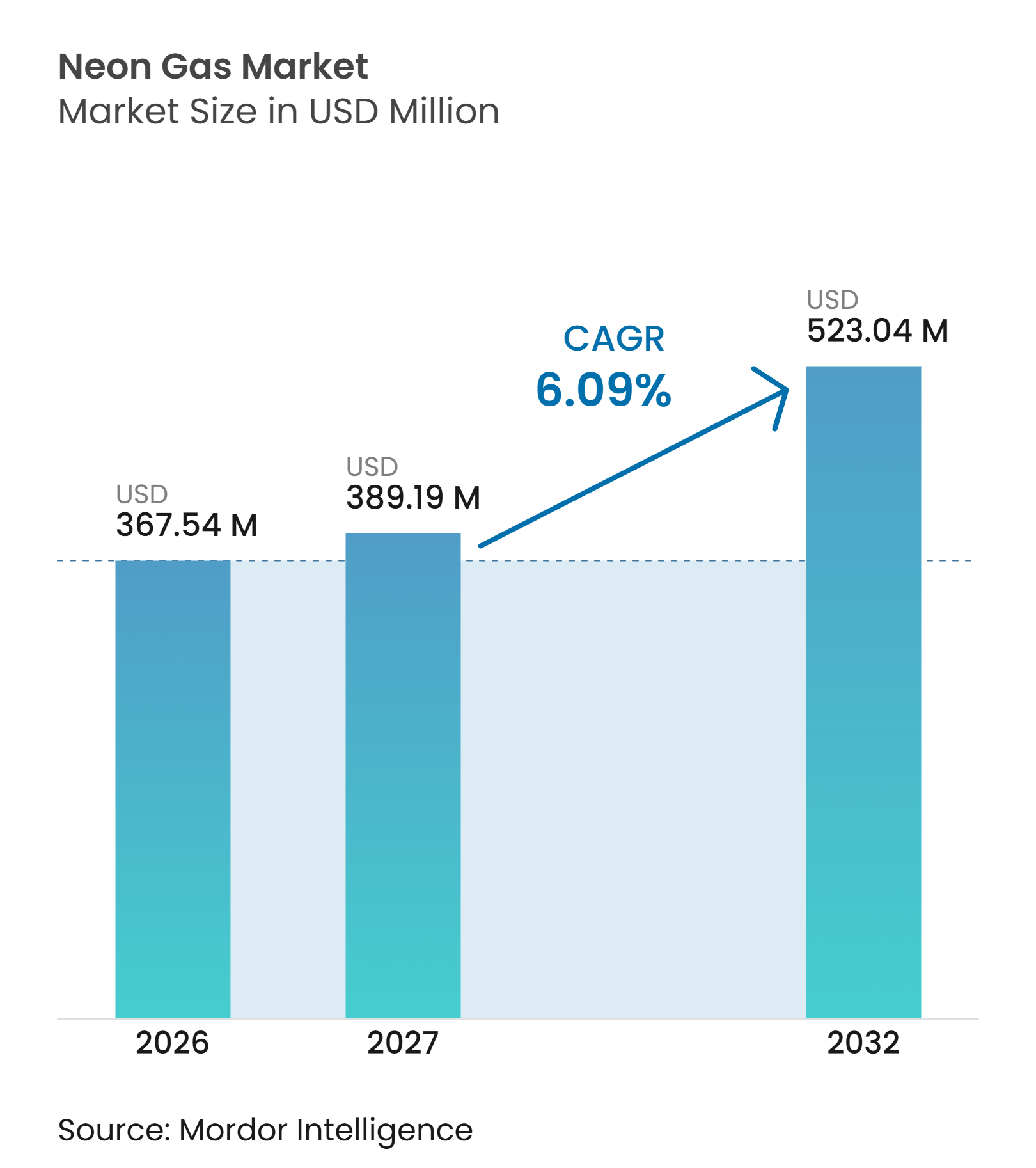
The Neon Gas Market size was valued at USD 367.54 million in 2026 and is estimated to grow from USD 389.19 million in 2027 to USD 523.04 million by 2032, at a CAGR of 6.09% during the forecast period (2027-2032). The neon gas market is closely linked to deep ultraviolet lithography, as excimer lasers require a stable supply of high-purity neon. Semiconductor fabrication is concentrated in a limited number of Asian production centers, keeping demand and supply decisions closely connected. New fabrication capacity in North America and Europe is also increasing the need for reliable rare-gas infrastructure. In response, the neon gas market is pursuing longer supply agreements, expanding local purification capacity, deploying recovery systems, and adopting more rigorous qualification processes. The shift toward extreme ultraviolet lithography constrains the longer-term outlook, but mature-node production keeps deep ultraviolet tools relevant during the forecast period.
Key Report Takeaways
- By grade, Ultra-High Purity held 45.56% of revenue in 2026 and is forecast to grow at a 6.89% CAGR through 2032.
- By supply mode, Cylinders held 44.03% of revenue in 2026, while On-Site Supply Systems are forecast to grow at a 7.63% CAGR through 2032.
- By application, Semiconductor and Electronics Manufacturing accounted for 70.17% of the neon gas market size in 2026, while Laser Technology is forecast to grow at a 7.45% CAGR through 2032.
- By geography, Asia-Pacific held 32.51% of revenue in 2026, while Europe is forecast to grow at a 7.32% CAGR through 2032.
Note: Market numbers in this report are based on Mordor Intelligence's proprietary estimation framework, which combines nine months of actuals with Q4 projections for base year 2026.
Market Trends and Insights
Drivers Impact Analysis of Neon Gas Market*
| Drivers | (~) % Impact on CAGR Forecast | Geographic Relevance | Impact Timeline |
|---|---|---|---|
| Semiconductor Fab Expansion and Lithography Intensity | +2.0% | Global, with concentration in Asia-Pacific and expansion in North America and Europe | Long term (≥ 4 years) |
| AI, High-Performance Computing, and Advanced Memory Demand | +1.2% | Global, with training infrastructure in North America and Asia-Pacific memory production | Medium term (2-4 years) |
| Government-Supported Semiconductor Localization | +0.7% | North America, Europe, Japan, South Korea, and China | Medium term (2-4 years) |
| Expansion of High-Purity Laser Applications | +0.6% | Europe and North America for medical and industrial lasers, Asia-Pacific for processing | Long term (≥ 4 years) |
| Neon Recovery and Closed-Loop Consumption Economics | +0.4% | South Korea and Taiwan, with early adoption in North America | Short term (≤ 2 years) |
| Source: Mordor Intelligence | |||
Semiconductor Fab Expansion and Lithography Intensity
Semiconductor capital spending directly shapes neon demand because deep ultraviolet exposure tools require certified ultra-high-purity gas for their excimer lasers. The neon gas market benefits when new facilities add exposure capacity or when established campuses add production lines. In July 2026, Linde committed USD 1 billion to expand its Phoenix industrial gas complex by adding 2 new SPECTRA air separation units for semiconductor facilities[1]. This investment illustrates how fabrication construction draws associated investment in gas separation, purification, storage, and distribution. Multiple production nodes on a single campus increase the need for dependable local supply and raise the value of on-site systems. This structure supports the neon gas market because customers place greater weight on continuity and qualification than on short-term purchasing flexibility. It also affects procurement planning because approved suppliers must coordinate construction schedules, commissioning dates, storage capacity, cylinder preparation, and operating procedures with the fab customer. A delay at any point in that chain can affect tool readiness, making qualified local capacity more valuable than a spot-market offer.
AI, High-Performance Computing, and Advanced Memory Demand
AI hardware requires advanced logic and memory devices, thereby increasing the importance of a secure supply of specialty gases throughout the semiconductor production chain. Advanced packaging adds additional process steps, requiring manufacturers to protect yield and maintain strict process control. TEMC expanded a diborane facility at Samsung Electronics' request for High-Bandwidth Memory 4 (HBM4) requirements and is developing a plant near the Yongin semiconductor cluster. The planned facility targets specialty-gas production and neon recycling capacity by 2027. The neon gas market therefore gains support from a broader mix of advanced semiconductor production, rather than from logic devices alone. This demand base also favors suppliers that can meet customer qualification requirements across high-purity gases and recovery services. Demand is especially relevant where advanced logic, high-bandwidth memory, and packaging activity are located close together. In those locations, gas suppliers must support production ramps while maintaining consistency across multiple process steps and customer production lines.
Government-Supported Semiconductor Localization
Supply-chain policies are reshaping where semiconductor materials and gases are produced, stored, and qualified. Japan's Ministry of Economy, Trade and Industry supported Air Liquide's Naoshima Island air separation unit, which is scheduled to produce argon and neon domestically from 2027. The project addresses Japan's prior reliance on imported neon and strengthens domestic supply security. South Korea's 2025 to 2027 supply-chain stabilization plan identifies resilience for economic-security items as a national priority. These policies support the neon gas market by encouraging local supply options, even when local producers need several years to complete construction and customer qualification. Localization can also shorten supply routes and make it easier for customers to work with suppliers during audits, maintenance periods, and unexpected changes in tool utilization. The effect is strongest where policy support is paired with local industrial infrastructure and experienced technical teams.
Expansion of High-Purity Laser Applications
High-purity neon supports excimer lasers used in ophthalmic procedures, dermatology, and advanced materials processing. These applications require consistent purity, traceability, and dependable delivery because gas quality can affect laser stability. Deutsches Institut für Normung (DIN) 50450-2:2025-07 establishes a testing protocol for oxygen impurities in neon and related carrier gases used in semiconductor technology. This standard raises the technical requirements for qualified suppliers and reinforces the importance of laboratory capability. The neon gas market gains from laser applications because the segment combines specialized performance requirements with ongoing needs for documentation and gas control. Medical and industrial users must also manage cylinder handling, residual gas, testing records, and replacement schedules without interrupting laser operation. These operating requirements support specialist suppliers with established analytical facilities and responsive technical service.
Restraints Impact Analysis of Neon Gas Market*
| Restraints | (~) % Impact on CAGR Forecast | Geographic Relevance | Impact Timeline |
|---|---|---|---|
| High Capital Intensity of Neon Capture and Purification | -1.5% | Global, most acute where steel-linked air separation infrastructure is limited | Long term (≥ 4 years) |
| Concentrated Feedstock and Purification Infrastructure | -1.2% | Ukraine, Russia, and China for feedstock, and South Korea, the United States, and Germany for purification | Medium term (2-4 years) |
| Substitution by Extreme Ultraviolet (EUV), Solid-State, and Alternative Lithography Technologies | -0.8% | Global, especially leading-edge logic facilities | Long term (≥ 4 years) |
| Source: Mordor Intelligence | |||
High Capital Intensity of Neon Capture and Purification
New neon purification capacity requires cryogenic separation equipment, advanced impurity removal, analytical systems, and long customer qualification periods. These demands limit the number of companies able to enter the neon gas market at semiconductor-grade quality. POSCO began crude neon production in 2022, established an industrial-gas division in 2023, formed a joint venture in 2024, acquired Chemgas Korea in September 2025, and completed its Gwangyang rare-gas plant in May 2026. This sequence demonstrates the multi-year commitment required to build an integrated position. Companies without steel-linked feedstock, capital resources, or proven purification technology face a slower route to commercial supply. These barriers preserve the role of established gas companies and qualified regional producers in the neon gas market. The challenge is compounded because customer qualification often continues after physical construction is complete. Producers must demonstrate repeatable quality, dependable packaging, and stable delivery before a customer will approve material for sensitive semiconductor processes.
Concentrated Feedstock and Purification Infrastructure
Neon occurs in the atmosphere at very low concentrations and is recovered as a byproduct of large-scale air separation. This links availability to the locations and operating rates of steel-linked oxygen plants. Ukraine's Ingas and Cryoin previously supplied a substantial share of the semiconductor-grade neon market, while the conflict disrupted operations and asset ownership became subject to state intervention[2]. China expanded rare-gas capacity after 2022, which improved supply diversity but created another concentration exposure within technology trade tensions. The neon gas market remains vulnerable when production and purification capability are clustered in a few locations. Customers have responded by seeking alternative supply sources, local capacity, and recovery options. Supply diversification can reduce exposure to a single location, but it does not eliminate the need for equivalent purity and documentation at each alternative source. Resilience programs must therefore address feedstock, purification, analytical testing, logistics, and customer approval together.
*Our forecasts treat driver/restraint impacts as directional, not additive. The impact forecasts reflect baseline growth, mix effects, and variable interactions.
Neon Gas Market Segment Analysis
By Grade:
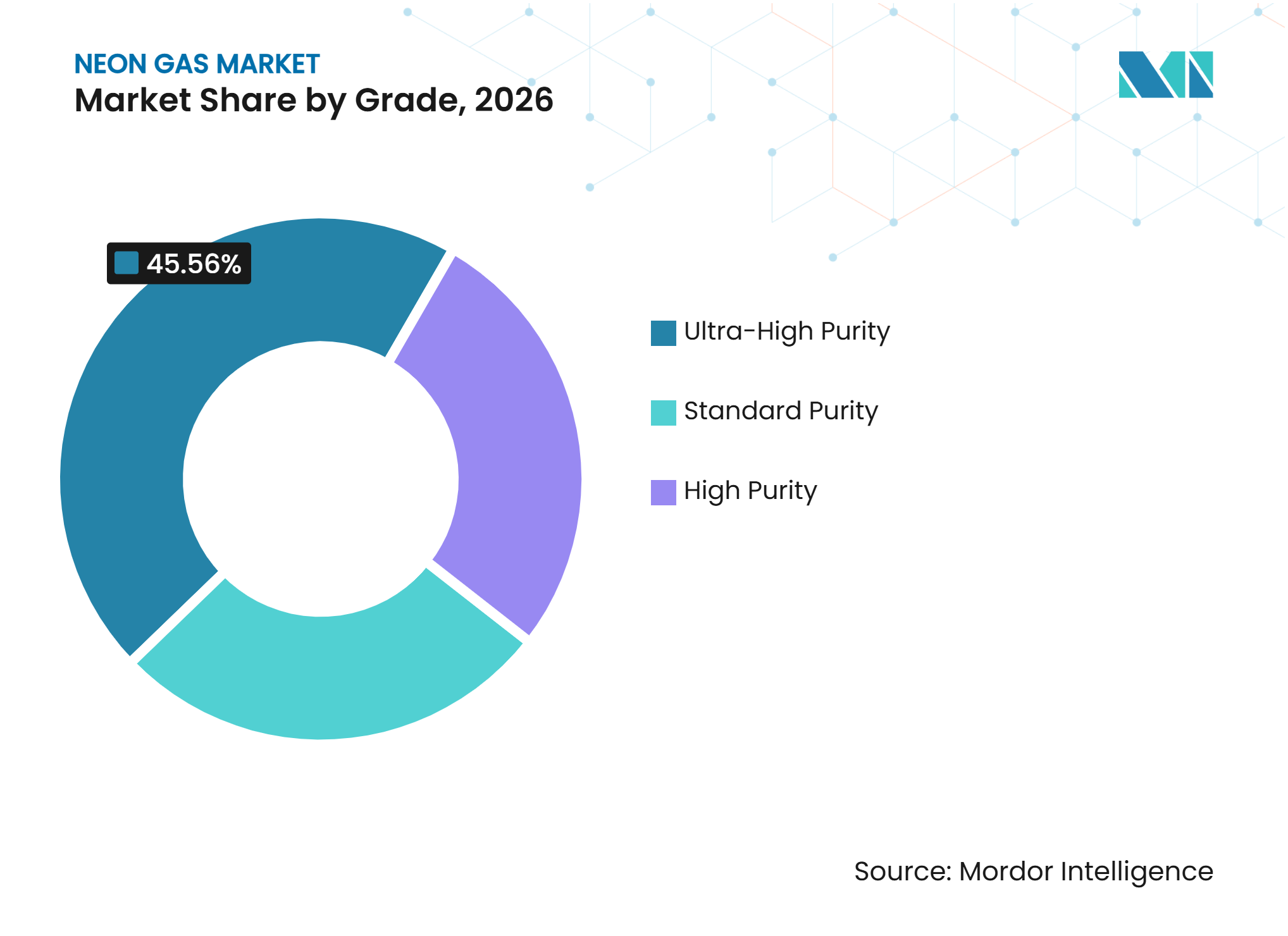
Ultra-High Purity Leads as Process Requirements TightenUltra-high purity neon accounted for 45.56% of the neon gas market in 2026 and is forecast to grow at a 6.89% CAGR through 2032. This grade is used in applications that require tight control of moisture, oxygen, particles, and other contaminants. Semiconductor fabrication is the primary driver of demand for qualified ultra-high purity material. Fabs running advanced processes require dependable purity levels and formal validation before a source can enter production. These requirements direct more spending toward suppliers with separation technology, purification systems, cylinder preparation controls, and testing capacity.
Standard purity and high purity grades remain relevant for signage, cryogenic work, older laser systems, and applications with less demanding specifications. Their role is narrower in segments where customers place greater value on analytical certification and consistent product supply. The neon gas market therefore has a clear quality hierarchy, with value rising alongside qualification demands. DIN's 2025 testing standard for oxygen impurities in neon provides a reference point for technical verification in semiconductor-related applications. Suppliers that can document performance and maintain traceability are better positioned to serve high-value accounts. The grade mix is likely to remain weighted toward ultra-high purity material as more customers prioritize process control.



By Supply Mode:
On-Site Systems Gain Importance at Large FacilitiesCylinders accounted for 44.03% of the neon gas market in 2026, as many mid-quantity customers require flexible packaged delivery. Laser manufacturers, medical device facilities, laboratories, and research centers commonly use cylinders because they do not require dedicated on-site infrastructure. Cylinder delivery also remains practical where demand patterns are variable, or quantities are limited. Bulk and micro-bulk supply serve customers who need larger, more consistent quantities than packaged gases can provide. Drum tanks are used for selected applications where high-quantity delivery is preferred over cylinder racks.
On-site supply systems are projected to grow at a 7.63% CAGR through 2032, the fastest rate among supply modes. Large semiconductor campuses favor these systems because local supply arrangements can support continuous operations and tighter inventory management. Air Products reported that its on-site gas segment generated nearly half of company revenue under long-term take-or-pay arrangements in fiscal 2025. Linde is expanding supply to Samsung with an eighth air separation unit at the Pyeongtaek campus. These arrangements support long-term customer relationships and make supply reliability a central competitive factor in the neon gas market.
By Application:
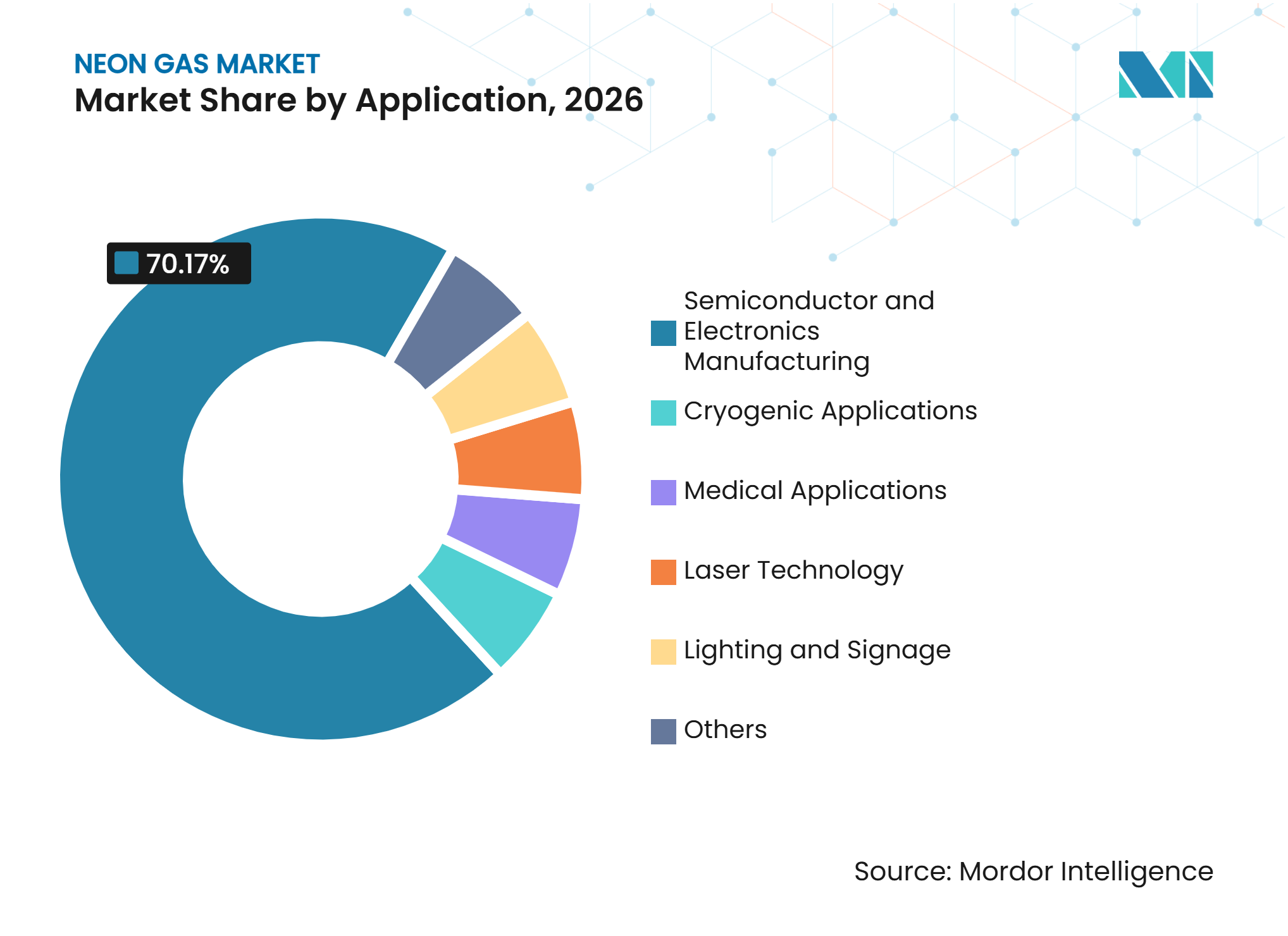
Semiconductor Demand Sets the Market’s DirectionSemiconductor and electronics manufacturing accounted for 70.17% of the neon gas market share in 2026. Deep ultraviolet lithography is closely linked to wafer production, tool utilization, and fab expansion plans. This concentration makes demand sensitive to semiconductor investment cycles and production changes. Customers consequently treat neon as a supply-security input rather than a routine operating material. This segment also favors suppliers that can demonstrate supply continuity, purity, and formal qualification for use in production.
Laser technology is forecast to grow at a 7.45% CAGR through 2032, driven by medical lasers, precision materials processing, and photonic applications. Lighting and signage continue to see demand from retrofit installations and architectural uses, but incremental growth in this segment is limited. Cryogenic applications use neon's low boiling point for ultra-low-temperature research platforms. Medical applications include laser-based therapeutic equipment used in dermatological and cardiovascular procedures. Other applications include emerging uses such as satellite propulsion, where rare gases support ion-thruster systems. Nippon Sanso Holdings has identified sustainable semiconductor process technology as a strategic development area, reflecting the broader importance of specialty gas innovation across advanced manufacturing.

Geography Analysis
Asia-Pacific
Asia-Pacific held 32.51% of the neon gas market share in 2026, supported by semiconductor clusters in South Korea, Taiwan, Japan, and mainland China. The region combines large wafer production with a growing focus on local rare-gas supply and recovery. Samsung commercialized an 80% neon-reuse system at Pyeongtaek Plant 4 in November 2026, with plans to expand to other sites. This model reduces fresh-gas requirements while increasing demand for collection, purification, testing, and return logistics. Japan's Naoshima Island project is scheduled to begin domestic production of neon in 2027. Japan's Ministry of Economy, Trade and Industry has supported economic security measures for industrial and technological infrastructure. These developments make supply resilience and qualification capability important regional priorities.
Europe
Europe is forecast to expand at a 7.32% CAGR through 2032, the fastest regional growth rate in the neon gas market. Semiconductor policy and local industrial-gas investment are supporting new capacity and more structured supply arrangements. Air Liquide invested more than EUR 250 million in Germany's Silicon Saxony cluster in 2025 to build industrial gas production units for a major semiconductor customer. SIAD inaugurated an air separation unit in Zagreb in July 2025, extending its capacity in Central Europe. The company also selected Porto Marghera in Venice for a large-scale air separation unit production plant. DIN 50450-2:2025-07 is a relevant compliance benchmark for oxygen-impurity testing in semiconductor-related neon. Documentation and safety practices are also shaped by European Industrial Gases Association (EIGA) guidance for safety data sheets.
North America, South America, and Middle East and Africa
North America is focused on domestic supply capability as semiconductor capacity expands and manufacturers reduce reliance on imported inputs. Linde's USD 1 billion investment in Phoenix connects industrial gas infrastructure directly to new semiconductor facilities. Universal Industrial Gases announced a USD 100 million project in Darlington County, South Carolina, beside a Nucor steel mill in March 2025. Steel-linked air separation remains central to the economics of domestic rare-gas supply. South America has developing demand in Brazilian electronics assembly and automotive activity, but local production remains limited. The Middle East and Africa have potential rare-gas capacity around large industrial sites and hydrocarbon-processing operations. This mixed-geography group offers longer-term opportunities to integrate industrial gases with existing high-volume oxygen plants. The neon gas market in these regions depends on whether new processing and purification capacity can achieve semiconductor-grade qualification.
Competitive Landscape
Market Concentration
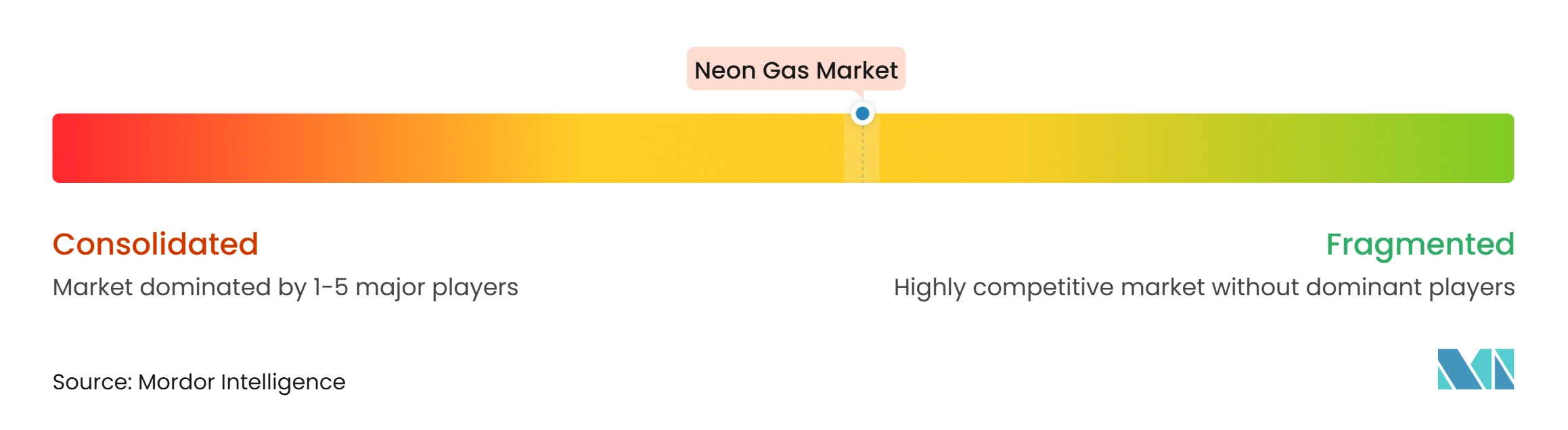
The neon gas market is moderately fragmented, with Linde, Air Liquide, Air Products and Chemicals, Messer, and Nippon Sanso Holdings accounting for most of the global revenue. Their positions are built on extensive experience in cryogenic air separation, purification, analytics, distribution, and on-site customer service. Linde includes rare gases, such as neon, krypton, and xenon, in its atmospheric gas portfolio. Long-term on-site arrangements strengthen supplier positions because physical assets and operating processes become integrated with customer facilities, as illustrated by Linde's expansion at Samsung's Pyeongtaek campus. Competition therefore depends on technical capability, customer qualification, location, and the ability to offer continuous supply.
Regional producers are increasing competitive pressure by combining access to local feedstock with rare-gas purification. POSCO completed its Gwangyang high-purity rare-gas plant in May 2026 and is building an integrated supply position around its steel-linked resources. Samsung's recycling partnership with TEMC demonstrates an alternative route to competition through recovery, refining, and closed-loop gas management. SIAD's Zagreb investment and planned Porto Marghera facility show how specialized air separation engineering can broaden regional supply options. These developments indicate that competitive differentiation is shifting toward secure feedstock, technical purification, and local service coverage.
Documentation and operating standards also influence supplier selection, particularly for semiconductor and medical customers. The European Industrial Gases Association (EIGA)'s 2025 safety-data-sheet guidelines provide a common reference for industrial-gas documentation across Europe, while DIN's oxygen-impurity testing method offers a further benchmark for performance validation. Market entry based on raw gas availability alone is insufficient, as buyers require reliable purification, validated quality systems, and dependable delivery. On-site systems and recovery projects can deepen customer relationships and add service revenue. Regional entrants can succeed where they secure feedstock and complete customer qualification before committing to demand capacity.
Neon Gas Industry Leaders
-
Air Liquide
-
Linde PLC
-
Air Products and Chemicals, Inc.
-
Messer SE & Co. KGaA
-
Nippon Sanso Holdings Corporation
- *Disclaimer: Major Players sorted in no particular order
Neon Gas Market Companies Covered in this Report
- Air Liquide
- Air Products and Chemicals, Inc.
- Airgas, Inc.
- Cryoin Engineering Ltd.
- Gulfcryo
- Ingas LLC
- Iwatani Corporation
- Jinhong Gas Co., Ltd.
- Linde PLC
- Messer SE & Co. KGaA
- Nippon Sanso Holdings Corporation
- POSCO Group
- Samsung Electronics Co., Ltd.
- SIAD Group
- TEMC Co., Ltd.
- Universal Industrial Gases, LLC
Recent Industry Developments in Neon Gas Market
- November 2026: Samsung Electronics commercialized a neon gas recycling system at Pyeongtaek Plant 4, developed in collaboration with domestic specialty gas supplier TEMC. The three-tank closed-loop system captures waste neon gas from chip manufacturing tools, which TEMC refines to high purity before returning it to Samsung for reuse, achieving an 80% recycling rate for neon. Samsung plans to extend the system to Plants 5, Yongin, and Honam, as well as existing Hwaseong facilities, with a target domestic neon waste recycling rate of 99.9% by 2030.
- July 2025: Linde committed USD 1 billion to expand its industrial gas complex at a semiconductor manufacturer's campus in Phoenix, Arizona. The investment covers 2 new SPECTRA air separation units, bringing the site's total to 5. The expansion will supply ultra-high-purity nitrogen, oxygen, and argon to 2 new semiconductor fabrication facilities.
Global Neon Gas Market Report Scope
Neon is a chemical element that is virtually non-reactive and chemically inert under normal conditions. It belongs to the noble gas group and does not form stable compounds with other elements under standard conditions. Neon is colorless, odorless, and exists as a monatomic gas at room temperature. It is extracted from air through fractional distillation, with global production measured in tons per year.
The neon gas market is segmented by grade, supply mode, application, and geography. By grade, the market is segmented into standard purity, high purity, and ultra-high purity. By supply mode, the market is segmented into cylinders, bulk and micro-bulk, drum tanks, and on-site supply systems. By application, the market is segmented into semiconductor and electronics manufacturing, laser technology, lighting and signage, cryogenic applications, medical applications, and others. The report also covers market sizes and forecasts for neon gas across 15 countries in major regions. The market sizes and forecasts are provided in terms of value (USD).
Segmentation Overview
| Standard Purity |
| High Purity |
| Ultra-High Purity |
| Cylinders |
| Bulk and Micro-Bulk |
| Drum Tanks |
| On-Site Supply Systems |
| Semiconductor and Electronics Manufacturing |
| Laser Technology |
| Lighting and Signage |
| Cryogenic Applications |
| Medical Applications |
| Others |
| Asia-Pacific | China |
| India | |
| Japan | |
| South Korea | |
| ASEAN Countries | |
| Rest of Asia-Pacific | |
| North America | United States |
| Canada | |
| Mexico | |
| Europe | Germany |
| United Kingdom | |
| France | |
| Italy | |
| NORDIC Countries | |
| Rest of Europe | |
| South America | Brazil |
| Argentina | |
| Rest of South America | |
| Middle East and Africa | Saudi Arabia |
| South Africa | |
| Rest of Middle East and Africa |
| By Grade | Standard Purity | |
| High Purity | ||
| Ultra-High Purity | ||
| By Supply Mode | Cylinders | |
| Bulk and Micro-Bulk | ||
| Drum Tanks | ||
| On-Site Supply Systems | ||
| By Application | Semiconductor and Electronics Manufacturing | |
| Laser Technology | ||
| Lighting and Signage | ||
| Cryogenic Applications | ||
| Medical Applications | ||
| Others | ||
| By Geography | Asia-Pacific | China |
| India | ||
| Japan | ||
| South Korea | ||
| ASEAN Countries | ||
| Rest of Asia-Pacific | ||
| North America | United States | |
| Canada | ||
| Mexico | ||
| Europe | Germany | |
| United Kingdom | ||
| France | ||
| Italy | ||
| NORDIC Countries | ||
| Rest of Europe | ||
| South America | Brazil | |
| Argentina | ||
| Rest of South America | ||
| Middle East and Africa | Saudi Arabia | |
| South Africa | ||
| Rest of Middle East and Africa | ||
Key Questions Answered in the Report
What is current market size of Neon Gas Market?
The Neon Gas Market size was valued at USD 367.54 million in 2026 and is estimated to grow from USD 389.19 million in 2027 to USD 523.04 million by 2032, at a CAGR of 6.09% during the forecast period (2027-2032).
Which neon grade leads demand?
Ultra-High Purity neon held 45.56% of revenue in 2026 and is projected to grow at a 6.89% CAGR through 2032.
Which supply mode is growing fastest for neon gas?
On-Site Supply Systems are expected to grow at a 7.63% CAGR through 2032 as large fabs prioritize continuous local supply.
Why is Asia-Pacific important for neon gas suppliers?
Asia-Pacific held 32.51% of revenue in 2026 because it contains major semiconductor fabrication clusters in South Korea, Taiwan, Japan, and China.