
Natural Gas Generators Market Size and Share
Market Overview
| Study Period | 2022 - 2032 |
|---|---|
| Market Size (2027) | USD 12.95 Billion |
| Market Size (2032) | USD 19.99 Billion |
| Growth Rate (2027 - 2032) | 9.08 % |
| Fastest Growing Market | Asia-Pacific |
| Largest Market | Asia-Pacific |
| Market Concentration | Medium |
Major Players *Disclaimer: Major Players sorted in no particular order Image © Mordor Intelligence. Reuse requires attribution under CC BY 4.0. | |
Natural Gas Generators Market Analysis by Mordor Intelligence
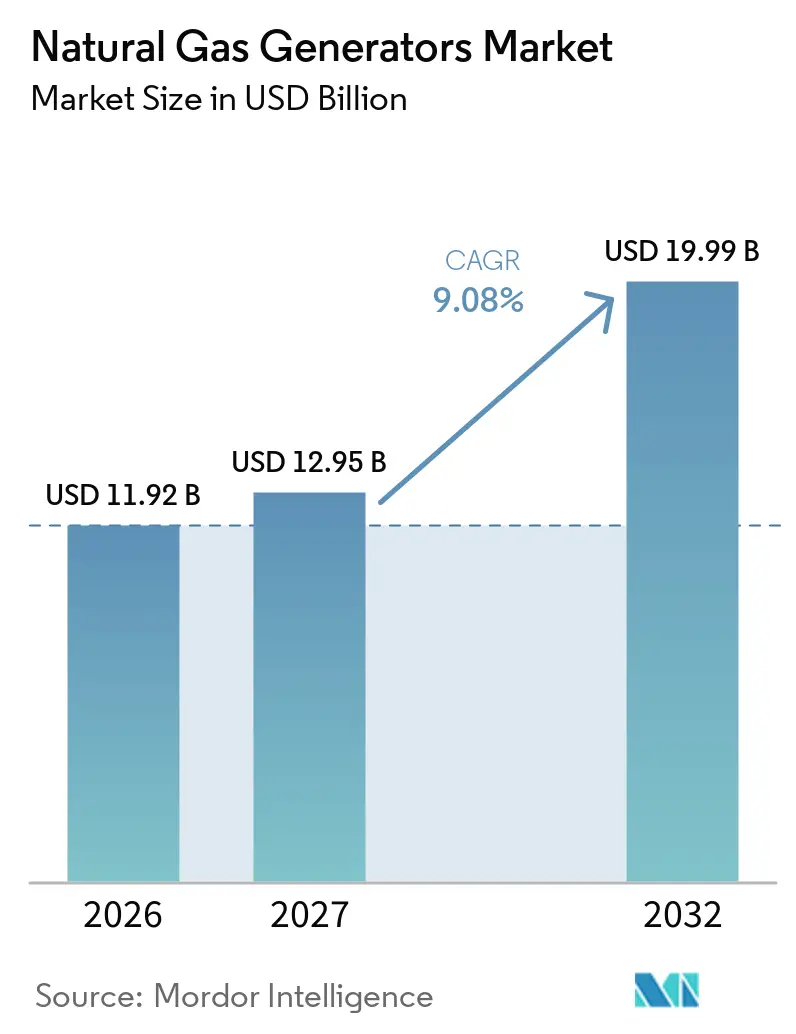
The Natural Gas Generators Market size was valued at USD 11.92 billion in 2026 and is estimated to grow from USD 12.95 billion in 2027 to reach USD 19.99 billion by 2032, at a CAGR of 9.08% during the forecast period (2027-2032). The natural gas generators market is being reshaped by data center projects that need power before grid connections are available. Data center developers in the United States have announced 101 GW of behind-the-meter natural gas capacity, with 57 GW supported by public equipment orders and 7 GW under construction. This demand favors equipment that can operate continuously rather than only during outages. Natural gas generators also benefit from reliability investment after severe weather and from rules that raise the compliance cost of new diesel equipment. Battery and hydrogen systems remain alternatives for selected standby uses, but fuel supply, storage, and cost constraints limit their role in large continuous-duty applications.
Key Report Takeaways
- By capacity, below 75 kVA held 18.1% of the natural gas generators market share in 2026, while 750 to 2,000 kVA is forecast to grow at an 11.7% CAGR through 2032.
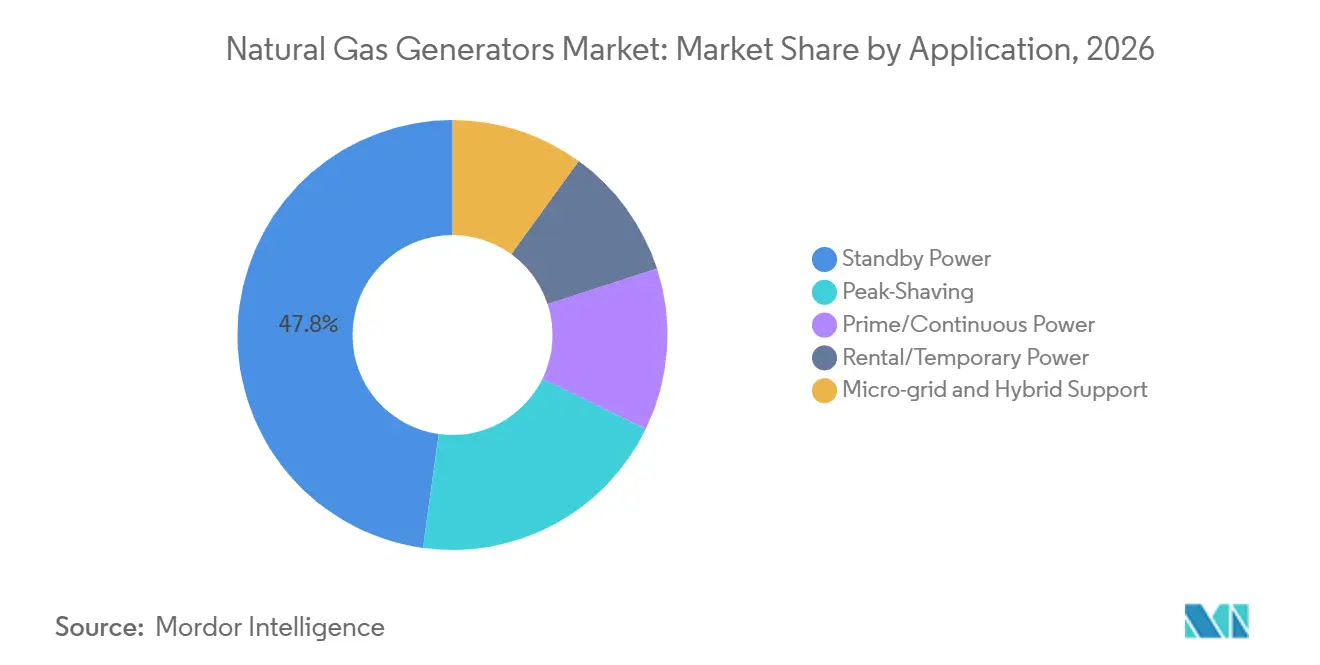
- By application, Standby Power held 47.8% of the natural gas generators market share in 2026, while it is forecast to grow at a 9.9% CAGR through 2032.
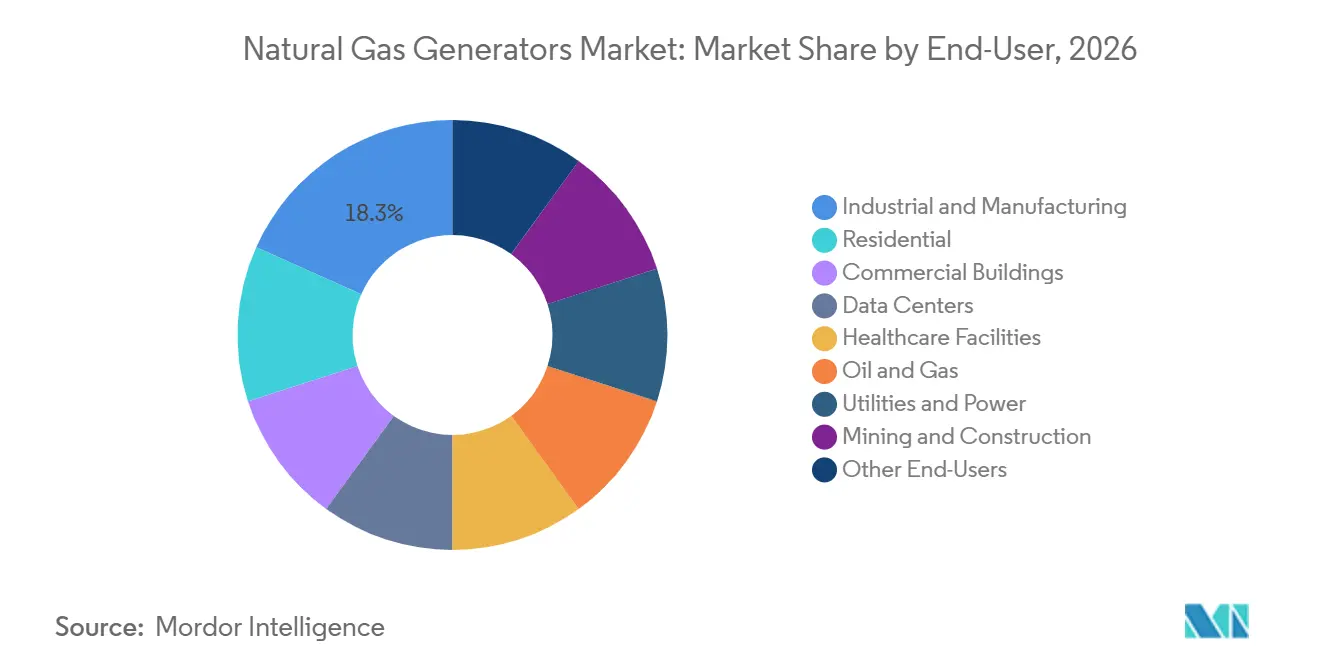
- By end user, Industrial and Manufacturing held 18.3% revenue share in 2026, while Data Centers are forecast to grow at a 14.7% CAGR through 2032.
- By geography, Asia-Pacific held 40.1% revenue share in 2026 and is forecast to grow at a 9.3% CAGR through 2032.
Note: Market numbers in this report are based on Mordor Intelligence's proprietary estimation framework, which combines nine months of actuals with Q4 projections for base year 2026.
Market Trends and Insights
Drivers Impact Analysis of Natural Gas Generators Market*
| Driver | (~) % Impact on CAGR Forecast | Geographic Relevance | Impact Timeline |
|---|---|---|---|
| Data Center Load Growth and On-Site Gas Power Procurement | +2.8% | North America, Asia-Pacific, Europe | Short term (≤ 2 years) |
| Gas Pipeline Expansion and LNG-Backed Fuel Availability | +1.2% | North America, South Asia, Middle East and Africa | Medium term (2-4 years) |
| Grid Reliability Investment After Extreme Weather Events | +1.0% | North America, core Asia-Pacific, Middle East and Africa | Short term (≤ 2 years) |
| Diesel Replacement Under Local Air Quality Rules | +1.4% | North America, European Union, urban Asia-Pacific | Medium term (2-4 years) |
| Flexible CHP and Microgrid Deployment | +0.8% | Global, with early gains in North America and Northern Europe | Medium term (2-4 years) |
| Faster Commissioning of Modular Generation for Large Loads | +0.6% | North America, Southeast Asia | Short term (≤ 2 years) |
| Source: Mordor Intelligence | |||
Data Center Load Growth and On-Site Gas Power Procurement
The natural gas generators market is seeing a shift from occasional backup use toward continuous supply for large data centers. Global data center electricity use is projected to exceed 1,000 TWh by 2030, compared with 460 TWh in 2024.[1] The International Energy Agency expects natural gas and coal to provide more than 40% of the additional electricity demand through 2030. In the United States, grid interconnection queues can extend for 5 to 7 years, while one Tennessee operator deployed 200 MW of data center load with mobile natural gas generators in 122 days.[2] This difference in delivery time makes on-site equipment attractive even where grid power may eventually be available. Global natural gas turbine and engine orders reached 100 GW by the end of 2025, against annual manufacturing capacity of 60 to 70 GW.
Gas Pipeline Expansion and Liquefied Natural Gas (LNG)-Backed Fuel Availability
Fuel access is becoming less restrictive for the natural gas generators market in locations that historically relied on diesel. U.S. pipeline projects completed in 2025 added 6.3 billion cubic feet per day (Bcf/d) of capacity, and 85% of that capacity served the South Central region.[3] The region combines LNG export activity with rising electricity demand, which strengthens the business case for new gas infrastructure. New global LNG export capacity is expected to add 300 billion cubic meters per year by 2030, led by projects in the United States and Qatar.[4] Greater fuel availability can support installations in Southeast Asia, South Asia, and sub-Saharan Africa where diesel remains common. It also gives industrial users more confidence that a gas-based power project can secure fuel over its operating life.
Grid Reliability Investment After Extreme Weather Events
The natural gas generators market benefits when critical facilities strengthen their power resilience plans. North American Electric Reliability Corporation (NERC) recorded a 20 GW, or 2.5%, annual increase in aggregate peak demand across its assessment areas in the 2025-2026 winter assessment. The assessment identified potential supply shortfalls in extreme cold in Electric Reliability Council of Texas (ERCOT), SERC Reliability Corporation (SERC)-East, and SERC-Central. Texas approved USD 1.8 billion for a program supporting solar, battery, and gas-fired backup systems at hospitals, water treatment plants, and nursing homes. The program permits individual projects of up to 2.5 MW, supporting distributed equipment rather than only central power stations. American Gas Association data show 1 annual outage per 650 gas customers, compared with 1 annual outage per electric customer, which supports gas-based resilience planning.
Diesel Replacement Under Local Air Quality Rules
Local emissions rules can shift new equipment decisions toward natural gas generators. The Bay Area Air Quality Management District adopted requirements in December 2024 for Tier 4 controls on emergency diesel engines rated at 50 brake horsepower or more. These requirements increase the compliance burden associated with new diesel installations. Virginia guidance has also directed data centers to evaluate natural gas engines as a lower-nitrogen oxides (NOx) alternative to diesel equipment. The District of Columbia proposed renewed category permits for natural gas emergency engines in March 2025. For large fleets, the cost of updating diesel assets to meet stricter requirements can exceed the cost of installing equivalent gas units. This supports replacement activity in commercial buildings, industrial sites, and data centers.
Restraints Impact Analysis of Natural Gas Generators Market*
| Restraint | (~) % Impact on CAGR Forecast | Geographic Relevance | Impact Timeline |
|---|---|---|---|
| Natural Gas Price Volatility and Basis Risk | -1.2% | Global, most acute in Europe and price-sensitive Asia-Pacific markets | Short term (≤ 2 years) |
| Upfront Site, Pipeline, and Emissions Control Costs | -0.8% | Emerging markets, urban North America, European Union | Medium term (2-4 years) |
| Sparse Gas Grid Access in Remote and Emerging Markets | -0.6% | Sub-Saharan Africa, remote Asia-Pacific, parts of South America | Long term (≥ 4 years) |
| Battery, Renewable, Hydrogen, and Fuel Cell Substitution | -1.0% | Global, most advanced in the European Union and coastal North America | Long term (≥ 4 years) |
| Source: Mordor Intelligence | |||
Natural Gas Price Volatility and Basis Risk
Fuel-price exposure remains a material restraint on the natural gas generators market. Henry Hub front-month futures reached 102% 30-day historical volatility in February 2025 during a polar vortex, before easing to 69% by mid-2025 as storage conditions normalized. Buyers that operate continuously may face a larger fuel-cost risk than buyers that use generators only for emergency standby. The risk is particularly relevant where fuel is indexed to volatile regional benchmarks. The International Energy Agency reported a 95% correlation between Title Transfer Facility (TTF) and Japan Korea Marker (JKM) prices in 2024, allowing events in one market to transmit quickly into another. European price volatility in 2024 was 50% above the 2010-2019 average.
Battery, Renewable, Hydrogen, and Fuel Cell Substitution
Batteries and hydrogen systems are credible alternatives for selected short-duration standby uses. Pacific Gas and Electric and Energy Vault put a 293 MWh hybrid hydrogen fuel cell and battery microgrid into service in Calistoga, California, replacing a diesel generator for community emergency backup. Vertiv and Ballard completed system testing for a hydrogen-powered data center backup module intended to replace diesel units. These systems can address specific resilience needs where operating hours are limited. Their current economics and storage needs remain less favorable for large continuous-duty power requirements. Natural gas retains advantages in dispatchable output and established fuel infrastructure for prime power and combined heat and power projects. The substitution risk is therefore more pronounced for smaller standby systems than for large data center and industrial installations.
*Our forecasts treat driver/restraint impacts as directional, not additive. The impact forecasts reflect baseline growth, mix effects, and variable interactions.
Natural Gas Generators Market Segment Analysis
By Capacity:
Large-Format Engines Gain Share as AI Load GrowsThe 750 to 2,000 kVA category is forecast to expand to an 11.7% CAGR by 2032, making it the fastest-growing capacity range in the natural gas generators market. The category serves modular data center installations and industrial combined heat and power projects that need paralleled equipment. A Caterpillar G3516 set can provide 2 MW of continuous-duty capacity at a hyperscale site. Several large reciprocating units can be combined to supply a full project phase while avoiding long turbine delivery times. The 2,000 to 6,250 kVA and above-6,251 kVA ranges are also gaining relevance as operators pursue larger private power systems. Their use is linked to projects that require flexible construction schedules and staged capacity additions. The natural gas generators market provides a practical route for developers that need dependable capacity before a utility connection is completed. This need is strongest where data center construction is moving faster than transmission additions.
Below 75 kVA accounted for 18.1% of the natural gas generators market size in 2026. The category is supported by residential standby purchases in storm-prone areas and by small commercial installations in urban locations with unreliable grids. The 75 to 125 kVA, 125 to 375 kVA, and 375 to 625 kVA ranges serve commercial buildings, health facilities, and small industrial users. Together, these ranges from a broad installed base across routine backup and limited prime-power use. The 625 to 750 kVA category bridges commercial and light-industrial specifications. Caterpillar obtained Environmental Protection Agency (EPA) certification in November 2025 for natural gas generator sets used in emergency and non-emergency service up to 3.1 MW in U.S. 60 Hz applications. This type of certification can shorten approval processes for continuous-duty projects and improve the position of reciprocating equipment against turbines.
By Application:
Standby Dominance Masks a Structural Prime Power ShiftStandby Power held 47.8% of the natural gas generators market size in 2026 and is forecast to grow at a 9.9% CAGR through 2032. It remains the largest application because hospitals, commercial buildings, and digital infrastructure require power during grid interruptions. Data center construction is expanding the definition of standby equipment. Some sites require systems that remain ready for extended full-load operation rather than a limited number of annual hours. This requirement creates a distinction between conventional backup units and systems designed for sustained data center operation. It also increases demand for larger engines, higher service coverage, and resilient fuel arrangements. The natural gas generators industry is responding with equipment designed for continuous duty and rapid deployment. This adds value beyond the initial generator sale through maintenance, monitoring, and parts support.
Prime and Continuous Power is the second-largest application and remains important in upstream oil and gas operations, remote industrial facilities, and combined heat and power plants. These users select on-site generation where a grid connection is unavailable or does not provide an economic solution. Peak-Shaving use is growing as demand charges and time-of-use tariffs encourage commercial and industrial customers to reduce grid use at high-cost periods. Rental and Temporary Power support construction, events, and emergency response. It also serves data center developers that require temporary capacity while permanent installations are commissioned. Microgrid and Hybrid Support is smaller by current revenue but have strong relevance for projects that combine solar, batteries, and gas generation. Texas's USD 1.8 billion Backup Power Package Program specifically supports gas-fired generation within microgrids for critical infrastructure. Gas equipment can provide firm output when solar generation is unavailable and batteries are depleted.
By End User:
Data Centers Drive Above-Average GrowthIndustrial and Manufacturing held 18.3% revenue share in 2026. Process industries, metals, chemicals, mining, and heavy manufacturing have used gas generation for prime power and for combined heat and power applications over many years. These users value reliable supply and the opportunity to use waste heat. Their installed base supports ongoing demand for replacement units, service, and upgrades. Industrial sites also use generator systems when expansion outpaces local grid capacity. Manufacturing clusters in emerging economies can create demand across several capacity classes. The natural gas generators market remains relevant to these customers because it can be matched to specific site loads and fuel arrangements. This demand base provides stability alongside the faster-growing data center segment.
Data Centers are projected to grow at 14.7% CAGR through 2032. Their requirements are reshaping capacity allocation, equipment lead times, and supply-chain priorities for major engine manufacturers. A large site may use 20 to 30 parallel reciprocating units instead of a single standby generator. Continuous operation of these fleets creates higher service and parts needs than conventional emergency installations. Oil and Gas also remains important, especially in wellhead and upstream electrification uses in North America, the Middle East, and the Permian Basin. Healthcare is a stable end-user group because reliable power is required and natural gas supports water heating, space heating, and combined heat and power systems. The American Gas Association reported that 80% of U.S. hospitals use natural gas for water heating and 74% use it for space heating. Residential, commercial buildings, utilities, and mining and construction together broaden the customer base for the natural gas generators industry.
Geography Analysis
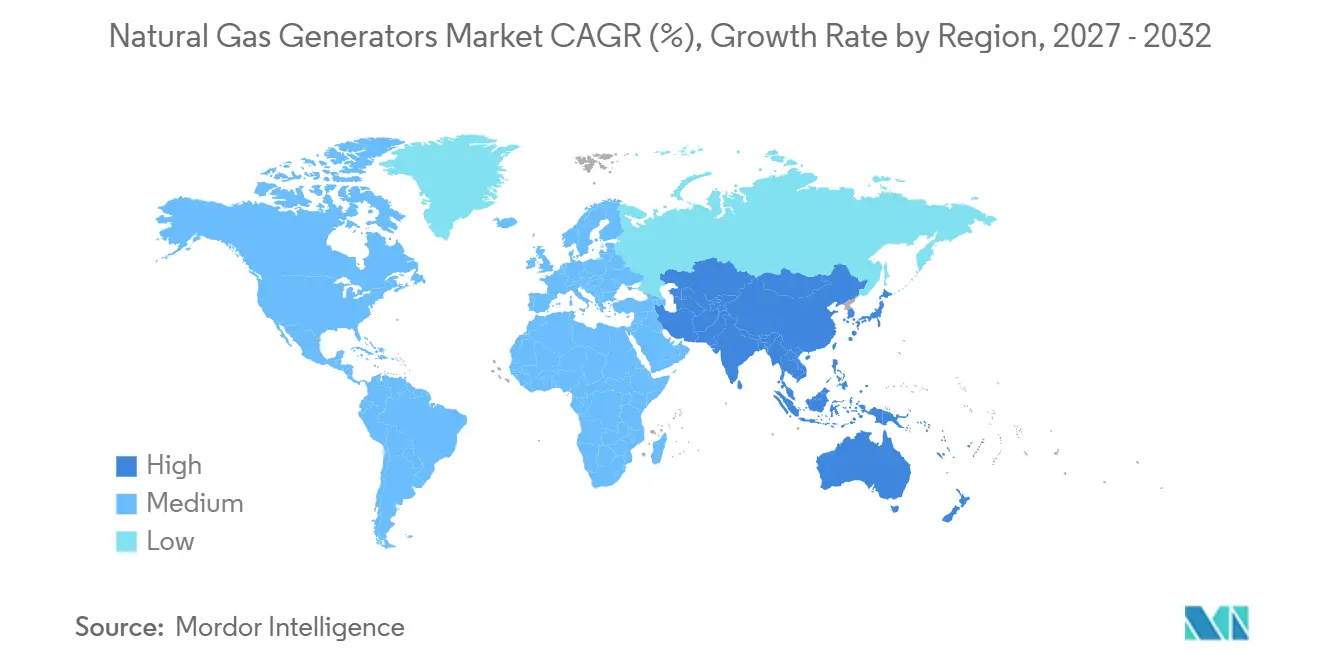
Asia-Pacific held 40.1% of the natural gas generators market size in 2026 and is forecast to grow at a 9.3% CAGR through 2032. China added 22.4 GW of gas-fired power capacity in 2025 and had 30.9 GW under construction. India, Vietnam, Indonesia, and Thailand are supporting industrial and standby procurement through manufacturing activity and gas infrastructure expansion. These markets combine uneven grid reliability with efforts to move industrial sites from diesel to gas. Japan is also developing power arrangements for data center demand through natural gas co-location services.
North America is the second-largest regional market in the natural gas generators market and is supported by data center investment and reliability concerns following severe weather. The United States had nearly 252 GW of gas-fired capacity in development in early 2026, nearly 3 times the prior-year level. More than one-third of this development pipeline was intended for direct on-site data center power. Texas represented 80.6 GW of the pipeline, supported by 356 GW of Electric Reliability Council of Texas (ERCOT) data center interconnection requests and extensive gas infrastructure. The addition of 6.3 Bcf/d of U.S. pipeline capacity in 2025 strengthens fuel availability in the South Central region.
The natural gas generators market in Europe faces a more mixed outlook because it must balance energy-transition policies with the need for flexible power. Germany plans up to 20 GW of new gas-fired capacity by 2030, with an initial tender for 5 to 10 GW. The Middle East and Africa combine large gas-based developments in Gulf Cooperation Council states with long-term prime-power opportunities where grid access is limited. South America is advancing gas-fired projects in Brazil, Colombia, and Mexico, and regional prospects depend on local fuel access, emissions rules, and industrial investment.
Competitive Landscape
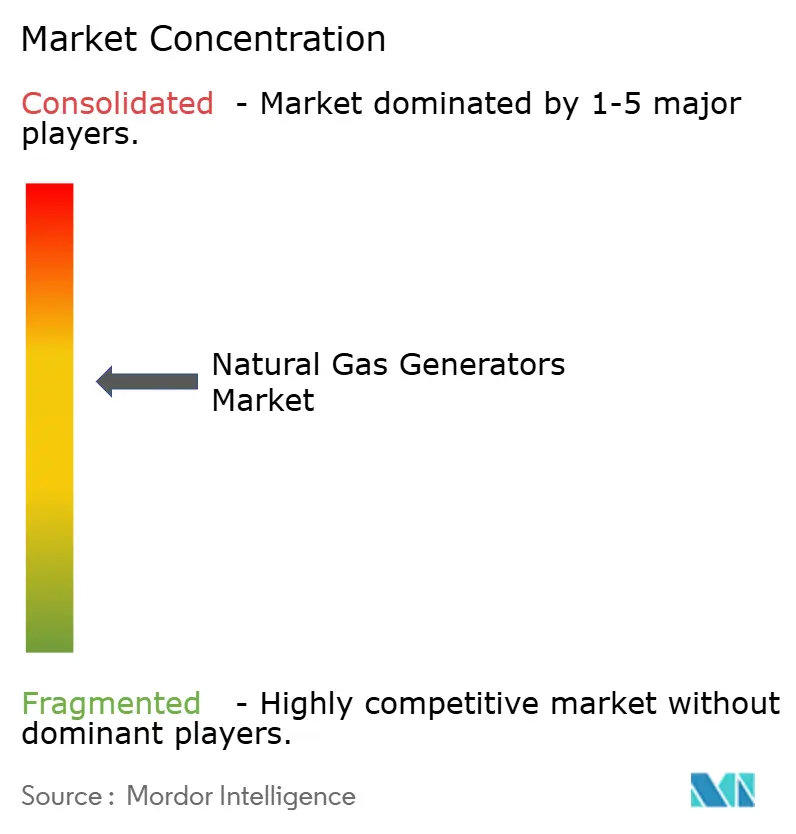
The natural gas generators market is moderately concentrated on large-engine applications. Caterpillar, Cummins, INNIO, and Wärtsilä lead major orders for data center and industrial prime-power equipment. HIMOINSA, Aksa, Kirloskar, Yanmar, and Weifang Yuyang serve smaller and mid-sized capacity needs in their respective regions. Large suppliers are expanding manufacturing capacity and product lines to serve behind-the-meter data center demand. Caterpillar is expanding its Lafayette, Indiana, factory to increase engine output by 2027, while Cummins has invested in capacity for its 95-liter engine platform.
INNIO received a 2.3 GW Jenbacher engine order from VoltaGrid for Oracle Cloud Infrastructure and xAI facilities. This order indicates that reciprocating gas engines can compete for large continuous-power projects. Caterpillar, Boyd CAT, and American Intelligence & Power also announced a 2 GW equipment agreement for the Monarch Compute Campus in West Virginia. The natural gas generators market is therefore being influenced by customers that can commit to multiyear, gigawatt-scale procurement. Their volume requirements favor manufacturers with established production, service capacity, and proven large-engine platforms.
Suppliers in the natural gas generators market are also moving toward service contracts that combine generators, battery storage, remote monitoring, and preventive maintenance. Generac identified combined heat and power, microgrids, distributed energy resources, and demand response as strategic growth areas in its 2025 annual report. Hydrogen-ready designs can help customers plan for fuel changes, while certification requirements under U.S. EPA rules and EU Stage V rules remain barriers in regulated regions. Clarke Energy is primarily an INNIO Jenbacher distributor and service provider, so Aggreko is a more distinct competitor in rental and temporary natural gas generation.
Natural Gas Generators Industry Leaders
-
Caterpillar Inc.
-
Cummins Inc.
-
INNIO Group
-
Generac Power Systems, Inc.
-
Kohler Co.
- *Disclaimer: Major Players sorted in no particular order
Natural Gas Generators Market Companies Covered in this Report
- 2G Energy AG
- Aksa Power Generation
- Arrow Engine Company
- Caterpillar Inc.
- Clarke Energy Ltd.
- Cummins Inc.
- DEUTZ AG
- Generac Power Systems, Inc.
- HIMOINSA, S.L.
- INNIO Group
- Kawasaki Heavy Industries, Ltd.
- Kirloskar Oil Engines Limited
- Kohler Co.
- MAN Energy Solutions SE
- Mitsubishi Heavy Industries, Ltd.
- Power Solutions International, Inc.
- Rolls-Royce Power Systems AG
- Wärtsilä Corporation
- Weifang Yuyang Power Equipment Co., Ltd.
- Yanmar Holdings Co., Ltd.
Recent Industry Developments in Natural Gas Generators Market
- June 2026: PEAK Scientific, headquartered at Inchinnan Business Park, Renfrewshire, has launched the Genius NEO laboratory gas generator at the American Society for Mass Spectrometry (ASMS) conference in the United States. Developed by its engineering team, the system delivers higher gas purity, improved efficiency, and reduced noise compared to previous PEAK generators.
- February 2026: Generac Power Systems formally documented natural gas generators as a core strategic growth platform in its 2025 annual 10-K filing, identifying CHP, microgrid, DER, and demand-response markets as expanding addressable segments beyond traditional residential and commercial standby.
- January 2026: American Intelligence & Power Corporation (AIP Corp), Caterpillar, and Boyd CAT announced a strategic alliance and a 2 GW purchase agreement for Caterpillar G3516 fast-response natural gas gensets for the Monarch Compute Campus in West Virginia, with deliveries scheduled from September 2026 through August 2027 and an 8 GW phased expansion target.
- June 2025: Aggreko has expanded its Greener Upgrades portfolio with three new natural gas generators: a 350 kW trailer-mounted unit with rich-burn combustion for non-attainment zones, a 1500 kW generator capable of running on various gas types, and a 1500 kW Rapid Deploy trailer-mounted unit. All three aim to reduce emissions and fuel costs.
Global Natural Gas Generators Market Report Scope
A natural gas generator is an internal combustion engine or turbine system that burns natural gas to produce mechanical energy, which an alternator then converts into electrical energy.
The natural gas generators market is segmented by capacity, application, end-user, and geography. By capacity, the market is segmented into below 75 kVA, 75 to 125 kVA, 125 to 375 kVA, 375 to 625 kVA, 625 to 750 kVA, 750 to 2,000 kVA, 2,000 to 6250 kVA, and others (above 6251kVA). By application, the market is divided into standby power, prime/continuous power, peak-shaving, rental/temporary power, and micro-grid and hybrid support. By end-user industry, the market is divided into residential, commercial buildings, industrial and manufacturing, data centers, healthcare facilities, oil and gas, utilities and power, mining and construction, and other end-users. The report also covers the market size and forecasts for the global natural gas generators market across 26 countries in key regions. For each segment, the market sizing and forecasts have been provided on the basis of value (USD).
Segmentation Overview
| Below 75 kVA |
| 75 to 125 kVA |
| 125 to 375 kVA |
| 375 to 625 kVA |
| 625 to 750 kVA |
| 750 to 2,000 kVA |
| 2,000 to 6250 kVA |
| Others (Above 6251kVA) |
| Standby Power |
| Prime/Continuous Power |
| Peak-Shaving |
| Rental/Temporary Power |
| Micro-grid and Hybrid Support |
| Residential |
| Commercial Buildings |
| Industrial and Manufacturing |
| Data Centers |
| Healthcare Facilities |
| Oil and Gas |
| Utilities and Power |
| Mining and Construction |
| Other Enduser |
| North America | United States |
| Canada | |
| Mexico | |
| Europe | Germany |
| France | |
| Italy | |
| Spain | |
| United Kingdom | |
| Poland | |
| Russia | |
| Rest of Europe | |
| Asia-Pacific | China |
| India | |
| Japan | |
| South Korea | |
| Australia | |
| Indonesia | |
| Vietnam | |
| Thailand | |
| Rest of Asia-Pacific | |
| South America | Brazil |
| Argentina | |
| Chile | |
| Rest of South America | |
| Middle East and Africa | Saudi Arabia |
| United Arab Emirates | |
| Egypt | |
| South Africa | |
| Morocco | |
| Rest of Middle East and Africa |
| By Capacity | Below 75 kVA | |
| 75 to 125 kVA | ||
| 125 to 375 kVA | ||
| 375 to 625 kVA | ||
| 625 to 750 kVA | ||
| 750 to 2,000 kVA | ||
| 2,000 to 6250 kVA | ||
| Others (Above 6251kVA) | ||
| By Application | Standby Power | |
| Prime/Continuous Power | ||
| Peak-Shaving | ||
| Rental/Temporary Power | ||
| Micro-grid and Hybrid Support | ||
| By End-User | Residential | |
| Commercial Buildings | ||
| Industrial and Manufacturing | ||
| Data Centers | ||
| Healthcare Facilities | ||
| Oil and Gas | ||
| Utilities and Power | ||
| Mining and Construction | ||
| Other Enduser | ||
| By Geography | North America | United States |
| Canada | ||
| Mexico | ||
| Europe | Germany | |
| France | ||
| Italy | ||
| Spain | ||
| United Kingdom | ||
| Poland | ||
| Russia | ||
| Rest of Europe | ||
| Asia-Pacific | China | |
| India | ||
| Japan | ||
| South Korea | ||
| Australia | ||
| Indonesia | ||
| Vietnam | ||
| Thailand | ||
| Rest of Asia-Pacific | ||
| South America | Brazil | |
| Argentina | ||
| Chile | ||
| Rest of South America | ||
| Middle East and Africa | Saudi Arabia | |
| United Arab Emirates | ||
| Egypt | ||
| South Africa | ||
| Morocco | ||
| Rest of Middle East and Africa | ||
Key Questions Answered in the Report
What is the projected value of natural gas generators by 2032?
The natural gas generators market is projected to reach USD 19.99 billion by 2032, growing at a 9.08% CAGR from 2027.
Why are data centers increasing demand for natural gas generators?
Developers use on-site generation because grid interconnection can take 5 to 7 years, while mobile gas generation can be deployed far sooner.
Which capacity range is growing fastest?
The 750 to 2,000 kVA range is forecast to grow at an 11.7% CAGR through 2032, supported by data center and industrial combined heat and power projects.
Which application holds the largest share?
Standby Power held 47.8% of revenue in 2026 and is forecast to grow at a 9.9% CAGR through 2032.
Which end user is growing fastest?
Data Centers are forecast to expand at a 14.7% CAGR through 2032 as operators procure continuous-duty on-site power systems.
Which region leads demand and growth?
Asia-Pacific held 40.1% revenue share in 2026 and is forecast to grow at a 9.3% CAGR through 2032.