
Natural Gas Compressor Market Size and Share
Market Overview
| Study Period | 2022 - 2032 |
|---|---|
| Market Size (2027) | USD 6.11 Billion |
| Market Size (2032) | USD 7.52 Billion |
| Growth Rate (2027 - 2032) | 4.25 % |
| Fastest Growing Market | Asia-Pacific |
| Largest Market | North America |
| Market Concentration | Medium |
Major Players *Disclaimer: Major Players sorted in no particular order Image © Mordor Intelligence. Reuse requires attribution under CC BY 4.0. | |
Natural Gas Compressor Market Analysis by Mordor Intelligence
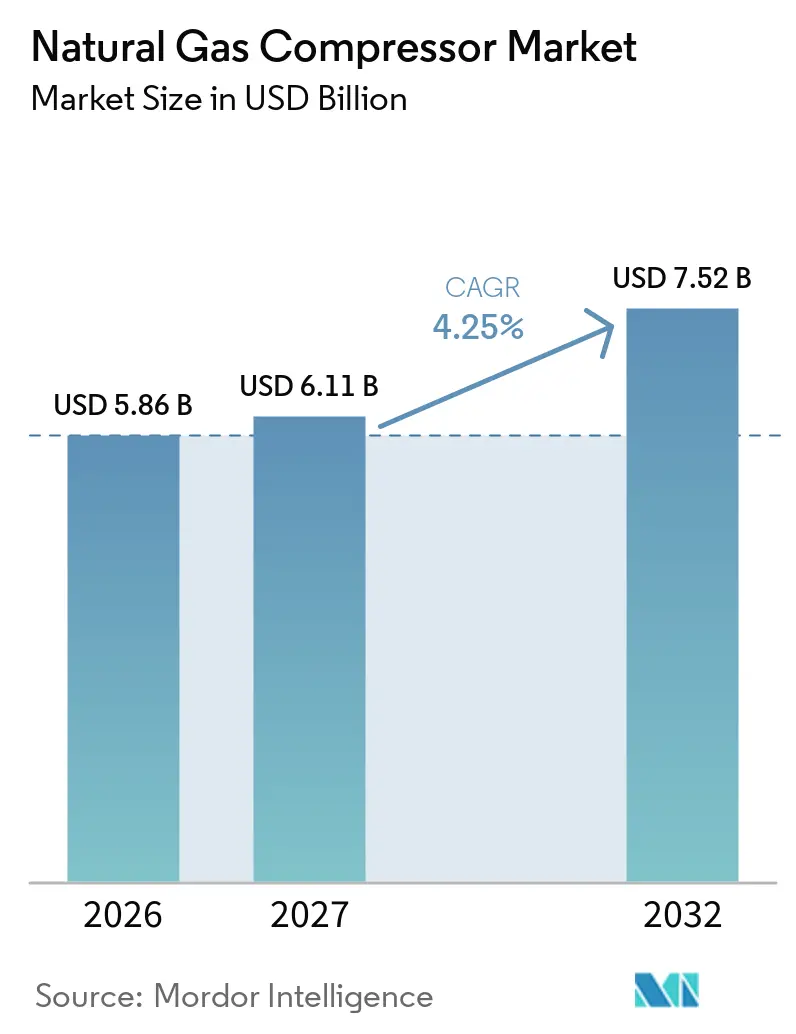
The Natural Gas Compressor Market size is expected to grow from USD 5.86 billion in 2026 to USD 6.11 billion in 2027 and is forecast to reach USD 7.52 billion by 2032 at 4.25% CAGR over 2027-2032. LNG liquefaction, pipeline renewal, and gas-fired power generation are the main demand bases for the natural gas compressor market. North American project activity supports near-term orders, while Asian pipeline and distribution investment supports the longer outlook. Equipment suppliers in the Natural gas compressor market are competing through larger integrated packages, electric drives, monitoring systems, and service contracts. High switching costs in the Natural gas compressor market favor established suppliers once a compressor and turbine package is specified, although Chinese suppliers are strengthening their technical position in controls and sealing systems. Hydrogen blending creates an equipment challenge because it can narrow stable operating conditions and increase material and seal requirements.[1]
Key Report Takeaways
- By compressor type, centrifugal compressors held 43.4% of the Natural gas compressor market share in 2026 and are forecast to grow at a 4.7% CAGR through 2032.
- By technology, dynamic compression held a 56.3% share in 2026, while positive displacement technology is forecast to grow at a 4.5% CAGR through 2032.
- By end user, oil and gas upstream held 46.2% share in 2026, while midstream is forecast to grow at a 4.8% CAGR through 2032.
- By power capacity, above-1,000 kW equipment held 35.7% share in 2026 and is forecast to grow at a 4.9% CAGR through 2032.
- By geography, North America held 34.3% share in 2026, while Asia-Pacific is forecast to grow at a 5.1% CAGR through 2032.
Note: Market numbers in this report are based on Mordor Intelligence's proprietary estimation framework, which combines nine months of actuals with Q4 projections for base year 2026.
Market Trends and Insights
Drivers Impact Analysis of Natural Gas Compressor Market*
| Driver | (~) % Impact on CAGR Forecast | Geographic Relevance | Impact Timeline |
|---|---|---|---|
| Expansion of LNG Export, Import, and Regasification Infrastructure | +1.0% | North America, APAC, MEA | Medium term (2-4 years) |
| Pipeline Expansion, Modernization, and Replacement of Aging Compression Assets | +0.9% | North America, Europe, Russia | Short term (≤ 2 years) |
| Rising Gas-Fired Power Generation and Industrial Gas Demand | +0.7% | Middle East, Europe, North America | Short term (≤ 2 years) |
| Increasing Adoption of Energy-Efficient and Digitally Monitored Compression Systems | +0.5% | Global | Medium term (2-4 years) |
| Hydrogen-Ready Compression and Low-Carbon Gas Infrastructure | +0.3% | Europe, North America, Japan | Long term (≥ 4 years) |
| Compressor Electrification for Methane and Scope 1 Emissions Reduction | +0.4% | North America, EU, India | Medium term (2-4 years) |
| Source: Mordor Intelligence | |||
Expansion of Liquefied Natural Gas (LNG) Export, Import, and Regasification Infrastructure
North American LNG construction is increasing demand for centrifugal compressor packages in the natural gas compressor market. U.S. liquefaction capacity is expected to more than double by 2029, with North America accounting for more than 50% of global additions.[2] Baker Hughes is supplying 8 centrifugal compressors for Sempra Infrastructure’s Port Arthur LNG Phase 2 project, which includes 2 LNG trains and 13 Mtpa of capacity.[3] Commonwealth LNG also authorized 6 Baker Hughes refrigerant turbo compressors for its 9.5 Mtpa Cameron, Louisiana facility.[4] Each LNG train needs equipment beyond the main liquefaction compressors, including feed-gas boosters, boil-off-gas compressors, and recompression circuits. Related pipeline station approvals can lengthen procurement schedules and provide suppliers with more visible equipment backlogs.
Pipeline Expansion, Modernization, and Replacement of Aging Compression Assets
Pipeline investment is moving beyond capacity additions toward reliability upgrades and emissions-focused replacement work. Northern Natural Gas is investing USD 3 billion over the next decade through its Asset Modernization program for a 14,300-mile network. Williams filed for its Kemmerer Horsepower Replacement project in 2025, replacing 4 reciprocating units with 1 Solar Mars 90 turbine-compressor. The filing projects a 93% reduction in NOx emissions and an 89% reduction in methane emissions while retaining delivery capacity. Replacement programs favor higher-specification units because fewer large packages can replace several aging machines. This pattern raises the value of integrated turbine-compressor systems in the natural gas compressor market.
Rising Gas-Fired Power Generation and Industrial Gas Demand
Gas-fired generation continues to shape compressor requirements as electricity consumption rises and coal-to-gas switching continues. U.S. power-sector natural gas use reached 35.8 Bcf/d in 2025. The International Gas Union reported that oil-to-gas switching added 18 bcm of annual demand in the Middle East during 2025. European gas-to-power demand rose by more than 20% year over year during the 2025 heating season, amid lower wind and hydro output. Where grids are congested, new gas-fired capacity can require localized compression even without new pipeline mileage. This creates distributed demand for the Natural Gas Compressor Market in regions such as Southeast Asia and the U.S. Southeast.
Increasing Adoption of Energy-Efficient and Digitally Monitored Compression Systems
Operators are using digital monitoring to limit outages, manage energy costs, and meet closer regulatory scrutiny. China published GB/T 16665-2025 in October 2025, with the standard becoming effective in May 2026 and requiring real-time energy-saving monitoring for industrial compressor units. Burckhardt Compression launched UP! Detect in 2025 to identify valve and bearing anomalies in reciprocating compressors and provide remote diagnostic support. Ariel’s Smart Compressor at ATCO EnPower’s carbon storage facility uses a real-time digital twin to anticipate vibration shutdowns and adjust variable clearance pockets. These systems support longer equipment life but can shift supplier revenue toward recurring service work. The Natural gas compressor market therefore benefits from monitoring sales even where replacement cycles become less frequent.
Restraints Impact Analysis of Natural Gas Compressor Market*
| Restraint | (~) % Impact on CAGR Forecast | Geographic Relevance | Impact Timeline |
|---|---|---|---|
| High Capital, Installation, and Lifecycle Maintenance Costs | -0.7% | Global | Short term (≤ 2 years) |
| Complex Safety, Emissions, and Pressure-Equipment Compliance Requirements | -0.5% | Global, intensified in EU and North America | Medium term (2-4 years) |
| Grid Reliability and Interconnection Constraints for Electrified Compressor Stations | -0.4% | North America, Europe, India | Medium term (2-4 years) |
| Hydrogen Compatibility, Material Degradation, and Reduced Energy Throughput | -0.3% | Europe, North America | Long term (≥ 4 years) |
| Source: Mordor Intelligence | |||
High Capital, Installation, and Lifecycle Maintenance Costs
Large compressors require substantial upfront investment and long delivery schedules in the natural gas compressor market. Liquefied Natural Gas (LNG)-grade centrifugal packages can cost USD 15 million to USD 30 million per fully installed unit and have procurement lead times of 18 to 30 months. This exposes project developers to financing and cost escalation risk before gas sales begin. Maintenance can require 2% to 4% of original equipment value each year for interstate transmission service, while aging reciprocating equipment can approach 6% to 8%. Smaller midstream operators may choose rental arrangements rather than ownership when capital is constrained. High fleet use reported by contract compression providers indicates why access to available equipment can become a commercial constraint.
Complex Safety, Emissions, and Pressure-Equipment Compliance Requirements
Safety, emissions, and pressure-equipment rules add cost and time to compressor projects. U.S. requirements for reciprocating compressors include rod-packing replacement and leak-detection procedures, while a Colorado State University study estimated potential annual savings of USD 95,000 per compressor from vent-gas capture systems. European Pressure Equipment Directive assessments can extend commissioning timelines by 12 to 24 months. Electrification adds another compliance transition for pipeline stations. Suppliers operating across regions must manage different certification and safety requirements. This can divide research and development spending and delay equipment launches in the natural gas compressor market.
*Our forecasts treat driver/restraint impacts as directional, not additive. The impact forecasts reflect baseline growth, mix effects, and variable interactions.
Natural Gas Compressor Market Segment Analysis
By Compressor Type:
Centrifugal Units Anchor LNG and High-Flow PipelinesCentrifugal compressors held 43.4% of the Natural gas compressor market share in 2026 and are projected to grow at a 4.7% CAGR through 2032. Their position reflects their role in LNG liquefaction and high-throughput transmission service. Baker Hughes’ Port Arthur LNG Phase 2 supply agreement covers 8 centrifugal compressors coupled with Frame 7 turbine drivers. A 2025 technical study placed centrifugal isentropic efficiency at 70% to 90% at rated flow. These characteristics make centrifugal units suitable for large pipeline stations and continuous LNG duty.
Reciprocating compressors remain important in wellhead compression, gathering, storage, and other variable-flow applications. Ariel reported healthy 2025 order activity in North American gathering and booster applications. Rotary screw equipment serves mid-scale distribution and CNG uses, particularly where modular deployment is useful. Axial and diaphragm designs are used in narrower high-purity or hydrogen-tolerant applications. The Natural gas compressor industry therefore needs several compressor configurations rather than one universal design. Application conditions, including flow variability, pressure ratio, and gas composition, determine the preferred technology.
By Technology:
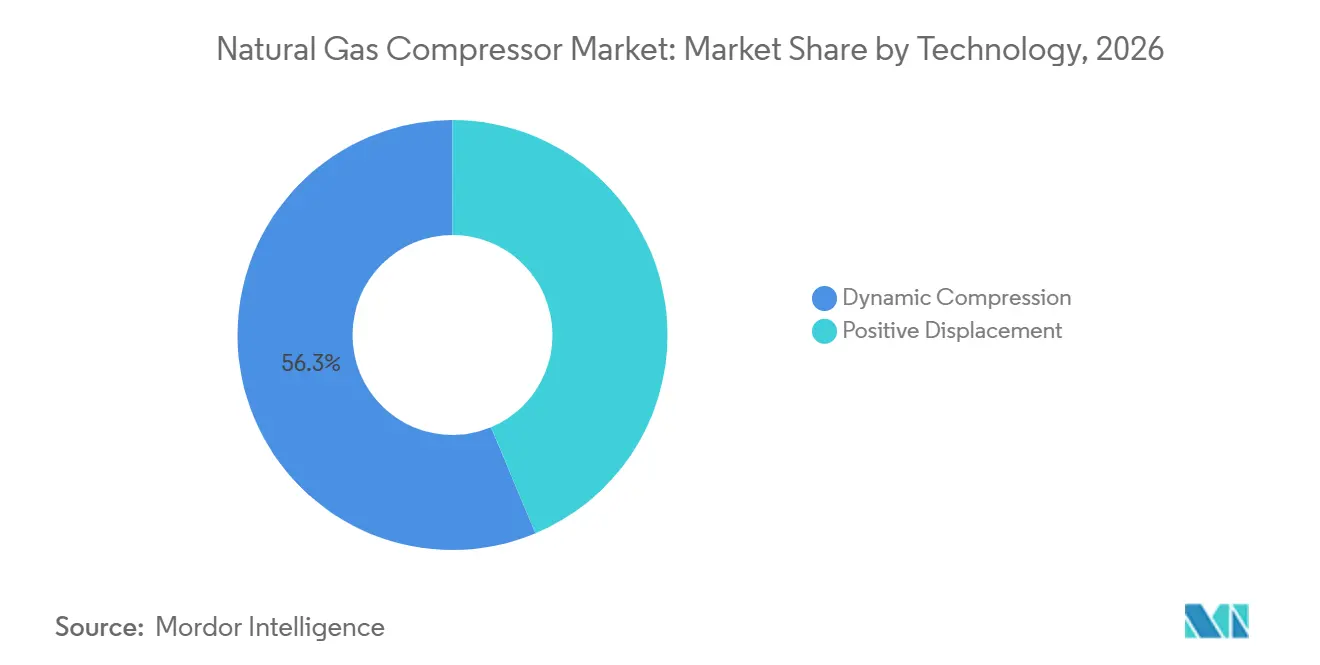
Dynamic Compression Leads, Positive Displacement Builds MomentumDynamic compression accounted for 56.3% of the technology segment in 2026. It is used in high-throughput Liquefied Natural Gas (LNG) and transmission applications where centrifugal and axial machines offer lifecycle advantages. Positive displacement technology is forecast to record a 4.5% CAGR through 2032. Its relevance in the Natural gas compressor market is supported by upstream gathering, hydrogen pilot circuits, and storage injection and withdrawal cycles. Hydrogen blending affects centrifugal operating range and supports the use of positive displacement designs in some hydrogen-tolerant duties.
Both technology families face a higher compliance baseline. ISO 13631:2025 updated vibration control requirements for the equipment categories. The change raises design and commissioning expectations for suppliers across the natural gas compressor market. Dynamic systems retain their advantage where stable high flow is needed. Positive displacement systems retain an operating role where flows vary or compression ratios are higher. The choice is guided by the service profile rather than a simple preference for one technology family.
By End User:
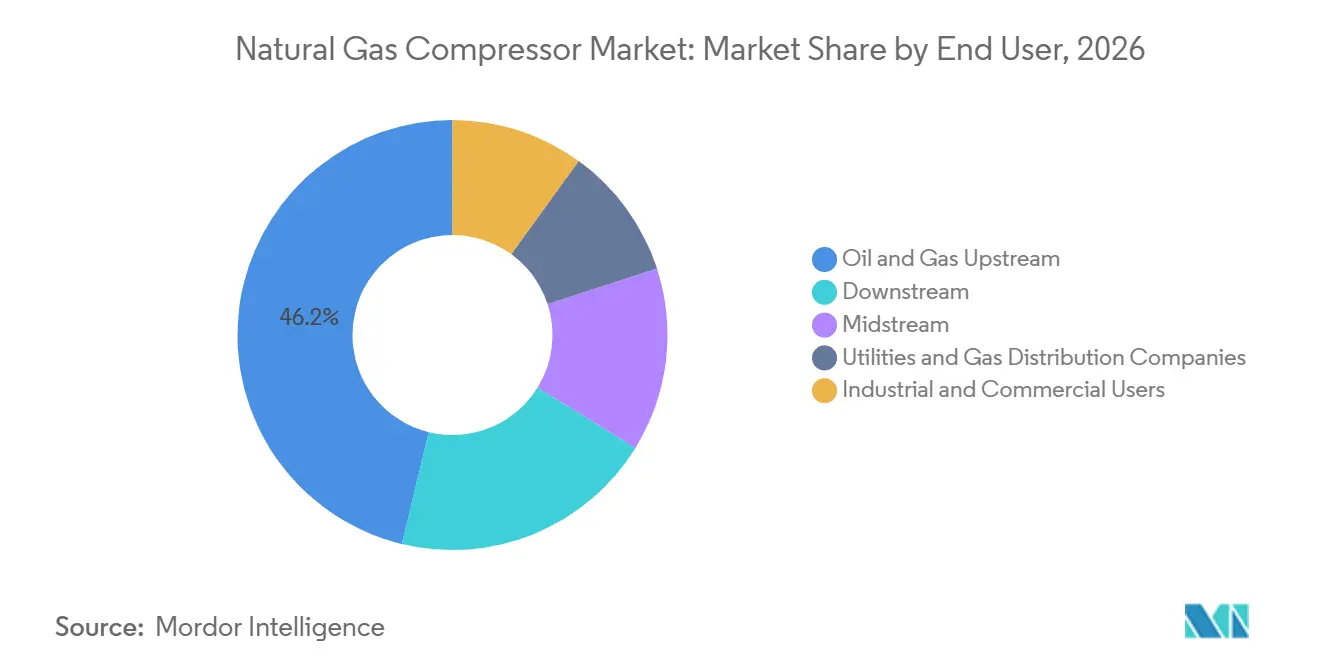
Upstream Holds Majority Share, Midstream AcceleratesOil and gas upstream accounted for 46.2% of demand in 2026, the largest end-user position. Wellhead compression, gas lift, injection, and gathering support this demand across producing basins. The Natural gas compressor market size for midstream applications is forecast to grow at a 4.8% CAGR through 2032. Gulf Coast LNG-related feed-gas gathering additions support this outlook. Pipeline electrification also favors motor-drive-compatible equipment.
As shale wells mature and reservoir pressure declines, operators add booster stages over time. This supports service and aftermarket work even when drilling slows. Midstream demand is linked to LNG feed-gas systems and broader transmission upgrades. Downstream, utility, and distribution applications develop more steadily with regasification terminals and city gas networks. The Natural gas compressor industry serves each end user with different duty cycles and equipment configurations. This diversity reduces dependence on a single project category.
By Power Capacity:
High-Horsepower Equipment Commands Both Volume and GrowthAbove-1,000 kW equipment accounted for 35.7% of demand in 2026 and is forecast to grow at a 4.9% CAGR through 2032. Large LNG and transmission projects favor fewer, higher-capacity compressor trains. Commonwealth LNG authorized 6 LM9000-powered refrigerant turbo compressors rated at 73 MW each and 44% thermal efficiency. Long procurement periods and turbine-compressor integration create a significant qualification requirement for suppliers. This makes the high-capacity segment strategically important in the natural gas compressor market.
Equipment in the 500 to 1,000 kW range is used in gathering, processing, and distribution service. It supports expansion into secondary cities and developing gas networks. Equipment below 500 kW has a broad installed base across booster systems, Compressed Natural Gas (CNG) stations, and distributed applications. Its lower unit value limits its revenue contribution despite high unit volumes. China’s general machinery association reported gas compressor production growth across capacity ranges during 2025, supported by pipeline and petrochemical investment. These capacity bands widen the Natural gas compressor market’s exposure to different project scales.
Geography Analysis
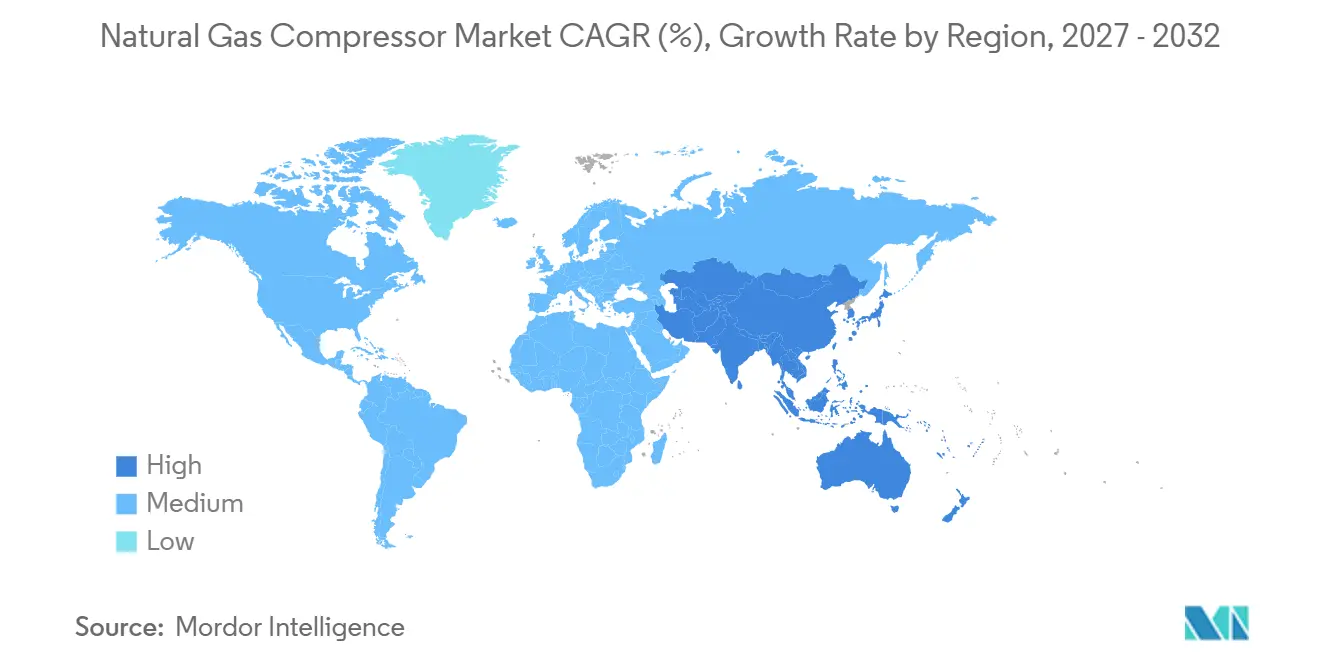
North America held 34.3% in 2026, the largest regional share, supported by shale production, LNG construction, and a large base of aging pipeline assets. U.S. LNG capacity is expected to more than double by 2029. Mountain Valley Pipeline filed for the MVP Boost Project in 2025, seeking compression additions at 3 existing stations and a new Virginia station. Contract compression demand remains supported by high equipment use across active producing regions.
Europe remains a significant region because energy security and network resilience have raised the value of transmission investment. National Gas committed more than GBP 350 million, equivalent to USD 440 million at 2025 average exchange rates, for compressor replacements at 3 transmission system sites. The equipment is designed for future hydrogen blending. European gas-to-power use rose more than 20% year over year during the 2025 heating season. Germany, Poland, and Italy remain important locations for asset upgrades, while restrictions have reduced Western supplier access to new Russian projects.
Asia-Pacific is forecast to grow at a 5.1% CAGR through 2032, the highest regional rate in the natural gas compressor market. China’s pipeline expansion, India’s city gas buildout, and Southeast Asian LNG import projects support the outlook. China accounted for 32.1% of global natural gas compressor patent filings in 2025, ahead of the U.S. share of 29.4%, with activity focused on sealing technology and intelligent controls. Electrification creates an additional equipment requirement where stations have reliable grid access. Brazil, Argentina, and Saudi Arabia also provide incremental demand through gas reinjection, shale development, and gas-for-power programs.
Competitive Landscape
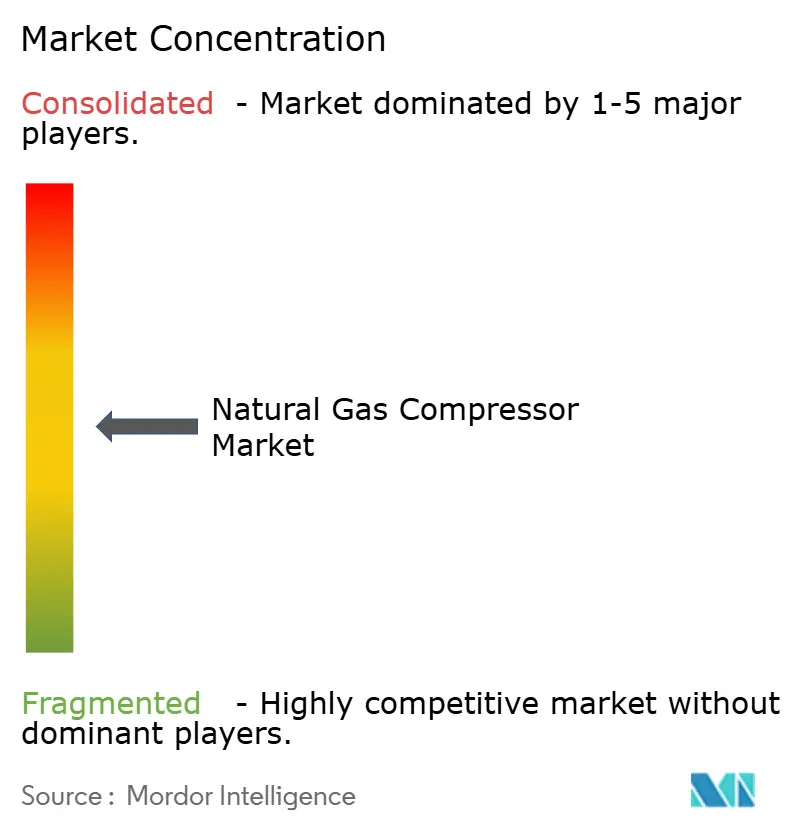
The Natural gas compressor market is moderately consolidated, with the 5 leading vendors holding a combined 40% of revenue. Baker Hughes, Atlas Copco, Siemens Energy, Ariel Corporation, and Burckhardt Compression are leading suppliers, supported by their ability to supply critical equipment, integrate packages, and provide long-term service. Jereh Group and Kaishan Holding are expanding across Asia-Pacific and the Middle East and Africa through competitive pricing and financing terms. No single supplier holds more than 10% of global revenue, which leaves buyers with several qualified choices.
Suppliers are placing greater emphasis on system integration and digital aftermarket support. Burckhardt Compression launched UP! Detect commercially in 2025, using data-driven diagnostics for reciprocating compressor components. Baker Hughes secured the Port Arthur LNG Phase 2 supply agreement for 4 Frame 7 turbines and 8 centrifugal compressors. These moves show how equipment, controls, and service capabilities can be combined in a single project award. API Standard 618, ISO 13631, and ISO 8573-1 make it harder for undercapitalized entrants to compete for high-consequence work.
Acquisition activity has strengthened supplier positions in specialized compression fields. Burckhardt Compression completed its acquisition of Fornovo Gas in July 2026 to expand its CNG and biogas compression portfolio. Ingersoll Rand acquired TMIC and Adicomp in July 2025 for EUR 160 million, equivalent to USD 175 million at 2025 exchange rates, to build renewable natural gas compression capability. USA Compression Partners, LP completed its USD 860 million acquisition of J-W Power Company in January 2026, creating a fleet of 4.4 million active horsepower. The Natural gas compressor market continues to reward suppliers that can prove performance in demanding applications, while above-300-bar hydrogen compression and small-scale offshore floating compression remain open fields.
Natural Gas Compressor Industry Leaders
-
Atlas Copco AB
-
Ariel Corporation
-
Siemens Energy AG
-
Baker Hughes Company
-
Ingersoll Rand Inc.
- *Disclaimer: Major Players sorted in no particular order
Natural Gas Compressor Market Companies Covered in this Report
- Ariel Corporation
- Atlas Copco AB
- Baker Hughes Company
- BAUER KOMPRESSOREN GmbH
- BORSIG GmbH
- Burckhardt Compression AG
- Elliott Company
- Enerflex Ltd.
- Howden Group Limited
- Ingersoll Rand Inc.
- Jereh Group Co., Ltd.
- Kaishan Holding Group Co., Ltd.
- KOBELCO COMPRESSORS CORPORATION
- MAN Energy Solutions SE
- Mitsubishi Heavy Industries, Ltd.
- NEUMAN & ESSER Group
- Shaanxi Blower (Group) Co., Ltd.
- Siemens Energy AG
- Solar Turbines Incorporated
- Sundyne, LLC
Recent Industry Developments in Natural Gas Compressor Market
- July 2026: Burckhardt Compression completed the acquisition of Fornovo Gas S.p.A. (Italy), a European biogas and CNG compression leader with 120 employees, strengthening its position in European alternative gas compression.
- July 2026: Nova Compression acquired the operating assets of Energy Gas Compression, Inc. (EGC), adding 52,000 active horsepower and expanding Nova’s total fleet to 400,000 horsepower across the Eagle Ford Basin and South Texas.
- January 2026: USA Compression Partners completed the USD 860 million acquisition of J-W Power Company, creating a combined fleet of 4.4 million active horsepower with expanded coverage across the Permian, Northeast, Gulf Coast, Rockies, and Mid-Continent.
- September 2025: Sempra Infrastructure reached Final Investment Decision (FID) on Port Arthur LNG Phase 2, with Baker Hughes contracted to supply 4 Frame 7 turbines and 8 centrifugal compressors for Trains 3 and 4, with Train 3 targeting 2030 operations.
Global Natural Gas Compressor Market Report Scope
A natural gas compressor is a mechanical device that increases the pressure of natural gas, reducing its volume and providing the energy required for the gas to flow through pipelines, storage facilities, and processing plants.
The natural gas compressor market is segmented into compressor type, technology, end user, power capacity, and geography. By compressor type, the market is segmented into centrifugal compressors, reciprocating compressors, rotary screw compressors, and other compressor types. By technology, the market is divided into positive displacement and dynamic compression. By end user, the market is segregated into oil and gas, upstream, midstream, downstream, utilities and gas distribution companies, and industrial and commercial users. By power capacity, the market is segmented into Up to 500 kW, 500–1,000 kW, and Above 1,000 kW. The report also covers the market size and forecasts for the global natural gas compressor market across 26 countries in key regions. For each segment, the market sizing and forecasts have been provided on the basis of value (USD).
Segmentation Overview
| Centrifugal Compressors |
| Reciprocating Compressors |
| Rotary Screw Compressors |
| Other Compressor Types |
| Positive Displacement |
| Dynamic Compression |
| Oil and Gas Upstream |
| Midstream |
| Downstream |
| Utilities and Gas Distribution Companies |
| Industrial and Commercial Users |
| Up to 500 kW |
| 500–1,000 kW |
| Above 1,000 kW |
| North America | United States |
| Canada | |
| Mexico | |
| Europe | Germany |
| France | |
| Italy | |
| Spain | |
| United Kingdom | |
| Poland | |
| Russia | |
| Rest of Europe | |
| Asia-Pacific | China |
| India | |
| Japan | |
| South Korea | |
| Australia | |
| Indonesia | |
| Vietnam | |
| Thailand | |
| Rest of Asia-Pacific | |
| South America | Brazil |
| Argentina | |
| Chile | |
| Rest of South America | |
| Middle East and Africa | Saudi Arabia |
| United Arab Emirates | |
| Egypt | |
| South Africa | |
| Morocco | |
| Rest of Middle East and Africa |
| By Compressor Type | Centrifugal Compressors | |
| Reciprocating Compressors | ||
| Rotary Screw Compressors | ||
| Other Compressor Types | ||
| By Technology | Positive Displacement | |
| Dynamic Compression | ||
| By End User | Oil and Gas Upstream | |
| Midstream | ||
| Downstream | ||
| Utilities and Gas Distribution Companies | ||
| Industrial and Commercial Users | ||
| By Power Capacity | Up to 500 kW | |
| 500–1,000 kW | ||
| Above 1,000 kW | ||
| By Geography | North America | United States |
| Canada | ||
| Mexico | ||
| Europe | Germany | |
| France | ||
| Italy | ||
| Spain | ||
| United Kingdom | ||
| Poland | ||
| Russia | ||
| Rest of Europe | ||
| Asia-Pacific | China | |
| India | ||
| Japan | ||
| South Korea | ||
| Australia | ||
| Indonesia | ||
| Vietnam | ||
| Thailand | ||
| Rest of Asia-Pacific | ||
| South America | Brazil | |
| Argentina | ||
| Chile | ||
| Rest of South America | ||
| Middle East and Africa | Saudi Arabia | |
| United Arab Emirates | ||
| Egypt | ||
| South Africa | ||
| Morocco | ||
| Rest of Middle East and Africa | ||
Key Questions Answered in the Report
What is the forecast growth rate for natural gas compressors?
The sector is forecast to grow at a 4.25% CAGR from 2027 to 2032, reaching USD 7.52 billion by 2032.
Which compressor type leads demand?
Centrifugal compressors lead with 43.4% share in 2026 and are forecast to grow at a 4.7% CAGR through 2032.
Which end user is growing fastest?
Midstream is forecast to grow at a 4.8% CAGR through 2032, supported by LNG feed-gas gathering and pipeline work.
Which region has the strongest outlook?
Asia-Pacific has the highest forecast regional CAGR at 5.1% through 2032, supported by Chinese and Indian infrastructure investment.
Why are LNG projects important for compressor suppliers?
LNG facilities need main liquefaction compressors as well as feed-gas, boil-off-gas, and recompression equipment.
What limits hydrogen blending in existing compressor fleets?
Hydrogen can reduce the stable operating range of centrifugal compressors and can require changes to seals, materials, and controls.