
Market Overview
| Study Period | 2020 - 2031 |
|---|---|
| Forecast Data Period | 2026 - 2031 |
| Base Year Market Size (2025) | USD 2.45 Billion |
| Market Size (2026) | USD 2.58 Billion |
| Market Size (2031) | USD 3.37 Billion |
| Growth Rate (2026 - 2031) | 5.44 % |
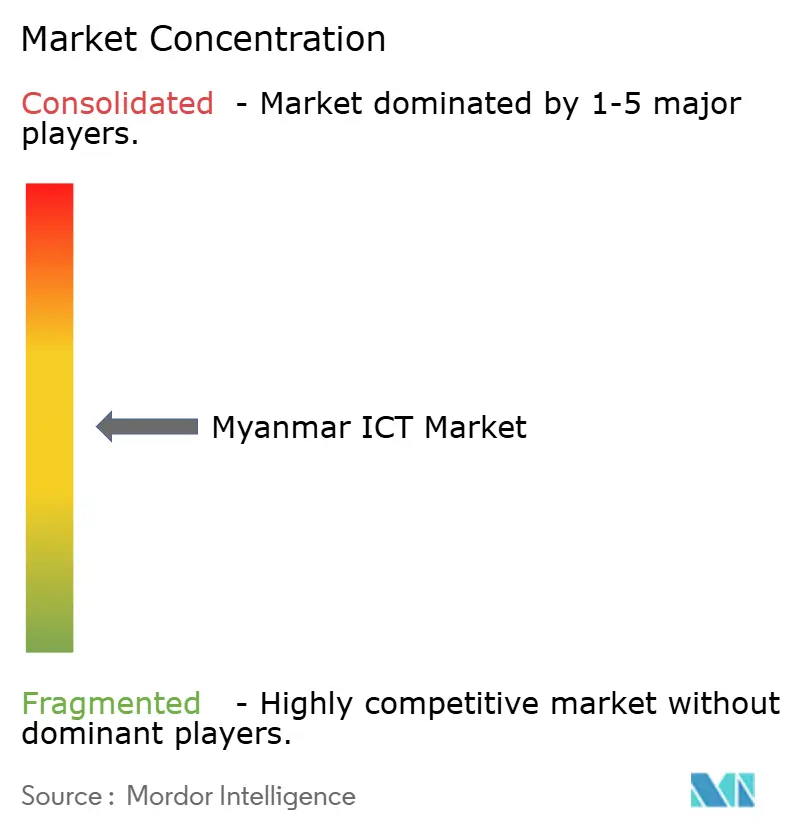
| Market Concentration | Medium |
Major Players *Disclaimer: Major Players sorted in no particular order Image © Mordor Intelligence. Reuse requires attribution under CC BY 4.0. | |
Myanmar ICT Market Analysis by Mordor Intelligence
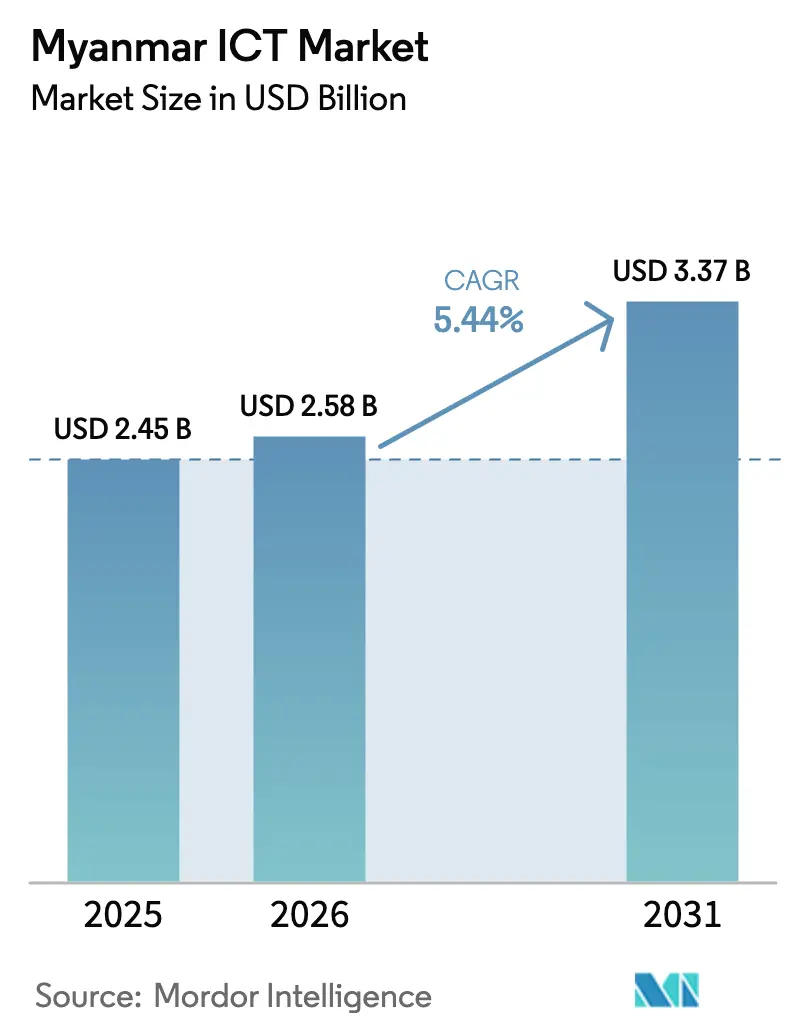
The Myanmar ICT market size was valued at USD 2.45 billion in 2025 and estimated to grow from USD 2.58 billion in 2026 to reach USD 3.37 billion by 2031, at a CAGR of 5.44% during the forecast period (2026-2031). Robust mobile adoption, government-backed digitization policies, and fresh subsea cable capacity shape the growth trajectory despite political risk and infrastructure gaps. Communication services anchor investment as operators accelerate 4G rollout and stage early 5G trials, while cloud-first strategies help enterprises sidestep capital constraints. Managed security gains traction after the 2025 Cybersecurity Law imposed new compliance mandates, and community wireless initiatives open rural demand. Gaming and esports show outsized momentum thanks to improved handset affordability and a growing pool of competitive players. Supply risks stem from chronic power outages, sanctions that limit foreign capital, and data-localization costs, yet local firms continue to capture whitespace left by risk-averse multinationals.
Key Report Takeaways
- By type, communication services led with 53.12% revenue share in 2025. IT services is forecast to expand at a 5.95% CAGR through 2031.
- By enterprise size, small and medium enterprises held 62.10% of the Myanmar ICT market share in 2025. The same segment is projected to grow at a 5.58% CAGR through 2031.
- By deployment model, cloud commanded 48.35% share of the Myanmar ICT market size in 2025. Cloud is projected to advance at a 5.60% CAGR between 2026-2031.
- By end-user vertical, government and public administration accounted for a 21.60% share of the Myanmar ICT market size in 2025. Gaming and esports is advancing at a 6.10% CAGR through 2031.
Note: Market size and forecast figures in this report are generated using Mordor Intelligence’s proprietary estimation framework, updated with the latest available data and insights as of 2026.
Myanmar ICT Market Trends and Insights
Drivers Impact Analysis*
| Driver | (~) % Impact on CAGR Forecast | Geographic Relevance | Impact Timeline |
|---|---|---|---|
| Government digital transformation initiatives | +1.5% | Nationwide, early traction in Yangon, Mandalay, Naypyidaw | Medium term (2-4 years) |
| Rapid mobile and internet penetration | +1.2% | Urban centers spreading to rural areas | Short term (≤ 2 years) |
| Expansion of affordable 4G-5G infrastructure | +0.8% | Economic corridors | Medium term (2-4 years) |
| Surge in community wireless networks | +0.6% | Rural and conflict-affected regions | Long term (≥ 4 years) |
| Demand for managed security after e-commerce rules | +0.4% | Commercial hubs | Short term (≤ 2 years) |
| New subsea cable landings | +0.3% | Coastal regions extending inland | Long term (≥ 4 years) |
| Source: Mordor Intelligence | |||
Government Digital Transformation Initiatives
Public-sector ICT spend is rising as 14 ministries execute the National Digital Government Strategy. Projects include e-ID rollout, inter-agency data platforms, and blockchain-based land records, lifting demand for cloud, integration, and cybersecurity services.
Rapid Mobile and Internet Penetration
Smartphone adoption surged as inexpensive Android models replaced feature phones, and operators expanded prepaid distribution to over 720,000 retail points. Rising data usage fuels cloud adoption and mobile commerce, expanding the Myanmar ICT market to rural districts.[1]Studio Dradio Durans, “Myanmar Mobile,” studiodradiodurans.com
Expansion of Affordable 4G-5G Infrastructure
ATOM Myanmar’s LTE-only launch drew 60,000 users in its first month, proving latent demand for fast data and mapping a path to shared-network 5G deployment that can lower unit costs for operators and enterprises.
New Subsea Cable Landings Enabling Data-Center Growth
The MIST cable and other systems cut latency and boost international bandwidth, spurring local data-center builds in a market that still hosts only six facilities, far below regional peers.
Restraints Impact Analysis*
| Restraint | (~) % Impact on CAGR Forecast | Geographic Relevance | Impact Timeline |
|---|---|---|---|
| Political instability and sanctions | −0.9% | Nationwide, severe on foreign investment | Short term (≤ 2 years) |
| Chronic power outages | −0.7% | Rural and industrial areas | Medium term (2-4 years) |
| High-skill ICT brain drain | −0.5% | Urban tech hubs | Medium term (2-4 years) |
| Costly surveillance and data-localization mandates | −0.4% | National | Long term (≥ 4 years) |
| Source: Mordor Intelligence | |||
Political Instability and Sanctions
Uncertain regulations and targeted sanctions stalled several foreign-funded projects; however, the gap allowed regional partners to engage through joint ventures that align with new compliance realities.[2]Visual Rebellion, “In Myanmar, Solar Power Isn't Just About Being Green—It's a Matter of Survival,” visualrebellion.org
Chronic Power Outages
National generation capacity fell to 2,964 MW in 2022, forcing firms to buy generators or solar kits, which inflates ICT operating costs but also spurs off-grid renewable solutions for telecom towers and edge data sites.
*Our forecasts treat driver/restraint impacts as directional, not additive. The impact forecasts reflect baseline growth, mix effects, and variable interactions.
Segment Analysis
By Type: Communication Services Drive Infrastructure Investment
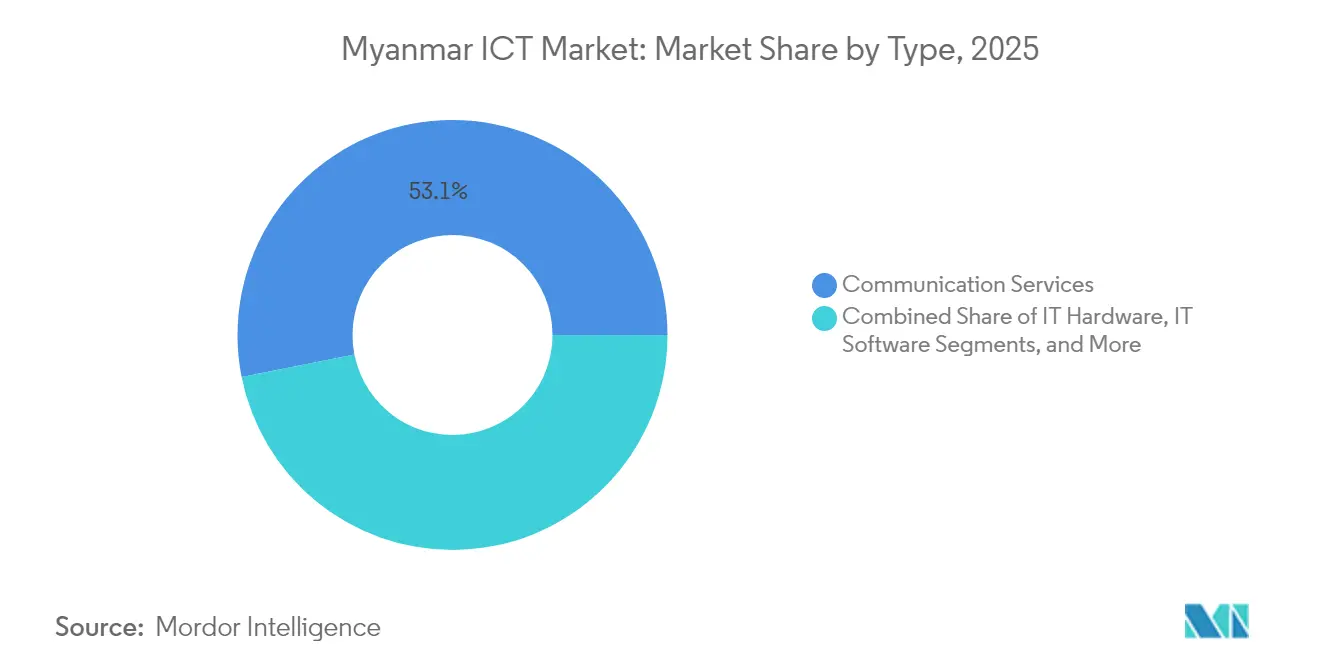
Communication services accounted for 53.12% of the Myanmar ICT market size in 2025 and remain the backbone of digital growth. Network expansion enables downstream demand for IT services and security, while hardware sales track the rollout of base stations and customer-premise equipment. The Myanmar ICT market share for IT services is set to rise with a 5.95% CAGR as firms outsource migration, integration, and support tasks. Low-cost equipment providers help operators contain capex, and managed security vendors gain contracts linked to new compliance rules.
Steady hardware orders come from carrier network builds and end-user upgrades, although supply-chain hurdles may affect the timeline. Software adoption is on the rise as government e-services require process digitization and local language interfaces. Vendors bundle infrastructure, applications, and managed services, creating integrated deals that cater to resource-constrained buyers.



By Enterprise Size: SME Digital Acceleration
SMEs held 62.10% of the Myanmar ICT market share in 2025 and post a 5.58% CAGR outlook as mobile-first cloud tools lower entry barriers. Subscription SaaS and pay-as-you-go infrastructure fit cash-flow realities, letting firms digitize sales, finance, and supply management with minimal upfront spend. Large enterprises invest more per seat, often in hybrid clouds, advanced security, and analytics, supporting specialized service revenue for system integrators.
Local consultancies such as Information Matrix tailor e-government and SME solutions, illustrating a homegrown support ecosystem. Donor-funded programs that promote digital payments and e-commerce onboarding further propel SME tech use. Workforce skilling remains essential as talent outflow constrains scaling for both SME and large-enterprise projects.
By Deployment Model: Cloud-First Strategy Gains Momentum
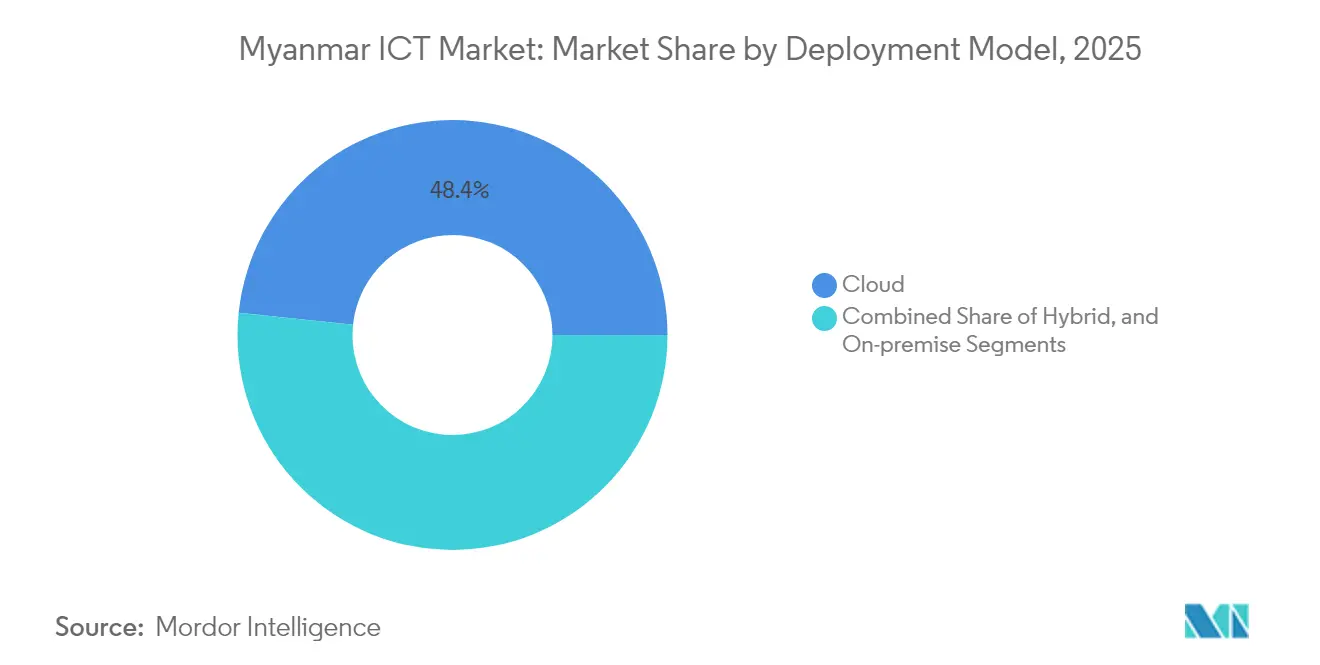
Cloud deployments represented 48.35% of the Myanmar ICT market size in 2025 and are growing at 5.60% CAGR as firms bypass legacy hardware. Hybrid cloud interest rises when data-localization rules bind critical workloads inside the country yet need global platforms for scalability. On-premise persists in finance and government workloads that must meet strict control or latency needs.
The Myanmar ICT market benefits from forthcoming domestic data centers that allow hyperscale partners to meet location mandates while expanding regional node presence. Local providers shape service portfolios around compliance consulting, managed Kubernetes, and disaster recovery. Energy shortages push demand for efficient cooling and renewable energy in new facilities, influencing total cost of ownership calculations.
By End-user Industry Vertical: Government Leads Digital Transformation
Government and public administration contributed 21.60% of 2025 spending as ministries digitized citizen services and internal workflows. Procurements span biometric ID, blockchain land registration, and digital tax platforms, anchoring long-tail opportunities for local integrators. Gaming and esports, the fastest-growing vertical with a 6.10% CAGR, rides on mobile broadband availability and a player base that has earned USD 1.42 million in prize money across 267 athletes, placing the country 72nd globally.
BFSI modernizes core systems and mobile wallets, while utilities roll out smart-meter pilots. Hospitals also pilot telehealth calls, showing cost advantages of USD 1.6 per session compared to in-person care. The manufacturing adoption of Industry 4.0 remains early, but is catalyzed by 4G/5G private networks that enable sensor data and RPA on the shop floor.
Geography Analysis
Growth clusters in Yangon, Mandalay, and Naypyidaw where telecom density, enterprise headquarters, and skilled labor attract ICT rollouts. These corridors host most cloud implementations and data-center projects, tightening competition for limited colocation space and clean power. Government agencies based in Naypyidaw drive demand for secure communication links that interconnect provincial offices with central systems.
Border areas with Thailand and China gain from cross-border fiber and trade platforms that extend the Myanmar ICT market into logistics, e-commerce, and customs digitization. Enhanced subsea and terrestrial links reduce latency, encouraging regional cloud players to serve Myanmar workloads from nearby PoPs. Secondary cities see rising 4G coverage and pilot 5G zones as operators vie for early adopter mindshare.
Rural districts rely on community wireless and satellite links, giving specialized ISPs and equipment makers opportunities in low-power networking. Solar-backed base stations and micro data centers counter frequent outages and reduce diesel costs. NGOs and ed-tech providers leverage these setups to deliver health and learning apps, gradually narrowing the digital divide.
Regulatory Landscape
Myanmar ICT regulation is anchored by the Telecommunications Law 2013, with the Ministry of Transport and Communications (MOTC) and the Post and Telecommunications Department (PTD) issuing sector rules and technical requirements. Market entry and conduct are set through the 2013 Licensing Rules and the Interconnection and Access Rules, which define licensing conditions and interconnection principles for licensed operators and service providers.
A key compliance shift is device and identity control via the Central Equipment Identity Register (CEIR) program, where all active SIMs in handsets must be registered by 31 March 2026. From 1 April 2026, non-registered handsets can be subject to a limited temporary usage period pending tax or penalty settlement, creating additional operational requirements for operators, distributors, and handset channels. Universal service obligations also remain a material cost factor, with a Universal Service Fund levy of 2% of relevant revenue for nationwide licensees, shaping telecom economics and the scope of rural coverage programs.
Value Chain Analysis
Myanmar's ICT value chain starts with international and regional OEMs and network vendors supplying radio, transport, and core-network equipment, then moves to national operators and fixed broadband providers that build and operate access networks and wholesale capacity. In communications services, MPT remains a central ecosystem player, while Ooredoo Myanmar's exit and the transition of operations to Nine Communications Company Ltd (U9) have reshaped the operator layer and supplier relationships.
Downstream, aggregators and platform providers enable monetization through digital services such as A2P messaging, while distributors and retail partners extend reach into mass-market customer acquisition and top-up. Examples include Globe Teleservices supporting MPT with A2P messaging and firewall capabilities, and MPT working with retailers such as City Mart Holding Co., Ltd. (CMHL) to distribute and bundle digital services. Systems integration, managed services, and cybersecurity providers support enterprise and government implementation of cloud migration, security controls, and compliance processes tied to evolving mandates.
Competitive Landscape
The Myanmar ICT market features moderate fragmentation as sanctions prompted some foreign exits, while local firms scaled to fill supply gaps. Telecommunications remains concentrated among MPT, Ooredoo, and ATOM, yet IT services and software niches contain many small consultancies and start-ups. Domestic developers benefit from language localization skills and proximity to regulators navigating the 2025 cybersecurity mandates.
Partnership strategies dominate foreign engagement. Huawei continued supporting Ooredoo’s BSS overhaul through a services-led model that reduces political exposure. Regional cloud players pursue joint ventures with local data-center owners to align with localization rules. Managed security providers such as VSS Myanmar add value through compliance expertise amid rising breach risks.
Competitive tactics center on bundled offerings combining connectivity, cloud, and security. Pricing flexibility, rapid deployment, and local language support offer differentiation. Talent retention poses a threat as skilled engineers leave for overseas positions, leading firms to invest in upskilling programs and university partnerships to replenish the pipeline.
Myanmar ICT Industry Leaders
Myanma Posts and Telecommunications Public Co.
Ooredoo Myanmar Limited
Atom Myanmar Limited
Frontiir Co., Ltd.
Huawei Technologies Co., Ltd.
- *Disclaimer: Major Players sorted in no particular order

Market Opportunities and Future Outlook
Rural connectivity and low-income access remain the clearest whitespace, supported by the PTD Universal Service Strategy (2024 to 2026). The program focus on reaching remote areas increases demand for cost-efficient network buildouts, community wireless support, and low-power site solutions, which also align with the market's chronic power constraints.
Compliance-driven digitization around device identity and messaging security is also creating new spend pockets across telecom and enterprise ICT stacks. The CEIR deadline of 31 March 2026 is forcing operators and channels to tighten registration workflows and partner integrations, and partnerships such as Globe Teleservices working with MPT on secure A2P messaging (March 2026) show activity around monetization and fraud-control layers. Consumer digital engagement continues to open room through bundled rewards and data propositions, supported by MPT and City Mart Holding Co., Ltd. launching City Rewards points-to-data redemption (July 2026), which supports more frequent digital interactions and offers a reusable model for retail and ecosystem tie-ups.
Recent Industry Developments
- July 2026: ATOM Myanmar Limited announced an official co-sponsorship partnership with the Myanmar National League for the 2026-27 season, involving a 150 million MMK investment. The sponsorship expands brand visibility within domestic sports channels and strengthens community engagement for the operator. It signals continued local market investment and enhances cross-channel marketing potential.
- July 2026: MPT completed the installation of 27 new mobile base stations and upgraded 9 existing stations to the 4G LTE network across eight regions and states in Myanmar. The capacity addition strengthens mobile coverage and reliability across rural and urban areas. This development supports ongoing digitization efforts and improves user experiences for data dependent services.
- May 2026: ATOM Myanmar Limited launched the ATOM Store App 2.0, a self service platform upgrade providing enhanced UI/UX and personalized features. The upgrade improves customer self service and data driven engagement with the brand. It expands monetization potential through enhanced digital services and higher engagement rates.


Research Methodology Framework and Report Scope
Market Definition and Coverage
For this study, the market is counted as ICT-related spending and revenues generated inside Myanmar across telecom and enterprise technology, covering hardware, software, and deployment spend that supports connectivity and digital operations.
Scope exclusions: We exclude consumer electronics sold mainly for entertainment use, informal gray-market device trade, and pure media content revenues that are not tied to ICT services.
Segmentation Overview
- By Type
- IT Hardware
- Computer Hardware
- Networking Equipment
- Peripherals
- IT Software
- IT Services
- Managed Services
- Business Process Services
- Business Consulting Services
- Cloud Services
- IT Infrastructure
- IT Security
- Communication Services
- IT Hardware
- By End-User Enterprise Size
- Small and Medium Enterprises
- Large Enterprises
- By Deployment Model
- On-premise
- Cloud
- Hybrid
- By End-user Industry Vertical
- Government and Public Administration
- BFSI
- Energy and Utilities
- Retail, E-commerce and Logistics
- Manufacturing and Industry 4.0
- Healthcare and Life Sciences
- (Up/Mid/Down-stream)
- Gaming and Esports
Data Sources, Market Sizing, and Validation
Desk Research
Desk research started with mapping Myanmar ICT demand and supply signals that can be checked against public data. We leaned on sources such as the International Telecommunication Union for connectivity indicators, the World Bank for macro baselines, Myanmar's regulator and ministry releases for licensing and policy direction, and UN Comtrade for trade trends that proxy hardware inflows. Where available, documents from groups such as GSMA and the IMF were used to sense-check broadband, smartphone adoption, and spending ability.
Next, we aligned these indicators to revenue pools and investment cycles using company filings, investor presentations, and credible press coverage of network expansions and enterprise digitization programs. A paid subscription for company financials and intelligence helped standardize reported numbers and ownership changes, and a patent database was used as a light input to understand the pace of local innovation activity. The examples listed above are not exhaustive, and many other public sources were also referenced for data collection, validation, and clarification.
Primary Interviews and Surveys
We use expert interviews and surveys in Myanmar with CXOs, functional or unit leaders, and managers from telecom, IT, software, hardware, and user organizations. Responses test price, adoption, purchasing, deployment, and service assumptions, while filling gaps in reported revenue. Analysts compare these findings with desk data and recheck conflicting answers before triangulating the final model.
Distribution of primary research fieldwork respondents
| Company type | Respondent position |
|---|---|
| Top tier: 30% | CXOs: 15% |
| Mid tier: 45% | Functional/Unit leaders: 30% |
| Smaller Players: 25% | Managers: 55% |
Market-Sizing & Forecasting
The sizing logic starts from a top-down build where national connectivity and enterprise digitization indicators are translated into a spend pool, and then filtered to what is addressable as ICT revenue in Myanmar. In practice, inputs such as mobile and fixed broadband subscriptions, network coverage expansion pace, ICT import intensity for core devices, and enterprise IT budget direction (cloud migration, security compliance, and application spending) were used to shape the base-year level.
Those totals were then corroborated with selective bottom-up approximations, including channel checks on typical shipment volumes for key hardware categories and sampled average selling prices, plus a light roll-up of publicly visible operator and large-enterprise ICT spending signals. When gaps showed up, especially for smaller buyers and informal procurement, we applied conservative penetration assumptions that were reviewed again in interviews.
For the forecast, we relied on scenario analysis because policy uncertainty, investment cycles, and power and infrastructure constraints can change the slope quickly. The scenarios were anchored on variables that practitioners could validate, such as expected 4G and early 5G rollout tempo, subsea and terrestrial fiber upgrades, cloud adoption rate by larger enterprises, and inflation and currency movements that affect ICT pricing in USD terms.
Data Validation & Update Cycle
Validation was done through stepwise checks rather than one pass. We compared the model outputs with independent signals like connectivity growth rates, hardware trade direction, and reported capital spending patterns, and then investigated any large year-to-year jumps before sign-off.
If a variance could not be explained by a clear driver, assumptions were revisited and, when needed, respondents were re-contacted to confirm what changed in pricing, demand timing, or procurement constraints. The report is refreshed annually, and interim updates are considered when material events occur, such as regulatory shifts, major network outages, or sudden currency swings. Before delivery, an analyst performs a fresh review so clients receive the latest updated view.
Mordor Intelligence's Myanmar Ict Market Sizing Compared With Other Published Estimates
Published market sizes for Myanmar ICT rarely line up perfectly because the term ICT can be stretched to include adjacent spending, and because currency treatment and base-year timing can shift the total by a lot. It also matters whether an estimate is built from subscriber and enterprise spending signals, or whether it is derived mainly from a single segment and then expanded.
Key gap drivers are usually scope choices, how telecom services are counted versus only equipment, and how fast price changes are assumed to flow through in USD. Some figures also blend in wider digital economy activities, which can lift totals but makes the number harder to reconcile to ICT revenue pools.
Benchmark comparison
| Source | Market Size | Gaps in Research Methodology |
|---|---|---|
| Mordor Intelligence | USD 2.45 B (2025) | |
| Regional Consultancy A | USD 2.70 B (2026) | Uses a later base year and appears to include a wider set of digital services around ICT, which can raise the total when enterprise digital payments and platform activity are counted alongside core ICT spend. |
| Trade Journal B | USD 1.00 B (2018) | Anchored to an older contribution-style estimate that is closer to sector value added, and it does not fully capture later mobile data monetization and enterprise technology spending expansion. |
The table shows a wide spread across years and definitions, and in Mordor Intelligence's model the ICT total is kept tied to telecom and enterprise technology revenues recorded in-country, with hardware and software counted when the spending is attributable to Myanmar demand. This makes the number easier to track over time because the same demand signals and pricing logic can be rechecked at each update, even when policy or currency conditions change.


Key Questions Answered in the Report
What is the current value of the Myanmar ICT market?
The Myanmar ICT market size is USD 2.58 billion in 2026 and is projected to reach USD 3.37 billion by 2031.
Which segment captures the largest share of ICT spending?
Communication services hold 53.12% of 2025 spending, reflecting the priority on connectivity rollout.
How fast is the cloud segment growing?
Cloud deployments are expanding at a 5.60% CAGR between 2026-2031 as enterprises adopt pay-as-you-grow models.
Why is gaming considered a high-growth vertical in Myanmar?
Mobile broadband access and a USD 1.42 million esports earnings pool support a 6.10% CAGR in the vertical.
What are the main risks facing technology investors in Myanmar?
Political instability, power shortages, and data-localization mandates weigh on cost and project timelines.
How concentrated is competition among telecom operators?
Three national operators dominate radio access networks, yet IT services and software remain fragmented, offering entry points for niche players.
Page last updated on:


 Your data is secure and never sold or shared.


