
MS Polymer Market Size and Share
Market Overview
| Study Period | 2021 - 2031 |
|---|---|
| Market Size (2026) | USD 5.44 Billion |
| Market Size (2031) | USD 7.33 Billion |
| Growth Rate (2026 - 2031) | 6.13 % |
| Fastest Growing Market | Asia-Pacific |
| Largest Market | Asia-Pacific |
| Market Concentration | Medium |
Major Players *Disclaimer: Major Players sorted in no particular order Image © Mordor Intelligence. Reuse requires attribution under CC BY 4.0. | |
MS Polymer Market Analysis by Mordor Intelligence
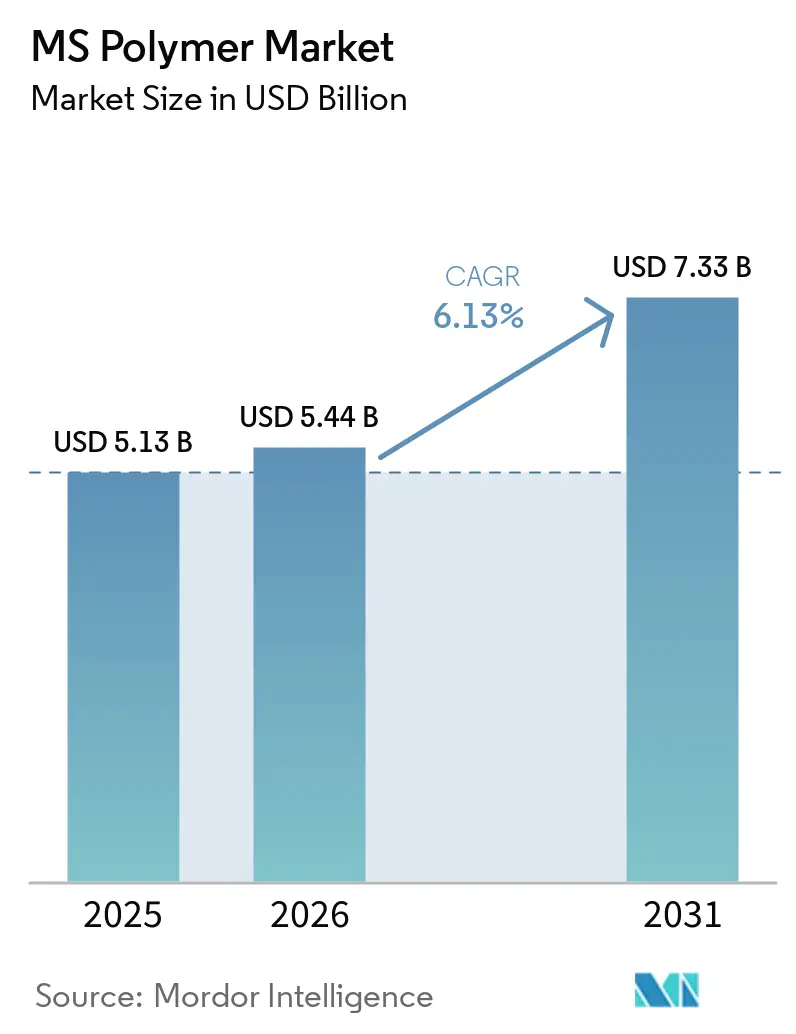
The MS Polymer Market size was valued at USD 5.13 billion in 2025 and is estimated to grow from USD 5.44 billion in 2026 to reach USD 7.33 billion by 2031, at a CAGR of 6.13% during the forecast period (2026-2031). The MS polymer market is moving beyond specialist uses as construction, vehicle, and electronics buyers seek adhesives and sealants with low volatile organic compound (VOC) emissions and no isocyanates. Regulatory requirements are making reformulation more important for manufacturers that previously used polyurethane systems. Producers with polymer synthesis capability can protect supply, control costs, and support tailored product development as demand broadens, while companies that depend on purchased inputs face greater exposure to feedstock pricing and allocation decisions. Capacity additions by Kaneka Corporation and Wacker Chemie AG indicate that upstream silane-terminated polyether production remains an important competitive factor, because base-resin availability affects the ability to serve customers across several product categories and geographic markets. The MS polymer market also benefits from renovation activity and electric vehicle assembly, although material availability and validation requirements can slow adoption in some applications and favor suppliers that can provide dependable technical support over a lengthy approval period.
Key Report Takeaways
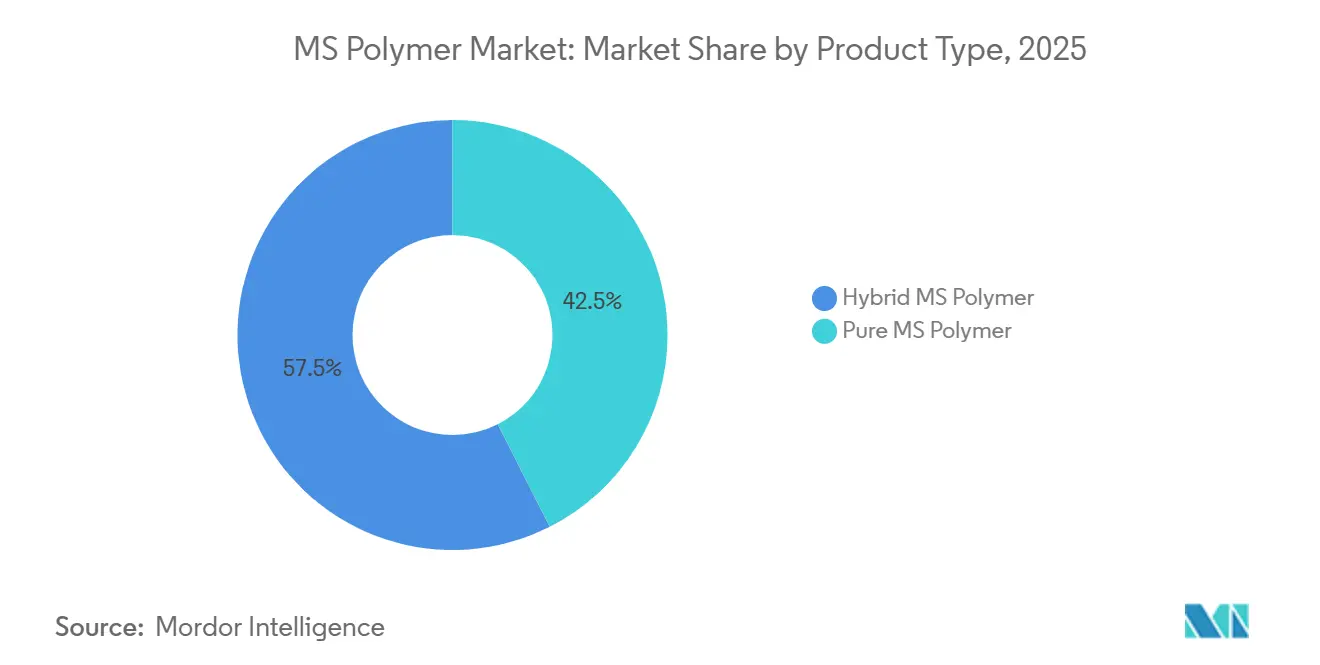
- By product type, hybrid MS polymer held 57.46% of the MS polymer market share in 2025 and is projected to advance at a 6.52% CAGR through 2031.
- By application, adhesives held 38.57% of the MS polymer market share in 2025 and are projected to advance at a 6.78% CAGR through 2031.
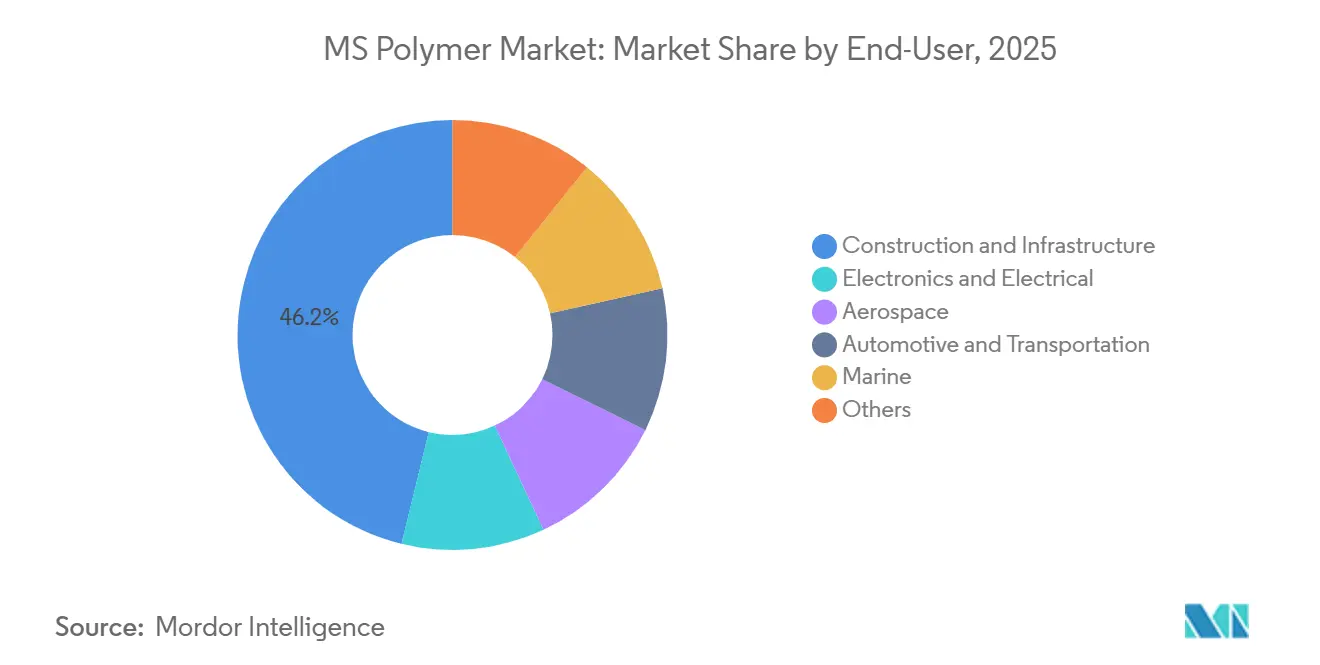
- By end-user, construction and infrastructure held 46.18% of the MS polymer market share in 2025, while automotive and transportation are projected to advance at a 7.15% CAGR through 2031.
- By geography, Asia-Pacific held 41.25% of the MS polymer market share in 2025 and is projected to advance at a 7.07% CAGR through 2031.
Note: Market size and forecast figures in this report are generated using Mordor Intelligence’s proprietary estimation framework, updated with the latest available data and insights as of January 2026.
Global MS Polymer Market Trends and Insights
Drivers Impact Analysis*
| Driver | (~) % Impact on CAGR Forecast | Geographic Relevance | Impact Timeline |
|---|---|---|---|
| Low-VOC and Isocyanate-Free Substitution | +1.8% | Global, with highest intensity in EU and North America | Short term (≤ 2 years) |
| Green-Building and Energy-Efficiency Specifications | +1.5% | Global; most pronounced in EU, North America, and East Asia | Medium term (2–4 years) |
| Aging Building-Envelope Replacement | +1.2% | North America, EU (Renovation Wave), Japan, South Korea | Medium term (2–4 years) |
| Lightweight Mixed-Material Vehicle Assembly | +0.9% | Global; concentrated in Germany, South Korea, China, and USA | Long term (≥ 4 years) |
| Electronics Encapsulation and Thermal-Cycling Protection | +0.6% | East Asia core (China, South Korea, Japan), spill-over to North America | Medium term (2–4 years) |
| Source: Mordor Intelligence | |||
Low-VOC and Isocyanate-Free Substitution
Low-VOC and isocyanate-free substitution is a central source of demand for the MS polymer market. The MS polymer market gains from this change because compliance and formulation choices are closely connected for industrial buyers, especially when site managers need simpler handling procedures and suppliers can demonstrate that the product supports the required health, safety, and environmental documentation. Commission Regulation (EU) 2020/1149 introduced phased restrictions on diisocyanates under Registration, Evaluation, Authorisation and Restriction of Chemicals (REACH), including training requirements for industrial users[1]European Commission, “Commission Regulation (EU) 2020/1149,” Official Journal of the European Union, eur-lex.europa.eu. These requirements encourage manufacturers to reduce safety-management burdens and occupational-health exposure associated with legacy materials, particularly when operations use adhesive and sealing products repeatedly across several plants and product lines. In April 2026, Henkel AG & Co. KGaA introduced Teroson MS 9381 HPT for heavy equipment, a one-component silane-modified polymer adhesive-sealant that excludes tin, solvents, isocyanates, silicones, and polyvinyl chloride. Henkel AG & Co. KGaA stated that the product can reduce application steps from 3 to 2 and can cut cradle-to-gate carbon dioxide emissions by up to 50% compared with conventional polyurethane materials. Once a buyer qualifies an isocyanate-free bill of materials, a return to polyurethane can require another full validation cycle, which supports repeat demand for established formulations and gives approved suppliers a stronger position in later purchasing decisions.
Green-Building and Energy-Efficiency Specifications
Green-building and energy-efficiency specifications support the use of the MS polymer market in commercial buildings, health care facilities, and educational projects. Low-emitting material requirements within Leadership in Energy and Environmental Design (LEED) and Building Research Establishment Environmental Assessment Method (BREEAM) frameworks favor adhesive and sealant products that meet total volatile organic compound limits and can be documented clearly during project specification and material review. The revised Energy Performance of Buildings Directive directs European building policy toward higher energy performance, which increases the relevance of durable envelope sealing solutions. MS polymer products can provide paintability and low-emission characteristics needed for many building-envelope uses, helping contractors use a single material approach across visible joints, facade details, and other areas that require a finished appearance. Products that satisfy South Coast Air Quality Management District Rule 1168 limits can also support certification work across several jurisdictions when other applicable requirements are met, which is useful for suppliers seeking to serve projects with similar but separately administered low-emission material requirements. This alignment can reduce the administrative burden for suppliers that invest early in documentation and testing, while helping building contractors compare acceptable products with fewer separate technical reviews.
Aging Building-Envelope Replacement
Aging building-envelope replacement creates a durable construction opportunity for the MS polymer market because repair decisions often arise from deterioration rather than discretionary new construction. The European Commission’s Renovation Wave aims to support energy-efficient renovation of 35 million buildings by 2030 under the Fit for 55 framework. Window sealing, facade bonding, and insulation-panel installation are relevant uses within this renovation activity, especially where a project needs materials that perform reliably on aged building surfaces. Older surfaces can be contaminated, uneven, or difficult to prepare, which makes primerless adhesion valuable to installers. This technical feature can simplify work on existing buildings compared with systems that need additional surface preparation, and it can be particularly useful where renovation contractors need to complete repairs quickly without extensive disruption to residents, businesses, or ongoing facility operations. Demand from renovation can therefore remain steadier than demand linked only to new building starts, because maintenance needs and energy-performance rules can continue to shape project decisions during weaker construction cycles.
Lightweight Mixed-Material Vehicle Assembly
Lightweight mixed-material vehicle assembly is broadening automotive demand in the MS polymer market. Electric and hybrid vehicles combine high-strength steel, aluminum, carbon fiber-reinforced polymer, and engineering plastics in structures that need flexible bonding, allowing manufacturers to reduce reliance on conventional fastening approaches where weight and joint durability are important. These materials expand and contract differently under temperature changes, and dissimilar metals can create corrosion concerns. MS polymer adhesives provide primerless adhesion, ambient-temperature curing, and electrochemical inertness for relevant joints, allowing designers to address mixed materials without relying solely on mechanical fasteners or higher-temperature bonding processes. In December 2025, Henkel AG & Co. KGaA launched Loctite MS 9650 for automotive display bonding, with ultraviolet resistance, creep behavior comparable to silicone-grade adhesives, and no isocyanates or polyvinyl chloride. Battery-module sealing and Advanced Driver-Assistance Systems (ADAS) sensor housings also value bonds that can be reworked during servicing, unlike many epoxy-based systems, which creates a separate use case linked to repair and replacement activity.
Restraints Impact Analysis*
| Restraint | (~) % Impact on CAGR Forecast | Geographic Relevance | Impact Timeline |
|---|---|---|---|
| Silane Feedstock Price Volatility | -0.8% | Global; most acute in Europe and Asia-Pacific | Short term (≤ 2 years) |
| Moisture-Cure Throughput Constraints | -0.5% | Global; most limiting in electronics and automotive OEM facilities | Medium term (2–4 years) |
| Long OEM and Electronics Qualification Cycles | -0.4% | Global; most pronounced in North America, EU, and Japan | Long term (≥ 4 years) |
| Source: Mordor Intelligence | |||
Silane Feedstock Price Volatility
Silane feedstock price volatility remains a constraint on the MS polymer market because silane-terminated polyether production depends on chlorosilane and alkoxysilane intermediates. Their production is capital intensive, energy intensive, and concentrated in a limited upstream supply base, so a disruption can affect material availability throughout the downstream adhesives and sealants value chain. Silicon metal costs can change with energy prices, Chinese production limits, and competing demand from solar and semiconductor supply chains, leaving downstream producers exposed to cost movements that do not directly reflect conditions in finished adhesive and sealant demand. Export-container constraints tightened silane spot liquidity in early 2026 and supported higher prices. Wacker Chemie AG’s proprietary GENIOSIL alpha-silane technology illustrates why integrated producers can have an advantage over formulators that buy feedstock on contract or spot markets, as control over specialized inputs can provide greater visibility into cost, availability, and product consistency across a customer program. As demand increases, long-term supply relationships may become more important than spot purchasing for smaller formulators, especially when producers prioritize established framework customers during periods of limited liquidity.
Moisture-Cure Throughput Constraints
Moisture-cure throughput constraints limit adoption where the MS polymer market serves high-volume manufacturing. Single-component formulations react with atmospheric moisture, so cure speed depends on humidity and cannot be accelerated freely without affecting elastic performance. Automotive lines operate on short cycle times, while moisture-cure materials can need hours for handling strength and days for full performance. Electronics plants also protect moisture-sensitive components in controlled environments, creating a conflict with the humidity needed for curing. Post-application humidity chambers can add equipment expense and process complexity, making implementation harder for facilities designed around tightly controlled processing conditions and rapid movement of components through production stages. Two-component products can shorten cure times through catalyzed crosslinking, but they require precise dispensing systems and add quality-control requirements, which transfer part of the constraint from curing time to line investment and process management.
*Our forecasts treat driver/restraint impacts as directional, not additive. The impact forecasts reflect baseline growth, mix effects, and variable interactions.
Segment Analysis
By Product Type: Hybrid MS Polymer Anchors Both Demand and Growth Rate
Hybrid MS polymer held 57.46% of the MS polymer market size in 2025. This position reflected the ability of blended-backbone formulations to balance adhesion, modulus, cure speed, and ultraviolet stability. Formulators can use the same underlying platform across construction sealants, flooring adhesives, and assembly adhesives. This can reduce raw-material complexity across commercial product lines, allowing companies to manage a wider range of customer requirements without carrying an unnecessarily broad set of separate polymer inputs and base formulations. Hybrid grades also help suppliers tailor performance for different substrate combinations without rebuilding the full formulation approach, which can improve portfolio flexibility for producers serving construction and industrial customers at the same time.
Pure MS polymer held the remaining product-type demand and is relevant where a clean regulatory profile and broad substrate compatibility matter most. Direct glazing on curtain-wall facades, food-contact equipment maintenance, and health care facility bonding are examples of such uses. The MS polymer industry is also shifting from organotin-catalyzed systems toward tin-free options. In March 2025, Wacker Chemie AG presented GENIOSIL STP-E 140 and STP-E 340 as tin-free silane-terminated polyethers that achieve low modulus in construction sealants without tin catalysts. Continued REACH review of organotin compounds supports attention to tin-free hybrid grades in Europe, where regulatory documentation is an important part of many professional construction and industrial procurement processes.


By Application: Adhesives Lead Both Demand and Growth Rate
Adhesives held 38.57% of the MS polymer market size in 2025 and are projected to advance at a 6.78% CAGR through 2031. Construction panel bonding, flooring installation, facade attachment, and transportation body assembly support this demand. Primerless adhesion to glass, metal, painted surfaces, and concrete helps reduce application steps, which can be important for installers working with different materials in the same project and seeking to limit the number of products needed at the job site. High lap-shear strength under dynamic loads also supports use in transportation and industrial bonding. These characteristics allow adhesives to serve projects where multiple materials meet in a single joint, including areas where installers need durable bonds without extensive substrate preparation or separate primer steps.
Sealants serve facade joints, curtainwall glazing perimeters, transportation body seams, and marine superstructure joints. Their paintability, non-staining behavior on natural stone, and movement capacity help distinguish them from silicone and polyurethane products. Coatings remain a smaller use but are gaining relevance in liquid-applied waterproofing for roofs, balconies, and terraces, where seamless application can reduce installation labor compared with systems that use sheet materials and multiple overlaps. Wacker Chemie AG started hybrid polymer production in Nünchritz in May 2025 for applications including construction adhesives, flooring, and liquid waterproofing membranes. European formulators are also examining bio-derived polyol feedstocks to support Environmental Product Declaration documentation as construction product requirements become more detailed, particularly for renovation contractors that track product declarations during material selection.
By End-User: Construction and Infrastructure Anchors Revenue, While Automotive and Transportation Advance Fastest
Construction and infrastructure held 46.18% of the MS polymer market size in 2025, while automotive and transportation is projected to advance at a 7.15% CAGR through 2031. Construction demand comes from renovation programs, green-building procurement, and facade refurbishment across mature and developing economies. These projects require reliable sealing and bonding across varied surfaces. Renovation spending and policy-driven retrofit work can make the demand profile more stable than vehicle production. The MS polymer market serves building applications that need paintable, low-emission, and weather-resistant materials, which keep the segment relevant to both facade repair and new envelope installation work.
Automotive is growing with electric vehicle platforms, lightweighting needs, and mixed-material vehicle structures, creating demand for products that maintain flexibility across joints exposed to vibration, thermal cycling, and routine service conditions. Electronics and electrical applications include encapsulation for electronic control units, ADAS sensor housings, and battery management system printed circuit boards. Flexible encapsulants can operate from -40 °C to +85 °C and can perform better than brittle epoxies in thermal-shock conditions. Marine and aerospace use remain specialized and require products that tolerate saltwater, ultraviolet exposure, dynamic movement, and long service lives, so qualification requirements support demand for higher-performance materials in these applications.

Geography Analysis
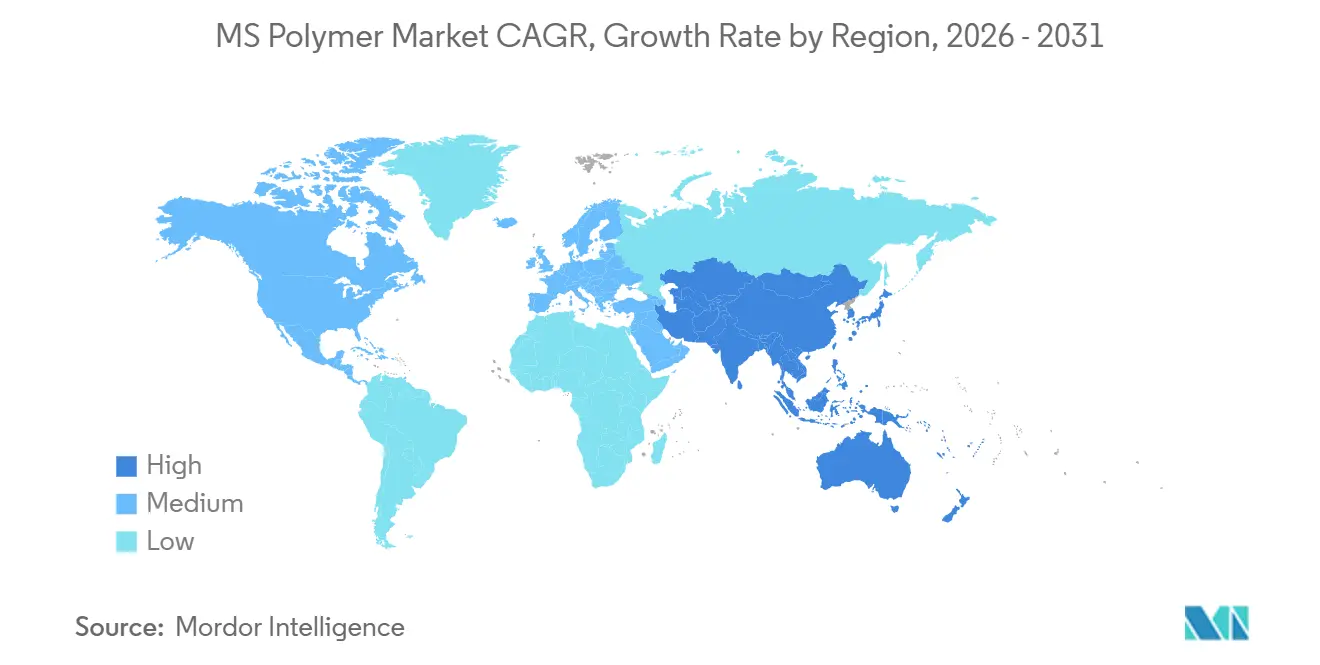
Asia-Pacific held 41.25% of the MS polymer market size in 2025 and is projected to advance at a 7.07% CAGR through 2031. The MS polymer market benefits from a regional base that combines established manufacturing centers with expanding infrastructure programs. China combines large construction sealant demand with growing automotive adhesive demand from domestic electric vehicle manufacturing, giving suppliers access to building and transportation end uses within the same broad manufacturing and construction economy. India’s infrastructure agenda supports demand for construction-grade sealants and adhesives across roads, rail, airports, and urban housing, with the range of project types creating opportunities for suppliers that can address both general building joints and more demanding construction interfaces. Japan’s Green Transformation, Zero Energy House building-renovation program directs investment toward envelope refurbishment and low-volatile-organic-compound sealing solutions[2]Ministry of Economy, Trade and Industry, Japan, “Green Transformation, Zero Energy House Housing Standards and Building Renovation Programme,” Ministry of Economy, Trade and Industry, meti.go.jp. South Korea adds demand from electronics manufacturing and automotive production. Vietnam, Indonesia, and Malaysia are emerging demand centers through industrial construction and regional automotive assembly, adding to regional demand beyond the more established markets of China, Japan, South Korea, and India.
Europe is shaped by REACH restrictions, building-energy requirements, and the Renovation Wave. Germany, the United Kingdom, France, and Italy are major national demand centers, with Germany supported by automotive original equipment manufacturers and Tier-1 suppliers. European compliance requirements can influence export-oriented supply chains in Asia and North America. This creates a need for suppliers to align formulations with common documentation and performance standards, even when final assembly or construction activity takes place outside Europe. North America follows as another important regional block, supported by renovation-led construction in the United States. LEED and Passive House projects add specification demand for lower-emission products, while Mexico’s automotive growth strengthens cross-border procurement aligned with United States standards and reinforces the value of formulations accepted by regional original equipment manufacturer supply chains.
South America is led by Brazil and Argentina, where infrastructure spending and housing renovation are introducing MS polymer products alongside silicone and polyurethane systems. Brazil’s high ultraviolet exposure, persistent humidity, and thermal cycling can favor durable sealing systems in facades and transportation, because these operating conditions can place greater stress on joint performance over an extended service period. The Middle East and Africa is supported by construction programs in Saudi Arabia, the United Arab Emirates, and South Africa. High-ambient-temperature glazing and facade work are important uses in these locations. Saudi Arabia’s Vision 2030 supports commercial, hospitality, and infrastructure construction that needs high-performance envelope systems. South Africa also serves as a distribution base for construction demand across Sub-Saharan Africa, extending the relevance of local inventory and technical support beyond its domestic building projects.

Competitive Landscape
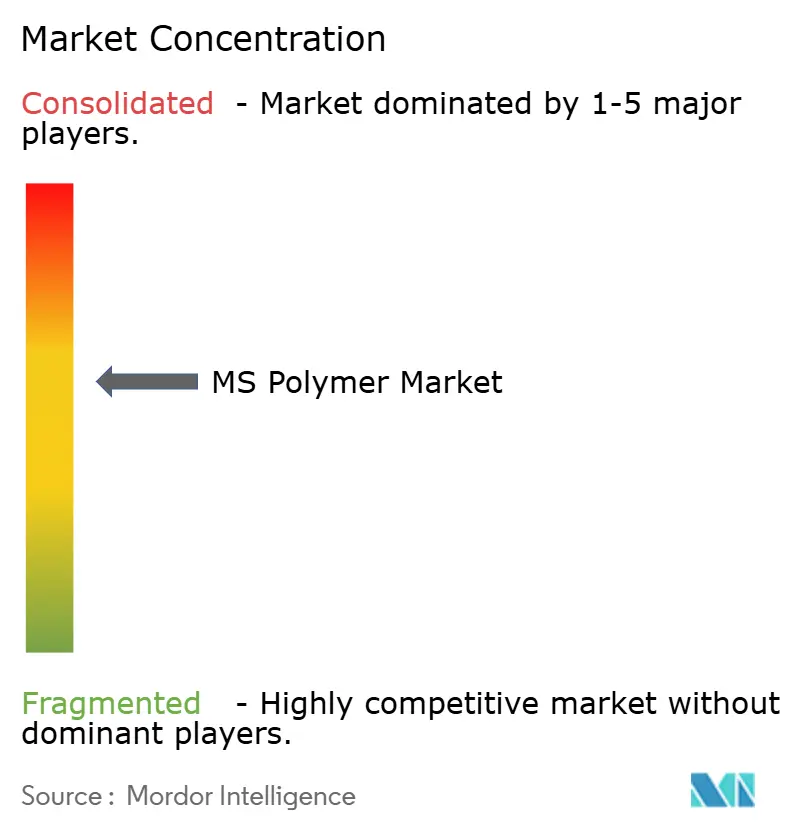
The MS polymer market is moderately concentrated, with the top five players including Kaneka Corporation, Wacker Chemie AG, Henkel AG & Co. KGaA, Arkema, and Sika AG. These companies have polymer synthesis capability, silane expertise, application knowledge, or established distribution systems, which create barriers for competitors that only formulate finished sealants or adhesives from purchased raw materials. Wacker differentiates through its alpha-silane GENIOSIL platform, while Kaneka Corporation has expanded European capacity. Kaneka Corporation commissioned its fourth MS Polymer production line in Westerlo, Belgium, in June 2024, expanding its ability to supply European customers that need dependable access to isocyanate-free and low-volatile-organic-compound base resins for formulated products. The line added 10,000 metric tons per year and brought potential European output to 43,000 metric tons per year. This investment strengthens access to base resins for sealant, adhesive, and coating formulations.
Wacker Chemie AG began producing hybrid polymers at Nünchritz in May 2025 after a double-digit-million-euro investment that created 50 jobs. The site supports tin-free alpha-silane-based binders for construction adhesives, flooring products, and waterproofing membranes, giving Wacker Chemie AG a production base for several construction uses that need elastic and lower-emission formulations. Henkel AG & Co. KGaA has broadened its portfolio through products for automotive displays, rail applications, and heavy equipment. MAPEI S.p.A., H.B. Fuller Company, and Soudal Group compete through professional construction specifications and certification portfolios. Their positions depend on technical service, project approvals, and consistent local product availability, since professional users often value reliable on-site performance and continuity of supply over a narrow purchase-price comparison.
The MS polymer market has room for bio-derived backbones and two-component products suited to faster electronics and automotive production, since each addresses a specific gap in circular-material documentation or manufacturing throughput without changing the underlying need for flexible bonding. Regional formulators in China and Southeast Asia compete in commodity sealant grades through local inventory and price positioning. This can pressure margins in construction uses and lead larger suppliers toward more specialized formulations, where technical differentiation, approval history, and service requirements matter more than local inventory pricing alone. Evonik Industries AG expanded its IMCD distribution relationship to the United States in 2026 for VISIOMER specialty methacrylates used in adhesive, sealant, and coating formulations. Adjacent materials also compete in some battery-protection applications, which makes product development and qualification support important for established suppliers that want to expand specifications beyond traditional construction sealants and general industrial bonding uses.
MS Polymer Industry Leaders
Kaneka Corporation
Wacker Chemie AG
Henkel AG & Co. KGaA
Arkema
Sika AG
- *Disclaimer: Major Players sorted in no particular order

Recent Industry Developments
- August 2026: Forza Inc. launched ForzaSEAL T-OS150, a semi-self-leveling hybrid polymer sealant designed to replace conventional polyurethane and silicone sealants in transportation manufacturing. The launch expands the use of hybrid polymer sealants in vehicle manufacturing and supports demand for MS polymer-based sealing solutions.
- December 2025: Kastar introduced high-tack MS polymer sealants formulated without solvents or isocyanates and designed to provide early holding strength with long-term elasticity. The launch supports the adoption of MS polymer sealants in construction applications where improved environmental performance and bonding strength are required.


Global MS Polymer Market Report Scope
MS polymers (modified silane polymers) are high-performance hybrid materials that combine the strength of polyurethanes with the weather resistance of silicones. They combine flexibility, adhesion, weatherability, and low-emission characteristics, making them suitable for applications where durable bonding and sealing performance are required.
The MS Polymer Market is segmented by product type, application, end-user, and geography. By product type, the market is segmented into hybrid MS polymer and pure MS polymer. By application, the market is segmented into adhesives, sealants, coatings, and others. By end-user, the market is segmented into construction and infrastructure, automotive and transportation, electronics and electrical, marine, aerospace, and others. The report also covers the market size and forecasts for MS polymers in 15 countries across major regions. For each segment, the market sizing and forecasts have been done on the basis of value (USD).
| Hybrid MS Polymer |
| Pure MS Polymer |
| Adhesives |
| Sealants |
| Coatings |
| Others |
| Construction and Infrastructure |
| Automotive and Transportation |
| Electronics and Electrical |
| Marine |
| Aerospace |
| Others |
| Asia-Pacific | China |
| India | |
| Japan | |
| South Korea | |
| Rest of Asia-Pacific | |
| North America | United States |
| Canada | |
| Mexico | |
| Europe | Germany |
| United Kingdom | |
| France | |
| Italy | |
| Rest of Europe | |
| South America | Brazil |
| Argentina | |
| Rest of South America | |
| Middle East and Africa | Saudi Arabia |
| South Africa | |
| Rest of Middle East and Africa |
| By Product Type | Hybrid MS Polymer | |
| Pure MS Polymer | ||
| By Application | Adhesives | |
| Sealants | ||
| Coatings | ||
| Others | ||
| By End-User | Construction and Infrastructure | |
| Automotive and Transportation | ||
| Electronics and Electrical | ||
| Marine | ||
| Aerospace | ||
| Others | ||
| By Geography | Asia-Pacific | China |
| India | ||
| Japan | ||
| South Korea | ||
| Rest of Asia-Pacific | ||
| North America | United States | |
| Canada | ||
| Mexico | ||
| Europe | Germany | |
| United Kingdom | ||
| France | ||
| Italy | ||
| Rest of Europe | ||
| South America | Brazil | |
| Argentina | ||
| Rest of South America | ||
| Middle East and Africa | Saudi Arabia | |
| South Africa | ||
| Rest of Middle East and Africa | ||


Key Questions Answered in the Report
What is the size of the MS polymer market?
The MS polymer market stands at USD 5.44 billion in 2026 and is projected to reach USD 7.33 billion by 2031.
What is driving demand for MS polymer products?
Low-VOC and isocyanate-free substitution, building renovation, energy-efficiency specifications, and mixed-material vehicle assembly support demand.
Which product type led the market demand in 2025?
Hybrid MS polymer led with a 57.46% share in 2025 because it could balance adhesion, cure speed, modulus, and ultraviolet stability.
Which application led the market demand in 2025?
Adhesives led with a 38.57% share in 2025, supported by construction, flooring, facade, and transportation bonding uses.
Page last updated on:





