
MS Polymer Adhesives Market Size and Share
Market Overview
| Study Period | 2022 - 2032 |
|---|---|
| Market Size (2027) | USD 6.03 Billion |
| Market Size (2032) | USD 8.48 Billion |
| Growth Rate (2027 - 2032) | 7.04 % |
| Fastest Growing Market | Asia-Pacific |
| Largest Market | Asia-Pacific |
| Market Concentration | Medium |
Major Players *Disclaimer: Major Players sorted in no particular order Image © Mordor Intelligence. Reuse requires attribution under CC BY 4.0. | |
MS Polymer Adhesives Market Analysis by Mordor Intelligence
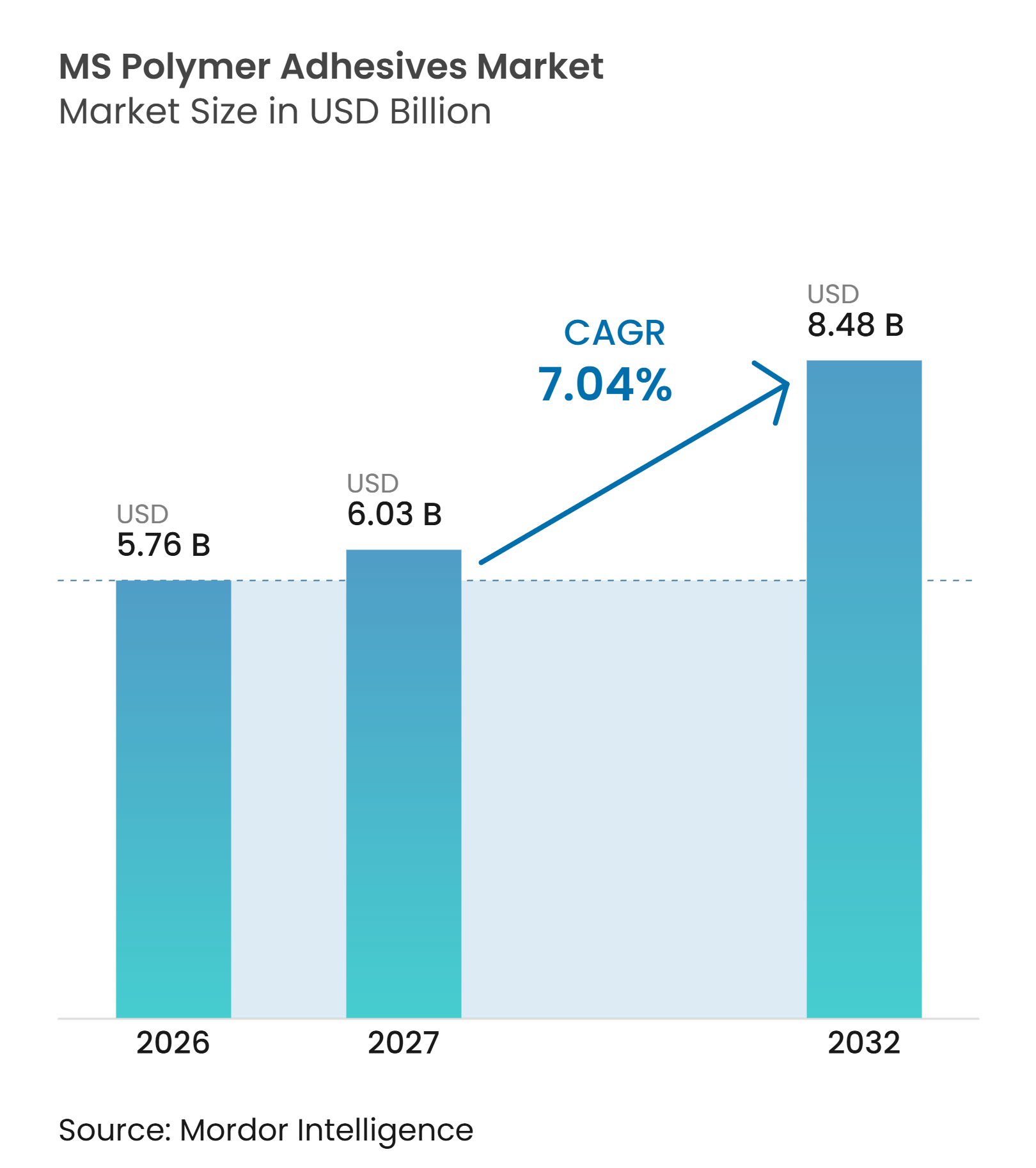
The MS Polymer Adhesives Market size was valued at USD 5.76 billion in 2026 and is estimated to grow from USD 6.03 billion in 2027 to reach USD 8.48 billion by 2032, at a CAGR of 7.04% during the forecast period (2027-2032). MS polymer adhesives, also called silane-modified polyether or silane-modified polymer adhesives, cure through moisture-activated silane chemistry and avoid isocyanates and organic solvents. This profile supports their use where users need lower-emission materials, primerless bonding, and compatibility across dissimilar substrates. Regulatory requirements for volatile organic compounds and diisocyanates are raising the administrative and material costs associated with conventional chemistries in several established markets. Construction remains the main demand base, while vehicle electrification, modular construction, and renewable-energy applications are widening the range of uses for the MS polymer adhesives market. Suppliers are responding through new polymer capacity, application-specific products, and regional production investments, although price sensitivity and variable cure conditions still limit adoption in some projects.
Key Report Takeaways
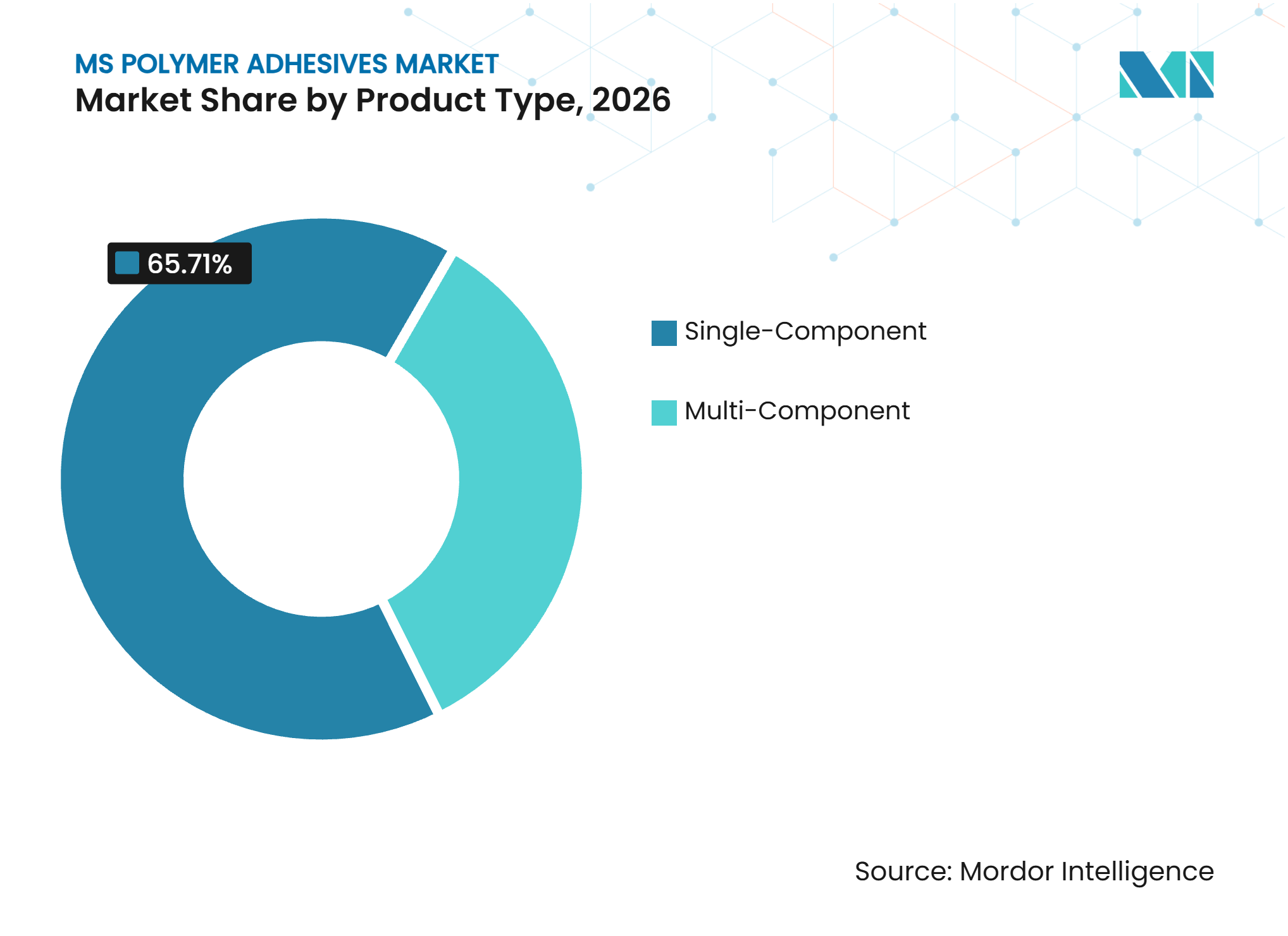
- By product type, single-component held 65.71% of the MS polymer adhesives market share in 2026, while multi-component is forecast to advance at a 7.89% CAGR through 2032.
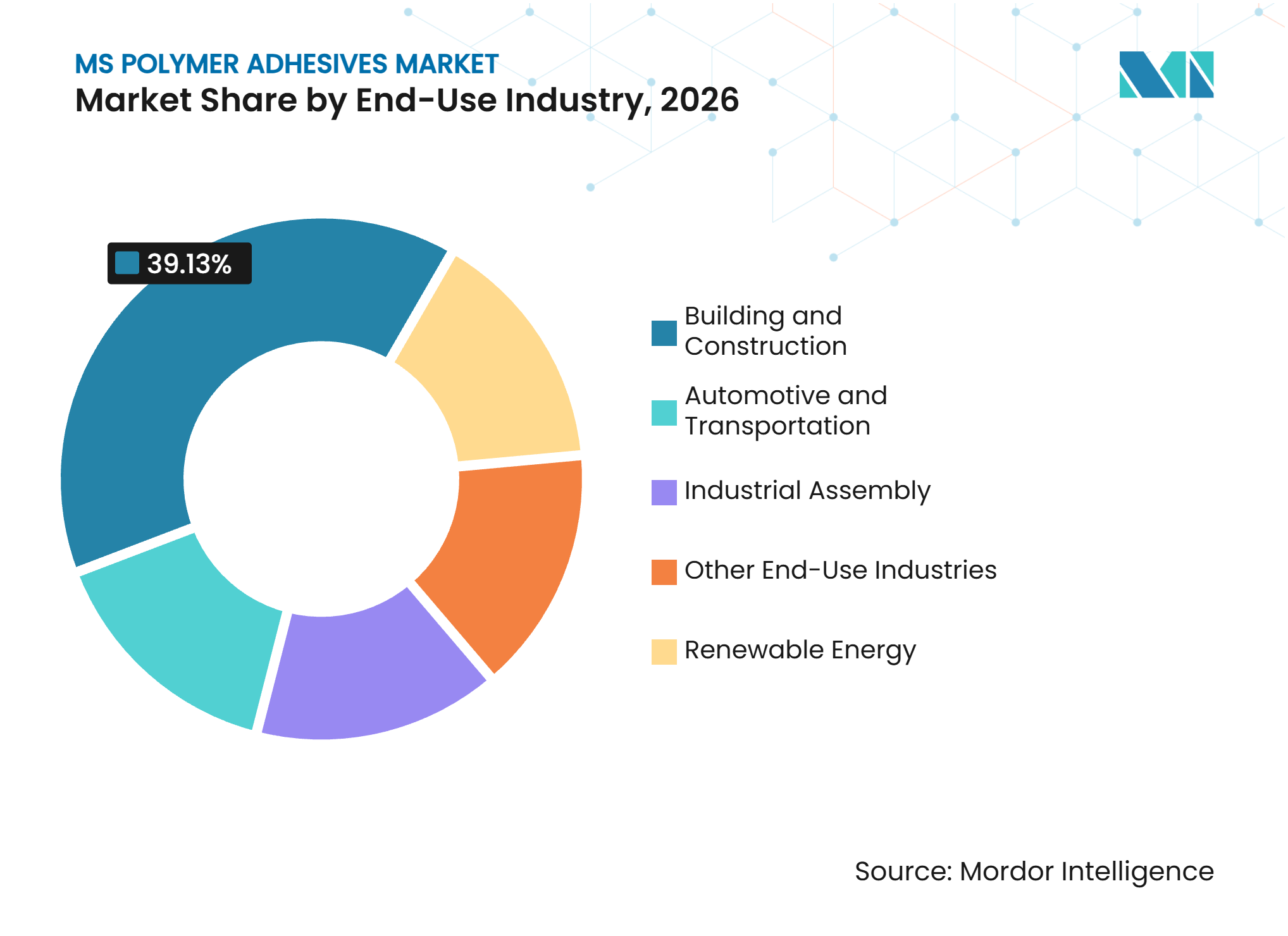
- By end-use industry, building and construction held 39.13% of the MS polymer adhesives market share in 2026, while automotive and transportation are forecast to advance at an 8.43% CAGR through 2032.
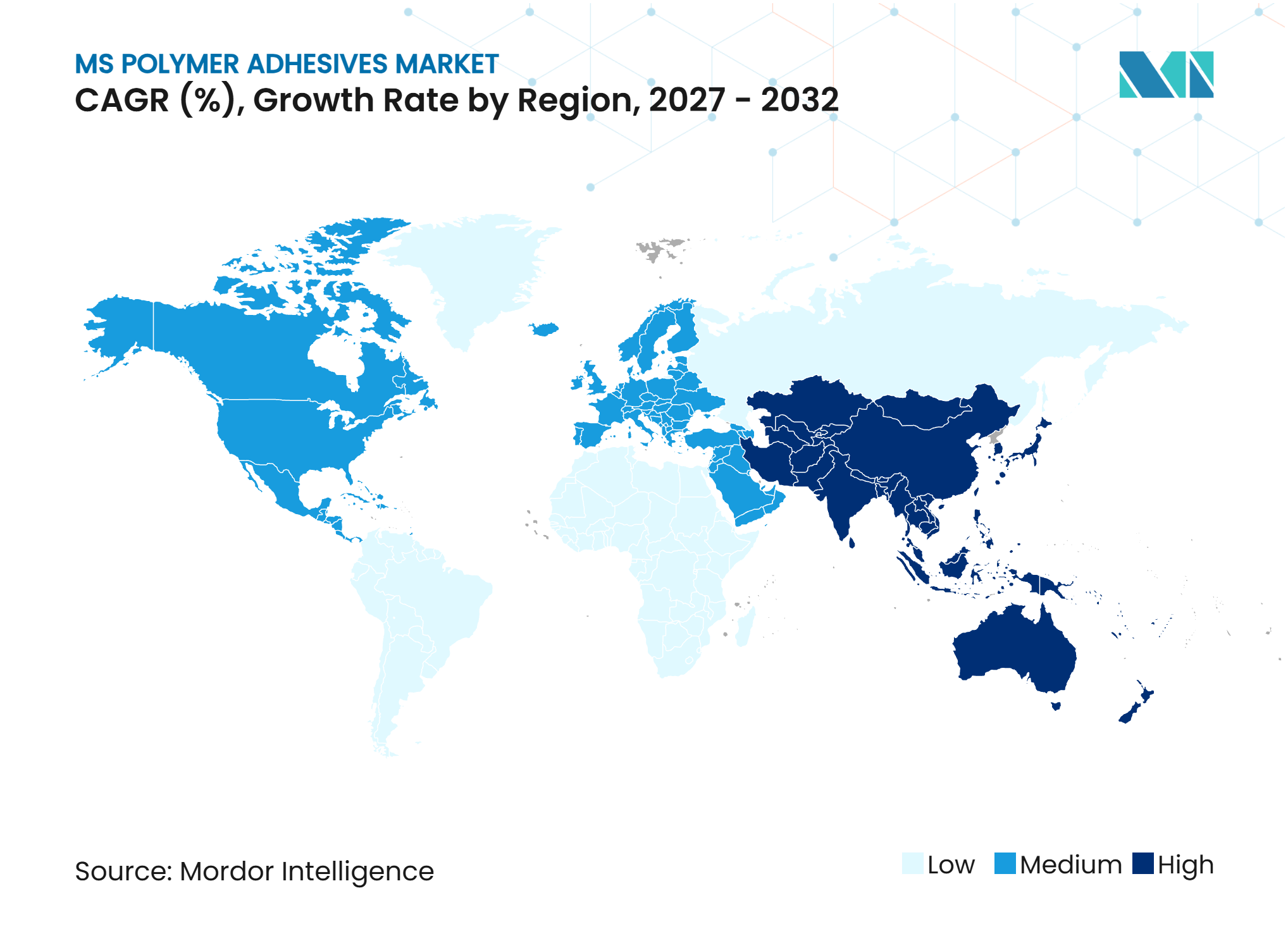
- By geography, Asia-Pacific held 42.56% of the MS polymer adhesives market share in 2026 and is forecast to advance at an 8.11% CAGR through 2032.
Note: Market numbers in this report are based on Mordor Intelligence's proprietary estimation framework, which combines nine months of actuals with Q4 projections for base year 2026.
Market Trends and Insights
Drivers Impact Analysis of MS Polymer Adhesives Market*
| Driver | (~) % Impact on CAGR Forecast | Geographic Relevance | Impact Timeline |
|---|---|---|---|
| Low-VOC and Isocyanate-Free Adhesive Adoption | +2.5% | Global, with regulatory intensity concentrated in EU, Japan, and North America (CARB states) | Short term (≤ 2 years) |
| Lightweight and Mixed-Material Transportation Assemblies | +2.0% | Global; APAC and EU as primary OEM specification centers | Medium term (2-4 years) |
| Green Building, Renovation, and Energy-Efficient Construction | +1.5% | Europe, North America; emerging in APAC green-rated projects | Medium term (2-4 years) |
| Prefabricated Construction and Modular Manufacturing | +1.0% | APAC core markets (China, India, Japan) with spillover to EU and North America | Medium term (2-4 years) |
| Primerless Processing and Reduced Assembly Steps | +0.5% | Global; automotive OEM lines and electronics assembly in APAC | Short term (≤ 2 years) |
| Source: Mordor Intelligence | |||
Low-VOC and Isocyanate-Free Adhesive Adoption
The MS polymer adhesives market benefits from demand for materials that can meet indoor-air and workplace requirements without relying on isocyanate-based systems. Japan Adhesive Industry Association (JAIA) product registration activity shows that volatile organic compound requirements remain relevant to adhesive producers operating in Japan. The U.S. Environmental Protection Agency finalized amendments to national volatile organic compound emission standards for aerosol coatings in January 2025, reinforcing the direction of regulatory attention toward product emissions[1]. MS polymer systems offer a route to lower-emission and isocyanate-free formulations, which can reduce handling complexity for contractors and plant operators. Germany’s EMICODE certification and France’s indoor-emission labeling influence procurement decisions for construction products, especially where project owners seek documented low-emission performance. Helopal’s 2025 certification information identifies EC1Plus status for an MS adhesive product, showing that suppliers can position these systems within building-certification programs.
Lightweight and Mixed-Material Transportation Assemblies
Electric vehicles use aluminum, engineering plastics, carbon-fiber reinforcements, glass, and coated metals in assemblies that have different thermal and surface properties. These substrate combinations can increase the need for flexible bonding materials that distribute stress without adding mechanical fasteners. Henkel AG & Co. KGaA launched Loctite MS 9650 in December 2025 for automotive display and lightweight structural bonding, citing UV resistance, primerless adhesion, and compatibility with glass, metal, painted surfaces, and plastics. CEMEDINE Co.,Ltd.’s 2025 technical material for its Super X range also supports the use of silane-modified polymer systems across varied construction and industrial substrates. H.B. Fuller Company has identified lightweight adhesive selection as relevant to electric-vehicle manufacturing, where bond flexibility and thermal performance influence material choice. Primerless processing also removes a preparation step, which can improve production flow in automotive and electronics assembly when validated for the specified substrate.
Green Building, Renovation, and Energy-Efficient Construction
Low-emission sealants and adhesives are increasingly considered during material selection for green-building projects. Green Seal revised its GS-36 standard for commercial adhesives in March 2025, maintaining a recognized reference point for lower-impact adhesive procurement in North American projects. Materials used within the building weatherproofing boundary can also be evaluated under Leadership in Energy and Environmental Design (LEED) and similar project frameworks. MS polymer adhesives are relevant because they combine paintability, weather resistance, and low-emission formulation options in window, facade, and interior applications. Renovation work creates demand for resealing aging facades, panel joints, and service penetrations where older polysulfide, silicone, or polyurethane materials need replacement. These characteristics support opportunities for the MS polymer adhesives market in energy-efficient renovation, including building-integrated photovoltaic installations that require durable module and roof bonding.
Prefabricated Construction and Modular Manufacturing
Off-site construction places greater value on repeatable dispensing, controlled curing, and reliable adhesion across substrates prepared in a factory environment. The Modular Building Institute reported in October 2025 that MS polymer-based adhesives maintained bond integrity in modular rail-station tile installations where vibration can challenge cementitious systems. A single hybrid adhesive can be used for panel joints, window surrounds, and service penetrations, reducing the number of products held by a module fabricator. CEMEDINE Co.,Ltd. stated that its TGA-3 elastic-plastic adhesive was used in steel brace connections at the Osaka-Kansai Expo Signature Pavilion, showing the use of advanced adhesive technology in a public construction project. The company reported a 20% reduction in connection area and 30% fewer high-tension bolts than conventional bolt-only joints for that application. Programs supporting prefabrication in China and India create a setting where factory-applied MS polymer products can gain wider acceptance.
Restraints Impact Analysis of MS Polymer Adhesives Market*
| Restraint | (~) % Impact on CAGR Forecast | Geographic Relevance | Impact Timeline |
|---|---|---|---|
| Higher Formulation and Qualification Costs Than Conventional Sealants | -0.8% | Global; most acute in price-sensitive residential markets in SEA, South Asia, and sub-Saharan Africa | Short term (≤ 2 years) |
| Limited Awareness and Penetration in Underdeveloped Markets | -0.5% | MEA, South America, parts of ASEAN | Long term (≥ 4 years) |
| Moisture and Temperature Dependence During Cure | -0.3% | Northern Europe, Canada, high-altitude APAC markets | Medium term (2-4 years) |
| Source: Mordor Intelligence | |||
Higher Formulation and Qualification Costs Than Conventional Sealants
Silane-terminated polyether monomers are more expensive than several established polyurethane and silicone inputs, which affects purchasing decisions in projects that prioritize upfront cost. This price difference is especially significant in residential and small-commercial work where performance specifications are less demanding. Wacker Chemie AG reported in its 2025 annual report that conditions in silicone markets affected its business environment, highlighting the competitive pressure created by alternative chemistries. Automotive qualification can also require extended chemical testing, substrate trials, production validation, and approved-material submissions. These processes favor suppliers that already hold original equipment manufacturer approvals and application records. Moisture cure creates a further operational constraint because cold or low-humidity conditions can slow the cure rate and require closer process control.
Limited Awareness and Penetration in Underdeveloped Markets
MS polymer technology has a longer specification history in Japan and Europe than in several developing construction markets. Contractors in parts of South America, sub-Saharan Africa, and South Asia may be more familiar with solvent-borne products, bitumen sealants, commodity silicones, or conventional polyurethane systems. Installer education on moisture cure, primerless application, and International Organization for Standardization (ISO) 11600 performance classification can therefore influence adoption. Pidilite Industries Ltd. reported 22.2% growth in its adhesives and sealants category during fiscal year 2024-2025, yet the scale of established product habits can still slow the uptake of newer chemistries. Mapei S.p.A. announced local manufacturing investments in Egypt and Brazil during 2025, which can strengthen product availability and technical support in adjacent markets. Market development in these regions depends on distribution, installer training, and confidence in product performance under local conditions.
*Our forecasts treat driver/restraint impacts as directional, not additive. The impact forecasts reflect baseline growth, mix effects, and variable interactions.
MS Polymer Adhesives Market Segment Analysis
By Product Type:
Single-Component Leads; Multi-Component Systems Grow FasterSingle-component held 65.71% of the MS polymer adhesives market share in 2026. Their leading position reflects their suitability for field installation, where sole operators and small crews can apply a ready-to-use material without ratio control or mixing equipment. These products are widely used in facade sealing, windows, interior finishing, and renovation because users can dispense them directly from a cartridge or sausage pack. Their moisture-cure mechanism can limit cure depth in thick joints and can make storage and application conditions important in humid or cold climates.
Multi-component is projected to advance at a 7.89% CAGR through 2032. Their MS polymer adhesives market size is expanding in industrial settings because two-part systems can provide faster handling strength and support controlled automated dispensing. These capabilities suit robotic assembly lines where cycle time and bead consistency are central to throughput. Wacker Chemie AG introduced GENIOSIL STP-E 140 and GENIOSIL STP-E 340 in March 2025, describing alpha-gamma silane binders designed to provide high elasticity and low modulus without organotin catalysts. As automotive and industrial users update material specifications, multi-component products can gain share where their cure profile and mechanical performance justify the added handling requirements.


By End-Use Industry:
Building and Construction Hold Revenue; Automotive and Transportation Expand FasterBuilding and construction accounted for 39.13% of the MS polymer adhesives market share in 2026. The segment uses these products for facade joints, window installation, prefabricated panels, roofing details, flooring, and general renovation work. A paintable and non-staining cured surface can make MS polymer products useful where architects require finishing compatibility that is difficult to obtain with some silicone systems. Green-building requirements also encourage the selection of low-emission products that can meet project documentation needs.
Automotive and transportation are projected to advance at an 8.43% CAGR through 2032. Vehicle makers are using more dissimilar materials as they seek lightweight structures, protect battery packs, and integrate display systems. MS polymer adhesive systems can provide flexible bonding across glass, metal, coated panels, and plastics while avoiding isocyanates. Industrial assembly is also an important user group where predictable viscosity and dispensing performance support appliance and consumer-electronics manufacturing. Renewable-energy installations remain a smaller application area, but demand for ultraviolet-stable and weather-resistant panel bonding gives the MS polymer adhesives market a route into photovoltaic and related equipment applications.


Geography Analysis
Asia-Pacific
Asia-Pacific held 42.56% of the MS polymer adhesives market share in 2026 and is projected to advance at an 8.11% CAGR through 2032. China supports the MS polymer adhesives market through infrastructure activity, construction chemicals production, and a large vehicle supply chain. Japan remains an important technology center for silane and polymer chemistry, while the country’s adhesive sector maintains established product-registration and compliance practices through the JAIA. India provides a large distribution opportunity as construction activity extends beyond major cities and installer networks become more familiar with advanced sealants. Pidilite Industries Ltd’s reported reach across 38,500 towns gives it a broad route to construction customers, although specification practices remain important for wider adoption. South Korea adds demand from electric-vehicle components and semiconductor equipment, supporting the region’s combination of construction and precision assembly uses.
Europe
Europe is a major specification-driven area for the MS polymer adhesives market. Environmental and indoor-emission requirements influence procurement for construction and renovation projects, particularly where developers use the German Sustainable Building Council (DGNB) and related certification systems. Helopal’s certification documentation demonstrates the relevance of EMICODE EC1 Plus status in this environment. The region’s renovation demand supports applications in facade resealing, windows, weatherproofing, and building-envelope upgrades. Soudal Group expanded its United Kingdom logistics capacity through a 10-year lease for Tamworth space in September 2025, indicating continued support for its construction-products distribution network. Northern European markets also favor low-emission materials, but cooler conditions can require users to manage moisture-cure performance carefully.
North America, South America, and Middle East and Africa
North America supports the MS polymer adhesives market through construction recovery and demand from vehicle and durable-goods production. The U.S. Environmental Protection Agency’s 2025 amendments to volatile organic compound standards support the broader compliance context for lower-emission materials. Bostik began a USD 27 million investment at its Middleton, Massachusetts, plant in May 2025 to expand specialty-adhesive capacity for construction and durable-goods customers. In South America, Mapei S.p.A. announced its first Brazilian manufacturing facility in September 2025, with operations planned for 2027. The Middle East and Africa are earlier-stage markets where large infrastructure programs can increase awareness among contractors and specifiers. Regional expansion depends on local distribution, contractor access, and technical support for construction and industrial users.
Competitive Landscape
Market Concentration
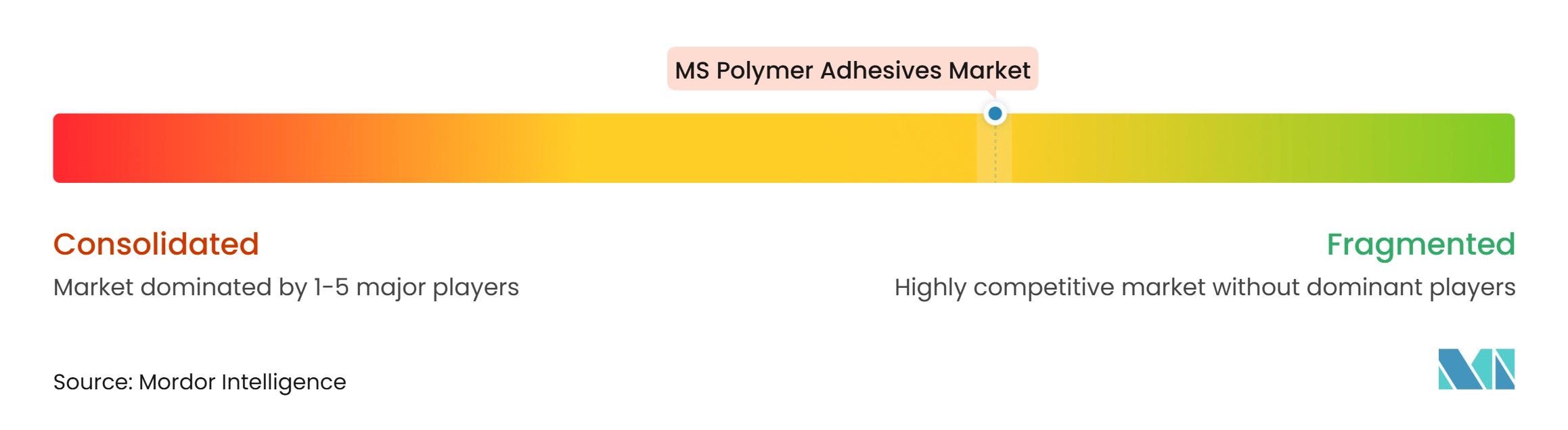
The MS polymer adhesives market is moderately concentrated, with the top five players including Henkel AG & Co. KGaA, Sika AG, Arkema, H.B. Fuller Company, and 3M. Sika AG, Henkel AG & Co. KGaA, Arkema through Bostik, and Wacker Chemie AG have broad technical and geographic capabilities. Sika AG reported seven bolt-on acquisitions in 2025, which strengthened its building-finishing, Middle Eastern construction, and Asia-Pacific distribution positions. Henkel AG & Co. KGaA launched Loctite MS 9650 in December 2025 for automotive display and lightweight structural bonding, focusing on primerless adhesion and a PVC-free, isocyanate-free formulation[2].
Wacker Chemie AG commenced production of alpha-silane hybrid polymers at Nünchritz in 2025, adding a dedicated supply source for high-performance sealants, adhesives, and liquid waterproofing products. This investment supports independent formulators that do not produce their own polymer backbones. Arkema’s Bostik launched VSR 400A in August 2025, a silyl-modified polymer conductive seam sealant for heavy-duty truck hoods that integrates conductivity and sealing into one product. Producers such as 3M, Dow, ITW Performance Polymers, Permabond, Shin-Etsu Chemical Co., Ltd., CEMEDINE Co.,Ltd., and Tremco Incorporated add specialized adhesive, sealant, silicone, hybrid-polymer, and industrial bonding capabilities.
Competitive opportunities include tin-free formulations, products for food-contact settings, bio-based silane-modified polymer systems, and renewable-energy panel bonding. Soudal Group supports its position with SMX (Soudal Modified Extensions) technology used in its hybrid-polymer sealants and adhesives. Mapei S.p.A. opened a USD 25 million production plant in Egypt in April 2025, giving it a local base for Egypt, North Africa, and Middle Eastern customers. Technical differentiation is likely to remain tied to material science, qualification history, application support, and the ability to supply customers in multiple regions.
MS Polymer Adhesives Industry Leaders
-
Henkel AG & Co. KGaA
-
Sika AG
-
Arkema
-
H.B. Fuller Company
-
3M
- *Disclaimer: Major Players sorted in no particular order
MS Polymer Adhesives Market Companies Covered in this Report
- 3M
- Arkema
- CEMEDINE Co.,Ltd.
- Dow
- H.B. Fuller Company
- Henkel AG & Co. KGaA
- ITW Performance Polymers
- Mapei S.p.A.
- Permabond
- Pidilite Industries Ltd.
- Shin-Etsu Chemical Co., Ltd.
- Sika AG
- Soudal Group
- Tremco Incorporated
- Wacker Chemie AG
Recent Industry Developments in MS Polymer Adhesives Market
- October 2026: Henkel AG & Co. KGaA introduced Loctite MS 9810, a new one-component MS Polymer formed-in-place gasketing sealant. The product offers resistance to hot oils, elevated temperatures, and mechanical movement, supporting the MS polymer adhesives market through expanded applications in automotive sealing and drivetrain assembly.
- March 2025: Wacker Chemie AG introduced GENIOSIL STP-E 140 and GENIOSIL STP-E 340, two silane-terminated polymer products designed for tin-free adhesive and sealant formulations. The products allow manufacturers to adjust curing speed, skin formation time, and mechanical properties, supporting the MS Polymer Adhesives Market through expanded formulation flexibility and the development of high-performance bonding solutions.
Global MS Polymer Adhesives Market Report Scope
MS polymer adhesives are moisture-curing adhesives based on modified silane-terminated polymers that provide strong bonding, flexibility, and resistance to environmental exposure. They are used to bond different substrates while offering durability and reduced reliance on conventional mechanical fasteners.
The MS Polymer Adhesives Market is segmented by product type, end-use industry, and geography. By product type, the market is segmented into single-component and multi-component adhesives. By end-use industry, the market is segmented into building and construction, automotive and transportation, industrial assembly, renewable energy, and other end-use industries. The report also covers the market size and forecasts for MS polymer adhesives across 15 countries. For each segment, the market sizing and forecasts have been done on the basis of value (USD).
Segmentation Overview
| Single-Component |
| Multi-Component |
| Building and Construction |
| Automotive and Transportation |
| Industrial Assembly |
| Renewable Energy |
| Other End-Use Industries |
| Asia-Pacific | China |
| India | |
| Japan | |
| South Korea | |
| ASEAN Countries | |
| Rest of Asia-Pacific | |
| North America | United States |
| Canada | |
| Mexico | |
| Europe | Germany |
| United Kingdom | |
| France | |
| Italy | |
| NORDIC Countries | |
| Rest of Europe | |
| South America | Brazil |
| Argentina | |
| Rest of South America | |
| Middle East and Africa | Saudi Arabia |
| South Africa | |
| Rest of Middle East and Africa |
| By Product Type | Single-Component | |
| Multi-Component | ||
| By End-Use Industry | Building and Construction | |
| Automotive and Transportation | ||
| Industrial Assembly | ||
| Renewable Energy | ||
| Other End-Use Industries | ||
| By Geography | Asia-Pacific | China |
| India | ||
| Japan | ||
| South Korea | ||
| ASEAN Countries | ||
| Rest of Asia-Pacific | ||
| North America | United States | |
| Canada | ||
| Mexico | ||
| Europe | Germany | |
| United Kingdom | ||
| France | ||
| Italy | ||
| NORDIC Countries | ||
| Rest of Europe | ||
| South America | Brazil | |
| Argentina | ||
| Rest of South America | ||
| Middle East and Africa | Saudi Arabia | |
| South Africa | ||
| Rest of Middle East and Africa | ||
Key Questions Answered in the Report
What is the size of the MS polymer adhesives market?
The MS Polymer Adhesives Market size was valued at USD 5.76 billion in 2026 and is estimated to grow from USD 6.03 billion in 2027 to reach USD 8.48 billion by 2032, at a CAGR of 7.04% during the forecast period (2027-2032).
What is driving demand in the MS polymer adhesives market?
Demand is supported by low-emission material requirements, isocyanate-free formulations, lightweight vehicle assembly, renovation work, and modular construction.
Which product type held the largest share in 2026?
Single-component held a 65.71% share in 2026 because it is suitable for direct field application without mixing equipment.
Which end-use industry is projected to advance fastest through 2032?
Automotive and transportation are projected to advance at an 8.43% CAGR through 2032, supported by mixed-material electric-vehicle applications.