
MRO Protective Coatings Market Size and Share
Market Overview
| Study Period | 2022 - 2032 |
|---|---|
| Market Size (2027) | USD 6.85 Billion |
| Market Size (2032) | USD 8.79 Billion |
| Growth Rate (2027 - 2032) | 5.11 % |
| Fastest Growing Market | Asia-Pacific |
| Largest Market | Asia-Pacific |
| Market Concentration | Medium |
Major Players *Disclaimer: Major Players sorted in no particular order Image © Mordor Intelligence. Reuse requires attribution under CC BY 4.0. | |
MRO Protective Coatings Market Analysis by Mordor Intelligence
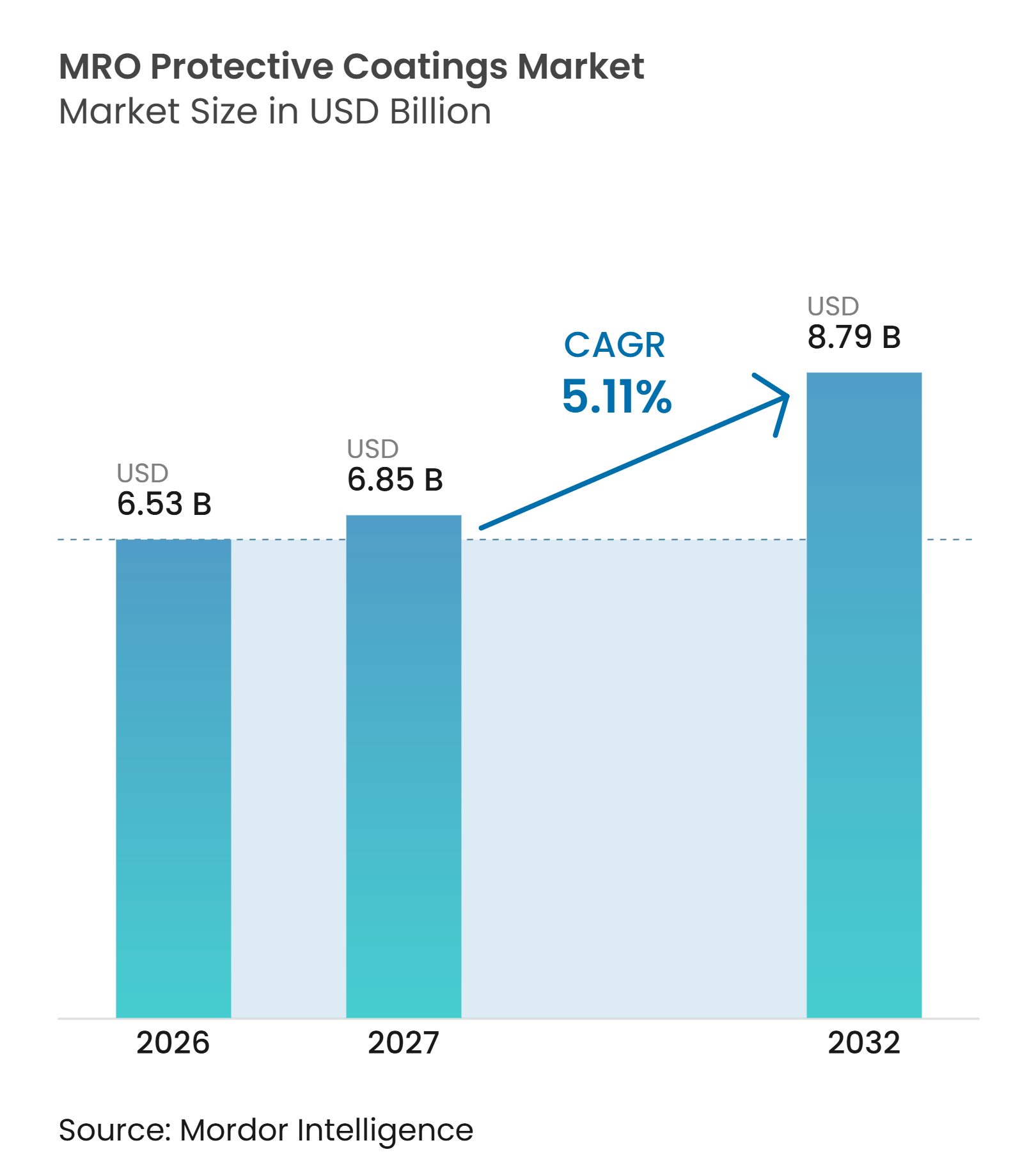
The MRO Protective Coatings Market size was valued at USD 6.53 billion in 2026 and is estimated to grow from USD 6.85 billion in 2027 to reach USD 8.79 billion by 2032, at a CAGR of 5.11% during the forecast period (2027-2032). Demand is tied to the need to preserve working assets, including ships, refineries, bridges, power facilities, and water systems. This makes the Maintenance, Repair, and Operations (MRO) protective coatings market less dependent on consumer spending cycles than many other coatings categories. Record shipbuilding activity and the large repair requirements across U.S. infrastructure support demand for protective systems. Suppliers are also shifting their portfolios toward products that reduce material loss, meet lower-emission requirements, and provide longer service intervals. The competitive environment is changing as larger suppliers broaden their technology, application, and service capabilities.
Key Report Takeaways
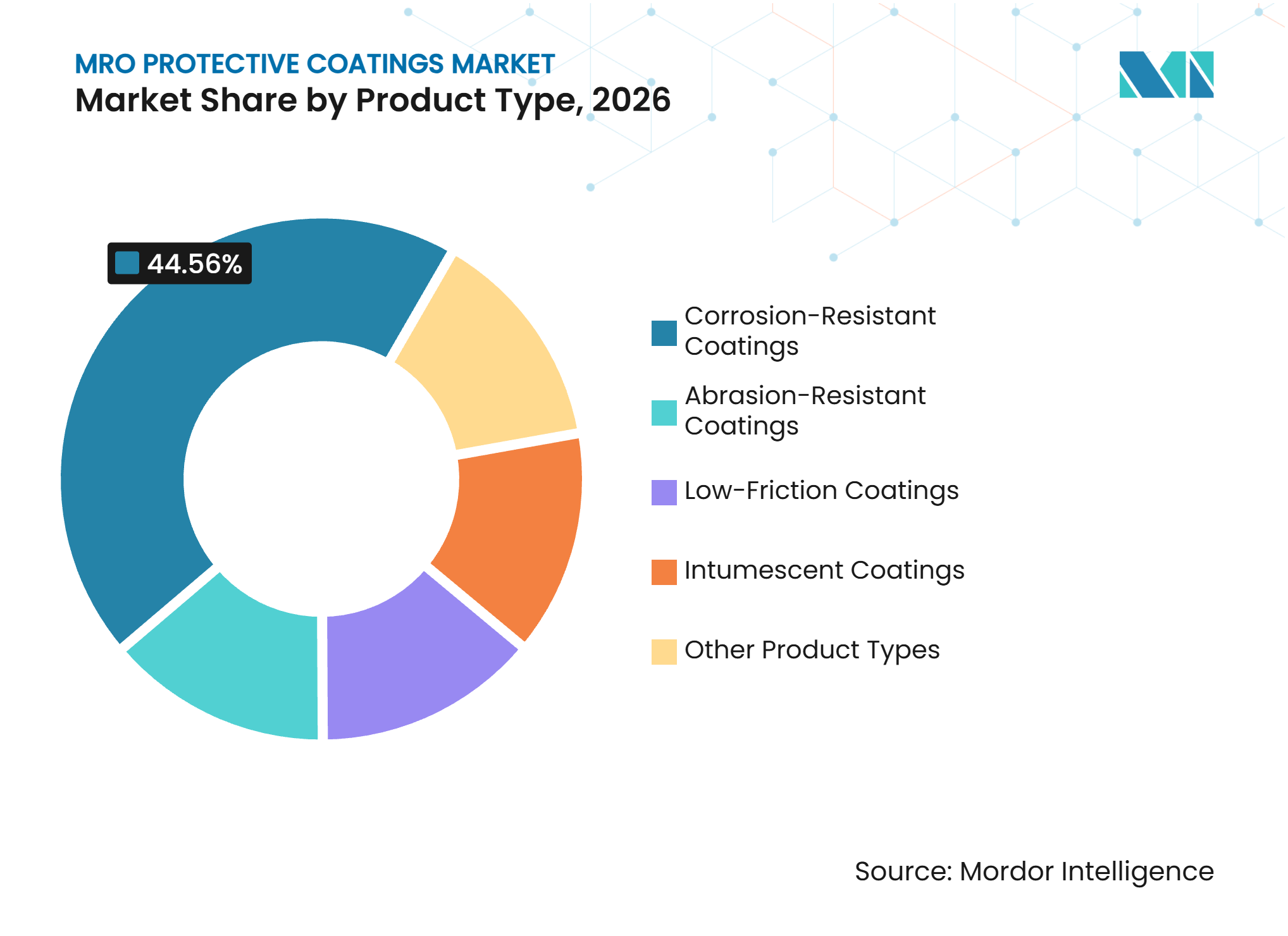
- By product type, corrosion-resistant coatings held 44.56% of the MRO protective coatings market share in 2026, while abrasion-resistant coatings are forecast to advance at a 5.67% CAGR through 2032.
- By substrate, metal held 50.13% of the MRO protective coatings market share in 2026, while plastic and composites are forecast to advance at a 5.81% CAGR through 2032.
- By application method, spray held 55.29% of the MRO protective coatings market share in 2026, while electrostatic spraying is forecast to advance at a 5.96% CAGR through 2032.
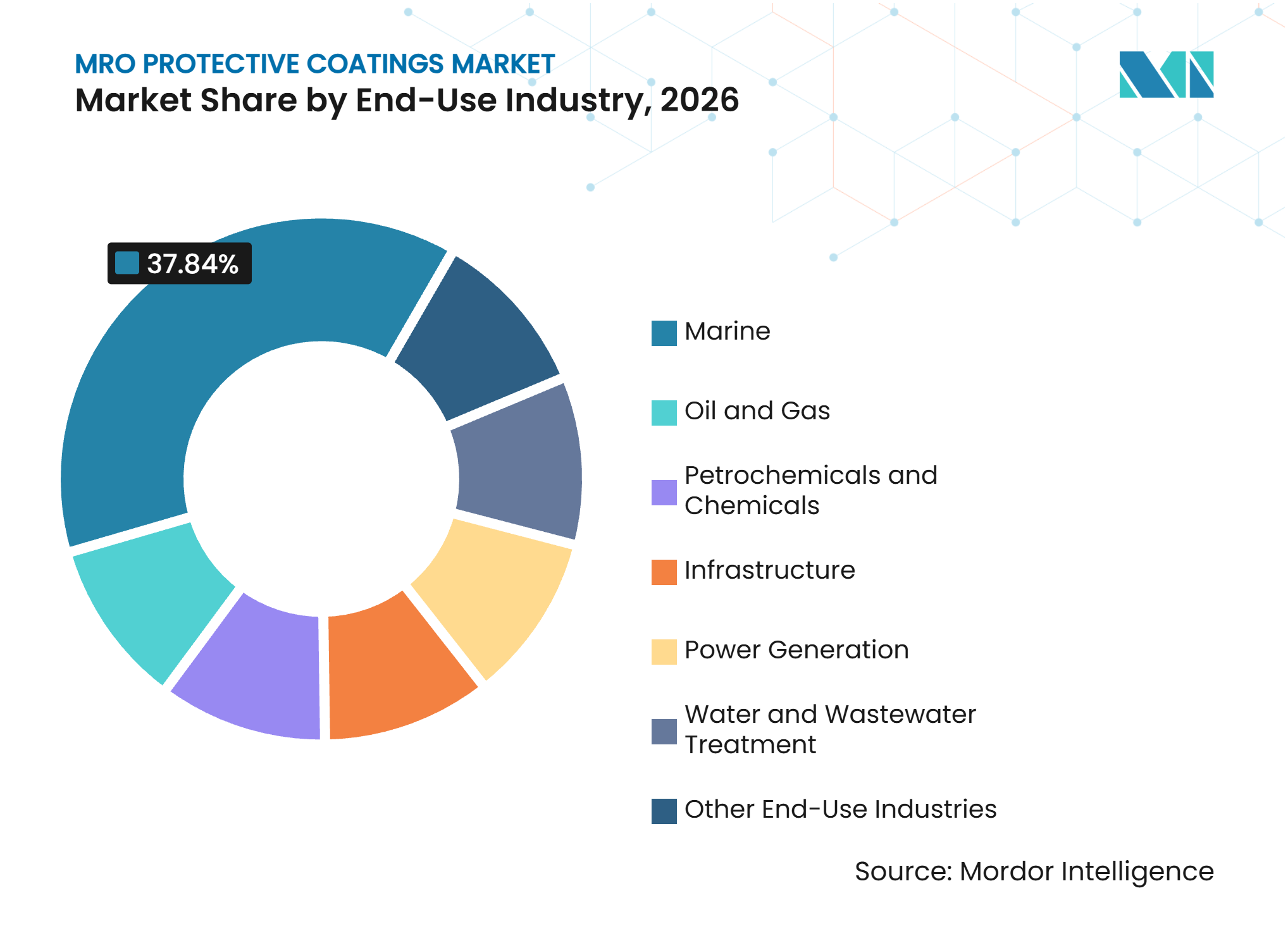
- By end-use industry, marine held 37.84% of the MRO protective coatings market share in 2026, while oil and gas is forecast to advance at a 6.15% CAGR through 2032.
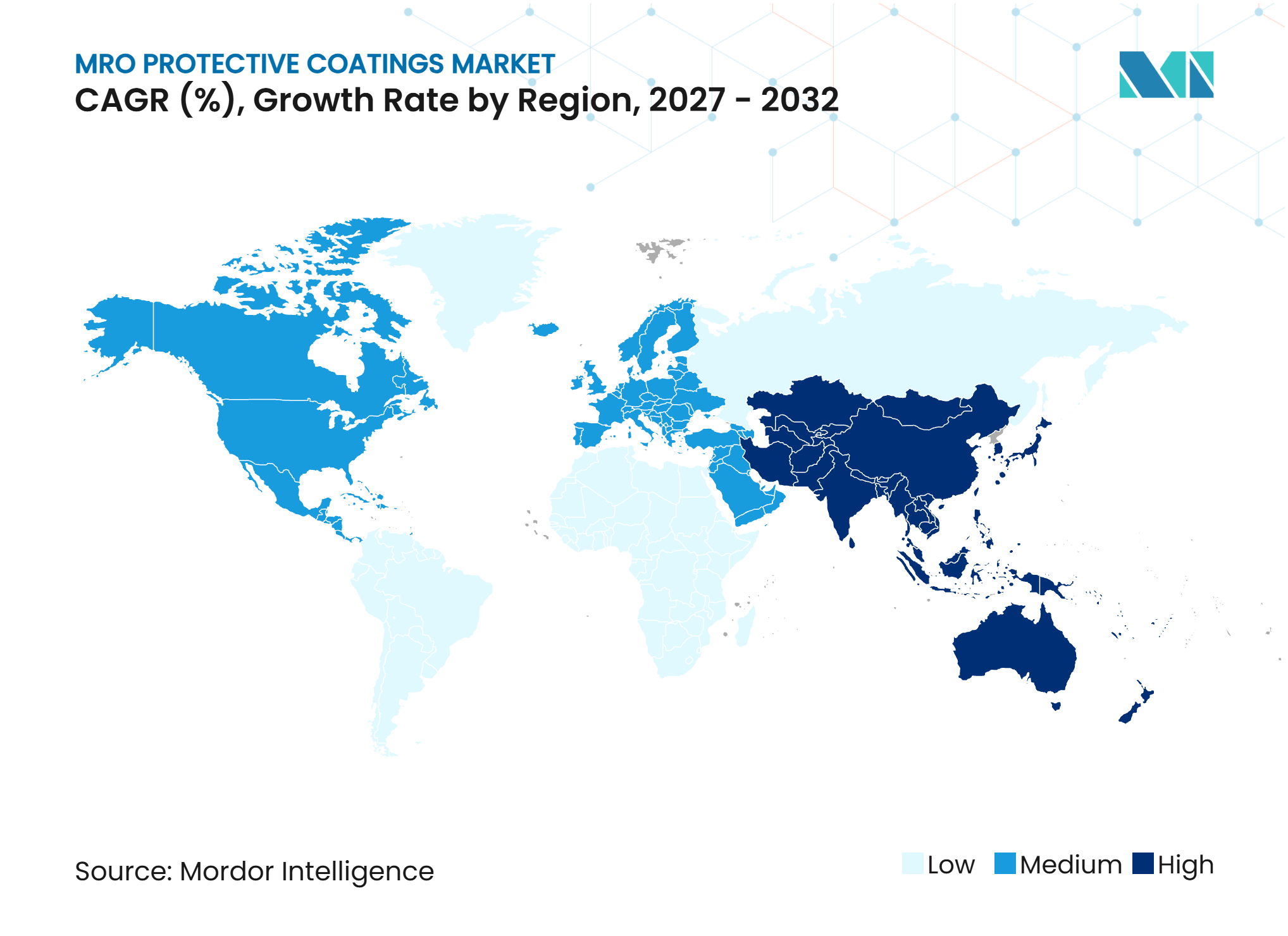
- By geography, Asia-Pacific held 39.41% of the MRO protective coatings market share in 2026 and is forecast to advance at a 6.03% CAGR through 2032.
Note: Market numbers in this report are based on Mordor Intelligence's proprietary estimation framework, which combines nine months of actuals with Q4 projections for base year 2026.
Market Trends and Insights
Drivers Impact Analysis of MRO Protective Coatings Market*
| Driver | (~) % Impact on CAGR Forecast | Geographic Relevance | Impact Timeline |
|---|---|---|---|
| Aging Industrial and Infrastructure Asset Base | +1.7% | Global, with concentration in North America, EU, and APAC legacy industrial corridors | Long term (≥ 4 years) |
| Marine and Offshore Asset Maintenance Standards | +1.1% | APAC core (China, South Korea, Japan), spillover to MEA and Europe | Long term (≥ 4 years) |
| Demand for Extended Asset Life and Lower Maintenance Cost | +0.9% | Global | Medium term (2-4 years) |
| Digital Corrosion Monitoring and Predictive Maintenance | +0.7% | North America & EU early adopters; APAC scaling rapidly | Medium term (2-4 years) |
| Low-VOC and High-Solids Reformulation | +0.5% | North America, EU, China (regulatory compliance driven) | Short term (≤ 2 years) |
| Source: Mordor Intelligence | |||
Aging Industrial and Infrastructure Asset Base
Aging industrial assets create recurring demand in the MRO protective coatings market because critical structures require regular surface protection. The American Society of Civil Engineers gave U.S. infrastructure an overall C grade in 2025, while 9 of 18 assessed categories remained rated D or below. The association stated that USD 9.1 trillion is needed to bring all assessed infrastructure categories to a good condition. Many European bridges, tunnels, and water facilities are also reaching the end of their original service lives. Earlier solvent-borne and lead-containing systems often require full removal before recoating under modern environmental requirements. The U.S. Environmental Protection Agency Architectural and Industrial Maintenance Coatings Rule also affects the chemistry used in replacement systems
Marine and Offshore Asset Maintenance Standards
Coating inspections make drydocking a compliance requirement as well as a maintenance event in the MRO protective coatings market. The International Maritime Organization resolutions MSC.557(108) and MSC.558(108) took effect in January 2026 and updated requirements for qualified coating inspectors under the Performance Standards for Protective Coatings. The revised rules recognize the Association for Materials Protection and Performance (AMPP) Certified Coating Inspector designation for dedicated seawater ballast tanks and crude oil tanker cargo tanks. China delivered 53.69 million deadweight tons of ships in 2025, equal to 56.1% of global output, which expanded the future coated asset base[1]. Jotun reported all-time-high protective coatings sales in 2025, while Hempel reported 9.8% organic growth in marine sales to EUR 750 million. Longer drydock intervals raise the importance of durable, traceable coating systems that can perform for extended periods.
Demand for Extended Asset Life and Lower Maintenance Cost
Asset owners in the MRO protective coatings market increasingly assess corrosion management against the cost of interruption and replacement rather than the unit price of paint. Saudi Aramco reported that more than USD 70 million invested in corrosion-management technologies over 3 years generated more than USD 770 million in savings and avoided costs. This evidence supports spending on coating systems that protect operating equipment for longer periods. Global specifications, including ISO 12944:2018 and NORSOK M-501, also narrow the number of approved systems for large projects. The Sherwin-Williams Company expanded its Global Core product line in March 2025 with products that meet these specifications. Common specifications support consistent coating selection across regions and favor suppliers with qualified product portfolios.
Digital Corrosion Monitoring and Predictive Maintenance
Digital monitoring is moving maintenance planning in the MRO protective coatings market from fixed intervals toward condition-based decisions. Saudi Aramco stated that it collects more than 10 million corrosion-monitoring sensor readings each year across 40 facilities, 63,000 static equipment items, and 20,000 pipeline segments. The company said that artificial intelligence-enabled maintenance initiatives created USD 2 billion in value during 2024. Jotun offers AssetKeeper to support data-based corrosion-control planning for industrial customers. These systems require documented coating performance and help asset owners identify work before failure develops. The resulting demand favors coatings that have clear application records and verified durability.
Restraints Impact Analysis of MRO Protective Coatings Market*
| Restraint | (~) % Impact on CAGR Forecast | Geographic Relevance | Impact Timeline |
|---|---|---|---|
| Volatile Epoxy, Titanium Dioxide, and Energy Input Costs | -1.2% | Global; most acute in EU and North America | Short term (≤ 2 years) |
| VOC, PFAS, and Hazardous-Metal Compliance Complexity | -0.8% | North America & EU primary; China Blue Sky Action standards extending to APAC core | Medium term (2-4 years) |
| Surface Preparation Downtime and Access Constraints | -0.6% | Global | Medium term (2-4 years) |
| Source: Mordor Intelligence | |||
Volatile Epoxy, Titanium Dioxide, and Energy Input Costs
Volatile raw material and energy costs remain a material constraint for the MRO protective coatings market. Producers serving long-term specifications cannot always recover higher input prices as soon as they occur. This creates pressure on margins, particularly for smaller regional suppliers with limited purchasing scale. Price movements can also make customers defer noncritical work in price-sensitive applications. Larger suppliers can use their supply arrangements, broad portfolios, and technical service to manage the disruption more effectively. This difference can shift demand toward established brands while limiting near-term growth.
VOC, PFAS, and Hazardous-Metal Compliance Complexity
Volatile Organic Compound (VOC) limits, per- and polyfluoroalkyl substances (PFAS) restrictions, and hazardous-metal phaseouts require simultaneous reformulation work across the MRO protective coatings market. The European Chemicals Agency published an updated PFAS restriction proposal in August 2025 after considering more than 5,600 scientific comments[2]. The proposal covers several substances used in coatings, including fluorinated surfactants, binders, and waxes. Formulators must map their supply chains and assess potential substitutes before a final regulation is adopted. Different regulatory schedules across regions can create temporary differences in product cost and timing. Registration, Evaluation, Authorisation and Restriction of Chemicals (REACH) and the U.S. National Emission Standards for Hazardous Air Pollutants remain important compliance frameworks for suppliers.
*Our forecasts treat driver/restraint impacts as directional, not additive. The impact forecasts reflect baseline growth, mix effects, and variable interactions.
MRO Protective Coatings Market Segment Analysis
By Product Type:
Corrosion-Resistant Coatings Anchor Demand, Abrasion-Resistant Coatings Grow FasterCorrosion-resistant coatings held 44.56% of the MRO protective coatings market share in 2026. Their role reflects the broad installed base of steel bridges, tanks, offshore platforms, ship hulls, pipelines, and process equipment. These assets require barrier and sacrificial protection against electrochemical degradation. This segment remains supported by periodic recoating requirements across industrial applications. Abrasion-resistant coatings are projected to advance at a 5.67% CAGR through 2032. Demand comes from equipment exposed to mechanical wear, including slurry pipelines, pumps, and impellers.
Belzona International Ltd. supplies composite repair systems that restore worn surfaces in place, avoiding equipment replacement in selected applications. Low-friction systems are also used where ship operators seek to manage hull drag and fuel consumption. Jotun released Hull Performance Solutions 2.0 in 2025, while Hempel offers Hempaguard NB for newbuilding applications. Intumescent coatings serve passive fire-protection requirements on offshore platforms and steel structures. Jotun introduced Jotachar 1709 XT in 2025 for offshore wind and oil and gas maintenance environments. This range of use cases supports specialized performance in the MRO protective coatings market rather than a single product standard.



By Substrate:
Metal Leads Demand, While Plastic and Composites ExpandMetal held 50.13% of the MRO protective coatings market share in 2026. Carbon steel and stainless steel remain common across ship hulls, pipelines, pressure vessels, and industrial equipment. Owners generally protect these assets through maintenance because replacement requires substantial capital and operational disruption. Plastic and composites are projected to advance at a 5.81% CAGR through 2032. Their use is expanding in offshore wind nacelles, aerospace structures, and lightweight vehicle components. Demand for composite surfaces is tied to specialized primers and preparation methods.
Coating adhesion on composites differs from adhesion on blast-cleaned steel, which raises the value of dedicated formulation and application expertise. Concrete remains relevant in infrastructure and water-treatment facilities where linings protect against chemical attack and abrasion. The City of Sioux Falls Regional Water Reclamation Facility selected a 3-coat system for final clarifier pools in a 2025 project. Wood, glass, and other materials continue to require maintenance protection in narrower applications. ISO 12944:2018 continues to guide preparation and coating-system selection for metal applications. These differences require MRO protective coatings market suppliers to align chemistry with the substrate and operating conditions.
By Application Method:
Spray Retains Scale, While Electrostatic Spraying Gains AdoptionSpray held 55.29% of the MRO protective coatings market share in 2026. It is widely used in marine yards, structural-steel fabrication, and field maintenance because it covers large surfaces efficiently. Airless spray remains central to the application of high-film-build epoxy and zinc-rich primers. Electrostatic spraying is projected to advance at a 5.96% CAGR through 2032. PPG Industries, Inc. completed its 100th marine drydocking using electrostatic application in 2025. The company reported a 40% reduction in overspray compared with conventional airless spray.
Electrostatic application improves transfer efficiency and reduces the material that fails to reach the substrate. This can lower coating consumption and VOC emissions per coated surface. These benefits align with customer interest in reducing cost and meeting environmental requirements. Brush and roller methods remain useful for spot work and confined spaces where spray equipment is unsuitable. Dip application continues to serve high-volume finishing of fasteners and other components. PPG Industries, Inc. reported adoption of electrostatic marine methods in Singapore, China, Turkey, and Dubai, showing a practical growth path for the MRO protective coatings market.
By End-Use Industry:
Marine Holds the Largest Position, Oil and Gas Grows FasterMarine held 37.84% of the MRO protective coatings market share in 2026. Coatings are required in new vessel construction and at scheduled drydockings throughout a ship’s operating life. Merchant ships commonly operate for 20 to 25 years and undergo class surveys at 5-year intervals. Oil and gas is projected to advance at a 6.15% CAGR through 2032. Growth is associated with corrosion-under-insulation management, offshore asset life extension, and offshore wind activity. Marine demand remains closely linked to global shipbuilding and repair activity.
Petrochemicals, chemicals, and power generation require systems that resist chemical attack and high-temperature conditions. These uses support demand for high-build epoxy phenolic and silicone-based products. Infrastructure, water, and wastewater treatment also require corrosion and abrasion protection. Saudi Aramco has installed corrosion-monitoring systems across 63,000 static equipment items and 20,000 pipeline segments. The data generated by these systems can support more targeted maintenance schedules. This places greater weight on documented service life and performance-based product selection.

Geography Analysis
Asia-Pacific
Asia-Pacific held 39.41% of the MRO protective coatings market share in 2026 and is projected to advance at a 6.03% CAGR through 2032. China delivered 53.69 million deadweight tons of ships in 2025, up 11.4% from 2024 and equal to 56.1% of global output. Its order book reached 274.42 million deadweight tons, representing 66.8% of the global total. South Korea and Japan also maintain large shipbuilding bases, which concentrate marine coating requirements in the region. India adds a separate source of demand through infrastructure development and heavy-duty maintenance work. China’s VOC controls are also supporting waterborne and high-solids formulations in maintenance applications.
North America
North America is driving demand in the MRO protective coatings market because aging infrastructure, oil and gas facilities, and environmental requirements support premium systems. The American Society of Civil Engineers (ASCE) reported a USD 9.1 trillion funding need to bring assessed U.S. infrastructure to good repair. PPG Industries, Inc. reported double-digit organic sales growth in protective and marine coatings in 2025. Akzo Nobel N.V. also reported double-digit protective coatings growth in North America during fiscal year 2025. NACE International and AMPP certification requirements influence application and inspection specifications in the region. The EPA’s Architectural and Industrial Maintenance Coatings Rule similarly shapes product selection. These compliance factors favor suppliers that combine approved systems with training and technical support.
Europe, South America, and Middle East and Africa
Europe faces maintenance needs in the MRO protective coatings market from its aging industrial estate, offshore wind buildout, and REACH chemical requirements. Hempel A/S reported 0.1% organic growth in its Energy and Infrastructure segment in 2025. South America is supported by Brazilian shipbuilding and refinery maintenance, while Mexico remains a target for growth in architectural and protective coatings. The Middle East has active asset-integrity programs, and Saudi Aramco’s corrosion management spending shows the financial importance placed on prevention. Demand across these regions is shaped by different asset profiles rather than one shared demand source. South Africa and other African markets have potential from mining and infrastructure investment. Belzona International Ltd. expanded its distribution coverage in Angola in 2025, reflecting ongoing local network development.
Competitive Landscape
Market Concentration
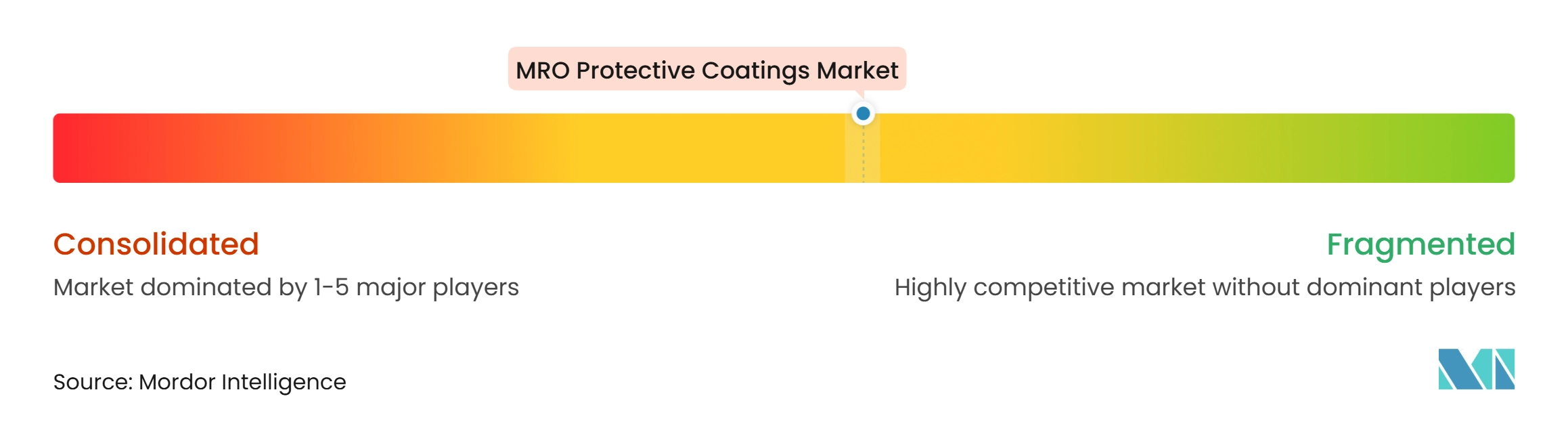
The MRO protective coatings market is moderately concentrated, with the top five players including PPG Industries, Inc., The Sherwin-Williams Company, Akzo Nobel N.V., Axalta Coating Systems, LLC, and BASF. BASF is primarily an upstream materials supplier following its planned divestment of automotive original equipment manufacturer coatings, refinish coatings, and surface-treatment businesses. Henkel AG & Co. KGaA participates mainly through adhesives, sealants, and surface-treatment capabilities. H.B. Fuller Company has an adhesives and specialty-chemicals focus rather than a significant finished MRO protective coating offering. This range of business models shapes how each company participates in the MRO protective coatings market.
Akzo Nobel N.V. and Axalta Coating Systems, LLC announced an all-stock merger of equals in November 2025. The combined company is expected to have approximately USD 17 billion in revenue and an enterprise value of USD 25 billion. The transaction was expected to close in late 2026 or early 2027, subject to approvals. BASF signed an agreement with Carlyle in October 2025 to divest its automotive original equipment manufacturer coatings, refinish coatings, and surface-treatment businesses. The Sherwin-Williams Company completed its acquisition of BASF’s Brazilian decorative paints business in October 2025. These actions show how leading firms are adjusting their geographic coverage and portfolio focus.
Technology and compliance capability are important competitive factors besides product pricing. Jotun’s AssetKeeper and HullKeeper, along with PPG Industries, Inc.’s electrostatic application protocol, link coating products with asset-management needs. Chugoku Marine Paints, Ltd. and Mitsui Chemicals applied ISCC PLUS-certified bio-based epoxy resin paint to ballast tanks on a liquefied ammonia tanker in July 2025. The product was presented as the first such marine application and is scheduled to be used on a vessel due for delivery in May 2026. AMPP certification requirements add importance to inspection knowledge and documented application processes. Companies that can support approved systems, technical service, and traceable maintenance records are better positioned for complex projects.
MRO Protective Coatings Industry Leaders
-
PPG Industries, Inc.
-
The Sherwin-Williams Company
-
Akzo Nobel N.V.
-
Axalta Coating Systems, LLC
-
BASF
- *Disclaimer: Major Players sorted in no particular order
MRO Protective Coatings Market Companies Covered in this Report
- Akzo Nobel N.V.
- Axalta Coating Systems, LLC
- BASF
- Belzona International Ltd.
- Chugoku Marine Paints, Ltd.
- H.B. Fuller Company
- Hempel A/S
- Henkel AG & Co. KGaA
- Jotun
- Kansai Paint Co.,Ltd.
- Nippon Paint Holdings Co., Ltd.
- PPG Industries, Inc.
- RPM International Inc.
- Sika AG
- The Sherwin-Williams Company
Recent Industry Developments in MRO Protective Coatings Market
- October 2026: LongWater Private Equity acquired a majority stake in Blastco, a Texas-based industrial coatings and tank rehabilitation contractor specializing in surface preparation, protective coatings, and infrastructure maintenance. The acquisition supported the MRO protective coatings market by expanding industrial coating application and tank rehabilitation services for municipal, energy, midstream, and industrial infrastructure.
- September 2026: CRC Evans opened a 90,000-square-foot protective coatings facility in the United Kingdom, combining specialty welding, multilayer coating application, and manufacturing capabilities for energy and critical infrastructure projects. The development supported the MRO protective coatings market by expanding industrial coating capacity and strengthening maintenance and asset-protection services for energy infrastructure.
Global MRO Protective Coatings Market Report Scope
The MRO protective coatings market comprises specialized coating solutions used to protect equipment, structures, and industrial assets from corrosion, wear, and surface degradation. These coatings help extend asset service life, reduce maintenance requirements, and maintain operational reliability across industrial environments.
The MRO Protective Coatings Market is segmented by product type, substrate, application method, end-use industry, and geography. By product type, the market is segmented into corrosion-resistant coatings, abrasion-resistant coatings, low-friction coatings, intumescent coatings, and other product types. By substrate, the market is segmented into metal, concrete, plastic and composites, wood and glass, and other substrates. By application method, the market is segmented into brush, roller, spray, dip, and electrostatic spraying. By end-use industry, the market is segmented into marine, oil and gas, petrochemicals and chemicals, infrastructure, power generation, water and wastewater treatment, and other end-use industries. The report also covers the market size and forecasts for MRO protective coatings across 15 countries. For each segment, the market sizing and forecasts have been done on the basis of value (USD).
Segmentation Overview
| Corrosion-Resistant Coatings |
| Abrasion-Resistant Coatings |
| Low-Friction Coatings |
| Intumescent Coatings |
| Other Product Types |
| Metal |
| Concrete |
| Plastic and Composites |
| Wood and Glass |
| Other Substrates |
| Brush |
| Roller |
| Spray |
| Dip |
| Electrostatic Spraying |
| Marine |
| Oil and Gas |
| Petrochemicals and Chemicals |
| Infrastructure |
| Power Generation |
| Water and Wastewater Treatment |
| Other End-Use Industries |
| Asia-Pacific | China |
| India | |
| Japan | |
| South Korea | |
| ASEAN Countries | |
| Rest of Asia-Pacific | |
| North America | United States |
| Canada | |
| Mexico | |
| Europe | Germany |
| United Kingdom | |
| France | |
| Italy | |
| NORDIC Countries | |
| Rest of Europe | |
| South America | Brazil |
| Argentina | |
| Rest of South America | |
| Middle East and Africa | Saudi Arabia |
| South Africa | |
| Rest of Middle East and Africa |
| By Product Type | Corrosion-Resistant Coatings | |
| Abrasion-Resistant Coatings | ||
| Low-Friction Coatings | ||
| Intumescent Coatings | ||
| Other Product Types | ||
| By Substrate | Metal | |
| Concrete | ||
| Plastic and Composites | ||
| Wood and Glass | ||
| Other Substrates | ||
| By Application Method | Brush | |
| Roller | ||
| Spray | ||
| Dip | ||
| Electrostatic Spraying | ||
| By End-Use Industry | Marine | |
| Oil and Gas | ||
| Petrochemicals and Chemicals | ||
| Infrastructure | ||
| Power Generation | ||
| Water and Wastewater Treatment | ||
| Other End-Use Industries | ||
| By Geography | Asia-Pacific | China |
| India | ||
| Japan | ||
| South Korea | ||
| ASEAN Countries | ||
| Rest of Asia-Pacific | ||
| North America | United States | |
| Canada | ||
| Mexico | ||
| Europe | Germany | |
| United Kingdom | ||
| France | ||
| Italy | ||
| NORDIC Countries | ||
| Rest of Europe | ||
| South America | Brazil | |
| Argentina | ||
| Rest of South America | ||
| Middle East and Africa | Saudi Arabia | |
| South Africa | ||
| Rest of Middle East and Africa | ||
Key Questions Answered in the Report
What is the size of the MRO protective coatings market?
The MRO protective coatings market size was valued at USD 6.53 billion in 2026 and is estimated to grow from USD 6.85 billion in 2027 to reach USD 8.79 billion by 2032, at a CAGR of 5.11% during the forecast period (2027-2032).
Which product type held the largest share in 2026?
Corrosion-resistant coatings held 44.56% of the market share in 2026.
Which application method is projected to advance fastest through 2032?
Electrostatic spraying is projected to advance at a 5.96% CAGR through 2032, supported by reduced overspray and improved transfer efficiency.
Which end-use industry is projected to advance fastest through 2032?
Oil and gas is projected to advance at a 6.15% CAGR through 2032 as operators prioritize corrosion management and asset-life extension.