
Molded Plastics Market Size and Share
Market Overview
| Study Period | 2022 - 2032 |
|---|---|
| Market Size (2027) | USD 636.52 Billion |
| Market Size (2032) | USD 821.31 Billion |
| Growth Rate (2027 - 2032) | 5.23 % |
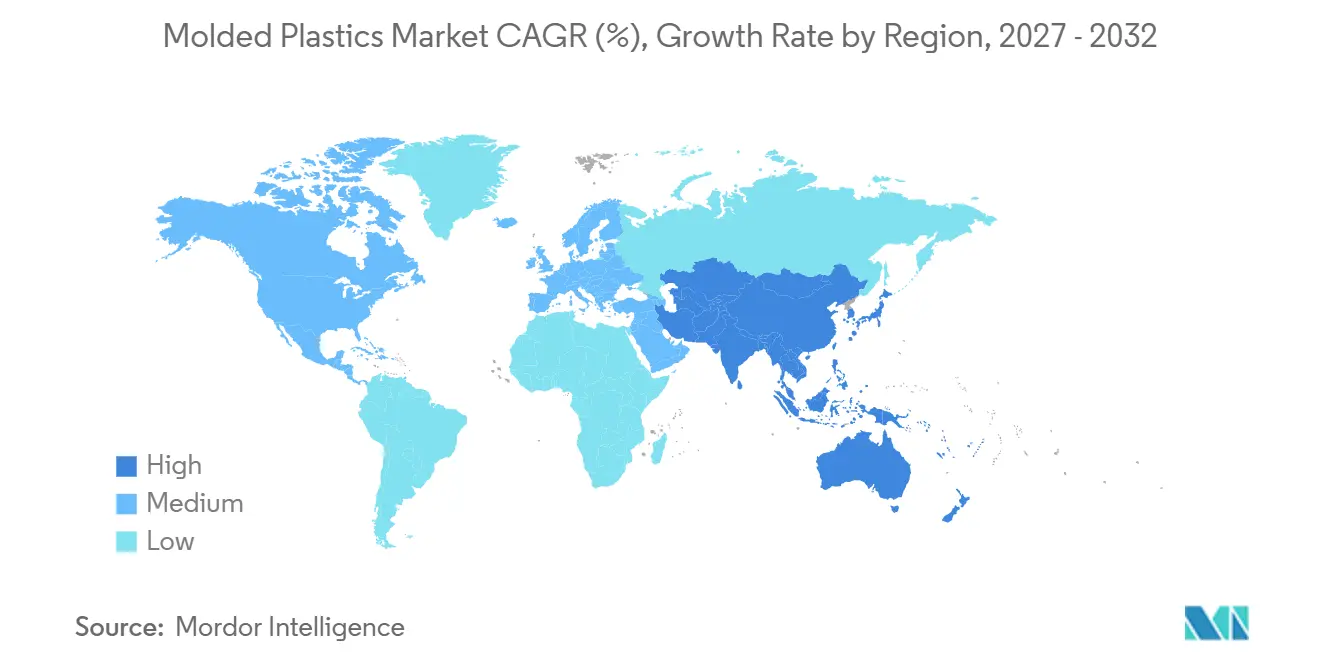
| Fastest Growing Market | Asia-Pacific |
| Largest Market | Asia-Pacific |
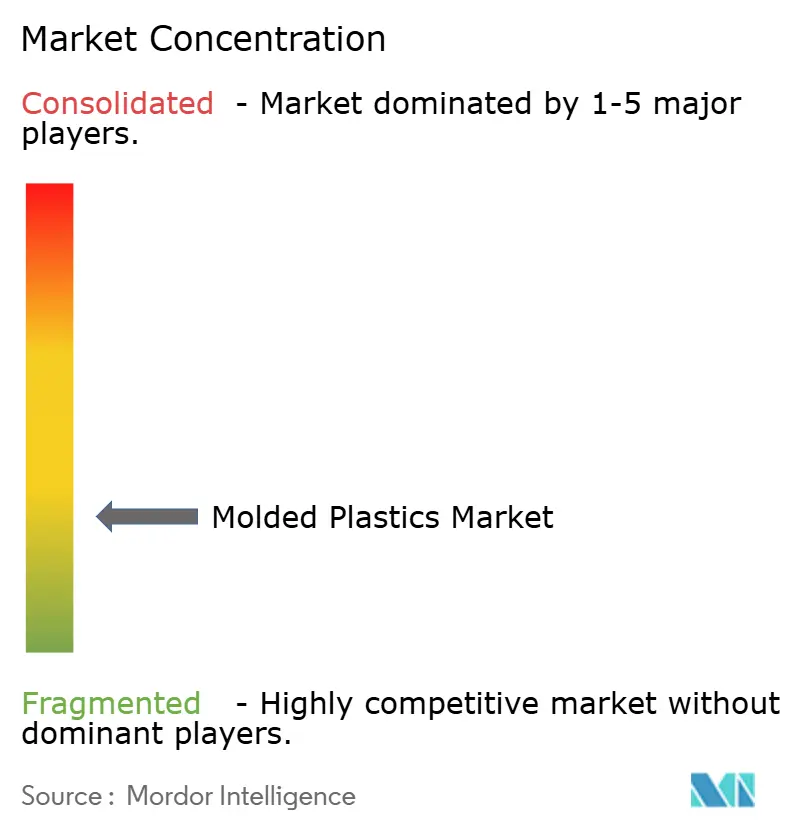
| Market Concentration | Low |
Major Players *Disclaimer: Major Players sorted in no particular order Image © Mordor Intelligence. Reuse requires attribution under CC BY 4.0. | |
Molded Plastics Market Analysis by Mordor Intelligence
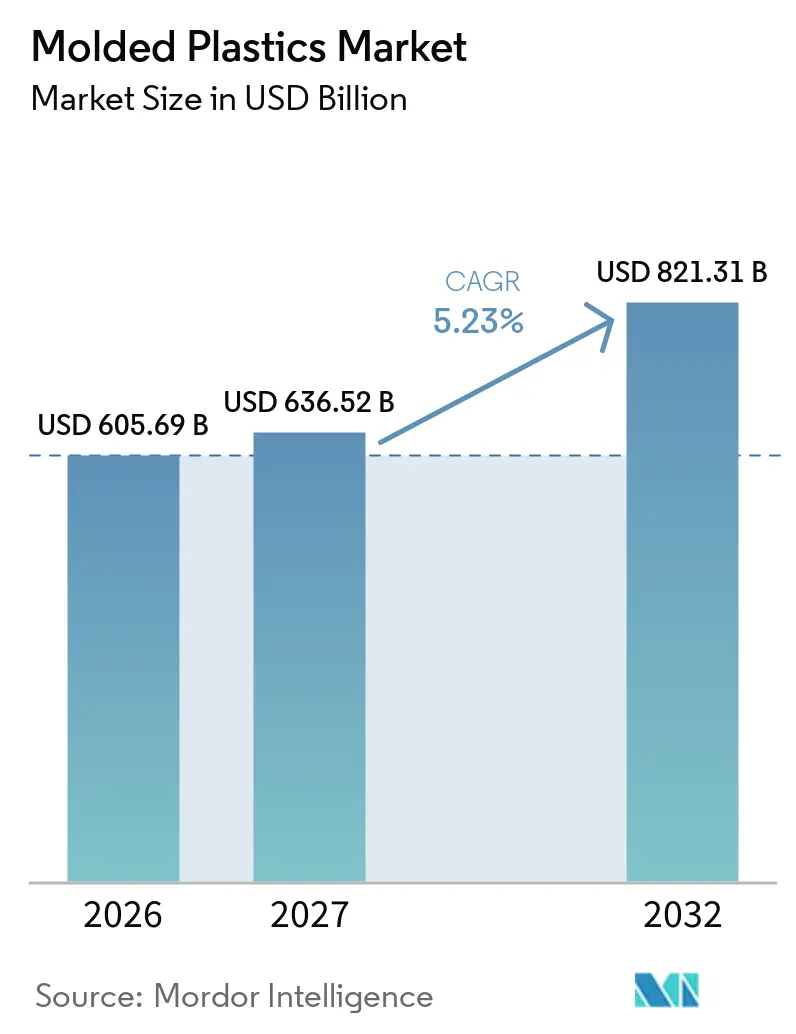
The Molded Plastics Market size was valued at USD 605.69 billion in 2026 and is estimated to grow from USD 636.52 billion in 2027 to reach USD 821.31 billion by 2032, at a CAGR of 5.23% during the forecast period (2027-2032). Demand is supported by packaging, automotive, electrical and electronics, and medical uses, where material requirements are becoming more specialized. Regulation is increasing the value of traceable recycled content and documented material performance, particularly in Europe and Japan. Vehicle electrification is expanding demand for parts that manage heat, insulation, and safety while reducing vehicle weight. Producers are responding through circular resin supply, specialized formulations, and deeper participation in higher-value applications. Regional production is moving toward Asia, which is changing access to feedstocks, pricing conditions, and proximity to end users.
Key Report Takeaways
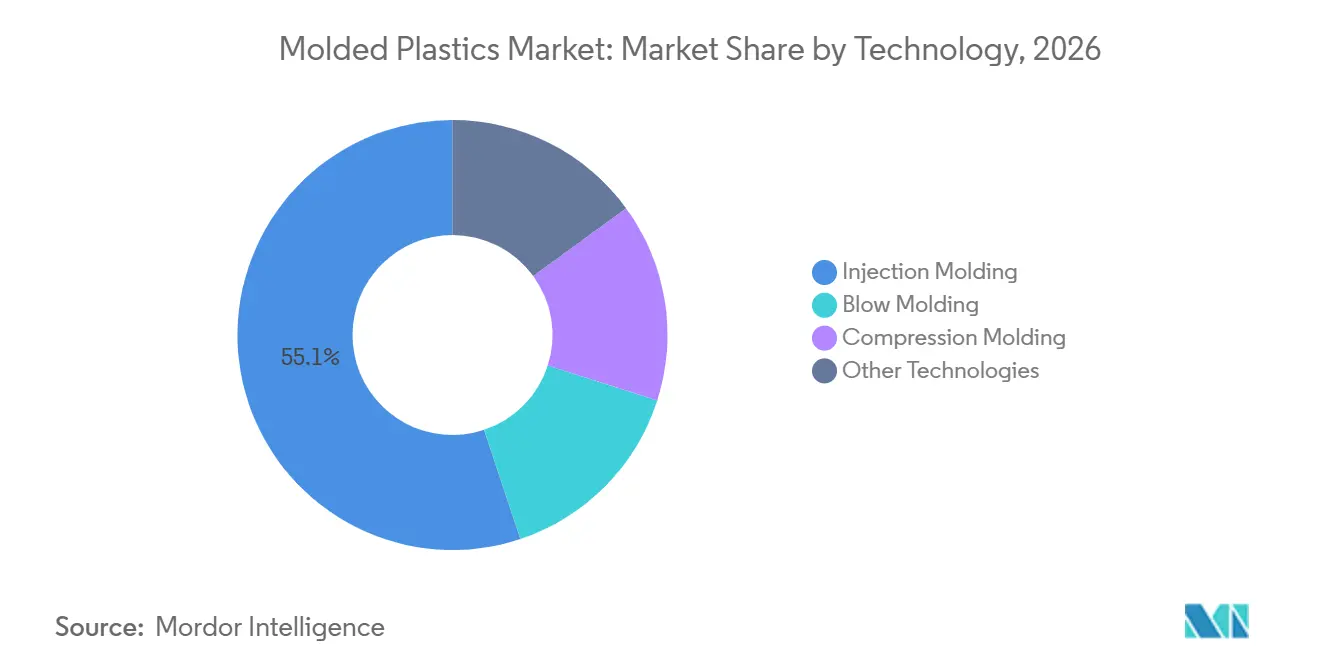
- By technology, injection molding held 55.12% of the molded plastics market share in 2026, while blow molding is forecast to advance at a 5.89% CAGR through 2032.
- By material, polypropylene (PP) held 37.45% of the molded plastics market share in 2026, while polyurethane is forecast to advance at a 6.12% CAGR through 2032.
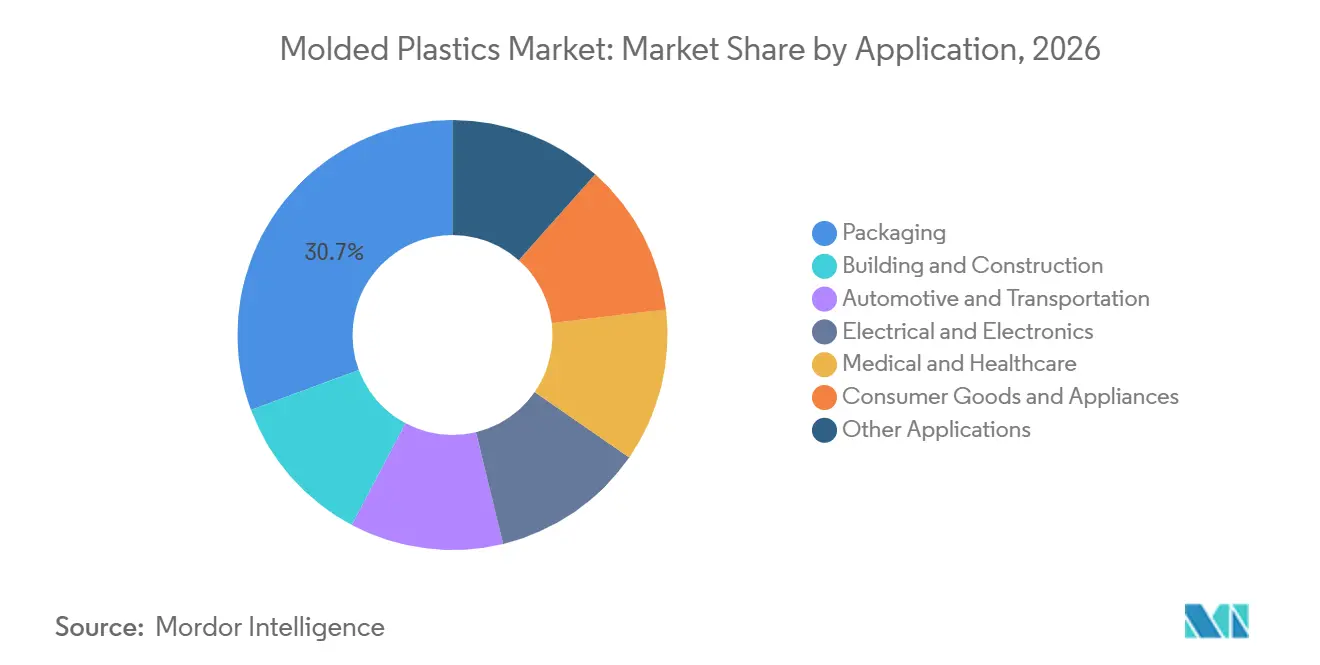
- By application, packaging held 30.67% of the molded plastics market share in 2026, while medical and healthcare is forecast to advance at a 6.73% CAGR through 2032.
- By geography, Asia-Pacific held 40.75% of the molded plastics market share in 2026 and is forecast to advance at a 6.61% CAGR through 2032.
Note: Market numbers in this report are based on Mordor Intelligence's proprietary estimation framework, which combines nine months of actuals with Q4 projections for base year 2026.
Market Trends and Insights
Drivers Impact Analysis of Molded Plastics Market*
| Driver | (~) % Impact on CAGR Forecast | Geographic Relevance | Impact Timeline |
|---|---|---|---|
| Lightweighting and Metal Replacement in Vehicles | +1.8% | Global, with peak impact in Europe, APAC, and North America | Medium term (2-4 years) |
| Growth in E-commerce and Thin-wall Packaging Demand | +1.4% | Global, led by APAC and North America | Short term (≤ 2 years) |
| Expansion of Medical-grade and Diagnostic Components | +1.2% | North America and Europe, spillover to APAC | Medium term (2-4 years) |
| Adoption of Recycled, Bio-based, and Circular Polymer Grades | +0.9% | Global, EU-led with expanding adoption in APAC and North America | Long term (≥ 4 years) |
| EV Battery, Connector, and Thermal-management Components | +0.7% | APAC core, spillover to Europe and North America | Medium term (2-4 years) |
| Source: Mordor Intelligence | |||
Lightweighting and Metal Replacement in Vehicles
Automakers are replacing some metal components with injection-molded thermoplastics to meet fleet emission targets and improve battery-electric vehicle range. Battery-electric vehicle platforms use new molded parts, including battery intrusion-protection plates, door carriers, and glass-fiber-reinforced polyamide roof beams. Röchling SE & Co. KG secured a December 2025 contract to supply thermoplastic composite intrusion-protection plates for a major European original equipment manufacturer’s battery-electric vehicle platform from 2027. Hybrid molding, which combines thermoforming and injection molding in one cycle, can reduce manufacturing steps and support higher-volume production. The European Parliament’s provisional agreement on vehicle circularity rules would require 15% recycled plastic in new vehicles within 6 years and 25% within 10 years, adding recycled-content requirements to lightweighting decisions. These changes are shaping investment decisions across the molded plastics market and favor suppliers that can meet structural, safety, and recycled-material specifications at the same time.
Growth in E-commerce and Thin-wall Packaging Demand
E-commerce has increased the importance of packaging that withstands filling, stacking, transport, and direct-to-consumer delivery. Thin-wall containers and blow-molded bottles require close dimensional control because logistics stress can be greater than in store-shelf distribution. Amcor plc completed its merger with Berry Global in April 2025, expanding its ability to serve flexible and rigid packaging formats. Amcor reported using 218,000 metric tons of post-consumer recycled plastic by the end of fiscal 2025 and stated that 96% of its rigid packaging by weight was recyclable. Standardized package dimensions and recycled-content requirements from large retailers and logistics platforms are encouraging redesigns of thin-wall molds and earlier qualification of recycled resin. The molded plastics market therefore benefits where packaging suppliers can balance durability, resin efficiency, and compliance requirements.
Expansion of Medical-grade and Diagnostic Components
Population aging, point-of-care diagnostics, and single-use medical devices are increasing demand for precise molded components. Micro-injection molding supports diagnostic cartridges, wearable sensor housings, and drug-delivery components where dimensional consistency is important. SABIC introduced LNP ELCRES NPCRX9612U resin in 2025 for medical devices, including insulin pumps and diagnostic imaging equipment, with a material profile designed to address chemical exposure requirements. Medical manufacturers must meet quality and biocompatibility requirements under International Organization for Standardization 13485 and International Organization for Standardization 10993, which raises qualification barriers for suppliers. Röchling SE & Co. KG received International Sustainability and Carbon Certification PLUS certification for its 3 German medical sites in September 2025, enabling mass-balanced, bio-based, and circular material options. These technical and compliance requirements support more stable demand than commodity-oriented uses of the molded plastics market.
Adoption of Recycled, Bio-based, and Circular Polymer Grades
Recycled and bio-based polymer adoption is increasing as regulations and brand commitments create clearer demand for circular materials. The European Commission’s 2025 plastics measures sought to support harmonized criteria for recycled plastics and advance mass-balance rules for chemical recycling. Dow invested in Xycle’s advanced recycling plant at the Port of Rotterdam, which is expected to be operational by the end of 2026. LyondellBasell Industries Holdings B.V. is developing its MoReTec-1 chemical recycling facility in Wesseling, Germany, with startup targeted for 2027. Recycled polymers can vary in melt flow, color, and contamination levels, which makes blending and process control important for parts with narrow tolerances. This gives molders and resin suppliers an advantage in the molded plastics market when they can maintain material consistency and traceability.
Restraints Impact Analysis of Molded Plastics Market*
| Restraint | (~) % Impact on CAGR Forecast | Geographic Relevance | Impact Timeline |
|---|---|---|---|
| Petrochemical Feedstock Price Volatility | -0.7% | Global, most acute in Europe and APAC | Short term (≤ 2 years) |
| Energy, Labor, and Compliance Cost Inflation | -0.5% | Europe, North America, and APAC | Medium term (2-4 years) |
| Fragmented Recycling Feedstock Quality | -0.3% | Global, most acute in South America and MEA | Long term (≥ 4 years) |
| Source: Mordor Intelligence | |||
Petrochemical Feedstock Price Volatility
Naphtha-based polypropylene and polyethylene prices remain linked to crude oil movements and regional cracker margins. Molded-part producers face margin pressure when short-term supply contracts do not allow timely cost pass-through. New non-naphtha capacity can also alter regional cost positions. Exxon Mobil Corporation began operations at its polypropylene facility in Huizhou, China, in April 2025, adding regional supply in a major plastics-producing market. INEOS is developing Project ONE, an ethane cracker in Antwerp that is expected to affect northwestern European ethylene supply after startup. These changes make procurement strategy and feedstock flexibility increasingly important across the molded plastics market.
Fragmented Recycling Feedstock Quality
Inconsistent recycled feedstock can create process-control challenges in parts that need narrow tolerances or reliable appearance. Japan aims to increase domestic recycled plastics use to 1 million metric tons by 2030, while its recycling system requires additional collection, sorting, and reprocessing capacity[1]. Plastipak Holdings, Inc. reported 24.8% post-consumer recycled content in 2025 and operates food-grade recycled polyethylene terephthalate capacity in Luxembourg. Such operations require dedicated sorting, washing, and quality-control systems that are difficult for smaller regional processors to replicate. European Union’s work on common end-of-waste criteria may reduce fragmentation over time, although national implementation schedules can delay investment decisions. Feedstock consistency remains a practical limit on the pace of circular adoption across the molded plastics market.
*Our forecasts treat driver/restraint impacts as directional, not additive. The impact forecasts reflect baseline growth, mix effects, and variable interactions.
Molded Plastics Market Segment Analysis
By Technology:
Injection Molding Maintains Scale While Blow Molding ExpandsInjection molding held 55.12% of the molded plastics market share in 2026. The process supports complex and precise parts at high volumes for medical devices, vehicle interiors, and electronic housings. Its broad equipment base and repeatable processing conditions reinforce its use across many end uses. Low constant-pressure injection molding can reduce the machine tonnage needed for some parts and help lower material consumption in automotive applications. These improvements are useful where energy and labor costs are rising. Injection molding remains central to the molded plastics industry because it serves both high-volume packaging and specification-driven components.
Blow molding is projected to advance at a 5.89% CAGR through 2032. Demand is supported by e-commerce packaging, beverage containers, personal care packaging, and industrial containers. The shift away from some glass formats also favors lightweight polymer containers. Blow molding is being explored for thermoplastic battery housings with integrated fluid conduits, which extends its potential beyond packaging. Compression molding and other processes retain a role in aerospace, defense, and structural composite uses. These applications add specialized opportunities to the molded plastics market where part integrity and material performance matter more than production volume.

By Material:
Polypropylene Leads Revenue While Polyurethane Gains ValuePolypropylene held 37.45% of the molded plastics market size in 2026. Its cost-performance balance supports demand in packaging, automotive components, and consumer goods. It is also compatible with recycled-content programs that are becoming more common in procurement specifications. Exxon Mobil Corporation, Milliken, and Ravago demonstrated polypropylene compounds using 25% certified post-consumer recycled content, including end-of-life vehicle material, for automotive applications. This work shows that recycled polypropylene can be adapted for higher-performance requirements. The material remains important where processors need a practical balance of cost, processability, and recycled-content potential.
Polyurethane is projected to advance at a 6.12% CAGR through 2032. It is used in thermal management, noise-vibration-harshness control, and lightweight structural foam components for electric vehicles. Its chemistry supports both rigid and flexible molding uses. Polyethylene remains important for blow-molded packaging and industrial containers. Polyvinyl chloride is used in construction conduit and medical tubing, while polystyrene is used in rigid packaging and laboratory disposables. Registration, Evaluation, Authorisation and Restriction of Chemicals requirements and single-use plastics rules are increasing scrutiny of some polyvinyl chloride and polystyrene applications in Europe.
By Application:
Packaging Provides Revenue While Medical and Healthcare Add GrowthPackaging held 30.67% of the molded plastics market size in 2026. Thin-wall injection molding and stretch blow molding support food, consumer goods, and e-commerce formats. The segment has high production volumes but faces pressure from recycled-content targets and extended producer responsibility obligations. Packaging producers are investing in material-efficient designs and recycled resin qualification. Amcor plc’s packaging portfolio after its Berry Global combination illustrates the value of operating across rigid and flexible formats. Packaging remains a major source of demand, even as compliance expenses influence material selection.
Medical and healthcare is projected to advance at a 6.73% CAGR through 2032. Aging populations, point-of-care diagnostics, and infection-control requirements support demand for single-use devices and diagnostic components. Injection molding is suited to syringes, diagnostic housings, wearable-device enclosures, and microfluidic cassettes. International Organization for Standardization (ISO) 13485 clean-room and quality requirements can limit the supplier pool for contract medical molding. Automotive and transportation demand is shifting toward battery components and structural composites with higher specification requirements. Electrical and electronics demand is supported by data centers, semiconductor packaging, and electric-vehicle connector systems.
Geography Analysis
Asia-Pacific
Asia-Pacific held 40.75% of the molded plastics market share in 2026 and is projected to advance at a 6.61% CAGR through 2032. The region benefits from broad manufacturing capacity in packaging, vehicles, electronics, and healthcare products. China’s Ministry of Industry and Information Technology issued plastics-related standards in 2025 covering applications including polypropylene pipe systems and automotive modified polypropylene panels[2]. These standards indicate that manufacturing quality requirements are advancing alongside capacity growth. India is attracting automotive component investment as local electric-vehicle production develops. IAC Group opened its Chakan 3 facility in May 2025 for electric-vehicle interior components in collaboration with Mahindra Group. The region’s scale, local demand, and developing standards give it a leading role in the molded plastics market.
North America
North America is focused on higher-value medical, electronics, packaging, and electric-vehicle components. Dow started up its Poly-7 polyethylene plant in Freeport, Texas, in 2025, adding capacity for specialty packaging, health and hygiene, and industrial uses. This supports regional polyethylene availability for packaging processors in the molded plastics market. Covestro AG announced investment in additional polycarbonate compounding capacity in Hebron, Ohio, for automotive, electronics, and healthcare applications. Mexico is gaining relevance as an automotive molding and assembly base because manufacturers seek shorter supply chains for North American operations. This favors suppliers that can respond quickly to vehicle model changes and localize compound supply. Trade policy and tariff uncertainty remain important operating considerations for the region.
Emerging and Developing Regions
Europe faces strong regulatory influence but a more difficult manufacturing cost position. The European Union’s proposed automotive circularity rules would create demand for recycled polymer content in new vehicles. European producers are increasingly concentrating on specialty compounds and certified applications rather than commodity grades. Germany’s weaker production data highlights the pressure from energy costs and imports. South America has packaging and automotive demand, especially in Brazil and Argentina, but macroeconomic conditions, currency risk, and recycling limitations constrain investment. The Middle East and Africa benefit from Gulf petrochemical feedstock integration, including the presence of SABIC. Value-added compounding and medical-grade molding are still developing across much of the region. These regions offer longer-term opportunities in the molded plastics market as downstream manufacturing and recycling systems expand.
Competitive Landscape
The molded plastics market is highly fragmented, with the top five players including Amcor plc, Aptar, Plastipak Holdings, Inc., Magna International Inc., and IAC Group. LyondellBasell Industries Holdings B.V.’s MoReTec-1 project shows how major resin suppliers are building chemical recycling capacity before future demand requirements become more binding. BASF supplies engineering plastics, polyurethane, thermoplastic polyurethane, and monomers through its Materials segment. Competition in commodity polyolefins remains broad, while technical materials are more dependent on formulation expertise and qualification history.
Specialty suppliers are differentiating in medical, electrical, and electric-vehicle applications. Ensinger is expanding its TECAPOWDER polyimide powder production footprint to meet demand from battery technology, aerospace, electronics, and industrial customers. Covestro AG is expanding polycarbonate compounding capacity in Ohio for customized materials used in automotive, electronics, and healthcare products. SABIC is developing specialty copolymers and recycled-content resins for medical and automotive uses. These companies compete on technical documentation, processing support, and the ability to meet safety and regulatory requirements. Certifications such as International Sustainability and Carbon Certification PLUS (ISCC PLUS), International Organization for Standardization 13485, and Underwriters Laboratories (UL) 94 increasingly influence supplier qualification.
Downstream producers are also strengthening positions through recycling, application specialization, and broader product offerings. Plastipak Holdings, Inc. uses closed-loop recycled polyethylene terephthalate systems to support bottle and preform production. Amcor plc broadened its packaging platform through the Berry Global merger, helping it serve more rigid and flexible packaging needs. Röchling SE & Co. KG is using composite design and medical-site certification to address battery-electric vehicle and regulated healthcare requirements. Aptar, Avient Corporation, Eastman Chemical Company, Exxon Mobil Corporation, IAC Group, Magna International Inc., and other suppliers remain relevant through dispensing systems, additives, specialty plastics, polyolefins, automotive interiors, and lightweight composite components. The competitive field remains diverse because no single provider controls all resin, processing, recycling, and end-use capabilities.
Molded Plastics Industry Leaders
-
Amcor plc
-
Aptar
-
Plastipak Holdings, Inc.
-
Magna International Inc.
-
IAC Group
- *Disclaimer: Major Players sorted in no particular order
Molded Plastics Market Companies Covered in this Report
- Amcor plc
- Aptar
- Avient Corporation
- BASF
- Covestro AG
- Dow
- Eastman Chemical Company
- Ensinger
- Exxon Mobil Corporation
- IAC Group
- INEOS
- LyondellBasell Industries Holdings B.V.
- Magna International Inc.
- Plastipak Holdings, Inc.
- Röchling SE & Co. KG
Recent Industry Developments in Molded Plastics Market
- October 2026: Husky Technologies introduced its HyCAP PRO high-output injection molding system for beverage closure manufacturing, designed to improve production economics and manufacturing efficiency. The launch supports the molded plastics market by advancing high-speed injection molding technology and enabling manufacturers to improve the production of plastic closures.
- September 2026: Pexco LLC acquired Recto Molded Products Inc. and Legacy Extrusions, expanding its injection molding, tooling, assembly, and thermoplastic extrusion capabilities. The acquisition added approximately 27 injection molding presses and six extrusion lines, strengthening Pexco LLC's manufacturing capacity for engineered plastic components across industrial applications.
Global Molded Plastics Market Report Scope
Molded plastics are polymer-based products manufactured by shaping molten or softened plastic materials into specific forms using molds. They offer design flexibility, durability, and production efficiency, making them suitable for components and products across various industrial and consumer applications.
The Molded Plastics Market is segmented by technology, material, application, and geography. By technology, the market is segmented into injection molding, blow molding, compression molding, and other technologies. By material, the market is segmented into polypropylene (PP), polyethylene (PE), polyvinyl chloride (PVC), polystyrene (PS), polyurethane (PU), and other materials. By application, the market is segmented into packaging, building and construction, automotive and transportation, electrical and electronics, medical and healthcare, consumer goods and appliances, and other applications. The report also covers the market size and forecasts for molded plastics across 16 countries. For each segment, the market sizing and forecasts have been done on the basis of value (USD).
Segmentation Overview
| Injection Molding |
| Blow Molding |
| Compression Molding |
| Other Technologies |
| Polypropylene (PP) |
| Polyethylene (PE) |
| Polyvinyl Chloride (PVC) |
| Polystyrene (PS) |
| Polyurethane (PU) |
| Other Materials |
| Packaging |
| Building and Construction |
| Automotive and Transportation |
| Electrical and Electronics |
| Medical and Healthcare |
| Consumer Goods and Appliances |
| Other Applications |
| Asia-Pacific | China |
| India | |
| Japan | |
| South Korea | |
| ASEAN Countries | |
| Rest of Asia-Pacific | |
| North America | United States |
| Canada | |
| Mexico | |
| Europe | Germany |
| United Kingdom | |
| France | |
| Italy | |
| NORDIC Countries | |
| Russia | |
| Rest of Europe | |
| South America | Brazil |
| Argentina | |
| Rest of South America | |
| Middle East and Africa | Saudi Arabia |
| South Africa | |
| Rest of Middle East and Africa |
| By Technology | Injection Molding | |
| Blow Molding | ||
| Compression Molding | ||
| Other Technologies | ||
| By Material | Polypropylene (PP) | |
| Polyethylene (PE) | ||
| Polyvinyl Chloride (PVC) | ||
| Polystyrene (PS) | ||
| Polyurethane (PU) | ||
| Other Materials | ||
| By Application | Packaging | |
| Building and Construction | ||
| Automotive and Transportation | ||
| Electrical and Electronics | ||
| Medical and Healthcare | ||
| Consumer Goods and Appliances | ||
| Other Applications | ||
| By Geography | Asia-Pacific | China |
| India | ||
| Japan | ||
| South Korea | ||
| ASEAN Countries | ||
| Rest of Asia-Pacific | ||
| North America | United States | |
| Canada | ||
| Mexico | ||
| Europe | Germany | |
| United Kingdom | ||
| France | ||
| Italy | ||
| NORDIC Countries | ||
| Russia | ||
| Rest of Europe | ||
| South America | Brazil | |
| Argentina | ||
| Rest of South America | ||
| Middle East and Africa | Saudi Arabia | |
| South Africa | ||
| Rest of Middle East and Africa | ||
Key Questions Answered in the Report
What is the size of the molded plastics market?
The molded plastics market size was valued at USD 605.69 billion in 2026 and is estimated to grow from USD 636.52 billion in 2027 to reach USD 821.31 billion by 2032, at a CAGR of 5.23% during the forecast period (2027-2032).
Which technology held the largest share in 2026?
Injection molding held 55.12% in 2026 because it can produce complex parts at high volumes for packaging, medical, automotive, and electronics uses.
Which material is expected to grow fastest through 2032?
Polyurethane is projected to advance at a 6.12% CAGR through 2032, supported by electric-vehicle thermal management, noise control, and lightweight structural foam needs.
Which application is projected to grow fastest through 2032?
Medical and healthcare is projected to advance at a 6.73% CAGR through 2032, supported by diagnostic devices, aging populations, and single-use medical products.