
Mobile Network Benchmarking Platforms Market Size and Share
Market Overview
| Study Period | 2020 - 2031 |
|---|---|
| Market Size (2026) | USD 1.24 Billion |
| Market Size (2031) | USD 1.86 Billion |
| Growth Rate (2026 - 2031) | 8.45 % |
| Fastest Growing Market | Asia-Pacific |
| Largest Market | North America |
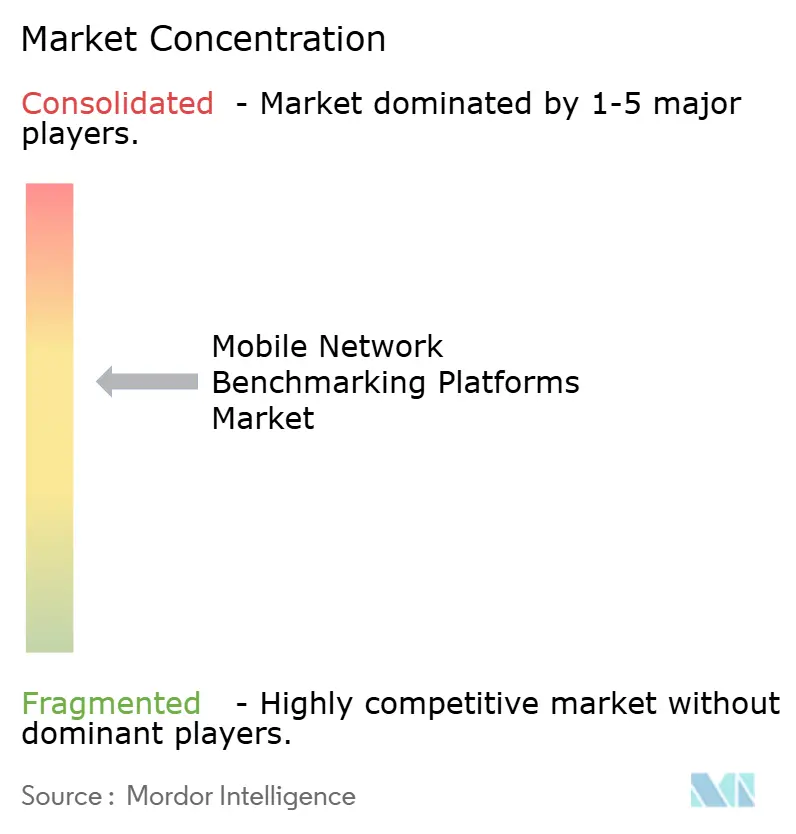
| Market Concentration | Medium |
Major Players *Disclaimer: Major Players sorted in no particular order Image © Mordor Intelligence. Reuse requires attribution under CC BY 4.0. | |
Mobile Network Benchmarking Platforms Market Analysis by Mordor Intelligence
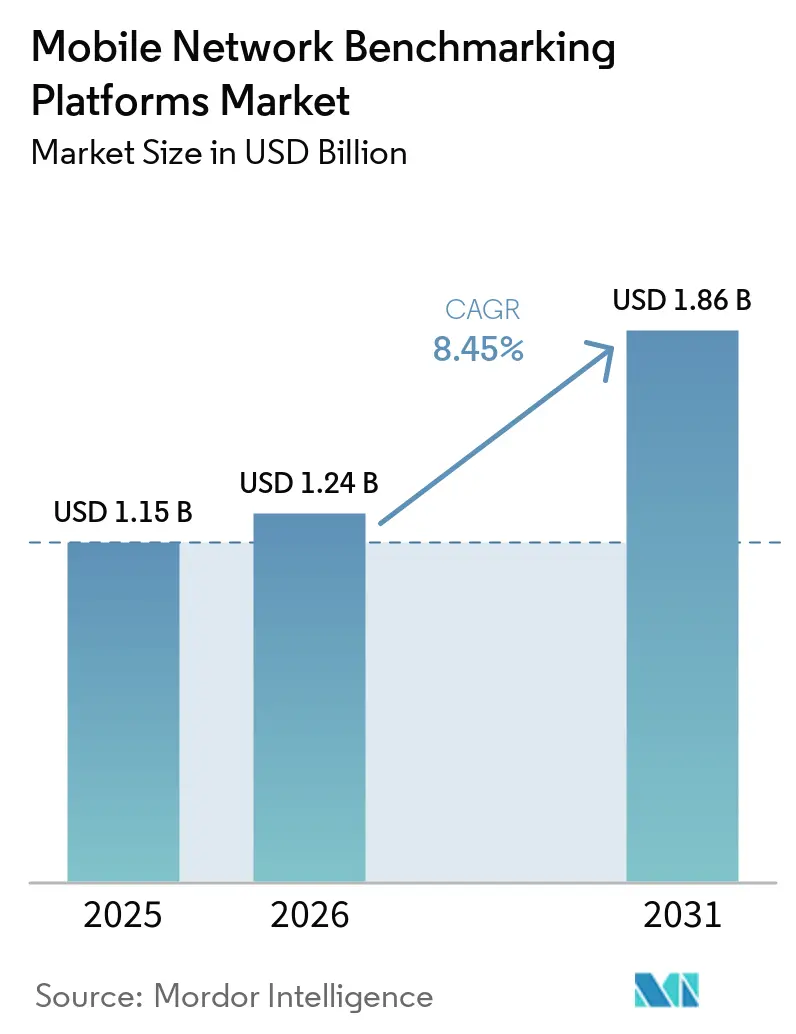
The mobile network benchmarking platforms market size was USD 1.15 billion in 2025 and is estimated to increase from USD 1.24 billion in 2026 to reach USD 1.86 billion by 2031, at a CAGR of 8.45% during the forecast period 2026-2031. The mobile network benchmarking platforms market is being reshaped by the shift from 5G Non-Standalone to 5G Standalone networks, which requires more detailed measurement of latency, mobility, and service quality. Vendor consolidation changed the supply base during 2025, while software integration is expected to become more important from 2027. Operators now need evidence that supports commercial claims, investment planning, and compliance reporting across more complex network environments. This need supports recurring platform use and favors vendors that combine field measurement, analytics, and automation. The mobile network benchmarking platforms market also benefits when the same measurements support technical teams, customer-experience teams, regulators, and management decisions.
Key Report Takeaways
- By offering, software platforms held 66.11% of the mobile network benchmarking platforms market share in 2025 and are projected to expand at an 8.72% CAGR through 2031.
- By platform architecture, cloud platforms accounted for 59.24% of the 2025 market and are expected to advance at an 8.94% CAGR through 2031.
- By application, competitive network benchmarking held 32.34% of the 2025 application segment, while network optimization and troubleshooting is projected to expand at a 9.14% CAGR through 2031.
- By end user, mobile network operators held 52.21% of the 2025 end-user segment, while telecommunications regulators are expected to record the highest CAGR of 9.22% through 2031.
- By network generation, 4G and LTE-Advanced networks accounted for 48.26% of the 2025 segment, while 5G benchmarking is projected to expand at a 9.13% CAGR through 2031.
- By geography, North America held 27.62% of the 2025 market, while Asia-Pacific is expected to expand at a 9.22% CAGR through 2031.
Note: Market size and forecast figures in this report are generated using Mordor Intelligence’s proprietary estimation framework, updated with the latest available data and insights as of January 2026.
Market Trends and Insights
Drivers Impact Analysis of Mobile Network Benchmarking Platforms Market*
| Driver | (~) % Impact on CAGR Forecast | Geographic Relevance | Impact Timeline |
|---|---|---|---|
| Accelerating 5G Standalone and Advanced 5G Rollouts | +2.8% | Global, concentrated in Asia-Pacific, North America, and GCC | Short term (≤ 2 years) |
| Rising Operator Focus on Network Experience and Churn Reduction | +2.1% | Global, most acute in North America, Western Europe, and South Korea | Medium term (2-4 years) |
| Increasing Network Complexity Across Multi-Band and Multi-RAT Environments | +1.3% | Global, with Asia-Pacific at the core and spillover to Middle East and Africa | Medium term (2-4 years) |
| Expansion of Crowdsourced and Real-World Quality-of-Experience Analytics | +0.9% | North America and Europe, with Brazil, India, and Japan advancing rapidly | Medium term (2-4 years) |
| Regulatory Demand for Independent Broadband and Mobile Quality Comparisons | +0.7% | Europe, North America, Australia, and expanding to South America | Short term (≤ 2 years) |
| Growing Need for Benchmarking in Private 5G and Neutral-Host Networks | +0.5% | Global, especially manufacturing regions in Germany, Japan, China, and South Korea | Long term (≥ 4 years) |
| Source: Mordor Intelligence | |||
Accelerating 5G Standalone and Advanced 5G Rollouts
The mobile network benchmarking platforms market is affected by the transition from 5G Non-Standalone to 5G Standalone, which changes the depth of measurement that operators require. Standalone networks expose network slicing enforcement, user-plane latency, and RedCap handover behavior that older drive-test tools were not designed to measure in sufficient detail. According to GSA, global 5G Standalone launches are expected to increase significantly by March 2026 compared to Q1 2025. The organization also reported several commercially launched 5G-Advanced networks that require a Standalone core. The 3GPP Release 18 feature set creates new conformance obligations, which can require significant software upgrades rather than routine platform maintenance. Anritsu reported industry-first verification of 3GPP RAN5 Release 18 Lower Layer Triggered Mobility test cases in June 2026, showing how standards milestones can lead to new upgrade cycles.[1]Anritsu Corporation, “Anritsu Supports Industry First Verification of 3GPP RAN5 Rel18 Lower Layer Triggered Mobility Testcases for 5G New Radio Standalone,” Anritsu Corporation, anritsu.com. These changes turn equipment compatibility, protocol coverage, and update speed into practical supplier-selection factors for operator procurement teams.
Rising Operator Focus on Network Experience and Churn Reduction
Network experience has become a stronger commercial differentiator than basic coverage in mature 5G markets. Opensignal recorded a higher consistent quality score for T-Mobile in its recent United States assessment, placing it ahead of AT&T. These comparisons support pricing claims and give operators evidence for subscriber retention programs. As a result, the mobile network benchmarking platforms market is moving from periodic testing programs toward always-on measurement services. Nokia and Infovista reported that their automated field validation program significantly reduced reporting time, lowered repeat drive tests, and improved troubleshooting productivity across multiple live implementations. This places more weight on automated analytics than on small improvements in hardware measurement accuracy. The same automation can help operators apply results sooner, before field performance differences become more visible to subscribers.
Increasing Network Complexity Across Multi-Band and Multi-RAT Environments
Operators in the mobile network benchmarking platforms market must now maintain 4G, 5G Non-Standalone, and 5G Standalone layers on much of the same infrastructure. Carrier aggregation, enhanced MIMO, and multi-vendor Open RAN configurations add more radio conditions to each credible assessment. A Standalone deployment with 4-carrier aggregation requires platforms that capture radio resource management, inter-band handover latency, and user-plane throughput during real mobility conditions. Anritsu and its partners demonstrated AI-based analysis that confirmed throughput improvements of more than 2x in 4-transmit antenna configurations at MWC Barcelona 2026. The resulting technical burden raises the minimum cost of a credible program and strengthens the position of suppliers with integrated hardware and software capabilities. It also creates demand for lab scenarios that reflect real propagation conditions before operators commit resources to wider field validation.
Expansion of Crowdsourced and Real-World Quality-of-Experience Analytics
Crowdsourced measurement is increasingly used as a primary input for the mobile network benchmarking platforms market, particularly for regulatory and enterprise intelligence work. Its scale gives continuous smartphone-based measurement an advantage over a limited fleet of test vehicles. Ookla states that its Consumer QoE platform collects hundreds of millions of measurements each day from Android devices and captures RF indicators across radio access technologies. Infovista introduced GenAI responsiveness benchmarking in VistaTest during July 2026, including Time to First Token measurement through a deterministic OpenAI API-based protocol.[2]Infovista, “How Nokia and Infovista Are Redefining Field Performance Validation,” Infovista, infovista.com. Brazil's ANATEL maintains technical cooperation agreements with Ookla and Opensignal, demonstrating a model that connects crowdsourced data with public quality oversight.[3]Agência Nacional de Telecomunicações, “Technical Cooperation Agreement,” Agência Nacional de Telecomunicações, gov.br. The combination of broad passive data and targeted active tests gives decision makers more context than either measurement method can provide alone.
Restraints Impact Analysis of Mobile Network Benchmarking Platforms Market*
| Restraint | (~) % Impact on CAGR Forecast | Geographic Relevance | Impact Timeline |
|---|---|---|---|
| High Cost of Benchmarking Hardware, Devices, and Field Campaigns | -1.9% | Global, most acute in South America, Middle East and Africa, and emerging Asia-Pacific | Medium term (2-4 years) |
| Shortage of Specialized Radio-Performance and Data-Analytics Expertise | -1.4% | Global, particularly constraining in Middle East and Africa, South Asia, and South America | Long term (≥ 4 years) |
| Inconsistent Cross-Operator Measurement Standards and Data Comparability | -0.8% | Global, most disruptive across multiple regulatory jurisdictions | Medium term (2-4 years) |
| Privacy, Consent, and Data-Localization Constraints for Crowdsourced Measurements | -0.5% | Europe, China, India, and South Korea, with broader data sovereignty adoption | Long term (≥ 4 years) |
| Source: Mordor Intelligence | |||
High Cost of Benchmarking Hardware, Devices, and Field Campaigns
Benchmarking hardware competes directly with network deployment budgets while operators continue Standalone build-outs. A multi-band and multi-RAT field campaign requires radio test platforms, instrumented vehicles, reference devices, and licensed analytics software. This combination can make quarterly campaigns impractical for tier-2 and tier-3 operators. Larger operators can absorb refresh costs through enterprise licenses, while smaller operators increasingly use managed services or pay-per-campaign arrangements. The mobile network benchmarking platforms market therefore has a geographic divide, as operators in South America, sub-Saharan Africa, and smaller Asia-Pacific markets rely more heavily on managed services and crowdsourced alternatives. Cost also limits campaign frequency and geographic coverage, leaving gaps in the quality data available for local network decisions.
Shortage of Specialized Radio-Performance and Data-Analytics Expertise
A rigorous 5G Standalone program requires radio engineering, protocol-layer knowledge, and data analytics skills. Telecommunications education has not yet produced these combined skills at the scale needed for expanding Standalone architectures. The work includes latency disaggregation, network slicing KPI development, and AI-RAN performance assessment. Operators without internal expertise become more dependent on vendor professional services, which increases program costs and can limit internal capability. In the mobile network benchmarking platforms market, automation has eased part of this issue, as Nokia and Infovista reported reductions in repeat drive tests and improvements in troubleshooting productivity. The final interpretive step still requires skilled teams to turn measurement differences into network and commercial decisions.
*Our forecasts treat driver/restraint impacts as directional, not additive. The impact forecasts reflect baseline growth, mix effects, and variable interactions.
Mobile Network Benchmarking Platforms Market Segment Analysis
By Offering:
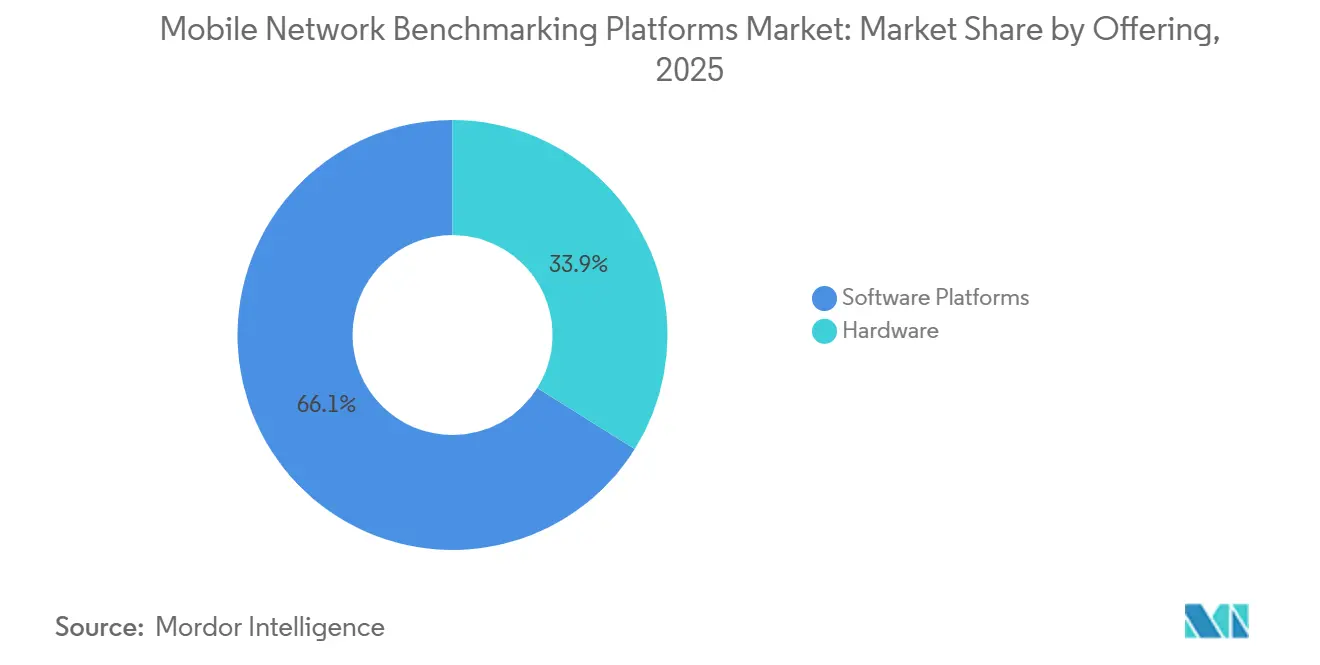
Software Platforms Lead as Analytics Becomes the Core Value PropositionSoftware platforms held 66.11% of the 2025 offering segment and are projected to expand at an 8.72% CAGR through 2031. Their lead reflects a move toward analytics flexibility and cloud-native scaling rather than proprietary hardware tied to one supplier. Hardware remains necessary for calibration, conformance testing, and private-network validation where software probes cannot reproduce physical radio conditions. It includes measurement handsets, drive-test units, network scanners, and signal analyzers. The mobile network benchmarking platforms market size for software is supported by recurring license and data-subscription revenue rather than single device purchases.
Infovista added GenAI responsiveness benchmarking to VistaTest in July 2026, extending the range of application performance that software platforms can measure. This addition measures Time to First Token across networks through a deterministic protocol. Hardware is evolving alongside software instead of disappearing from operator programs. Anritsu expanded its Virtual Network Master series to KVM-based private cloud environments in April 2026, enabling end-to-end evaluation of latency, jitter, throughput, and packet loss in virtualized infrastructure. The two offerings are moving toward hybrid architectures that preserve hardware demand in enterprise and private network settings.


By Platform Architecture:
Cloud Platforms Benefit From Elastic Capacity and Analytics IntegrationCloud architecture held 59.24% of the 2025 segment and is projected to expand at an 8.94% CAGR through 2031. Cloud deployment allows operators in the mobile network benchmarking platforms market to run concurrent campaigns in several locations and process high volumes of crowdsourced data. It also links benchmarking outputs with cloud-hosted network operations and customer-experience systems. This reduces the delays created by batch transfers from field devices to on-premises servers. VIAVI reported strong revenue growth for its Network and Service Enablement division, supported by the integration of Spirent assets and expanded software analytics and service instrumentation.
On-premises deployment still serves locations where data residency rules or operational sensitivity limit external processing. China’s data-localization approach supports local processing of subscriber-derived measurement data and sustains on-premises demand in a large 5G environment. The mobile network benchmarking platforms industry increasingly competes on data-pipeline quality, API coverage, and integrations, alongside radio measurement precision. Suppliers with cloud-native orchestration can automate test scheduling and provide real-time dashboards. That capability supports recurring subscriptions among operators that use platform workflows instead of large dedicated test-engineering teams.
By Application:
Competitive Benchmarking Anchors Revenue While Optimization Use Cases AccelerateCompetitive network benchmarking accounted for 32.34% of the 2025 application segment. It has established budgets because its results support marketing, investor reporting, and regulatory compliance. Network optimization and troubleshooting is projected to record the highest CAGR of 9.14% through 2031. Operators in the mobile network benchmarking platforms market are applying comparative data more often to internal network management and field-issue resolution. This change shortens the path from a measurement result to an investment or corrective action.
AI-supported tools can convert drive-test and crowdsourced measurements into recommended actions with less manual analysis. Germany's Bundesnetzagentur recorded a higher volume of valid mobile broadband speed tests than in the prior period. These large data volumes make assisted analysis important for public agencies and operators. Network planning support, device certification, and coverage assurance continue to develop, although their investment priority is lower.
By End User:
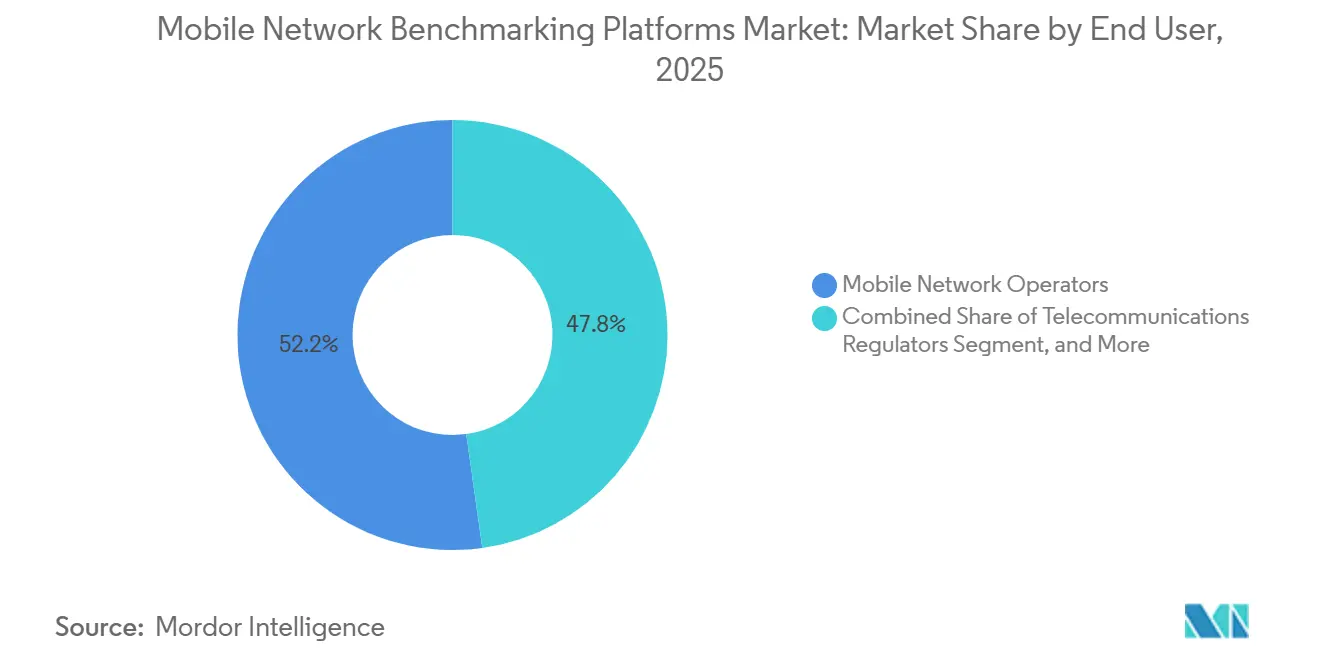
Mobile Network Operators Anchor Demand as Regulatory Procurement Scales FasterMobile network operators held 52.21% of the 2025 end-user segment. They use platforms to monitor their own performance, compare rival networks, and meet spectrum-license obligations. Telecommunications regulators are projected to expand at a 9.22% CAGR through 2031. Governments are an expanding source of demand in the mobile network benchmarking platforms market because they need independent quality reporting that does not rely only on operator submissions. The Federal Communications Commission opened its eighth broadband data collection window in January 2026 for data as of December 31, 2025.
The United Kingdom's Ofcom Telecoms Access Review 2026-31 set out quality-of-service measurement standards within the next regulatory cycle. Regulatory procurement is more durable than spending tied only to operator capital cycles. Device manufacturers, neutral-host operators, and private-network managers form a smaller but important group. Fraunhofer HHI's 2025 xG-ALOE plugfest validated Open RAN interoperability, including Time-Sensitive Networking synchronization and LiFi backhaul integration. This group could account for a larger share of new deployments as private-network monitoring becomes more formalized.

By Network Generation:
4G Supports Near-Term Revenue While 5G Testing Drives Structural Expansion4G and LTE-Advanced networks held 48.26% of the 2025 network-generation segment. They remain economically important where they carry most mobile traffic and have active coverage obligations. Operators in South America, sub-Saharan Africa, and parts of Southeast Asia continue LTE-Advanced Pro densification and quality programs. These programs need multi-band handover analysis at a level of detail similar to early 5G assessments. The 5G testing segment in the mobile network benchmarking platforms market is projected to expand at a 9.13% CAGR through 2031 as operators manage Non-Standalone coverage, Standalone capability, and 5G-Advanced conformance.
The 3GPP Release 18 framework extends measurement needs to Lower Layer Triggered Mobility and RedCap features. Earlier platforms need substantial software or hardware changes to test these protocol layers. Anritsu verified Release 18 Lower Layer Triggered Mobility test cases in June 2026, demonstrating the benefit of early standards-compliant capabilities. This process can make approved test suppliers important partners for device makers and operators entering certification. The mobile network benchmarking platforms industry, therefore, serves both legacy revenue assurance and emerging 5G capability validation.
Geography Analysis
North America Mobile Network Benchmarking Platforms Market
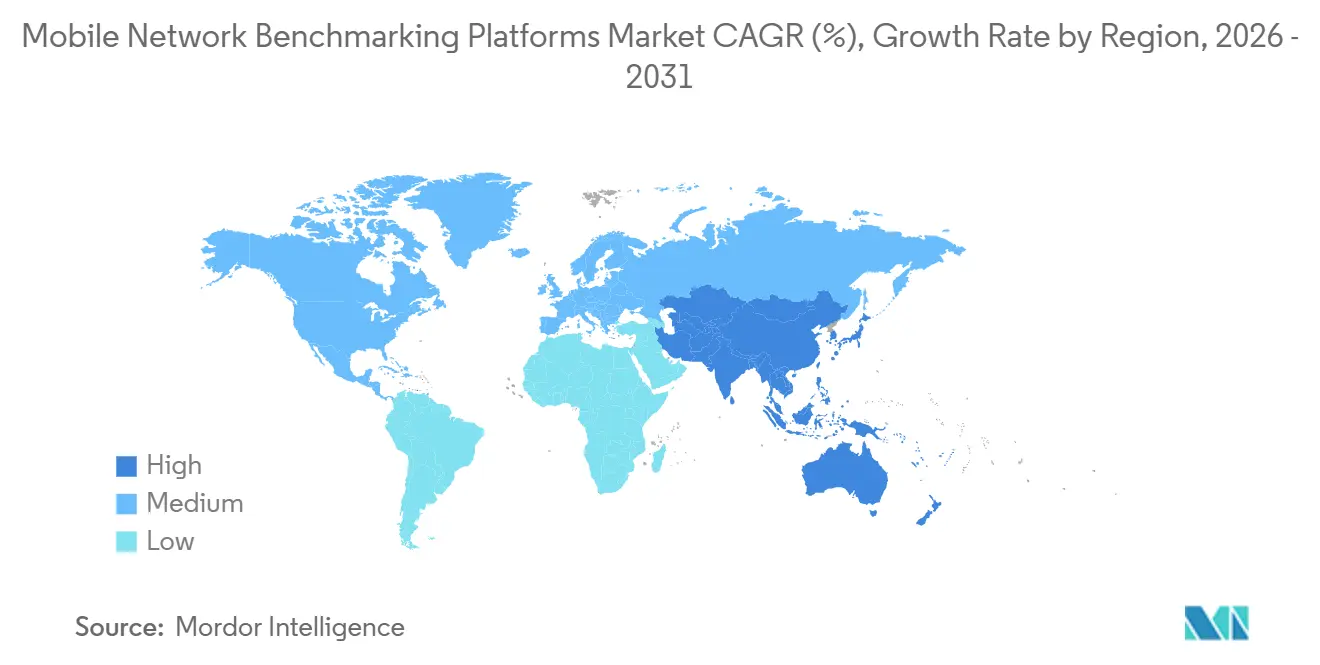
North America held 27.62% of the 2025 mobile network benchmarking platforms market. All 3 United States Tier-1 operators had completed nationwide 5G Standalone deployment, and the median Standalone download speed reached 404 Mbps in Q4 2025. The region includes major benchmarking suppliers, including Keysight Technologies, VIAVI Solutions, Ookla, and Opensignal. This supplier concentration supports close interaction between operator requirements and platform development. North America is expected to expand more slowly than the Asia-Pacific because its network environment is more mature.
APAC Mobile Network Benchmarking Platforms Market
Asia-Pacific is projected to record the highest CAGR of 9.22% in the mobile network benchmarking platforms market through 2031. China had deployed an extensive 5G base station network and operated a large base of enterprise private networks, creating demand for private-network validation and AI-capability assessment. India reached a significant 5G subscriber base, supporting broader network-quality differentiation. Japan opened applications for mmWave spectrum, creating demand for mmWave-specific test tools.
EMEA and South America Mobile Network Benchmarking Platforms Market
Europe, Middle East and Africa, and South America cover very different deployment conditions in the mobile network benchmarking platforms market. Europe’s Standalone sample share rose from 1.1% in Q4 2024 to 2.8% in Q4 2025, with Austria at 8.7%, Spain at 8.3%, the United Kingdom at 7%, and France at 5.9%. The European Commission examined investment and demand conditions for fiber and 5G networks, supporting discussion of quality-based service provisions. In the GCC, UAE median Standalone download speed improved through carrier aggregation and enhanced network capabilities. Brazil’s ANATEL agreements with Ookla and Opensignal provide a crowdsourced quality model that other South American regulators can examine.

Competitive Landscape
The mobile network benchmarking platforms market is moderately consolidated in its higher-value tier. Keysight Technologies, VIAVI Solutions, Rohde and Schwarz, and Infovista hold many premium operator and regulatory contracts. Ookla, Opensignal, EXFO, and Anritsu compete for related demand in crowdsourced analytics, data center testing, and device certification. Keysight completed its acquisition of Spirent recently. VIAVI completed its acquisition of Spirent's high-speed Ethernet, network security, and channel emulation testing business during the same period.
The transactions redistributed capabilities across network automation, lifecycle assurance, channel emulation, and high-speed Ethernet testing. This created room for specialized mobile-performance suppliers to pursue operator contracts during the integration period. VIAVI reported higher Network and Service Enablement revenue, reflecting strong year-over-year growth. The company also pursued restructuring intended to generate annualized savings. These actions show that acquisition benefits still depend on operating integration and portfolio focus.
Competition is increasingly centered on AI-enabled platforms and standards work. Rohde and Schwarz introduced a digital-twin testbed with NVIDIA for hardware-in-the-loop testing of 5G-Advanced and 6G architecture at MWC 2026. Infovista launched VistAI and VistaOne at MWC 2026, expanding its focus from periodic campaigns to autonomous operations. Anritsu submitted industry-first 3GPP RAN5 Release 18 Lower Layer Triggered Mobility conformance test cases in April 2026 and verified those test cases in June 2026. Private 5G neutral-host testing, AI-generated network KPIs, Open RAN interoperability, and GenAI responsiveness remain areas where vendors can develop new capabilities.
Mobile Network Benchmarking Platforms Industry Leaders
Keysight Technologies, Inc.
Rohde & Schwarz GmbH & Co. KG
Infovista SAS
Anritsu Corporation
VIAVI Solutions Inc.
- *Disclaimer: Major Players sorted in no particular order
Mobile Network Benchmarking Platforms Market Companies Covered in this Report
- Keysight Technologies, Inc.
- Rohde & Schwarz GmbH & Co. KG
- Infovista SAS
- Anritsu Corporation
- VIAVI Solutions Inc.
- Spirent Communications plc
- Ookla, LLC
- Opensignal Limited
- Tutela Technologies Ltd.
- Accuver Co., Ltd.
- EXFO Inc.
- NETSCOUT SYSTEMS, INC.
- RADCOM Ltd.
- Teoco Corporation
- Qualcomm Incorporated
- Nokia Corporation
- Telefonaktiebolaget LM Ericsson
- Huawei Technologies Co., Ltd.
- ZTE Corporation
- Global Wireless Solutions, Inc.

Recent Industry Developments in Mobile Network Benchmarking Platforms Market
- July 2026: Infovista introduced GenAI mobile network benchmarking capabilities within VistaTest, formerly TEMS Suite, enabling operators and benchmarking organizations to measure Time to First Token and GenAI responsiveness across multiple networks using a deterministic OpenAI API-based test protocol, the first commercial benchmarking product to formally quantify application-layer AI performance as a comparable mobile network KPI. The capability allowed testing teams to compare application responsiveness alongside familiar radio and throughput measures in the same campaign.
- June 2026: Anritsu announced industry-first support for 3GPP RAN5 Release 18 NR Lower Layer Triggered Mobility conformance test cases on the ME7834NR 5G NR Mobile Device Test Platform, enabling device vendors and operators to validate the high-mobility 5G-Advanced handover protocol that is expected to become mandatory for commercial 5G-Advanced devices. It supported validation of a handover function that affects service continuity during high-mobility use cases.
- April 2026: Anritsu expanded its Virtual Network Master series to KVM-based private cloud environments with the MX109031PC, delivering software-probe-based E2E communication quality evaluation, covering latency, jitter, throughput, and packet loss, for enterprise organizations running private on-premises cloud infrastructure where hardware instruments cannot be deployed. The release addressed private cloud environments where virtualized workloads require direct end-to-end service quality monitoring.
- April 2026: Rohde and Schwarz and Gatehouse Satcom formalized a collaboration to accelerate validation methodologies for 5G IoT-NTN and NR-NTN technologies across GEO, MEO, and LEO satellite configurations, addressing testing complexity created by satellite-to-cellphone 5G convergence as the sector moves from trials to commercial deployments. The work addressed validation across satellite configurations with different propagation delays and operating conditions.


Global Mobile Network Benchmarking Platforms Market Report Scope
Mobile Network Benchmarking Platforms Market refers to software platforms and specialized solutions that measure, compare, and analyze the performance of mobile network operators. These platforms assess key performance indicators such as coverage, signal strength, download and upload speed, latency, reliability, voice quality, and service availability.
The Mobile Network Benchmarking Platforms Market Report is Segmented by Offering (Hardware, and Software Platforms), Platform Architecture (On-Premises, and Cloud), Application (Competitive Network Benchmarking, Network Optimization and Troubleshooting, and Rollout Validation and Site Acceptance), End User (Mobile Network Operators, Telecommunications Regulators, Network Testing Service Providers, and Network Equipment Manufacturers), Network Generation (2G and 3G Networks, 4G and LTE-Advanced Networks, and 5G), and Geography (North America, Europe, Asia-Pacific, Middle East and Africa, South America). The Market Forecasts are Provided in Terms of Value (USD).
| Hardware |
| Software Platforms |
| On-Premises |
| Cloud |
| Competitive Network Benchmarking |
| Network Optimization and Troubleshooting |
| Rollout Validation and Site Acceptance |
| Other Applications |
| Mobile Network Operators |
| Telecommunications Regulators |
| Network Testing Service Providers |
| Network Equipment Manufacturers |
| Other End Users |
| 2G and 3G Networks |
| 4G and LTE-Advanced Networks |
| 5G |
| North America | United States |
| Canada | |
| South America | Brazil |
| Argentina | |
| Rest of South America | |
| Europe | Germany |
| United Kingdom | |
| France | |
| Italy | |
| Spain | |
| Russia | |
| Rest of Europe | |
| Asia-Pacific | China |
| Japan | |
| South Korea | |
| India | |
| Australia | |
| Southeast Asia | |
| Rest of Asia-Pacific | |
| Middle East | Saudi Arabia |
| United Arab Emirates | |
| Turkey | |
| Rest of Middle East | |
| Africa | South Africa |
| Egypt | |
| Nigeria | |
| Rest of Africa |
| By Offering | Hardware | |
| Software Platforms | ||
| By Platform Architecture | On-Premises | |
| Cloud | ||
| By Application | Competitive Network Benchmarking | |
| Network Optimization and Troubleshooting | ||
| Rollout Validation and Site Acceptance | ||
| Other Applications | ||
| By End User | Mobile Network Operators | |
| Telecommunications Regulators | ||
| Network Testing Service Providers | ||
| Network Equipment Manufacturers | ||
| Other End Users | ||
| By Network Generation | 2G and 3G Networks | |
| 4G and LTE-Advanced Networks | ||
| 5G | ||
| By Geography | North America | United States |
| Canada | ||
| South America | Brazil | |
| Argentina | ||
| Rest of South America | ||
| Europe | Germany | |
| United Kingdom | ||
| France | ||
| Italy | ||
| Spain | ||
| Russia | ||
| Rest of Europe | ||
| Asia-Pacific | China | |
| Japan | ||
| South Korea | ||
| India | ||
| Australia | ||
| Southeast Asia | ||
| Rest of Asia-Pacific | ||
| Middle East | Saudi Arabia | |
| United Arab Emirates | ||
| Turkey | ||
| Rest of Middle East | ||
| Africa | South Africa | |
| Egypt | ||
| Nigeria | ||
| Rest of Africa | ||


Key Questions Answered in the Report
What is the mobile network benchmarking platforms market size?
The mobile network benchmarking platforms market size is estimated at USD 1.24 billion in 2026 and is forecast to reach USD 1.86 billion by 2031 at an 8.45% CAGR. The forecast reflects more frequent testing and analysis requirements as operators expand Standalone capabilities.
What is driving demand for mobile network benchmarking platforms?
5G Standalone adoption, network-experience competition, multi-band network complexity, and independent quality reporting are increasing demand. These needs require evidence that can be used in both technical operations and commercial planning.
Which offering leads mobile network benchmarking platform spending?
Software platforms led the offering segment with 66.11% in 2025 and are projected to expand at an 8.72% CAGR through 2031. Their position reflects demand for flexible analytics, data subscriptions, and platform integration.
Which deployment architecture is expanding fastest?
Cloud platforms led with 59.24% in 2025 and are expected to expand at an 8.94% CAGR through 2031 because they support scalable testing and analytics integration. On-premises deployment remains relevant where data-residency requirements are strict.
Which users purchase mobile network benchmarking platforms?
Mobile network operators are the largest users, while telecommunications regulators are expected to record the fastest growth at a 9.22% CAGR through 2031. Regulators require independent measurement to support quality oversight.
Why do 5G Standalone networks require new test capabilities?
They require detailed validation of slicing, latency, RedCap mobility, and 5G-Advanced features that older test methods cannot fully assess. Release 18 requirements can therefore prompt software updates or new platform procurement.
Page last updated on:





