
Mobile B2B Commerce Software Market Size and Share
Market Overview
| Study Period | 2020 - 2031 |
|---|---|
| Market Size (2026) | USD 3.78 Billion |
| Market Size (2031) | USD 6.24 Billion |
| Growth Rate (2026 - 2031) | 10.54 % |
| Fastest Growing Market | Asia-Pacific |
| Largest Market | North America |
| Market Concentration | Medium |
Major Players *Disclaimer: Major Players sorted in no particular order Image © Mordor Intelligence. Reuse requires attribution under CC BY 4.0. | |
Mobile B2B Commerce Software Market Analysis by Mordor Intelligence
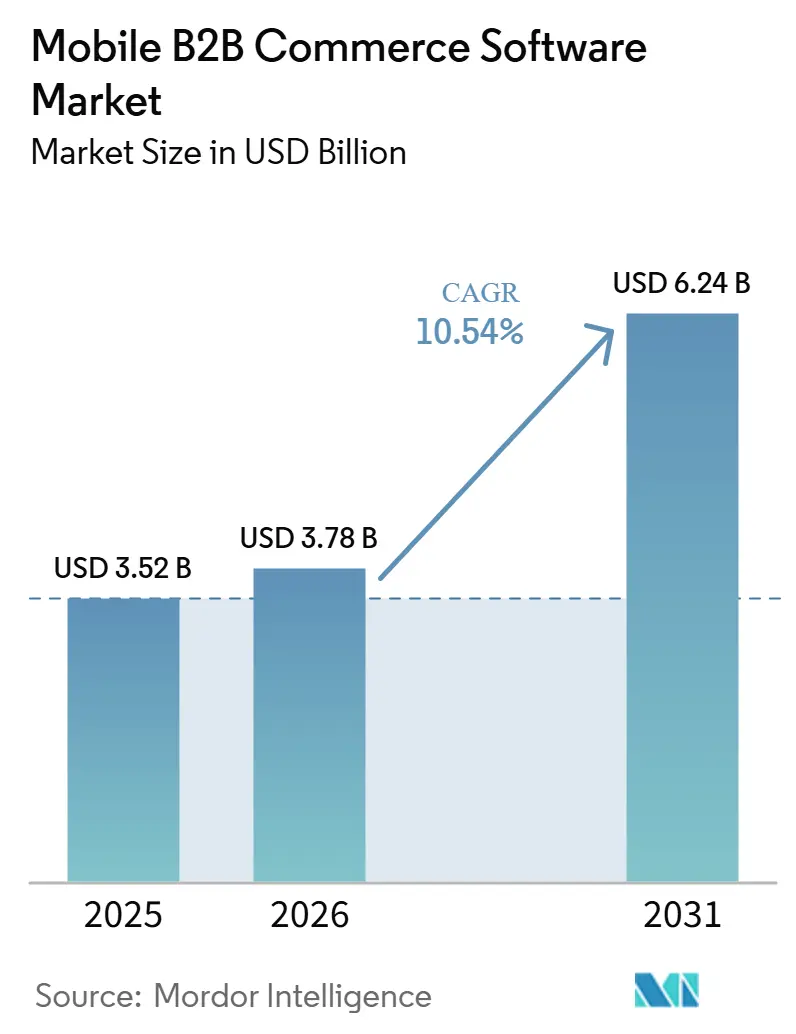
The Mobile B2B Commerce Software Market size was valued at USD 3.52 billion in 2025 and estimated to grow from USD 3.78 billion in 2026 to reach USD 6.24 billion by 2031, at a CAGR of 10.54% during the forecast period (2026-2031). The Mobile B2B Commerce Software Market is expanding as procurement work moves from calls, emails, and manual entry to mobile portals, field applications, and assisted ordering tools. Buyers increasingly expect to research products, place orders, and manage accounts without waiting for a sales representative. This raises the importance of consistent ordering, pricing, and inventory information across every buyer touchpoint. Providers are responding with artificial intelligence capabilities, deeper enterprise resource planning connections, and tools that support mobile ordering in the field. Flexible deployment and embedded payment functions also shape platform selection, particularly where organizations have differing data and compliance needs.
Key Report Takeaways
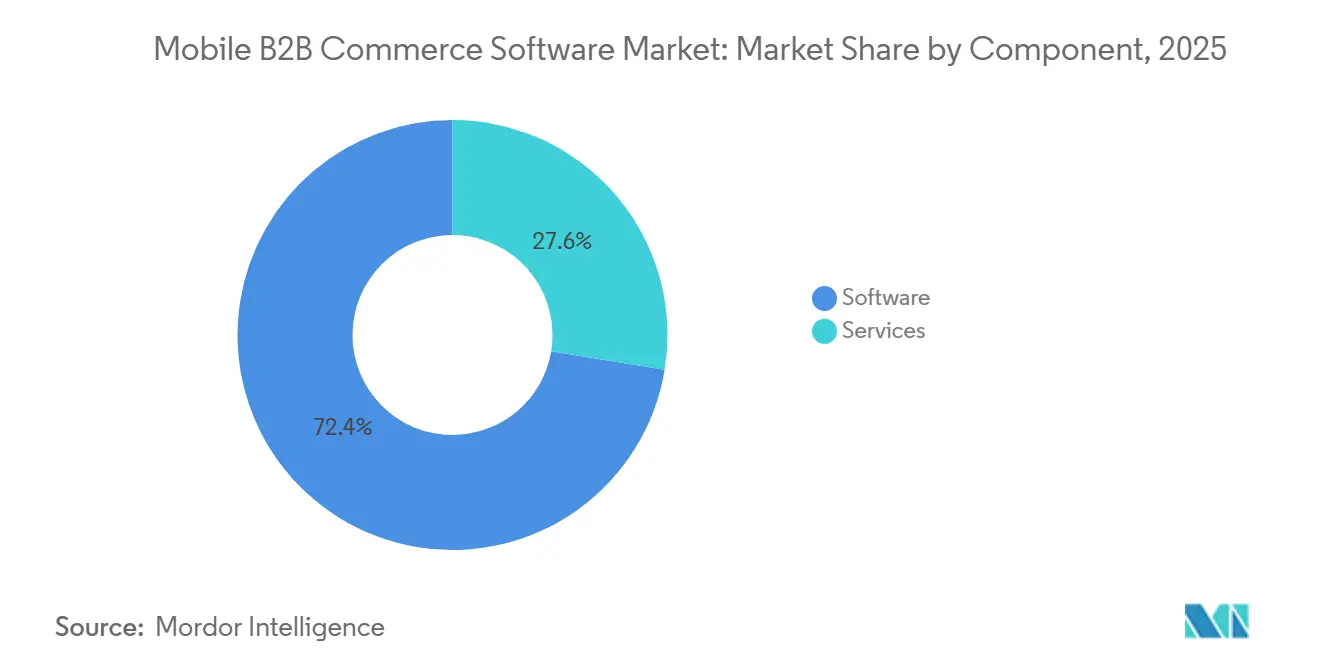
- By component, software accounted for 72.41% of the Mobile B2B Commerce Software Market share in 2025, while services are projected to expand at a CAGR of 13.82% through 2031.
- By commerce channel, buyer self-service portals accounted for 28.19% of revenue in the Mobile B2B Commerce Software Market 2025, while direct store delivery and route commerce are projected to expand at a CAGR of 14.43% through 2031.
- By deployment model, cloud accounted for 68.41% of the installed base in 2026, while hybrid deployment is projected to expand at a CAGR of 12.69% through 2031.
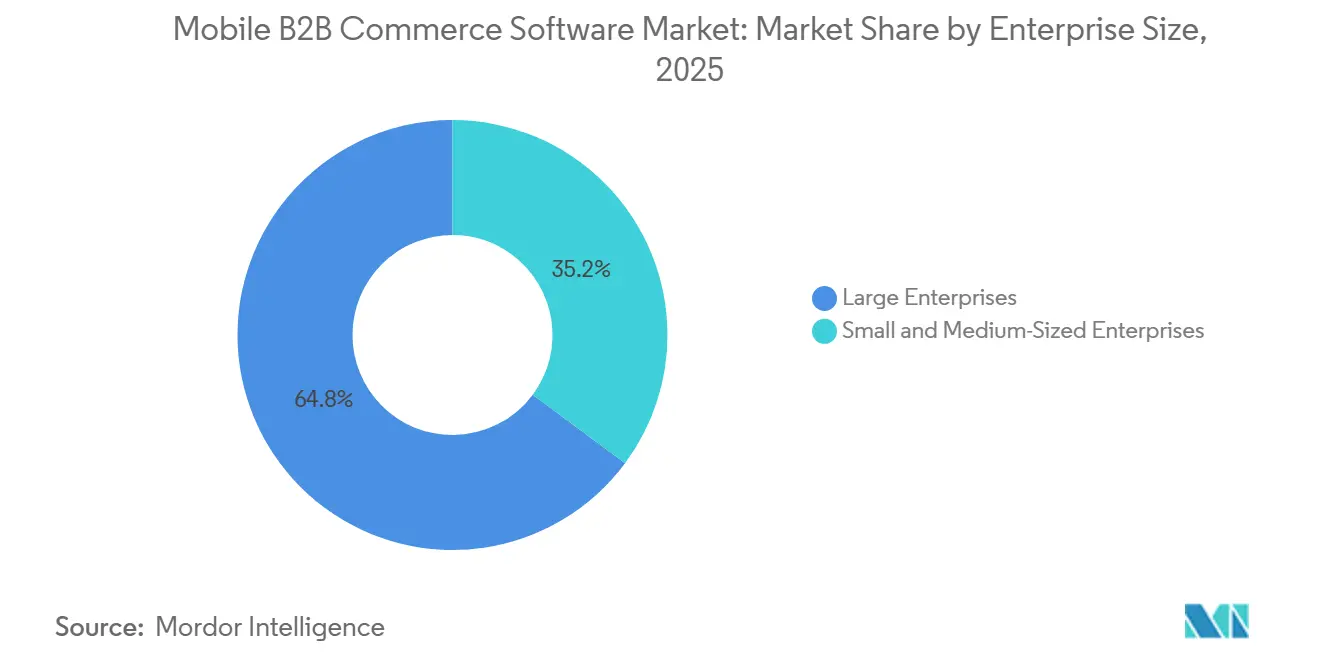
- By enterprise size, large enterprises held 64.83% of revenue in 2025, while small and medium-sized enterprises are projected to expand at a CAGR of 15.24% through 2031.
- By end user, retail and e-commerce accounted for 24.36% of revenue in the Mobile B2B Commerce Software Market 2025, while healthcare and life sciences are projected to expand at a CAGR of 13.91% through 2031.
- By geography, North America held 34.62% of revenue in 2025, while Asia-Pacific is projected to expand at a CAGR of 14.18% through 2031.
Note: Market size and forecast figures in this report are generated using Mordor Intelligence’s proprietary estimation framework, updated with the latest available data and insights as of January 2026.
Global Mobile B2B Commerce Software Market Trends and Insights
Drivers Impact Analysis*
| Driver | (~) % Impact on CAGR Forecast | Geographic Relevance | Impact Timeline |
|---|---|---|---|
| B2B Buyer Shift Toward Self-Service Experiences | +2.1% | Global | Short term (≤ 2 years) |
| AI-Enabled Procurement, Reordering, and Product Discovery | +1.8% | North America, Europe, Asia-Pacific | Medium term (2-4 years) |
| Mobile Field Sales and Assisted Ordering Digitization | +1.5% | Asia-Pacific, Middle East and Africa, North America | Short term (≤ 2 years) |
| ERP-Connected Real-Time Pricing and Inventory Visibility | +1.2% | North America and Europe | Medium term (2-4 years) |
| Cloud, Headless, and Composable Commerce Expansion | +1.0% | North America and Europe | Medium term (2-4 years) |
| Mobile Payment Rails and Embedded Finance Adoption | +0.9% | Asia-Pacific and North America | Medium term (2-4 years) |
| Source: Mordor Intelligence | |||
B2B Buyer Shift Toward Self-Service Experiences
Self-service portals have become a basic expectation for enterprise and mid-market buyers. In 2025, 85% of B2B organizations offered a self-service storefront or portal, compared with 68% in 2024. Manufacturers and distributors still received only 30-45% of orders through portals, with the rest arriving through email and phone. This leaves room for the Mobile B2B Commerce Software Market to improve order capture without changing the underlying customer relationship. Organizations that automate email orders alongside portal transactions can address the gap more effectively than those focused only on portal design. Demand is also moving toward product search, order lists, and reorder functions that require less manual navigation.
AI-Enabled Procurement, Reordering, and Product Discovery
Artificial intelligence is being applied to inventory checks, purchase recommendations, and routine reorders. These functions can shorten order cycles and reduce dependence on manual procurement work. In July 2026, Salesforce released a Buyer Agent that supports product discovery, order management, and purchase completion through WhatsApp and SMS. The release also enables vendors to publish branded mobile applications without custom development. The Mobile B2B Commerce Software Market, therefore, places greater value on structured product catalogs, as incomplete catalog data can undermine automated ordering. In June 2026, commercetools and Mirion Technologies deployed an agent that converts unstructured order requests into quotes and carts, reducing manual processing.[1]commercetools, “commercetools Partners with Mirion Technologies on B2B Commerce AI Agent,” commercetools, commercetools.com
Mobile Field Sales and Assisted Ordering Digitization
Field teams often place orders in locations where portal-based workflows are not practical. These settings include factory floors, trade shows, and retail store visits. Mobile applications with offline synchronization, barcode scanning, and account-specific pricing support faster order entry in these environments. The Mobile B2B Commerce Software Market benefits where distributors need representatives to capture orders during store visits and route activity. FrieslandCampina deployed Ivy Mobility sales force automation and distribution management tools across markets in Asia and Africa during 2025.[2]FrieslandCampina and Ivy Mobility, “FrieslandCampina Transforms Route-to-Market with Next-Gen Capabilities,” Ivy Mobility, ivymobility.com Field tools also need timely enterprise resource planning updates, because delayed price or inventory data can create corrections after an order is submitted.
ERP-Connected Real-Time Pricing and Inventory Visibility
Buyers and sales representatives need current contract prices, available inventory, and credit information when they place an order. This makes enterprise resource planning integration important to the Mobile B2B Commerce Software Market. SAP found that 43% of surveyed B2B buyers identified seamless procurement-system integration as the leading feature for improving digital buying experiences. Older enterprise resource planning systems were often designed for batch processing rather than high volumes of real-time application requests.[3]SAP SE, “2025 B2B Buyer Benchmark Report - EMEA,” SAP, sap.com This can lead to slow checkout, price differences, and lower buyer confidence. Sana Commerce added configurable sales-document fields for SAP S/4HANA users in January 2026, allowing enterprise resource planning data to appear more directly in buyer interfaces.[4]Sana Commerce, “Sana for SAP S/4HANA Release Notes January 2026,” Sana Commerce, sana-commerce.com
Restraints Impact Analysis*
| Restraint | (~) % Impact on CAGR Forecast | Geographic Relevance | Impact Timeline |
|---|---|---|---|
| Legacy ERP Data Quality and Integration Debt | -0.9% | Global | Medium term (2-4 years) |
| Mobile Fraud, Identity Abuse, and BYOD Exposure | -0.7% | North America, Europe, Asia-Pacific | Short term (≤ 2 years) |
| Complex B2B Pricing, Approval, and Credit Workflows | -0.5% | Global | Medium term (2-4 years) |
| Supplier Digital Readiness and Connectivity Gaps | -0.4% | Asia-Pacific, Middle East and Africa | Long term (≥ 4 years) |
| Source: Mordor Intelligence | |||
Legacy ERP Data Quality and Integration Debt
Legacy enterprise resource planning data and integration work continue to be a major constraint on platform deployment. Pricing, credit limits, and product data may be changed in both the enterprise resource planning system and the commerce platform. This creates conflict-resolution work that can vary between implementations. FIS stated in June 2026 that application programming interface (API) compatibility for artificial intelligence (AI)- enabled solutions can increase project costs by up to 60%. The Mobile B2B Commerce Software Market faces slower adoption when organizations have deferred data remediation or enterprise resource planning modernization. Companies with cleaner data and more flexible connections can introduce mobile functions more quickly than competitors with older system designs.
Mobile Fraud, Identity Abuse, and BYOD Exposure
Personal devices introduce additional risks when used for procurement approvals. Verizon found that 3 in 4 information technology workers reported regular bring-your-own-device use in 2025, although only 52% of organizations explicitly allowed it. Zimperium recorded more than 1.2 million enterprise-focused phishing attacks in the third quarter of 2025. It also found sideloaded applications on 23.5% of enterprise mobile devices. The Mobile B2B Commerce Software Market must address risks involving purchase approvals, saved credentials, pricing data, and personal-device access. Access controls that evaluate each application connection can help organizations protect systems without managing every employee-owned device.
*Our forecasts treat driver/restraint impacts as directional, not additive. The impact forecasts reflect baseline growth, mix effects, and variable interactions.
Segment Analysis
By Component: Software Leads While Services Support More Complex Deployments
Software held 72.41% of the Mobile B2B Commerce Software Market share in 2025, reflecting the priority buyers place on securing core platform capabilities before commissioning wider implementation work. Organizations typically begin with licenses for the commerce platform, catalog management, account access, and system connectivity. They can then determine how customer data, product data, pricing, and order records will be moved between the platform and other internal systems. This sequence limits the risk of investing in extensive customization before the essential ordering process is stable. It also explains why software spending was larger than services spending at this stage of adoption.
Services are projected to expand at a CAGR of 13.82% from 2026 to 2031, because many deployments require support beyond the initial license purchase. Service providers help organizations connect enterprise resource planning systems, configure price rules, establish account hierarchies, and convert approval processes into digital workflows. They also support data cleansing for product descriptions, customer records, and contract terms that are incomplete or inconsistent. In June 2026, commercetools introduced tools intended to build commerce experiences and centralize third-party connections more quickly. Providers with established connectors for SAP, Microsoft Dynamics, and NetSuite may be better suited to mid-market customers with limited internal integration resources.


By Commerce Channel: Direct Store Delivery and Route Commerce Gains Momentum
Buyer self-service portals held 28.19% of the Mobile B2B Commerce Software Market share in 2025, making them the largest individual channel in the segment. Manufacturing, distribution, and wholesale companies adopted account-specific portals widely during the 2022-2025 investment period. These portals let buyers view agreed-upon prices, browse relevant products, review prior orders, and submit requests at their convenience. They are especially effective when customers make repeat purchases from a known assortment and require limited assistance. However, many organizations still receive a substantial share of orders through email and phone, showing that portal access does not immediately change every ordering habit.
Direct store delivery and route commerce are projected to expand at a CAGR of 14.43% from 2026 to 2031. Mobile-native tools replace paper-based van sales, route accounting, and manual store-order processes in consumer goods and beverage distribution. Faster order capture can help distributors improve shelf replenishment and retailer service levels. Representatives can use offline applications, barcode scanning, location-based visit schedules, and route planning where connectivity is unreliable. Marketplaces, supplier networks, and punchout systems remain important for larger buyers that want to consolidate supplier access through fewer procurement connections.
By Deployment Model: Cloud Holds the Largest Base as Hybrid Meets Data Needs
Cloud deployment accounted for 68.41% of the installed base in 2026, driven by broader adoption of cloud-based enterprise resource planning environments. Cloud-hosted integration layers can extend application programming interfaces from those systems into buyer-facing portals and mobile ordering tools. This can reduce reliance on the complex middleware that older on-premises deployments frequently required. The Mobile B2B Commerce Software Market benefits from the ability to scale as transaction volumes, product assortments, and buyer groups expand. Cloud delivery also makes it easier to distribute feature updates across portals and mobile applications without separate local installations.
Hybrid deployment is projected to expand at a CAGR of 12.69% from 2026 to 2031. Organizations with regulated or sensitive procurement data may retain records in on-premises enterprise resource planning systems while using cloud-based mobile interfaces. This model is relevant for defense contractors, pharmaceutical distributors, and financial institutions that need to balance usability with internal control requirements. On-premises systems still have a role in markets with strict data requirements, including Germany and Japan. For organizations moving to cloud or hybrid models, data remediation in the enterprise resource planning system is often more time-consuming than infrastructure setup.
By Enterprise Size: Small and Medium-Sized Enterprises Expand Faster
Large enterprises held 64.83% of revenue in 2025, as their deployments tend to be broader and more expensive than those of smaller companies. They often operate across multiple sites, channels, countries, and product catalogs, which increases the scope of the software program. These buyers also require deeper enterprise resource planning connections and detailed approval structures for different users, business units, and customer accounts. Larger contract values follow from the need to support these connected processes rather than from mobile access alone. Their operating requirements continue to influence the platform architecture and controls offered across the Mobile B2B Commerce Software Market.
Small and medium-sized enterprises are projected to expand at a CAGR of 15.24% from 2026 to 2031. Subscription-based cloud platforms can reduce upfront costs and shorten the time to start using digital ordering tools. Smaller companies may not have dedicated information technology teams, so setup, catalog publication, customer access, and approval templates need to be straightforward to manage. Shopify launched its B2B Wholesale Hub in July 2026, featuring company pricing catalogs, net payment terms, and a buyer portal within Shopify Plus. The release targets smaller and mid-market merchants seeking native wholesale functions without relying on extra applications or custom development.
By End User: Retail and E-Commerce Holds Scale While Healthcare Expands Faster
Retail and e-commerce held 24.36% of revenue in 2025, giving the segment the largest share among end users. Wholesalers and supplier networks use mobile software for store ordering, promotional fulfillment, and sales representative-supported purchasing across distributed retail locations. High-order frequency and complex catalogs made digital ordering a practical early use case for this group. Concentrated buyer networks also made it easier for retailers and distributors to assess the operational value of self-service tools. These factors supported the segment's leading role in the Mobile B2B Commerce Software Market.
Healthcare and life sciences are projected to expand at a CAGR of 13.91% from 2026 to 2031. Hospital systems, pharmaceutical distributors, and medical device suppliers are digitizing previously paper-based purchasing processes or those managed through electronic data interchange, with limited mobile access. These organizations need visible approval records, traceability, product information, and dependable links to internal procurement controls. AdvaMed described a healthcare company using composable commerce to improve scalability and cross-market customer experiences in 2025. Automotive, transportation, industrial manufacturing, energy, utilities, education, research institutions, and government organizations also use mobile ordering for maintenance, repair, and operations supplies.
Geography Analysis
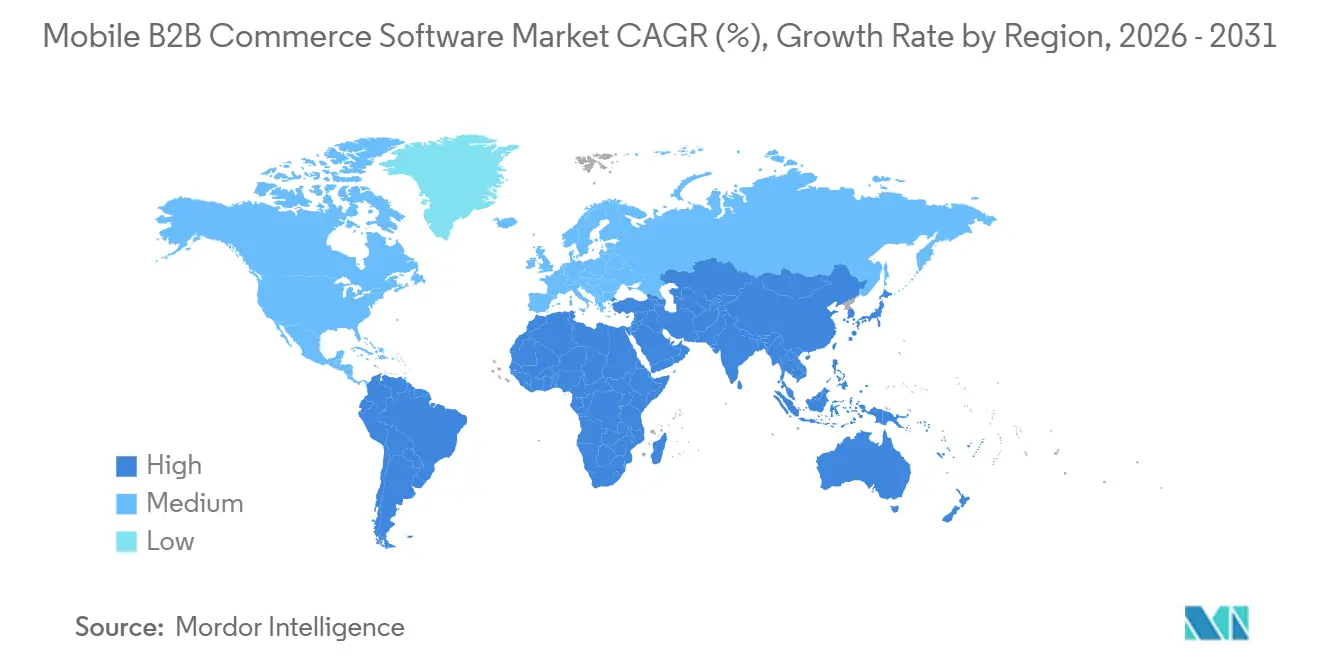
North America held 34.62% of Mobile B2B Commerce Software Market share in 2025. The United States has broad enterprise software adoption, established cloud infrastructure, and many manufacturers and distributors that are digitizing procurement and field sales. These conditions support mobile access to pricing, inventory, and delivery information. Canada generally follows U.S. supply chain standards and enterprise resource planning practices. Mexico is gaining demand from nearshoring activity that links manufacturers to U.S.-based production networks.
South America remains smaller in share, with Brazil showing the most advanced adoption. Brazil's mobile payment infrastructure, including the Pix instant payment system, supports embedded payment options for wholesale and distribution businesses. Argentina and other South American countries are at earlier stages of adoption and mainly use cloud-based wholesale ordering tools. Europe has different deployment preferences because data residency and auditability requirements can favor hybrid and on-premises models. Germany, the United Kingdom, and France are major European adopters, with manufacturers and distributors using enterprise resource planning (ERP)- connected tools across their dealer networks.
Asia-Pacific is projected to expand at a CAGR of 14.18% from 2026 to 2031. China contributes manufacturing-linked digital commerce scale, while India is supported by broader MSME digitization and Digital India programs. South Korea has advanced mobile infrastructure, and Vietnam, Indonesia, and Thailand have growing mobile-first buyer groups. Japan is automating procurement and supplier management amid labor shortages, increasing pressure on operating teams. Adoption in the Middle East and Africa is earlier, though Saudi Arabia and the United Arab Emirates are investing in digital commerce infrastructure, while Nigeria and South Africa offer longer-term potential for low-bandwidth ordering tools.

Competitive Landscape
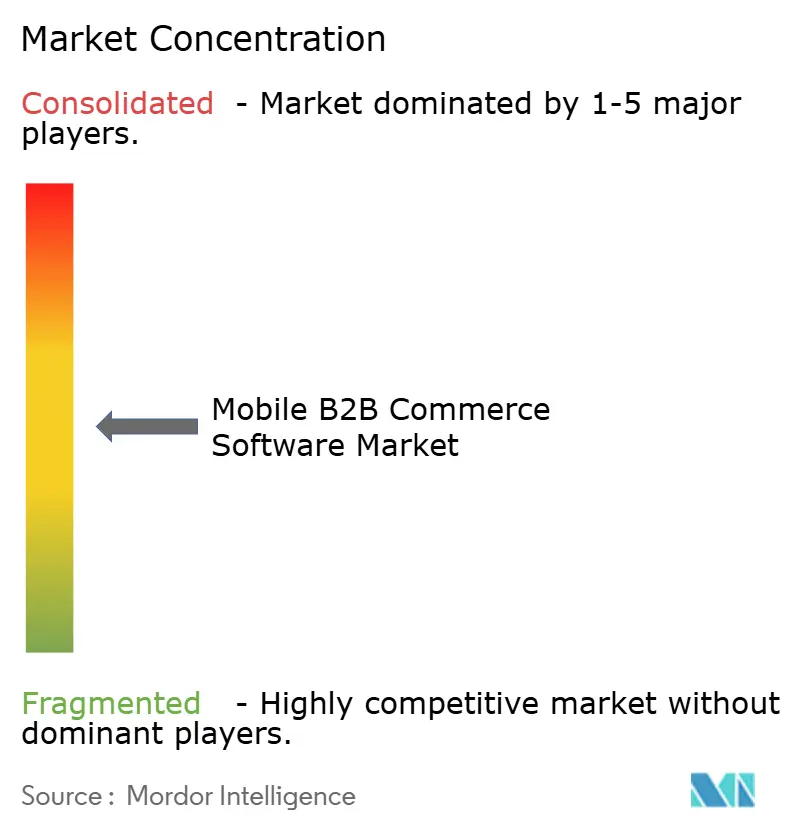
The Mobile B2B Commerce Software Market includes broad platform providers and focused specialists. commercetools, Salesforce, Adobe Commerce, Shopify, and BigCommerce compete across enterprise sizes and end-user needs. Pepperi, Sana Commerce, Elastic Path, VTEX, Oro, and Intershop focus on areas such as field sales, enterprise resource planning-connected ordering, and modular platform design. Competition is strongest in the mid-market, where providers are compared on implementation costs, artificial intelligence capabilities, connector availability, and time to launch. Self-service portals and mobile optimization are now expected capabilities rather than clear points of difference.
Artificial intelligence capability is an important competitive focus in 2026. Salesforce released its B2B Commerce Suite update in July 2026 with a Buyer Agent for product discovery, order management, and purchase completion. commercetools partnered with Mirion Technologies in June 2026 to apply an agent to unstructured order requests. Elastic Path announced a May 2026 partnership with ReFiBuy to optimize catalog data for artificial intelligence shopping workflows. These moves show that providers are incorporating automated procurement support into their core offerings. Buyers are likely to compare model transparency, data readiness, and platform connections alongside current feature sets.
Opportunities remain among Tier 2 and Tier 3 industrial suppliers that lack the budgets or enterprise resource planning maturity for larger platforms. Cross-border purchasing is another opportunity where small and medium-sized enterprises need currency, tax, and logistics information in one mobile process. Healthcare-focused platforms can also differentiate through drug serialization, medical device traceability, and multilayer approval requirements. BigCommerce released a B2B Buyer Portal in May 2026, featuring two-way connectors to NetSuite, SAP Business One, and Microsoft Dynamics 365. The provider base is broad across platform providers and specialists, and the available information does not show combined shares that would indicate control by a small group.
Mobile B2B Commerce Software Industry Leaders
Shopify Inc
Adobe Inc.
Salesforce, Inc.
BigCommerce Holdings, Inc
commercetools GmbH
- *Disclaimer: Major Players sorted in no particular order

Recent Industry Developments
- July 2026: Salesforce shipped its B2B Commerce Suite update on July 21, 2026, introducing a native Buyer Agent built on the Agentforce platform that handled product discovery, order management, and purchase completion through WhatsApp, SMS, and branded mobile apps without sales representative involvement. The release bundled intent-driven AI search, omnichannel quoting, a Mobile Publisher tool for app store deployment, and the Headless360 Reference Architecture for custom B2B channel development, positioning Salesforce's B2B commerce offering as a full agentic procurement stack.
- July 2026: Shopify launched its native B2B Wholesale Hub on July 15, 2026, embedded within the core Shopify Plus admin, providing company-level pricing catalogs, net payment terms automation, draft order bulk management, and a self-serve buyer portal without requiring third-party applications. The release was expected to accelerate small and medium-sized enterprise and mid-market merchant migration from fragmented wholesale application stacks and competing platforms in the USD 5 million to USD 150 million annual revenue band.
- June 2026: commercetools launched commercetools for Builders on June 23, 2026, an AI-native developer toolset enabling production-grade B2B and B2C commerce experiences to be built using natural-language prompts with tools including Claude Code, Cursor, and Vercel's v0. The company simultaneously unveiled a Commerce Integration Layer to centralize third-party system connectivity and collapse enterprise implementation timelines from months to days.
- June 2026: commercetools partnered with Mirion Technologies on June 16, 2026, deploying an AI agent that converts unstructured customer order requests into ready-to-action quotes and carts within the B2B commerce workflow, reducing manual order processing and accelerating quote-to-order timelines. The partnership was positioned as a real-world demonstration of commercetools' autonomous commerce vision for technically complex, high-specification product categories.


Global Mobile B2B Commerce Software Market Report Scope
The mobile B2B commerce software market comprises software solutions and associated services that facilitate, manage, and streamline business-to-business transactions on mobile devices such as smartphones and tablets. This market encompasses platforms that support various specialized commerce channels, including customer self-service portals, mobile ordering applications for field sales representatives, B2B marketplaces, procurement and punchout catalog integrations, and direct store delivery (DSD) and route accounting systems. Deployed via cloud, hybrid, or on-premises models, these solutions cater to organizations of all sizes across diverse industries, including manufacturing, wholesale distribution, retail, and automotive. By providing mobile-first capabilities such as offline catalog access, real-time inventory visibility, automated customer-specific pricing, and seamless integration with backend ERP systems, mobile B2B commerce software empowers businesses to enhance the buyer experience, increase field sales productivity, reduce order processing errors, and accelerate order-to-cash cycles.
The Mobile B2B Commerce Software Market Report is Segmented by Component (Software, and Services), Commerce Channel (Buyer Self-Service Portals, Sales Representative Mobile Ordering, B2B Marketplaces and Supplier Networks, Procurement and Punchout Commerce, and Direct Store Delivery and Route Commerce), Deployment Model (Cloud, Hybrid, and On-Premises), Enterprise Size (Large Enterprises, and Small and Medium-Sized Enterprises), End User (IT and Telecommunication, BFSI, Automotive and Transportation, Healthcare and Life Sciences, Retail and E-Commerce, Industrial Manufacturing, Education and Research Institutions, Government and Administration, Energy and Utilities, and Other End-Users), and Geography (North America, South America, Europe, Asia-Pacific, and Middle East and Africa). The Market Forecasts are Provided in Terms of Value (USD).
| Software |
| Services |
| Buyer Self-Service Portals |
| Sales Representative Mobile Ordering |
| B2B Marketplaces and Supplier Networks |
| Procurement and Punchout Commerce |
| Direct Store Delivery and Route Commerce |
| Cloud |
| Hybrid |
| On-Premises |
| Large Enterprises |
| Small and Medium-Sized Enterprises |
| IT and Telecommunication |
| BFSI |
| Automotive and Transportation |
| Healthcare and Life Sciences |
| Retail and E-Commerce |
| Industrial Manufacturing |
| Education and Research Institutions |
| Government and Administration |
| Energy and Utilities |
| Other End Users |
| North America | United States | |
| Canada | ||
| Mexico | ||
| South America | Brazil | |
| Argentina | ||
| Rest of South America | ||
| Europe | Germany | |
| United Kingdom | ||
| France | ||
| Russia | ||
| Spain | ||
| Rest of Europe | ||
| Asia-Pacific | China | |
| Japan | ||
| India | ||
| South Korea | ||
| Southeast Asia | ||
| Rest of Asia-Pacific | ||
| Middle East and Africa | Middle East | Saudi Arabia |
| United Arab Emirates | ||
| Rest of Middle East | ||
| Africa | South Africa | |
| Nigeria | ||
| Rest of Africa | ||
| By Component | Software | ||
| Services | |||
| By Commerce Channel | Buyer Self-Service Portals | ||
| Sales Representative Mobile Ordering | |||
| B2B Marketplaces and Supplier Networks | |||
| Procurement and Punchout Commerce | |||
| Direct Store Delivery and Route Commerce | |||
| By Deployment Model | Cloud | ||
| Hybrid | |||
| On-Premises | |||
| By Enterprise Size | Large Enterprises | ||
| Small and Medium-Sized Enterprises | |||
| By End User | IT and Telecommunication | ||
| BFSI | |||
| Automotive and Transportation | |||
| Healthcare and Life Sciences | |||
| Retail and E-Commerce | |||
| Industrial Manufacturing | |||
| Education and Research Institutions | |||
| Government and Administration | |||
| Energy and Utilities | |||
| Other End Users | |||
| By Geography | North America | United States | |
| Canada | |||
| Mexico | |||
| South America | Brazil | ||
| Argentina | |||
| Rest of South America | |||
| Europe | Germany | ||
| United Kingdom | |||
| France | |||
| Russia | |||
| Spain | |||
| Rest of Europe | |||
| Asia-Pacific | China | ||
| Japan | |||
| India | |||
| South Korea | |||
| Southeast Asia | |||
| Rest of Asia-Pacific | |||
| Middle East and Africa | Middle East | Saudi Arabia | |
| United Arab Emirates | |||
| Rest of Middle East | |||
| Africa | South Africa | ||
| Nigeria | |||
| Rest of Africa | |||


Key Questions Answered in the Report
What is the size of the Mobile B2B Commerce Software Market?
The Mobile B2B Commerce Software Market is estimated at USD 3.78 billion in 2026 and is forecast to reach USD 6.24 billion by 2031, at a CAGR of 10.54%. Growth is supported by the shift from manual ordering to connected mobile procurement tools.
Which component holds the largest share?
Software held 72.41% of revenue in 2025, while services are projected to grow at a CAGR of 13.82% through 2031 as deployments require integration and workflow support.
Which commerce channel is growing the fastest?
Direct store delivery and route commerce is projected to grow at a CAGR of 14.43% through 2031, supported by mobile field ordering, barcode scanning, and offline access.
Why are small and medium-sized enterprises adopting mobile commerce software?
Subscription-based cloud platforms lower upfront costs and reduce the need for large information technology teams. Small and medium-sized enterprises are projected to grow at a CAGR of 15.24% through 2031.
Which end-user segment is expanding fastest?
Healthcare and life sciences is projected to grow at a CAGR of 13.91% through 2031 as organizations digitize purchasing processes that require traceability and approval controls.
Which region is growing the fastest?
Asia-Pacific is projected to grow at a CAGR of 14.18% through 2031, supported by manufacturing activity, MSME digitization, mobile infrastructure, and mobile-first buyers.
Page last updated on:


 Your data is secure and never sold or shared.


