
Milled Carbon Fiber Market Size and Share
Market Overview
| Study Period | 2022 - 2032 |
|---|---|
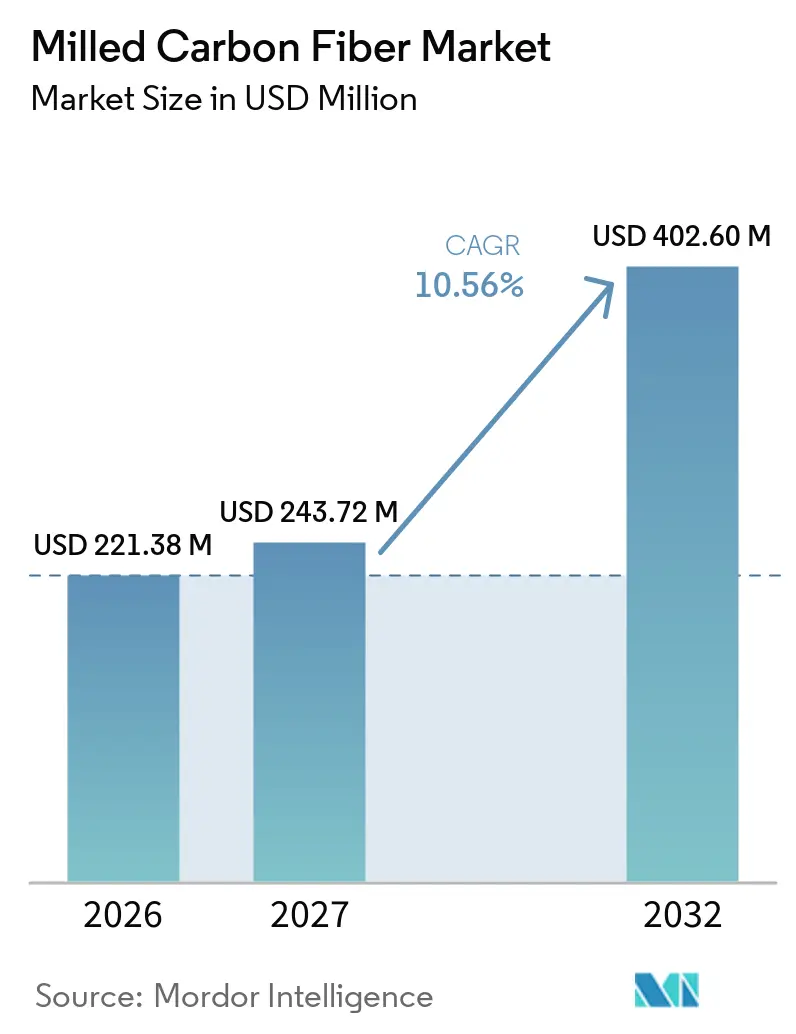
| Market Size (2027) | USD 243.72 Million |
| Market Size (2032) | USD 402.60 Million |
| Growth Rate (2027 - 2032) | 10.56 % |
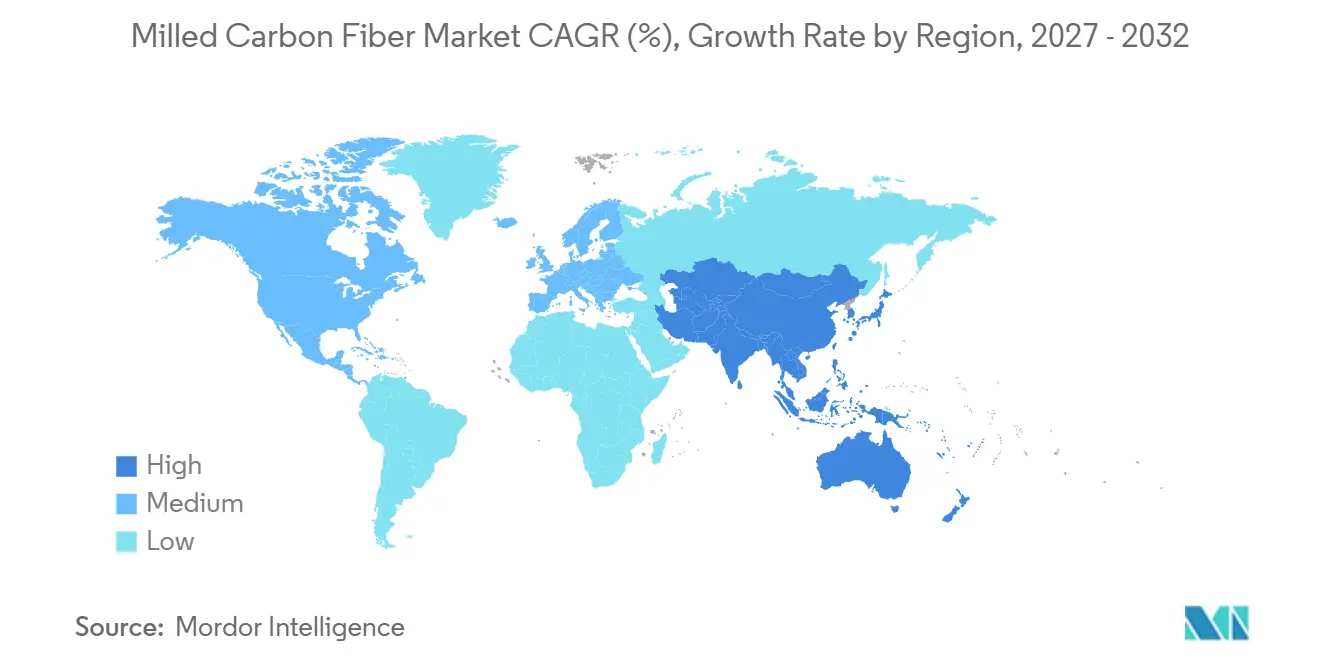
| Fastest Growing Market | Asia-Pacific |
| Largest Market | North America |
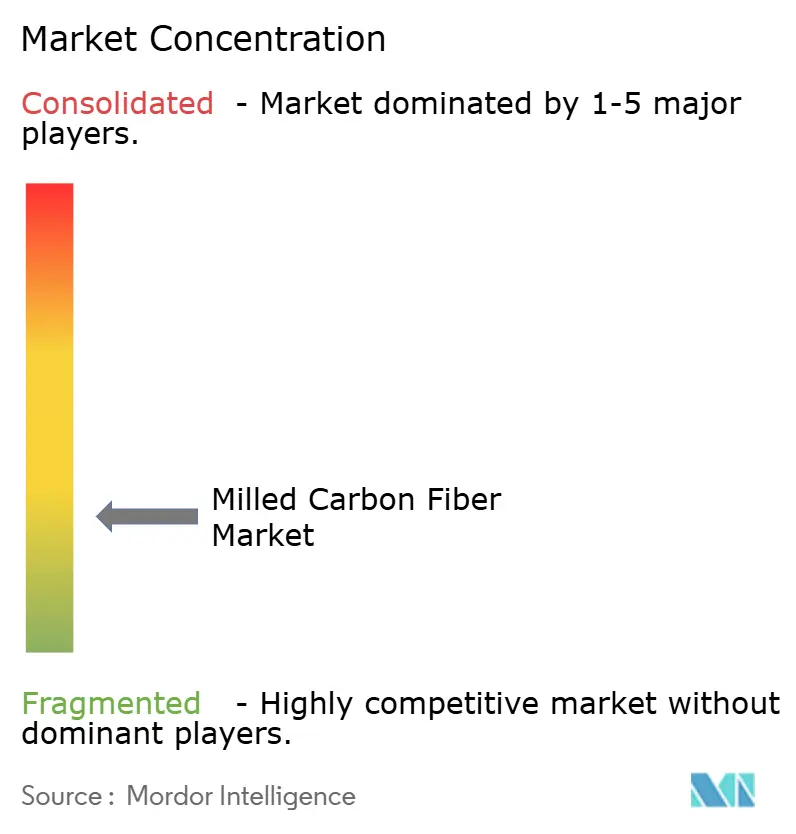
| Market Concentration | Low |
Major Players *Disclaimer: Major Players sorted in no particular order Image © Mordor Intelligence. Reuse requires attribution under CC BY 4.0. | |
Milled Carbon Fiber Market Analysis by Mordor Intelligence
The Milled Carbon Fiber Market size was valued at USD 221.38 million in 2026 and is estimated to grow from USD 243.72 million in 2027 to reach USD 402.60 million by 2032, at a CAGR of 10.56% during the forecast period (2027-2032). The milled carbon fiber market is being shaped by requirements for lighter vehicle parts, lower material emissions, documented recycled content across value chains, and more reliable thermal and electrical performance in polymer compounds. Recycled material has moved from a limited alternative to an important supply stream as processors improve recovery quality and buyers seek documented carbon reductions. The milled carbon fiber market also benefits from applications that can use existing molding equipment, which reduces the need for major line changes. Producers are responding by combining feedstock access, particle-size control, surface treatment, and traceability rather than competing on fiber supply alone. Qualification requirements and processing costs remain important because customers need stable properties, traceability, and repeatable results in demanding applications.
Key Report Takeaways
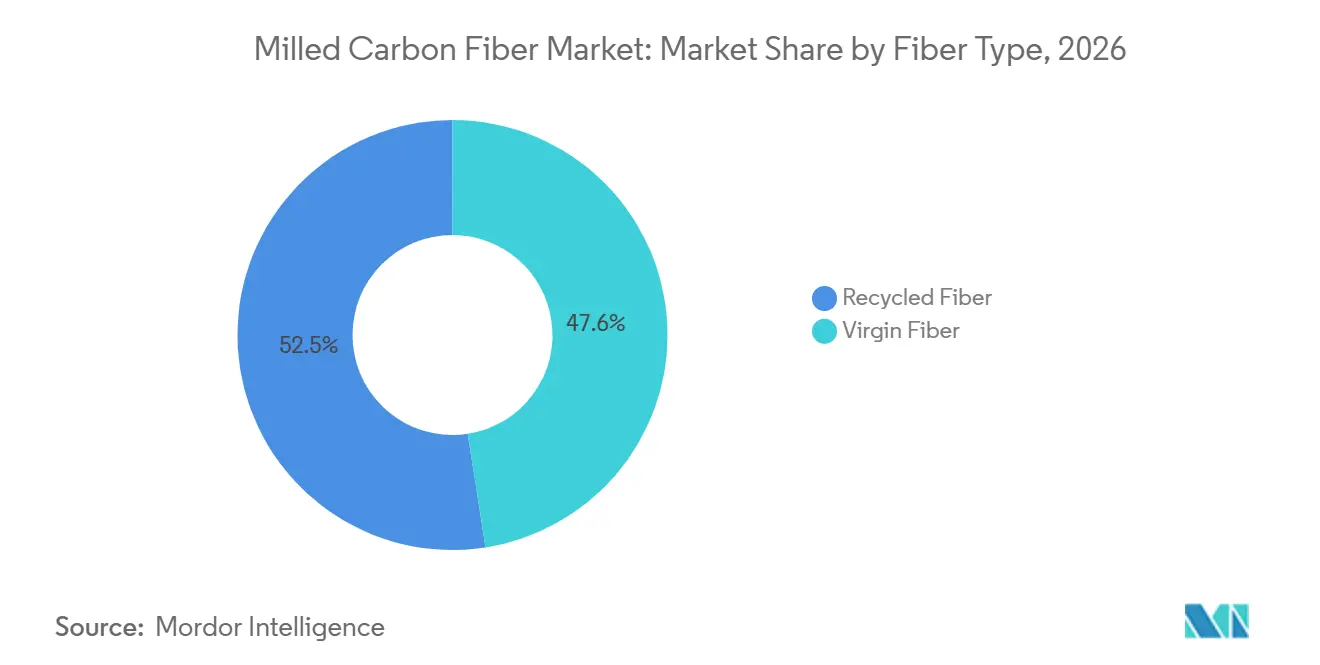
- By fiber type, recycled fiber held 52.45% of the milled carbon fiber market share in 2026, while recycled fiber is projected to advance at an 11.06% CAGR through 2032.
- By application, reinforcements held 43.62% of the milled carbon fiber market share in 2026, while coatings and adhesives are projected to advance at an 11.34% CAGR through 2032.
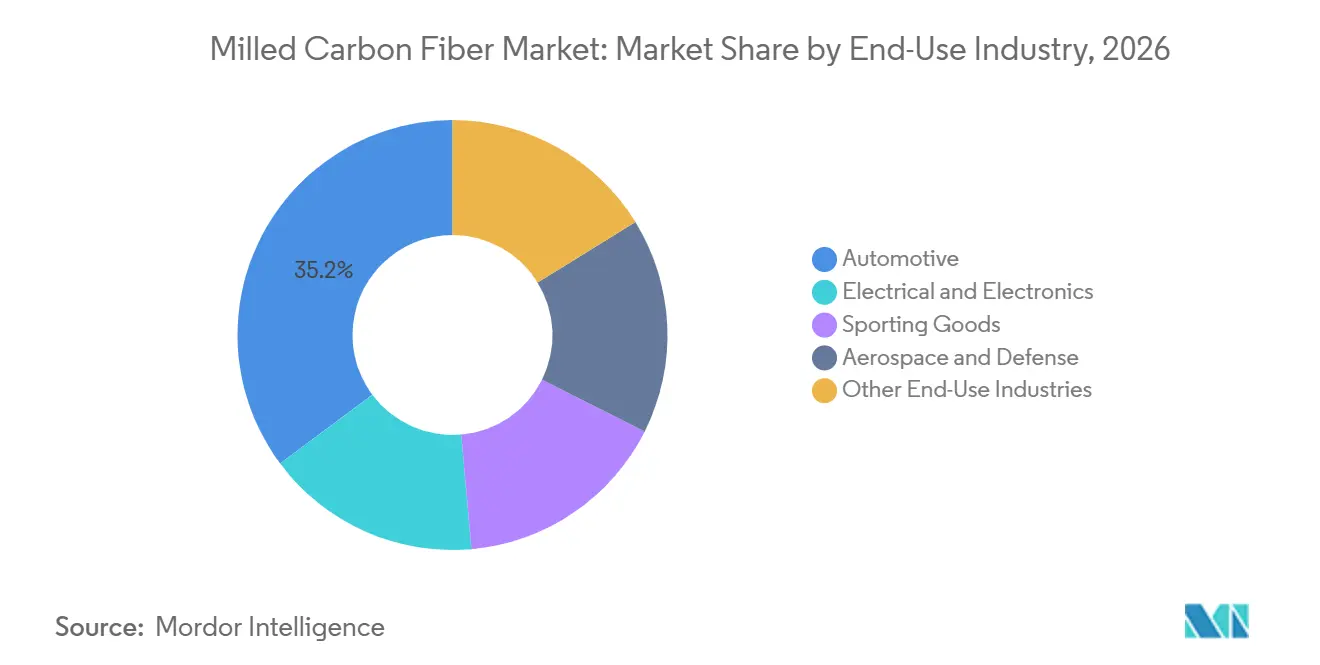
- By end-use industry, automotive held 35.20% of the milled carbon fiber market share in 2026 and is projected to advance at an 11.57% CAGR through 2032.
- By geography, North America held 32.78% of the milled carbon fiber market share in 2026, while Asia-Pacific is projected to advance at an 11.49% CAGR through 2032.
Note: Market numbers in this report are based on Mordor Intelligence's proprietary estimation framework, which combines nine months of actuals with Q4 projections for base year 2026.
Market Trends and Insights
Drivers Impact Analysis of Milled Carbon Fiber Market*
| Driver | (~) % Impact on CAGR Forecast | Geographic Relevance | Impact Timeline |
|---|---|---|---|
| Lightweighting for Vehicle Efficiency and EV Range | +3.2% | Global, concentrated in North America, Europe, and East Asia | Short term (≤ 2 years) |
| Recycled Fiber Cost and Embodied-Carbon Advantage | +2.8% | Global; strongest pull in North America and EU | Short term (≤ 2 years) |
| Demand for Conductive and Thermally Stable Fillers | +1.6% | APAC core, spillover to North America | Medium term (2–4 years) |
| Aerospace and Wind-Industry Composite Scrap Availability | +1.4% | North America & EU | Medium term (2–4 years) |
| Qualification of Milled Fiber in Additive Manufacturing Feedstock | +1.0% | Global | Long term (≥ 4 years) |
| Source: Mordor Intelligence | |||
Lightweighting for Vehicle Efficiency and EV Range
Electric vehicle platforms need lower mass outside the battery pack because heavier components reduce the range available from a fixed battery capacity. The milled carbon fiber market serves this requirement in injection-molded battery brackets, motor housings, and structural panels. A 2025 study found that polypropylene filaments with 9.09 weight percent (wt%) milled carbon fiber had 74% higher tensile strength and 99% higher flexural strength than unfilled polymer. These results support the use of carbon-fiber-filled compounds where manufacturers want greater stiffness without metal inserts or heavier mineral fillers. The milled format can run through standard injection-molding screws, which reduces the equipment barrier for high-volume vehicle programs. Component-level weight reduction can therefore be introduced without a full redesign of the molding process.
Recycled Fiber Cost and Embodied-Carbon Advantage
Recycled milled fiber offers both lower material emissions and a lower energy requirement than virgin fiber routes. A 2025 review reported an embodied greenhouse-gas footprint of 2.0 kg CO₂-equivalent per kilogram for recycled carbon fiber, compared with 12.6 kg CO₂-equivalent per kilogram for virgin carbon fiber. The same review reported that recycled-fiber production can use 50% to 70% less energy than virgin production. This makes recycled feedstock relevant to buyers in the milled carbon fiber market that must document material-level emissions in their supply chains. The milled carbon fiber market can also gain from lower procurement costs when recovered feedstock is available at a suitable quality. The commercial value of recycled grades depends on consistent properties, since a lower carbon footprint does not remove the need for reliable compound performance.
Demand for Conductive and Thermally Stable Fillers
Electronic devices, power conversion equipment, data-center hardware, and vehicle battery systems need materials that manage heat without adding the weight of metal parts. Milled carbon fiber can be dispersed into thin polymer sections and can contribute both thermal and electrical functionality. A 2025 study of aligned carbon-fiber arrays in silicone composites reported through-plane thermal conductivity of 141.57 W m⁻¹ K⁻¹. Carbon-fiber-filled housings can also support electromagnetic interference shielding in equipment for 5G networks and advanced driver-assistance systems. The milled carbon fiber market is suited to these uses because suppliers can use a single filler to address reinforcement, thermal transfer, and electrical conductivity in the right polymer system. Performance still depends on fiber alignment, loading level, and dispersion quality.
Aerospace and Wind-Industry Composite Scrap Availability
Composite scrap from aerospace manufacturing and retired wind-energy equipment can provide feedstock for recycled milled fiber. Aerospace-grade scrap is valuable because it can offer controlled fiber quality and more consistent surface characteristics than mixed post-consumer waste. In June 2025, Westlake Epoxy and Alpha Recyclage Composites announced a collaboration that targets 1,000 metric tons of composite waste processed annually by 2027 through steam pyrolysis. The project shows how processors are organizing feedstock collection and recycling capacity around industrial volumes. Recovered material can lower disposal requirements while creating an input for compound and coating applications. Reliable scrap supply remains important because variation in resin systems and fiber grades affects the quality of the resulting milled material.
Restraints Impact Analysis of Milled Carbon Fiber Market*
| Restraint | (~) % Impact on CAGR Forecast | Geographic Relevance | Impact Timeline |
|---|---|---|---|
| High Energy and Processing Cost for Consistent Particle-Size Distribution | -2.5% | Global; most acute in North America and EU where energy and labor costs are highest | Short term (≤ 2 years) |
| Variable Fiber Length and Surface Chemistry in Recycled Feedstock | -2.0% | Global | Medium term (2–4 years) |
| Qualification and Test-Standard Gaps for Recycled Composite Grades | -1.5% | North America & EU | Long term (≥ 4 years) |
| Source: Mordor Intelligence | |||
High Energy and Processing Cost for Consistent Particle-Size Distribution
Narrow particle-size specifications require shredding, milling, classification, and quality checks that use energy and equipment time. A 2025 study reported mechanical milling energy of 2.03 MJ per kilogram of processed composite material. Energy use rises when customers require tighter particle distributions or when feedstock has a high fiber volume fraction. This creates pressure on margins in applications where processors compete primarily on price. Smaller recyclers can face wider batch variation than operators with continuous grinding and air-classification systems. Investment in continuous equipment can improve consistency, but it can also be difficult in regions with high energy prices or limited financing.
Variable Fiber Length and Surface Chemistry in Recycled Feedstock
Recycled composite feedstock varies by original fiber grade, resin system, service history, and recovery process. These differences influence fiber length, surface chemistry, and adhesion to a new polymer matrix. A 2025 comparative assessment found that recycling methods can produce materially different fiber quality and environmental outcomes[1]. Solvolysis can retain surface characteristics that are closer to virgin fiber, while pyrolysis can change the surface in ways that affect matrix adhesion. Customers in conductive filler and thermal-management applications are particularly sensitive to these variations because network formation depends on consistent fiber geometry. The milled carbon fiber market will remain divided between commodity recycled grades and higher-specification material until sorting and characterization improve.
*Our forecasts treat driver/restraint impacts as directional, not additive. The impact forecasts reflect baseline growth, mix effects, and variable interactions.
Milled Carbon Fiber Market Segment Analysis
By Fiber Type:
Recycled Fiber Has a Cost and Carbon AdvantageRecycled fiber held 52.45% of the milled carbon fiber market share in 2026 and is projected to advance at an 11.06% CAGR through 2032. Its position reflects lower input costs and lower emissions associated with recovery routes. A 2025 review found an embodied greenhouse-gas footprint of 2.0 kg CO₂-equivalent per kilogram for recycled carbon fiber, compared with 12.6 kg CO₂-equivalent per kilogram for virgin carbon fiber. The review also found that recycling can use 50% to 70% less energy than virgin production. These characteristics support procurement programs that measure product-level emissions and use recycled material in reinforcement, coating, conductive, and thermal applications.
Virgin fiber held 47.55% of the milled carbon fiber market share in 2026 and continues to serve applications requiring precise geometry and verified surface chemistry. Aerospace interiors, defense electronics, and demanding power-electronics applications can place greater weight on controlled properties than on material cost. The boundary between recycled and virgin material will depend on progress in fiber recovery and specification practices. Pyrolysis-recovered fiber can supply broader compound applications, while solvolysis-recovered material can serve higher-value coatings and thermal-management uses. ISO 19350:2025 supports the assessment of recycled filament properties, helping buyers compare materials during qualification.
By Application:
Reinforcements Lead While Coatings and Adhesives ExpandReinforcements held 43.62% of the milled carbon fiber market share in 2026. Established formulations for injection-molded parts and bulk molding compound components support this position. Qualified suppliers and existing compound recipes support continued use in structural and semi-structural parts. Electrically conductive fillers, thermal-management materials, and electromagnetic shielding use the same basic material properties in specialized ways. Additive manufacturing is another application where fiber geometry and polymer compatibility determine final performance.
Coatings and adhesives are projected to advance at an 11.34% CAGR through 2032. Demand is linked to conductive coatings for battery enclosures, motor casings, and underbody shielding in electric vehicles. Milled carbon fiber can help formulators meet conductivity or antistatic requirements at lower volumetric loadings than some alternatives. Lower filler loading can improve coating flow and reduce total compound cost. Carbon fiber can also act as a structural modifier in underbody sealants and bonding formulations for multi-material vehicle bodies.
By End-Use Industry:
Automotive Leads Demand and GrowthAutomotive held 35.20% of the milled carbon fiber market share in 2026 and is projected to advance at an 11.57% CAGR through 2032. Vehicle makers use milled fiber in interior trim, under-hood compounds, battery housings, cross-beam assemblies, and underbody components. The shift toward electric vehicles increases the value of reducing mass in structural and functional parts. In March 2025, Syensqo and Vartega Inc. announced a collaboration to convert dry carbon fiber and prepreg waste into EasyFeed Bundles for Syensqo’s ECHO portfolio of specialty polymers. The applications include automotive structural parts, damping rings, and transmission-related products.
Electrical and electronics demand is supported by the need for heat management and electromagnetic interference shielding in power equipment, 5G infrastructure, and server racks. Sporting goods users can value recycled content and lower embedded emissions, while aerospace and defense users place high importance on material specifications. These higher-requirement customers can also generate valuable scrap for the recycling supply chain. In December 2025, Mitsubishi Chemical Group Corporation announced a phased expansion at its Aichi, Japan, and Sacramento, California, plants that targeted approximately double current production capacity by 2027. Civil engineering and marine composites are additional uses as corrosion-resistant compound applications develop.

Geography Analysis
North America Milled Carbon Fiber Market
North America held 32.78% of the milled carbon fiber market share in 2026. The region combines a large automotive base, recycling activity, and early use of milled fiber in structural and functional applications. Demand includes injection-molded compounds, additive manufacturing materials, and components that need lower weight or electrical performance. Automotive qualification programs give milled carbon fiber market suppliers a path to higher-volume use when recovered fiber properties are consistent. Research on milled-fiber-filled polypropylene filament also supports functional automotive part fabrication.
APAC Milled Carbon Fiber Market
Asia-Pacific is projected to advance at an 11.49% CAGR through 2032. China’s electric vehicle production, Japan’s composites base, and South Korea’s fiber-producer capacity support regional demand. Japan has a role in recycled carbon-fiber qualification through work on testing and fiber recovery. ISO 19350:2025 provides a method for assessing tensile-strength distribution and interfacial shear strength of recycled carbon-fiber filaments. India and the Association of Southeast Asian Nations (ASEAN) countries can provide further demand as electric vehicle adoption grows outside China.
EMEA and South America Milled Carbon Fiber Market
Europe benefits from aerospace scrap availability, recycling investment, and buyer interest in lower-carbon composite materials. Westlake Epoxy and Alpha Recyclage Composites announced a 2025 collaboration for a French recycling operation targeting 1,000 metric tons of annual composite-waste processing by 2027. South America, the Middle East, and Africa remain earlier-stage demand areas for imported material in automotive and aerospace maintenance, repair, and overhaul applications. Their progress depends on import economics, local recycling capacity, and original equipment manufacturer investment.
Competitive Landscape
The milled carbon fiber market is highly fragmented, with the top five players including TORAY INDUSTRIES, INC., Mitsubishi Chemical Group Corporation, Teijin Limited, SGL Carbon, and Procotex. Offerings can differ by feedstock access, recovery route, milling capability, and ability to document recycled content. Buyers increasingly need traceability and reliable quality data for use in regulated or high-performance applications.
Companies are using partnerships and capacity plans to build more circular composite supply chains. In March 2025, Syensqo and Vartega Inc. announced a technical and commercial collaboration to recover Syensqo waste for use in specialty polymers. In June 2025, Syensqo signed a contract with Fairmat to process its United Kingdom carbon fiber prepreg waste for applications in sports, energy, mobility, and electronics[2]. In December 2025, Mitsubishi Chemical Group Corporation announced an expansion intended to approximately double carbon fiber production capacity by 2027. These actions show efforts to secure feedstock, expand production, and connect material recovery with downstream demand.
Opportunities are concentrated in precise grades for additive manufacturing and thermal-management compounds. Recycled material with controlled length distribution can address printability limitations in high-resolution processes. A 2025 study of recycled milled fiber in polyamide 6,6 showed that functional filament performance can be achieved with appropriate process control. ISO 19350:2025 gives manufacturers a shared basis for assessing recycled-fiber filament behavior, and competitive positions will depend on the ability to supply specification-grade material at commercial volumes.
Milled Carbon Fiber Industry Leaders
-
TORAY INDUSTRIES, INC.
-
Mitsubishi Chemical Group Corporation
-
Teijin Limited
-
SGL Carbon
-
Procotex
- *Disclaimer: Major Players sorted in no particular order
Milled Carbon Fiber Market Companies Covered in this Report
- Carbon Fiber Recycling, Inc.
- Formosa Plastics Corporation
- Gen 2 Carbon Limited
- Hexcel Corporation
- HS HYOSUNG ADVANCED MATERIALS
- KUREHA CORPORATION
- Mitsubishi Chemical Group Corporation
- Nippon Graphite Fiber Co., Ltd.
- Procotex
- SGL Carbon
- Shocker Composites LLC
- Syensqo
- Teijin Limited
- TORAY INDUSTRIES, INC.
- Vartega Inc.
Recent Industry Developments in Milled Carbon Fiber Market
- March 2026: Teijin Carbon expanded its Tenax Next product line with additional carbon fiber materials based on circular feedstocks, reporting a verified 36% reduction in carbon dioxide emissions while maintaining benchmark tensile and stiffness performance. The development supports the milled carbon fiber market by increasing the availability of lower-carbon carbon fiber feedstocks and strengthening demand for sustainable reinforcement materials.
- November 2025: Carbon Fiber Recycling, LLC launched a new range of milled recycled carbon fiber produced from recovered cured composites, prepreg scrap, and dry-fiber waste, offering customized fiber lengths for injection molding, bulk molding compounds, and 3D printing. The launch supports the milled carbon fiber market by expanding access to recycled reinforcement materials that reduce reliance on virgin carbon fiber and help lower material costs and environmental impact.
Global Milled Carbon Fiber Market Report Scope
Milled carbon fiber consists of chopped and finely processed carbon fibers used as reinforcing or functional additives in polymer compounds and other materials. It helps improve mechanical strength, stiffness, dimensional stability, and electrical or thermal conductivity in specialized formulations.
The Milled Carbon Fiber Market is segmented by fiber type, application, end-use industry, and geography. By fiber type, the market is segmented into recycled fiber and virgin fiber. By application, the market is segmented into reinforcements, coatings and adhesives, electrically conductive fillers, thermal management materials, electromagnetic shielding, additive manufacturing feedstock, and other applications. By end-use industry, the market is segmented into automotive, electrical and electronics, sporting goods, aerospace and defense, and other end-use industries. The report also covers the market size and forecasts for milled carbon fiber across 15 countries. For each segment, the market sizing and forecasts have been done on the basis of value (USD).
Segmentation Overview
| Recycled Fiber |
| Virgin Fiber |
| Reinforcements |
| Coatings and Adhesives |
| Electrically Conductive Fillers |
| Thermal Management Materials |
| Electromagnetic Shielding |
| Additive Manufacturing Feedstock |
| Other Applications |
| Automotive |
| Electrical and Electronics |
| Sporting Goods |
| Aerospace and Defense |
| Other End-Use Industries |
| Asia-Pacific | China |
| India | |
| Japan | |
| South Korea | |
| ASEAN Countries | |
| Rest of Asia-Pacific | |
| North America | United States |
| Canada | |
| Mexico | |
| Europe | Germany |
| United Kingdom | |
| France | |
| Italy | |
| NORDIC Countries | |
| Rest of Europe | |
| South America | Brazil |
| Argentina | |
| Rest of South America | |
| Middle East and Africa | Saudi Arabia |
| South Africa | |
| Rest of Middle East and Africa |
| By Fiber Type | Recycled Fiber | |
| Virgin Fiber | ||
| By Application | Reinforcements | |
| Coatings and Adhesives | ||
| Electrically Conductive Fillers | ||
| Thermal Management Materials | ||
| Electromagnetic Shielding | ||
| Additive Manufacturing Feedstock | ||
| Other Applications | ||
| By End-Use Industry | Automotive | |
| Electrical and Electronics | ||
| Sporting Goods | ||
| Aerospace and Defense | ||
| Other End-Use Industries | ||
| By Geography | Asia-Pacific | China |
| India | ||
| Japan | ||
| South Korea | ||
| ASEAN Countries | ||
| Rest of Asia-Pacific | ||
| North America | United States | |
| Canada | ||
| Mexico | ||
| Europe | Germany | |
| United Kingdom | ||
| France | ||
| Italy | ||
| NORDIC Countries | ||
| Rest of Europe | ||
| South America | Brazil | |
| Argentina | ||
| Rest of South America | ||
| Middle East and Africa | Saudi Arabia | |
| South Africa | ||
| Rest of Middle East and Africa | ||
Key Questions Answered in the Report
What is the size of the milled carbon fiber market?
The milled carbon fiber market size was valued at USD 221.38 million in 2026 and is estimated to grow from USD 243.72 million in 2027 to reach USD 402.60 million by 2032, at a CAGR of 10.56% during the forecast period (2027-2032).
Which fiber type held the largest share in 2026?
Recycled fiber held 52.45% of the market share in 2026.
What application held the largest share in 2026?
Reinforcements held 43.62% of the market share in 2026.
Which end-use industry is projected to advance fastest through 2032?
Automotive is projected to advance at an 11.57% CAGR through 2032.