
Military Aircraft Actuation Systems Market Size and Share
Market Overview
| Study Period | 2020 - 2032 |
|---|---|
| Market Size (2027) | USD 3.13 Billion |
| Market Size (2032) | USD 4.61 Billion |
| Growth Rate (2027 - 2032) | 8.05 % |
| Fastest Growing Market | Asia-Pacific |
| Largest Market | North America |
| Market Concentration | Medium |
Major Players *Disclaimer: Major Players sorted in no particular order Image © Mordor Intelligence. Reuse requires attribution under CC BY 4.0. | |
Military Aircraft Actuation Systems Market Analysis by Mordor Intelligence
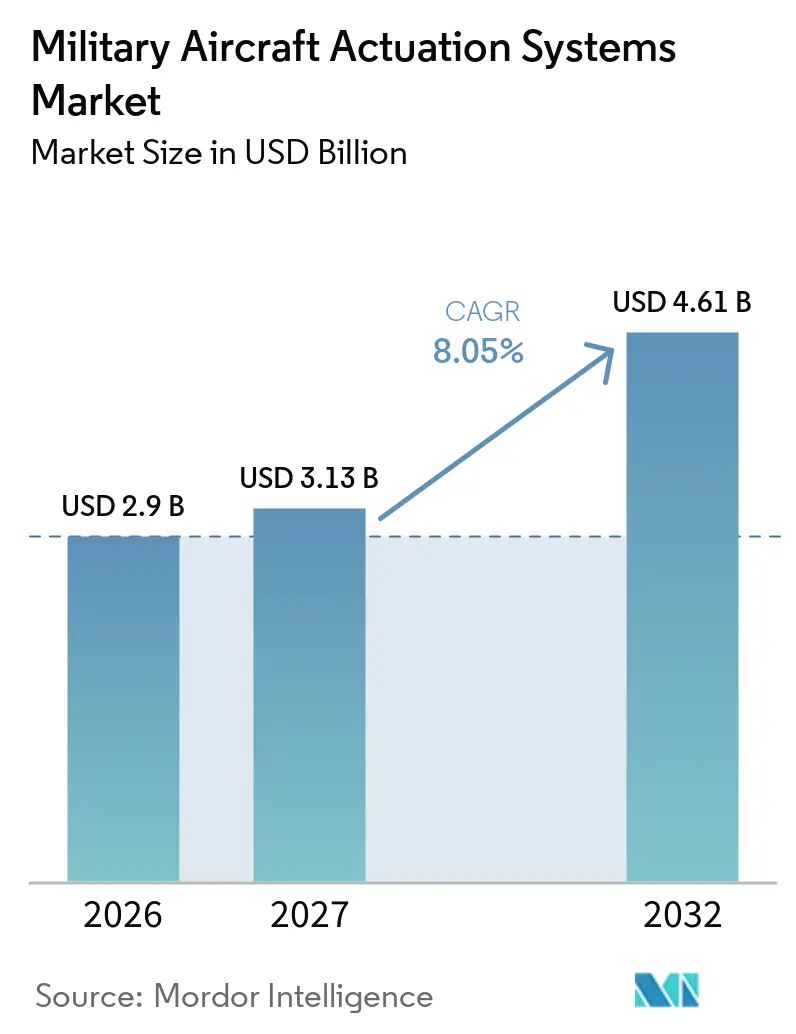
The military aircraft actuation systems market size was valued at USD 2.90 billion in 2026 and is forecast to grow from USD 3.13 billion in 2027 to reach USD 4.61 billion by 2032, at an 8.05% CAGR during the forecast period (2027-2032). Defense fleet renewal supports demand for actuators on combat, transport, and trainer platforms, while overhaul work keeps legacy fleets relevant to suppliers. The US Do requested USD 68.30 billion for aviation and related systems in FY2026, including USD 32.40 billion for tactical air, which supports procurement and sustainment activity across the supply chain. More-electric aircraft designs favor self-contained electro-hydrostatic and electromechanical solutions, although hydraulic systems remain necessary on many installed platforms. The military aircraft actuation systems market also faces material and qualification constraints, which favor suppliers with certified products, established repair networks, and reliable sourcing of magnets and semiconductors.
Key Report Takeaways
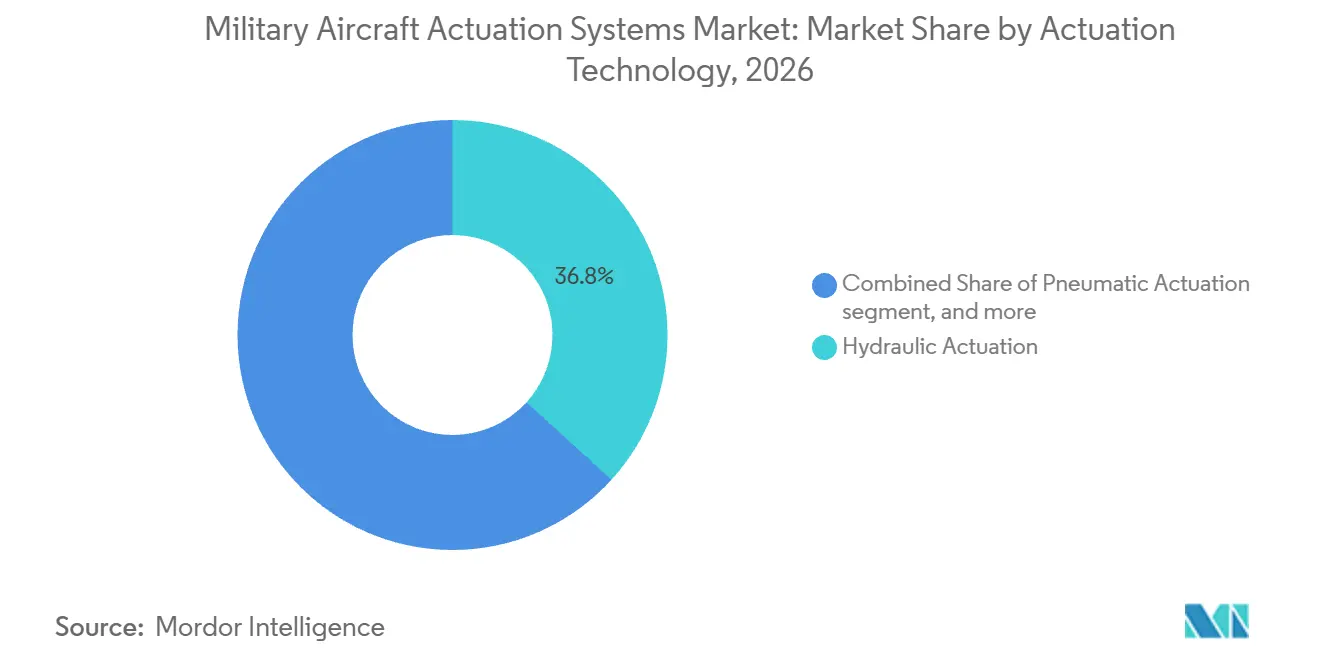
- By actuation technology, hydraulic actuation held 36.75% of the military aircraft actuation systems market share in 2026, while electro-hydrostatic actuation is forecast to grow at a 10.89% CAGR through 2032.
- By type, linear actuators accounted for 69.76% revenue share in 2026, while rotary actuators are projected to expand at a 9.67% CAGR through 2032.
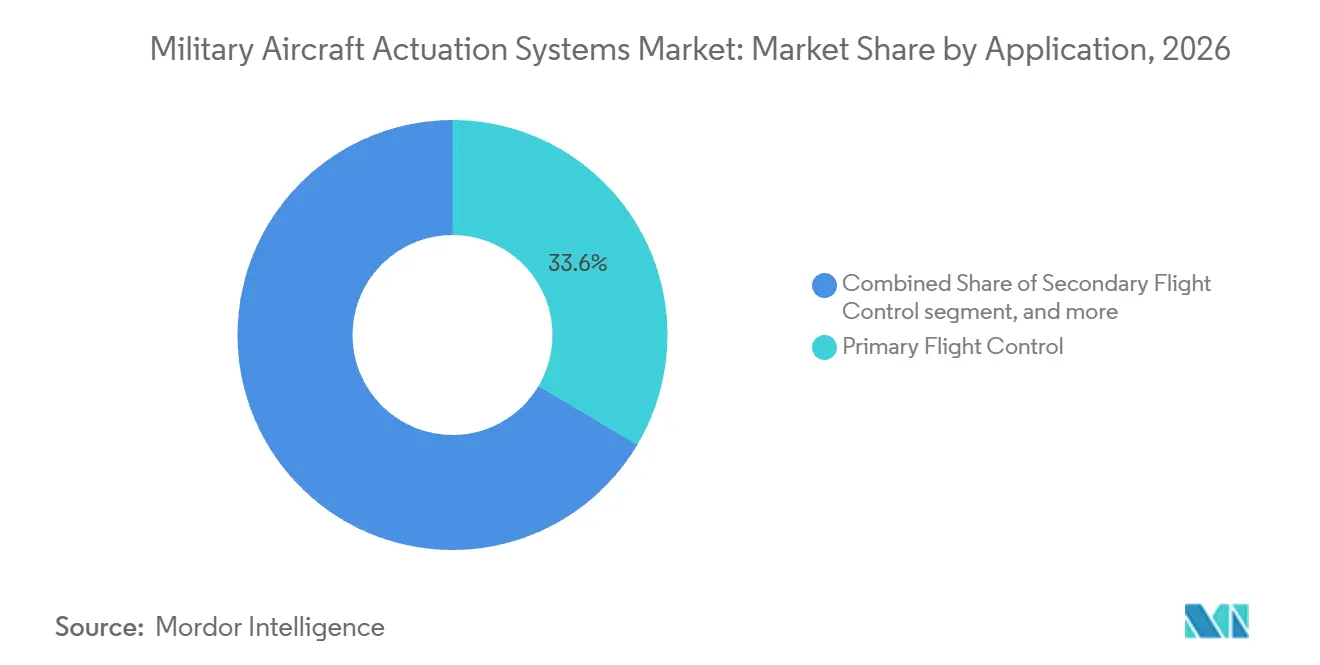
- By application, primary flight control held a 33.56% revenue share in 2026, while weapons bay and stores actuation is forecast to grow at a 9.85% CAGR through 2032.
- By aircraft type, combat aircraft accounted for 63.45% revenue share in 2026, while training aircraft is forecast to expand at a 9.41% CAGR through 2032.
- By installation type, aftermarket services held 53.65% revenue share in 2026, while OEM installations are forecast to grow at a 10.01% CAGR through 2032.
- By geography, North America accounted for 36.78% of revenue share in 2026, while Asia-Pacific is forecast to expand at a 10.34% CAGR through 2032.
Note: Market numbers in this report are based on Mordor Intelligence's proprietary estimation framework, which combines nine months of actuals with Q4 projections for base year 2026.
Market Trends and Insights
Drivers Impact Analysis of Military Aircraft Actuation Systems Market*
| Driver | (~) % Impact on CAGR Forecast | Geographic Relevance | Impact Timeline |
|---|---|---|---|
| Defense fleet modernization and replacement programs | +2.00% | Global | Short term (≤ 2 years) |
| More-electric aircraft architecture adoption | +1.50% | North America and Europe, with spillover to Asia-Pacific | Medium term (2-4 years) |
| Increasing demand for advanced flight control actuation in next-generation military aircraft | +1.60% | North America and Europe | Medium term (2-4 years) |
| Expansion of fighter, transport, and special-mission fleets | +1.20% | Asia-Pacific, with spillover to Middle East and Africa | Short term (≤ 2 years) |
| Increasing demand for platform availability and predictive maintenance | +0.80% | Global | Medium term (2-4 years) |
| Indigenous aerospace manufacturing and localization programs | +0.70% | Asia-Pacific, with spillover to Middle East and Africa | Long term (≥ 4 years) |
| Source: Mordor Intelligence | |||
Defense Fleet Modernization and Replacement Programs
The military aircraft actuation systems market benefits from fleet modernization, as both new aircraft and deep upgrades require qualified actuation content. The FY2026 US aviation and related systems request totals USD 68.30 billion, up from USD 45.30 billion in FY2017, supporting procurement, development, and overhaul activities.[1] The F-35 production framework covering lots 21 through 30 establishes a long production horizon for power-by-wire flight control equipment. The B-21 Raider received USD 721.60 million in advance procurement for FY2026, while B-52 modernization also supports refurbishment demand on a platform expected to remain in service past 2050. These programs create recurring demand for production units, spares, repairs, and engineering support over extended service lives.
More-Electric Aircraft Architecture Adoption
More-electric aircraft architecture is changing the technology mix in the military aircraft actuation systems market by moving selected functions away from centralized hydraulic circuits. Local electrical power and self-contained actuation can reduce hydraulic routing, maintenance requirements, and energy losses across the airframe. Electro-hydrostatic systems preserve hydraulic force density while removing dependence on an aircraft-wide hydraulic loop. This direction raises the importance of electronics qualification under DO-254 and environmental testing under DO-160. Suppliers without electro-hydrostatic or electromechanical products may have fewer opportunities as future platforms select power-by-wire flight control architectures.
Advanced Flight Control Actuation for Next-Generation Aircraft
Next-generation combat aircraft require actuation systems that fit tighter spaces while retaining high force output and dependable operation. Belgium’s PFC-REA project began in May 2025 with a EUR 5.59 million (USD 6.23 million) budget and runs through February 2028 to develop a rotary electromechanical actuator for primary flight controls.[2] The program addresses thin wing profiles that can limit the use of conventional hydraulic plumbing and linear arrangements. Japan allocated JPY 206.60 billion (USD 1.31 billion) to next-generation fighter development in its FY2026 budget request under the Global Combat Air Program (GCAP) with the UK and Italy. The combined requirements of stealth geometry, internal weapons integration, and electrical power distribution raise design and qualification demands. As a result, suppliers are competing on installed envelope, thermal performance, environmental resilience, and long-term support capability rather than actuator output alone.
Fleet Expansion, Availability, and Localization Programs
Fleet expansion creates both original-equipment and maintenance demand because actuator overhaul schedules do not always match broader airframe upgrade cycles. The FY2025 US Air Force budget includes USD 861.10 million for F-22A modifications and USD 206.90 million for C-130J modifications, which may include actuator refurbishment or replacement. Training and transport fleets also need high availability because they accumulate operating hours rapidly. In India, the Aeronautical Development Agency and Godrej & Boyce signed an agreement at Aero India 2025 to develop flight-control actuators for the AMCA program. The agreement covers precision manufacturing, assembly, testing, and qualification test-rig development, linking localization to domestic production capability. This part of the military aircraft actuation systems market therefore rewards suppliers that combine certified hardware with repair capacity, testing facilities, and local industrial partnerships.
Restraints Impact Analysis of Military Aircraft Actuation Systems Market*
| Restraint | (~) % Impact on CAGR Forecast | Geographic Relevance | Impact Timeline |
|---|---|---|---|
| Long qualification cycles and high non-recurring engineering costs | -1.50% | Global | Short term (≤ 2 years) |
| Dependence on rare-earth magnets, semiconductors, and specialized materials | -1.10% | Global | Short term (≤ 2 years) |
| Thermal management and power density limits in electromechanical actuators | -0.90% | North America and Europe | Medium term (2-4 years) |
| Export controls, classified design data, and sovereignty requirements | -0.80% | Global | Medium term (2-4 years) |
| Source: Mordor Intelligence | |||
Long Qualification Cycles and High Non-Recurring Engineering Costs
Qualification remains a material constraint in the military aircraft actuation systems market because primary flight control products are safety-critical. Military programs require thermal cycling, vibration assessment, electromagnetic compatibility testing, failure-mode analysis, and life simulation before first delivery. These activities can extend for 5 to 8 years from design freeze to the first article on a new platform. The process makes early supplier selection important, since a new entrant must invest before aircraft requirements are fully stable. It also makes qualification standards, including MIL-STD-810 and MIL-STD-461, central to product development and production planning. High non-recurring engineering costs strengthen established suppliers’ positions, while repair and aftermarket work can provide a more accessible route for newer regional suppliers.
Materials, Thermal Limits, and Export Controls
Electromechanical and electro-hydrostatic systems depend on magnets, semiconductors, and specialized materials that face supply and qualification risks. The International Energy Agency reported that China accounted for 60% of rare-earth mining, 91% of separation and refining, and 94% of sintered permanent magnet production in 2024. Thermal management and power density also remain design challenges for electric actuation in high-load military applications. China expanded its rare-earth export controls in October 2025, adding requirements affecting internationally manufactured items containing Chinese-origin rare earths. The US Department of Commerce announced a letter of intent for USD 50 million in CHIPS incentives to support Vulcan Elements’ domestic magnet production in November 2025. These constraints can lengthen qualification timelines and encourage regional sourcing for systems subject to export control and sovereignty requirements.
*Our forecasts treat driver/restraint impacts as directional, not additive. The impact forecasts reflect baseline growth, mix effects, and variable interactions.
Military Aircraft Actuation Systems Market Segment Analysis
By Actuation Technology:
Electro-Hydrostatic Systems Gain New-Platform RelevanceHydraulic actuation held 36.75% of the military aircraft actuation systems market in 2026, supported by legacy combat and transport fleets with centralized hydraulic power systems. Replacing a hydraulic actuator on an in-service aircraft can require lengthy flight-clearance work to support the continued use of the installed technology. Electro-hydrostatic actuation is the fastest-growing technology, with a forecast CAGR of 10.89% through 2032. Its self-contained hydraulic loop combines hydraulic force density with less dependence on central hydraulic distribution. Moog Inc. states that its aircraft electro-hydrostatic actuators support the F-35 power-by-wire system and the A400M.[3] This operating record supports the shift toward electro-hydrostatic designs for safety-critical flight controls on future platforms.
Conventional hydraulic systems remain important where existing platform architecture, proven reliability, and high-load capability outweigh the benefits of redesign. Pneumatic systems continue to serve lower-complexity uses, including canopy jettisoning, door control, and selected auxiliary functions. The military aircraft actuation systems industry is therefore moving through a gradual technology transition rather than a complete replacement cycle. Suppliers need hydraulic support capabilities alongside electric and electro-hydrostatic development programs to address the full installed base.

By Type:
Linear Actuators Retain Scale While Rotary Designs ExpandLinear actuators accounted for 69.76% of revenue in 2026 because conventional flight surfaces commonly use linear movement for ailerons, elevators, rudders, and leading-edge flaps. Their high output force per unit stroke is well-suited to the large loads on aircraft control surfaces. Rotary actuators are forecast to grow at a 9.67% CAGR through 2032 as aircraft designs place greater weight on compact installation. Thinner wing profiles and constrained internal spaces can make conventional hinge-moment arrangements harder to integrate. Belgium’s PFC-REA project specifically selected a rotary electromechanical approach for next-generation primary flight control applications. The project reflects demand for actuator architectures that work within reduced structural envelopes without compromising flight control requirements.
Rotary designs can also limit some sealing challenges associated with linear electromechanical configurations. Their growth does not remove the large installed base of linear hydraulic and electro-hydraulic products. India’s Aeronautical Development Agency issued a tender in October 2026 for 5 flight-worthy units of a leading-edge flap actuation system, underscoring ongoing demand for compact, qualified hardware for indigenous programs. The design choice will depend on the surface, load path, available space, certification plan, and maintenance concept. Once a configuration is qualified for a platform, the selected supplier can gain follow-on opportunities for spares, repair, and upgrades across the aircraft’s operating life. This gives the military aircraft actuation systems market a long lead time between initial technical selection and later aftermarket revenue.
By Application:
Primary Flight Control Remains Largest While Weapons-Bay Systems AdvancePrimary flight control represented 33.56% of revenue in 2026, reflecting the number, redundancy, and safety requirements of actuators fitted to core control surfaces. A twin-engine combat aircraft can use 4 to 8 primary surface actuators, and each unit must meet strict reliability and availability requirements. The weapons-bay and stores segment is forecast to grow at a 9.85% CAGR through 2032. Internal weapons bays on stealth platforms require compact bay-door actuation capable of completing repeated cycles under demanding operating conditions. India’s DRDO initiated a Technology Development Fund project for a jam-tolerant geared rotary actuator for next-generation fighter weapons-bay applications.
Landing gear, steering, braking, and engine or fuel-control functions add important demand beyond primary surfaces. Wear-related maintenance cycles make landing gear and braking systems relevant to aftermarket activity. Weapons-bay work is especially tied to platforms where internal carriage supports low-observable design requirements. Engine and fuel-control applications also require actuation systems that perform near high-temperature powerplant interfaces. These applications can favor electric solutions when they meet thermal and reliability targets, while established hydraulic solutions remain prevalent across many fleets. The military aircraft actuation systems market size for these applications reflects the differing content levels and service needs of combat, transport, and training aircraft. Suppliers must balance common product platforms with tailored qualification for each operating environment.
By Aircraft Type:
Combat Aircraft Lead Revenue and Training Aircraft Grow FastestCombat aircraft accounted for 63.45% of revenue in 2026 because high-performance platforms use multiple actuators for flight control, landing gear, weapons bays, and engine control. A single F-35 carries a broad range of actuation equipment, resulting in higher system content than many transport or training platforms. The US F-35 production framework supports ongoing requirements for qualified actuation components and associated support. Transport platforms, including the C-130J, C-17, A400M, and KC-46A, also generate steady demand for repairs and life extensions. The US Air Force’s FY2025 budget includes USD 206.90 million for C-130J modifications. These fleets provide a substantial sustainment base because they are operated for long periods and frequently undergo capability upgrades.
Training aircraft are forecast to expand at a 9.41% CAGR through 2032, as pilot-training needs and new trainer deliveries support demand for original equipment. In April 2026, the US Air Force approved the T-7A Red Hawk for production and awarded Boeing a USD 219 million contract for the first 14 aircraft, related spares, and support equipment. The program is planned to deliver 351 aircraft to replace the T-38 fleet. Training fleets accumulate hours at a high rate, which can bring repair demand earlier in the service life than on some combat fleets. The military aircraft actuation systems industry can therefore find new platform opportunities in trainer programs alongside the larger revenue base of combat aircraft.
By Installation Type:
Aftermarket Demand Supports Revenue While OEM Programs AccelerateThe aftermarket accounted for 53.65% of revenue in 2026 because many military aircraft in service were designed decades ago and require recurring actuator overhauls, refurbishments, or replacements. Hydraulic, electro-hydraulic, and early electric systems all need maintenance under condition-based support programs. In September 2026, the US Navy awarded Moog Military Aircraft LLC a USD 16.5 million contract to overhaul V-22 Osprey swashplate actuators through March 2029. The contract illustrates the recurring nature of sustainment work for a single rotary-wing platform family. Aftermarket work depends on installed fleet numbers, utilization, repair capability, qualification status, and the availability of replacement parts. It also provides a stable route for suppliers with established repair stations and fleet-specific technical expertise.
OEM installation is forecast to grow at a 10.01% CAGR through 2032 as the T-7A, KF-21, GCAP platforms, and AMCA variants progress through qualification and production. New contracts create demand for development, test hardware, serial production units, and spares. An OEM win can also create a long aftermarket tail, since aircraft operators need approved support over decades of service. Suppliers may accept meaningful non-recurring engineering costs to secure this later repair and replacement work. The military aircraft actuation systems market size for OEM activity is thus shaped by a relatively small number of platform selections with long operating lives. Successful suppliers need early design involvement, program-level certification planning, and the capacity to support later increases in production rate.
Geography Analysis
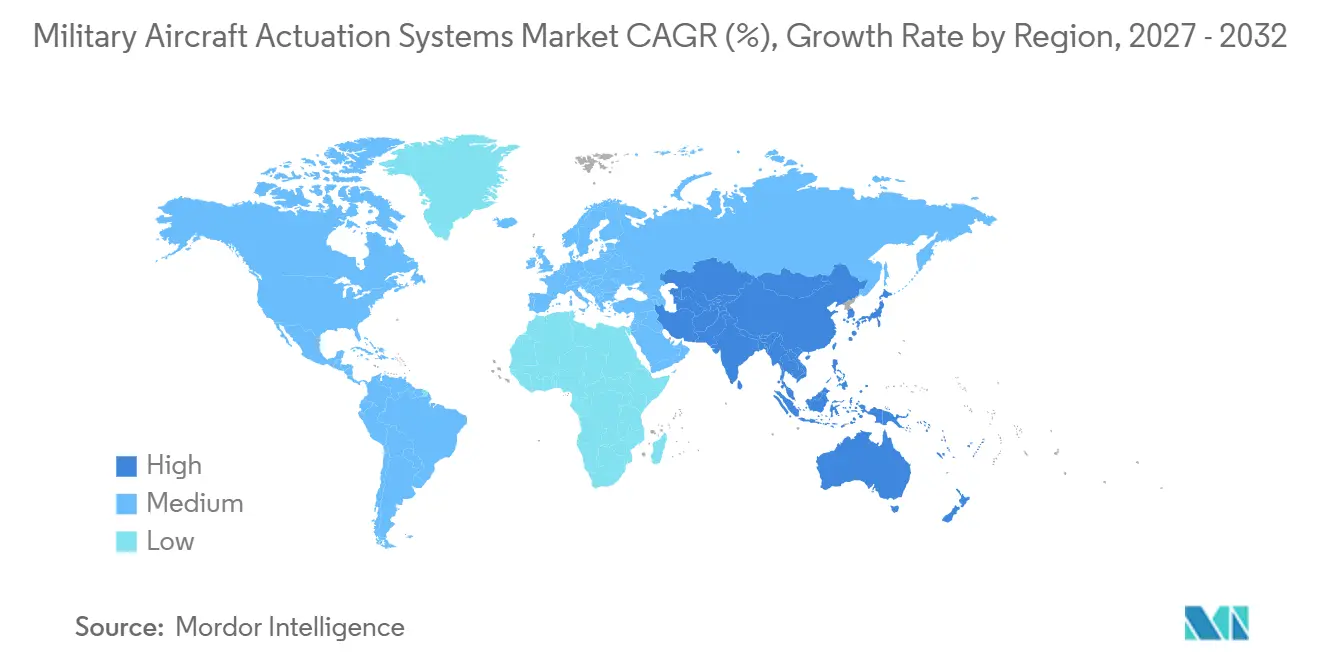
North America held 36.78% of the military aircraft actuation systems market share in 2026, supported by US aircraft procurement, modernization, and sustainment spending. The FY2026 US DoD request allocates USD 68.30 billion to aviation and related systems. F-35 production, B-21 advance procurement, and upgrades for F-22A, F-16, C-17, and B-52 platforms create both original-equipment and repair demand. The region also has a broad base of certified suppliers and maintenance organizations. Material security has become increasingly important because electric actuation relies on magnets and electronics. The Department of Commerce’s support for domestic magnet production highlights the link between industrial policy and aerospace supply resilience. MIL-STD-810, MIL-STD-461, and export controls remain key compliance factors for products supplied into US defense programs.
Asia-Pacific is forecast to grow at a 10.34% CAGR through 2032. Regional demand is supported by fleet replacement, new indigenous programs, and national requirements for domestic production capability. India’s AMCA-related actuator development activity shows how local manufacturing, test capability, and qualification work are becoming part of supplier selection. South Korea’s KF-21 program adds another production and support opportunity within the region. Companies entering the region need to address local-content expectations as well as platform-specific qualification rules. This combination of fleet growth and localization makes partnership models important for suppliers seeking long-term positions.
Europe is expanding sovereign next-generation capability through the GCAP and national technology projects. Belgium’s rotary electromechanical actuator project runs from May 2025 through February 2028 and supports the development of flight control systems for future combat aircraft. Export-control requirements and the protection of classified design data can influence which suppliers participate in programs. The Middle East and Africa primarily support demand by sustaining F-15, Eurofighter, and Tornado fleets, with modernization requirements under review. South America has smaller but continuing needs linked to Brazil’s C-390 fleet and legacy fighter support in Argentina and Colombia. Across these regions, aircraft acquired in the 1990s and 2000s are entering deeper upgrade and life-extension cycles. The military aircraft actuation systems market size is therefore supported by a mix of European technology development and sustainment demand in other regions.
Competitive Landscape
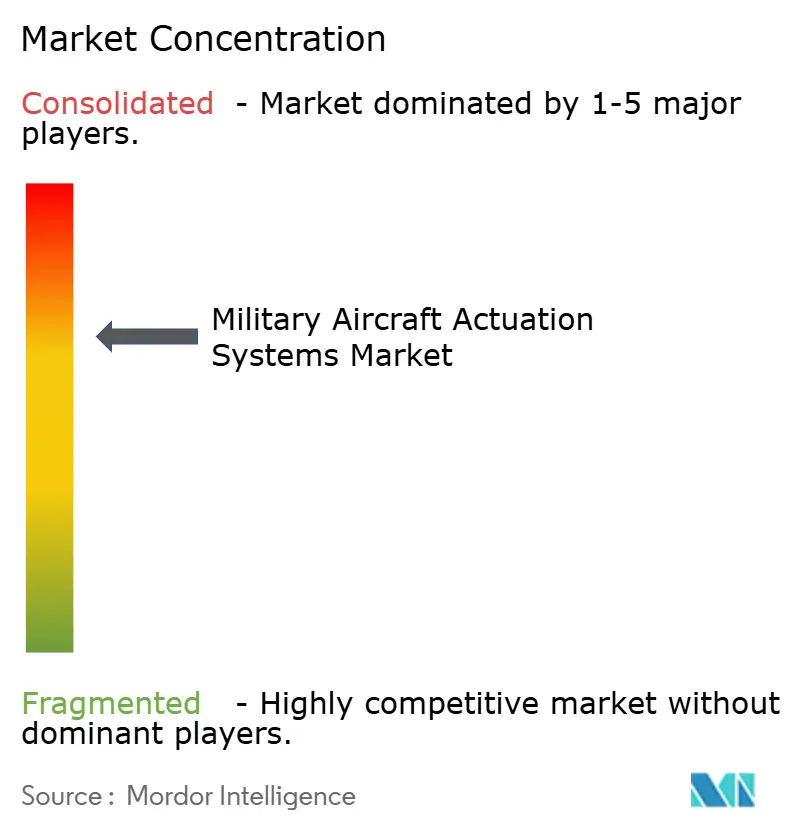
The military aircraft actuation systems market is moderately consolidated at the OEM level, where Moog Inc., Safran SA, Honeywell Aerospace Inc., Woodward, Inc., and Parker-Hannifin Corporation hold established positions in complex applications. Qualification is an important source of supplier strength because changing an approved actuator on a production aircraft can require costly engineering and flight clearance work. This creates long-lived revenue from production, spares, repairs, and upgrades. Moog’s electro-hydrostatic technology is used in the F-35 power-by-wire system and the Airbus A400M, demonstrating operational use in combat and transport applications. The military aircraft actuation systems market favors suppliers that can maintain qualification data, support fleet operators, and deliver hardware over long program cycles. These conditions raise the value of proven design capability and repair infrastructure.
Strategic activity centers on expanding electric and electro-hydrostatic product lines, strengthening repair capabilities, and reducing exposure to material disruptions. Moog’s V-22 repair work illustrates how a certified position can produce recurring support opportunities during a platform’s service life. The US Air Force’s T-7A production approval in April 2026 also creates an opportunity for suppliers qualified on a new training platform. Domestic magnet manufacturing support in the US represents another strategic shift because it may reduce dependence on constrained material sources. The military aircraft actuation systems market is consequently shaped by technical product development and supply chain assurance. Suppliers are likely to prioritize program partnerships and material qualification alongside conventional product performance.
Regional entrants can find opportunities in training aircraft, maintenance work, and indigenous fighter programs where governments encourage local industrial participation. Hindustan Aeronautics Limited, Godrej & Boyce, and Korea Aerospace Industries operate in environments where domestic sourcing is strategically important. These companies still face substantial certification, test, and support requirements before competing in safety-critical flight-control applications. ITAR and other export-control regimes can also limit access to data, components, and certain foreign suppliers. Established tier-one companies remain well-positioned, with approved equipment and long-standing repair capabilities. At the same time, localization requirements can create controlled routes for regional firms to enter selected applications. The competitive structure is therefore neither fully closed nor broadly fragmented, as qualification and national industrial policy shape access to each program.
Military Aircraft Actuation Systems Industry Leaders
-
Moog Inc.
-
Parker-Hannifin Corporation
-
Safran SA
-
Woodward, Inc.
-
Honeywell Aerospace Inc.
- *Disclaimer: Major Players sorted in no particular order
Military Aircraft Actuation Systems Market Companies Covered in this Report
- Moog Inc.
- Parker-Hannifin Corporation
- Safran SA
- Honeywell Aerospace Inc.
- Woodward, Inc.
- RTX Corporation
- Triumph Group, Inc.
- Liebherr-International Deutschland GmbH (Liebherr Group)
- Curtiss-Wright Corporation
- Eaton Corporation plc
- BAE Systems plc
- Leonardo S.p.A.
- Air Industries Group
- Airbus SE
- Arkwin Industries, Inc.
- Northrop Grumman Corporation
Recent Industry Developments in Military Aircraft Actuation Systems Market
- October 2026: The US Navy awarded Moog Military Aircraft LLC (Moog Inc.) a USD 16.50 million sole-source, firm-fixed-price contract for the overhaul of V-22 Osprey swashplate actuators, with work performed in East Aurora, New York, and Havelock, North Carolina, through March 2029. The award underscores the long-duration, high-value nature of aftermarket actuation sustainment contracts on rotary-wing military platforms.
- February 2026: Moog Military Aircraft LLC (Moog Inc.) announced a contract with the US DoD running through August 2030, covering electromechanical actuation supply and support services for US military aircraft platforms.
- January 2025: Air Industries Group announced a contract worth USD 5.90 million for flight control assemblies (actuators) for the US Air Force F-5/T-38 aircraft.
Global Military Aircraft Actuation Systems Market Report Scope
The military aircraft actuation systems market comprises mechanical, hydraulic, pneumatic, electromechanical, and electro-hydrostatic systems designed to control and operate movable components across military fixed-wing aircraft. The scope includes linear and rotary actuators supplied for new military aircraft production, fleet modernization, component replacement, and aftermarket programs. The market focuses exclusively on military fixed-wing aircraft applications and excludes commercial aircraft, military and commercial helicopters, unmanned aerial vehicles (UAVs), and other unmanned aircraft platforms.
The military aircraft actuation systems market is segmented by actuation technology, type, application, aircraft type, installation type, and geography. By actuation technology, the market is segmented into hydraulic actuation, pneumatic actuation, electromechanical actuation, electro-hydrostatic actuation, and others. By type, the market is segmented into linear and rotary actuators. By application, the market is segmented into primary flight control, secondary flight control, landing gear, steering, and braking, thrust reverser and nacelle, engine and fuel-control, weapons bay and stores, and others. By aircraft type, the market is segmented into combat aircraft, training aircraft, transport aircraft, and others. By installation type, the market is segmented into original equipment manufacturer (OEM) and aftermarket. The report also covers market sizes and forecasts for the military aircraft actuation systems market in major countries across the regions. For each segment, the market size is provided in terms of value (USD).
Segmentation Overview
| Hydraulic Actuation |
| Pneumatic Actuation |
| Electromechanical Actuation |
| Electro-Hydrostatic Actuation |
| Others |
| Linear |
| Rotary |
| Primary Flight Control |
| Secondary Flight Control |
| Landing Gear, Steering, and Braking |
| Thrust Reverser and Nacelle |
| Engine and Fuel-Control |
| Weapons Bay and Stores |
| Others |
| Combat Aircraft |
| Training Aircraft |
| Transport Aircraft |
| Others |
| Original Equipment Manufacturer (OEM) |
| Aftermarket |
| North America | United States | |
| Canada | ||
| Mexico | ||
| Europe | United Kingdom | |
| France | ||
| Germany | ||
| Italy | ||
| Russia | ||
| Rest of Europe | ||
| Asia-Pacific | China | |
| India | ||
| Japan | ||
| South Korea | ||
| Australia | ||
| Rest of Asia-Pacific | ||
| South America | Brazil | |
| Rest of South America | ||
| Middle East and Africa | Middle East | Saudi Arabia |
| United Arab Emirates | ||
| Turkey | ||
| Africa | South Africa | |
| Rest of Africa | ||
| By Actuation Technology | Hydraulic Actuation | ||
| Pneumatic Actuation | |||
| Electromechanical Actuation | |||
| Electro-Hydrostatic Actuation | |||
| Others | |||
| By Type | Linear | ||
| Rotary | |||
| By Application | Primary Flight Control | ||
| Secondary Flight Control | |||
| Landing Gear, Steering, and Braking | |||
| Thrust Reverser and Nacelle | |||
| Engine and Fuel-Control | |||
| Weapons Bay and Stores | |||
| Others | |||
| By Aircraft Type | Combat Aircraft | ||
| Training Aircraft | |||
| Transport Aircraft | |||
| Others | |||
| By Installation Type | Original Equipment Manufacturer (OEM) | ||
| Aftermarket | |||
| By Geography | North America | United States | |
| Canada | |||
| Mexico | |||
| Europe | United Kingdom | ||
| France | |||
| Germany | |||
| Italy | |||
| Russia | |||
| Rest of Europe | |||
| Asia-Pacific | China | ||
| India | |||
| Japan | |||
| South Korea | |||
| Australia | |||
| Rest of Asia-Pacific | |||
| South America | Brazil | ||
| Rest of South America | |||
| Middle East and Africa | Middle East | Saudi Arabia | |
| United Arab Emirates | |||
| Turkey | |||
| Africa | South Africa | ||
| Rest of Africa | |||
Key Questions Answered in the Report
What is the projected value of military aircraft actuation systems by 2032?
The military aircraft actuation systems market is projected to reach USD 4.61 billion by 2032, rising from USD 3.13 billion in 2027 at an 8.05% CAGR.
Which actuation technology is growing fastest in military aircraft?
Electro-hydrostatic actuation is forecast to grow at a 10.89% CAGR through 2032 because it supports more-electric aircraft architecture.
Why do hydraulic actuators remain important for military aircraft?
Hydraulic actuation held 36.75% revenue share in 2026 because many combat and transport fleets use established centralized hydraulic systems.
Which aircraft category creates the greatest demand for these systems?
Combat aircraft accounted for 63.45% of revenue in 2026 because high-performance platforms need multiple flight control, landing gear, weapons-bay, and engine control actuators.
What supports aftermarket demand for aircraft actuators?
Aftermarket services held 53.65% of revenue in 2026 because legacy fleets need recurring overhaul, refurbishment, and replacement work.
Which region is expanding fastest for military aircraft actuator suppliers?
Asia-Pacific is forecast to grow at a 10.34% CAGR through 2032, supported by new aircraft programs, fleet expansion, and localization activity.