
Military Aerospace Coatings Market Size and Share
Market Overview
| Study Period | 2021 - 2031 |
|---|---|
| Market Size (2026) | USD 368.27 Million |
| Market Size (2031) | USD 446.77 Million |
| Growth Rate (2026 - 2031) | 3.94 % |
| Fastest Growing Market | Asia-Pacific |
| Largest Market | North America |
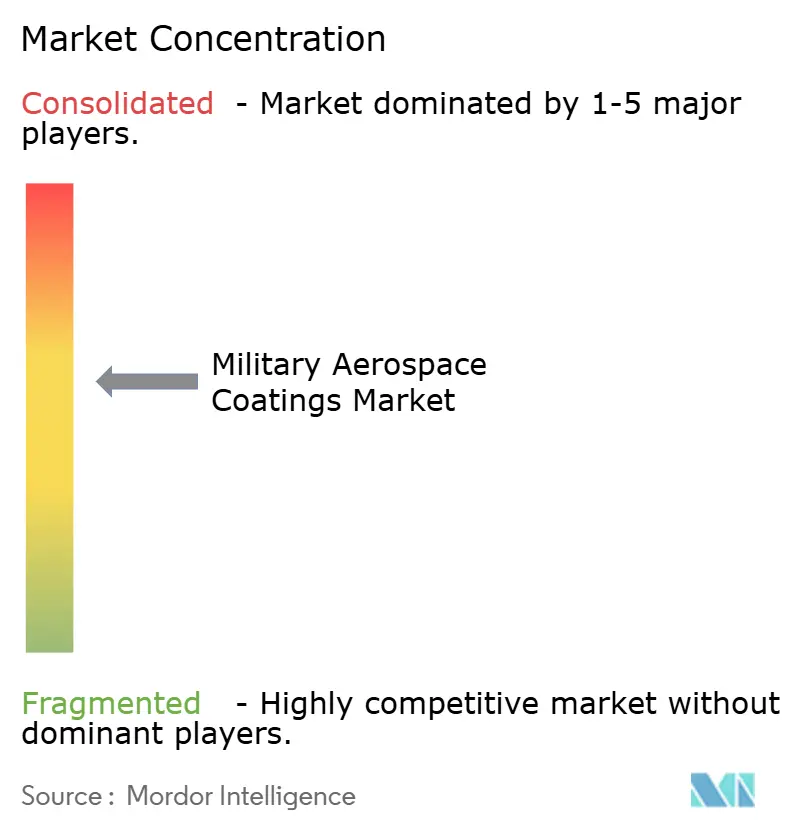
| Market Concentration | Medium |
Major Players *Disclaimer: Major Players sorted in no particular order Image © Mordor Intelligence. Reuse requires attribution under CC BY 4.0. | |
Military Aerospace Coatings Market Analysis by Mordor Intelligence
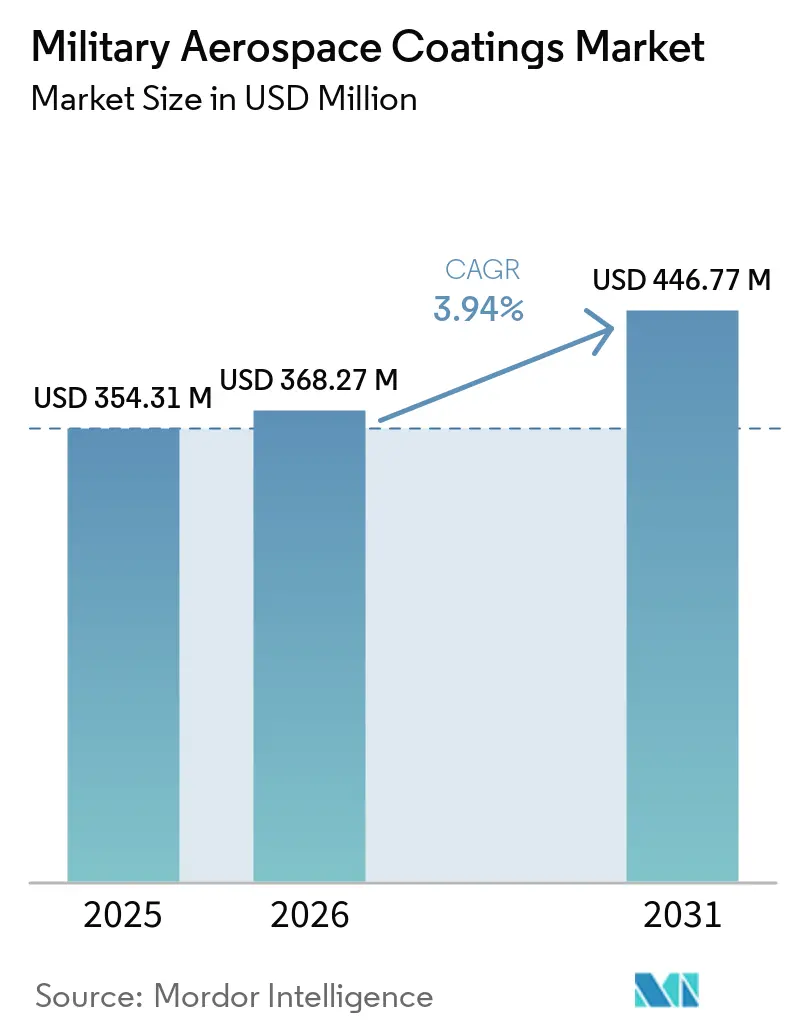
The Military Aerospace Coatings Market size was valued at USD 354.31 million in 2025 and is estimated to grow from USD 368.27 million in 2026 to reach USD 446.77 million by 2031, at a CAGR of 3.94% during the forecast period (2026-2031). Rising defense procurement supports demand for coatings across new aircraft programs and service-life extension work. Global military expenditure reached USD 2.887 trillion in 2025, marking the 11th consecutive annual increase, while spending rose 14% in Europe and 8.1% in Asia and Oceania. These budget conditions support both original aircraft production and the maintenance of existing fleets. Environmental requirements are also changing product development, as suppliers work to qualify chrome-free, low-volatile organic compound (VOC), and per- and polyfluoroalkyl substances (PFAS)-reduced systems. The military aerospace coatings market, therefore, depends on the ability of suppliers to meet long approval cycles while serving regional manufacturing and maintenance programs.
Key Report Takeaways
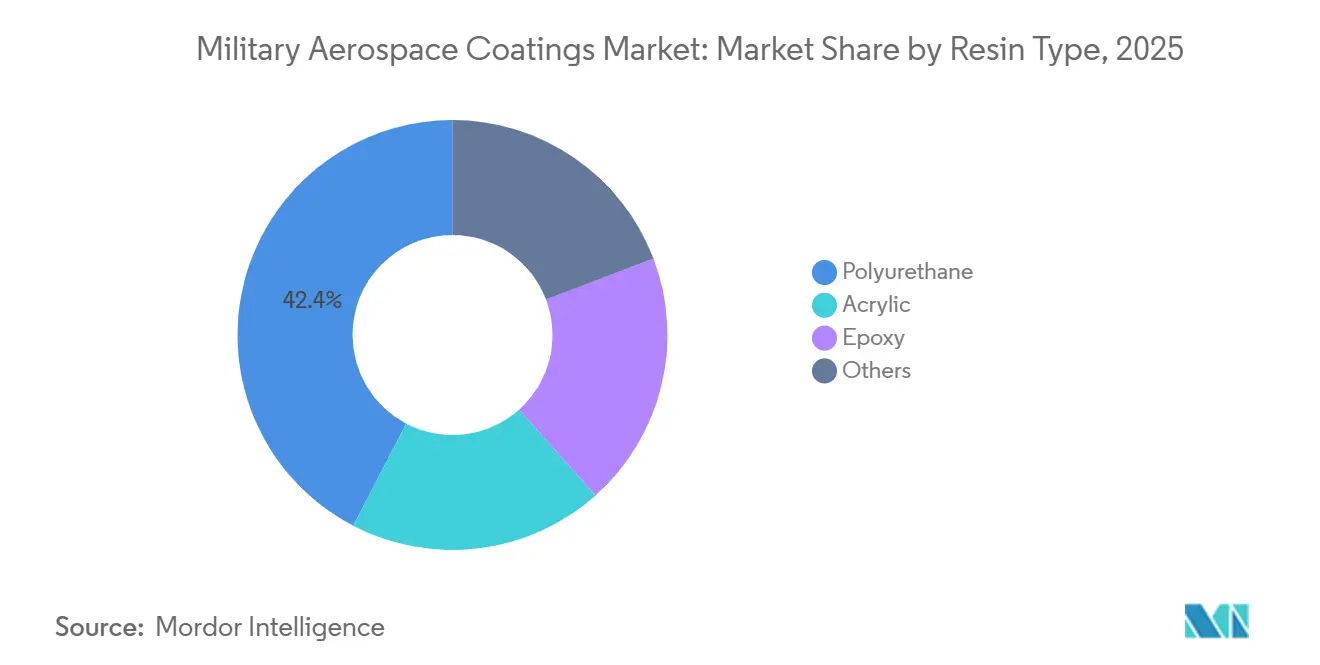
- By resin type, polyurethane held 42.36% of the military aerospace coatings market in 2025 and is projected to advance at a 5.35% CAGR through 2031.
- By technology, solvent-borne held 57.34% of the military aerospace coatings market in 2025, while water-borne is projected to advance at a 5.67% CAGR through 2031.
- By user type, original equipment manufacturers (OEMs) held 54.78% of the military aerospace coatings market in 2025, while maintenance, repair and overhaul (MRO) are projected to advance at a 6.13% CAGR through 2031.
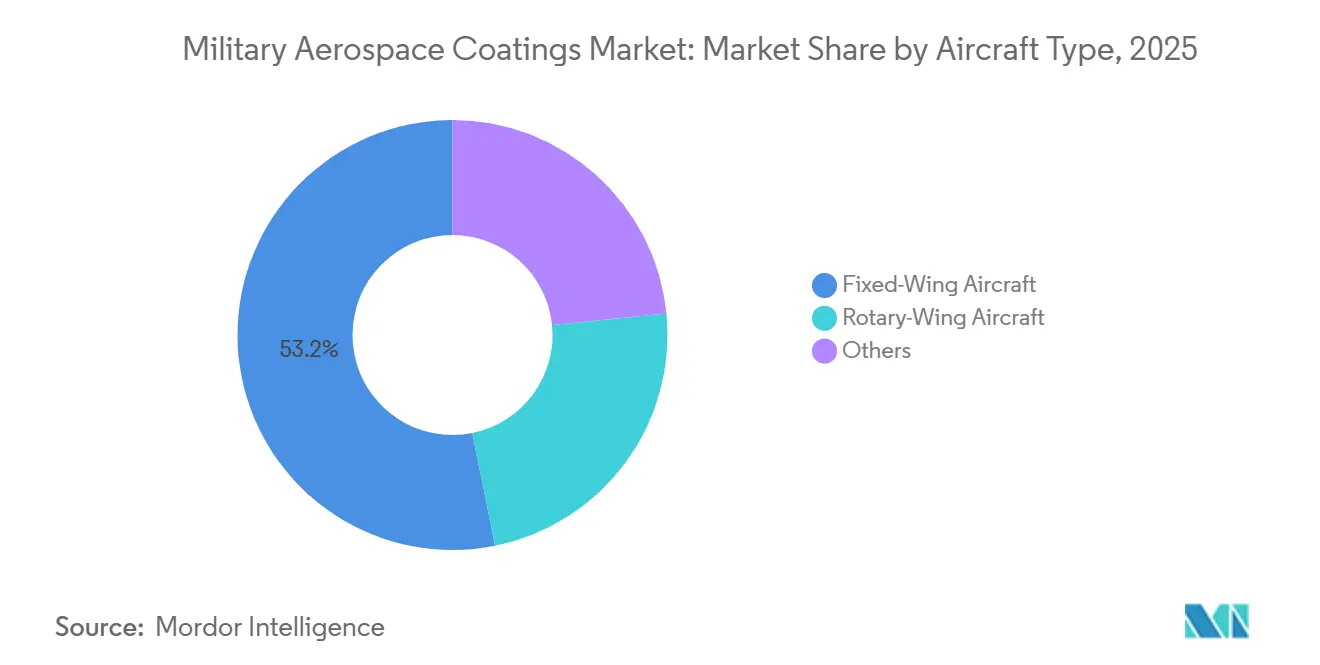
- By aircraft type, fixed-wing aircraft held 53.17% of the military aerospace coatings market in 2025, while rotary-wing aircraft is projected to advance at a 5.77% CAGR through 2031.
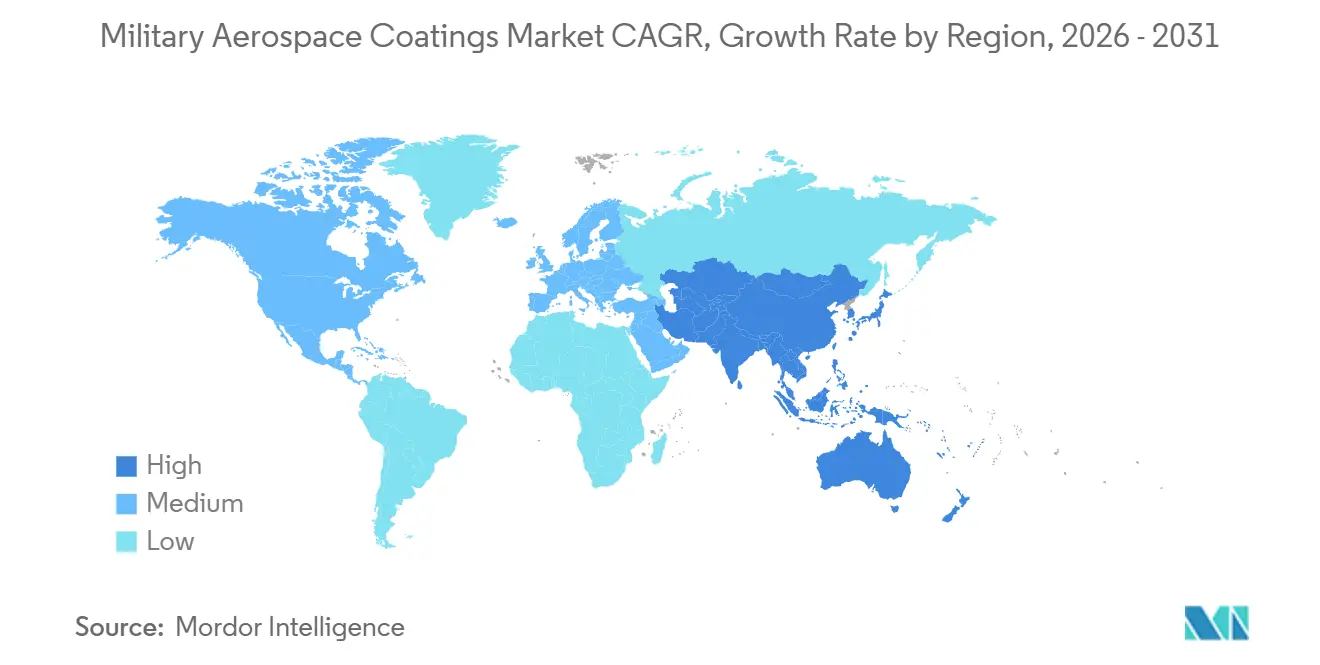
- By geography, North America held 40.13% of the military aerospace coatings market in 2025, while Asia-Pacific is projected to advance at a 5.45% CAGR through 2031.
Note: Market size and forecast figures in this report are generated using Mordor Intelligence’s proprietary estimation framework, updated with the latest available data and insights as of January 2026.
Global Military Aerospace Coatings Market Trends and Insights
Drivers Impact Analysis*
| Driver | (~) % Impact on CAGR Forecast | Geographic Relevance | Impact Timeline |
|---|---|---|---|
| Defense Fleet Modernization and Service-Life Extension | +1.4% | Global; highest concentration in North America and Europe | Medium term (2-4 years) |
| Recurring Corrosion-Control and Recoating Demand | +1.1% | Global; strongest in North America and Asia-Pacific | Long term (≥ 4 years) |
| Stealth and Multispectral Signature Management | +0.9% | Global; concentrated in US, China, India, and EU defense programs | Long term (≥ 4 years) |
| Indigenous Defense Manufacturing and Regional MRO Expansion | +0.7% | APAC core, spillover to MEA | Medium term (2-4 years) |
| Qualification of Low-VOC, Chrome-Free and PFAS-Reduced Systems | +0.5% | North America & EU, with early adoption in APAC defense OEMs | Short term (≤ 2 years) |
| Source: Mordor Intelligence | |||
Defense Fleet Modernization and Service-Life Extension
Defense procurement creates demand through new aircraft programs and through work that keeps older aircraft in service. New platforms need primer, topcoat, and specialty functional layers across the airframe. Service-life extension programs also require stripping and full recoating after structural repair. The North Atlantic Treaty Organization committed in June 2025 to increasing direct defense contributions to 3.5% of gross domestic product by 2035. This commitment supports a longer planning horizon for military aviation programs. Older aircraft can also require current chrome-free or low-VOC systems when they are returned to service, which brings reformulated coatings into use before a formal phaseout deadline.
Recurring Corrosion-Control and Recoating Demand
Corrosion control remains an essential maintenance requirement for military aircraft. A 2025 study in Engineering Failure Analysis found that the lack of reliable, accelerated test methods for alternatives limits the removal of hexavalent chromium from structural aircraft coatings. Alternative systems, therefore, need extended field validation before they can be qualified. Research published in 2025 also examined the effect of materials deterioration and corrosion on the readiness of the United States naval aviation. Protective primers and repair topcoats remain necessary when corrosion affects aircraft availability. Within the military aerospace coatings market, this requirement makes demand less dependent on short defense-budget cycles than on discretionary equipment purchases.
Stealth and Multispectral Signature Management
Radar-absorbent and infrared-suppressive coatings serve functions that conventional exterior topcoats cannot provide. A 2026 scientific paper reported a laser-induced graphene absorber with more than 90% absorption across the 2.4 to 16.2 GHz range, providing a relevant materials pathway for radar-absorbing paint research. These materials require demanding qualification and durability testing before use on military platforms. Their value depends heavily on certification and maintenance requirements. Improved durability can lengthen recoating intervals, but it also raises the technical standard for repair work. The military aerospace coatings market can, therefore, support specialized products, and the military aerospace coatings market values performance approval more than coating volume in these uses.
Indigenous Defense Manufacturing and Regional MRO Expansion
In-country defense production is changing how aerospace coatings are specified and qualified in Asia-Pacific. South Korea’s KF-21 Boramae, the first mass-production aircraft, rolled out in March 2026 with KCC Corporation coatings applied across external surfaces and fuel-tank interiors. This program demonstrates the growing role of domestic suppliers in national aircraft production. India’s Tata Advanced Systems Limited co-produces Apache fuselages in Hyderabad, creating domestic requirements for aerospace manufacturing support. Local testing and certification can take 2 to 4 years for multinational suppliers entering indigenously certified programs. The military aerospace coatings market also needs local coating supply, technical service, and qualified repair products as regional maintenance, repair and overhaul capacity expands.
Restraints Impact Analysis*
| Restraint | (~) % Impact on CAGR Forecast | Geographic Relevance | Impact Timeline |
|---|---|---|---|
| Lengthy Military Qualification and Certification Cycles | -0.8% | Global | Long term (≥ 4 years) |
| Environmental Compliance and Reformulation Costs | -0.5% | North America & EU primarily | Medium term (2-4 years) |
| Specialized Application Infrastructure and Skilled-Labor Constraints | -0.3% | Global; acute in MEA and South America | Medium term (2-4 years) |
| Source: Mordor Intelligence | |||
Lengthy Military Qualification and Certification Cycles
Military coating approvals can take 3 to 7 years, depending on the substrate and the range of testing required. The process is governed by specifications such as Military Performance (MIL-PRF) specification requirements in the United States, Defence Standard frameworks in the United Kingdom, and North Atlantic Treaty Organization standards. A February 2026 United Kingdom Health and Safety Executive decision on an authorization application for chromate-containing aerospace primers noted the difficulty of validating and implementing chrome-free alternatives across the full supply chain[1]United Kingdom Health and Safety Executive, “UK REACH Authorisation Decision, Application Ref AFA063-01,” United Kingdom Government, gov.uk. Manufacturers often use pre-qualified systems because a replacement coating can require full platform approval. The military aerospace coatings market sees slower adoption of new products, while suppliers with established approval portfolios retain protection. Military Performance Specification requirements administered through the United States Army Research Laboratory and Naval Sea Systems Command technical manuals also set entry criteria for platform-specific approvals.
Environmental Compliance and Reformulation Costs
The shift away from hexavalent chromium and PFAS-containing formulations requires reformulation, testing, and platform requalification. The European Chemicals Agency adopted its opinion on the proposed PFAS restriction on March 2, 2026, including military aerospace and transport applications[2]European Chemicals Agency, “RAC Opinion on PFAS Restriction Under REACH,” European Chemicals Agency, echa.europa.eu. Suppliers must fund product development while existing approved chromate products remain in use. Smaller companies can face greater difficulty maintaining parallel development programs. These costs can delay a change to new systems and limit the number of suppliers able to support a full military specification range. Within the military aerospace coatings market, larger suppliers with established test resources can be better placed to manage this transition.
*Our forecasts treat driver/restraint impacts as directional, not additive. The impact forecasts reflect baseline growth, mix effects, and variable interactions.
Segment Analysis
By Resin Type: Polyurethane Supports Exterior Topcoat Requirements
Polyurethane held 42.36% of the military aerospace coatings market share in 2025 and is projected to advance at a 5.35% CAGR through 2031. Its position reflects compliance with MIL-PRF-85285 requirements for gloss retention, ultraviolet stability, chemical resistance, and flexibility at temperature extremes. These properties support its use on aircraft exterior surfaces. The resin can serve airframes exposed to chemical fluids, sunlight, and changing operating temperatures. Its performance profile also supports a consistent appearance after routine maintenance work. Epoxy resins remain important primer chemistries because they adhere well to carbon-fiber composite substrates. Acrylic resins serve more specialized roles, including radome-transparent coatings and interior applications. In these uses, fast curing and dielectric performance can be more important than exterior durability.
SOCOMORE appointed Blend Supply as its Authorized Master Distributor for North America, effective April 2026, for AeroGlaze, Chemglaze polyurethane coatings, and PreKote surface treatments. The distribution arrangement supports access to military-origin polyurethane coating products for maintenance, repair and overhaul customers. Indestructible Paint Ltd. received recognition from the Institute of Materials Finishing for chromium-free anticorrosive primers for aluminum alloys with salt-spray resistance above 1,000 hours. Akzo Nobel N.V. qualified a new chrome-free primer for Airbus Defence and Space in 2026. These developments show continuing work to combine exterior protection with reduced environmental impact. They also show that approval progress can influence the timing of resin substitution. Fluoropolymer systems in the other resin category face pressure from the proposed PFAS restriction. Water-borne and high-solids variants are expected to gain use through 2031, although qualification pace remains a limiting factor.



By Technology: Water-Borne Advances While Solvent-Borne Remains Dominant
Solvent-borne held 57.34% of the military aerospace coatings market share in 2025. Its installed position reflects long-standing MIL-PRF qualification data and the need for proven performance on airworthiness-critical assets. Water-borne is projected to advance at a 5.67% CAGR through 2031. Tighter emission permits at military depots support their development. Water-borne systems need to meet the same performance expectations as existing coating systems. Their wider use depends on qualification results and application capability at each facility. Liebherr-Aerospace implemented Registration, Evaluation, Authorisation and Restriction of Chemicals (REACH)-compliant Trivalent Chromium System processes at service centers in Asia-Pacific, including Shanghai, during the first quarter of 2026. The program shows how the military aerospace coatings market is preparing service networks for lower-emission coating processes.
Powder and radiation-cured coatings remain limited in military aircraft work. Large and complex airframes do not generally suit powder-coating methods. PPG Industries, Inc. presented its AEROCRON electrocoat primer in June 2026 as a chrome-free technology that can provide uniform film thickness through electrodeposition. The method can reduce volatile organic compound output compared with spray application. It also provides a different method for applying primer across relevant components. A military qualification could change the technology mix in primer applications. Until then, solvent-borne products retain an operational advantage because their performance history is established.
By User Type: Original Equipment Manufacturer Leads While Maintenance, Repair and Overhaul Accelerates
Original equipment manufacturers held 54.78% revenue share in 2025. New aircraft programs require complete initial coating systems across primers, topcoats, and functional layers. Programs such as the F-47 Next Generation Air Dominance aircraft, the KF-21, and India’s Advanced Medium Combat Aircraft support this baseline demand. Production demand is linked to aircraft build schedules and program-specific technical requirements. Coating suppliers must provide products that fit each approved aircraft system. Maintenance, repair and overhaul is projected to advance at a 6.13% CAGR through 2031. Fleet aging and the labor needed to maintain stealth-related coatings support this faster growth. Repair activity uses coatings in smaller batches and under tighter turnaround schedules than original production.
Maintenance providers also need custom color matching to preserve camouflage continuity after repairs. This creates demand for specialized repair product lines. Condition-based maintenance systems can trigger recoating after measured degradation rather than at a fixed interval. That approach can increase the use of touch-up and repair coatings between major maintenance events. It can also shift work toward products designed for localized surface restoration. Hentzen Coatings, Inc. and SOCOMORE offer repair product portfolios that align with this type of maintenance work. The military aerospace coatings market size for maintenance applications is therefore supported by the technical intensity of repair work as well as coating volume.
By Aircraft Type: Rotary-Wing Platforms Require Durable Coatings for Demanding Operating Conditions
Fixed-wing aircraft held a 53.17% revenue share in 2025. Fighter fleets, bombers, tankers, and transport aircraft support coating demand and application complexity in this category. Rotary-wing aircraft is projected to advance at a 5.77% CAGR through 2031. Attack, maritime patrol, and special operations helicopter programs support this rate. Rotor wash can increase particle erosion on leading edges and rotor blade surfaces. Aircraft used in demanding environments need frequent attention to erosion-prone surfaces. Blade tips need strong erosion resistance because deterioration can affect aerodynamic performance and produce vibration.
The B-21 Raider uses radar-absorbent material integrated into its composite structure rather than only a surface layer. This approach can make stealth-related repair work more specialized on future aircraft. The other aircraft category includes unmanned aerial systems, surveillance platforms, and missile airframes. These platforms have growing strategic relevance even though their current revenue contribution is smaller. Their use broadens the range of substrates and operating conditions addressed by coating suppliers. Their composite-intensive structures can require qualification work beyond existing MIL-PRF approvals designed for manned aircraft. This creates an opportunity for suppliers prepared to develop unmanned aerial system-specific coating submissions under Military Detail Specification (MIL-DTL-53022) processes.
Geography Analysis
North America held 40.13% revenue share in 2025. United States Air Force, Navy, and Marine Corps programs support demand across new production and sustainment activities. Congress-approved Fiscal Year 2026 defense spending exceeded USD 1 trillion for the first time. The funding included procurement for the F-47 Next Generation Air Dominance aircraft and modifications to F-35, B-52, and tanker fleets. These aircraft programs need qualified coating applications during production and maintenance. The regional supplier base also has a concentration of MIL-PRF-approved portfolios. PPG Industries, Inc. began construction in October 2025 on a USD 380 million aerospace coatings and sealants facility in Shelby, North Carolina. The 198,000-square-foot facility is expected to be completed in the first half of 2027.
Europe’s defense coating demand rose in 2025 and remains supported in 2026 by equipment procurement and regional readiness initiatives. European Union member-state equipment procurement reached EUR 115 billion (approximately USD 133.65 billion) in 2025, representing a 26% real increase from 2024. Germany’s military spending reached USD 114 billion in 2025, a 24% increase, according to the Stockholm International Peace Research Institute (SIPRI). Regional procurement can support both aircraft acquisition and sustainment requirements. Akzo Nobel N.V. reached a milestone in July 2026 in the expansion of its Pamiers, France, aerospace coatings site. These developments support regional coating supply for aerospace programs.
Asia-Pacific is projected to advance at a 5.45% CAGR through 2031. This military aerospace coatings market benefits from national procurement plans and the expansion of domestic aerospace manufacturing capacity. India spent USD 92.1 billion on its military in 2025, while Japan spent USD 62.2 billion in 2025. The KF-21 rollout and India’s local C295 assembly mark a shift toward domestic aircraft manufacturing. These programs create requirements for locally supported coating specifications and technical service. Akzo Nobel N.V. opened a color blending and distribution facility in Chonburi, Thailand, in September 2026. South America and the Middle East and Africa remain smaller areas, but fleet expansion can create demand for qualified coatings from supply chains that still depend on imports.

Competitive Landscape
The military aerospace coatings market is moderately concentrated, with the top five players including PPG Industries, Inc., Akzo Nobel N.V., The Sherwin-Williams Company, Axalta Coating Systems, LLC, and Hentzen Coatings, Inc. PPG Industries, Inc., Akzo Nobel N.V., and The Sherwin-Williams Company have broad MIL-PRF qualification portfolios and established relationships with major defense aircraft manufacturers. These portfolios can be difficult to replicate because they reflect testing, documentation, and platform-specific approvals. Akzo Nobel N.V. and Axalta Coating Systems, LLC announced an all-stock merger in 2025 that was targeted for completion in late 2026 or early 2027. The combined entity would bring together USD 400 million in annual research and development spending and 3,200 granted and pending patents. This transaction could increase the concentration of aerospace coating qualification capabilities. The competitive position of large suppliers depends on both technical portfolios and the ability to support long platform approval cycles.
Specialist suppliers remain important in technical niches. Hentzen Coatings, Inc. has a position in chrome-free primer qualification. Indestructible Paint Ltd., acquired by Seaforth Holdings in March 2026, is expanding into defense and space coating applications. PPG Industries, Inc. continues to develop AEROCRON electrocoat primer for lower-emission applications. SOCOMORE changed its North American distribution model through Blend Supply to improve responsiveness for Maintenance, Repair and Overhaul and OEM customers. These actions show that competition includes both qualification depth and customer service coverage. They also reflect the importance of timely product availability for repair customers.
The Sherwin-Williams Company received a USD 1.20 million Department of Defense award in August 2026 for work on a flexible chromium-free aircraft primer. The project supports the development of an environmentally compliant military primer. Mapaero, part of Akzo Nobel N.V.’s portfolio, serves North Atlantic Treaty Organization program needs with camouflage and infrared-suppressive topcoats. Qualification requirements can limit direct price competition in these products. The military aerospace coatings market rewards suppliers that can support product development through a full approval cycle. New entrants must demonstrate performance alongside their ability to navigate lengthy approval requirements. Areas of opportunity include unmanned aerial system-specific qualifications, regional manufacturing programs in Asia-Pacific, and coatings suited to condition-based repairs. The military aerospace coatings industry remains shaped by the balance between large qualification incumbents and specialized suppliers.
Military Aerospace Coatings Industry Leaders
PPG Industries, Inc.
Akzo Nobel N.V.
The Sherwin-Williams Company
Axalta Coating Systems, LLC
Hentzen Coatings, Inc.
- *Disclaimer: Major Players sorted in no particular order

Recent Industry Developments
- September 2026: Akzo Nobel N.V. opened a color blending and distribution facility in Chonburi, Thailand, supplying aerospace topcoats and primers to MRO providers and OEMs. The facility strengthens regional supply capabilities and reduces lead times for coatings used in military aviation and aerospace applications.
- July 2026: Akzo Nobel N.V. completed a major phase of its EUR 22 million (approximately USD 25.6 million) investment at its Pamiers, France production site. The upgraded facility increases production capabilities and supports growing demand for high-performance aerospace coatings, including primers and topcoats used in military aircraft applications.


Global Military Aerospace Coatings Market Report Scope
Military aerospace coatings are specialized protective and functional coatings designed for aircraft operating in demanding military environments. They provide resistance to corrosion, chemicals, abrasion, weathering, and other stresses while supporting aircraft durability and operational performance.
The Military Aerospace Coatings Market is segmented by resin type, technology, user type, aircraft type, and geography. By resin type, the market is segmented into polyurethane, epoxy, acrylic, and others. By technology, the market is segmented into solvent-borne, water-borne, and others. By user type, the market is segmented into original equipment manufacturer and maintenance, repair and overhaul. By aircraft type, the market is segmented into fixed-wing aircraft, rotary-wing aircraft, and others. The report also covers the market size and forecasts for military aerospace coatings in 16 countries across major regions. For each segment, the market sizing and forecasts have been done on the basis of value (USD).
| Polyurethane |
| Epoxy |
| Acrylic |
| Others |
| Solvent-Borne |
| Water-Borne |
| Others |
| Original Equipment Manufacturer |
| Maintenance, Repair and Overhaul |
| Fixed-Wing Aircraft |
| Rotary-Wing Aircraft |
| Others |
| Asia-Pacific | China |
| India | |
| Japan | |
| South Korea | |
| ASEAN Countries | |
| Rest of Asia-Pacific | |
| North America | United States |
| Canada | |
| Mexico | |
| Europe | Germany |
| United Kingdom | |
| France | |
| Italy | |
| NORDIC Countries | |
| Russia | |
| Rest of Europe | |
| South America | Brazil |
| Argentina | |
| Rest of South America | |
| Middle East and Africa | Saudi Arabia |
| South Africa | |
| Rest of Middle East and Africa |
| By Resin Type | Polyurethane | |
| Epoxy | ||
| Acrylic | ||
| Others | ||
| By Technology | Solvent-Borne | |
| Water-Borne | ||
| Others | ||
| By User Type | Original Equipment Manufacturer | |
| Maintenance, Repair and Overhaul | ||
| By Aircraft Type | Fixed-Wing Aircraft | |
| Rotary-Wing Aircraft | ||
| Others | ||
| By Geography | Asia-Pacific | China |
| India | ||
| Japan | ||
| South Korea | ||
| ASEAN Countries | ||
| Rest of Asia-Pacific | ||
| North America | United States | |
| Canada | ||
| Mexico | ||
| Europe | Germany | |
| United Kingdom | ||
| France | ||
| Italy | ||
| NORDIC Countries | ||
| Russia | ||
| Rest of Europe | ||
| South America | Brazil | |
| Argentina | ||
| Rest of South America | ||
| Middle East and Africa | Saudi Arabia | |
| South Africa | ||
| Rest of Middle East and Africa | ||


Key Questions Answered in the Report
What is the size of the military aerospace coatings market?
The Military Aerospace Coatings Market size was valued at USD 354.31 million in 2025 and is estimated to grow from USD 368.27 million in 2026 to reach USD 446.77 million by 2031, at a CAGR of 3.94% during the forecast period (2026-2031).
What is driving demand for military aerospace coatings?
Defense procurement, service-life extension work, corrosion control, and lower-emission coating qualification support demand.
Which resin type held the largest share in 2025?
Polyurethane held 42.36% revenue share in 2025, supported by its durability and MIL-PRF-85285 performance requirements.
Which technology is expected to grow fastest through 2031?
Water-borne is projected to advance at a 5.67% CAGR through 2031 as depot emission requirements tighten.
Page last updated on:





