
Middle East OTT Market Size and Share
Market Overview
| Study Period | 2020 - 2031 |
|---|---|
| Forecast Data Period | 2026 - 2031 |
| Base Year Market Size (2025) | USD 14.85 Billion |
| Market Size (2026) | USD 16.60 Billion |
| Market Size (2031) | USD 25.56 Billion |
| Growth Rate (2026 - 2031) | 9.02 % |
| Market Concentration | Medium |
Major Players *Disclaimer: Major Players sorted in no particular order Image © Mordor Intelligence. Reuse requires attribution under CC BY 4.0. | |
Middle East OTT Market Analysis by Mordor Intelligence
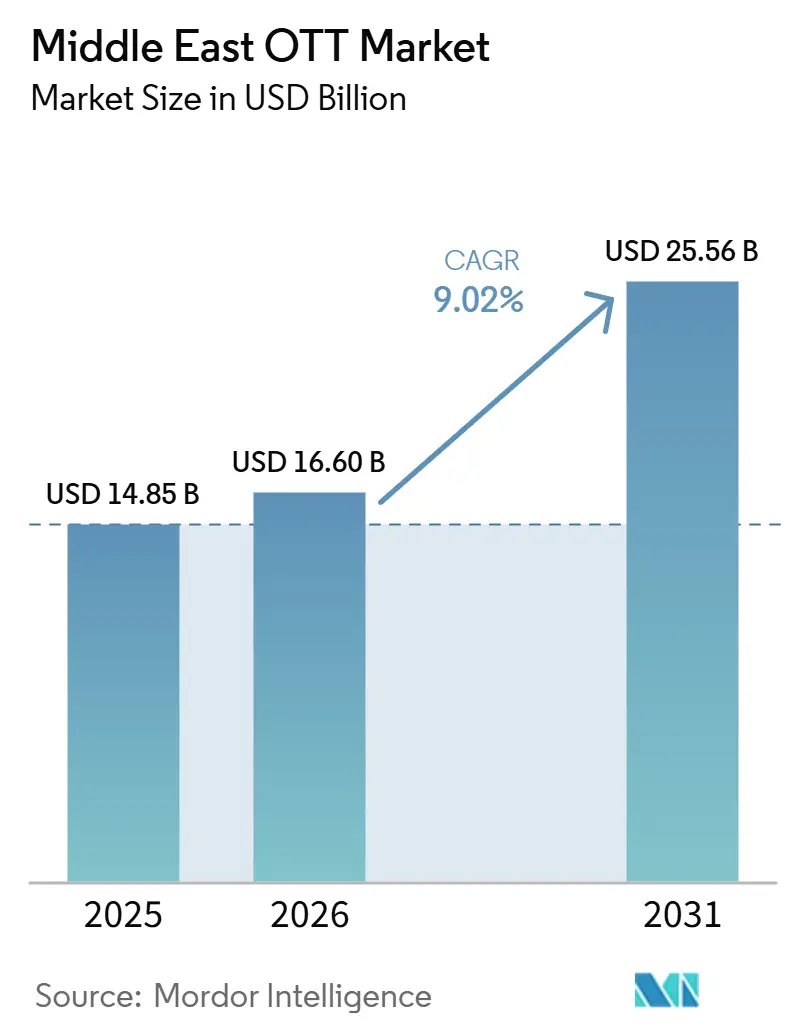
The Middle East OTT market size was valued at USD 14.85 billion in 2025 and estimated to grow from USD 16.60 billion in 2026 to reach USD 25.56 billion by 2031, at a CAGR of 9.02% during the forecast period (2026-2031). The Middle East OTT market is shifting from satellite pay TV toward app-based viewing, supported by younger audiences, mobile connectivity, and connected television adoption. Premium Arabic programming and exclusive sports rights remain important for subscriber retention. Bundled offers are changing how households pay for services and how platforms reach new viewers. Advertising-supported services are also widening access for households that do not want several paid subscriptions. Piracy, content rules, and fragmented rights continue to limit revenue capture and complicate programming decisions.
Key Report Takeaways
- By revenue model, SVOD held 47.50% of the Middle East OTT market share in 2025, while AVOD is projected to expand at a 9.86% CAGR through 2031.
- By device type, Smartphones and Tablets held 62.50% of the Middle East OTT market share in 2025, while Smart TVs are projected to expand at a 9.98% CAGR through 2031.
- By content genre, TV Shows and Episodic Content held 41.46% of the Middle East OTT market share in 2025, while Documentaries are projected to expand at a 9.55% CAGR through 2031.
- By geography, Saudi Arabia held 53.10% of the Middle East OTT market share in 2025, while the United Arab Emirates is projected to expand at a 10.81% CAGR through 2031.
Note: Market size and forecast figures in this report are generated using Mordor Intelligence’s proprietary estimation framework, updated with the latest available data and insights as of January 2026.
Middle East OTT Market Trends and Insights
Drivers Impact Analysis*
| Driver | (~) % Impact on CAGR Forecast | Geographic Relevance | Impact Timeline |
|---|---|---|---|
| Rising Smartphone and Smart TV Penetration | +2.3% | Regional, strongest in Saudi Arabia and UAE | Short term (≤ 2 years) |
| Arabic and Local Language Originals Scaling Retention | +1.9% | GCC core, with spillover to the Levant | Medium term (2-4 years) |
| Telecom Bundling and Carrier Billing Expansion | +1.4% | GCC-wide, with early gains in Saudi Arabia and UAE | Short term (≤ 2 years) |
| FAST and Ad-Supported Monetization Broadening Reach | +1.0% | GCC and Egypt | Medium term (2-4 years) |
| Connected TV and Big-Screen Streaming Adoption | +0.8% | GCC-wide | Medium term (2-4 years) |
| Content Anti-Piracy Enforcement Improving Monetization Capture | +0.6% | Saudi Arabia, UAE, and Egypt | Long term (≥ 4 years) |
| Source: Mordor Intelligence | |||
Rising Smartphone and Smart TV Penetration
Smartphone penetration exceeded 90% in Saudi Arabia during 2024, and connected screens were present in more than 85% of Gulf households in 2025. This installed base favors the Middle East OTT market because viewers can move between mobile and household screens without relying on satellite equipment. Connected television viewing also gives advertisers more direct audience measurement than linear television. Saudi Arabia, the UAE, and Qatar have prioritized 5G deployment, lowering barriers to high-bitrate mobile viewing and reducing buffering. The Middle East OTT market can therefore serve both mobile-first viewers and households that increasingly prefer larger screens.
Arabic and Local Language Originals Scaling Retention
Arabic output increased from 120 titles in 2020 to more than 400 in 2025, and was expected to exceed 500 in 2026. The larger catalog gives the Middle East OTT market programming that is less easily replaced by international services. It also helps platforms keep subscribers outside the Ramadan season, when viewing interest can otherwise weaken. Netflix launched its Write the Future Feature Film Writers Lab with Saudi Arabia's Righters House in 2025, extending its role from content licensing to talent development.[1]Ali Al Saloom, “Righters House Partners With Netflix to Boost Saudi Film Industry,” Leaders MENA, leaders-mena.com Arabic-scripted drama was described as a USD 2 billion seasonal advertising opportunity, while production costs remained below many Western benchmarks. This combination supports subscription revenue and advertising inventory when platforms have suitable rights and distribution.
Telecom Bundling and Carrier Billing Expansion
Carrier billing removes payment barriers for households without international cards and simplifies subscription management for households that use multiple services. In June 2025, e& Egypt signed an exclusive arrangement with Shahid to include its library across prepaid and postpaid plans. MBC Group and Netflix announced their MBCNOW bundle in July 2025, offering savings of more than 21% compared to separate subscriptions. e& UAE also combined a Samsung Smart TV and streaming services into a single monthly bill, starting at AED 109 (USD 30). These offers make the Middle East OTT market more accessible while giving providers more information about cross-platform viewing. Direct carrier billing is also expanding across Bahrain, Saudi Arabia, Oman, and Qatar.
FAST and Ad-Supported Monetization Broadening Reach
FAST channels give first-time viewers a way to use streaming services without a subscription commitment. Warner Bros. Discovery and Etisalat's StarzOn launched the region's first children-focused FAST channel on July 1, 2025. STARZPLAY operated more than 60 FAST channels, which was the highest count among major regional services. Zee Alwan and Zee Aflam also brought Bollywood programs to Arabic-speaking households through TCL's FAST platform. This expansion creates a need for Arabic subtitling and localization that platform operators may source from specialist providers. AVOD is projected to grow at a 10.42% CAGR through 2031, showing that advertising supports a distinct revenue path in the Middle East OTT market.
Restraints Impact Analysis*
| Restraint | (~) % Impact on CAGR Forecast | Geographic Relevance | Impact Timeline |
|---|---|---|---|
| Piracy, Credential Sharing, and Illegal IPTV Leakage | -1.8% | Regional, strongest in Egypt, Iraq, and lower-income markets | Long term (≥ 4 years) |
| Fragmented Content Regulation and Censorship Requirements | -1.2% | Primarily Saudi Arabia and UAE | Medium term (2-4 years) |
| Price Sensitivity and Subscription Fatigue in Multi-Service Households | -0.9% | GCC, especially multi-service households | Medium term (2-4 years) |
| Rights Fragmentation Across Leagues, Studios, and Windowing Models | -0.7% | Regional | Long term (≥ 4 years) |
| Source: Mordor Intelligence | |||
Piracy, Credential Sharing, and Illegal IPTV Leakage
Illegal streaming has developed beyond casual account sharing into a substantial competing channel for premium video and live sports. StreamEast logged more than 1.6 billion visits before its August 2025 shutdown, according to the Alliance for Creativity and Entertainment. beIN Sports reported annual losses exceeding USD 1 billion due to unauthorized streaming in the Middle East. In July 2026, the Cairo Economic Court sentenced 2 StreamEast operators to 2 years in prison and imposed EGP 5.5 million (USD 110,000) in fines on each defendant. An estimated 23% of regional users still access pirate IPTV services, reducing the returns available to content buyers. Credential sharing remains difficult to identify because legal treatment varies across regional jurisdictions.
Fragmented Content Regulation and Censorship Requirements
The Middle East OTT market operates under separate national rules rather than a single regional content framework. Saudi Arabia's 2025 Media Rules restricted content that conflicts with Islamic values and required advance licensing under Digital Content Platform regulations. Some foreign platforms must also establish a local corporate presence, increasing entry costs for smaller providers. The UAE's Cabinet Decision No. 42 of 2025 took effect on May 29, 2025, with first-offense penalties reaching AED 1 million (USD 270,000). The UAE Media Council introduced an AI-enabled content-monitoring platform with Presight in 2025. These requirements can improve compliance processes for established platforms, but they make commissioning and launch schedules harder for new entrants.
*Our forecasts treat driver/restraint impacts as directional, not additive. The impact forecasts reflect baseline growth, mix effects, and variable interactions.
Segment Analysis
By Revenue Model: SVOD Anchors Revenue While AVOD Expands Access
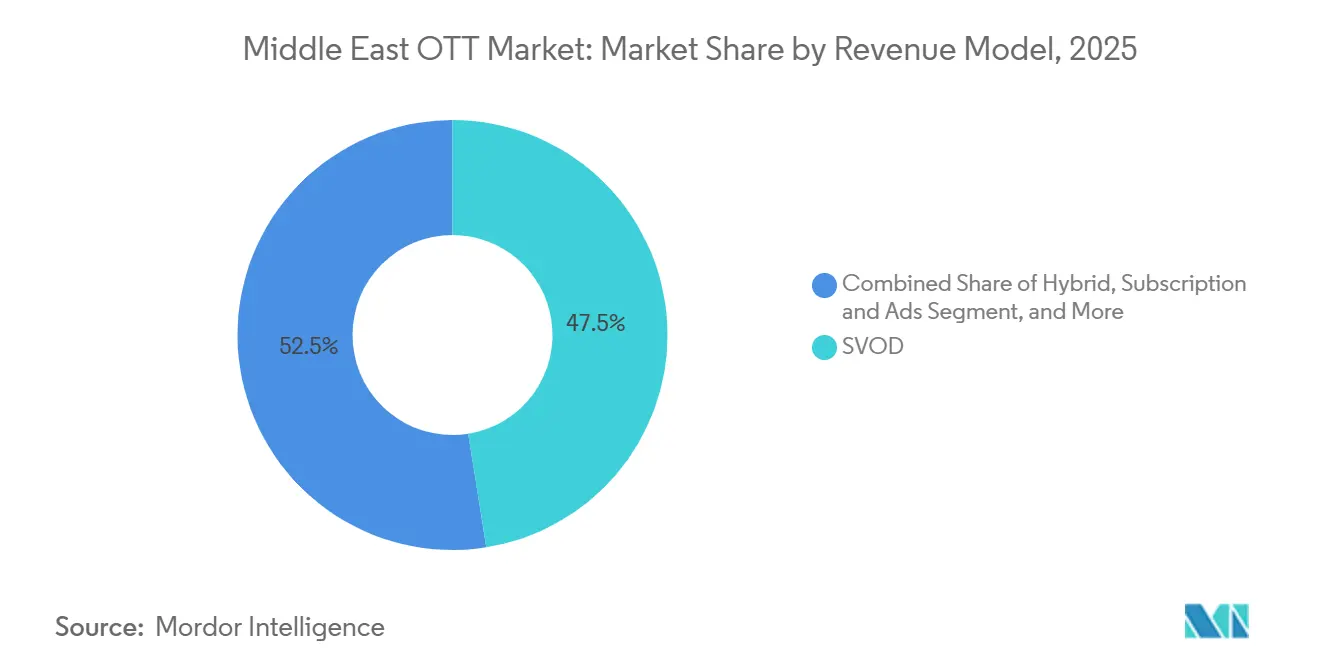
SVOD held 47.50% of the Middle East OTT market share in 2025, supported by demand for ad-free Arabic originals and exclusive sports programs. Subscription libraries have reduced TVOD's role, as titles that once supported pay-per-view are increasingly included in recurring plans. TVOD remains relevant for recent theatrical releases and premium live events where immediate access can support a separate charge. The Middle East OTT market size continues to depend on the platform's ability to maintain a valuable Arabic catalog. These catalogs create a reason for customers to retain a specific service rather than switching easily between similar options.
AVOD is projected to expand at a 9.86% CAGR through 2031 as advertisers seek streaming inventory and viewers look for lower-cost choices. Hybrid subscription and advertising models are also gaining interest because they can offer paid tiers alongside free or lower-priced options. Telecom companies can bundle these models across income groups without presenting a single fixed price to every household. The Middle East OTT industry can use this structure to turn price sensitivity into a choice of access level rather than a barrier to viewing. Services with local catalogs retain an advantage because local programming is less available on competing platforms.



By Device Type: Mobile Viewing Remains Central as Smart TV Use Rises
Smartphones and Tablets accounted for 62.50% of the Middle East OTT market share by device type in 2025. Younger consumers first adopted streaming through mobile plans before household broadband became broadly available. This history keeps mobile viewing central to the Middle East OTT market, particularly for daily short-form and personal viewing. Laptops and desktops continue to play a smaller but stable role in business-oriented cities such as Dubai and Abu Dhabi. They remain useful for remote workers who view longer programs during breaks or outside working hours.
Smart TVs are projected to expand at a 9.98% CAGR between 2026 and 2031. STARZPLAY integrated its service into OORO, ELARABY Group's Arabic-language television operating system, in July 2026.[2]STARZPLAY, “STARZPLAY Strategic Partnership With ELARABY Group for OORO Smart TV OS,” STARZPLAY, linkedin.com This arrangement places services within the television interface, making device-level distribution more important. Gaming consoles and legacy set-top boxes are losing viewing share as embedded applications replace many of their functions.
By Content Genre: Episodic Programs Lead as Documentaries Gain Viewers
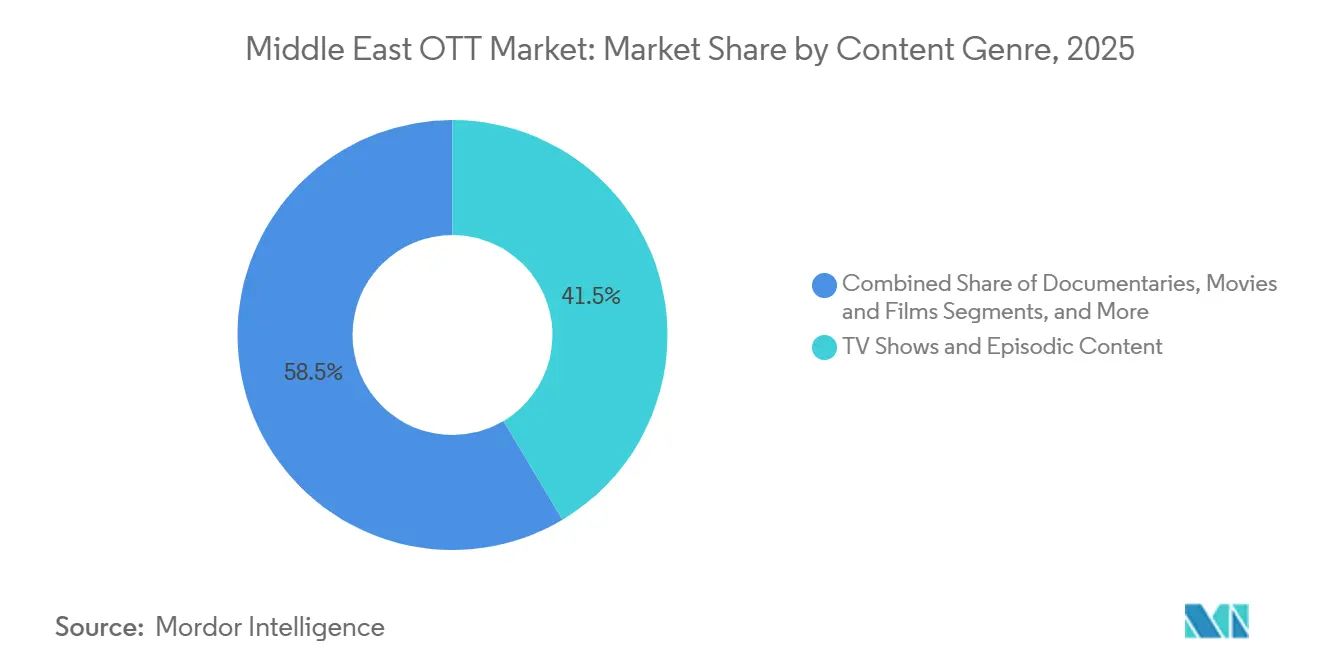
TV Shows and Episodic Content held 41.46% of the Middle East OTT market share by content genre in 2025. Ramadan dramas create concentrated audiences that resemble the viewing peaks once associated with linear television. Turkish drama series also supports long viewing hours across Arab markets. The Middle East OTT market size for episodic programming benefits when platforms can offer a steady release schedule. This reduces the gap between major seasonal releases and supports ongoing subscriber engagement.
Documentaries are projected to expand at a 9.55% CAGR through 2031, reflecting interest in factual and investigative programming. Netflix's 2026 Arabic slate included reality and unscripted programs such as Dubai Bling, Love Is Blind, and Habibi, alongside scripted drama. This mix enables platforms to achieve faster production cycles and lower costs for some formats. Movies and films remain important through theatrical window releases and Bollywood programming. Zee Entertainment's FAST deployment allowed households to watch Bollywood content without a subscription. Sports highlights, gaming content, and live events may help platforms keep viewers engaged after major rights periods end.
Geography Analysis
Saudi Arabia accounted for 53.10% of the Middle East OTT market share by revenue in 2025. Its large population, high smartphone use, and Vision 2030 entertainment agenda support this position. Shahid had 4.4 million subscribers as of December 2024 and became the anchor service for the MBCNOW aggregator launched in February 2025. Netflix's Righters House collaboration in 2025 also shows Saudi Arabia's growing role as a source of screenwriting and production. Digital Content Platform rules require operating licenses and, in selected cases, a local corporate presence, which favors firms already established in the country.
The UAE is projected to grow at a 10.81% CAGR between 2026 and 2031. Its expatriate population requires broad catalogs and interfaces across South Asian, Arabic, European, and East Asian preferences. e& UAE's All-In TV combined a Samsung smart television and services on a single monthly bill starting at AED 109 (USD 30).[3]e&, “e& Partners With Samsung to Launch All-In TV,” Zawya, zawya.com This model may be especially relevant for middle-income expatriate households that need flexible device payment options.
Qatar, Kuwait, Bahrain, Oman, and the Rest of Middle East held the remaining Middle East OTT market share in 2025. Qatar is supported by beIN Media Group's major sports rights and an affluent domestic audience. Kuwait's South Asian diaspora allows content libraries to serve needs that overlap with the UAE, while Bahrain has served as an early testing location for payment innovation, including VUZ's carrier billing rollout. Oman remains earlier in the adoption cycle, while Ooredoo's 2025 MobiBox partnership shows how carrier billing can extend digital entertainment beyond video services.
Competitive Landscape
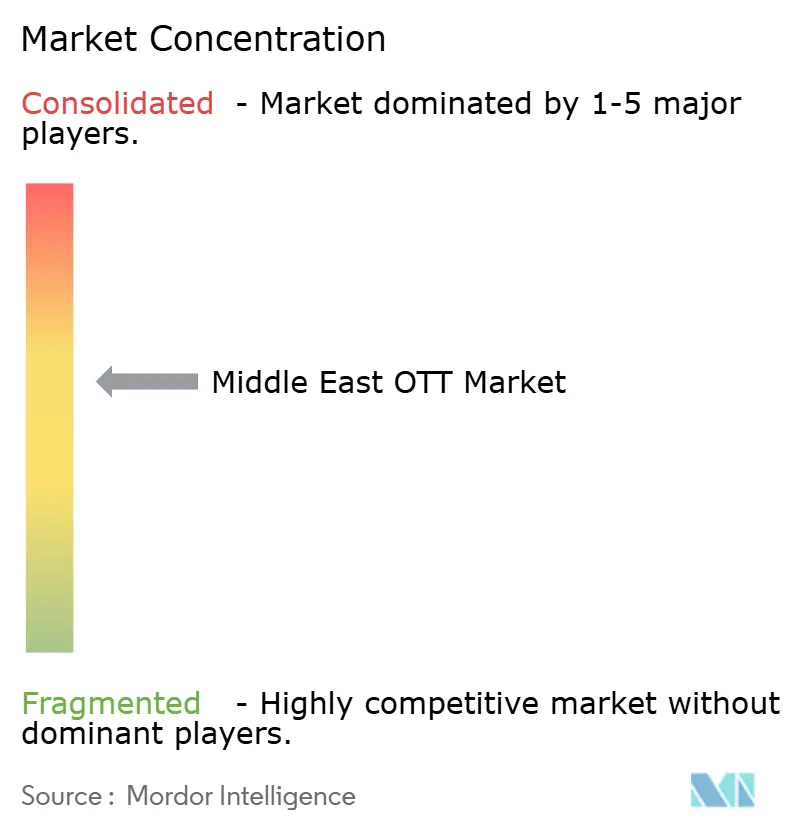
The Middle East OTT market is moderately consolidated among major platforms but remains fragmented by content rights. Shahid, Netflix, OSN+, and STARZPLAY hold leading positions among audiences, while more than 10 regional services compete across genres, languages, and countries. The December 2025 Shahid, Disney+, and OSN+ bundle shows that broad catalog access has become more important than a standalone service offer. The July 2025 MBCNOW partnership similarly combined Netflix, Shahid, and MBC television channels. These moves indicate that few providers can independently meet demand for Arabic originals, global premium programs, and live sports.
Warner Bros. Discovery completed a USD 57 million minority investment in OSN Streaming in March 2025 and committed to investing in local Arabic content. This approach gave the studio regional production exposure without a full standalone entry. Anghami's FY2025 revenue rose 27% to USD 99.3 million, supported by 3.5 million subscribers, and OSN submitted a preliminary proposal in July 2026 to buy Anghami shares it did not own at USD 3.39 per ordinary share.[4]Anghami, “OSN Seeks Full Ownership of Anghami in Proposed Take-Private Deal,” Wamda, wamda.com A completed transaction would bring regional video and audio streaming under one owner.
Technology choices are becoming important alongside catalog depth in the Middle East OTT market. STARZPLAY's January 2026 arrangement with Bilibili introduced premium Chinese animation to viewers across MENA. The agreement addressed younger viewers interested in anime and K-drama adjacent content. Home-screen placement and factory-installed apps are becoming important distribution assets for major and smaller platforms. WATCH IT! used an LG webOS home-screen offer with 6 months of free access on selected models in 2025. Smaller platforms such as YuppTV and WATCH IT! are using diaspora audiences and device partnerships to compete with better-funded services.
Middle East OTT Industry Leaders
Netflix, Inc.
Amazon.com, Inc.
Alphabet Inc.
The Walt Disney Company
Apple Inc.
- *Disclaimer: Major Players sorted in no particular order

Recent Industry Developments
- June 2026: OSN Streaming submitted a preliminary, non-binding proposal to acquire all outstanding shares of Anghami that it does not currently own, at USD 3.39 per ordinary share in cash, in a move that would delist the MENA music and entertainment platform from Nasdaq. OSN presently held 67% of Anghami's issued and outstanding shares, and full ownership would consolidate the region's leading audio and video streaming assets within a single entity.
- January 2026: STARZPLAY secured the first regional deal to distribute premium Chinese animation, donghua, from Bilibili across MENA, with curated weekly releases targeting younger digitally native audiences. The agreement marked the first Bilibili content partnership in the region and positioned STARZPLAY in an underserved content category with growing viewership.
- December 2025: Disney+ and OSN+ launched the GCC's first all-in-one streaming bundle, priced at the cost of 2 services, uniting Shahid's Arabic originals with Disney+'s international catalog and OSN+'s HBO programming slate under a single subscription billed through Shahid. The bundle launched on December 18, 2025, across GCC markets with unified billing.
- July 2025: MBC Group announced the first MBC-Netflix partnership in the MENA region, bundling Netflix with Shahid and MBC's linear TV channels under MBCNOW and offering subscribers a saving of over 21% versus individual subscriptions. Shahid held 4.4 million subscribers as of December 2024 and Netflix had 3 million MENA subscribers at the time of the announcement.


Middle East OTT Market Report Scope
The Middle East OTT market refers to the delivery of video, audio, and other media content over the internet directly to consumers, bypassing traditional cable, satellite, and broadcast television platforms. The scope of the report covers OTT services across the Middle East, including subscription-based, advertising-based, and transactional models, with analysis of key market trends, growth drivers, challenges, competitive landscape, and opportunities during the forecast period.
The Middle East OTT Market Report is Segmented by Revenue Model (SVOD, AVOD, TVOD, and Hybrid, Subscription and Ads), Device Type (Smartphones and Tablets, Smart TVs, Laptops and Desktops, and Other Device Types), Content Genre (Movies and Films, TV Shows and Episodic Content, Documentaries, and Other Content Genres), and Geography (Saudi Arabia, United Arab Emirates, Qatar, Kuwait, Bahrain, Oman, and Rest of Middle East). The Market Forecasts are Provided in Terms of Value (USD).
| SVOD |
| AVOD |
| TVOD |
| Hybrid, Subscription and Ads |
| Smartphones and Tablets |
| Smart TVs |
| Laptops and Desktops |
| Other Device Types |
| Movies and Films |
| TV Shows and Episodic Content |
| Documentaries |
| Other Content Genres |
| Saudi Arabia |
| United Arab Emirates |
| Qatar |
| Kuwait |
| Bahrain |
| Oman |
| Rest of Middle East |
| By Revenue Model | SVOD |
| AVOD | |
| TVOD | |
| Hybrid, Subscription and Ads | |
| By Device Type | Smartphones and Tablets |
| Smart TVs | |
| Laptops and Desktops | |
| Other Device Types | |
| By Content Genre | Movies and Films |
| TV Shows and Episodic Content | |
| Documentaries | |
| Other Content Genres | |
| By Geography | Saudi Arabia |
| United Arab Emirates | |
| Qatar | |
| Kuwait | |
| Bahrain | |
| Oman | |
| Rest of Middle East |


Key Questions Answered in the Report
What is the Middle East OTT market size?
The Middle East OTT market is estimated at USD 16.60 billion in 2026 and is projected to reach USD 25.56 billion by 2031 at a 9.02% CAGR.
Which revenue model leads regional streaming services?
SVOD led with a 47.50% share in 2025, while AVOD is projected to post a 9.86% CAGR through 2031.
Which devices are most important for streaming in the Middle East?
Smartphones and tablets held 62.50% of device-based revenue in 2025, but smart TVs are projected to grow at a 9.98% CAGR.
Why are Arabic originals important to OTT providers?
Local programs help platforms retain subscribers, especially beyond the Ramadan viewing season, and support both subscription and advertising revenue.
What limits growth for streaming providers in the region?
Piracy, credential sharing, separate national content requirements, price sensitivity, and fragmented rights can reduce revenue and slow expansion.
Page last updated on:





