
Middle East Feed Phytogenics Market Size and Share
Market Overview
| Study Period | 2021 - 2031 |
|---|---|
| Forecast Data Period | 2026 - 2031 |
| Base Year Market Size (2025) | USD 44.10 Million |
| Market Size (2026) | USD 47.80 Million |
| Market Size (2031) | USD 71.60 Million |
| Growth Rate (2026 - 2031) | 8.42 % |
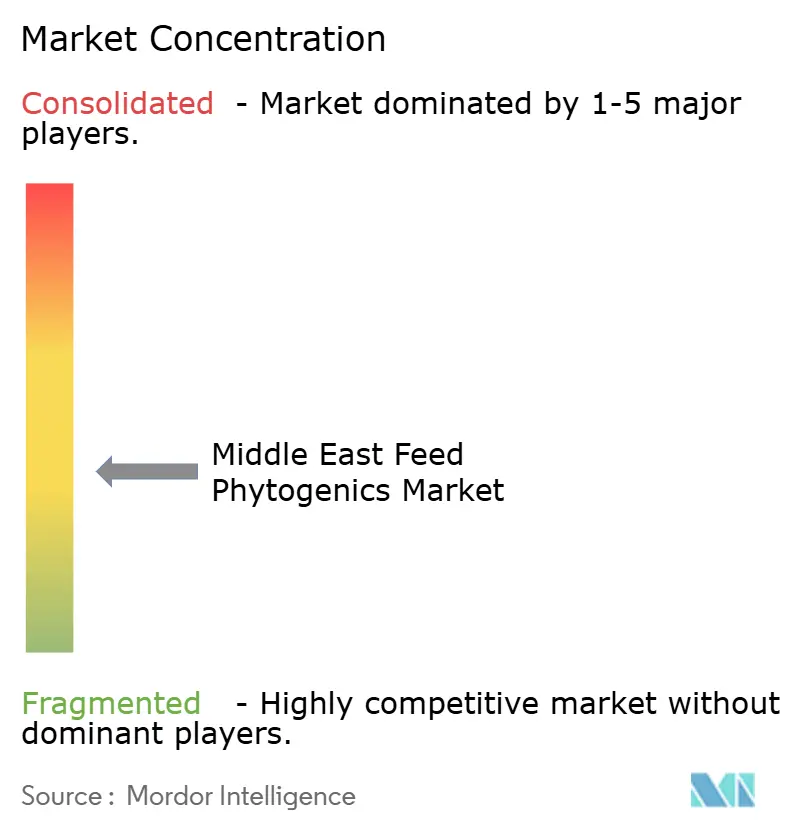
| Market Concentration | Medium |
Major Players *Disclaimer: Major Players sorted in no particular order Image © Mordor Intelligence. Reuse requires attribution under CC BY 4.0. | |
Middle East Feed Phytogenics Market Analysis by Mordor Intelligence
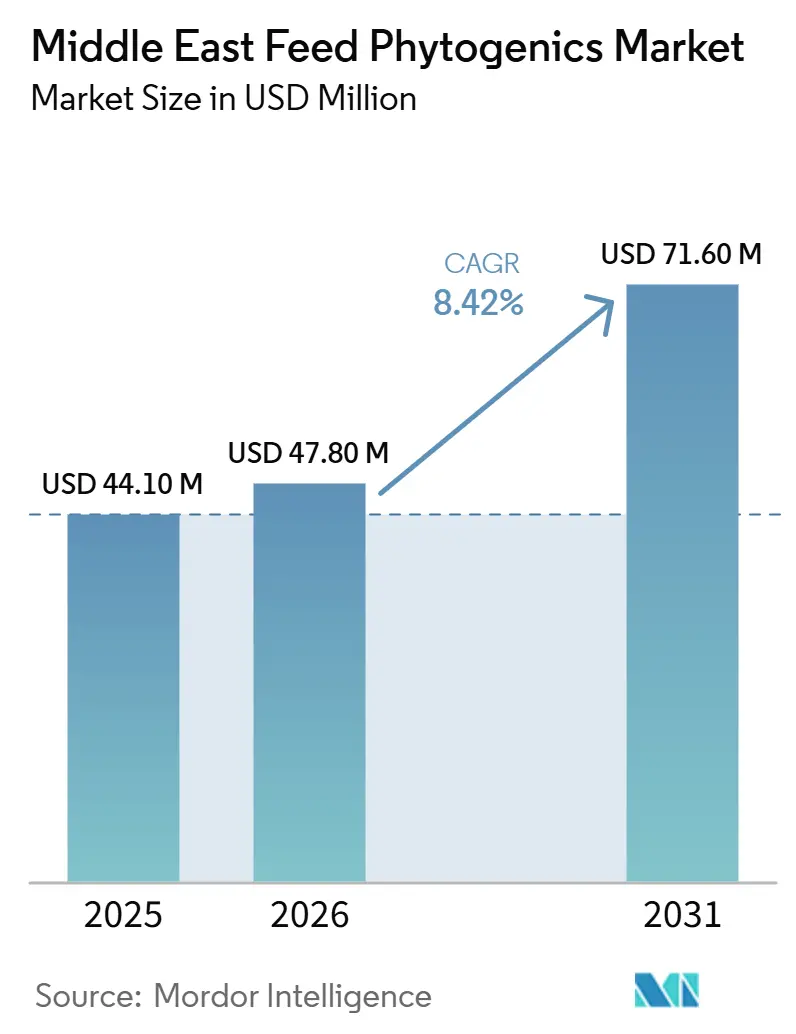
The Middle East phytogenics market for feed is projected to expand from USD 44.1 million in 2025 and USD 47.8 million in 2026 to USD 71.6 million by 2031, registering a CAGR of 8.42% between 2026 and 2031. The Middle East feed phytogenics market is moving along a distinct regional path, driven by feed import dependence, food security programs, and the steady expansion of intensive livestock systems in the Gulf. Poultry still sets the pace for additive adoption, while aquaculture is opening a second demand base that is becoming more relevant across Saudi Arabia and the United Arab Emirates. The strongest commercial momentum remains concentrated in the parts of the market that are already the largest, favoring suppliers with dry-format, herb-and-spice-based essential oil programs aligned with large feed mill operations. The competitive environment remains moderately fragmented, leaving a large share of the Middle East feed phytogenics market in the hands of regional distributors and specialist suppliers. Risk also remains concentrate, as Red Sea and Strait of Hormuz shipping disruptions can raise landed costs, while poultry segment occupied major share in 2025, leavings the Middle East feed phytogenics market exposed to disease events and feed cost shocks in its largest livestock base.
Key Report Takeaways
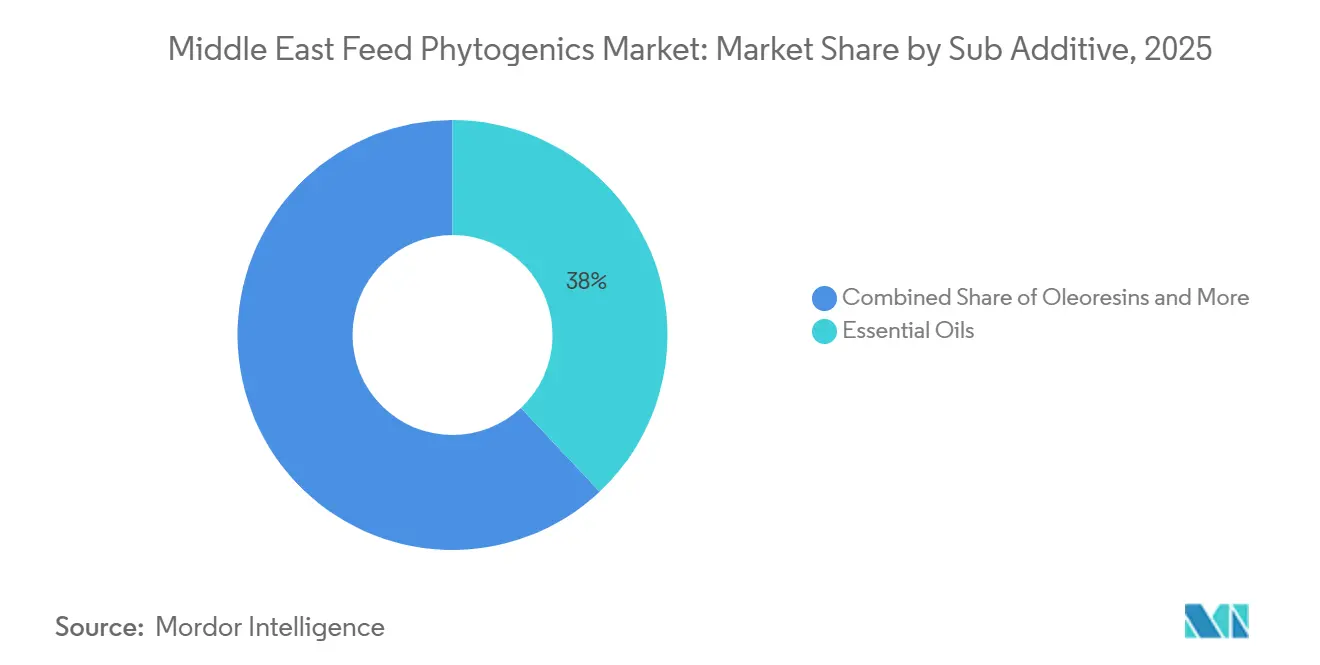
- By sub-additive, the Middle East feed phytogenics market size was dominated by the essential oils segment, with a 38.0% revenue share in 2025, while the segment is also projected to grow at the fastest CAGR of 8.9% from 2026 to 2031.
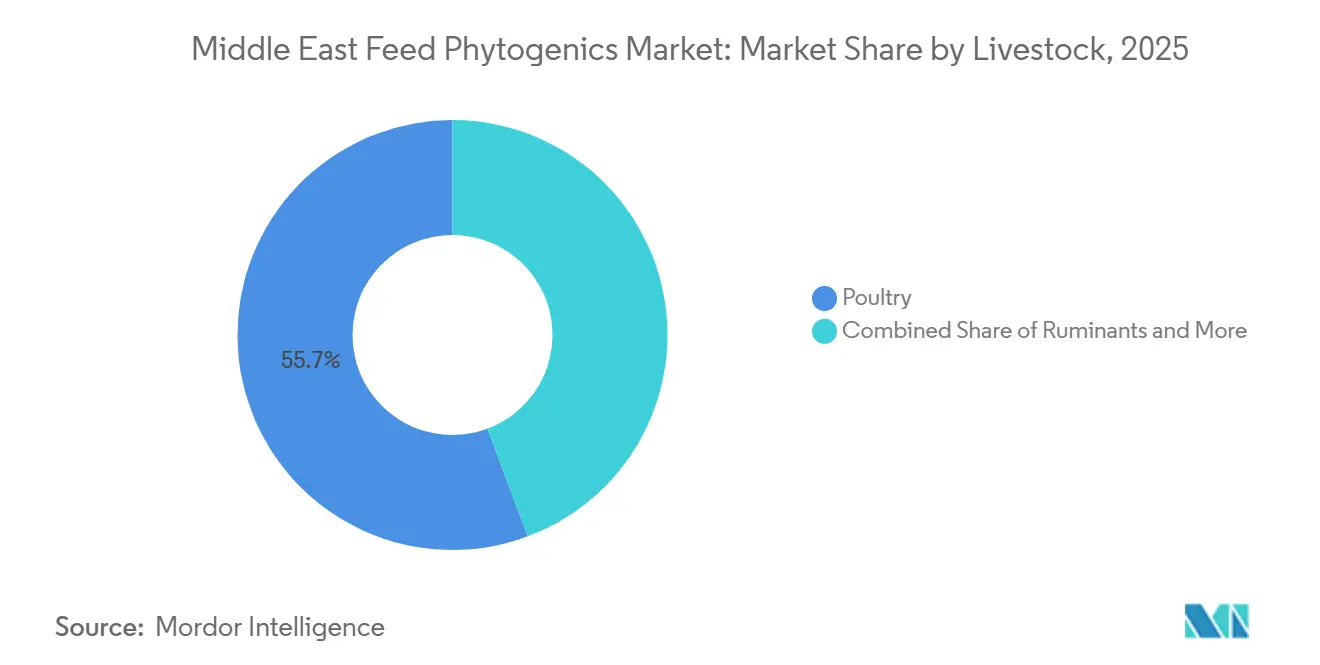
- By animal, poultry captured 55.7% of the Middle East feed phytogenics market share in 2025, while aquaculture is projected to be the fastest livestock segment with a 9.0% CAGR during 2026-2031.
- By geography, Saudi Arabia held the largest 32% country share in 2025, while the United Arab Emirates is projected to be the fastest country market with a 9.1% CAGR during 2026-2031.
Note: Market size and forecast figures in this report are generated using Mordor Intelligence’s proprietary estimation framework, updated with the latest available data and insights as of January 2026.
Middle East Feed Phytogenics Market Trends and Insights
Drivers Impact Analysis*
| Driver | (~) % Impact on CAGR Forecast | Geographic Relevance | Impact Timeline |
|---|---|---|---|
| Shift from Antibiotic Growth Promoters to Natural Performance Additives | +1.5% | Saudi Arabia, United Arab Emirates, Bahrain, and Kuwait, where restrictions on antibiotic growth promoters tightened in 2024 and 2025 | Short term (≤ 2 years) |
| Expansion of Industrial Poultry Production Under Food-Security Programs | +1.3% | Saudi Arabia, Turkey, United Arab Emirates, and Iran, where domestic protein supply programs are supporting integrator expansion | Medium term (2-4 years) |
| Rising Feed-Efficiency Focus Amid High Feed Input Costs | +1.2% | Region-wide, with stronger impact in high import-dependent markets including Saudi Arabia | Medium term (2-4 years) |
| Red Sea and Gulf Aquaculture Build-Out | +0.9% | Saudi Arabia, United Arab Emirates, and Oman, where mariculture and hatchery investments are expanding | Long term (≥ 4 years) |
| Halal-Certified Phytogenics for Export-Oriented Poultry Value Chains | +0.6% | Saudi Arabia, United Arab Emirates, and Iran, where documentation and product traceability matter for export-linked poultry chains | Medium term (2-4 years) |
| Heat-Stress Mitigation Demand in Arid Production Systems | +1.0% | Gulf Cooperation Council countries and Turkey, where high summer temperatures pressure animal performance | Medium term (2-4 years) |
| Source: Mordor Intelligence | |||
Shift from Antibiotic Growth Promoters to Natural Performance Additives
Saudi Arabia and the United Arab Emirates tightened restrictions on antibiotic growth promoters in 2024 and 2025, which accelerated the shift toward phytogenics and other natural feed additives in intensive poultry and ruminant systems. Saudi Arabia’s National Action Plan on Antimicrobial Resistance 2022-2025 set a clear direction toward reducing antimicrobial use in food animals, and that policy direction created a compliance-led demand base for alternatives in the Middle East feed phytogenics market[1]Source: World Health Organization, “Kingdom of Saudi Arabia National Action Plan on Antimicrobial Resistance 2022-2025,” World Health Organization, who.int. This shift matters commercially because smaller integrators that once relied on lower-cost antibiotic programs now face a narrower economic gap between conventional programs and phytogenic solutions. The Middle East feed phytogenics market also benefits, as buyers increasingly evaluate these products as a practical response to regulatory pressure rather than as a discretionary performance input. A 2025 systematic review in Frontiers in Animal Science reported that phytogenic feed additives improved broiler body weight gain by 5% to 13%, while one essential oil blend at 125 parts per million lifted total weight gain by 12.9% and improved feed conversion ratio from 1.71 to 1.60 over 42 days.
Expansion of Industrial Poultry Production Under Food-Security Programs
Food security policy is driving large poultry investments across the Gulf, creating a stable volume base for additive suppliers serving the Middle East feed phytogenics market. Saudi Arabia’s Vision 2030 framework includes strong support for agricultural self-sufficiency, and the poultry segment remains central to that effort. As new feed mills and integrated farms come online, purchasing shifts toward standardized additive programs that can be validated across larger flocks and multiple feed cycles. This pattern supports established suppliers because large integrators tend to favor consistent technical service, clear documentation, and products that fit into long-term procurement contracts. The result is that poultry expansion not only adds volume to the Middle East feed phytogenics market but also raises the value of supplier relationships and performance evidence in the region.
Rising Feed-Efficiency Focus Amid High Feed Input Costs
Feed efficiency has become a core purchasing issue because the region remains heavily exposed to imported feed ingredients, and that keeps procurement managers focused on any tool that can improve feed conversion in the Middle East feed phytogenics market. The United States Department of Agriculture Foreign Agricultural Service reported that Saudi Arabia imported 1.4 million metric tons of soybeans and soybean meal in 2024, reflecting the level of raw material exposure that underpins feed formulation decisions. In that setting, a measurable improvement in feed conversion ratio directly translates into lower feed costs per unit of animal output. The Middle East feed phytogenics market, therefore, draws support from a commercial logic tied more to operating economics than to policy alone, making demand durable when ingredient costs remain elevated. A 2025 paper in Scientific Reports found that nanoencapsulated lavender essential oil led to higher body weight gain and a lower feed conversion ratio than free-form applications in broilers, supporting the value of more effective formulations.
Red Sea and Gulf Aquaculture Build-Out
Aquaculture is becoming a more important driver of demand for the Middle East feed phytogenics market, as the region is building capacity in hatcheries, marine pens, and aquafeed production. NEOM also announced a joint venture with Tabuk Fisheries Company, including a hatchery with a planned capacity of 42 million fingerlings, pointing to a more industrialized aquaculture base in Saudi Arabia. This matters because aquaculture requires species-specific gut health, stress, and immunity programs that differ from those used in poultry. Suppliers that bring aquatic efficacy data into the Middle East feed phytogenics market are likely to gain an advantage as regional producers build modern feed systems around evidence-based nutrition programs.
Restraints Impact Analysis*
| Restraint | (~) % Impact on CAGR Forecast | Geographic Relevance | Impact Timeline |
|---|---|---|---|
| Higher Cost versus Conventional Additive Programs | -1.30% | Region-wide, with stronger pressure in Iraq, Iran, and smaller Gulf markets where premium input penetration is lower | Short term (≤ 2 years) |
| Inconsistent Efficacy and Dosage Standardization Across Botanical Actives | -0.90% | Region-wide, with greater impact where local validation capacity is limited | Medium term (2-4 years) |
| Red Sea and Strait of Hormuz Logistics Disruptions | -1.00% | Gulf countries that depend on imported additives from Europe and India | Short term (≤ 2 years) |
| Fragmented Approvals and Limited in-Market Testing Infrastructure | -0.70% | Iraq, Iran, and smaller regional markets where registration and validation systems are uneven | Medium term (2-4 years) |
| Source: Mordor Intelligence | |||
Higher Cost versus Conventional Additive Programs
Higher pricing remains the clearest barrier to the Middle East feed phytogenics market, especially in cost-sensitive farming systems where producers primarily compare additives based on near-term feed costs. This issue is most visible in Iraq and Iran, where tighter farm economics reduce the willingness to pay a premium for performance or compliance-led solutions. The Gulf Cooperation Council Standardization Organization standard GSO 2141:2023 added quality and safety compliance requirements for feed additives, which can increase documentation and import costs for smaller product lots. Regional suppliers with local blending capacity are in a stronger position because they can spread those costs over broader product portfolios. That leaves standalone phytogenic suppliers under greater pressure unless they can clearly demonstrate performance gains that offset the initial price premium.
Inconsistent Efficacy and Dosage Standardization Across Botanical Actives
Performance variability also restrains the Middle East feed phytogenics market, as the efficacy of phytogenic products depends heavily on botanical composition, extraction quality, and proper dosing practices. When nutritionists cannot rely on consistent active compound profiles, product adoption slows, and buyers return to more familiar additive programs. The 2025 Frontiers in Animal Science review noted that phytogenic responses can be nonlinear, and excessive inclusion can reduce feed efficiency rather than improve it. This matters more in markets with limited local trial infrastructure because efficacy data are often borrowed from European or North American conditions that do not match the Middle Eastern climate or feed inputs. Suppliers that provide technical support, dosage guidance, and farm-level trial coordination are better placed to reduce that trust gap in the Middle East feed phytogenics market.
*Our forecasts treat driver/restraint impacts as directional, not additive. The impact forecasts reflect baseline growth, mix effects, and variable interactions.
Segment Analysis
By Sub Additive: Essential Oils Lead in Both Share and Growth
Essential oils accounted for 38.0% of revenue in 2025, which made them the largest product type in the Middle East feed phytogenics market, and they are also projected to be the fastest-growing product category at an 8.9% CAGR during 2026-2031. Their position reflects the strong commercial acceptance of compounds such as carvacrol, thymol, and cinnamaldehyde in broiler and layer programs across the region. These compounds provide nutritionists with a clear inclusion case because they are linked to antimicrobial activity, antioxidant support, and improved feed efficiency. Oleoresins accounted for the second-largest product block because they align well with water-based delivery strategies and practical farm programs for heat-stressed birds. Other phytogenics remained smaller parts of the portfolio mix, but they continued to gain attention in ruminant and niche health applications.
A 2025 paper in Scientific Reports showed that nanoencapsulated essential oil formulations outperformed free-form formulations in terms of body weight gain and feed conversion ratio in broilers, strengthening the technical case for premium products in this segment[2]Source: Scientific Reports, “Modulation of Performance, Meat Quality and Gut Health of Broiler Chicken in Response to Dietary Nanoencapsulated Lavender Essential Oil,” Scientific Reports, nature.com. That finding matters because the Middle East feed phytogenics market is increasingly rewarding products that hold activity through feed processing and deliver a predictable release in the animal. Suppliers with established essential oil programs are in a stronger position because the largest part of the Middle East feed phytogenics industry is already aligned with the fastest-expanding product class. The Middle East feed phytogenics market share held by essential oils in 2025 also shows that buyers are no longer treating the category as a trial segment. Instead, essential oils now form the core product platform for many poultry-focused phytogenic programs.



By Animal: Poultry Dominates, Aquaculture Grows Fastest
Poultry accounted for 55.7% of revenue in 2025, making it the largest livestock segment in the Middle East feed phytogenics market, while Aquaculture is projected to be the fastest-growing segment with a 9% CAGR during 2026-2031. Poultry’s scale reflects the central role of broiler and layer production in food security programs across the Gulf, where feed additives are closely linked to flock efficiency and consistency. Within poultry, broilers account for the main share of phytogenic use because their economics respond quickly to changes in feed conversion and body weight gain. Ruminants still form an important secondary outlet, especially for dairy cattle in heat-stressed systems and for sheep and goats in markets where tannin and saponin-based programs are being tested. Even so, the structure of the Middle East feed phytogenics market remains firmly poultry-led in terms of current revenue.
Almarai reported SAR 3.9 billion (USD 1.04 billion) in poultry revenue in 2025, underscoring the scale of large poultry operations that support additive demand in the region. Species such as tilapia, shrimp, sea bass, and sea bream require more specialized gut-health and immunity programs, creating opportunities for differentiated suppliers. The gap between poultry’s current size and aquaculture’s faster trajectory is one of the clearest structural shifts in the Middle East feed phytogenics market during 2026-2031.
Geography Analysis
Saudi Arabia accounted for 32% of 2025 revenue, making it the largest market in the Middle East for feed phytogenics. Its position is built on the scale of domestic poultry and aquaculture expansion in support of long-term food security goals, with Vision 2030 continuing to support agricultural and protein supply investments. The country’s aquaculture push is also supported by the National Fisheries Development Program's target of 530,000 metric tons by 2030, which adds a second feed demand engine beyond poultry[3]Source: United States Department of Agriculture Foreign Agricultural Service, “An Overview of the Aquaculture Industry in Saudi Arabia,” USDA FAS, apps.fas.usda.gov. NEOM’s Topian aquaculture venture, including a planned hatchery to produce 42 million fingerlings, reinforces the build-out and links the country to more advanced aquaculture nutrition requirements. Saudi Arabia also tightened the regulatory setting for antimicrobial products in late 2024, which supports a stronger compliance case for phytogenic adoption among major integrators.
Turkey and Iran form the second tier of the regional landscape and give the Middle East feed phytogenics market broader geographic depth beyond the Gulf core. Turkey remains important because of its livestock base, its role in botanical sourcing, and its relevance as a practical entry point for herb-and-spice-based formulations used across nearby markets. Iran offers significant livestock potential in absolute terms, but near-term growth remains constrained by import frictions, payment complexities, and exposure to shipping routes that affect feed additive supply. Iraq also presents an opportunity, as its poultry sector is developing, yet inconsistent approvals and weaker local technical infrastructure slow product expansion. These markets do not yet match Saudi Arabia in scale, but they matter because they expand the demand base and create space for suppliers with flexible channel strategies.
The United Arab Emirates is projected to be the fastest-growing market in the Middle East feed phytogenics market, with a 9.1% CAGR during 2026-2031. Its faster pace is linked to the adoption of premium additives in poultry and aquaculture, its role as a regional re-export hub, and tighter import compliance systems that favor organized suppliers. The United Arab Emirates Ministry of Climate Change and Environment requires pre-registration, certification of origin, and approval procedures for imported feed and additives, thereby giving companies with stronger regulatory documentation a competitive advantage. Oman and the rest of the region remain smaller in current value, but they still represent structurally relevant demand pools as aquaculture and feed distribution networks widen.
Competitive Landscape
The Middle East feed phytogenics market is moderately fragmented, despite the influence of large multinational suppliers in setting many commercial standards for regional buyers. Key players in the market include Cargill, Incorporated, DSM-Firmenich AG, Kemin Industries, Inc., Nutreco N.V., and Archer Daniels Midland Company. However, a significant portion of the industry remains outside the dominance of these leading companies. This dynamic creates opportunities for specialized phytogenic suppliers and regional distributors to compete by offering technical support, tailored products, and flexible pricing. Larger companies often pursue platform integration strategies, bundling phytogenics with postbiotics, enzymes, and mycotoxin solutions to simplify feed mill purchasing decisions. For instance, Cargill reported in 2025 that its Micronutrition and Health Solutions business achieved double-digit annual growth over the previous three years, highlighting the value of integrated nutrition platforms in markets like the Middle East.
The Middle East feed phytogenics market remains open to focused challengers, as technical specialization continues to play a critical role. Anpario plc, for example, reported a 12% increase in business revenue, reaching GBP 40.5 million (USD 51.4 million) in fiscal 2025, with a notable resurgence in growth within the Middle East. Smaller, specialized suppliers can effectively compete when customers prioritize product-specific support over broad portfolio offerings. Segments such as aquatic validation, heat-stress formulations, and halal-compliant documentation rely heavily on technical evidence and localized service capabilities rather than the scale of a supplier's brand. Consequently, while scale offers advantages, it does not eliminate competition, ensuring active commercial rivalry across the region.
Corporate restructuring is influencing competition in the Middle East feed phytogenics market by altering how major suppliers allocate capital and regional focus. In February 2026, DSM-Firmenich AG announced an agreement to divest its Animal Nutrition and Health business to CVC Capital Partners for an enterprise value of EUR 2.2 billion (USD 2.4 billion). Earlier, in September 2024, DSM-Firmenich AG inaugurated a new Animal Nutrition and Health manufacturing facility in Sadat City, Egypt, to serve customers in Egypt, the Middle East, Southern Europe, and Africa. Such developments are significant, as factors like regional supply support, local blending capabilities, and distributor responsiveness can influence purchasing decisions as much as product performance claims. Over the forecast period, companies that combine validated phytogenic efficacy with reliable regional service are expected to achieve the most sustainable market share growth.
Middle East Feed Phytogenics Industry Leaders
Cargill, Incorporated
Kemin Industries, Inc.
Nutreco N.V. (SHV Holdings N.V.)
DSM-Firmenich AG
Archer Daniels Midland Company
- *Disclaimer: Major Players sorted in no particular order

Recent Industry Developments
- February 2026: DSM-Firmenich AG announced its agreement to divest the Animal Nutrition and Health (ANH) business to CVC Capital Partners for an enterprise value of approximately EUR 2.2 billion (USD 2.4 billion). This transaction follows the prior sale of DSM-Firmenich's Feed Enzymes activities to Novonesis for EUR 1.5 billion (USD 1.6 billion) in 2025. The full divestiture, anticipated to close at end-2026, will make ANH an independent entity, with implications for its Middle East commercial strategy, including phytogenic operations
- March 2025: Cargill, Incorporated’s launch of the Biostrong phytogenic line at VIV Asia 2025 it will intensify competition in the Middle East feed phytogenics market by expanding access to gut health and feed efficiency solutions for poultry producers seeking antibiotic alternatives.
- March 2025: Kemin Industries, Inc.’s launch of PROSIDIUM strengthens feed biosecurity and pathogen control capabilities in the Middle East feed phytogenics market. Once regional registration is completed, the product will broaden feed safety offerings and intensify competition among suppliers serving livestock producers.


Middle East Feed Phytogenics Market Report Scope
Feed Phytogenics market reports provide strategic analysis of plant-derived feed additives used to replace antibiotic growth promoters and improve livestock gut health. The Middle East feed phytogenics market report is segmented by product type (essential oils, oleoresins, and other phytogenics), by animal (poultry, ruminants, and more), and by geography (Saudi Arabia, Turkey, and more). The market forecasts are provided in terms of value (USD) and volume (metric tons).
| Essential Oil |
| Herbs and Spices |
| Other Phytogenics |
| Aquaculture | Fish |
| Shrimp | |
| Other Aquaculture Species | |
| Poultry | Broiler |
| Layer | |
| Other Poultry Birds | |
| Ruminants | Beef Cattle |
| Dairy Cattle | |
| Other Ruminants | |
| Swine | |
| Other Animals |
| Saudi Arabia |
| Turkey |
| Iran |
| United Arab Emirates |
| Iraq |
| Rest of Middle East |
| By Sub Additive | Essential Oil | |
| Herbs and Spices | ||
| Other Phytogenics | ||
| By Animal | Aquaculture | Fish |
| Shrimp | ||
| Other Aquaculture Species | ||
| Poultry | Broiler | |
| Layer | ||
| Other Poultry Birds | ||
| Ruminants | Beef Cattle | |
| Dairy Cattle | ||
| Other Ruminants | ||
| Swine | ||
| Other Animals | ||
| By Geography | Saudi Arabia | |
| Turkey | ||
| Iran | ||
| United Arab Emirates | ||
| Iraq | ||
| Rest of Middle East | ||


Key Questions Answered in the Report
What is the size outlook for the Middle East feed phytogenics space through 2031?
The Middle East feed phytogenics market stands at USD 47.8 million in 2026 and is projected to reach USD 71.6 million by 2031, growing at a CAGR of 8.42% during 2026-2031.
Which product type is the largest and fastest in the region?
Essential Oils are both the largest product category with 38% share in 2025 and the fastest-growing one with an 8.9% CAGR during 2026-2031.
Why is poultry still the main demand center for phytogenic additives in the Middle East?
Poultry accounted for 55.7% of 2025 revenue, and the segment remains closely tied to food security programs, large integrated feed operations, and the need for feed efficiency and heat-stress support.
Which country is currently the largest market and which one is growing the fastest?
Saudi Arabia held the largest country share at 32% in 2025, while the United Arab Emirates is projected to grow the fastest at a 9.1% CAGR during 2026-2031.
Page last updated on:





