
Middle East and Africa Warehouse Real Estate Market Size and Share
Market Overview
| Study Period | 2021 - 2032 |
|---|---|
| Forecast Data Period | 2027 - 2032 |
| Base Year Market Size (2026) | USD 18.23 Billion |
| Market Size (2027) | USD 19.64 Billion |
| Market Size (2032) | USD 28.61 Billion |
| Growth Rate (2027 - 2032) | 7.81 % |
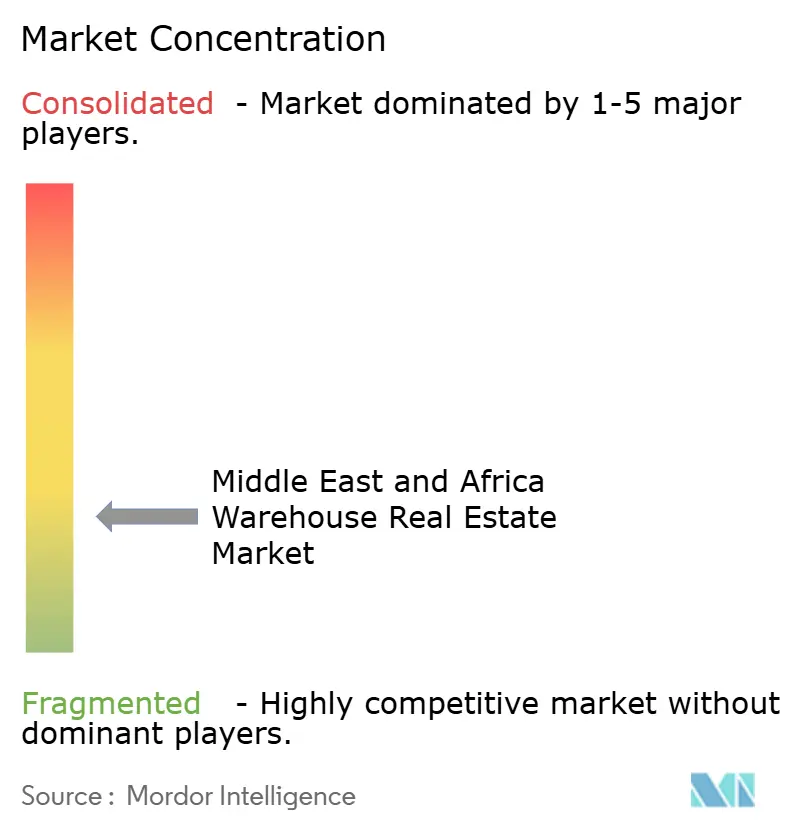
| Market Concentration | Low |
Major Players *Disclaimer: Major Players sorted in no particular order Image © Mordor Intelligence. Reuse requires attribution under CC BY 4.0. | |
Middle East and Africa Warehouse Real Estate Market Analysis by Mordor Intelligence
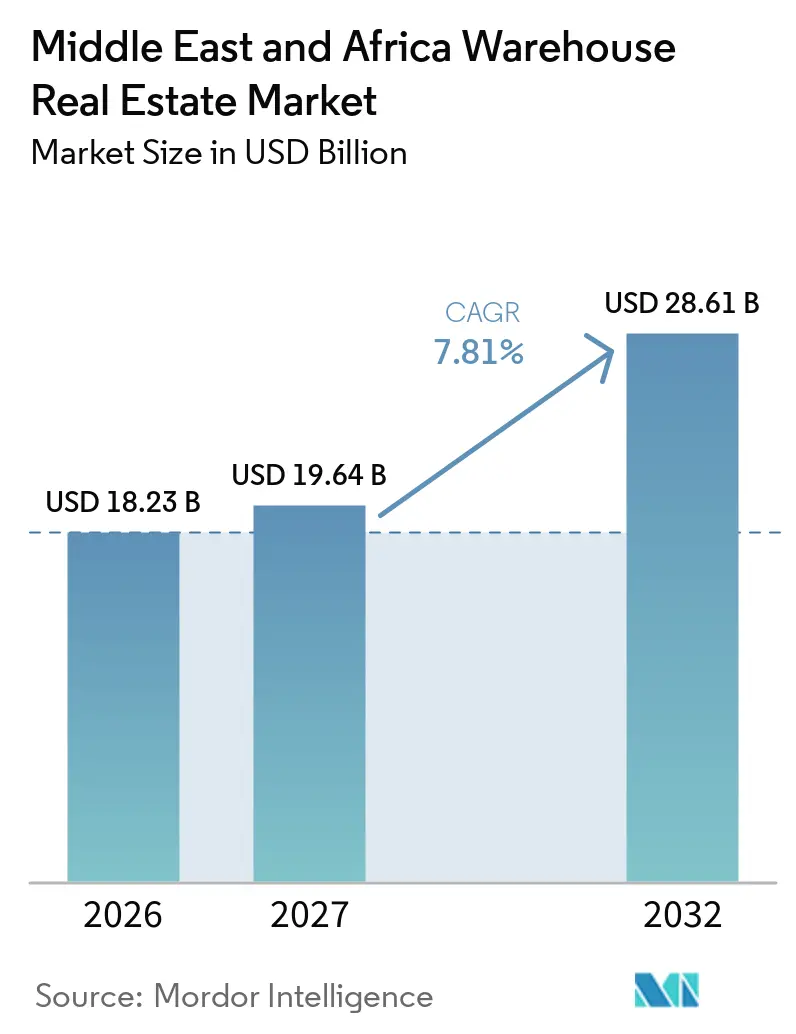
The Middle East And Africa Warehouse Real Estate Market size is projected to be USD 18.23 billion in 2026, USD 19.64 billion in 2027, and reach USD 28.61 billion by 2032, growing at a CAGR of 7.81% from 2027 to 2032.
The Middle East and Africa warehouse real estate market is supported by demand for modern distribution space near ports, airports, industrial zones, and large cities. New capacity is increasingly designed for faster handling, stronger temperature control, and reliable links to road, rail, and maritime networks. Developers are focusing on Class A buildings because large occupiers need consistent specifications and compliance standards. The Middle East and Africa warehouse real estate market also has room to grow in African cities where modern storage remains limited, especially where food distribution, consumer delivery, and local manufacturing are expanding at the same time. Investment is likely to favor locations with dependable utilities, clear land rights, and established transport access. It will also favor projects that can offer tenants predictable operating costs, suitable loading areas, and room for expansion without disrupting existing operations.
Key Report Takeaways
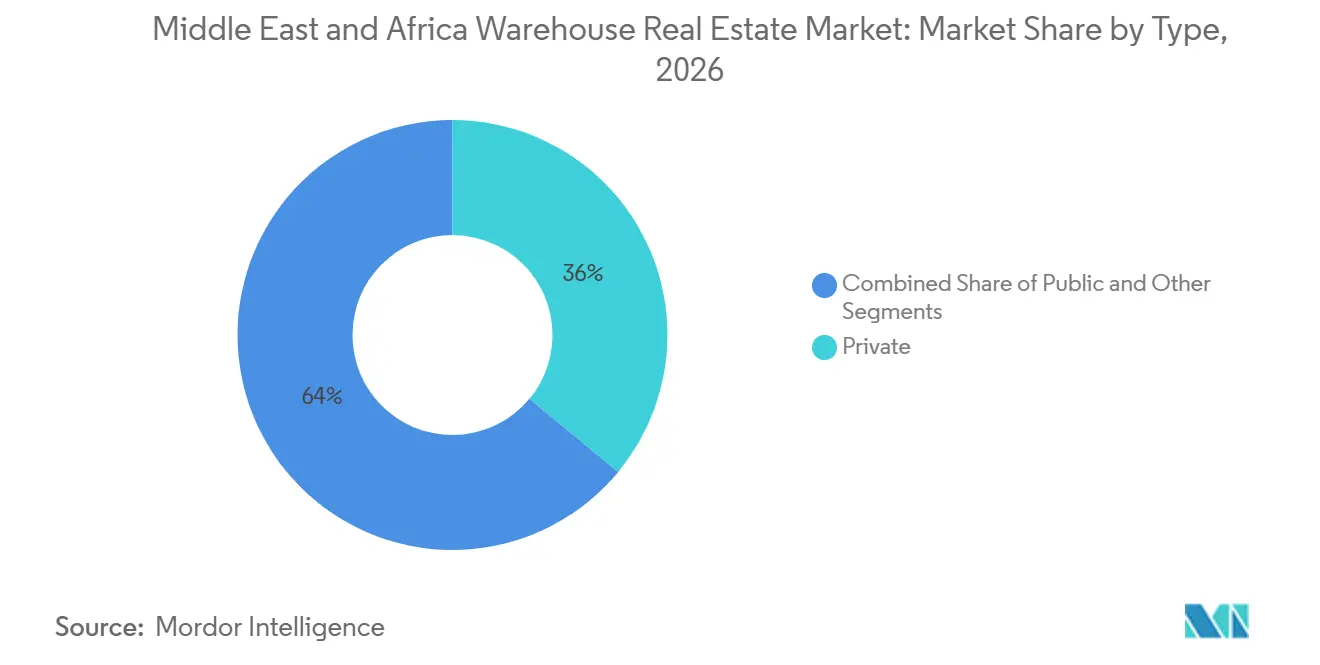
- By type, private warehouses held 36.00% of the Middle East and Africa warehouse real estate market share in 2026, while other formats are forecast to grow at an 8.60% CAGR through 2032.
- By temperature control, general warehouses accounted for 55.00% of the Middle East and Africa warehouse real estate market size in 2026, while refrigerated warehouses are forecast to grow at an 8.20% CAGR through 2032.
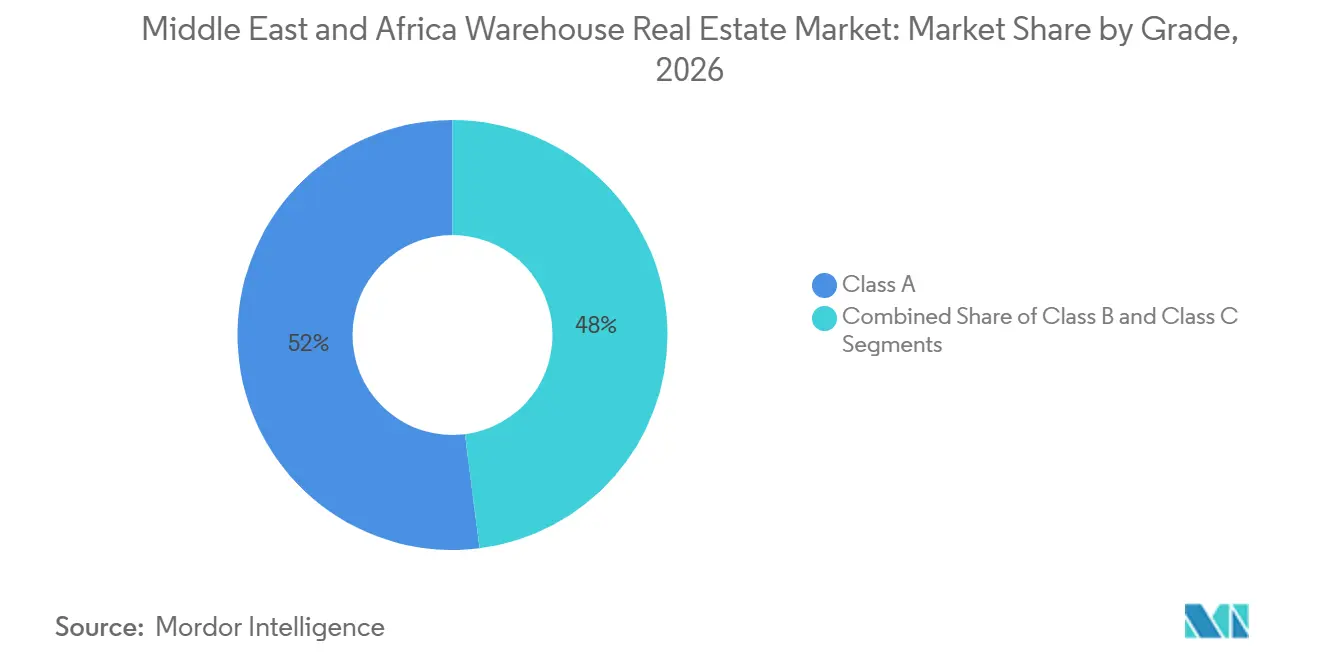
- By grade, Class A facilities held 52.00% of the Middle East and Africa warehouse real estate market share in 2026 and are forecast to grow at a 9.00% CAGR through 2032.
- By warehouse size, facilities above 250,000 square feet held 44.00% of the Middle East and Africa warehouse real estate market size in 2026, while facilities below 50,000 square feet are forecast to grow at an 8.80% CAGR through 2032.
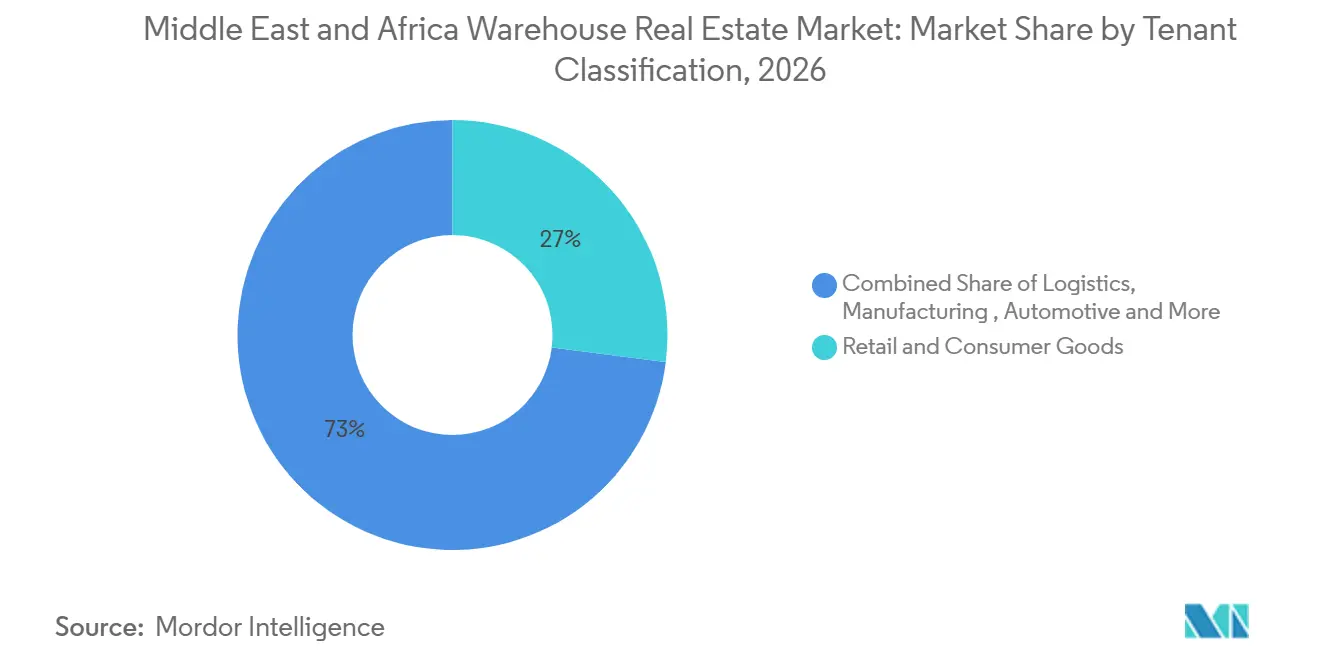
- By tenant classification, retail and consumer goods held 27% of the Middle East and Africa warehouse real estate market share in 2026, while food and beverage is forecast to grow at an 8.50% CAGR through 2032.
- By geography, the United Arab Emirates held 35.00% of the Middle East and Africa warehouse real estate market share in 2026, while Saudi Arabia is forecast to grow at a 9.20% CAGR through 2032.
Note: Market numbers in this report are based on Mordor Intelligence's proprietary estimation framework, which combines nine months of actuals with Q4 projections for base year 2026.
Market Trends and Insights
Drivers Impact Analysis of Middle East and Africa Warehouse Real Estate Market*
| Drivers | (~) % Impact on CAGR Forecast | Geographic Relevance | Impact Timeline |
|---|---|---|---|
| Jebel Ali, Khalifa, Riyadh, and Jeddah Logistics Hub Expansion | +2.0% | United Arab Emirates and Saudi Arabia, with spillover to Oman and Bahrain | Short term (≤ 2 years) |
| High Smartphone Penetration and E-commerce Fulfillment | +1.6% | Gulf Cooperation Council, Egypt, and Nigeria | Short term (≤ 2 years) |
| Saudi Vision and Gulf Economic Diversification Programs | +1.4% | Saudi Arabia and wider Gulf Cooperation Council | Medium term (2-4 years) |
| Food Security, Pharmaceutical, and Temperature-Controlled Logistics | +0.9% | Gulf Cooperation Council, Egypt, and North Africa | Medium term (2-4 years) |
| Manufacturing, Mining, and Regional Distribution Hubs | +0.7% | Saudi Arabia, South Africa, and Nigeria | Medium term (2-4 years) |
| Industrial Parks, Special Economic Zones, and Cross-Border Trade Integration | +0.6% | Saudi Arabia, United Arab Emirates, and Egypt | Long term (≥ 4 years) |
| Source: Mordor Intelligence | |||
Jebel Ali, Khalifa, Riyadh, and Jeddah Logistics Hub Expansion
Port and airport logistics hubs are increasing demand for buildings that can move goods quickly between transport modes. Jeddah also benefits from DP World’s completed modernization of the South Container Terminal, which lifted capacity to 4 million twenty-foot equivalent units in 2025[1]. These investments strengthen the case for nearby warehouse space with high throughput and access to skilled logistics operators. They also encourage occupiers to place regional inventory closer to gateways, rather than holding it in dispersed facilities with weaker transport connections. The Middle East and Africa warehouse real estate market is therefore likely to see its strongest near-term demand around established trade gateways. This pattern may extend to inland sites only where road and rail connections can move cargo reliably from ports, allowing tenants to avoid delays, limit repeated handling, and serve both domestic and cross-border customers from a practical operating base.
High Smartphone Penetration and E-commerce Fulfillment
Online retail is changing the type of warehouse space tenants need, especially close to large urban areas. The GSMA reported 48.1 million active mobile connections in Saudi Arabia and 21.9 million in the United Arab Emirates in 2025[2]. High mobile use supports frequent digital orders and raises the value of rapid fulfillment. Amazon opened its first fulfillment center in Abu Dhabi at Khalifa Economic Zones Abu Dhabi in 2026, showing how operators are placing capacity inside well-connected logistics zones. The Middle East and Africa warehouse real estate market needs more small, flexible facilities to support same-day and short-distance delivery. This preference can place pressure on urban land, where industrial sites are scarce, and approvals can take time. It also rewards developers that can offer sites close enough to customers while keeping vehicle access, loading activity, and local planning requirements under control. A well-located urban facility can shorten delivery routes. However, the building must still have enough space for vehicle movements, safe loading, inventory storage, and the changing delivery patterns of retailers and third-party logistics providers.
Saudi Vision and Gulf Economic Diversification Programs
Saudi Arabia’s industrial and logistics policy is directing private investment toward new supply chains and industrial districts. SAL Logistics Services and Sela signed a USD 1.07 billion agreement in March 2025 for the SAL Logistics Zone north of Riyadh[3]. The 1.57 million square meter project is planned as a multimodal hub with air, road, and future rail links. DHL Supply Chain also announced a USD 136.5 million investment for a multi-user facility in the Special Integrated Logistics Zone. These projects broaden the tenant base beyond retail into manufacturing, aviation, and regional distribution. They create a clearer pipeline for suppliers and logistics companies that need space before, during, and after goods move through airport and industrial networks. The Middle East and Africa warehouse real estate market benefits when public infrastructure and private tenant commitments advance together. This relationship can improve project viability because developers can plan around confirmed transport links, and occupiers can take space with greater confidence that the surrounding industrial district will be functional, accessible, and able to support their workforce needs.
Food Security, Pharmaceutical Logistics, and Regional Distribution Networks
Food security policies and pharmaceutical production are increasing the need for temperature-controlled buildings. RSA Cold Chain opened a Jebel Ali facility in September 2025 with 40,000 pallet positions and food-safety certifications. DP World also began work on a USD 29 million cold-storage facility in Egypt’s 6th of October City during October 2025. The facility will have 8 independently controlled chambers and 25,000 pallet positions. The World Bank has identified inadequate storage as a major contributor to food losses in Africa. Manufacturing, mining, special economic zones, and cross-border trade can add demand for general warehouses alongside this cold-chain requirement. Together, these activities increase the value of sites that can combine ordinary storage, controlled temperatures, customs handling, and dependable links to regional distribution routes. Facilities with this mix can support a broader customer base, although they require stronger operational controls and technical planning than a conventional warehouse designed for dry goods alone.
Restraints Impact Analysis of Middle East and Africa Warehouse Real Estate Market*
| Restraints | (~) % Impact on CAGR Forecast | Geographic Relevance | Impact Timeline |
|---|---|---|---|
| Limited Institutional Capital and High Local Financing Costs | -1.1% | Sub-Saharan Africa and non-Gulf Cooperation Council Middle East and North Africa | Long term (≥ 4 years) |
| Unreliable Power, Roads, and Utility Infrastructure | -0.8% | Nigeria, South Africa, Egypt, and Kenya | Long term (≥ 4 years) |
| Land Titling, Planning, and Municipal Approval Complexity | -0.6% | Middle East and North Africa and Sub-Saharan Africa | Medium term (2-4 years) |
| Currency Volatility, Informal Occupancy, and Tenant Credit Risk | -0.5% | Sub-Saharan Africa and Egypt | Long term (≥ 4 years) |
| Source: Mordor Intelligence | |||
Limited Institutional Capital and High Local Financing Costs
Warehouse development requires long-term capital, but financing remains uneven outside the Gulf Cooperation Council. Developers in several African countries often need an anchor tenant before a project can proceed. This reduces the supply of speculative buildings and limits the choice available to growing occupiers. The difference between well-funded Gulf projects and smaller African projects can widen the gap in building quality. It may also make it harder for tenants to find space that meets international standards in markets where consumer demand is rising. Still, long-term construction financing, property valuation practices, and institutional ownership are not yet fully developed. The Middle East and Africa warehouse real estate market may therefore develop at different speeds across the region. Local financing tools and reliable exit opportunities will be important for bringing more private capital into these locations. Without them, developers may concentrate on build-to-suit projects and delay new facilities until they have secured an occupier, limiting available space for smaller tenants.
Infrastructure, Land, and Tenant-Risk Constraints
Unreliable electricity, road congestion, and utility delays raise construction and operating costs for warehouse users. The U.S. International Trade Administration notes that logistics constraints remain a significant challenge in Nigeria. Developers may need to provide backup power, stronger site infrastructure, and extra time for approvals. Land title uncertainty can delay development and increase the cost of capital before a building is occupied. Currency volatility and informal occupancy can also weaken tenant credit quality and limit long leases. These constraints mean that the Middle East and Africa warehouse real estate market will require careful location selection, particularly outside the best-connected logistics zones. Developers and tenants will need to assess travel times, utility performance, land documentation, security, and the costs of maintaining equipment before deciding whether lower land rents offset the operational challenges of a less-developed location. They can also cause wide differences in operating performance between two sites in the same city, depending on access to power, roads, approvals, and reliable tenants.
*Our forecasts treat driver/restraint impacts as directional, not additive. The impact forecasts reflect baseline growth, mix effects, and variable interactions.
Middle East and Africa Warehouse Real Estate Market Segment Analysis
By Type:
Private Ownership Anchors the Largest SegmentPrivate warehouses held 36.00% of the Middle East and Africa warehouse real estate market share in 2026. This position reflects investor interest in assets that can be managed through a single owner or portfolio platform. AD Ports Group completed the sale of 3 warehouses at Khalifa Economic Zones Abu Dhabi to Aldar Properties in April 2026 for USD 177 million. The assets added 163,000 square meters of industrial and logistics space to Aldar’s portfolio. The transaction shows that stabilized warehouse properties can attract institutional buyers where occupancy and transport access are strong. Public ownership remains relevant where government bodies develop large logistics districts and lease capacity to tenants.
Other formats are forecast to grow at an 8.60% CAGR through 2032. This category includes co-warehousing, flexible units, and on-demand storage arrangements. These products can suit small and medium-sized enterprises that cannot commit to long lease terms. They also help online retail tenants adjust capacity around seasonal demand. The Middle East and Africa warehouse real estate market is likely to use these formats more often in large cities and new industrial clusters. Their success will depend on suitable zoning, accessible lease terms, and dependable day-to-day building management. Providers will also need to maintain security, inventory accuracy, transport access, and transparent pricing for tenants that use only part of a larger facility.

By Temperature Control:
General Warehouses Retain the Largest BaseGeneral warehouses accounted for 55.00% of the Middle East and Africa warehouse real estate market size in 2026. They support the movement of consumer goods, industrial inputs, and nonperishable products across the region. Their broad use makes them essential within port zones, free zones, and inland distribution centers. Developers can build general space at a lower technical complexity than specialized cold storage. This makes the format suitable for a wide mix of tenants. General facilities will continue to form the foundation of warehouse supply even as specialized demand expands. Their broad role means they can support many kinds of goods. However, owners still need to provide appropriate safety standards, loading efficiency, usable storage layouts, and maintenance practices that allow diverse occupiers to work without disruption. General warehouse owners also need to plan for changing customer requirements, including pallet storage, cross-docking, packaging, and returns handling. These functions are often less technically demanding than refrigeration, but they still require well-designed space, safe workflows, and reliable management. A building that can accommodate different users can maintain its relevance as tenant needs change across retail, manufacturing, and distribution activities. It can also provide an operational bridge for companies that start with regional distribution and later add local fulfillment, light assembly, or value-added logistics services. This flexibility supports occupancy, although it depends on suitable design and responsive property management. It also depends on reasonable lease structures, accurate service-charge management, and clear operating rules for shared facilities across locations and tenant groups.
Refrigerated warehouses are forecast to grow at an 8.20% CAGR through 2032. Food imports, local food production, pharmaceuticals, and quick-commerce services all need controlled temperatures. DP World’s planned Egypt facility is designed to serve food and agricultural supply chains through 8 temperature-controlled chambers. Modern cold facilities need continuous power, trained staff, and detailed monitoring systems. Maersk has identified digital tools, including Internet of Things monitoring, as important for cold-chain visibility in the Middle East. These requirements raise entry barriers but can support higher-quality assets in the Middle East and Africa warehouse real estate market. They also make the reliability of electricity, refrigeration equipment, maintenance teams, and product tracking central to tenant decisions.
By Grade:
Class A Facilities Lead Demand and GrowthClass A facilities held 52.00% of the Middle East and Africa warehouse real estate market share in 2026. The segment benefits from demand for clear heights, loading capacity, fire safety, digital systems, and reliable transport access. Large international tenants also need buildings that meet consistent internal standards across several countries. New projects are therefore increasingly designed with institutional specifications from the outset. Certified buildings can make it easier for tenants to meet their own sustainability and reporting requirements. This helps Class A properties attract logistics providers, consumer-goods companies, and manufacturers. Such occupiers often place a high value on safe working conditions, predictable building performance, and the ability to link local operations with their regional supply chains.
Class A facilities are forecast to grow at a 9.00% CAGR through 2032. Agility Logistics Parks opened a logistics park in Jeddah in November 2025, with 6 Grade A warehouses on a 576,760 square meter site. The facility serves retail, technology, automotive, energy, and e-commerce tenants. Older Class B and Class C stock can still serve cost-sensitive users, but it may need upgrades to remain competitive. Building certifications such as Leadership in Energy and Environmental Design and Excellence in Design for Greater Efficiencies can influence tenant selection. The Middle East and Africa warehouse real estate market is becoming more divided between modern buildings and older stock with limited upgrade potential. Owners of older facilities may need to invest in loading systems, power resilience, safety equipment, and digital tools to protect occupancy.
By Warehouse Size:
Large Facilities Hold the Most ValueWarehouses above 250,000 square feet accounted for 44.00% of the Middle East and Africa warehouse real estate market size in 2026. Large facilities are used by retailers, third-party logistics providers, manufacturers, and major distributors. They can consolidate inventory, support automation, and reduce the number of separate handling locations. Large buildings nevertheless remain central where industrial demand, land availability, and network scale coincide. Their role is especially important for occupiers that need centralized inventory management and high volumes, but do not require a location within a dense urban area. Large sites can give these tenants room for handling equipment, employee areas, staging space, and possible future expansion, which can be difficult to secure in a small urban warehouse.
Warehouses below 50,000 square feet are forecast to grow at an 8.80% CAGR through 2032. These units are useful for last-mile delivery, local inventory, and smaller tenant operations. They can be placed closer to dense customer areas than large distribution centers. Smaller buildings also allow businesses to enter a logistics zone without committing to excess space. The Middle East and Africa warehouse real estate market can benefit from this format as e-commerce and city delivery services expand. However, high land costs and local planning rules can limit its availability in the most crowded urban districts. Developers must balance delivery proximity against rent levels, vehicle access, local traffic requirements, and the practical need for adequate loading and parking space.
By Tenant Classification:
Retail and Consumer Goods Form the Largest BaseRetail and consumer goods held 27.00% of tenant demand in 2026. These tenants require distribution capacity for imported merchandise, fast-moving consumer goods, and local store replenishment. They value locations that link ports, free zones, main roads, and customer centers. Digital retail has added demand for faster order processing and smaller delivery networks. Warehouse operators can respond through shared space, more loading bays, and improved inventory systems. This tenant group remains a broad source of demand for the Middle East and Africa warehouse real estate market. Its requirements vary by product, but reliable access to shoppers, stores, and transport infrastructure makes it an important source of occupancy for both large regional distribution centers and smaller city-serving facilities.
Food and beverage is forecast to grow at an 8.50% CAGR through 2032. The segment requires a mix of general storage and temperature-controlled capacity to support food distribution and product-quality requirements. The segment needs both general and refrigerated space, depending on the product. DP World announced the Dubai Food District in January 2026, with planned cold stores, temperature-controlled warehouses, processing facilities, and digital support services. Pharmaceutical and health care tenants need controlled access and compliant temperature management. Manufacturing, logistics companies, and third-party logistics providers also support long-term occupancy in industrial areas. A wider tenant mix can reduce reliance on any single demand source. It can also support more stable lease demand when consumer spending, industrial output, or trade volumes move at different speeds across the Middle East and Africa warehouse real estate market.
Geography Analysis
The United Arab Emirates held 35.00% of the Middle East and Africa warehouse real estate market share in 2026. The country benefits from Jebel Ali, Khalifa Port, free zones, and established links to regional trade routes. Khalifa Economic Zones Abu Dhabi also continues to attract investors because of port and industrial-zone connectivity. These links can help occupiers combine imported goods, local distribution, and industrial activity within one logistics system, reducing the need for separate handling locations.
Saudi Arabia is forecast to grow at a 9.20% CAGR through 2032. Large policy-led projects are strengthening industrial and warehouse development around Riyadh, Jeddah, and Dammam. SAL’s planned logistics zone north of Riyadh shows the scale of projects being pursued in the country. Agility Logistics Parks and ROSHN Group formed a joint venture in March 2026 for a Jeddah logistics park valued at USD 667 million. Saudi Arabia combines great domestic demand with an expanding industrial base, making it an important growth location for the Middle East and Africa warehouse real estate market. The pace of development will still depend on timely infrastructure delivery, practical site access, and the ability to convert announced projects into leased, operating facilities.
Egypt, Nigeria, and South Africa remain important African locations, although their development conditions differ. DP World opened the USD 85 million Sokhna Logistics Park in Egypt’s Suez Canal Economic Zone in October 2025. The project covers nearly 300,000 square meters and is intended as an integrated distribution center. Nigeria has strong demand potential but faces infrastructure and operating-cost challenges. South Africa benefits from a more established logistics base, while energy and site constraints can affect new supply. Oman, Qatar, and Bahrain can also gain from special economic zones and cross-border trade links. Their prospects depend on how effectively port activity, industrial land, customs processes, and road connections are brought together for tenants seeking regional distribution capacity.
Competitive Landscape
The Middle East and Africa warehouse real estate market includes logistics developers, port operators, industrial-zone owners, real estate investors, and specialized warehouse providers. Competition is strongest in established Gulf logistics zones where buildings, utilities, and transport links are already available. Global capital is increasingly looking for projects with established tenants and transparent ownership structures. Local developers retain an advantage where land access and regulatory knowledge are important. The market still has room for new providers in cold storage, pharmaceutical facilities, and urban fulfillment sites. Entry into these areas requires careful project design, dependable utility supply, and clear tenant demand, because a specialized building cannot easily be repurposed if its systems or location do not match customer needs. These areas require different capabilities, and they can reward operators that understand specialized systems rather than relying only on standard storage buildings.
AD Ports Group and Aldar Properties illustrate how developers can recycle capital through sales of stabilized warehouses. Their April 2026 transaction transferred 3 Khalifa Economic Zones Abu Dhabi warehouses for USD 177 million. This approach can allow port-linked groups to reinvest in new industrial capacity while giving real estate investors access to income-producing assets. Agility Logistics Parks has also expanded its Saudi presence through its Jeddah park and its joint venture with ROSHN. Competition will favor firms that can develop, lease, and manage high-specification facilities across several locations. It will also favor firms that can work with public-sector landowners, maintain consistent operating standards, and offer tenants room to expand within the same regional network.
Cold-chain investment is another competitive area because food and health care tenants require specialized operations. RSA Cold Chain’s Jebel Ali facility combines a large pallet capacity with food-safety credentials. DP World’s Egypt cold-storage project adds a second example of an operator extending beyond standard distribution buildings. Developers that secure power reliability, technical expertise, and suitable sites can build a stronger position in this part of the Middle East and Africa warehouse real estate market. The competitive field remains more fragmented in many African locations because institutional supply is still limited. This can create space for local partnerships, but it can also make project execution more dependent on site-specific infrastructure, financing, and tenant-credit conditions. Operators entering these markets need to understand how each location works in practice. A site may appear suitable based on rent or land availability, yet still face delays linked to roads, utility connections, customs processes, or local approvals. The same issue applies to tenant selection, since warehouse owners need customers with suitable operating practices and enough financial strength to support lease commitments. Partnerships with port operators, industrial-zone authorities, and local service providers can reduce some of these risks. They do not remove the need for detailed diligence before development begins. For investors, the difference between a strong asset and a difficult one may depend as much on execution and operating reliability as on headline demand. This makes experienced local management an important competitive factor across the region.
Middle East and Africa Warehouse Real Estate Industry Leaders
-
Prologis, Inc.
-
Gulf Related
-
Aldar Properties PJSC
-
Aramex PJSC
-
Emaar Properties PJSC
- *Disclaimer: Major Players sorted in no particular order
Middle East and Africa Warehouse Real Estate Market Companies Covered in this Report
- Prologis, Inc.
- Gulf Related
- Aldar Properties PJSC
- Aramex PJSC
- Emaar Properties PJSC
- Mubadala Investment Company
- Agility Global PLC
- DP World Limited
- Red Sea International Company
- Panattoni Development Company, Inc.
- GLP Pte. Ltd.
- CBRE Group, Inc.
- JLL
- Cushman & Wakefield plc
- Gulf Warehousing Company Q.P.S.C.
- ASYAD Group
- Dubai Industrial City
- Al-Futtaim Logistics
- Saudi Logistics Services Company
- Dubai South Properties
Recent Industry Developments in Middle East and Africa Warehouse Real Estate Market
- May 2026: Gallega Global Logistics inaugurated a 215,000 square foot multi-user third-party logistics hub at Jebel Ali Free Zone, Dubai. The site has warehouse-management systems and flexible storage capacity for distribution across the United Arab Emirates and the Gulf Cooperation Council.
- April 2026: AD Ports Group completed the sale of 3 Khalifa Economic Zones Abu Dhabi warehouses to Aldar Properties for USD 177 million. The assets added 163,000 square meters of industrial and logistics space to Aldar’s portfolio.
- March 2026: Agility Logistics Parks and ROSHN Group formed a joint venture to develop a Grade A logistics park in Jeddah with a project value of USD 667 million. The development is planned across 1.3 million square meters and will be delivered in 3 phases.
Middle East and Africa Warehouse Real Estate Market Report Scope
Segmentation Overview
| Public |
| Private |
| Others |
| General Warehouse |
| Refrigerated Warehouse |
| Class A |
| Class B |
| Class C |
| Small-Scale Warehouses, Under 50,000 sq ft |
| Medium-Scale Warehouses, 50,000-250,000 sq ft |
| Large-Scale Warehouses, Above 250,000 sq ft |
| Manufacturing |
| Retail and Consumer Goods |
| Food and Beverage |
| Pharmaceuticals and Healthcare |
| Logistics |
| Other End Users |
| Saudi Arabia |
| United Arab Emirates |
| Nigeria |
| Egypt |
| South Africa |
| Rest of Middle East and Africa |
| By Type | Public |
| Private | |
| Others | |
| By Temperature Control | General Warehouse |
| Refrigerated Warehouse | |
| By Grade | Class A |
| Class B | |
| Class C | |
| By Warehouse Size | Small-Scale Warehouses, Under 50,000 sq ft |
| Medium-Scale Warehouses, 50,000-250,000 sq ft | |
| Large-Scale Warehouses, Above 250,000 sq ft | |
| By Tenant Classification | Manufacturing |
| Retail and Consumer Goods | |
| Food and Beverage | |
| Pharmaceuticals and Healthcare | |
| Logistics | |
| Other End Users | |
| By Countries | Saudi Arabia |
| United Arab Emirates | |
| Nigeria | |
| Egypt | |
| South Africa | |
| Rest of Middle East and Africa |
Key Questions Answered in the Report
What is the 2026 value of Middle East and Africa warehouse real estate?
The sector is valued at USD 18.23 billion in 2026 and is projected to reach USD 28.61 billion by 2032. Growth is supported by demand for modern distribution facilities near established logistics gateways and large urban customer centers.
What growth rate is expected through 2032?
The forecast CAGR is 7.81% from 2027 to 2032. The outlook reflects demand for Class A supply, temperature-controlled space, and flexible buildings that can serve e-commerce and regional distribution needs.
Which country has the largest share in 2026?
The United Arab Emirates leads with a 35.00% share in 2026. Port, free-zone, and industrial connectivity support its position within regional warehouse networks.
Which country is projected to grow fastest?
Saudi Arabia is forecast to expand at a 9.20% CAGR through 2032. Large logistics zones and industrial investment programs are strengthening development activity in Riyadh, Jeddah, and Dammam.
Which warehouse grade leads the sector?
Class A facilities account for 52% in 2026 and are forecast to grow at a 9.00% CAGR. These facilities appeal to tenants that need consistent specifications, reliable loading capacity, safety systems, and efficient access to transport networks.
Which tenant group is growing fastest?
Food and beverage is forecast to grow at an 8.50% CAGR through 2032. The segment requires a mix of general storage and temperature-controlled capacity to support food distribution and product-quality requirements.