
Middle East and Africa Transportation Technical Textiles Market Size and Share
Market Overview
| Study Period | 2021 - 2032 |
|---|---|
| Forecast Data Period | 2027 - 2032 |
| Base Year Market Size (2026) | USD 0.93 Billion |
| Market Size (2027) | USD 0.97 Billion |
| Market Size (2032) | USD 1.53 Billion |
| Growth Rate (2027 - 2032) | 9.54 % |
| Market Concentration | Medium |
Major Players *Disclaimer: Major Players sorted in no particular order Image © Mordor Intelligence. Reuse requires attribution under CC BY 4.0. | |
Middle East and Africa Transportation Technical Textiles Market Analysis by Mordor Intelligence
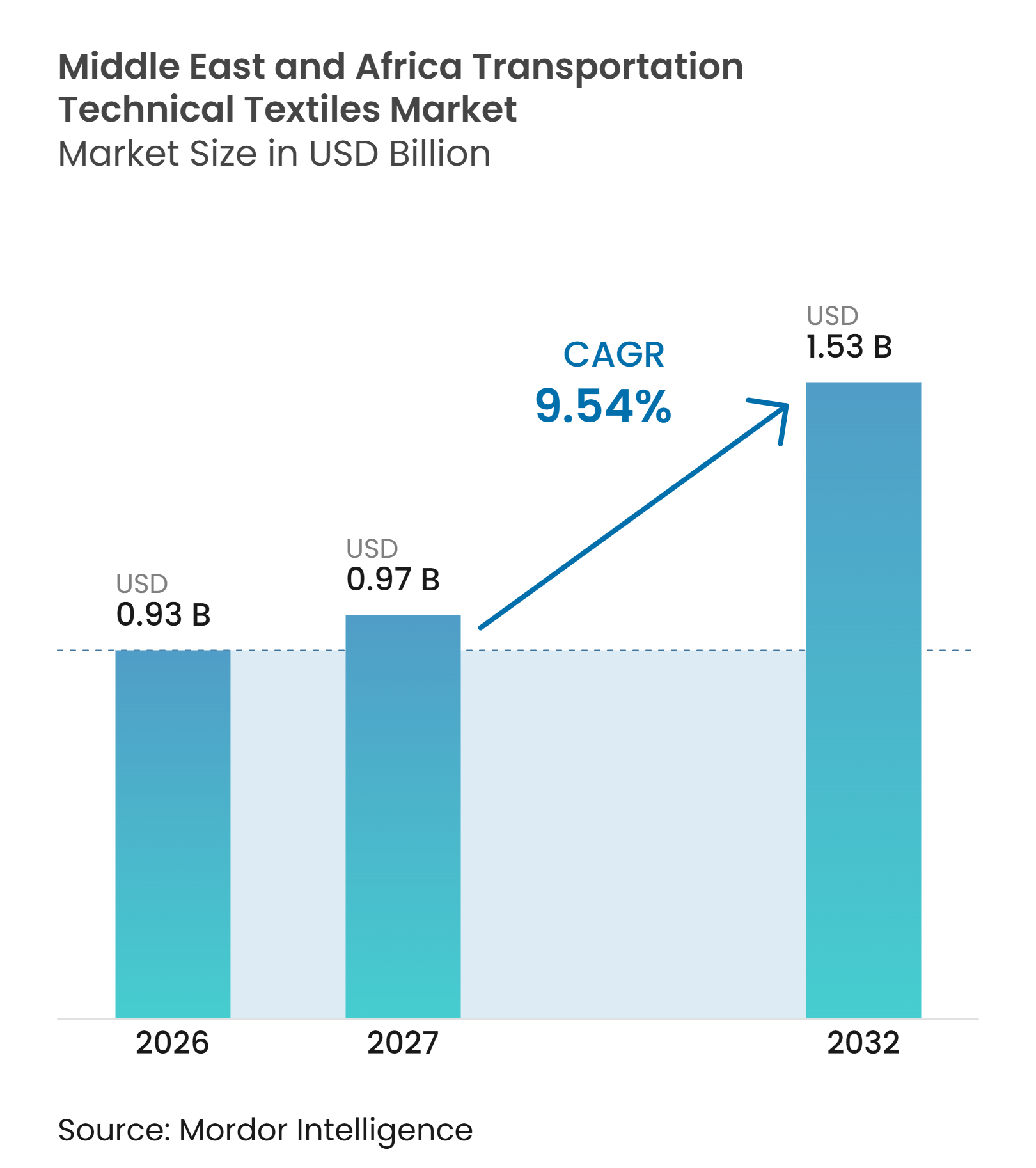
The Middle East And Africa Transportation Technical Textiles Market size was valued at USD 0.93 billion in 2026 and is estimated to grow from USD 0.97 billion in 2027 to reach USD 1.53 billion by 2032, at a CAGR of 9.54% during the forecast period (2027-2032).
Funded vehicle electrification programs in the Gulf Cooperation Council, or GCC, are raising requirements for lighter interior materials, acoustic insulation, and battery thermal barriers. Large sovereign roads, rail, airport, and port projects are also creating early demand for geotextiles used in embankments and subgrades. Localization rules are shifting procurement toward producers that can demonstrate domestic value addition and documented compliance. Advanced materials remain import-dependent, which exposes converters to exchange-rate movements and limits their ability to respond quickly to specialized specifications. The Middle East and Africa transportation technical textiles market therefore offers the clearest opportunity in qualified local conversion capacity rather than in commodity textile supply.
Key Report Takeaways
- By product type, transportation interior and upholstery textiles held the leading position in 2026, while structural and composite reinforcement textiles are forecast to grow at a 13.5% CAGR through 2032.
- By material type, polyester held the largest position in 2026, while carbon fibers are forecast to grow at a 14.5% CAGR through 2032.
- By transportation mode, road transportation held 76% in 2026, while aerospace and aviation are forecast to grow at a 13% CAGR through 2032.
- By geography, Saudi Arabia held 19% in 2026, while Nigeria is forecast to grow at an 11.5% CAGR through 2032.
Note: Market numbers in this report are based on Mordor Intelligence's proprietary estimation framework, which combines nine months of actuals with Q4 projections for base year 2026.
Market Trends and Insights
Drivers Impact Analysis of Middle East and Africa Transportation Technical Textiles Market*
| Driver | (~) % Impact on CAGR Forecast | Geographic Relevance | Impact Timeline |
|---|---|---|---|
| GCC Fleet Electrification and Lightweight Vehicle Platforms | +2.4% | GCC core, Egypt | Medium term (2-4 years) |
| Transport Infrastructure Mega-Projects and Geosynthetics Demand | +2.1% | Saudi Arabia, UAE, Egypt, Nigeria, Kenya, Ethiopia | Long term (≥ 4 years) |
| Local-Content Policies and Import Substitution | +1.7% | Saudi Arabia, UAE, South Africa, Turkey | Medium term (2-4 years) |
| Safety, Fire and Smoke Standards for Passenger Transport | +1.3% | Egypt, South Africa, Saudi Arabia, UAE rail corridors | Medium term (2-4 years) |
| Growing Demand for Sustainable and Recyclable Technical Textiles | +0.9% | Sub-Saharan Africa, GCC secondary fleet operators | Short term (≤ 2 years) |
| Extreme-Climate Performance Requirements | +0.6% | GCC heat corridors, Red Sea coast, Saharan zones | Long term (≥ 4 years) |
| Source: Mordor Intelligence | |||
GCC Fleet Electrification and Lightweight Vehicle Platforms
GCC electrification programs are increasing demand for technical textiles in seats, airbags, acoustic laminates, and battery thermal barriers. Saudi Arabia is targeting 30% electric-vehicle penetration in Riyadh by 2030, while EVIQ is building 5,000 fast chargers across 1,000 locations. Dubai’s Roads and Transport Authority committed to converting its taxi fleet to hybrid or electric vehicles by 2027, and the city had 39,000 electric vehicles on its roads in the first quarter of 2025.[1] Battery electric vehicles need non-combustible insulation around battery systems and more acoustic control in cabins without engine noise. Turkey-based Uspar Tekstil said in February 2025 that it had started supplying seat upholstery fabrics to electric-vehicle assemblers and was finalizing an additional original equipment manufacturer agreement. The GCC Standardization Organization’s 2025 electric vehicle technical regulation requires IATF 16949 quality-management conformity across the supply chain, favoring qualified suppliers in the Middle East and Africa transportation technical textiles market.[2]
Transport Infrastructure Mega-Projects and Geosynthetics Demand
Transport investment creates demand for nonwoven separators, woven geogrids, and drainage geocomposites before roads and rail systems begin operating. Saudi Arabia represents more than 36% of the Middle East and North Africa pipeline for airport, railway, and port infrastructure, with announced projects above USD 93 billion. Projects including NEOM’s Al-Badaa Biosolids Treatment Facility and the SPARK Road and Bridge network use nonwoven geotextiles and geogrids supplied by approved manufacturers. Egypt’s FY 2025-2026 transport plan targets daily rail and metro capacity of 9.4 million passengers and annual rail freight of 11 million tons. Nigeria’s Lagos-Calabar Coastal Highway received a USD 747 million syndicated loan in July 2025, and the Kano-Kaduna rail upgrade received USD 255 million in January 2025, supporting work along new transport corridors. In the Middle East and Africa transportation technical textiles market, these budgets matter because geosynthetic demand begins with embankment and subgrade work, ahead of rolling-stock procurement.
Local-Content Policies and Import Substitution
Local procurement rules are moving purchasing away from import-only supply structures and toward in-country processing. Saudi Aramco’s IKTVA program increased the Kingdom’s local procurement share from 35% in 2015 to 67% in 2025, with SAR 1.5 trillion (USD 1.8 trillion) in planned procurement spending for the next decade. The Local Content and Government Procurement Authority has included more than 1,500 materials and components on its mandatory domestic-sourcing list, including polypropylene rolls and coated fabrics. Saudi Arabian Railways has identified more than SAR 15 billion (USD 17.6 billion) in localization opportunities by 2030 across railcar production, maintenance, and technology development. Suppliers that meet original equipment manufacturer requirements can gain a procurement advantage where local content is a formal tender criterion. South Africa’s SANS 986 standard for geotextiles and National Regulator for Compulsory Specifications requirements also support domestic capability in the southern manufacturing corridor.
Safety, Fire, and Smoke Standards for Passenger Transport
New metro and high-speed rail systems are making fire, smoke, and toxicity compliance a decisive requirement for interior textiles. EN 45545-2 applies flame spread, smoke density, and toxicity requirements at hazard levels HL1 through HL3, with ISO 5659-2 among the relevant smoke-density methods. Saudi Civil Defence has adopted NFPA 130 for fixed-guideway transit fire protection, including rolling stock and station structures. South Africa’s Railway Safety Act, published in September 2025, requires operators to demonstrate materials compliance within their safety management systems when renewing permits.[3] These requirements raise the standard for seat upholstery, headliners, carpets, and acoustic insulation. This favors manufacturers with documented EN 45545-2 or NFPA 130-compatible product portfolios within the Middle East and Africa transportation technical textiles market.
Restraints Impact Analysis of Middle East and Africa Transportation Technical Textiles Market*
| Restraint | (~) % Impact on CAGR Forecast | Geographic Relevance | Impact Timeline |
|---|---|---|---|
| Imported Advanced Fibers, Machinery and Finishes | -1.7% | GCC, Sub-Saharan Africa, Egypt | Long term (≥ 4 years) |
| High Qualification Burden for OEM and Fleet Specifications | -1.3% | GCC, South Africa, Turkey | Medium term (2-4 years) |
| Energy, Water and Chemical Intensity of Finishing | -0.9% | Water-stressed GCC and North Africa, energy-intensive South Africa | Long term (≥ 4 years) |
| Limited Regional Application-Engineering Talent | -0.6% | Sub-Saharan Africa, GCC non-oil manufacturing hubs | Short term (≤ 2 years) |
| Source: Mordor Intelligence | |||
Imported Advanced Fibers, Machinery, and Finishes
The region lacks commercial-scale production of para-aramid, carbon fiber tow, and high-tenacity polyamide needed for airbag fabrics and seat-belt webbing. Saudi processing assets can make polypropylene and polyester nonwovens, but many flame-retardant coatings, ultraviolet stabilizers, and composite binders are sourced from outside the region. Limited availability of qualified electric heavy-duty trucks in the GCC also reflects wider supply-chain constraints that affect specialized textile components. Saudi industrial programs have committed investment to upstream polymer and fiber facilities, including the SPARK manufacturing city in Dammam, but specialty-fiber production remains at an early stage. Import dependence will therefore remain a structural constraint for the Middle East and Africa transportation technical textiles market during the forecast period.
High Qualification Burden for OEM and Fleet Specifications
Vehicle manufacturers, metro operators, and aircraft lessors require evidence against standards such as IATF 16949, EN 45545-2, and aviation fire and thermal-insulation requirements. Qualification typically takes 18 to 36 months and requires accredited testing of serial-production-scale samples. This timing gives global suppliers an advantage where they already hold certifications across road, rail, and aerospace applications. The GCC Standardization Organization’s 2025 regulation requires IATF 16949 compliance at each electric-vehicle supply-chain tier. Emerging producers may have manufacturing capacity but remain unable to sell into an approved original equipment manufacturer program for 3 or more years. The qualification burden therefore slows the conversion of local demand into local supply.
*Our forecasts treat driver/restraint impacts as directional, not additive. The impact forecasts reflect baseline growth, mix effects, and variable interactions.
Middle East and Africa Transportation Technical Textiles Market Segment Analysis
By Product Type:
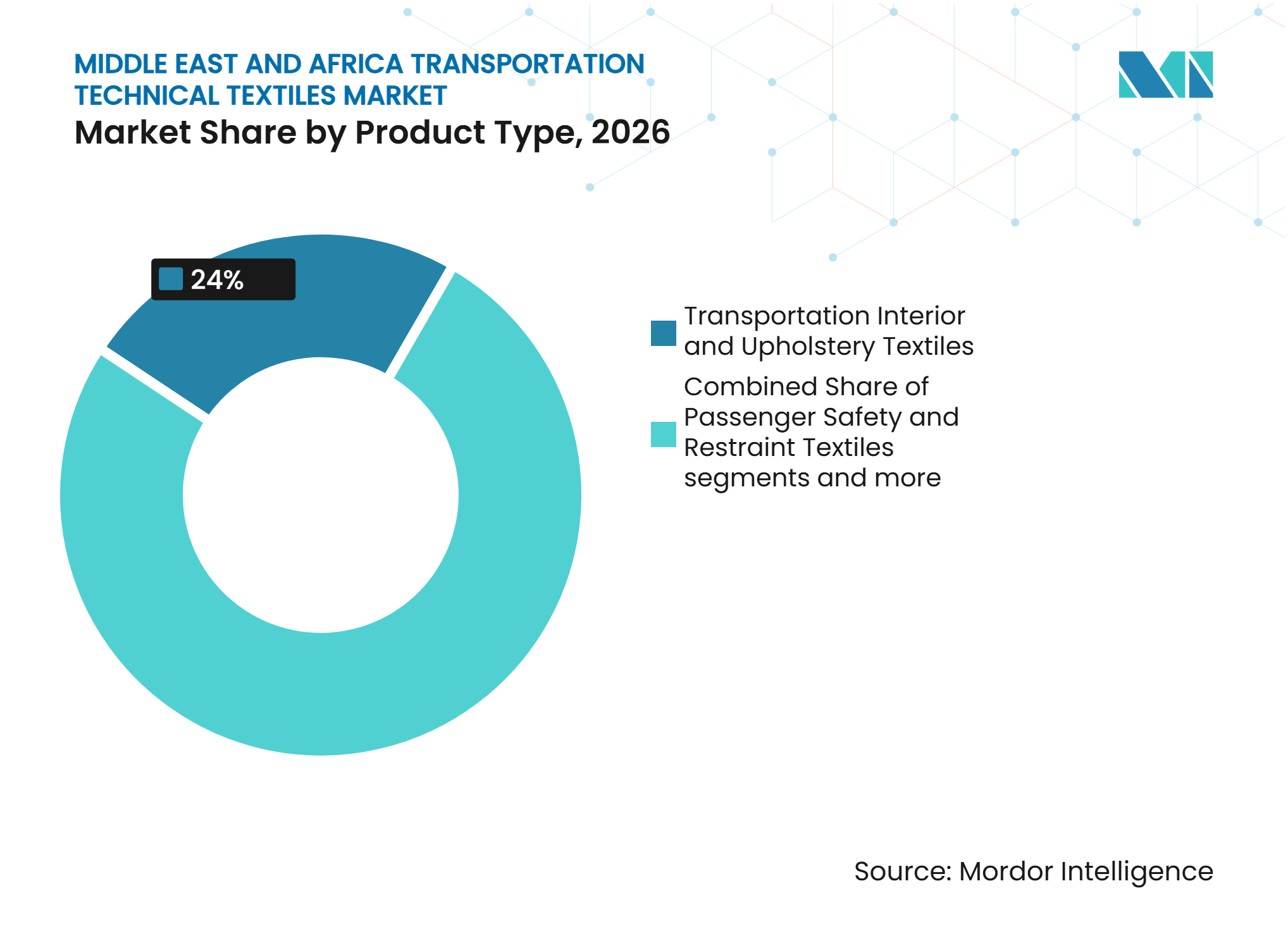
Interior Textiles Lead While Composites AccelerateTransportation interior and upholstery textiles accounted for 24% of the 2026 segment total, supported by high GCC fleet density and growing commercial metro ridership. Replacement demand for seat covers, headliners, and carpets supports this established position. Structural and composite reinforcement textiles are projected to grow at a 13.5% CAGR from 2027 to 2032. Strata Syensqo Advanced Materials produced 25,000 pounds of composite rolls at its Al Ain facility by November 2025 and subsequently achieved the production of multiple carbon-fiber prepreg rolls by May 2026 for manufacturing Boeing 777X test components under a long-term supply agreement.
Passenger safety and restraint textiles include airbag fabrics, seat-belt webbing, and supplemental restraint cushions. Their demand remains linked to new vehicle registrations, including purchases encouraged by electric-vehicle adoption. Acoustic, thermal, and protective insulation textiles are gaining importance because electric cabins expose road noise that combustion engines previously masked. Within the Middle East and Africa transportation technical textiles market, tyre and rubber reinforcement textiles retain steady demand from the region’s long-haul trucking fleet. In contrast, filtration, exterior, and protective textiles serve smaller vehicle and marine applications.



By Material Type:
Polyester Leads While Carbon Fiber AcceleratesPolyester accounted for 39% of the 2026 segment total, supported by its extensive use in geotextiles, upholstery base fabrics, automotive carpets, and tire cords. Its cost efficiency, durability, ease of processing, and established manufacturing infrastructure make it a preferred material across transportation and infrastructure applications. Carbon fiber is projected to grow at a 14.5% CAGR from 2027 to 2032, driven by rising demand for lightweight, high-strength materials in aerospace and advanced automotive manufacturing. A 2025 peer-reviewed study found that carbon-fiber composites can reduce aircraft structural weight by 30% to 50% and fuel consumption by 20% to 25% compared with aluminum and titanium alloys, strengthening their adoption in next-generation aircraft structures.
Polyamide remains important in one-piece-woven airbag fabrics, where high tensile strength and consistent yarn properties support controlled deployment and passenger safety. Polypropylene supports geotextile applications in road construction, soil stabilization, and drainage systems, with Fibertex Nonwovens South Africa producing ultraviolet-stabilized virgin polypropylene geotextiles certified for more than 100 years of durability under EN standards. Aramid fibers support fire-protection, protective clothing, and ballistic applications, while glass fibers remain established in structural composites, vehicle components, and marine applications. Polyethylene also serves specialized containment, protective, and high-strength textile applications, supported by its chemical resistance, low weight, and durability.
By Transportation Mode:
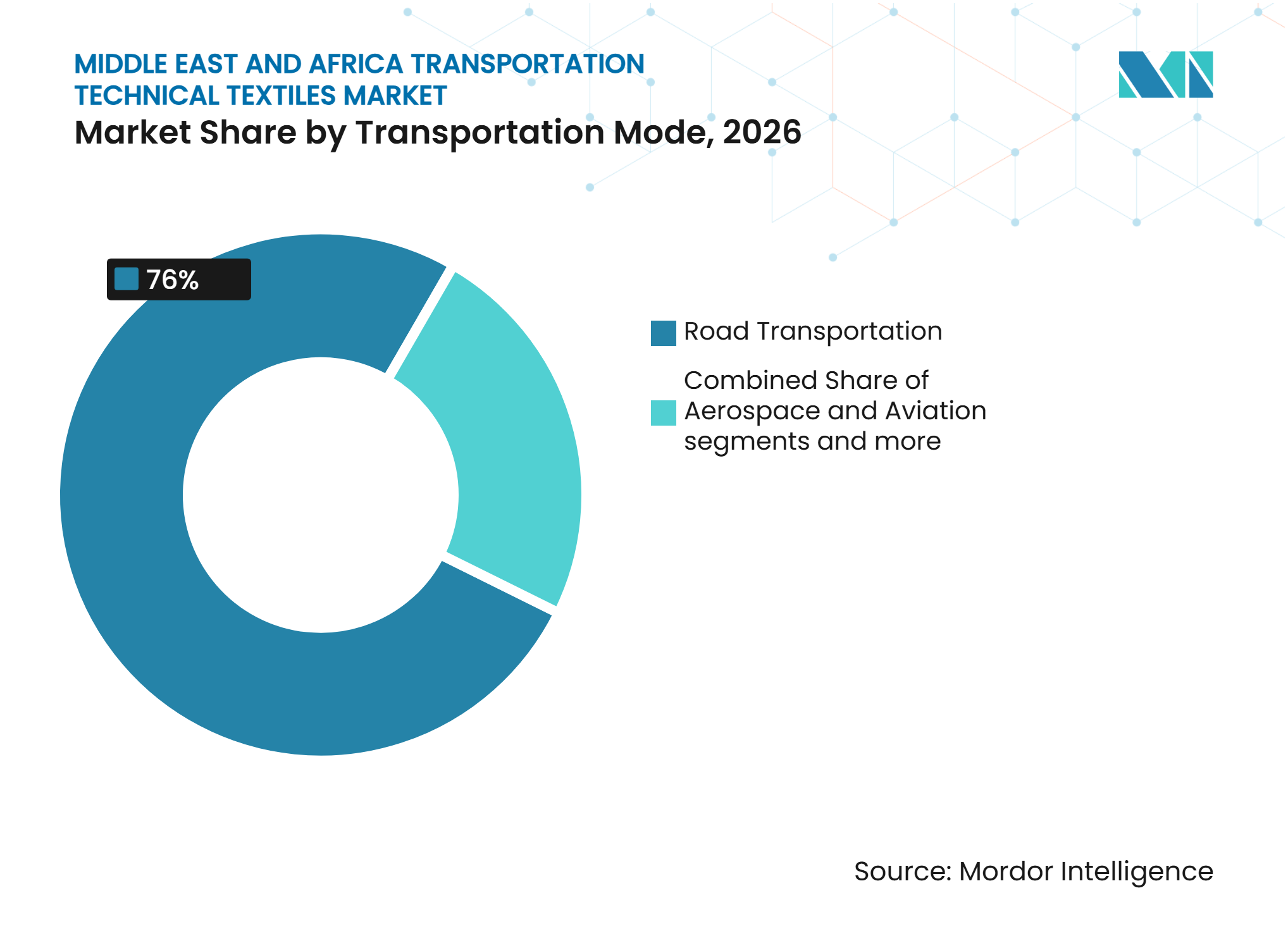
Road Leads While Aerospace Expands FasterRoad transportation accounted for 76% of the Middle East and Africa transportation technical textiles market share in 2026, supported by high motorization rates in the GCC, road-freight dependence across Africa, and limited electrified rail networks outside Egypt and South Africa. Battery-electric passenger cars are the fastest-growing road sub-segment, as governments introduce fiscal incentives, invest in charging infrastructure, and pursue localization initiatives to accelerate adoption. Road2.0 signatories in the UAE have pledged to deploy 6,000 commercial electric vehicles and achieve 30% fleet electrification by 2030. Rising vehicle production and demand for lightweight, durable, and fire-resistant materials are supporting technical textile applications in automotive interiors, seating, airbags, carpets, headliners, and acoustic insulation.
Aerospace and aviation is projected to grow at a 13% CAGR from 2027 to 2032, supported by aircraft orders from Emirates, flydubai, and Saudi carriers, which are increasing demand for composite-intensive aircraft, lightweight cabin interiors, and advanced insulation materials. Fleet expansion, passenger traffic growth, and investments in aviation infrastructure and maintenance, repair, and overhaul (MRO) facilities are creating opportunities for specialized textile suppliers. Meanwhile, rail transportation is gaining momentum in Egypt, Saudi Arabia, and South Africa as rolling-stock procurement, metro expansions, and high-speed rail projects increase demand for lightweight, low-smoke, and fire-resistant interior materials. Marine transportation remains a specialized segment, with demand for saltwater-resistant coated fabrics, protective covers, filtration media, and fire-retardant textiles used in engine rooms, offshore operations, and ferry interiors.

Geography Analysis
Saudi Arabia
Saudi Arabia accounted for 19% of the Middle East and Africa transportation technical textiles market share in 2026. Vision 2030 investments in NEOM, King Salman International Airport, the SAR phosphate railway track-doubling tender, and Qiddiya support demand for geosynthetics, low-smoke interiors, and thermal-management materials. SAR’s ASASAT program targets 70% local content in rail materials by 2030. SAR and Arsenali presented designs for the Desert Dream luxury train in January 2025, with sand-colored upholstery and textile detailing based on Hejaz architectural references. Saudi Aramco’s 2025 IKTVA forum also introduced ASMO and Novel, adding local logistics and non-metallic manufacturing capability. Obeikan Technical Fabrics, FPC Industry, and Mattex Group are broadening product portfolios and compliance capabilities to participate in this procurement pipeline.
Nigeria
Nigeria is forecast to grow at an 11.5% CAGR from 2027 to 2032. The Middle East and Africa transportation technical textiles market size in Nigeria is supported by highway and rail construction that turns deferred transport spending into active work. The Federal Executive Council approved more than NGN 4.2 trillion (USD 2.89 billion) in transport projects during 2025. China Development Bank released USD 255 million for the Kano-Kaduna rail project in January 2025, while a Deutsche Bank-led group provided USD 747 million for the Lagos-Calabar Coastal Highway in July 2025. Ports and industrial corridors around Lekki Deep Sea Port and the Dangote Petroleum Refinery also support demand for heavy-truck tyre cord and seating fabrics. Most demand is currently met by imports from South Africa, Turkey, and Asia, leaving a localization opening for suppliers that establish local production or conversion.
United Arab Emirates, Turkey, South Africa, Egypt, and Rest of Middle East and Africa
The Middle East and Africa transportation technical textiles market in the UAE is supported by its role as a commercial and logistics base for technical textile distribution, with the Green Mobility Strategy 2030 targeting 10% electric-vehicle sales and 30% electrification of public-sector fleets by 2030. ADNOC Distribution’s E2GO joint venture plans 70,000 charging points in Abu Dhabi, which supports demand for electric-vehicle interior materials. Turkey remains the region’s most developed technical textile manufacturing base, centered on Bursa and Istanbul suppliers of automotive fabrics, coated protective fabrics, and nonwovens. General Nonwovens announced a EUR 40 million (USD 47.1 million) investment in a technical-textile production line in 2025. South Africa supplies road, rail, and automotive projects through companies including Kaytech Engineered Fabrics and Fibertex Nonwovens. Egypt’s USD 23 billion high-speed rail program and Cairo Metro expansion are raising requirements for rail interiors, supported by financing from EIB, EBRD, AFD, and AIIB. Kenya, Ethiopia, Angola, and Morocco remain project-led demand centers where road geosynthetics are the primary textile application.
Competitive Landscape
Market Concentration
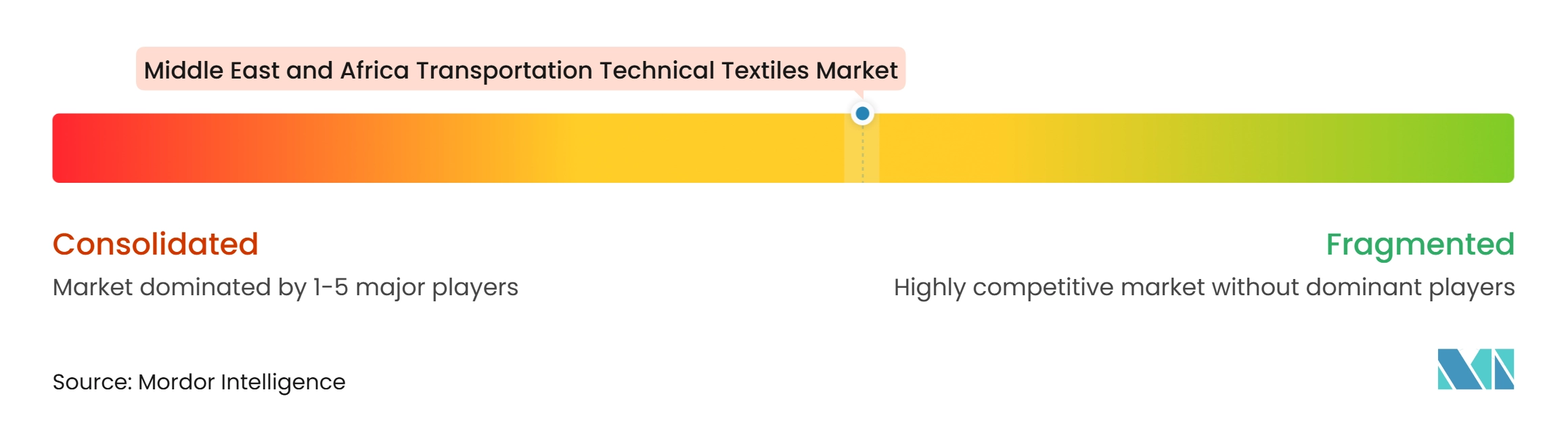
The Middle East and Africa transportation technical textiles market exhibits a medium level of market concentration. Regional specialists serve country-specific demand in geosynthetics and automotive nonwovens, while global suppliers provide advanced aramid, carbon-fiber, and airbag materials. Mattex Group, Kaytech Engineered Fabrics, and Fibertex Nonwovens compete through localization credentials, nearby delivery, and price. Obeikan Technical Fabrics received a Saudi Quality Mark license from SASO in July 2026 for its structural-fabric and coated-product portfolio. This compliance recognition supports its ability to address regulated Saudi procurement. DuPont, Toray, and Freudenberg Performance Materials retain leverage in advanced material categories where regional capability is still limited.
Freudenberg agreed in December 2025 to acquire Toray Industries’ remaining 25% stake in Japan Vilene Company for EUR 100 million (USD 117.6 million). The transaction gives Freudenberg full ownership of a nonwovens producer with 15 global production sites and automotive exposure. HUESKER Group, Officine Maccaferri, and Solmax compete in premium geosynthetics through engineering-consultant and EPC-contractor relationships. Sioen Industries and Thrace Nonwovens provide coated-fabric and nonwoven geosynthetic capabilities. Turkey-based Şafak Technical Textile and AUNDE Teknik Tekstil could increase their supply to GCC road and rail customers because they already have multi-modal certification and export capability. The Middle East and Africa transportation technical textiles market is the most open, where local producers can combine compliance, short lead times, and application support.
Electric-vehicle thermal-management textiles and original equipment manufacturer-qualified rail interiors remain underdeveloped local manufacturing spaces. Neither regional specialists nor global companies currently maintain dedicated Middle East and Africa-focused manufacturing capacity in these applications. The Strata Syensqo Advanced Materials joint venture produced carbon-fiber prepreg for Boeing’s 777X program in 2025, representing the region’s first movement into primary-structure aerospace composite supply. This capability can affect downstream composite-textile specifications in the Middle East and Africa transportation technical textiles market.
Middle East and Africa Transportation Technical Textiles Industry Leaders
-
Mattex Group
-
ALYAF INDUSTRIAL COMPANY LTD.
-
Obeikan Technical Fabrics
-
FPC Industry
-
TexoFib
- *Disclaimer: Major Players sorted in no particular order
Middle East and Africa Transportation Technical Textiles Market Companies Covered in this Report
- Mattex Group
- ALYAF INDUSTRIAL COMPANY LTD.
- Obeikan Technical Fabrics
- FPC Industry
- TexoFib
- Exeed Geotextile
- Infrastructure Reinforcement Industrial Company
- Fibertex Nonwovens (Pty) Ltd
- Kaytech Engineered Fabrics
- Spunchem International
- PFNonwovens
- Freudenberg Performance Materials
- Ahlstrom
- Berry Global Group, Inc.
- DuPont de Nemours, Inc.
- Toray Industries, Inc.
- Mitsui Chemicals, Inc.
- Sioen Industries NV
- HUESKER Group
- Officine Maccaferri S.p.A.
- Solmax
- Thrace Nonwovens and Geosynthetics S.A.
- Groupe Richbond
Recent Industry Developments in Middle East and Africa Transportation Technical Textiles Market
- September 2026: Alstom was selected as a strategic industrial partner in the next 15-year Gautrain concession. Its approximately EUR 800 million (USD 941.0 million) program includes eight new trains manufactured locally in Gauteng, signaling upgrades, communications improvements, and refurbishment of the existing fleet.
- July 2026: Embraer and Mubadala signed a strategic framework agreement to strengthen the UAE's aerospace manufacturing ecosystem. The collaboration covers maintenance, repair, and overhaul (MRO), workforce development, research and development, and next-generation aerostructures, including composites, additive manufacturing, and high-temperature alloys. This creates opportunities for advanced composite textiles, lightweight reinforcement fabrics, and high-performance materials used in aircraft structures and interiors.
- November 2025: Strata Syensqo Advanced Material (SSAM), a joint venture between Strata Manufacturing (Abu Dhabi) and Belgian firm Syensqo, confirmed at Dubai Airshow 2025 the production of 25,000 pounds of aerospace-grade carbon fiber prepreg rolls at its Al Ain facility, MENA’s first domestic supply capability, with export volumes targeting Boeing’s 777X program from H1 2026.
- July 2025: Nigeria secured a USD 747 million Deutsche Bank-led syndicated loan for the first 47.47 km section of the Lagos-Calabar Coastal Highway, catalyzing near-term demand for geotextile reinforcement fabrics along the new embankment corridor and setting the template for subsequent highway financing rounds.
Middle East and Africa Transportation Technical Textiles Market Report Scope
The Middle East And Africa Transportation Technical Textiles Market Report is Segmented by Product Type (Passenger Safety and Restraint Textiles, Transportation Interior and Upholstery Textiles, and More), by Material Type (Polyester (PET), and More), by Transportation Mode (Road Transportation, Aerospace and Aviation, and More), and by Geography (Saudi Arabia and More). The Market Forecasts are Provided in Terms of Value (USD).
Segmentation Overview
| Passenger Safety and Restraint Textiles | Automotive Airbag Fabrics and Textile Cushions |
| Seat Belt Webbing | |
| Other Transportation Safety and Restraint Textiles | |
| Transportation Interior and Upholstery Textiles | Seat Upholstery and Seating Fabrics |
| Automotive and Transportation Carpets | |
| Other Transportation Interior Textiles (Headliner, Window-Shading, etc.) | |
| Tyre and Rubber Reinforcement Textiles | |
| Acoustic, Thermal and Protective Insulation Textiles | |
| Transportation Filtration and Air Management Textiles | |
| Structural and Composite Reinforcement Textiles (Carbon Fiber, Glass Fiber Reinforcement Fabric, etc.) | |
| Transportation Exterior and Protective Textiles | |
| Other Transportation Technical Textiles |
| Polyester (PET) |
| Polyamide (Nylon) |
| Polypropylene (PP) |
| Polyethylene (PE) |
| Glass Fibers |
| Carbon Fibers |
| Aramid and Other High-Performance Synthetic Fibers |
| Natural and Regenerated Fibers |
| Other Specialty Fibers and Materials |
| Road Transportation | Passenger Cars | Internal Combustion Engine and Hybrid Passenger Cars |
| Battery Electric Passenger Cars | ||
| Commercial Vehicles | ||
| Two-Wheelers, Three-Wheelers and Other Road Vehicles | ||
| Aerospace and Aviation | Commercial and Business Aircraft | |
| Military Aircraft and Helicopters | ||
| Spacecraft and Other Aerospace Platforms | ||
| Rail Transportation | ||
| Marine Transportation | Commercial and Cargo Vessels | |
| Passenger, Cruise Vessels, Recreational and Other Marine Vessels | ||
| Other Specialized Transportation Platforms |
| Saudi Arabia |
| United Arab Emirates |
| Turkey |
| South Africa |
| Egypt |
| Nigeria |
| Rest of Middle East and Africa |
| By Product Type | Passenger Safety and Restraint Textiles | Automotive Airbag Fabrics and Textile Cushions | |
| Seat Belt Webbing | |||
| Other Transportation Safety and Restraint Textiles | |||
| Transportation Interior and Upholstery Textiles | Seat Upholstery and Seating Fabrics | ||
| Automotive and Transportation Carpets | |||
| Other Transportation Interior Textiles (Headliner, Window-Shading, etc.) | |||
| Tyre and Rubber Reinforcement Textiles | |||
| Acoustic, Thermal and Protective Insulation Textiles | |||
| Transportation Filtration and Air Management Textiles | |||
| Structural and Composite Reinforcement Textiles (Carbon Fiber, Glass Fiber Reinforcement Fabric, etc.) | |||
| Transportation Exterior and Protective Textiles | |||
| Other Transportation Technical Textiles | |||
| By Material Type | Polyester (PET) | ||
| Polyamide (Nylon) | |||
| Polypropylene (PP) | |||
| Polyethylene (PE) | |||
| Glass Fibers | |||
| Carbon Fibers | |||
| Aramid and Other High-Performance Synthetic Fibers | |||
| Natural and Regenerated Fibers | |||
| Other Specialty Fibers and Materials | |||
| By Transportation Mode | Road Transportation | Passenger Cars | Internal Combustion Engine and Hybrid Passenger Cars |
| Battery Electric Passenger Cars | |||
| Commercial Vehicles | |||
| Two-Wheelers, Three-Wheelers and Other Road Vehicles | |||
| Aerospace and Aviation | Commercial and Business Aircraft | ||
| Military Aircraft and Helicopters | |||
| Spacecraft and Other Aerospace Platforms | |||
| Rail Transportation | |||
| Marine Transportation | Commercial and Cargo Vessels | ||
| Passenger, Cruise Vessels, Recreational and Other Marine Vessels | |||
| Other Specialized Transportation Platforms | |||
| By Geography | Saudi Arabia | ||
| United Arab Emirates | |||
| Turkey | |||
| South Africa | |||
| Egypt | |||
| Nigeria | |||
| Rest of Middle East and Africa | |||
Key Questions Answered in the Report
What is the projected value of Middle East and Africa transportation technical textiles by 2032?
The sector is forecast to reach USD 1.53 billion by 2032, expanding at a 9.54% CAGR from 2027 to 2032.
Which transportation mode has the greatest demand for technical textiles in the region?
Road transportation led with a 76% share in 2026, supported by GCC vehicle ownership and African road-freight dependence.
Which material is expected to grow fastest in transportation technical textiles?
Carbon fibers are forecast to grow at a 14.5% CAGR through 2032, supported by aerospace composite applications.
Why are geotextiles important for transport projects in the region?
They are used in separators, reinforcement, drainage, embankments, and subgrades, making them early inputs in road and rail construction.
Which country is expected to record the fastest growth through 2032?
Nigeria is projected to expand at an 11.5% CAGR, supported by new highway and rail investment.
What limits local technical textile production across the region?
Import dependence for advanced fibers, specialty machinery, and finishing chemicals, along with lengthy qualification requirements, limits local supply.