
Middle East and Africa Tokenized Deposit Market Size and Share
Market Overview
| Study Period | 2021 - 2032 |
|---|---|
| Forecast Data Period | 2027 - 2032 |
| Base Year Market Size (2026) | USD 6.30 Billion |
| Market Size (2027) | USD 9.5 Billion |
| Market Size (2032) | USD 48.90 Billion |
| Growth Rate (2027 - 2032) | 38.80 % |
| Market Concentration | High |
Major Players *Disclaimer: Major Players sorted in no particular order Image © Mordor Intelligence. Reuse requires attribution under CC BY 4.0. | |
Middle East and Africa Tokenized Deposit Market Analysis by Mordor Intelligence
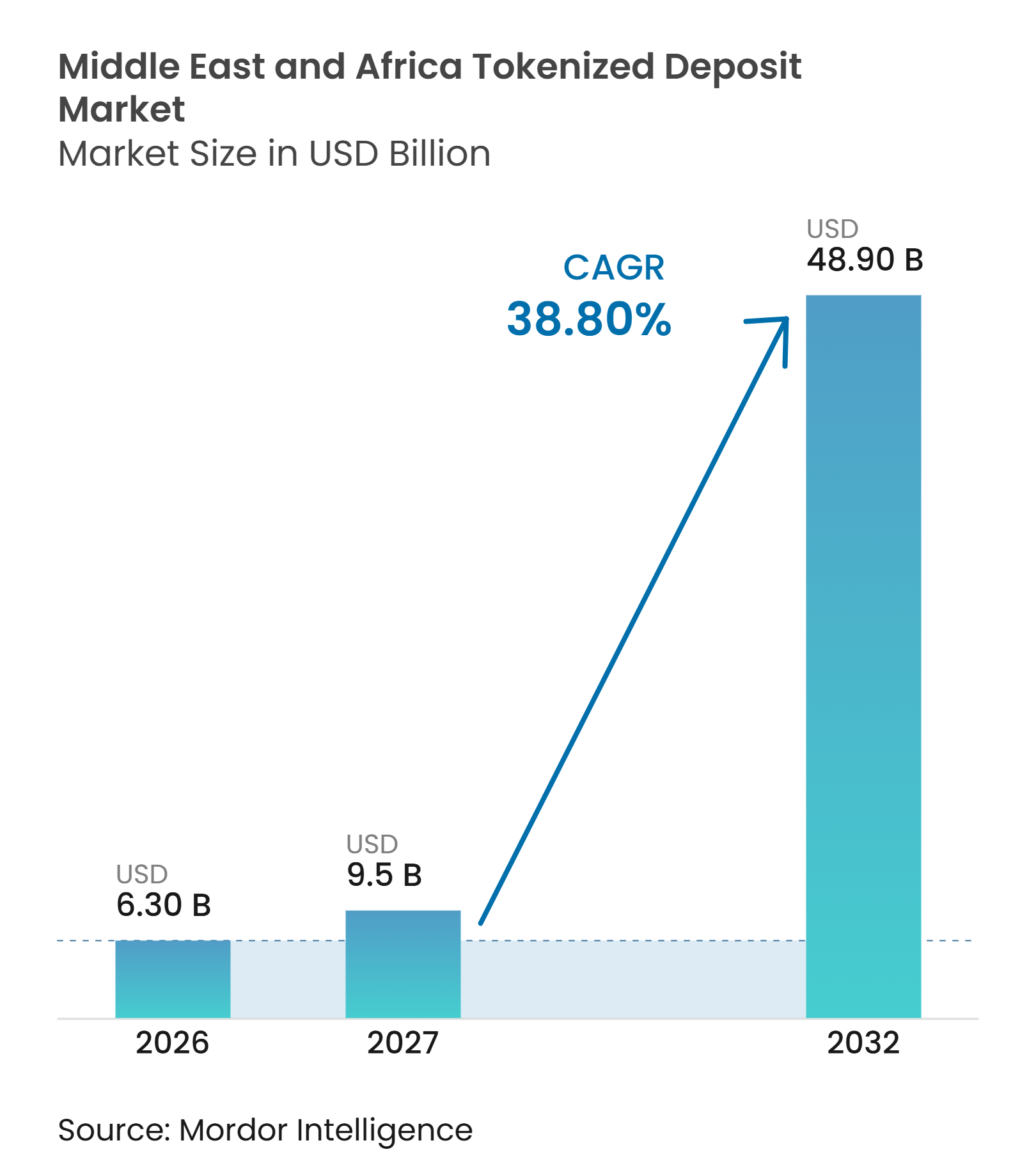
The Middle East And Africa Tokenized Deposit Market size is projected to expand from USD 6.30 billion in 2026 and USD 9.5 billion in 2027 to USD 48.90 billion by 2032, registering a CAGR of 38.80% between 2027 and 2032.
The Middle East and Africa tokenized deposit market is moving beyond limited trials as regulated banks place deposit liabilities on programmable ledger infrastructure while retaining them on their balance sheets. This approach allows banks to use established capital, compliance, and settlement arrangements while improving how money moves between institutions and corporate accounts. Swift activated its blockchain-based shared ledger with 17 banks from 6 continents in July 2026, including First Abu Dhabi Bank, Mashreq, and FirstRand Bank. The network gives participating banks a common coordination layer for tokenized deposit payments and supports the region’s move toward connected, always-on services. The opportunity is strongest where corporate treasury operations, cross-border trade, and payment corridors require more frequent settlement without replacing conventional bank deposits.
Key Report Takeaways
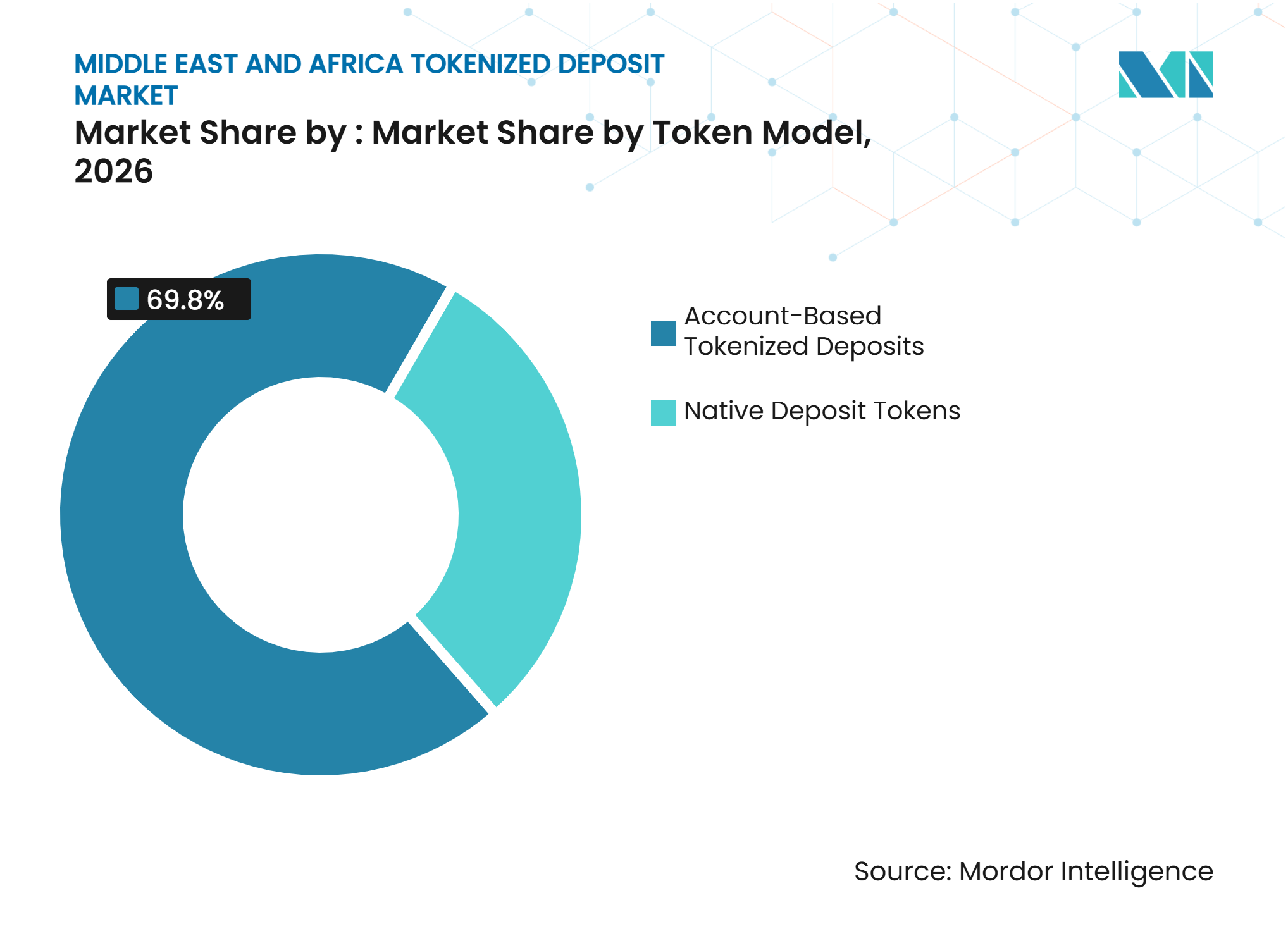
- By token model, account-based tokenized deposits captured 69.8% of the Middle East and Africa tokenized deposit market share in 2026, while native deposit tokens are projected to grow at a 48.2% CAGR through 2032.
- By network model, single-bank (intra-bank) networks captured 50.3% of the Middle East and Africa tokenized deposit market share in 2026, while interbank shared multi-bank networks are projected to grow at a 51.8% CAGR through 2032.
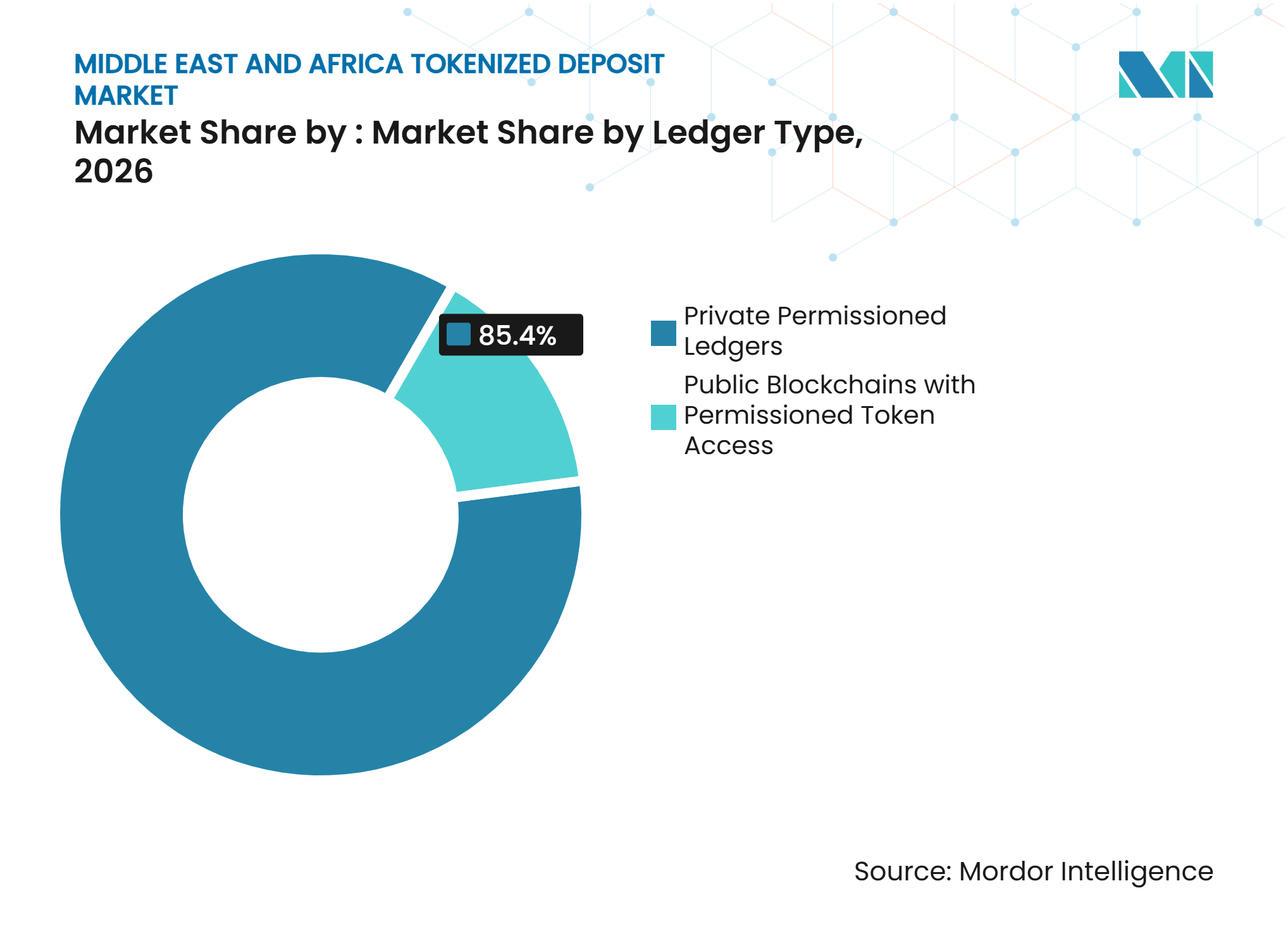
- By ledger type, private permissioned ledgers captured 85.4% of the Middle East and Africa tokenized deposit market share in 2026, while public blockchains with permissioned token access are projected to grow at a 48.3% CAGR through 2032.
- By use case, intra-group treasury and liquidity management captured 31.7% of the Middle East and Africa tokenized deposit market share in 2026, while FX and payment-versus-payment settlement are projected to grow at a 50.8% CAGR through 2032.
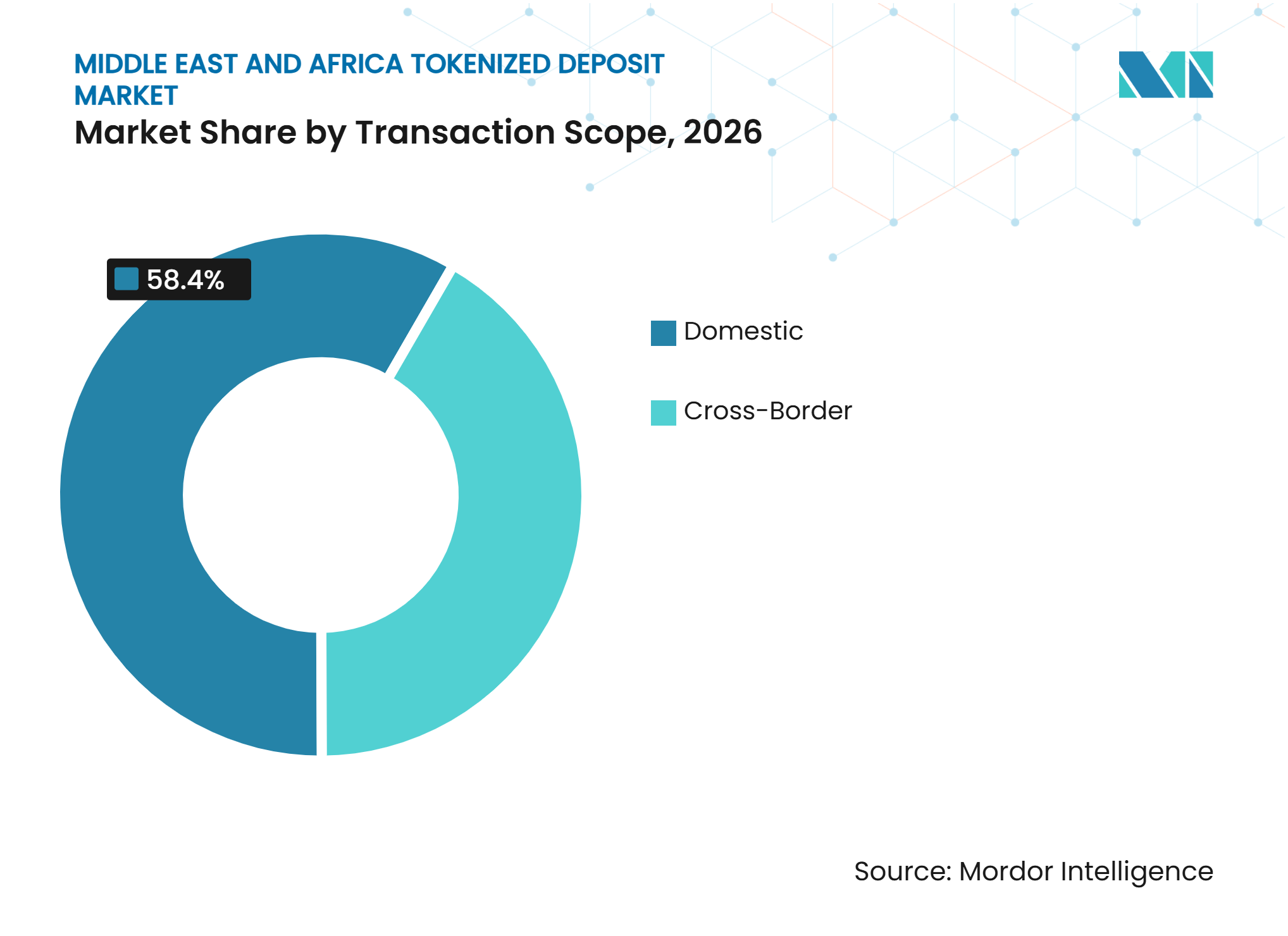
- By transaction scope, domestic transactions captured 58.4% of the Middle East and Africa tokenized deposit market share in 2026, while cross-border transactions are projected to grow at a 48.6% CAGR through 2032.
- By end user, banks and other deposit-taking institutions captured 57.6% of the Middle East and Africa tokenized deposit market share in 2026, while payments, fintech, and digital-asset firms are projected to grow at a 50.6% CAGR through 2032.
Note: Market numbers in this report are based on Mordor Intelligence's proprietary estimation framework, which combines nine months of actuals with Q4 projections for base year 2026.
Market Trends and Insights
Drivers Impact Analysis of Middle East and Africa Tokenized Deposit Market*
| Driver | (~) % Impact on CAGR Forecast | Geographic Relevance | Impact Timeline |
|---|---|---|---|
| Cross-Border Payment Inefficiencies and 24/7 Bank-to-Bank Settlement Demand | +9.2% | Global, concentrated in the United Arab Emirates, Saudi Arabia, and intra-African corridors | Short term (≤ 2 years) |
| GCC Bank Adoption and Enabling Regulatory Frameworks | +7.8% | United Arab Emirates core, with spillover to Bahrain and Qatar | Short term (≤ 2 years) |
| Corporate Treasury Demand for Programmable Liquidity and Cash Management | +6.4% | Multinationals with treasury centers in the United Arab Emirates and South Africa | Medium term (2-4 years) |
| Payment Costs and Settlement Frictions in African Corridors | +5.1% | Sub-Saharan Africa and intra-African corridors | Medium term (2-4 years) |
| Integration with Existing Banking Infrastructure | +4.2% | Middle East and North Africa core, with early gains in South Africa | Medium term (2-4 years) |
| Interoperability Across Bank-Issued Networks | +3.8% | Global, anchored by Swift Ledger participants in the region | Long term (≥ 4 years) |
| Source: Mordor Intelligence | |||
Cross-Border Payment Inefficiencies and Demand for 24/7 Bank-to-Bank Settlement
Traditional correspondent banking relies on sequential clearing, bilateral cut-off times, and settlement processes that can extend across several days. These conditions leave corporate liquidity in nostro accounts when companies need to manage balances across time zones. Swift’s shared ledger is designed to coordinate bank-issued tokenized deposit transfers outside standard banking hours while final settlement continues through existing correspondent arrangements[1]. First Abu Dhabi Bank completed live USD tokenized deposit transactions with Citigroup through the Swift Ledger MVP on September 2, 2026. Swift reports that 75% of payments on its existing infrastructure already reach beneficiary banks within 10 minutes, which places the commercial value of the new model in programmability and availability rather than raw transfer speed. The Middle East and Africa tokenized deposit market can therefore address operational timing constraints without requiring banks to abandon established payment rails.
GCC Bank Adoption of Tokenized Deposits and Enabling Regulatory Frameworks
The Gulf Cooperation Council has become a leading regional center for the Middle East and Africa tokenized deposit market because it combines active banks with a concentrated base of multinational treasury operations. HSBC launched its Tokenised Deposit Service in the United Arab Emirates on June 22, 2026, supporting transfers in AED, USD, EUR, GBP, HKD, and SGD on a 24/7 basis[2]. Citigroup expanded Citi Token Services to the United Arab Emirates on September 28, 2026, with USD and EUR capabilities, making the country its 7th operating location for the service. Several major institutional activations in a short period increase the value of common settlement and orchestration networks because each connected bank adds potential counterparties. Saudi Arabia’s central bank described proof-of-concept work involving account-based and token-based commercial bank money in November 2025, although a standing production framework had not been published. Bahrain and Qatar are positioned to extend regional connectivity as their banks participate in multi-currency settlement initiatives.
Corporate Treasury Demand for Programmable Liquidity and Cash Management
Multinational companies operating across the Middle East and Africa face restricted cash movement during weekends, holidays, and banking cut-off periods. Programmable conditions can automate intragroup transfers when account balances reach predetermined levels, reducing manual handling. Ant International became HSBC’s first Middle East client for the Tokenised Deposit Service in October 2026, completing real-time AED transfers within the United Arab Emirates and cross-border USD transfers to Hong Kong and Singapore. FirstRand Bank adopted Kinexys Digital Payments by J.P. Morgan in March 2026 for programmable intragroup USD treasury management, representing the first such deployment in Sub-Saharan Africa[3]. The service uses preset conditions to move funds between legal entities around the clock. These examples show how the Middle East and Africa tokenized deposit market is linked to measurable treasury use cases before wider third-party payment activity develops.
Cross-Border Payment Costs and Settlement Frictions in African Corridors
African payment corridors present a strong commercial case for the Middle East and Africa tokenized deposit market because transaction costs remain high for regional transfers. World Bank survey results reported by Afronomics show that the average cost of sending USD 200 across African corridors was 9.04% in the first quarter of 2025, compared with the 3% Sustainable Development Goal target[4]. The same source reports that intra-African corridors averaged 19.27%, which was higher than remittances sent from outside the continent. The International Monetary Fund found average remittance costs of 12.7% in the South Africa to Zimbabwe corridor in the first quarter of 2024, with cash handling accounting for more than 50% of the cost structure. Tokenized deposits can reduce the need for prefunded nostro balances and support payment-versus-payment settlement, which helps address foreign exchange settlement risk. The Buna platform connects more than 100 financial institutions across 22 member states and provides a regional payment layer that can support future settlement applications.
Restraints Impact Analysis of Middle East and Africa Tokenized Deposit Market*
| Restraint | (~) % Impact on CAGR Forecast | Geographic Relevance | Impact Timeline |
|---|---|---|---|
| Divergent Regulatory and Legal Frameworks | -2.2% | Broad, most acute in Gulf Cooperation Council to Africa corridors | Short term (≤ 2 years) |
| Technical and Settlement Interoperability Constraints | -1.9% | Global, most acute for platforms linking the United Arab Emirates, Africa, and Asia | Medium term (2-4 years) |
| Cybersecurity, Smart-Contract, and Operational Resilience Risks | -1.6% | Global, concentrated where public blockchain access layers are used | Short term (≤ 2 years) |
| Implementation Costs and 24/7 Liquidity Risks | -1.4% | National, with early challenges in Nairobi, Lagos, and Johannesburg deployments | Medium term (2-4 years) |
| Source: Mordor Intelligence | |||
Divergent Regulatory and Legal Frameworks Across Middle East and Africa Jurisdictions
Regulatory differences are a material barrier because cross-border tokenized deposit services must operate across separate licensing, financial crime, and foreign exchange requirements. The South African Reserve Bank’s November 2025 position paper identified tokenized commercial bank money as a relevant category for further policy analysis alongside stablecoins and wholesale central bank digital currencies. This direction does not yet provide a production framework for commercial bank tokenized money. A bank linking Abu Dhabi and Johannesburg must account for separate central bank expectations, anti-money-laundering and counter-terrorist-financing processes, and cross-border reporting requirements. The Basel Committee’s standards for bank exposures to crypto-assets and the Financial Action Task Force framework for virtual asset service providers add further compliance considerations for institutions operating connected systems. These factors make multi-corridor expansion more resource-intensive than a service confined to one jurisdiction.
Technical and Settlement Interoperability Constraints Across Banking Networks
Banks have launched distinct tokenized deposit platforms with their own data models, access policies, and settlement logic. This fragmentation can increase the cost of linking institutions, particularly where each connection requires separate implementation and testing. Swift’s approach provides an orchestration layer above bank platforms, but it continues to use existing correspondent channels for final settlement. As a result, 24/7 availability of payment instructions does not necessarily create 24/7 on-chain settlement finality. The OWASP Smart Contract Top 10 identifies access control and business logic flaws among important security risks for smart contract systems. Private permissioned networks can control participant access, but they must still achieve common operational and technical standards before they scale across the Middle East and Africa tokenized deposit market.
*Our forecasts treat driver/restraint impacts as directional, not additive. The impact forecasts reflect baseline growth, mix effects, and variable interactions.
Middle East and Africa Tokenized Deposit Market Segment Analysis
By Token Model:
Account-Based Services Lead in 2026, While Native Tokens Gain MomentumAccount-based tokenized deposits held 69.8% of the Middle East and Africa tokenized deposit market share in 2026. This model maps a client’s existing bank deposit to a token on a controlled ledger without changing the underlying bank relationship. It is suited to institutions that want to maintain familiar account structures, customer records, and capital treatment. HSBC’s Tokenised Deposit Service supports institutional transfers on bank-managed infrastructure while maintaining the legal structure and protections of a traditional bank deposit. Citi Token Services follows a similar bank-led approach for corporate liquidity movement in the United Arab Emirates. The leading position reflects the preference for controlled architectures that can operate within established banking processes.
Native deposit tokens are projected to grow at a 48.2% CAGR from 2027 to 2032. They are relevant to use cases that need programmable escrow, atomic delivery-versus-payment, and settlement finality within a network. ADI Chain provides token issuance infrastructure for institutional users across the Middle East and North Africa and Sub-Saharan Africa. The system is intended to support cross-institutional activity rather than only internal account transfers. Native token models may expand as trade and payment corridors require deeper interaction between participating banks. Their adoption will still depend on the ability to meet bank-grade governance, legal, and operational requirements.


By Network Model:
Intra-Bank Services Provide the Base, Shared Networks Lead GrowthSingle-bank intra-bank networks held a 50.3% share in 2026. This configuration allows a bank to test tokenization, reconciliation, and compliance processes within a single regulatory boundary. FirstRand Bank adopted Kinexys Digital Payments in March 2026 to automate programmable USD transfers across internal legal entities on a 24/7 basis. The model provides immediate treasury benefits without introducing external counterparty requirements. It also gives banks a controlled path to build operational knowledge before connecting to other institutions. This starting point explains why single-bank networks remain central to current deployment.
Interbank shared multi-bank networks are expected to grow at a 51.8% CAGR from 2027 to 2032. Their value comes from linking separate banks and enabling larger groups of corporate clients to transfer funds across institutions. The ADI Foundation and DCM Corp Limited partnership was announced in September 2026 to connect banks’ existing systems to ADI Chain for issuance and settlement. National Bank of Bahrain also signed an October 2026 memorandum of understanding with Partior to examine settlement in Bahraini dinar. Shared networks can lower the need for banks to replace core platforms, which is important for regional institutions with limited in-house engineering capacity. Their progress will be driven by common rulebooks, member participation, and clear responsibility for settlement and compliance.
By Ledger Type:
Private Permissioned Ledgers Remain the Preferred ArchitecturePrivate Permissioned Ledgers accounted for an 85.4% share in 2026. Regulated banks prefer this structure because it limits participation to verified entities and supports controlled transaction visibility. It can also help banks apply know-your-customer, anti-money-laundering, and data-residency rules at the network level. Swift’s shared ledger supports institutional participation through a controlled infrastructure model. The design matches the operational needs of banks that want to retain responsibility for their own deposit liabilities. The large share confirms that control and governance are currently more important than open access for institutional deployments.
Public Blockchains with Permissioned Token Access are projected to grow at a 48.3% CAGR from 2027 to 2032. This approach can offer wider technical reach while restricting token use to approved participants. It may become relevant where banks want more flexible cross-border programmability than fully closed networks can provide. Public-chain deployments still need strong access rules, contract review, and continuous oversight. The OWASP Smart Contract Top 10 provides a useful reference for the access control and business logic issues that must be addressed in these environments. Growth in this category will depend on whether banks can combine open technical infrastructure with the governance expected in regulated financial services.

By Use Case:
Treasury Pooling Supports Current Activity, While FX Settlement Expands FasterIntra-group treasury and liquidity management held a 31.7% share of the use-case segmentation in 2026. Banks and multinational companies commonly begin with transfers inside existing group structures because the participants and compliance processes are already known. HSBC and Ant International tested both AED transfers within the United Arab Emirates and cross-border USD transfers to Hong Kong and Singapore in October 2026. This shows how internal liquidity use cases can expand into broader payment corridors after the underlying infrastructure is proven. Treasury pooling also reduces the need to begin with more complex third-party settlement activity. It provides a practical route for clients to assess operational benefits before committing to wider network use.
FX and payment-versus-payment settlement are projected to grow at a 50.8% CAGR from 2027 to 2032. Payment-versus-payment structures can reduce principal risk by ensuring that linked transaction legs settle together. Partior and OpenAssets completed a July 2026 proof of concept involving atomic delivery-versus-payment between digital assets, stablecoins, and commercial tokenized deposits. Such applications are relevant to Gulf Cooperation Council banks that support major trade and foreign exchange flows. The use case requires robust legal and liquidity arrangements because settlement failure would affect more than one currency and institution. Its faster growth rate reflects the value placed on reducing risk and delays in cross-border settlement.
By Transaction Scope:
Domestic Services Offer an Early Foundation, While Cross-Border Demand AcceleratesDomestic transactions held a 58.4% share in 2026. Single-jurisdiction deployment avoids many of the legal and coordination challenges that arise when several regulators and banks are involved. The United Arab Emirates has become a domestic proving ground because global banks, corporate treasury centers, and active payment infrastructure are concentrated in one location. HSBC, First Abu Dhabi Bank, and Citigroup each established local tokenized deposit capabilities before extending related cross-border services. This sequence gives institutions time to test controls and client processes in a contained environment. It also supports a more measured transition toward networked settlement.
Cross-border transactions are projected to grow at a 48.6% CAGR from 2027 to 2032. The main demand comes from Gulf Cooperation Council to Africa trade routes and Arab to South Asia payment flows. Emirates NBD became the first Middle East, North Africa, and Türkiye region institution to enable real-time blockchain-based cross-border USD payments on Partior in July 2026. National Bank of Bahrain’s discussion with Partior may broaden multi-currency settlement coverage across the Gulf Cooperation Council. Cross-border services offer larger network benefits than domestic deployments, but they also have greater requirements for legal alignment and liquidity management. The Middle East and Africa tokenized deposit market will rely on interoperability to turn these early connections into broader regional corridors.
By End User:
Banks Lead Current Adoption, While Fintech Firms Expand Their RoleBanks and other deposit-taking institutions held a 57.6% share in 2026. They act as issuers of tokenized deposits and as direct users of the underlying settlement capabilities. Existing regulatory relationships, know-your-customer infrastructure, and correspondent networks reduce the barriers to product deployment. First Abu Dhabi Bank, Mashreq, and FirstRand Bank were among the institutions participating in the Swift ledger activation. Their participation shows that transaction-banking-focused institutions are at the center of current activity. Banks are likely to retain this role because the product is a regulated bank liability rather than a separate payment instrument.
Payments, fintech, and digital-asset firms are projected to grow at a 50.6% CAGR from 2027 to 2032. These firms need programmable bank money for cross-border payment products that require commercial bank settlement. Shared multi-currency networks can help them access institutional settlement without rebuilding bank-level compliance or bilateral correspondent relationships. Partior’s model is designed to provide connected settlement infrastructure across bank-issued tokenized money. Capital-markets firms, nonfinancial corporates, public entities, and individuals remain earlier-stage demand groups. Large corporate users are moving first because the gains from better cash management are easier to identify and measure at scale.
Geography Analysis
United Arab Emirates
The United Arab Emirates is the leading commercial location in the Middle East and Africa tokenized deposit market, with 3 live institutional deployments concentrated within a 90-day period in 2026. HSBC launched its Tokenised Deposit Service on June 22, 2026, adding the United Arab Emirates dirham as the 6th currency on its global network. Citigroup introduced Citi Token Services in the country on September 28, 2026, with 24/7 US dollar and euro capabilities. First Abu Dhabi Bank also completed the region’s first live Swift Ledger MVP transaction with Citigroup on September 2, 2026. The concentration of banks, corporate treasury centers, and digital finance infrastructure gives the country an operating environment suited to early institutional services. The Central Bank of the United Arab Emirates and the Virtual Assets Regulatory Authority are important compliance influences for financial institutions building digital asset and payment infrastructure.
South Africa
South Africa is the primary entry point for programmable commercial bank money in the Middle East and Africa tokenized deposit market. FirstRand Bank adopted Kinexys Digital Payments in March 2026 for programmable intragroup USD treasury management, which was the first client engagement for the platform in Sub-Saharan Africa. The South African Reserve Bank has identified tokenized commercial bank money as a category requiring further policy analysis. The International Monetary Fund found that average remittance costs in the South Africa to Zimbabwe corridor were 12.7% in the first quarter of 2024, while USD cash handling represented more than 50% of the cost structure. These cost pressures support the case for more efficient bank-based settlement in regional trade and remittance corridors. FirstRand’s participation in Swift’s ledger connects the country with a wider interbank coordination model. The South African Reserve Bank and foreign exchange reporting requirements will shape how local services move from internal treasury activity to broader cross-border use.
Bahrain, Saudi Arabia, Qatar, and Other Regional Markets
Saudi Arabia described proof-of-concept work on account-based and token-based commercial bank money in November 2025, but it had not published a production licensing path. Bahrain’s National Bank signed an October 2026 memorandum of understanding with Partior to explore Bahraini dinar settlement, which could add another Gulf Cooperation Council currency to multi-bank infrastructure. Qatar, Kuwait, and Oman participate in the Buna regional payment platform, which provides a base for cross-border activity across Arab markets. The platform went live with Pakistan’s Raast instant payment system in October 2025, creating its first non-Arab currency corridor. The partnership between ADI Foundation and DCM Corp Limited offers mid-tier banks across the Middle East and North Africa and Sub-Saharan Africa a way to connect legacy core systems to tokenized deposit infrastructure. These markets have different regulatory timelines, but shared payment infrastructure and growing bank participation can support future regional connectivity.
Competitive Landscape
Market Concentration
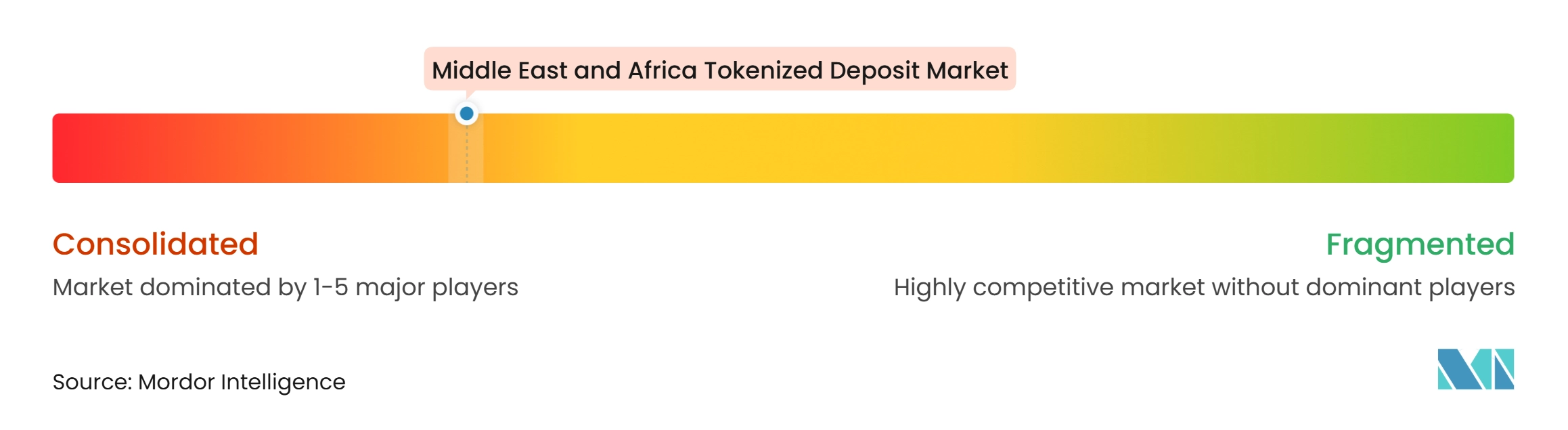
The Middle East and Africa tokenized deposit market is concentrated around global transaction banks with established Gulf Cooperation Council franchises. First Abu Dhabi Bank, HSBC, Standard Chartered, Citigroup, Mashreq, and FirstRand Bank have strong positions because they combine corporate client relationships with correspondent banking reach. Standard Chartered and HSBC completed the first live interbank tokenized deposit transaction on Swift’s blockchain-based shared ledger in August 2026. The transaction demonstrated that separately issued tokenized deposits can be coordinated through a shared institutional layer. Competition depends on client distribution, connectivity, and the ability to operate under bank-grade control standards. Banks with established multinational treasury relationships can introduce tokenized deposit services through existing cash-management offerings.
Emirates NBD followed a multi-network approach by joining Swift’s ledger activity and going live on Partior in July 2026 for real-time blockchain-based cross-border USD payments. HSBC and Ant International completed a live corporate pilot in October 2026 that covered AED payments within the United Arab Emirates and USD transfers to Hong Kong and Singapore. First Abu Dhabi Bank’s live Swift Ledger transaction with Citigroup provided another example of a bank using common infrastructure to extend beyond its own internal network. These moves show that leading banks are using partnerships and connected networks to widen the range of corporate payment use cases. Smaller institutions face a higher entry barrier because they may not have comparable technology budgets or cross-border client bases. Shared infrastructure providers can reduce that barrier by connecting core systems without requiring a complete replacement.
White-space opportunities are strongest among mid-tier Gulf Cooperation Council and Sub-Saharan African banks that serve corporate clients but have limited internal tokenization capability. The ADI Foundation and DCM Corp Limited partnership targets this group with a connection layer between core banking systems and institutional tokenized deposit rails. Partior offers a multi-currency network model for payment providers that need institutional settlement across participating banks. ISO/IEC 27001 certification and evolving Financial Action Task Force expectations raise the importance of information security and compliance readiness for new entrants. These requirements favor banks and infrastructure providers that already have formal control frameworks.
Middle East and Africa Tokenized Deposit Industry Leaders
-
HSBC Holdings plc
-
Citigroup Inc.
-
JPMorgan Chase & Co.
-
Standard Chartered PLC
-
First Abu Dhabi Bank PJSC
- *Disclaimer: Major Players sorted in no particular order
Middle East and Africa Tokenized Deposit Market Companies Covered in this Report
- First Abu Dhabi Bank PJSC
- HSBC Holdings plc
- Standard Chartered PLC
- Citigroup Inc.
- Mashreqbank PSC
- FirstRand Bank Limited
- Emirates NBD Bank PJSC
- JPMorgan Chase & Co.
- Swift
- Partior Pte. Ltd.
- ADI Foundation
- DCM Corp Limited
- Consensys Software Inc.
- DBS Group Holdings Ltd.
- OCBC Bank
Recent Industry Developments in Middle East and Africa Tokenized Deposit Market
- October 2026: HSBC and Ant International completed pilot tokenized deposit transactions across 2 United Arab Emirates payment corridors, including real-time AED intra-United Arab Emirates transfers and cross-border USD transfers to Hong Kong and Singapore. Ant International became the first Middle East client to use HSBC’s Tokenised Deposit Service, establishing a live corporate multi-corridor treasury management use case.
- September 2026: Citigroup expanded Citi Token Services into the United Arab Emirates with USD and EUR 24/7 tokenized deposit capabilities, making the country its 7th location for the service.
- September 2026: ADI Foundation and DCM Corp Limited announced an exclusive technical partnership to enable tokenized deposit issuance and settlement on ADI Chain for banks across the Middle East and North Africa and Sub-Saharan Africa.
- September 2026: First Abu Dhabi Bank completed live USD tokenized deposit transactions with Citigroup through Swift’s Ledger MVP. Deposits remained on participating banks' balance sheets while Swift Ledger coordinated payment commitments without taking custody of funds.
Middle East and Africa Tokenized Deposit Market Report Scope
Segmentation Overview
| Account-Based Tokenized Deposits |
| Native Deposit Tokens |
| Single-Bank (Intra-Bank) Networks |
| Interbank – Shared Multi-Bank Networks |
| Interbank – Bilateral and Cross-Network Links |
| Private Permissioned Ledgers |
| Public Blockchains with Permissioned Token Access |
| Securities and Digital-Asset Settlement and Collateral Management |
| FX and PvP Settlement |
| Intra-Group Treasury and Liquidity Management |
| Third-Party Commercial and Institutional Payments |
| Retail and Other Payments |
| Domestic |
| Cross-Border |
| Banks and Other Deposit-Taking Institutions | |
| Capital-Markets and Investment Firms | |
| Payments, Fintech and Digital-Asset Firms | |
| Nonfinancial Corporates | Large Corporates and Multinationals |
| SMEs | |
| Public Sector and Government Entities | |
| Individuals |
| By Token Model | Account-Based Tokenized Deposits | |
| Native Deposit Tokens | ||
| By Network Model | Single-Bank (Intra-Bank) Networks | |
| Interbank – Shared Multi-Bank Networks | ||
| Interbank – Bilateral and Cross-Network Links | ||
| By Ledger Type | Private Permissioned Ledgers | |
| Public Blockchains with Permissioned Token Access | ||
| By Use Case | Securities and Digital-Asset Settlement and Collateral Management | |
| FX and PvP Settlement | ||
| Intra-Group Treasury and Liquidity Management | ||
| Third-Party Commercial and Institutional Payments | ||
| Retail and Other Payments | ||
| By Transaction Scope | Domestic | |
| Cross-Border | ||
| By End User | Banks and Other Deposit-Taking Institutions | |
| Capital-Markets and Investment Firms | ||
| Payments, Fintech and Digital-Asset Firms | ||
| Nonfinancial Corporates | Large Corporates and Multinationals | |
| SMEs | ||
| Public Sector and Government Entities | ||
| Individuals | ||
Key Questions Answered in the Report
What is driving adoption of tokenized deposits in the Middle East and Africa?
Banks and corporate treasury teams are seeking 24/7 movement of funds, programmable liquidity management, and more efficient cross-border settlement. The regional forecast is a 38.8% CAGR from 2027 to 2032.
What is the projected value of tokenized deposits in the Middle East and Africa by 2032?
The sector is projected to reach USD 48.9 billion by 2032, rising from USD 9.5 billion in 2027.
Which token model is most widely used in the region?
Account-Based Tokenized Deposits held 69.8% share in 2026 because they align closely with existing deposit account structures and bank control models.
Which tokenized deposit network model is growing fastest?
Interbank Shared Multi-Bank Networks are projected to grow at a 51.8% CAGR through 2032 as banks seek to connect separate institutions and client bases.
Why is the United Arab Emirates important for tokenized deposit services?
The United Arab Emirates hosts live services from HSBC and Citigroup and the region’s first live Swift Ledger transaction by First Abu Dhabi Bank.
How do tokenized deposits help cross-border payments in Africa?
They can reduce reliance on prefunded nostro balances and support payment-versus-payment settlement. African corridors averaged a 9.04% cost for a USD 200 transfer in the first quarter of 2025.