
Market Overview
| Study Period | 2020 - 2031 |
|---|---|
| Forecast Data Period | 2026 - 2031 |
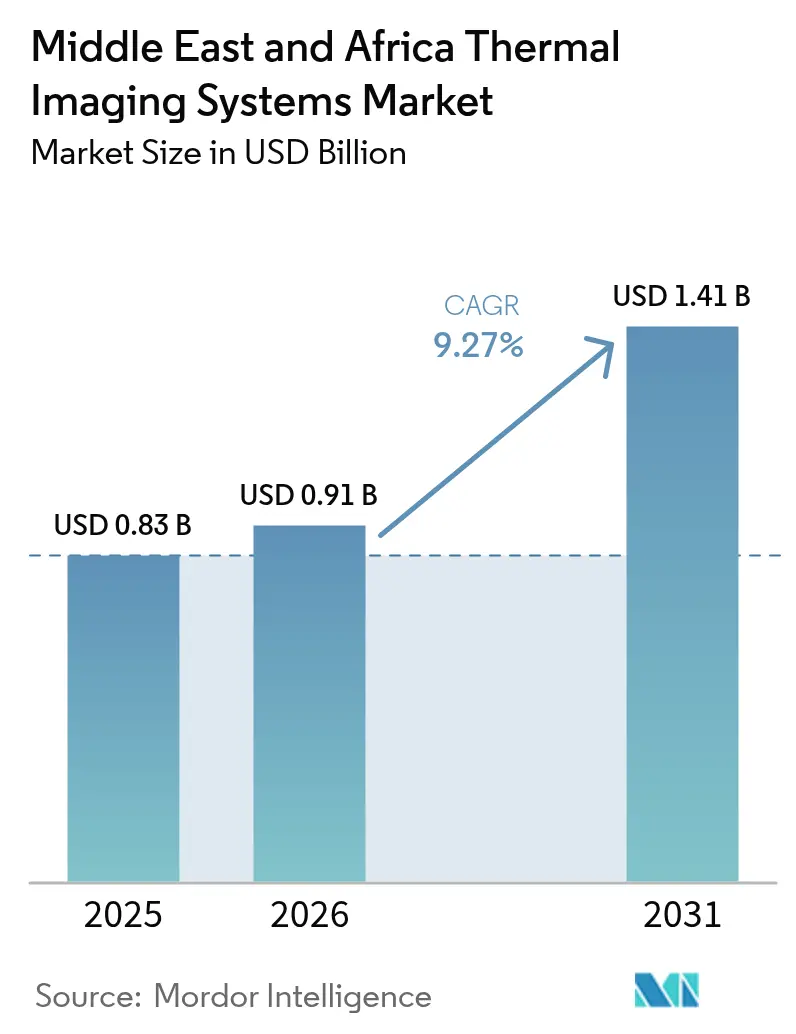
| Base Year Market Size (2025) | USD 0.83 Billion |
| Market Size (2026) | USD 0.91 Billion |
| Market Size (2031) | USD 1.41 Billion |
| Growth Rate (2026 - 2031) | 9.27 % |
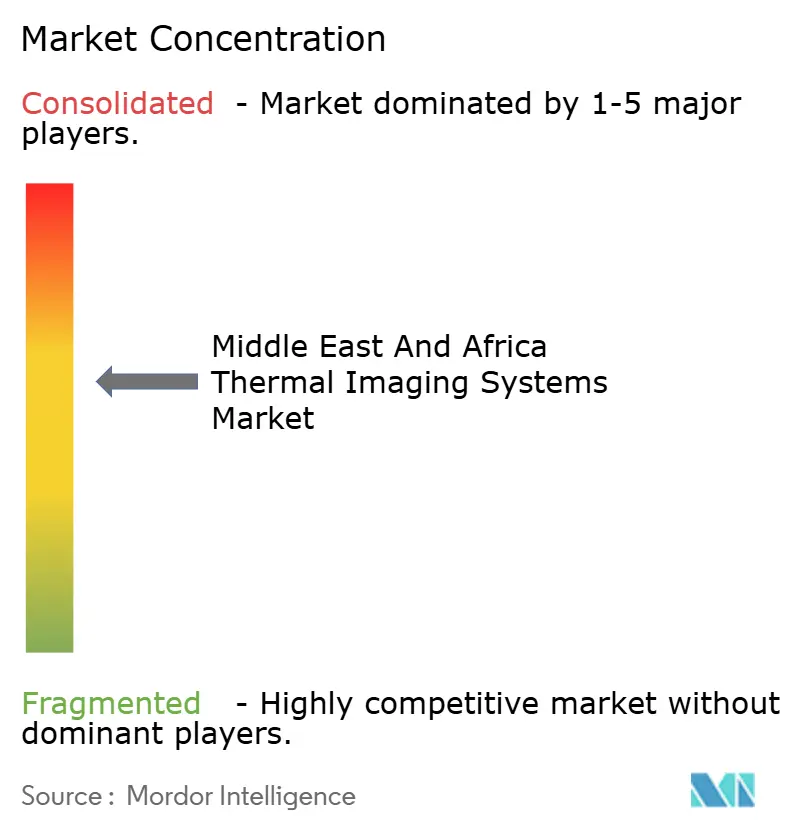
| Market Concentration | Medium |
Major Players *Disclaimer: Major Players sorted in no particular order Image © Mordor Intelligence. Reuse requires attribution under CC BY 4.0. | |
Middle East And Africa Thermal Imaging Systems Market Analysis by Mordor Intelligence
The Middle East And Africa Thermal Imaging Systems Market size is projected to expand from USD 0.83 billion in 2025 and USD 0.91 billion in 2026 to USD 1.41 billion by 2031, registering a CAGR of 9.27% between 2026 to 2031.
Rising demand for predictive maintenance in oil and gas, smart-city surveillance, and Gulf Cooperation Council defense modernization is expanding the addressable base for both cooled and uncooled solutions. Hardware continues to anchor revenue thanks to large-scale fixed-camera deployments on borders, ports, and energy assets, while recurring calibration, training, and analytics subscriptions are steering spending toward services. Wider availability of low-cost microbolometers and edge-AI chipsets is moving the thermal imaging systems market beyond its military core into commercial building inspection, automotive driver-assistance, and logistics. U.S. and European primes dominate high-end cooled platforms, Chinese vendors are gaining share in commercial fixed cameras, and start-ups are democratizing handheld diagnostics for small contractors.
Key Report Takeaways
- By solutions, hardware led with 71.68% revenue share in 2025; services are projected to advance at a 10.39% CAGR through 2031.
- By product type, fixed thermal cameras accounted for 58.05% of the thermal imaging systems market share in 2025, whereas handheld units are expected to post a 9.64% CAGR to 2031.
- By application, security and surveillance captured 46.32% revenue in 2025, while monitoring and inspection is set to grow at a 10.17% CAGR through 2031.
- By end-user, aerospace and defense occupied 54.06% spending in 2025; oil and gas is forecast to expand at an 11.54% CAGR over the same period.
- By Country, Saudi Arabia commanded 37.74% of regional revenue in 2025; Africa is positioned for a 10.03% CAGR to 2031.
Note: Market size and forecast figures in this report are generated using Mordor Intelligence’s proprietary estimation framework, updated with the latest available data and insights as of 2026.
Market Trends and Insights
Drivers Impact Analysis of Middle East And Africa Thermal Imaging Systems Market*
| Driver | (~) % Impact on CAGR Forecast | Geographic Relevance | Impact Timeline |
|---|---|---|---|
| Defense modernization programs across GCC states | +2.3% | Saudi Arabia, UAE, Qatar, Kuwait | Medium term (2-4 years) |
| Expanding oil and gas predictive maintenance requirements | +2.1% | Saudi Arabia, UAE, Kuwait, South Africa | Long term (≥ 4 years) |
| Rapid urban security investments through smart-city initiatives | +1.8% | Saudi Arabia, UAE, Egypt, South Africa | Medium term (2-4 years) |
| Lower-cost uncooled sensors boosting commercial adoption | +1.5% | UAE, Saudi Arabia, South Africa | Short term (≤ 2 years) |
| AI-enabled thermal-vision analytics improving ROI | +1.2% | Saudi Arabia, UAE, South Africa | Medium term (2-4 years) |
| Advent of rugged, drone-mounted thermal payloads for desert operations | +1.0% | Saudi Arabia, UAE, Qatar, Kuwait | Short term (≤ 2 years) |
| Source: Mordor Intelligence | |||
Defense Modernization Programs Across GCC States
Regional militaries are refreshing legacy electro-optical suites with third-generation thermal imagers that extend detection ranges and enable multispectral fusion. Saudi Arabia’s State Authority for Military Industries signed a 2024 memorandum with Hensoldt to localize production, underscoring the push for indigenous capability. Parallel U.S. Army awards to Teledyne FLIR for vehicle sensor systems cascade into foreign military sales channels and guide GCC specifications toward cooled mid-wave infrared arrays. Export-license bottlenecks persist, yet bilateral agreements are trimming approval cycles for trusted Gulf partners. As a result, hardware revenue rises while automatic target-recognition algorithms open recurring software opportunities.
Expanding Oil and Gas Predictive Maintenance Requirements
National oil companies now fuse thermal data with vibration and historian feeds to predict failures weeks ahead. Abu Dhabi National Oil Company rolled out AIQ’s Neuron 5 platform across upstream assets in 2024. Saudi Aramco’s 2024 contract with Gecko Robotics highlights robotic ultrasonic and thermal inspections that displace scaffold-based surveys and avert costly shutdowns. Drone-mounted cameras scan flare stacks and subsea lines for hotspots that signal corrosion or leaks, embedding thermal vision into digital-twin workflows. Cost avoidance from averted outages, often exceeding USD 20 million per incident, validates multiyear inspection budgets.
Rapid Urban Security Investments Through Smart-City Initiatives
Gigaprojects such as NEOM in Saudi Arabia and Dubai’s expanding smart-traffic grid integrate fixed thermal cameras for perimeter security, crowd monitoring, and autonomous-vehicle navigation. Dubai’s Roads and Transport Authority added thermal vision to incident-detection loops in 2024, cutting response times on major arterials.[1] Egypt’s New Administrative Capital mirrors this model across government buildings and transit hubs. Municipal buyers favor turnkey packages that couple cameras, cloud analytics, and cyber-secure data handling, converting one-off purchases into subscription revenue.
Lower-Cost Uncooled Sensors Boosting Commercial Adoption
Microbolometer prices below USD 100 and smartphone-compatible add-ons under USD 500 are moving the thermal imaging systems market into small construction firms and home inspectors. Magna International shipped over 1.2 million automotive thermal-sensing units by 2024 and will release its fifth-generation platform in 2025, anticipating a USD 500 million opportunity as advanced driver-assistance gains regulatory backing. Affordable handhelds priced under USD 1,000 now diagnose HVAC inefficiencies and electrical hotspots for small enterprises in the UAE and South Africa.
Restraints Impact Analysis of Middle East And Africa Thermal Imaging Systems Market*
| Restraint | (~) % Impact on CAGR Forecast | Geographic Relevance | Impact Timeline |
|---|---|---|---|
| High acquisition and maintenance costs for cooled platforms | −1.4% | Saudi Arabia, UAE, South Africa | Long term (≥ 4 years) |
| Stringent export-control regimes limiting sensor availability | −1.1% | Africa (excl. South Africa), select Middle East | Long term (≥ 4 years) |
| Shortage of certified thermography professionals | −0.9% | South Africa, Kenya, Nigeria, Saudi Arabia, UAE | Medium term (2-4 years) |
| Performance degradation from dust, humidity, and extreme heat | −0.7% | Saudi Arabia, UAE, Qatar, Kuwait, North Africa | Short term (≤ 2 years) |
| Source: Mordor Intelligence | |||
High Acquisition and Maintenance Costs for Cooled Platforms
Cooled mid-wave detectors exceed USD 50,000 per unit and rely on cryogenic coolers that demand six-month service intervals in sandy environments. Budget-constrained agencies in Africa and minor Gulf states therefore default to uncooled alternatives or defer projects, slowing top-line growth. Leasing models that shift maintenance risk to vendors are emerging but hinge on creditworthy buyers and predictable regulatory frameworks.
Stringent Export-Control Regimes Limiting Sensor Availability
ITAR and Wassenaar rules cap frame rate and pixel counts for many African buyers, stretching approval cycles to a year.[2] Western suppliers thus lean toward GCC markets while Chinese vendors ship lower-spec, license-free options into Africa, fragmenting the supply chain and limiting interoperability among regional forces.
*Our forecasts treat driver/restraint impacts as directional, not additive. The impact forecasts reflect baseline growth, mix effects, and variable interactions.
Middle East And Africa Thermal Imaging Systems Market Segment Analysis
By Solutions:
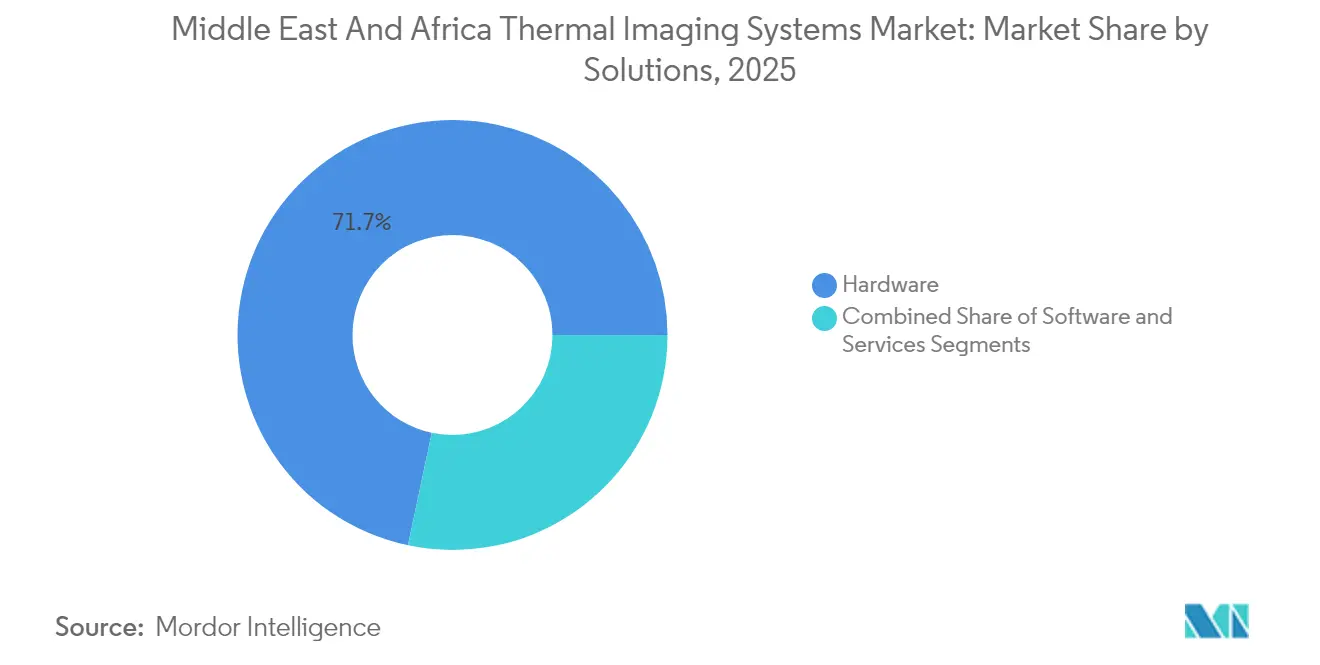
Hardware Remains Dominant, Services AccelerateHardware generated 71.68% of revenue in 2025, reflecting sustained procurement of cameras, lenses, and detector modules for defense borders, oil terminals, and smart-city grids. The thermal imaging systems market size for hardware is projected to expand steadily as governments fund perimeter upgrades. Services, however, will outpace all other categories at a 10.39% CAGR as operators lock in calibration, analytics, and training contracts that convert capital layouts into predictable operating expenses. Early adopters such as Advanced Energy Industries bundle annual service plans, fostering sticky client relationships.
The services trajectory also addresses the regional shortage of certified thermographers. Training providers in the UAE and South Africa charge up to USD 1,900 for Level II certification, and the 2024 launch of the Certified Thermographers Network – Africa aims to harmonize standards across 20-plus countries. Software revenue follows hardware penetration, as cloud-hosted dashboards and edge-AI engines monetize data streams over multiyear cycles.

By Product Type:
Fixed Cameras Lead, Handhelds Gain TractionFixed installations commanded 58.05% revenue in 2025 owing to large-area surveillance of borders, airports, and petro-chemical hubs. These systems integrate with visible-light cameras and radars, enabling layered situational awareness. Handheld units will post a 9.64% CAGR through 2031 as price points fall below USD 5,000 and smartphone add-ons popularize point-and-shoot diagnostics for electricians and building inspectors.
Teledyne FLIR’s Hadron 640 and Gremsy’s Vio F1 illustrate how miniaturized modules blur delineations between fixed and mobile platforms. Demand also comes from utilities that now issue handheld cameras to line crews for real-time fault detection. Consequently, the thermal imaging systems market share for handhelds is set to widen as field diagnostics embed infrared checks into daily workflows.
By Application:
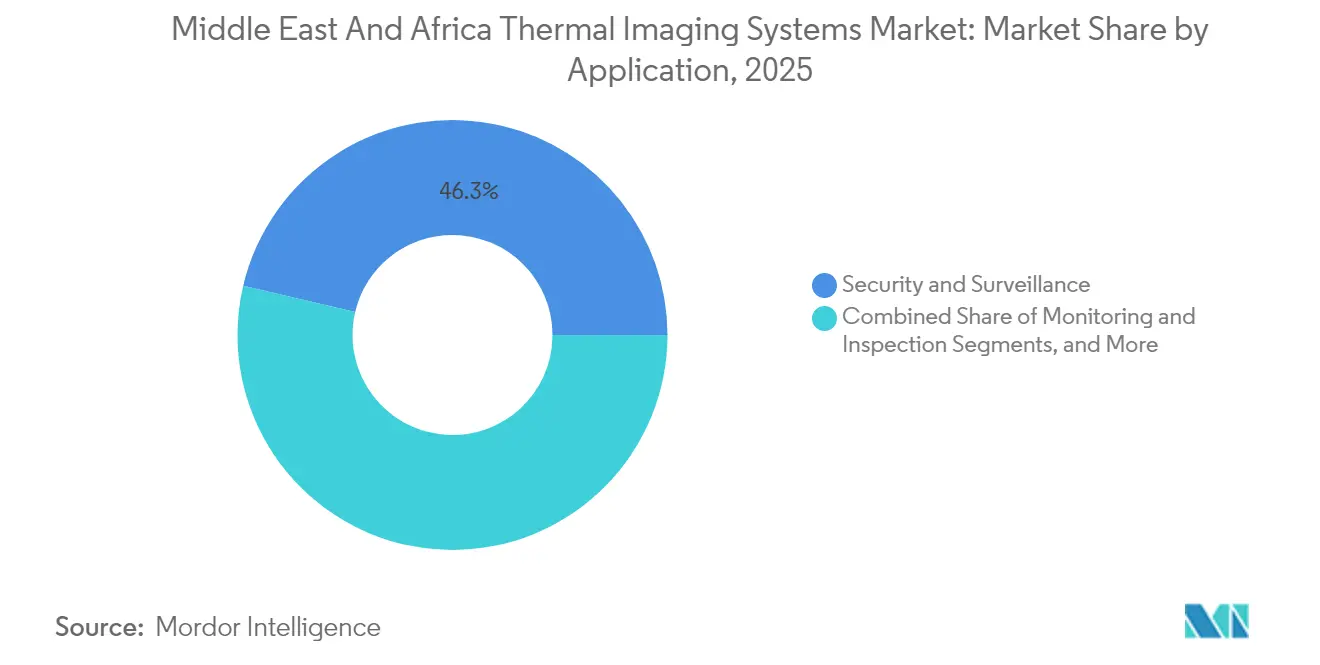
Security Rules, Monitoring SurgesSecurity and surveillance absorbed 46.32% of total demand in 2025 as regional governments invested in border fences, port checkpoints, and airport aprons. GCC militaries specify 1280 × 1024 detectors for 5-kilometer human classification, underpinning hardware orders. Monitoring and inspection, however, will climb at a 10.17% CAGR to 2031 as oil and gas, utilities, and food plants shift toward condition-based maintenance regimes that rely on continuous infrared feeds to flag overheating assets.
Fever screening, gas-leak detection, and laboratory research constitute the detection-and-measurement subset. Post-pandemic public-health mandates sustain temperature-screening lanes at high-traffic sites, while petro-chemical plants deploy optical gas imaging to visualize methane plumes invisible to the naked eye.
By End-User:
Defense Still Largest, Oil and Gas FastestAerospace and defense captured 54.06% spending in 2025 on the back of armored-vehicle retrofits and night-vision upgrades integrated into combined-arms platforms. The thermal imaging systems market size for defense is set to expand, but oil and gas will surpass all others in momentum with an 11.54% CAGR as upstream operators embed thermal lenses into digital-twin dashboards that trigger predictive work orders. Automotive OEMs likewise prepare for regulatory mandates on automatic emergency braking, driving future volume orders for long-wave infrared cameras.
Healthcare adoption includes non-contact neonatal monitoring and vein visualization, while food processors verify cooking temperatures and seal integrity to meet export compliance. Such varied use cases broaden the revenue pyramid, reducing over-reliance on a single vertical.
Geography Analysis
Saudi Arabia and United Arab Emirates Thermal Imaging Systems Market
Saudi Arabia retained 37.74% regional revenue in 2025, supported by Vision 2030 localization goals, Aramco’s refinery-inspection digitization, and NEOM’s smart-city build-out. The kingdom’s procurement scale yields favorable unit economics for cooled mid-wave arrays, and domestic assembly partnerships hint at future cost reductions. The United Arab Emirates ranks second, leveraging ADNOC’s predictive-maintenance rollouts and Dubai’s AI-driven traffic management to keep pipeline inspection and urban safety budgets buoyant.
Turkey and Africa Thermal Imaging Systems Market
Turkey’s defense programs, coupled with in-house detector fabrication at Aselsan, secure steady demand. Africa, forecast to grow 10.03% through 2031, is led by South African border-security upgrades and Kenyan wildlife-conservation initiatives that deploy drone-borne cameras. Fragmented regulations and service voids remain hurdles, yet Chinese suppliers tap this gap with bundled video-analytics packages priced well below Western offerings. Nigeria, Egypt, and Morocco emerge as mid-tier adopters in oil and gas and critical-infrastructure protection, albeit constrained by licensing delays and limited technician pools.
Middle East Thermal Imaging Systems Market
Across the rest of the Middle East-Qatar, Kuwait, Oman, Bahrain, Iraq, Jordan, and Lebanon smaller yet rising budgets target airport expansions, offshore-platform safety, and petro-chemical asset integrity. Public-private concession models spread capital costs across decades, making subscription-based thermal services attractive for municipalities. The thermal imaging systems market continues to normalize from a defense-heavy posture to a multipronged tool for operational safety, logistics, and urban governance.
Regulatory Landscape
Thermal imaging deployments in the Middle East and Africa operate under a mix of safety, building, utility-procurement, and security controls that vary by country and end-use. In the Gulf, project compliance often references regional and national standards, along with authority acceptance of inspection reports. Examples include the Gulf standard GSO IEC TS 62446-3:2021 for outdoor infrared thermography in photovoltaic plants and Dubai utility procurement specifications that define minimum technical performance for infrared thermography cameras (including detector resolution and environmental protection ratings).
In the UAE, acceptance requirements can extend beyond device specifications into permitting and reporting, including approval pathways for certain covert thermal camera installations through Dubai's Security Industry Regulatory Agency (SIRA), plus project-facing EHS and municipal requirements tied to construction and inspection sign-offs. Across Africa, public utilities and government entities shape requirements through tender and technical specifications for thermography cameras and related inspection workflows, which influences what products can be purchased and how they are validated. Compliance emphasis increasingly shifts toward calibration traceability and qualified operators, with Saudi Arabia tying calibration and audit readiness to sector-specific requirements, including food-related inspections aligned with Saudi Food and Drug Authority-related audit practices. These dynamics elevate the role of local testing, calibration access, and certified thermography capability alongside hardware availability, particularly where export controls already restrict higher-end cooled sensors.
Value Chain Analysis
The regional value chain is largely import-led, with detector cores and many lenses sourced from global manufacturers and then adapted for local operating environments by distributors and integrators. A common flow runs from global sensor and camera OEMs (including US, Israel, Europe, and China-based suppliers) to regional distributors that manage inbound logistics through hubs in the UAE and Saudi Arabia, with Dubai frequently used for consolidation via free-zone warehousing. Downstream, local system integrators and value-added resellers handle commissioning, VMS and analytics integration, ruggedization, and after-sales services such as calibration and preventive maintenance.
Bottlenecks tend to cluster around specialized infrared optics materials (for example, germanium or chalcogenide glass), constrained wafer-level capacity for some detector types, and export-license lead times for controlled thermal sensors, which can push deliveries out by multiple months on defense-grade platforms. Service readiness is a key differentiator for downstream operators. Integrators that can provide on-site inspections and drone-based thermal data capture, including solar PV thermography and microclimate mapping workflows used on large Saudi projects, help convert hardware sales into recurring inspection, analytics, and maintenance revenues, while reducing customer downtime in harsh desert conditions.
Competitive Landscape
The thermal imaging systems market features moderate concentration. Six Western defense primes Teledyne FLIR, L3Harris, Lockheed Martin, BAE Systems, Leonardo DRS, and Elbit Systems command the majority of cooled-detector sales, leveraging proprietary fabrication, ruggedization know-how, and embedded relationships with defense ministries. Chinese manufacturers such as Hangzhou Hikvision, Guide Infrared, and Zhejiang Dali supply price-competitive 384 × 288 and 640 × 512 uncooled cameras bundled with video-management software, rapidly scaling commercial installations across seaports and industrial parks.
Thermoteknix, Testo, Optris, and Ametek-Land specialize in high-accuracy radiometric devices for process control and scientific research, differentiating on calibration traceability and ISO 9001 compliance. North American start-ups, notably Seek Thermal and Infrared Cameras Inc., democratize handheld imaging under USD 500, expanding the user base among facility managers and electricians.
Technology integration sets competitive boundaries. Vendors embedding edge-AI inference chips reduce latency and bandwidth costs, critical for remote oil platforms and desert outposts. Compliance with ITAR and Wassenaar export regimes further segments suppliers: Western primes emphasize license support for GCC allies, while Chinese firms address less-restricted African buyers. Emerging white-space lies in autonomous-vehicle perception stacks, drone payloads for offshore inspections, and transformer health analytics in power grids.
Middle East And Africa Thermal Imaging Systems Industry Leaders
-
Teledyne FLIR LLC
-
L3Harris Technologies Inc.
-
Lockheed Martin Corporation
-
BAE Systems plc
-
Leonardo DRS Inc.
- *Disclaimer: Major Players sorted in no particular order
Middle East And Africa Thermal Imaging Systems Market Companies Covered in this Report
- Teledyne FLIR LLC
- L3Harris Technologies Inc.
- Lockheed Martin Corporation
- BAE Systems plc
- Leonardo DRS Inc.
- Elbit Systems Ltd.
- RTX Corporation (Raytheon Business Unit)
- Thermoteknix Systems Ltd.
- Hangzhou Hikvision Digital Technology Co. Ltd.
- Guide Infrared Co. Ltd.
- Zhejiang Dali Technology Co. Ltd.
- Silent Sentinel Holdings Ltd.
- Testo SE and Co. KGaA
- Seek Thermal Inc.
- Optris GmbH
- Ametek Land (Land Instruments International Ltd.)
- Wuhan Guide Infrared Co. Ltd.
- Infrared Cameras Inc.
- SATIR (Shenzhen SAT Infrared Technology Co. Ltd.)
- Ulirvision Technologies Co. Ltd.
- Seek Thermal Inc.
Read Analysis of Middle East And Africa Thermal Imaging Systems Companies
Market Opportunities and Future Outlook
Defense and maritime security procurement continues to create opportunity for integrated infrared surveillance suites that bundle sensors with software and shipboard integration, rather than standalone cameras. A relevant example is EDGE Group's Abu Dhabi Ship Building selecting HGH to provide infrared surveillance systems and its CYCLOPE software for eight offshore patrol vessels under Kuwait's Al Dorra program, announced in July 2026. Programs like this support demand for long-range thermal payloads, multi-sensor fusion, and lifecycle support delivered through regional shipbuilding and systems integration.
Saudi Arabia's localization framework also expands whitespace for suppliers that can pair thermal hardware with in-country support, depot maintenance, and approved localization plans. Teledyne FLIR Defense's contract to supply Lightweight Vehicle Surveillance System (LVSS) mobile surveillance units to a Saudi military entity, coordinated with a GAMI-approved localization plan (announced March 2025), shows how winning bids increasingly combine performance, delivery assurance, and local content. Outside defense, drone-based thermal inspection for solar PV and megaproject infrastructure supports a commercial pathway for uncooled radiometric payloads and analytics services, with demand shaped by utility specifications, PV thermography standards (GSO IEC TS 62446-3:2021), and operator requirements for calibrated measurements and qualified reporting.
Recent Industry Developments in Middle East And Africa Thermal Imaging Systems Market
- July 2026: HGH secured a contract from EDGE Group's Abu Dhabi Ship Building to equip eight offshore patrol vessels for the Kuwait Navy Al Dorra program with infrared surveillance systems and CYCLOPE software. The award reinforces demand for integrated thermal surveillance plus software in maritime security, and it strengthens the role of regional shipbuilding and systems integration in thermal imaging procurement.
- November 2025: Teledyne FLIR Defense announced Riyadh-based leadership and confirmed progress on its Saudi Regional Headquarters license, with a planned Riyadh headquarters opening in mid-2026. Establishing a Saudi RHQ aligns with in-country procurement and localization expectations and improves proximity for bid support, delivery coordination, and sustainment services for thermal-enabled surveillance programs.
- March 2025: Teledyne FLIR Defense signed a USD 7.8 million contract with Middle East Task Company (METCO) to provide Lightweight Vehicle Surveillance System (LVSS) mobile surveillance units to a military entity in Saudi Arabia, supported by an approved localization plan coordinated by GAMI. The deal expands mobile thermal surveillance footprints and indicates procurement preference for solutions packaged with localization and lifecycle support.
Middle East And Africa Thermal Imaging Systems Market Report Scope and Research Methodology
Market Definition and Coverage
This market covers thermal imaging systems sold and used across the Middle East and Africa, including fixed and handheld thermal cameras, plus the related software and services that directly support capture, analysis, and use of thermal images.
Scope exclusions: We exclude adjacent night-vision optics that do not use thermal sensing, and we exclude general CCTV components that are not purpose-built for thermal imaging.
Segments Covered in This Report
- By Solutions
- Hardware
- Software
- Services
- By Product Type
- Fixed Thermal Cameras
- Handheld Thermal Cameras
- By Application
- Security and Surveillance
- Monitoring and Inspection
- Detection and Measurement
- By End-user
- Aerospace and Defense
- Automotive
- Healthcare and Life Sciences
- Oil and Gas
- Food and Beverages
- Other End-users
- By Geography
- Middle East
- Saudi Arabia
- United Arab Emirates
- Turkey
- Rest of Middle East
- Africa
- South Africa
- Kenya
- Rest of Africa
- Middle East
Data Sources, Market Sizing, and Validation
Desk Research
Desk work started with building a clear demand map by country and end-use, then checking what is realistically being procured, installed, and used. We leaned on public sources such as UN Comtrade and national customs portals for trade direction, defense-focused context (similar to SIPRI reporting), and government procurement portals and tender bulletins where thermal equipment is visibly specified.
To keep assumptions grounded, we also reviewed sources such as civil aviation authority releases for airport security programs, oil and gas regulator or national oil company public updates for inspection activity, and peer-reviewed journals that discuss thermography use cases and typical performance requirements. Company annual reports, investor presentations, and credible press were used to understand product mix changes and pricing movement. In a few places, we also referenced paid subscriptions for company financials, news and financials, patents, and tender tracking to cross-check timelines and revenue exposure. These examples are not exhaustive, and many other public and paid sources were also consulted for data collection, validation, and research clarification.
Primary Interviews and Surveys
Primary work was used to pressure-test desk assumptions on adoption, pricing, and the split between security uses and inspection uses, since these can change fast with budgets and project timing. We spoke with a mix of suppliers, distributors, and system integrators, and also with end users in defense and civil security, oil and gas operations, and industrial maintenance teams across the region.
Because this is a multi-country market, inputs were checked across Gulf demand centers and also across key African buyers, and then the final assumptions were triangulated back to what is being procured and deployed on the ground.
Distribution of primary research fieldwork respondents
| Company type | Respondent position |
|---|---|
| Top tier: 30% | CXOs: 16% |
| Mid tier: 54% | Functional/Unit leaders: 31% |
| Smaller Players: 16% | Managers: 53% |
Market-Sizing & Forecasting
Sizing was built using a top-down and bottom-up model. On the top-down side, country demand pools were reconstructed using a practical mix of security infrastructure rollouts, defense modernization signals, industrial inspection intensity, and the installed base replacement cycle, which was then converted into value using typical system pricing bands.
Those totals were corroborated through selective bottom-up checks, mainly a roll-up of sampled supplier and channel revenue exposure in the region, plus a quick ASP x unit volume sense check for fixed and handheld cameras. If a country had weak visibility in one channel, we filled the gap using proxy indicators such as import patterns, tender frequency, and the nearby-country adoption curve, and then normalized it during expert calls.
For forecasting, scenario analysis was used so the model can reflect budget timing and project delays that are common in defense and public safety programs. Key inputs we tracked (illustrative) included new border and critical infrastructure surveillance projects, airport security upgrades, oil and gas inspection spending cadence, the mix shift between fixed and handheld devices, cooled versus uncooled preference in high-performance use cases, and expected price movement from product refresh cycles.
Data Validation & Update Cycle
Outputs were checked at multiple levels so unusual jumps do not pass through without explanation. We compare the model to independent signals such as procurement announcements, trade direction, and the implied unit economics, and then investigate variances by country and by application before sign-off.
A second analyst review is done for logic, arithmetic, and assumption consistency, and re-contact is triggered when pricing, scope, or adoption feedback conflicts across respondent groups. Reports are refreshed annually, with interim updates when material events occur such as large contract awards, policy shifts, or sudden supply constraints. Before delivery, we do a final pass so clients receive the latest updated view.
Mordor Intelligence's Middle East and Africa Thermal Imaging Systems Market Estimate Compared With Other Published Estimates
Published numbers for this market can look far apart because the scope line is drawn differently and the pricing logic is handled in different ways. Differences also show up when one estimate is built around public safety projects only, and another folds in industrial thermography and aftermarket services.
Some published figures also expand the scope to include adjacent night-vision or broad surveillance camera spending, and they may keep pricing flat even when the mix shifts toward lower-cost uncooled devices. Mordor Intelligence counts hardware plus the directly tied software and services for thermal imaging systems in Middle East and Africa, and it excludes non-thermal CCTV and non-thermal night-vision optics so the value stays tied to a repeatable thermal demand pool.
Benchmark comparison
| Source | Market Size | Gaps in Research Methodology |
|---|---|---|
| Mordor Intelligence | USD 0.83 B (2025) | |
| Industry Publisher A | USD 0.83 B (2024) | Uses a 2024 base year and a broader basket of use cases, with pricing held more stable across the forecast, which can compress the step-up seen when project mix shifts by country. |
| Research Publisher B | USD 0.41 B (2024) | Appears to center the estimate on a narrower set of thermal camera deployments, with less explicit capture of software and services value, which can understate total spend in enterprise and defense programs. |
The spread mainly comes from what gets counted as part of thermal imaging and how the base year is anchored. By keeping the market tied to clear product types, applications, and region-specific demand signals, the final number stays traceable and easier to reproduce when assumptions are updated.
Key Questions Answered in the Report
What is the projected value of the Middle East and Africa thermal imaging systems market in 2031?
The Middle East and Africa thermal imaging systems market is expected to reach USD 1.41 billion by 2031, supported by a 9.27% CAGR.
Which segment is growing fastest by solutions?
Services are forecast to post a 10.39% CAGR as buyers shift toward calibration, training, and analytics subscriptions.
How much of the market does Saudi Arabia currently hold?
Saudi Arabia accounted for 37.74% of regional revenue in 2025.
Why are handheld thermal cameras gaining popularity?
Falling prices below USD 5,000 and smartphone-compatible devices under USD 500 are enabling on-demand diagnostics for utilities, construction, and facility maintenance.
Which application is forecast to accelerate the most?
Monitoring and inspection is set to expand at a 10.17% CAGR as industries move toward condition-based maintenance.
What restrains adoption of cooled thermal platforms?
Acquisition costs above USD 50,000 and high maintenance demands limit uptake among budget-constrained agencies, especially in Africa and smaller Gulf nations.