
Middle East and Africa Optical Power Ground Wire (OPGW) Market Size and Share
Market Overview
| Study Period | 2022 - 2032 |
|---|---|
| Forecast Data Period | 2027 - 2032 |
| Base Year Market Size (2026) | USD 97.45 Million |
| Market Size (2027) | USD 101.16 Million |
| Market Size (2032) | USD 150.21 Million |
| Growth Rate (2027 - 2032) | 8.23 % |
| Market Concentration | Medium |
Major Players *Disclaimer: Major Players sorted in no particular order Image © Mordor Intelligence. Reuse requires attribution under CC BY 4.0. | |
Middle East and Africa Optical Power Ground Wire (OPGW) Market Analysis by Mordor Intelligence
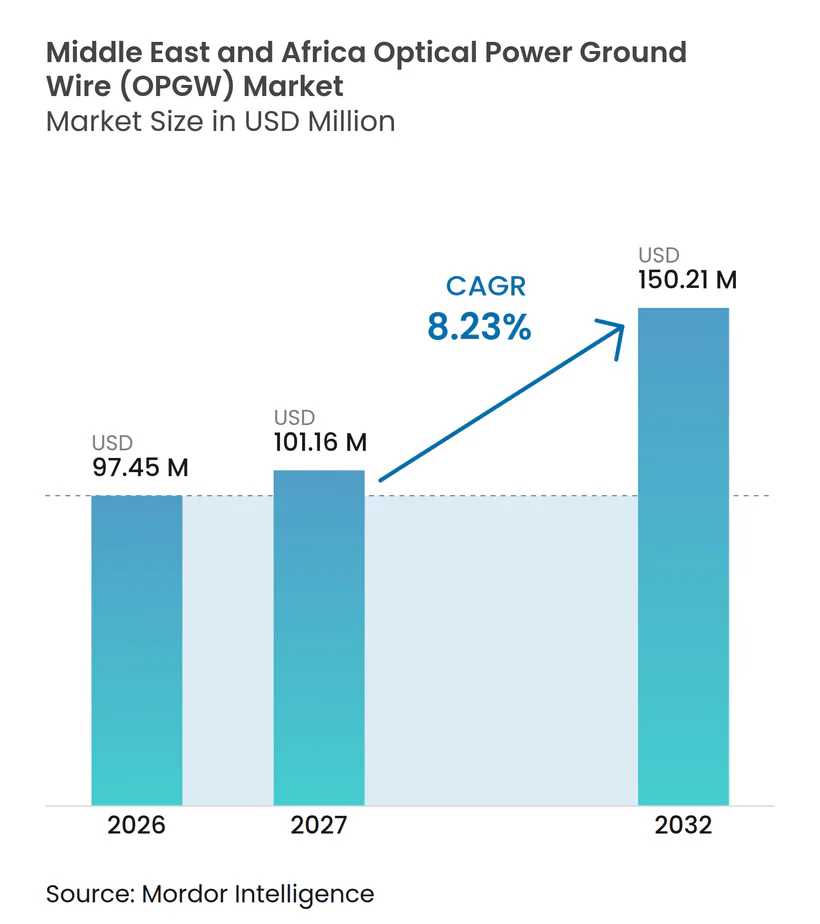
The Middle East And Africa Optical Power Ground Wire Market size is projected to expand from USD 97.45 million in 2026 and USD 101.16 million in 2027 to USD 150.21 million by 2032, registering a CAGR of 8.23% between 2027 and 2032. The Middle East and Africa OPGW market is supported by transmission expansion, renewable energy connections, and the growing use of digital monitoring across power networks. Utilities are treating optical ground wire as part of a transmission line’s communications system rather than as an optional addition, because it combines lightning protection with fiber capacity for protection, control, and operational data. This shifts procurement toward cable specifications that can support both current grid needs and future communications requirements. Local manufacturing rules in Saudi Arabia and Egypt also affect supplier selection, delivery planning, and the location of cable production. These conditions create opportunities for suppliers that can meet utility specifications, provide accredited testing records, and maintain a regional operating presence.
Key Report Takeaways
- By fiber count, 48F held a 36.11% share in 2026, while 96F is forecast to grow at an 11.71% CAGR through 2032.
- By cable design type, Design A held a 35.25% share in 2026, while Design B is forecast to grow at a 9.12% CAGR through 2032.
- By end-use industry, Power Utilities held a 76.54% share in 2026, while the same segment is forecast to grow at an 8.98% CAGR through 2032.
- By geography, Saudi Arabia held a 32.67% share in 2026, while the UAE is forecast to grow at an 8.81% CAGR through 2032.
Note: Market numbers in this report are based on Mordor Intelligence's proprietary estimation framework, which combines nine months of actuals with Q4 projections for base year 2026.
Market Trends and Insights
Drivers Impact Analysis of Middle East and Africa Optical Power Ground Wire (OPGW) Market*
| Driver | (~) % Impact on CAGR Forecast | Geographic Relevance | Impact Timeline |
|---|---|---|---|
| Grid Modernization and Transmission Reinforcement | +2.8% | Saudi Arabia, Nigeria, Egypt, Kenya | Medium term (2-4 years) |
| Renewable Energy Evacuation and Cross-Border Interconnection | +1.8% | GCC, Egypt | Medium term (2-4 years) |
| Smart Grid, SCADA, and Teleprotection Deployment | +0.9% | UAE, Saudi Arabia, Nigeria, South Africa | Short term (≤ 2 years) |
| Dual Use of Power Corridors for Utility and Telecom Connectivity | +0.6% | Saudi Arabia, UAE, Egypt | Medium term (2-4 years) |
| Monetization of Underused Utility Fiber Capacity | +0.4% | Saudi Arabia, UAE, Nigeria | Medium term (2-4 years) |
| Local Content and Regional Manufacturing Programs | +0.3% | Saudi Arabia, Egypt | Long term (≥ 4 years) |
| Source: Mordor Intelligence | |||
Grid Modernization and Transmission Reinforcement
The Middle East and Africa OPGW market benefits from investment in transmission networks that have not kept pace with generation additions in several countries. Saudi Electricity Company awarded USD 906 million of substation and transmission contracts for the Afif 1 and Afif 2 bulk supply points during 2025, adding work to the country’s high-voltage project pipeline. Nigeria is mobilizing USD 2.3 billion for its nationwide grid overhaul under the Presidential Power Initiative, which makes transmission reinforcement relevant to cable and communications procurement. Kenya also signed a USD 311 million public-private partnership with Africa50 and Power Grid Corporation of India Limited for high-voltage corridors, bringing another long-term transmission program into the regional pipeline.[1] New overhead lines need protection, control, and communications equipment, so OPGW is increasingly specified with the line rather than procured as a later upgrade. IEC 60794-4-10 and IEEE 1138-2021 compliance records also make testing capability an important factor in utility tenders.
Transmission investment has a broader effect than the immediate cable order because it establishes routes that can serve grid monitoring for decades. The Middle East and Africa OPGW market therefore follows not only annual electricity demand but also the schedule of substations, renewable connections, and long-distance overhead lines. Utilities often coordinate OPGW installation with stringing work because this avoids repeating access, safety, and outage activities on an energized corridor. This coordination favors suppliers that can work within a larger engineering, procurement, and construction schedule. It also increases the importance of delivery reliability, since a delayed optical ground wire installation can defer communication-system commissioning. In markets with limited contractor capacity, the availability of crews able to handle both cable stringing and fiber splicing remains relevant to the pace of deployment.
Renewable Energy Evacuation and Cross-Border Interconnection
The Middle East and Africa OPGW market is linked to renewable energy projects because remote solar and wind facilities require high-voltage lines to reach demand centers. Egypt’s electricity transmission company received a USD 223.66 million (EUR 200 million) financing package for a 500 kV substation upgrade and a high-voltage line intended to evacuate more than 2.1 GW of renewable energy from the Gulf of Suez.[2] The Egypt-Saudi Arabia interconnection includes OPGW fiber installation on a 320 km overhead line from Badr to Taba 2, showing the direct role of fiber infrastructure in cross-border power operations. Gulf Cooperation Council Interconnection Authority (GCCIA) also signed a USD 500 million interim financing agreement for a 530 km, 400 kV, 1,600 MW connection between the GCC grid and Oman. Protection, control, and metering across these routes require reliable communications that can operate alongside the transmission line. OPGW offers a practical way to place fiber on high-voltage routes where a separate terrestrial network may not be available.
Cross-border connections require common operating visibility between grid operators, which raises the value of dependable communications systems. This supports higher fiber-count specifications on routes expected to carry protection, operational data, and future network services. The Middle East and Africa OPGW market also gains from the long construction periods of interconnection projects because cable demand is tied to staged transmission works. Renewable power zones are often distant from cities, making overhead lines and their ground wire systems part of the initial project design. Suppliers with records in high-voltage environments can compete for these requirements when project owners emphasize system reliability. The underlying opportunity depends on project execution because financing, permitting, and cross-border coordination can extend the time between approval and cable installation.
Smart Grid, Supervisory Control and Data Acquisition (SCADA), and Teleprotection Deployment
Smart-grid investment is making fiber connectivity essential for line protection, remote supervision, and fault response across the Middle East and Africa OPGW market. The UAE Ministry of Energy and Infrastructure inaugurated the Emirates Monitoring Centre in July 2026 with Siemens Spectrum Power Supervisory Control and Data Acquisition (SCADA) V23 Q4 to provide real-time oversight of 48 GW of installed generation capacity.[3] The center illustrates how national monitoring facilities require dependable data links from transmission assets. Nigeria’s regulators approved OPGW installation on the Omotosho-Ikeja West 330 kV line in July 2025, and the Transmission Company of Nigeria stated that the installation would help operationalize the national SCADA system. The country’s World Bank-funded USD 486 million SCADA upgrade was reported as 69% complete, creating a practical need for communications upgrades on the transmission network. These programs create demand both for retrofits on existing towers and for OPGW on newly built lines.
SCADA and teleprotection change the role of the cable from a passive asset to an operational part of grid reliability. Utilities need data paths that continue to work in demanding outdoor conditions and that fit within high-voltage safety practices. OPGW allows fiber to be installed in the earth wire position, which supports both lightning protection and high-speed communications. This configuration is especially useful where a separate buried fiber route would add civil works or create route-access problems. The Middle East and Africa OPGW market can therefore benefit when utilities upgrade monitoring systems even if the underlying line is not fully rebuilt. The commercial opportunity is strongest where transmission owners align digital-system spending with a clear retrofit plan for their physical network.
Dual Use of Power Corridors for Utility and Telecom Connectivity
The Middle East and Africa OPGW market is also supported using excess utility fiber for external connectivity services. Transmission Company of Nigeria identified that a 96F OPGW installation on the Ikeja West-Akangba 330 kV line would leave most fibers available for lease to telecom and data-service providers.[4] This approach changes the economic case for higher fiber counts because the utility can retain capacity for protection and use remaining fibers for commercial arrangements. In the UAE and Saudi Arabia, the practice of leasing dark fiber from utility routes is more established than in many sub-Saharan African markets. Railway applications in Egypt and Kenya add another use case because aerial earth conductors can support signaling and train-control communications. The result is a wider base of demand than core transmission operations alone.
The value of excess fibers depends on clear governance between transmission owners, telecom operators, and regulators. Where utility rules permit leasing, fiber capacity can become a source of recurring revenue rather than unused technical reserves. This can encourage specifications such as 96F on strategic routes, especially where utilities expect growth in data traffic or third-party demand. The Middle East and Africa OPGW market is consequently affected by commercial rules as well as engineering standards. Higher-count cable does not automatically create revenue, since access conditions, pricing, and maintenance responsibilities must be settled before leasing begins. Even so, this model gives utilities a reason to consider long-term communications demand at the time of line construction.
Restraints Impact Analysis of Middle East and Africa Optical Power Ground Wire (OPGW) Market*
| Restraint | (~) % Impact on CAGR Forecast | Geographic Relevance | Impact Timeline |
|---|---|---|---|
| High Installation and Project Integration Costs | -1.5% | Sub-Saharan Africa, Egypt | Medium term (2-4 years) |
| Aluminum, Fiber, and Specialty Hardware Price Volatility | -1.0% | Global, with acute impact in GCC and Egypt | Short term (≤ 2 years) |
| Utility Telecom Governance Silos and Wayleave Friction | -0.7% | Nigeria, Kenya, Egypt, South Africa | Medium term (2-4 years) |
| Desert, Coastal, and Long Span Reliability Requirements | -0.5% | Saudi Arabia, UAE, Oman, Qatar | Long term (≥ 4 years) |
| Source: Mordor Intelligence | |||
High Installation and Project Integration Costs
High installation and project integration costs can slow deployment in the Middle East and Africa OPGW market, particularly where utility finances are weak. OPGW stringing requires specialized equipment, trained crews, safety procedures, and coordination with the transmission operator. The International Energy Agency stated that poor utility financial conditions in developing economies are holding back needed grid investment. Utilities may defer OPGW until a line is being reconductored or its structures are being replaced, rather than install it as a separate project. This can create a long interval between commissioning a line and activating its fiber communications capability. Split scopes for cable stringing and telecom splicing can add coordination work and increase administrative risk.
Installed cost is more than the cable price, because execution depends on access to the corridor, outage windows, and trained labor. This issue is most important in parts of sub-Saharan Africa where transmission owners must prioritize limited capital across several network needs. The Middle East and Africa OPGW market can be affected when utilities select lower initial cost solutions that do not provide immediate fiber capacity. Suppliers that can support installation planning, testing, and handover documentation may reduce some of this burden for project owners. Standardized scopes and qualified local contractors may also make procurement easier for utilities with limited internal resources. The constraint does not eliminate demand, but it can push deployment into later maintenance or reconstruction cycles.
Utility Telecom Governance and Route Access Friction
Utility-telecom governance issues can limit the commercial use of spare fiber in the Middle East and Africa OPGW market. A transmission operator may own the fiber route while a telecom provider manages services, creating uncertainty over access rights, maintenance responsibilities, and customer contracts. These questions are material in countries where the legal framework for utility fiber leasing is still developing. Nigeria’s stated interest in making excess OPGW fibers available to telecom and data-service providers shows the commercial potential, but it also highlights the need for clear implementation rules. Delays in permissions or wayleave arrangements can reduce the near-term value of higher fiber counts. Utilities may remain focused on protection and SCADA use until commercial governance is settled.
Route-access friction does not generally prevent the use of OPGW for the power system itself. It can, however, reduce the additional revenue case that supports larger fiber-count decisions. Clear agreements between utilities, telecom operators, and regulators can help set responsibilities for repairs, system security, and service quality. This is important on long-distance corridors where a fiber fault may affect both grid operations and commercial customers. The Middle East and Africa OPGW market is therefore influenced by policy and institutional coordination as well as cable demand. Progress in leasing models would make the economics of underused fiber capacity more attractive, especially on strategic national routes.
*Our forecasts treat driver/restraint impacts as directional, not additive. The impact forecasts reflect baseline growth, mix effects, and variable interactions.
Middle East and Africa Optical Power Ground Wire (OPGW) Market Segment Analysis
By Fiber Count:
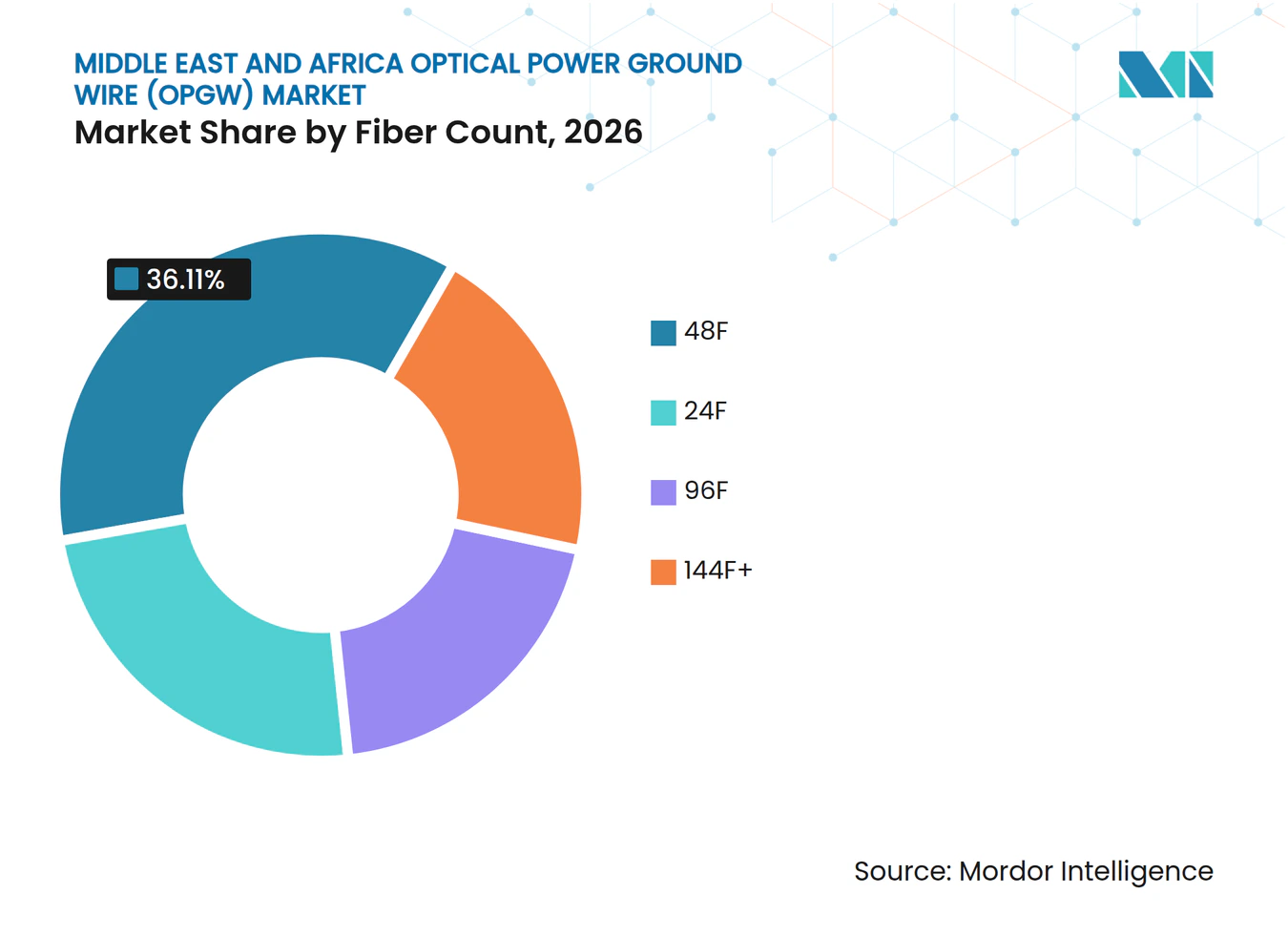
Higher-Density Cables Redefine Per-Km Economics48F accounted for 36.11% of the Middle East and Africa OPGW market share in 2026. It remains the common baseline for national-grid projects because it can accommodate SCADA, teleprotection, voice, administrative traffic, and some reserve capacity. Utilities in GCC markets have used this specification where it meets standard operating requirements without adding unnecessary complexity. The 24F category is becoming less relevant because the cost difference from 48F can be too small to justify reduced flexibility. The Middle East and Africa OPGW industry is moving toward higher density where future communications needs are clearer. That movement reflects an effort to avoid replacing an installed ground wire when extra fibers could have been included during the original stringing work.
96F is forecast to grow at an 11.71% CAGR through 2032, the highest rate among the fiber-count categories. Its adoption is supported by utilities that want capacity for operational traffic and possible dark-fiber leasing. Transmission Company of Nigeria specified 96F OPGW on several 330 kV lines in 2025 to support both SCADA operation and potential fiber monetization. The 144F+ category is gaining attention on cross-border lines and backbone routes where utilities are planning long-lived fiber corridors. Higher density does not suit every project, since the choice still depends on operating requirements, route importance, and the ability to commercialize spare fibers. The fiber-count mix will therefore differ between core national routes, local transmission connections, and corridors that are intended to serve multiple users.



By Cable Design Type:
Aluminum-Tube Baseline Faces Structural CompetitionDesign A held a 35.25% share in 2026. These cables use aluminum-tube fiber units and all-aluminum-alloy outer strands, matching established procurement practice in several GCC systems. The design is used where utilities require thermal performance in high short-circuit-current environments. Saudi Arabia and the UAE have contributed to its established position through their high-voltage transmission programs. Design A is supported by familiar specifications and supplier experience, which can simplify tender evaluation. Its leading position does not mean that utilities use one construction across every route, because environmental and mechanical conditions vary by project.
Design B is forecast to grow at a 9.12% CAGR through 2032, supported by its aluminum-clad steel wire construction. The construction provides corrosion resistance and tensile strength for corridors exposed to salt fog, humidity, or demanding terrain. Coastal Arabian Gulf routes, Oman’s mountain-to-coast connections, and Egypt’s Red Sea corridors are relevant use cases. Designs C and D are specified for long spans and wadi crossings where sag management is important. Designs E and F are relevant to HVDC and 500 kV+ backbone projects that require more than 72 fibers. The Middle East and Africa OPGW industry also faces higher qualification expectations, as utilities increasingly request IEC 60794-4-10 and IEEE 1138-2021 type-testing reports from independent accredited laboratories.
By End-Use Industry:
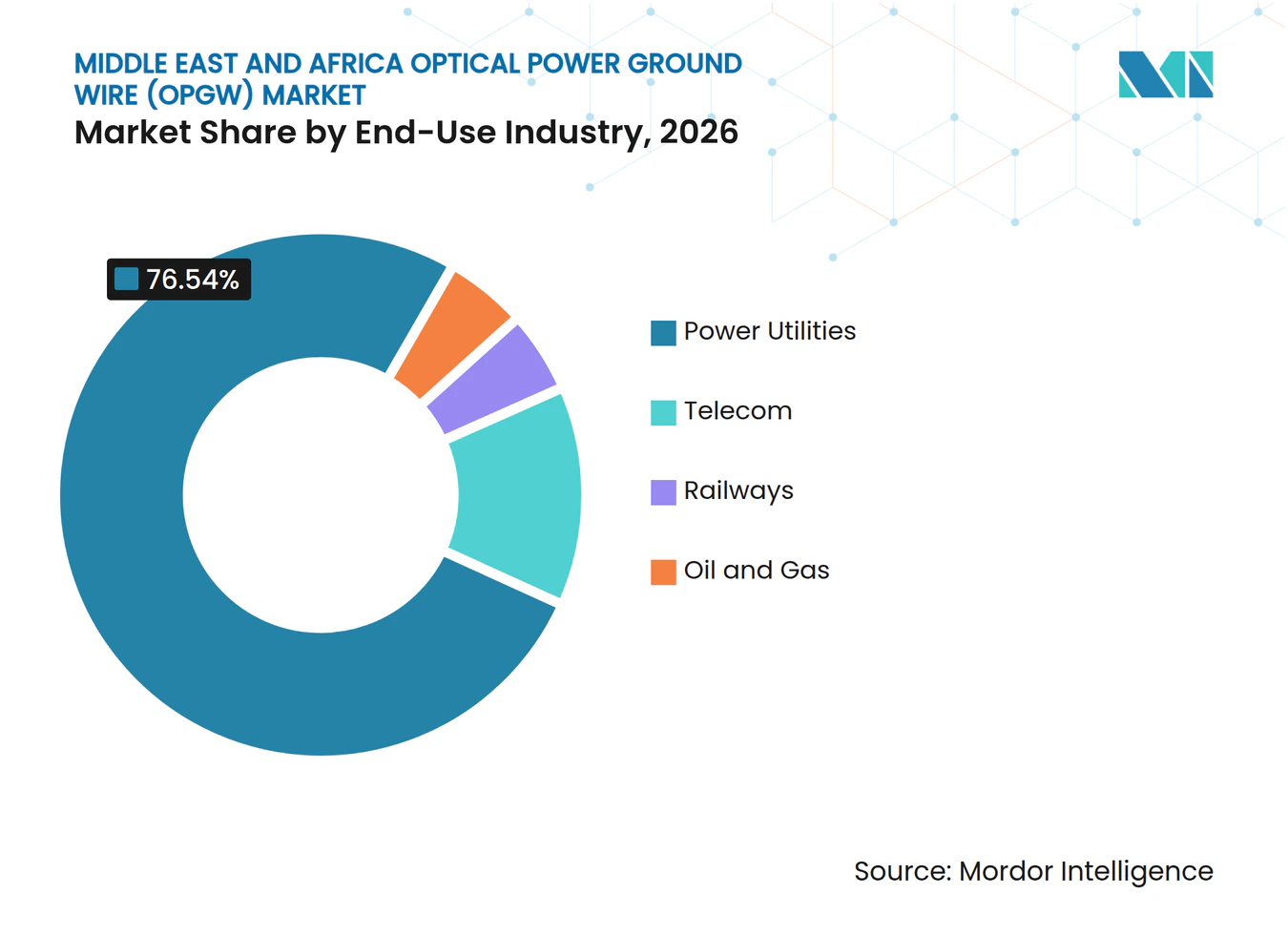
Power Utilities Anchor Demand While Adjacent Sectors ExpandPower Utilities accounted for 76.54% of the Middle East and Africa Optical Power Ground Wire (OPGW) market size in 2026. The segment is tied directly to new overhead transmission lines, grid reinforcement, and the connection of renewable generating assets. Renewable evacuation needs to reinforce this position because power projects require protection and operational communications across their transmission corridors. Egypt’s grid program includes a high-voltage line to carry renewable output from the Gulf of Suez, demonstrating the link between new generation and transmission communications requirements. Utilities also use OPGW for SCADA and teleprotection, which makes the cable part of the operating network rather than a separate telecommunications asset. This broad functional role keeps power companies at the center of demand.
Power Utilities are also forecast to expand at an 8.98% CAGR through 2032, the highest rate among the end-use categories. Telecom operators use utility routes where dark-fiber leasing arrangements are available, with more developed examples in the UAE and Saudi Arabia. Railways provide a smaller but relevant application, particularly where electrified routes use aerial earth conductors for signaling and train-control systems. Egypt and Kenya are cited as markets where this approach is emerging. Oil and Gas remains the slowest-growing end-use category through 2032, despite continued monitoring needs across long-lived GCC infrastructure. The overall end-use mix will remain heavily weighted to grid investment, while adjacent applications can improve the value of fiber capacity on selected routes.

Geography Analysis
Saudi Arabia held 32.67% of the Middle East and Africa OPGW market share in 2026. Its position reflects the scale of high-voltage transmission work linked to renewable development, network reinforcement, and national localization policy. The Public Investment Fund identifies OPGW as an investment opportunity with USD 372.93 million (SAR 1.4 billion) to USD 532.75 million (SAR 2 billion) in indicative demand through 2030 and low local production coverage. Saudi Electricity Company’s transmission pipeline includes 380 kV and 500 kV overhead projects in the Central, Eastern, and Southern Operating Areas. The country’s transmission specifications make OPGW relevant to these projects because high-voltage lines require protection and communications systems. Saudi localization policy can favor manufacturers that establish certified domestic production and comply with In-Kingdom Total Value Add (IKTVA) requirements.
Saudi Arabia’s influence extends beyond its own demand because it affects where regional suppliers choose to establish manufacturing capacity. Bahra Electric and Prysmian signed a localization agreement in January 2025 to manufacture OPGW products in Saudi Arabia, linking global product experience with in-country production. This type of arrangement can improve supply-chain responsiveness and support participation in local-content tenders. It also raises the competitive cost of serving Saudi projects through imports alone. The Middle East and Africa OPGW market is therefore shaped by Saudi procurement rules as well as by the volume of lines being built. The commercial effect is strongest for suppliers that can combine tested products, local support, and the documentation needed for utility qualification.
The UAE is forecast to grow at an 8.81% CAGR through 2032. Its growth is tied to grid digitization, interconnection activity, and large renewable projects that need advanced transmission infrastructure. The Abu Dhabi Fund for Development signed an AED 752 million agreement with the Gulf Cooperation Council Interconnection Authority (GCCIA) in 2025 to expand the GCC power grid, connecting it with the UAE national grid. The Emirates Monitoring Centre provides real-time oversight of 48 GW of installed generation capacity, underlining the importance of reliable communications across the national grid. Qatar and Oman are mid-tier contributors, with 400 kV connection upgrades and the GCC-Oman link adding requirements for protection and communications equipment.
Egypt and sub-Saharan African countries offer longer-term potential, though project schedules vary more widely. Egypt is progressing with a EUR 200 million grid package and a 500 kV Saudi interconnection that includes OPGW work on 320 km of overhead line. Nigeria is installing OPGW on 330 kV routes as part of efforts to operationalize the national SCADA system. Kenya’s USD 311 million transmission partnership and plan to develop 8,000 km of transmission lines over 20 years establish a multi-project foundation for future procurement. These countries may generate demand over longer periods because financing, contract execution, and installation capacity can determine when projects move from planning to cable delivery.
Competitive Landscape
Market Concentration
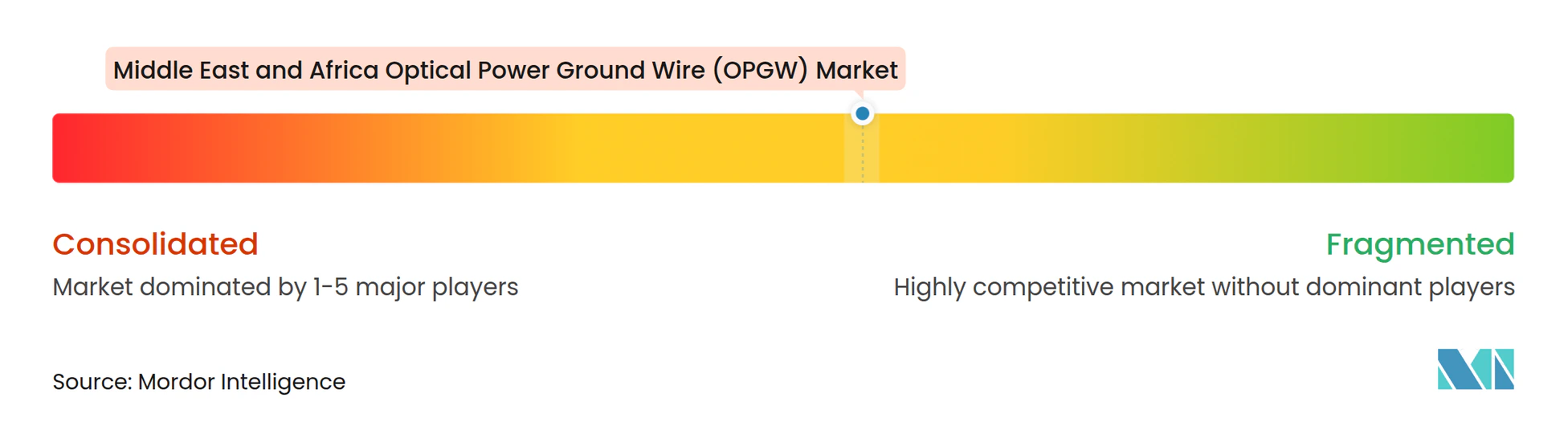
The Middle East and Africa OPGW market is moderately concentrated, with Prysmian, Nexans, Furukawa Electric, Sumitomo Electric, and LS Cable & System active on complex high-voltage work. Their position is supported by established product portfolios, testing capabilities, and experience with IEC 60794-4-10 and IEEE 1138-2021 requirements. These qualifications can be material barriers for suppliers that lack documented performance in demanding overhead-line conditions. Prysmian identifies OPGW as an active product line in its fiber-optic systems portfolio. Its 2026 half-year reporting also described its Digital Solutions activities and work with advanced overhead conductors on the GCCIA Kuwait-Saudi Arabia corridor. Global suppliers can use these system-level relationships to retain influence over specifications as well as cable supply.
Regional manufacturers include Riyadh Cables, DUCAB, Bahra Electric, El Sewedy Electric, Aberdare Cables, and Oman Cables. They compete through local-content eligibility, shorter delivery times, and the ability to adapt products to Saudi Electricity Company and Abu Dhabi utility requirements. DUCAB launched high-voltage fiber-optic cables during Middle East Energy in 2025, showing a move toward more demanding product categories. Local production can be especially important in Saudi Arabia because IKTVA-compliant offerings can receive procurement preference. Bahra Electric’s agreement with Prysmian to localize OPGW production provides a concrete example of this competitive response. El Sewedy also inaugurated an EGP 2 billion communications-cable factory in February 2025 with capacity for 4 million km of fiber-optic cable annually, including export-oriented output.
Competition is less settled in African projects that are too small to receive the full attention of global cable majors but still require qualified suppliers. This gives regional manufacturers an opportunity to build relationships with utilities and influence future technical specifications. The main competitive distinction is not price alone, because utilities also assess delivery confidence, laboratory qualification, installation support, and local service. Riyadh Cables signed a SAR 450 million supply agreement in April 2026 for power transmission cable products across Saudi infrastructure projects, reinforcing the importance of established local supply relationships. The Middle East and Africa OPGW market will remain accessible to global companies, but suppliers without regional production face a weaker position in tenders where localization is a formal evaluation factor. A balanced strategy requires technically qualified products, regional manufacturing or partnerships, and support for utility-specific approvals.
Middle East and Africa Optical Power Ground Wire (OPGW) Industry Leaders
-
Prysmian S.p.A.
-
Jiangsu Zhongtian Technology Co., Ltd.
-
Sumitomo Electric Industries, Ltd.
-
Nexans S.A.
-
Jiangsu Hengtong Optic-Electric Co., Ltd.
- *Disclaimer: Major Players sorted in no particular order
Middle East and Africa Optical Power Ground Wire (OPGW) Market Companies Covered in this Report
- Aberdare Cables (Pty) Limited
- Bahra Electric Company
- Dubai Cable Company Private Limited
- El Sewedy Electric Company S.A.E.
- Furukawa Electric Co., Ltd.
- Jiangsu Hengtong Optic-Electric Co., Ltd.
- Jiangsu Zhongtian Technology Co., Ltd.
- LS Cable & System Ltd.
- Middle East Specialized Cables Company
- National Cables Industry (P.S.C.)
- Nexans S.A.
- NKT A/S
- Oman Cables Industry (SAOG)
- Prysmian S.p.A.
- Riyadh Cables Group Co.
- Saudi Cable Company
- Sterlite Electric Limited
- Sumitomo Electric Industries, Ltd.
- Taihan Cable & Solution Co., Ltd.
- Tratos Cavi S.p.A.
Recent Industry Developments in Middle East and Africa Optical Power Ground Wire (OPGW) Market
- April 2026: Riyadh Cables Group signed a SAR 450 million supply agreement with Mohammed Al-Ojaimi Contracting Establishment for power transmission cable products across multiple Saudi power generation and infrastructure projects. The 12-month contract reinforces Riyadh Cables' position as the region's dominant local cable supplier and marks one of the largest single supply agreements for transmission cables in Saudi Arabia in recent years.
- December 2025: Kenya Electricity Transmission Company Limited signed a USD 311 million Public-Private Partnership (PPP) with Africa50 and Power Grid Corporation of India Limited for two high-voltage transmission corridors, introducing OPGW fiber infrastructure to Western Kenya's grid for the first time and establishing a model for private investment in African transmission.
- December 2025: The European Bank for Reconstruction and Development approved a EUR 200 million financing package for Egypt's Electricity Transmission Company to upgrade a 500 kV substation in Cairo and construct a high-voltage overhead transmission line evacuating more than 2.1 GW of renewable energy from the Gulf of Suez.
- October 2025: Riyadh Cables Group signed an agreement to acquire Artikul Aziya Kabel in Uzbekistan, marking a strategic expansion into Central Asia and a platform for sourcing scale and technology access beyond Middle East and Africa (MEA).
Middle East and Africa Optical Power Ground Wire (OPGW) Market Report Scope
An optical ground wire (OPGW) is a hybrid overhead cable installed at the top of high-voltage power transmission towers. It combines electrical grounding protection with fiber optic telecommunications.
The Middle East and Africa optical ground wire (OPGW) market is segmented by fiber count, cable design type, end-use industry, and geography. By fiber count, the market is segmented into 24F, 48F, 96F, and 144F and above. By cable design type, the market is segmented into Design A, Design B, Design C, Design D, Design E, and Design F. By end-use industry, the market is segmented into power utilities, telecommunications, railways, and oil and gas. The report also covers the market size and forecasts for the Middle East and Africa optical ground wire (OPGW) market across eight countries and subregions, including Saudi Arabia, the United Arab Emirates, Qatar, Oman, Egypt, Nigeria, South Africa, Kenya, and the Rest of the Middle East and Africa. For each segment, the market sizing and forecasts are provided on the basis of value (USD).
Segmentation Overview
| 24F |
| 48F |
| 96F |
| 144F+ |
| Design A |
| Design B |
| Design C |
| Design D |
| Design E |
| Design F |
| Power Utilities |
| Telecom |
| Railways |
| Oil & Gas |
| Saudi Arabia |
| United Arab Emirates |
| Qatar |
| Oman |
| Egypt |
| Nigeria |
| South Africa |
| Kenya |
| Rest of Middle East and Africa |
| By Fiber Count | 24F |
| 48F | |
| 96F | |
| 144F+ | |
| By Cable Design Type | Design A |
| Design B | |
| Design C | |
| Design D | |
| Design E | |
| Design F | |
| By End-Use Industry | Power Utilities |
| Telecom | |
| Railways | |
| Oil & Gas | |
| By Geography | Saudi Arabia |
| United Arab Emirates | |
| Qatar | |
| Oman | |
| Egypt | |
| Nigeria | |
| South Africa | |
| Kenya | |
| Rest of Middle East and Africa |
Key Questions Answered in the Report
What is the forecast for the Middle East and Africa OPGW market?
The Middle East and Africa OPGW market is forecast to reach USD 150.21 million by 2032, expanding at an 8.23% CAGR from 2027.
Which fiber count leads OPGW demand in the region?
48F leads with 36.11% share in 2026, while 96F is the fastest-growing fiber-count category at an 11.71% CAGR through 2032.
Why are utilities using OPGW cables?
Utilities use OPGW for lightning protection, SCADA, teleprotection, and other high-speed communications on overhead transmission lines.
Which end user has the largest requirement for OPGW?
Power Utilities account for 76.54% of demand in 2026 and are forecast to grow at an 8.98% CAGR through 2032.
Which country has the largest regional OPGW requirement?
Saudi Arabia holds 32.67% share in 2026, supported by transmission construction and local-content procurement requirements.
What challenges affect OPGW deployment in Africa and the Middle East?
High installation costs, utility financial limits, limited qualified installation capacity, and unclear fiber leasing rules can delay projects.