
Middle East and Africa Energy Retrofit Market Size and Share
Market Overview
| Study Period | 2022 - 2032 |
|---|---|
| Forecast Data Period | 2027 - 2032 |
| Base Year Market Size (2026) | USD 48.16 Billion |
| Market Size (2027) | USD 50.91 Billion |
| Market Size (2032) | USD 68.04 Billion |
| Growth Rate (2027 - 2032) | 5.97 % |
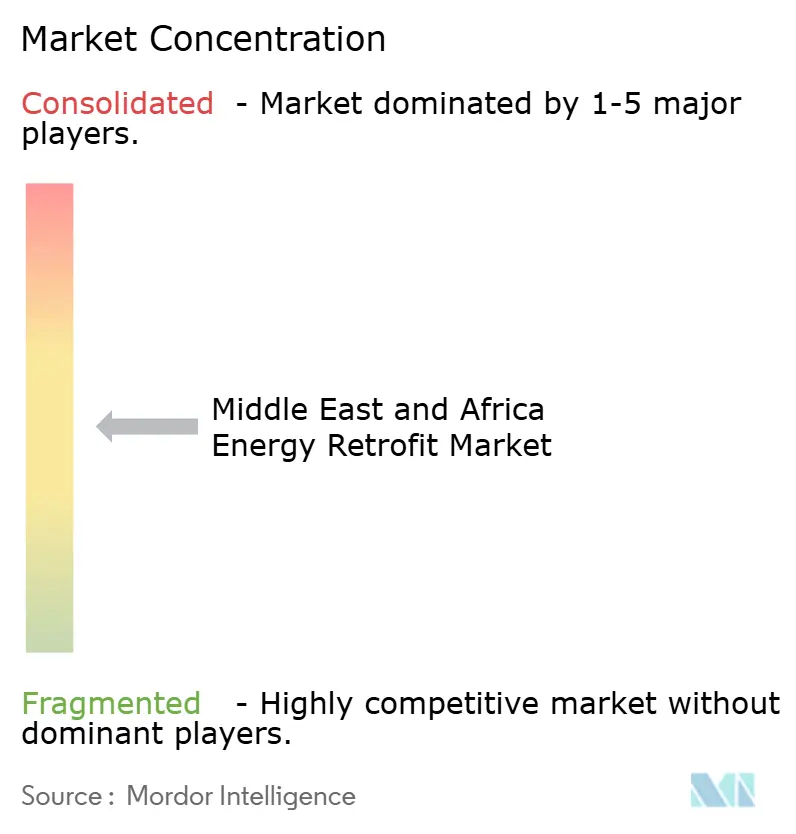
| Market Concentration | Medium |
Major Players *Disclaimer: Major Players sorted in no particular order Image © Mordor Intelligence. Reuse requires attribution under CC BY 4.0. | |
Middle East and Africa Energy Retrofit Market Analysis by Mordor Intelligence
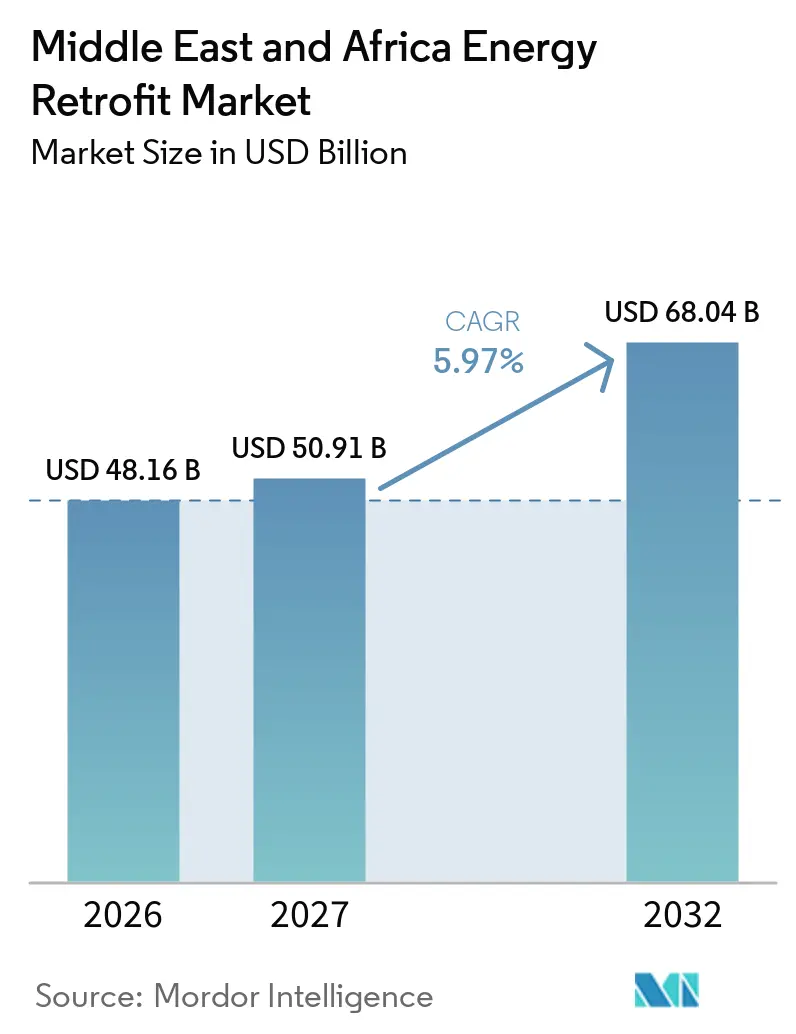
The Middle East and Africa Energy Retrofit Market size is projected to be USD 48.16 billion in 2026, USD 50.91 billion in 2027, and reach USD 68.04 billion by 2032, at a CAGR of 5.97% from 2027 to 2032. High cooling requirements make HVAC efficiency a central investment priority in Gulf commercial buildings, where HVAC can account for 60% to 70% of energy costs[1]. Mandatory energy codes, refrigerant transitions, and green-building requirements are bringing retrofit decisions forward for many owners. Saudi Arabia and the UAE remain the main sources of project activity, while Qatar is expected to show the strongest growth through 2031. Performance contracts can reduce the initial funding burden, especially for public buildings and larger commercial assets. The Middle East and Africa Energy Retrofit Market is also seeing growing demand for digital controls that improve existing equipment performance before a full system replacement is required.
Key Report Takeaways
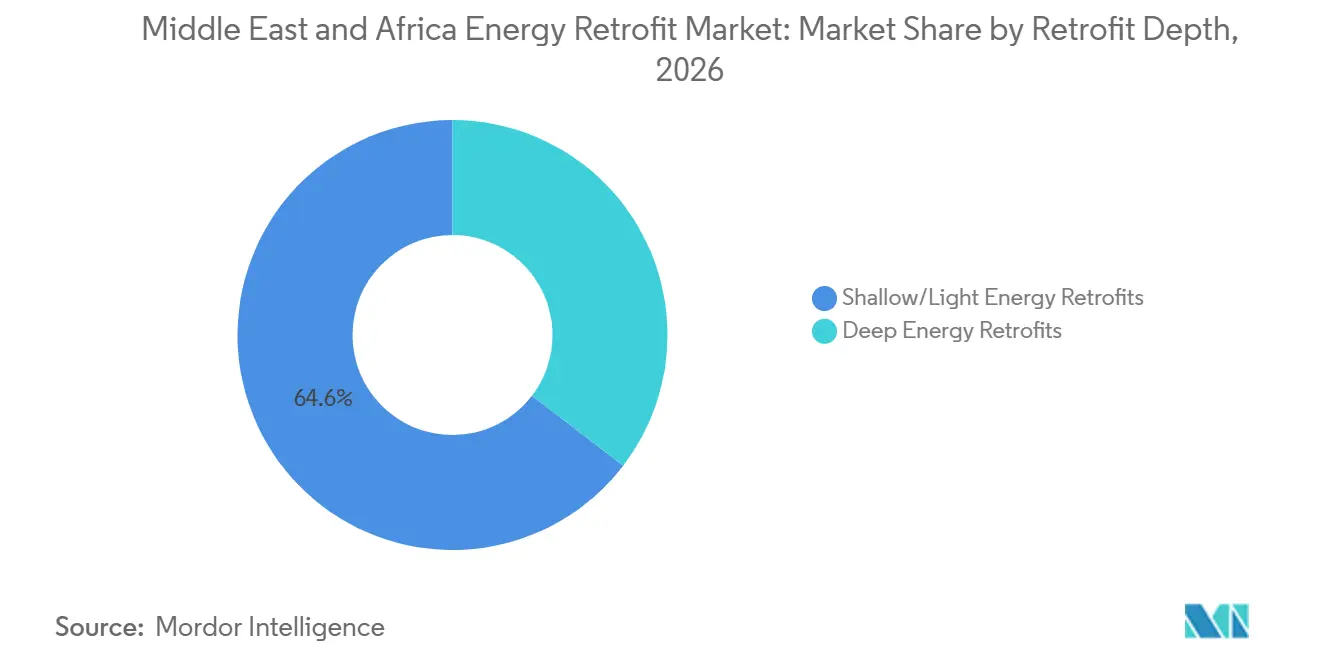
- By retrofit depth, shallow or light retrofits held 64.6% of regional value in 2026, while deep retrofits are forecast to grow at an 6.4% CAGR through 2032.
- By technology, HVAC systems held 31.5% of regional technology value in 2026, while Smart Building Controls and IoT are forecast to expand at a 7.1% CAGR through 2032.
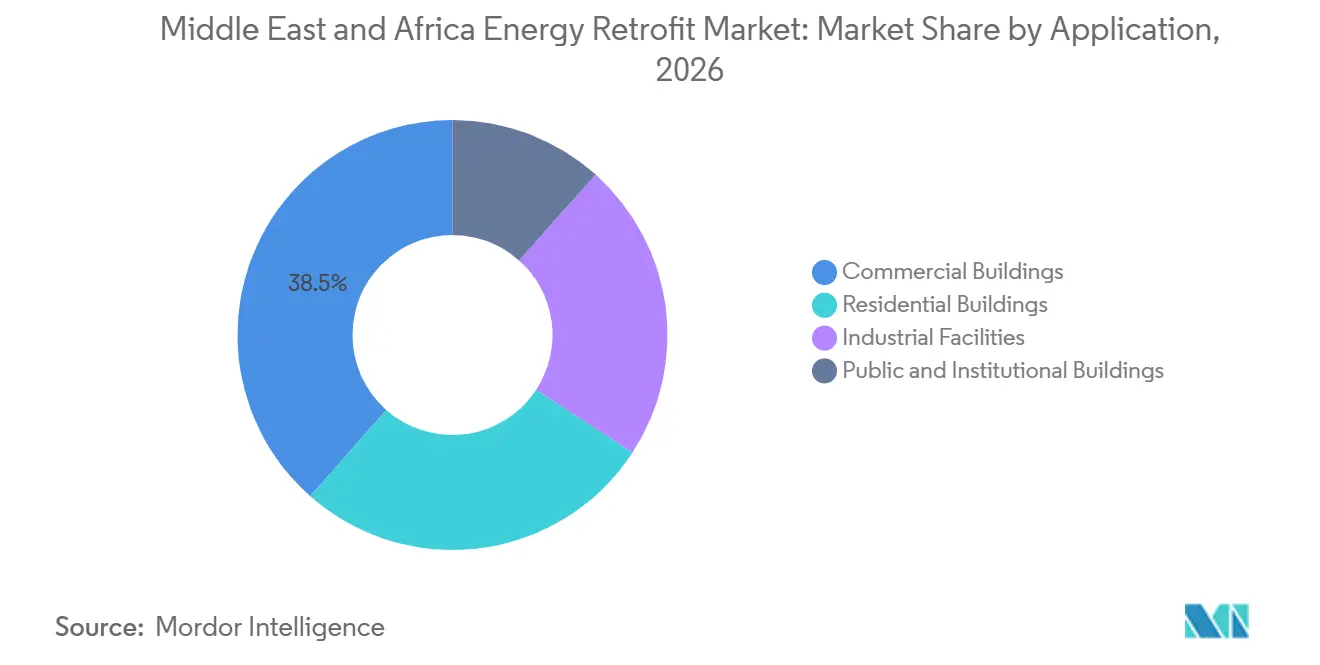
- By application, commercial buildings accounted for 38.5% of the Middle East and Africa Energy Retrofit Market size in 2026, while public and institutional buildings are forecast to grow at an 7.3% CAGR through 2032.
- By geography, Saudi Arabia held 28.3% of revenue in 2026, while Qatar is forecast to grow at an 7.6% CAGR through 2032.
Note: Market numbers in this report are based on Mordor Intelligence's proprietary estimation framework, which combines nine months of actuals with Q4 projections for base year 2026.
Market Trends and Insights
Drivers Impact Analysis of Middle East and Africa Energy Retrofit Market*
| Driver | % Impact on CAGR Forecast | Geographic Relevance | Impact Timeline |
|---|---|---|---|
| Cooling-Dominated Electricity Demand | +1.80% | GCC core (UAE, Saudi Arabia, Qatar, Kuwait); spill-over to North Africa | Short term (≤ 2 years) |
| Government Efficiency Mandates and Green-Building Codes | +1.50% | Saudi Arabia, UAE primary; Qatar, Egypt, Morocco, South Africa growing | Medium term (2-4 years) |
| Existing-Building Renovation and Asset Life Extension | +1.20% | UAE, Saudi Arabia, South Africa, Egypt | Medium term (2-4 years) |
| Outcome-Based Financing and ESCO Adoption | +0.90% | UAE (Dubai primary), Saudi Arabia, Morocco, Kenya | Medium term (2-4 years) |
| AI-Enabled Building Energy Optimization | +0.80% | UAE, Saudi Arabia; emerging in Qatar, Egypt | Long term (≥ 4 years) |
| Grid Reliability and Distributed Energy Integration | +0.50% | Sub-Saharan Africa (South Africa, Nigeria); North Africa (Egypt, Morocco) | Long term (≥ 4 years) |
| Source: Mordor Intelligence | |||
Cooling-Dominated Electricity Demand
Cooling demand gives the Middle East and Africa Energy Retrofit Market a different investment profile from temperate regions. HVAC systems consume 60% to 70% of building energy in the UAE, which makes chiller upgrades and variable-frequency drives important options for reducing operating costs. This level of consumption places HVAC projects ahead of many envelope-only measures in the early stages of retrofit planning. A published Abu Dhabi case study found that improving chiller coefficient of performance had a 5-year payback period, the most favorable result among the measures reviewed. The case supports a project pipeline centered on equipment efficiency and better system controls. It also increases the value of an accurate cooling-load assessment when owners plan a larger upgrade.
Government Efficiency Mandates and Green-Building Codes
Saudi Arabia made the 2024 Saudi Building Code energy provisions mandatory on June 30, 2025[2]. Renovations, changes of use, and expansions therefore create a direct compliance requirement for energy-related building work. The Saudi Energy Efficiency Center requires energy plans that address the envelope, HVAC, lighting, and hot water within the permit process. Research published in 2025 found that applying SBC 602 could save 182 million kWh annually and reduce carbon dioxide emissions by 126 million kg across Saudi residential buildings. These requirements can move projects from basic compliance work to broader performance upgrades when owners also seek higher green-building ratings. The same pattern supports demand across the Middle East and Africa Energy Retrofit Market as public authorities set more explicit standards for existing buildings.
Outcome-Based Financing and ESCO Adoption
Energy service company contracts are helping owners address the upfront cost of retrofit work. Global ESCO investment reached USD 42 billion in 2024, and public buildings accounted for two-thirds of building-sector ESCO project volume. The same survey reported average project energy savings of 25%, with longer contract terms for public projects. Etihad ESCO completed Dubai’s first Energy Savings Performance Contract in 2024, covering upgrades to HVAC, lighting, water, and insulation systems at DEWA facilities. This project provided a tested contract structure that other public and private owners can consider when developing projects. ESCO financing can also enable deeper work where a shorter self-funded payback would otherwise limit the scope of an upgrade.
AI-Enabled Building Energy Optimization
Digital optimization is creating an entry point for the Middle East and Africa Energy Retrofit Market that does not always require replacing major equipment. Emrill Energy reported 14% verified energy savings from the first phase of AI-driven HVAC retrofits across projects in Dubai and Sharjah[3]. In February 2026, the UAE Ministry of Energy and Infrastructure, Khazna Data Centers, and Agility announced a pilot using AI agents to optimize data-center and district-cooling energy performance. These projects show how controls, sensors, and analytics can identify operational losses in existing systems. They also support energy reporting needs that older building-management systems may not meet. The approach can create a lower-cost first step before owners make hardware investments.
Restraints Impact Analysis of Middle East and Africa Energy Retrofit Market*
| Restraint | % Impact on CAGR Forecast | Geographic Relevance | Impact Timeline |
|---|---|---|---|
| High Upfront Capital and Long Payback Periods | -1.40% | MEA-wide; most acute in sub-Saharan Africa, Egypt, Nigeria | Medium term (2-4 years) |
| Landlord-Tenant Split Incentives | -0.70% | UAE, Saudi Arabia (commercial and multi-tenant residential) | Medium term (2-4 years) |
| Limited Retrofit Skills and Measurement Capability | -0.50% | Sub-Saharan Africa, Egypt, Nigeria | Long term (≥ 4 years) |
| Subsidized Tariffs and Weak Savings Signals | -0.80% | Kuwait, Saudi Arabia (partly); Bahrain | Short term (≤ 2 years) |
| Source: Mordor Intelligence | |||
High Upfront Capital and Long Payback Periods
Deep retrofit packages combine envelope work, HVAC replacement, controls, and renewable integration, which can require substantial initial spending. A 2024 study of UAE government buildings found that deep envelope retrofit measures had payback periods of 15 to 20 years despite their longer-term carbon benefits. The IEA reported that private ESCO projects had payback periods of just over 6 years on average in 2024. This favors shallow and medium-depth measures when owners cannot use performance-based financing. Import costs and limited funding options can further constrain adoption in Nigeria and other markets with less mature financing systems. The Middle East and Africa Energy Retrofit Market, therefore, depends on contract structures that match project savings with the period needed to recover capital.
Landlord-Tenant Split Incentives
The owner who funds a retrofit does not always receive the energy savings. This issue is pronounced in gross-lease arrangements where utility costs are included in rent. Owners then have a limited way to recover the value of chiller upgrades, building-management recommissioning, or window-film installation. The IEA identifies fragmented ownership and split incentives as major barriers to ESCO growth in smaller commercial and residential buildings[4]. Net-lease structures and energy reporting requirements can improve the alignment between owners and occupiers in higher-grade assets. Wider adoption will depend on whether these arrangements extend beyond premium portfolios in Dubai and Abu Dhabi.
*Our forecasts treat driver/restraint impacts as directional, not additive. The impact forecasts reflect baseline growth, mix effects, and variable interactions.
Middle East and Africa Energy Retrofit Market Segment Analysis
By Retrofit Depth:
Shallow Retrofits Sustain Volume as Deep Retrofit Economics ImproveShallow or light projects held 64.6% of the Middle East and Africa Energy Retrofit Market size in 2026. Building-management recommissioning, LED replacements, and variable-speed drive installations can achieve shorter payback periods of 2 to 5 years. This makes them accessible to owners who do not use performance financing. Dubai’s demand-side management program supports these measures through technical guidance and performance benchmarking. The category remains the practical starting point for owners who are developing energy management practices. It also creates a foundation for later, more comprehensive work.
Deep retrofits are forecast to grow at an 6.4% CAGR through 2032. They bring HVAC work, envelope upgrades, controls, and renewable integration into one program. A study of educational buildings in Egypt found that deep retrofit scenarios could achieve energy savings of up to 45%, compared with 15% for standard retrofits. Al Maryah Tower in Abu Dhabi received the 2025 Retrofit Project of the Year award for a program that included a full HVAC overhaul and improved fresh-air systems. Such projects are most viable when major refurbishment cycles and funding decisions occur at the same time. The shift to lower-global-warming-potential cooling equipment can also encourage owners to combine a required chiller replacement with wider building improvements.

By Technology:
HVAC Anchors Spend and Smart Controls Lead GrowthHVAC systems held 31.5% of regional technology value in 2026. Lighting, building-envelope systems, renewable integration, smart controls and IoT, and water heating and plumbing make up the remaining technology mix. The strong HVAC position reflects high cooling loads and aging chiller fleets in many regional buildings. Etihad ESCO and Daikin replaced 15 chillers at JAFZA Package 3 with inverter models, with projected annual energy savings of 3,019,679 kWh and annual cost savings of AED 1,343,757. This project illustrates why equipment replacement continues to attract retrofit spending. Envelope measures can become more relevant when owners undertake deeper building upgrades alongside HVAC work.
Smart Building Controls and IoT are forecast to grow at a 7.1% CAGR through 2032. Sensor costs, data analysis tools, and energy reporting needs are supporting this growth. These systems can provide a clearer baseline of energy use and allow operators to adjust equipment performance. The UAE pilot announced in February 2026 places this approach within data centers and district cooling, two energy-intensive settings. Digital controls can therefore complement, rather than replace, the physical HVAC, envelope, and lighting measures used across the Middle East and Africa Energy Retrofit Market. Renewable integration also strengthens the economics of co-deployed efficiency measures by reducing grid electricity demand.
By Application:
Commercial Buildings Lead and Institutional Buildings Grow FastestCommercial buildings accounted for 38.5% of the Middle East and Africa Energy Retrofit Market size in 2026. Office towers, hotels, shopping malls, and mixed-use assets in Dubai, Abu Dhabi, Riyadh, and Doha form an important pipeline for energy-service projects. Corporate occupiers increasingly seek better energy-performance data from landlords to support emissions reporting. This can turn an efficiency upgrade into a lease-retention consideration. The commercial segment also has the building scale needed to support complex HVAC and control-system projects. It remains the leading application for integrated retrofits across the region.
Public and institutional buildings are forecast to expand at an 7.3% CAGR through 2032. Government programs can turn energy standards into formal procurement requirements across large building portfolios. South Africa’s Energy Efficiency in Public Buildings and Infrastructure Programme reached the tender stage in 2026 with a smart street-lighting retrofit at the East London Industrial Development Zone. The project uses an ESCO-style savings-recovery approach that can be replicated for public assets. Qatar’s Public Works Authority completed the final GSAS Design and Build audit for Qatar University’s College of Medicine building in September 2026. These examples show how public-sector requirements can create a steady project pipeline for the Middle East and Africa Energy Retrofit Market.
Geography Analysis
Middle East Energy Retrofit Market
Saudi Arabia held 28.3% of the Middle East and Africa Energy Retrofit Market share in 2026. Its position reflects building-stock scale, new development activity, and Vision 2030 sustainability requirements. Saudi Building Code provisions create retrofit triggers when buildings are renovated, expanded, or changed in use. The Mostadam framework can raise specifications beyond minimum energy-code compliance for owners pursuing higher ratings. Schneider Electric is deploying energy-management systems at the Diriyah project, which shows the role of digital platforms in major Saudi developments. Kuwait’s subsidized tariffs can weaken private retrofit incentives, while Oman is building activity through industrial energy-audit requirements.
Qatar Energy Retrofit Market
Qatar is forecast to be the fastest-growing geography, at an 7.6% CAGR through 2032. Qatar NDC 3.0 identifies buildings as a central area for climate action through demand-side management, energy and water efficiency, and facility standards. Msheireb Properties and Cundall began a portfolio decarbonization strategy in July 2025 covering more than 100 buildings, over 800 residential units, and more than 300 retail spaces. Tarsheed recorded electricity savings of 548.3 GWh and carbon dioxide reductions of 638,275 tonnes in 2023, according to peer-reviewed research. These results give Qatar a demonstrated basis for further demand-management programs. The country’s building-certification requirements also support more consistent performance standards for commercial assets.
Africa Energy Retrofit Market
African markets have earlier-stage retrofit activity, but policy and building-energy demand are creating a broader opportunity. Egypt has moved toward mandatory energy-efficiency standards for public buildings, while research has identified 43.1% energy-saving potential from envelope optimization and HVAC upgrades using existing technologies and local materials. South Africa faces retrofit cost premiums and technical capacity gaps, even as its public-building program expands training and performance-contracting options. Research in Morocco found that recycled-textile insulation in bioclimatic wall assemblies reduced summer energy use by 52%. Nigeria remains limited by equipment-import costs, financing constraints, and weak code enforcement. These conditions favor larger commercial projects until local funding and implementation capacity improve.
Competitive Landscape
The Middle East and Africa Energy Retrofit Industry is moderately consolidated at the systems-integration level. Johnson Controls, Schneider Electric, Siemens, Honeywell, and Trane Technologies compete through integrated energy-performance platforms rather than individual components. Etihad ESCO’s 2025 Wasl Properties Phase 2 tender named Johnson Controls, Siemens, and Honeywell among the awarded companies. Certification requirements can favor established firms with the technical qualifications needed for complex public tenders. Schneider Electric uses its EcoStruxure platform for integrated power and building management. Johnson Controls uses OpenBlue analytics in airport and hospital retrofit programs, while Siemens is building its presence in digital building diagnostics.
Regional firms also compete on project delivery, maintenance, and local market coverage. Al-Futtaim Engineering and Technologies, TAQA Energy Services, ELSEWEDY ELECTRIC, Etihad ESCO, and Emrill Energy operate in parts of the project pipeline where execution capability is important. Emrill’s AI-led HVAC retrofit program reported 14% verified energy savings in its first phase. This shows the opening for providers that focus on controls and analytics without supplying all core equipment. Their offer can be relevant where owners want operational savings before approving major capital work. The model adds a subscription-oriented option to the more traditional equipment-and-service approach.
The transition away from R134a equipment is shortening technology-selection cycles for some HVAC replacement projects. Daikin, Carrier, and Trane can benefit where owners need equipment compatible with lower-global-warming-potential refrigerants. Tabreed and Johnson Controls entered a long-term agreement in September 2025 covering variable-speed chillers, lifecycle services, performance-guaranteed retrofits, and remote monitoring across district-cooling plants. The agreement combines equipment, services, and ongoing performance support. This approach can strengthen recurring revenue and deepen customer relationships. Smaller contractors may remain more competitive in narrower installation and maintenance assignments. The Middle East and Africa Energy Retrofit Market therefore includes both global platform providers and regional specialists.
Middle East and Africa Energy Retrofit Industry Leaders
-
Johnson Controls International plc
-
Schneider Electric SE
-
Siemens AG
-
ENGIE SA
-
Honeywell International Inc.
- *Disclaimer: Major Players sorted in no particular order
Middle East and Africa Energy Retrofit Market Companies Covered in this Report
- ABB Ltd.
- ACCIONA
- AECOM
- Al-Futtaim Engineering and Technologies
- Ameresco, Inc.
- Carrier Global Corporation
- Daikin Industries, Ltd.
- Dalkia
- Eaton Corporation plc
- ELSEWEDY ELECTRIC
- ENGIE SA
- Honeywell International Inc.
- Johnson Controls International plc
- Kingspan Group plc
- Masdar
- ROCKWOOL A/S
- Saint-Gobain S.A.
- Schneider Electric SE
- Siemens AG
- Trane Technologies plc
Recent Industry Developments in Middle East and Africa Energy Retrofit Market
- April 2026: Johnson Controls launched Balanced Cooling in the UAE, a retrofit-friendly solution for buildings connected to centralized district cooling systems, designed to address low Delta T performance and improve thermal management with plug-and-play integration into existing HVAC and BMS infrastructure. The launch targets the estimated 40% district cooling penetration in Dubai by 2030.
- February 2026: Honeywell signed an MoU with Kortech, a Hassan Allam Holding subsidiary, to automate and digitize critical infrastructure across Egypt, Saudi Arabia, and the UAE. The partnership combines Honeywell's building automation and analytics capabilities with Kortech's turnkey construction execution, targeting data centers, commercial buildings, and smart city developments.
- November 2025: TAQA Energy Services, a TAQA subsidiary, signed an implementation agreement with Sdeira Group, an AD Ports subsidiary, during ADIPEC 2025 to retrofit Aryam ICAD Residential City in Abu Dhabi, targeting 36 GWh in annual electricity savings, 616,000 m³ in water savings, and 17,000 tonnes of carbon dioxide avoidance through HVAC upgrades and advanced energy monitoring across 8 building clusters.
- September 2025: Tabreed and Johnson Controls signed a long-term framework agreement to develop and deploy next-generation cooling technology across Tabreed's district cooling plant portfolio, covering variable-speed chillers, modular systems, lifecycle services, performance-guaranteed retrofits, and remote monitoring.
Middle East and Africa Energy Retrofit Market Report Scope
Energy retrofit refers to the process of upgrading or modifying existing buildings, facilities, or energy systems to improve energy efficiency, reduce energy consumption and operating costs, and lower greenhouse gas emissions. Retrofits can involve replacing outdated equipment, improving building insulation and windows, upgrading HVAC and lighting systems, installing smart energy controls, and integrating renewable energy technologies such as solar PV.
The Middle East and Africa Energy Retrofit Market is segmented by retrofit depth, technology, application, and geography. By retrofit depth, the market is segmented into deep energy retrofits and shallow/light energy retrofits. By technology, the market is segmented into HVAC systems, lighting systems, building envelope, renewable integration, smart building controls, IoT, and water heating and plumbing. By application, the market is segmented into residential, commercial, industrial, and public and institutional buildings. The report also covers the market size and forecasts for the Middle East and Africa energy retrofit market across 9 countries in the region. For each segment, the market sizing and forecasts have been provided on the basis of value (USD).
Segmentation Overview
| Deep Energy Retrofits |
| Shallow/Light Energy Retrofits |
| HVAC Systems |
| Lighting Systems |
| Building Envelope (Insulation and Glazing) |
| Renewable Integration (Solar PV, Solar Thermal) |
| Smart Building Controls and IoT |
| Water Heating and Plumbing |
| Residential Buildings |
| Commercial Buildings |
| Industrial Facilities |
| Public and Institutional Buildings |
| Middle East and Africa | United Arab Emirates |
| Saudi Arabia | |
| Oman | |
| Qatar | |
| Kuwait | |
| South Africa | |
| Egypt | |
| Morocco | |
| Nigeria | |
| Rest of Middle East and Africa |
| By Retrofit Depth | Deep Energy Retrofits | |
| Shallow/Light Energy Retrofits | ||
| By Technology | HVAC Systems | |
| Lighting Systems | ||
| Building Envelope (Insulation and Glazing) | ||
| Renewable Integration (Solar PV, Solar Thermal) | ||
| Smart Building Controls and IoT | ||
| Water Heating and Plumbing | ||
| By Application | Residential Buildings | |
| Commercial Buildings | ||
| Industrial Facilities | ||
| Public and Institutional Buildings | ||
| By Geography | Middle East and Africa | United Arab Emirates |
| Saudi Arabia | ||
| Oman | ||
| Qatar | ||
| Kuwait | ||
| South Africa | ||
| Egypt | ||
| Morocco | ||
| Nigeria | ||
| Rest of Middle East and Africa | ||
Key Questions Answered in the Report
What is the projected value of the Middle East and Africa energy retrofit market by 2032?
The Middle East and Africa Energy Retrofit Market is projected to reach USD 68.04 billion by 2032, growing at a 5.97% CAGR from 2027.
Which retrofit technology leads spending in the region?
HVAC systems led with 31.5% of value in 2026 because regional cooling loads make equipment efficiency a priority.
Which technology is growing fastest in energy retrofits?
Smart Building Controls and IoT are forecast to grow at a 7.1% CAGR through 2032, supported by sensor deployment and energy reporting needs.
Which country leads regional retrofit revenue?
Saudi Arabia led with 28.3% of regional revenue in 2026, supported by building scale and mandatory energy provisions.
Which country is expected to grow fastest through 2032?
Qatar is forecast to grow at an 7.6% CAGR through 2032, supported by building standards and demand-side management measures.
Why are ESCO contracts important for building upgrades?
ESCO contracts can link project repayment to verified savings, helping owners undertake upgrades that need more capital or longer payback periods.